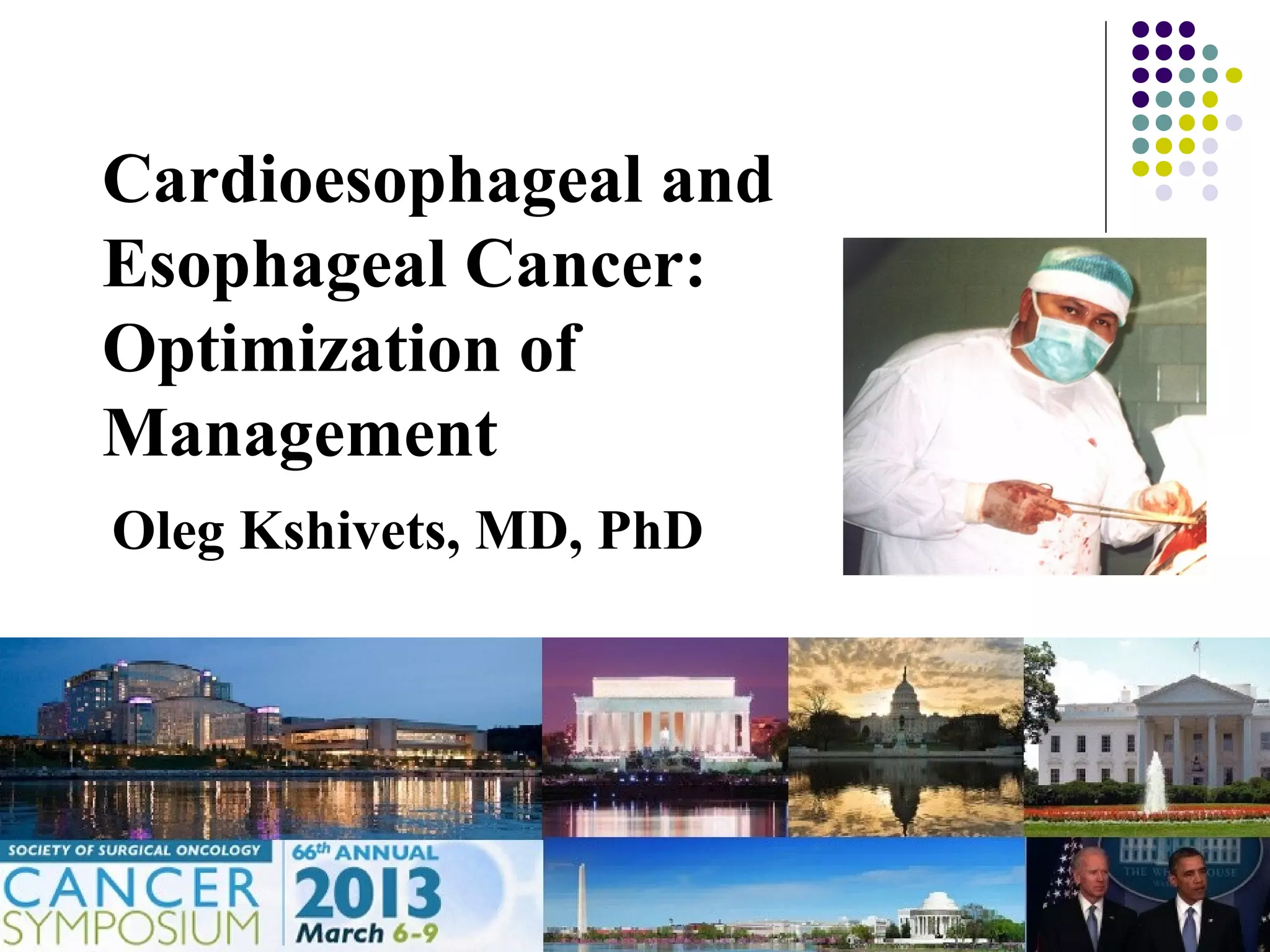
Cardioesophageal and
Esophageal Cancer:
Optimization of
Management
Oleg Kshivets, MD, PhD
Abstract:
    Oleg Kshivets
    Cardioesophageal and Esophageal Cancer:
    Optimization of Management
    OBJECTIVE: Search of best treatment plan for cardioesophageal/esophageal cancer (CEC) patients
    (CECP) was realized.
     METHODS: We analyzed data of 411 consecutive CECP (age=55.6±8.7 years; tumor size=6.7±3.3 cm)
    radically operated (R0) and monitored in 1975-2012 (m=307, f=104; esophagogastrectomy- EG
    Garlock=271, EG Lewis=140, combined EG with resection of pancreas, liver, diaphragm, colon
    transversum, lung, trachea, pericardium, splenectomy=127; adenocarcinoma=216, squamous=185, mix=10;
    T1=62, T2=99, T3=141, T4=109; N0=170, N1=57, M1A=184, G1=116, G2=98, G3=197; early CEC=43,
    invasive=368; esophageal cancer=139, cardioesophageal cancer=272): only surgery-S=327, adjuvant
    treatment-AT=84 (chemoimmunoradiotherapy=36: 5-FU+thymalin/taktivin +radiotherapy 45-50Gy,
    adjuvant chemoimmunotherapy=48). Survival curves were estimated by the Kaplan-Meier method.
    Differences in curves between groups of CECP were evaluated using a log-rank test. Cox modeling,
    clustering, SEPATH, Monte Carlo, bootstrap simulation and neural networks computing were used to
    determine any significant dependence.
       RESULTS: For total of 411 CECP overall life span (LS) was 1632.2±2141.6 days, (median=783 days) and
    cumulative 5-year survival (5YS) reached 40.1%, 10 years – 32.9%, 20 years – 24%. 102 CECP lived more
    than 5 years without CEC progressing. 216 CECP died because of CEC during the first 5 years after
    surgery. 5YS was superior significantly after AT (61.7%) compared with S (36.2%) (P=0.000 by log-rank
    test). Cox modeling displayed that 5YS significantly depended on: phase transition (PT) early-invasive
    CEC in term of synergetics, PT N0-N1M1A, AT, cell ratio factors (P=0.000-0.038). Neural networks
    computing, genetic algorithm selection and bootstrap simulation revealed relationships between 5YS and
    PT early-invasive CEC (rank=1), PT N0-N1M1A (rank=2), AT (3), segmented neutrophils/cancer cells-CC)
    (4), lymphocytes/CC (5), monocytes/CC (6). Correct prediction of 5YS was 100% by neural networks
    computing.
      CONCLUSIONS: Optimal management strategies for CECP are: 1) screening and early detection; 2)
    availability of experienced thoracoabdominal surgeons because of complexity of radical procedures; 3)
    aggressive en block surgery and adequate lymphadenectomy for completeness; 4) high-precision
    prediction; 5) adjuvant treatment for CECP with unfavorable prognosis.
Data:
 Males………………………………………………….307
 Females………..………………………………….......104


 Age=55.6±8.7 years
 Tumor Size=6.7±3.3 cm

 Only Surgery.………………………………………...327

 Adjuvant Chemoimmunoradio/Chemoimmunotherapy
  (5FU+thymalin/taktivin, 5-6 cycles+RT 45-50Gy)…..84
Radical Procedures:
 Left Thoracoabdominal Esophagogastrectomies
  (Garlock)……………………..……………………..271
 Right Thoracoabdominal Esophagogastrectomies

 (Ivor Lewis)………………….……………………...140

 Combined Esophagogastrectomies with

 Resection of Diaphragm, Pericardium, Lung, Liver,
  Pancreas, etc…………..…………..………………...127
 2-Field Lymphadenectomy….……………………..303

 3-Field Lymphadenectomy….……………………..108
Staging:
 T1……62         N0..…170           G1…………116
 T2……99         N1……57             G2…………..98
 T3…..141       N2…..184           G3…………197
 T4…..109       M1……..0
 Adenocarcinoma………..................................216

 Squamos Cell Carcinoma……………………185

 Mix Carcinoma..……………………………….10

 Early Cancer……43

 Invasive Cancer…….368
Survival Rate:
 Alive………………………………………....170 (41%)
 5-Year Survivors…………..……………….102 (24.8%)

 10-Year Survivors…………………………...54 (13%)

 Losses………………………………….……216 (52.6%)

 General Life Span=1632.2±2141.6 days

 For 5-Year Survivors=4491.3±2679.0 days

 For 10-Year Survivors=6228.6±2632.2 days

 For Losses=648.6±387.8 days

 Cumulative 5-Year Survival………………..40.1%

 Cumulative 10-Year Survival………………32.9%
General Esophageal/Cardioesophageal Cancer Patients Survival
after Complete Esophagogastrectomies (Kaplan-Meier) (n=411)
Results of Univariate Analysis of Phase Transition Early—Invasive
Cancer in Prediction of Esophageal/Cardioesophageal Cancer
Patients Survival (n=411)
Results of Univariate Analysis of Phase Transition N0—N1-2 in
Prediction of Esophageal/Cardioesophageal Cancer Patients
Survival (n=411)
Results of Univariate Analysis of Adjuvant Therapy in Prediction
of Esophageal/Cardioesophageal Cancer Patients Survival (n=411)
Results of Univariate Analysis of Tumor Localization in Prediction of
Esophageal/Cardioesophageal Cancer Patients Survival (n=411)
Results of Univariate Analysis of Tumor Hystology in Prediction of
Esophageal/Cardioesophageal Cancer Patients Survival (n=411)
Results of Univariate Analysis of Tumor Growth in Prediction of
Esophageal/Cardioesophageal Cancer Patients Survival (n=411)
Results of Discriminant
Fanction Analysis in
Prediction of
Esophageal/Cardioesophageal
Cancer Patients Survival after
Surgery (n=318)
Results of Multi-Factor Clustering
of Clinicopathological Data in
Prediction of
Esophageal/Cardioesophageal
Cancer Patients Survival after
Complete Esophagectomies (n=318)
Results of Cox Regression Modeling in
Prediction of
Esophageal/Cardioesophageal Cancer
Patients Survival after Surgery (n=411)
Results of Neural Networks Computing
in Prediction of
Esophageal/Cardioesophageal Cancer
Patients Survival after Complete
Esophagogastrectomies (n=318)
Results of Bootstrap Simulation in
Prediction of
Esophageal/Cardioesophageal
Cancer Patients Survival after
Complete Esophagectomies
(n=318)
Holling-Tenner Models of
Esophageal/Cardioesophageal Cancer
Cell Population and Cytotoxic Cell Population Dynamics
Results of Kohonen Self-Organizing Neural
Networks Computing in Prediction of
Esophageal/Cardioesophageal Cancer Patients
Survival after Complete Esophagogastrectomies (n=318)
Esophageal/Cardioesophageal
Cancer Dynamics
Results of Structurul Equation Modeling
in Prediction of
Esophageal/Cardioesophageal Cancer Patients Survival after
Esophagectomies, n=318
Conclusions:
 Optimal management strategies for esophageal and
  cardioesophageal cancer patients are:
 1) screening and early detection;

 2) availability of experienced thoracoabdominal
  surgeons because of complexity of radical procedures;
 3) aggressive en block surgery and adequate lymph node
  dissection for completeness;
 4) high-precision prediction;

 5) adjuvant treatment for esophageal and
  cardioesophageal cancer patients with unfavorable
  prognosis.
Address:
                  Oleg Kshivets, M.D., Ph.D.
                  Consultant Thoracic, Abdominal,
                  General Surgeon & Surgical
                  Oncologist


   e-mail: okshivets@yahoo.com
   skype: okshivets
    http: //www.ctsnet.org/home/okshivets

Kshivets sso2013

  • 1.
    Cardioesophageal and Esophageal Cancer: Optimizationof Management Oleg Kshivets, MD, PhD
  • 2.
    Abstract: Oleg Kshivets Cardioesophageal and Esophageal Cancer: Optimization of Management  OBJECTIVE: Search of best treatment plan for cardioesophageal/esophageal cancer (CEC) patients (CECP) was realized.  METHODS: We analyzed data of 411 consecutive CECP (age=55.6±8.7 years; tumor size=6.7±3.3 cm) radically operated (R0) and monitored in 1975-2012 (m=307, f=104; esophagogastrectomy- EG Garlock=271, EG Lewis=140, combined EG with resection of pancreas, liver, diaphragm, colon transversum, lung, trachea, pericardium, splenectomy=127; adenocarcinoma=216, squamous=185, mix=10; T1=62, T2=99, T3=141, T4=109; N0=170, N1=57, M1A=184, G1=116, G2=98, G3=197; early CEC=43, invasive=368; esophageal cancer=139, cardioesophageal cancer=272): only surgery-S=327, adjuvant treatment-AT=84 (chemoimmunoradiotherapy=36: 5-FU+thymalin/taktivin +radiotherapy 45-50Gy, adjuvant chemoimmunotherapy=48). Survival curves were estimated by the Kaplan-Meier method. Differences in curves between groups of CECP were evaluated using a log-rank test. Cox modeling, clustering, SEPATH, Monte Carlo, bootstrap simulation and neural networks computing were used to determine any significant dependence. RESULTS: For total of 411 CECP overall life span (LS) was 1632.2±2141.6 days, (median=783 days) and cumulative 5-year survival (5YS) reached 40.1%, 10 years – 32.9%, 20 years – 24%. 102 CECP lived more than 5 years without CEC progressing. 216 CECP died because of CEC during the first 5 years after surgery. 5YS was superior significantly after AT (61.7%) compared with S (36.2%) (P=0.000 by log-rank test). Cox modeling displayed that 5YS significantly depended on: phase transition (PT) early-invasive CEC in term of synergetics, PT N0-N1M1A, AT, cell ratio factors (P=0.000-0.038). Neural networks computing, genetic algorithm selection and bootstrap simulation revealed relationships between 5YS and PT early-invasive CEC (rank=1), PT N0-N1M1A (rank=2), AT (3), segmented neutrophils/cancer cells-CC) (4), lymphocytes/CC (5), monocytes/CC (6). Correct prediction of 5YS was 100% by neural networks computing.  CONCLUSIONS: Optimal management strategies for CECP are: 1) screening and early detection; 2) availability of experienced thoracoabdominal surgeons because of complexity of radical procedures; 3) aggressive en block surgery and adequate lymphadenectomy for completeness; 4) high-precision prediction; 5) adjuvant treatment for CECP with unfavorable prognosis.
  • 3.
    Data:  Males………………………………………………….307  Females………..………………………………….......104 Age=55.6±8.7 years  Tumor Size=6.7±3.3 cm  Only Surgery.………………………………………...327  Adjuvant Chemoimmunoradio/Chemoimmunotherapy (5FU+thymalin/taktivin, 5-6 cycles+RT 45-50Gy)…..84
  • 4.
    Radical Procedures:  LeftThoracoabdominal Esophagogastrectomies (Garlock)……………………..……………………..271  Right Thoracoabdominal Esophagogastrectomies  (Ivor Lewis)………………….……………………...140  Combined Esophagogastrectomies with  Resection of Diaphragm, Pericardium, Lung, Liver, Pancreas, etc…………..…………..………………...127  2-Field Lymphadenectomy….……………………..303  3-Field Lymphadenectomy….……………………..108
  • 5.
    Staging:  T1……62 N0..…170 G1…………116  T2……99 N1……57 G2…………..98  T3…..141 N2…..184 G3…………197  T4…..109 M1……..0  Adenocarcinoma………..................................216  Squamos Cell Carcinoma……………………185  Mix Carcinoma..……………………………….10  Early Cancer……43  Invasive Cancer…….368
  • 6.
    Survival Rate:  Alive………………………………………....170(41%)  5-Year Survivors…………..……………….102 (24.8%)  10-Year Survivors…………………………...54 (13%)  Losses………………………………….……216 (52.6%)  General Life Span=1632.2±2141.6 days  For 5-Year Survivors=4491.3±2679.0 days  For 10-Year Survivors=6228.6±2632.2 days  For Losses=648.6±387.8 days  Cumulative 5-Year Survival………………..40.1%  Cumulative 10-Year Survival………………32.9%
  • 7.
    General Esophageal/Cardioesophageal CancerPatients Survival after Complete Esophagogastrectomies (Kaplan-Meier) (n=411)
  • 8.
    Results of UnivariateAnalysis of Phase Transition Early—Invasive Cancer in Prediction of Esophageal/Cardioesophageal Cancer Patients Survival (n=411)
  • 9.
    Results of UnivariateAnalysis of Phase Transition N0—N1-2 in Prediction of Esophageal/Cardioesophageal Cancer Patients Survival (n=411)
  • 10.
    Results of UnivariateAnalysis of Adjuvant Therapy in Prediction of Esophageal/Cardioesophageal Cancer Patients Survival (n=411)
  • 11.
    Results of UnivariateAnalysis of Tumor Localization in Prediction of Esophageal/Cardioesophageal Cancer Patients Survival (n=411)
  • 12.
    Results of UnivariateAnalysis of Tumor Hystology in Prediction of Esophageal/Cardioesophageal Cancer Patients Survival (n=411)
  • 13.
    Results of UnivariateAnalysis of Tumor Growth in Prediction of Esophageal/Cardioesophageal Cancer Patients Survival (n=411)
  • 14.
    Results of Discriminant FanctionAnalysis in Prediction of Esophageal/Cardioesophageal Cancer Patients Survival after Surgery (n=318)
  • 15.
    Results of Multi-FactorClustering of Clinicopathological Data in Prediction of Esophageal/Cardioesophageal Cancer Patients Survival after Complete Esophagectomies (n=318)
  • 16.
    Results of CoxRegression Modeling in Prediction of Esophageal/Cardioesophageal Cancer Patients Survival after Surgery (n=411)
  • 17.
    Results of NeuralNetworks Computing in Prediction of Esophageal/Cardioesophageal Cancer Patients Survival after Complete Esophagogastrectomies (n=318)
  • 18.
    Results of BootstrapSimulation in Prediction of Esophageal/Cardioesophageal Cancer Patients Survival after Complete Esophagectomies (n=318)
  • 19.
    Holling-Tenner Models of Esophageal/CardioesophagealCancer Cell Population and Cytotoxic Cell Population Dynamics
  • 20.
    Results of KohonenSelf-Organizing Neural Networks Computing in Prediction of Esophageal/Cardioesophageal Cancer Patients Survival after Complete Esophagogastrectomies (n=318)
  • 21.
  • 22.
    Results of StructurulEquation Modeling in Prediction of Esophageal/Cardioesophageal Cancer Patients Survival after Esophagectomies, n=318
  • 23.
    Conclusions:  Optimal managementstrategies for esophageal and cardioesophageal cancer patients are:  1) screening and early detection;  2) availability of experienced thoracoabdominal surgeons because of complexity of radical procedures;  3) aggressive en block surgery and adequate lymph node dissection for completeness;  4) high-precision prediction;  5) adjuvant treatment for esophageal and cardioesophageal cancer patients with unfavorable prognosis.
  • 24.
    Address: Oleg Kshivets, M.D., Ph.D. Consultant Thoracic, Abdominal, General Surgeon & Surgical Oncologist  e-mail: okshivets@yahoo.com  skype: okshivets  http: //www.ctsnet.org/home/okshivets