KUVEMPU UNIVERSITY  Department of Computer Science Jnana Sahyadri Shankarghatta Seminar on “ Kruskal’s Algorithm ” Presented by,  Chaitra.M.S  3 rd   sem , M.Sc, Dept. Of Computer Science, Shankarghatta. Under the guidance of, Suresh.M,   Dept. Of Computer Science, Shankarghatta.
Contents Spanning trees Finding a spanning tree Minimum-cost spanning trees Kruskal’s algorithm And example
Spanning Trees
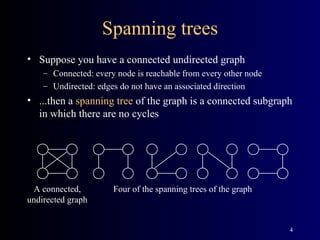
Spanning trees Suppose you have a connected undirected graph Connected: every node is reachable from every other node Undirected: edges do not have an associated direction ...then a  spanning tree  of the graph is a connected subgraph in which there are no cycles A connected, undirected graph Four of the spanning trees of the graph
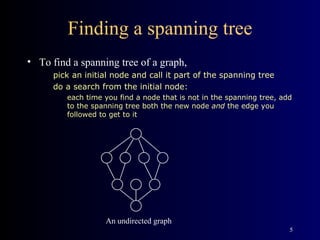
Finding a spanning tree To find a spanning tree of a graph, pick an initial node and call it part of the spanning tree do a search from the initial node: each time you find a node that is not in the spanning tree, add to the spanning tree both the new node  and  the edge you followed to get to it An undirected graph
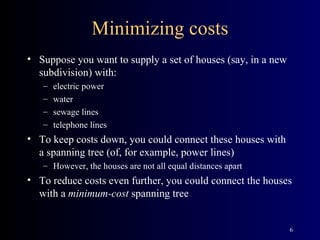
Minimizing costs Suppose you want to supply a set of houses (say, in a new subdivision) with: electric power water sewage lines telephone lines To keep costs down, you could connect these houses with a spanning tree (of, for example, power lines) However, the houses are not all equal distances apart To reduce costs even further, you could connect the houses with a  minimum-cost  spanning tree
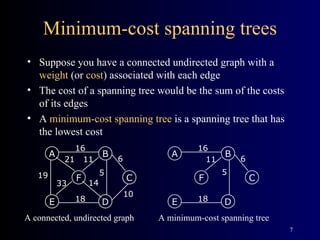
Minimum-cost spanning trees Suppose you have a connected undirected graph with a  weight  (or  cost ) associated with each edge The cost of a spanning tree would be the sum of the costs of its edges A  minimum-cost spanning tree  is a spanning tree that has the lowest cost A B E D F C 16 19 21 11 33 14 18 10 6 5 A connected, undirected graph A B E D F C 16 11 18 6 5 A minimum-cost spanning tree A B E D F C 16 19 21 11 33 14 18 10 6 5 A connected, undirected graph
Kruskal algorithm(E,cost,n,t) //E is set of  edges in G .G has n vertices.Cost[u,v] is //cost of edge(u,v).t is the set of edges in minimum-cost //spanning tree.the final cost is returned.  { //construct a heap out of the edge costs using heapify For i=:1 to n do parent[i]:=-1; //each vertex is in a different set. i:=0;mincost:=0.0; While((i<n-1) and  (heap not empty)) do { //delete a minimum cost edje(u,v) from the heap and reheapify  using Adjust; j:=Find(u); k:=Find(v);
If  (j!=k) then {  i:=i+1; t[i,1]:=u; t[i,2]:=v; mincost:=mincost+cost[u,v]; union(j,k); } } if(i!=n-1) then write(“no spanning tree”); else return mincost; }
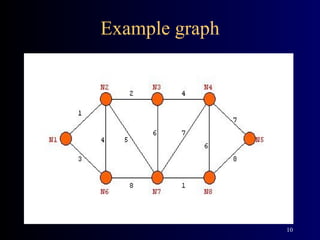
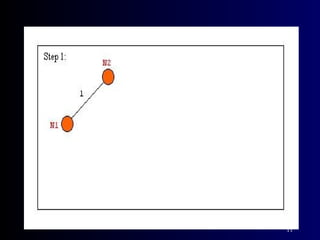
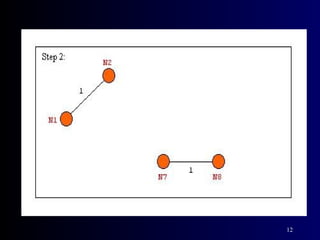
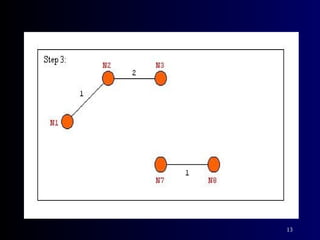
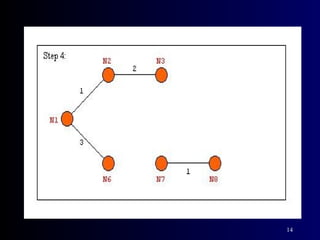
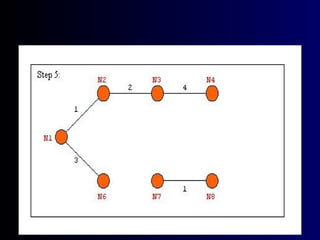
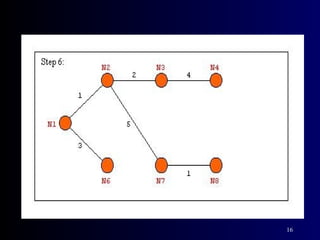
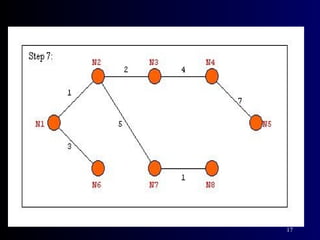
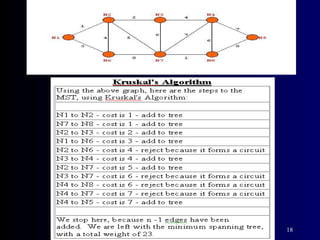
Example graph


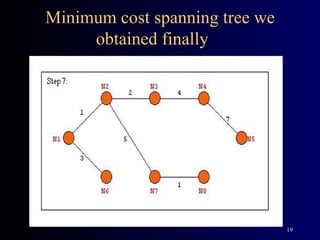
Minimum cost spanning tree we obtained finally
  Any queries???????????
Thank U………………

KRUSKALS'S algorithm from chaitra

  • 1.
    KUVEMPU UNIVERSITY Department of Computer Science Jnana Sahyadri Shankarghatta Seminar on “ Kruskal’s Algorithm ” Presented by, Chaitra.M.S 3 rd sem , M.Sc, Dept. Of Computer Science, Shankarghatta. Under the guidance of, Suresh.M, Dept. Of Computer Science, Shankarghatta.
  • 2.
    Contents Spanning treesFinding a spanning tree Minimum-cost spanning trees Kruskal’s algorithm And example
  • 3.
  • 4.
    Spanning trees Supposeyou have a connected undirected graph Connected: every node is reachable from every other node Undirected: edges do not have an associated direction ...then a spanning tree of the graph is a connected subgraph in which there are no cycles A connected, undirected graph Four of the spanning trees of the graph
  • 5.
    Finding a spanningtree To find a spanning tree of a graph, pick an initial node and call it part of the spanning tree do a search from the initial node: each time you find a node that is not in the spanning tree, add to the spanning tree both the new node and the edge you followed to get to it An undirected graph
  • 6.
    Minimizing costs Supposeyou want to supply a set of houses (say, in a new subdivision) with: electric power water sewage lines telephone lines To keep costs down, you could connect these houses with a spanning tree (of, for example, power lines) However, the houses are not all equal distances apart To reduce costs even further, you could connect the houses with a minimum-cost spanning tree
  • 7.
    Minimum-cost spanning treesSuppose you have a connected undirected graph with a weight (or cost ) associated with each edge The cost of a spanning tree would be the sum of the costs of its edges A minimum-cost spanning tree is a spanning tree that has the lowest cost A B E D F C 16 19 21 11 33 14 18 10 6 5 A connected, undirected graph A B E D F C 16 11 18 6 5 A minimum-cost spanning tree A B E D F C 16 19 21 11 33 14 18 10 6 5 A connected, undirected graph
  • 8.
    Kruskal algorithm(E,cost,n,t) //Eis set of edges in G .G has n vertices.Cost[u,v] is //cost of edge(u,v).t is the set of edges in minimum-cost //spanning tree.the final cost is returned. { //construct a heap out of the edge costs using heapify For i=:1 to n do parent[i]:=-1; //each vertex is in a different set. i:=0;mincost:=0.0; While((i<n-1) and (heap not empty)) do { //delete a minimum cost edje(u,v) from the heap and reheapify using Adjust; j:=Find(u); k:=Find(v);
  • 9.
    If (j!=k)then { i:=i+1; t[i,1]:=u; t[i,2]:=v; mincost:=mincost+cost[u,v]; union(j,k); } } if(i!=n-1) then write(“no spanning tree”); else return mincost; }
  • 10.
  • 11.
  • 12.
  • 13.
  • 14.
  • 15.
  • 16.
  • 17.
  • 18.
  • 19.
    Minimum cost spanningtree we obtained finally
  • 20.
    Anyqueries???????????
  • 21.