Which Doctor for Primary Health Care? Two studies from Chhattisgarh, India  Public Health Foundation of India National Health Systems Resource Center State Health Systems Resource Center, Chhattisgarh Sponsors: AHSPR WHO, NHSRC, SHRC Chhattisgarh December 10, 2010
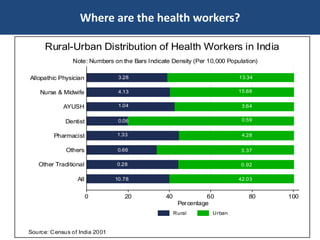
Where are the health workers?
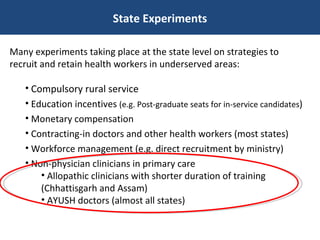
State Experiments Many experiments taking place at the state level on strategies to recruit and retain health workers in underserved areas: Compulsory rural service  Education incentives  (e.g. Post-graduate seats for in-service candidates ) Monetary compensation Contracting-in doctors and other health workers (most states) Workforce management (e.g. direct recruitment by ministry) Non-physician clinicians in primary care Allopathic clinicians with shorter duration of training (Chhattisgarh and Assam) AYUSH doctors (almost all states)
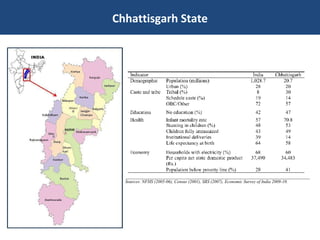
Chhattisgarh State
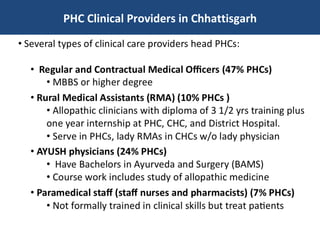
PHC Clinical Providers in Chhattisgarh
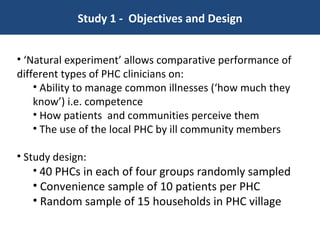
Study 1 -  Objectives and Design ‘ Natural experiment’ allows comparative performance of  different types of PHC clinicians on: Ability to manage common illnesses (‘how much they know’) i.e. competence How patients  and communities perceive them The use of the local PHC by ill community members  Study design: 40 PHCs in each of four groups randomly sampled Convenience sample of 10 patients per PHC Random sample of 15 households in PHC village
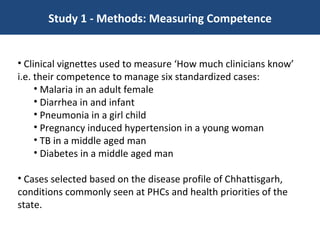
Study 1 - Methods: Measuring Competence Clinical vignettes used to measure ‘How much clinicians know’ i.e. their competence to manage six standardized cases:  Malaria in an adult female  Diarrhea in and infant Pneumonia in a girl child Pregnancy induced hypertension in a young woman TB in a middle aged man Diabetes in a middle aged man Cases selected based on the disease profile of Chhattisgarh, conditions commonly seen at PHCs and health priorities of the state.
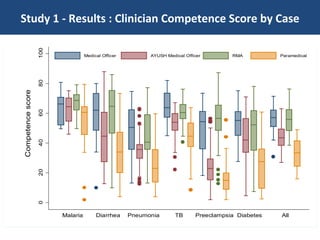
Study 1 - Results : Clinician Competence Score by Case
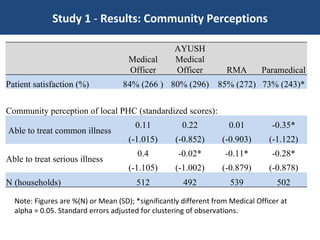
Study 1  -  Results: Community Perceptions Note: Figures are %(N) or Mean (SD); *significantly different from Medical Officer at alpha = 0.05. Standard errors adjusted for clustering of observations.   Medical Officer AYUSH Medical Officer RMA Paramedical Patient satisfaction (%) 84% (266 ) 80% (296) 85% (272) 73% (243)* Community perception of local PHC (standardized scores): Able to treat common illness  0.11 0.22 0.01 -0.35* (-1.015) (-0.852) (-0.903) (-1.122) Able to treat serious illness  0.4 -0.02* -0.11* -0.28* (-1.105) (-1.002) (-0.879) (-0.878) N (households) 512 492 539 502
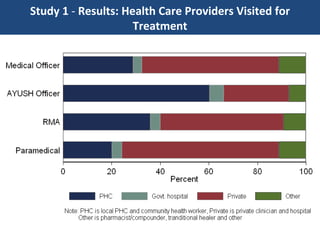
Study 1  -  Results: Health Care Providers Visited for Treatment
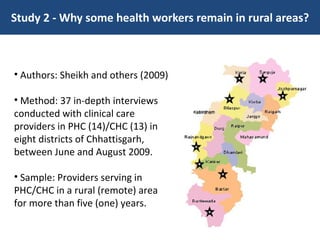
Study 2 - Why some health workers remain in rural areas? Authors: Sheikh and others (2009) Method: 37 in-depth interviews conducted with clinical care providers in PHC (14)/CHC (13) in eight districts of Chhattisgarh, between June and August 2009. Sample: Providers serving in PHC/CHC in a rural (remote) area for more than five (one) years.
Study 2 - Why some health workers remain in rural areas? Reasons for serving in rural areas: Serving in their own communities / Closeness to family Post-graduation opportunities Rural upbringing (most respondents from rural background) Good schools (for children) in area Personal values of service Professional interest in work Opportunity for both spouses to work (women doctors) Strong relationship with colleagues & community
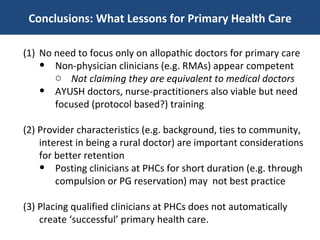
Conclusions: What Lessons for Primary Health Care No need to focus only on allopathic doctors for primary care Non-physician clinicians (e.g. RMAs) appear competent Not claiming they are equivalent to medical doctors AYUSH doctors, nurse-practitioners also viable but need focused (protocol based?) training (2) Provider characteristics (e.g. background, ties to community, interest in being a rural doctor) are important considerations for better retention Posting clinicians at PHCs for short duration (e.g. through compulsion or PG reservation) may  not best practice (3) Placing qualified clinicians at PHCs does not automatically create ‘successful’ primary health care.
Thank You
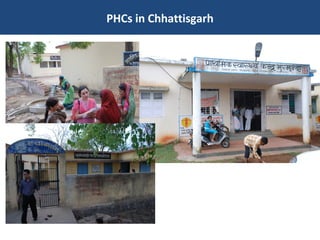
PHCs in Chhattisgarh
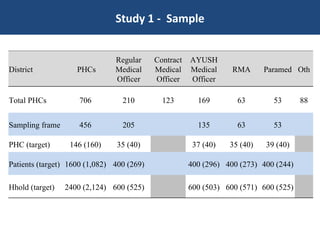
Study 1 -  Sample District PHCs Regular Medical Officer Contract Medical Officer AYUSH Medical Officer RMA Paramed Oth Total PHCs 706 210 123 169 63 53 88 Sampling frame 456 205   135 63 53   PHC (target) 146 (160) 35 (40)   37 (40) 35 (40) 39 (40)   Patients (target) 1600 (1,082) 400 (269)   400 (296) 400 (273) 400 (244)   Hhold (target) 2400 (2,124) 600 (525)   600 (503) 600 (571) 600 (525)  
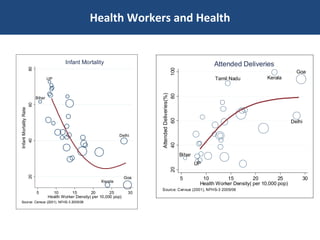
Health Workers and Health
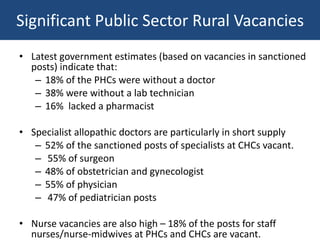
Significant Public Sector Rural Vacancies Latest government estimates (based on vacancies in sanctioned posts) indicate that:  18% of the PHCs were without a doctor 38% were without a lab technician 16%  lacked a pharmacist Specialist allopathic doctors are particularly in short supply  52% of the sanctioned posts of specialists at CHCs vacant.  55% of surgeon 48% of obstetrician and gynecologist 55% of physician 47% of pediatrician posts Nurse vacancies are also high – 18% of the posts for staff nurses/nurse-midwives at PHCs and CHCs are vacant.
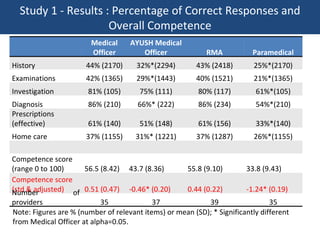
Study 1 - Results :   Percentage of Correct Responses and Overall Competence Note: Figures are % (number of relevant items) or mean (SD); * Significantly different from Medical Officer at alpha=0.05. Medical Officer AYUSH Medical Officer RMA Paramedical History 44% (2170) 32%*(2294) 43% (2418) 25%*(2170) Examinations 42% (1365) 29%*(1443) 40% (1521) 21%*(1365) Investigation 81% (105) 75% (111) 80% (117) 61%*(105) Diagnosis 86% (210) 66%* (222) 86% (234) 54%*(210) Prescriptions (effective)  61% (140) 51% (148) 61% (156) 33%*(140) Home care 37% (1155) 31%* (1221) 37% (1287) 26%*(1155) Competence score  (range 0 to 100) 56.5 (8.42) 43.7 (8.36) 55.8 (9.10) 33.8 (9.43) Competence score  (std & adjusted) 0.51 (0.47) -0.46* (0.20) 0.44 (0.22) -1.24* (0.19) Number of providers 35 37 39 35

Which doctors for primary health care?An assessment of task shifting among primary care clinicians -Krishna D .Rao

  • 1.
    Which Doctor forPrimary Health Care? Two studies from Chhattisgarh, India Public Health Foundation of India National Health Systems Resource Center State Health Systems Resource Center, Chhattisgarh Sponsors: AHSPR WHO, NHSRC, SHRC Chhattisgarh December 10, 2010
  • 2.
    Where are thehealth workers?
  • 3.
    State Experiments Manyexperiments taking place at the state level on strategies to recruit and retain health workers in underserved areas: Compulsory rural service Education incentives (e.g. Post-graduate seats for in-service candidates ) Monetary compensation Contracting-in doctors and other health workers (most states) Workforce management (e.g. direct recruitment by ministry) Non-physician clinicians in primary care Allopathic clinicians with shorter duration of training (Chhattisgarh and Assam) AYUSH doctors (almost all states)
  • 4.
  • 5.
    PHC Clinical Providersin Chhattisgarh
  • 6.
    Study 1 - Objectives and Design ‘ Natural experiment’ allows comparative performance of different types of PHC clinicians on: Ability to manage common illnesses (‘how much they know’) i.e. competence How patients and communities perceive them The use of the local PHC by ill community members Study design: 40 PHCs in each of four groups randomly sampled Convenience sample of 10 patients per PHC Random sample of 15 households in PHC village
  • 7.
    Study 1 -Methods: Measuring Competence Clinical vignettes used to measure ‘How much clinicians know’ i.e. their competence to manage six standardized cases: Malaria in an adult female Diarrhea in and infant Pneumonia in a girl child Pregnancy induced hypertension in a young woman TB in a middle aged man Diabetes in a middle aged man Cases selected based on the disease profile of Chhattisgarh, conditions commonly seen at PHCs and health priorities of the state.
  • 8.
    Study 1 -Results : Clinician Competence Score by Case
  • 9.
    Study 1 - Results: Community Perceptions Note: Figures are %(N) or Mean (SD); *significantly different from Medical Officer at alpha = 0.05. Standard errors adjusted for clustering of observations.   Medical Officer AYUSH Medical Officer RMA Paramedical Patient satisfaction (%) 84% (266 ) 80% (296) 85% (272) 73% (243)* Community perception of local PHC (standardized scores): Able to treat common illness 0.11 0.22 0.01 -0.35* (-1.015) (-0.852) (-0.903) (-1.122) Able to treat serious illness 0.4 -0.02* -0.11* -0.28* (-1.105) (-1.002) (-0.879) (-0.878) N (households) 512 492 539 502
  • 10.
    Study 1 - Results: Health Care Providers Visited for Treatment
  • 11.
    Study 2 -Why some health workers remain in rural areas? Authors: Sheikh and others (2009) Method: 37 in-depth interviews conducted with clinical care providers in PHC (14)/CHC (13) in eight districts of Chhattisgarh, between June and August 2009. Sample: Providers serving in PHC/CHC in a rural (remote) area for more than five (one) years.
  • 12.
    Study 2 -Why some health workers remain in rural areas? Reasons for serving in rural areas: Serving in their own communities / Closeness to family Post-graduation opportunities Rural upbringing (most respondents from rural background) Good schools (for children) in area Personal values of service Professional interest in work Opportunity for both spouses to work (women doctors) Strong relationship with colleagues & community
  • 13.
    Conclusions: What Lessonsfor Primary Health Care No need to focus only on allopathic doctors for primary care Non-physician clinicians (e.g. RMAs) appear competent Not claiming they are equivalent to medical doctors AYUSH doctors, nurse-practitioners also viable but need focused (protocol based?) training (2) Provider characteristics (e.g. background, ties to community, interest in being a rural doctor) are important considerations for better retention Posting clinicians at PHCs for short duration (e.g. through compulsion or PG reservation) may not best practice (3) Placing qualified clinicians at PHCs does not automatically create ‘successful’ primary health care.
  • 14.
  • 15.
  • 16.
    Study 1 - Sample District PHCs Regular Medical Officer Contract Medical Officer AYUSH Medical Officer RMA Paramed Oth Total PHCs 706 210 123 169 63 53 88 Sampling frame 456 205   135 63 53   PHC (target) 146 (160) 35 (40)   37 (40) 35 (40) 39 (40)   Patients (target) 1600 (1,082) 400 (269)   400 (296) 400 (273) 400 (244)   Hhold (target) 2400 (2,124) 600 (525)   600 (503) 600 (571) 600 (525)  
  • 17.
  • 18.
    Significant Public SectorRural Vacancies Latest government estimates (based on vacancies in sanctioned posts) indicate that: 18% of the PHCs were without a doctor 38% were without a lab technician 16% lacked a pharmacist Specialist allopathic doctors are particularly in short supply 52% of the sanctioned posts of specialists at CHCs vacant. 55% of surgeon 48% of obstetrician and gynecologist 55% of physician 47% of pediatrician posts Nurse vacancies are also high – 18% of the posts for staff nurses/nurse-midwives at PHCs and CHCs are vacant.
  • 19.
    Study 1 -Results : Percentage of Correct Responses and Overall Competence Note: Figures are % (number of relevant items) or mean (SD); * Significantly different from Medical Officer at alpha=0.05. Medical Officer AYUSH Medical Officer RMA Paramedical History 44% (2170) 32%*(2294) 43% (2418) 25%*(2170) Examinations 42% (1365) 29%*(1443) 40% (1521) 21%*(1365) Investigation 81% (105) 75% (111) 80% (117) 61%*(105) Diagnosis 86% (210) 66%* (222) 86% (234) 54%*(210) Prescriptions (effective) 61% (140) 51% (148) 61% (156) 33%*(140) Home care 37% (1155) 31%* (1221) 37% (1287) 26%*(1155) Competence score (range 0 to 100) 56.5 (8.42) 43.7 (8.36) 55.8 (9.10) 33.8 (9.43) Competence score (std & adjusted) 0.51 (0.47) -0.46* (0.20) 0.44 (0.22) -1.24* (0.19) Number of providers 35 37 39 35