Financing for Universal Health Coverage   (UHC) EPHP 2010 Bart Criel Institute of Tropical Medicine Antwerp, Belgium
Contents What is UHC about? World Health Report 2010 Health systems financing: the path to universal coverage What are the challenges for Indian policy-makers? Which role for what kind of research? Which way forward towards towards UHC?
UHC: what is it about? Everyone should be able to access health services and not be subject to financial hardship in doing so Call for UHC consistent with… Alma-Ata declaration  (1978) World Health Assembly resolution 58.33  (2005) World Health Report  PHC, now more than ever  (2008) Commission on Social Determinants of Health report  (2008) …
Changing global policy environment  Sociological changes Growing public demand and expectations More vocal civil society Medical-clinical changes Epidemiological transition: NCD, aging,… with increasing costs of health care New treatments Policy / Political changes Equity (back) high on the agenda (following SDH)
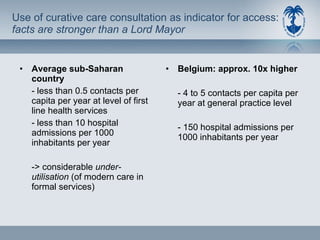
Use of curative care consultation as indicator for access:  facts are stronger than a Lord Mayor Average sub-Saharan country - less than 0.5 contacts per capita per year at level of first line health services - less than 10 hospital admissions per 1000 inhabitants per year -> considerable  under-utilisation  (of modern care in formal services) Belgium: approx.  10x higher - 4 to 5 contacts per capita per year at general practice level - 150 hospital admissions per 1000 inhabitants per year
Health care financing needs What to do  (in low-, middle-  and  high-income countries) ? 1. Need for  more  resources 2. Need to raise them in a  more fair  manner 3. Need to spend / allocate these resources in a  more efficient  way
How much is spent? How much needed?  OECD countries spend on health on average US$ 3600 per capita per year 31 of WHO’s member states spend less than US$ 35 4 member states spend less than US$ 10 India spends approximately US$ 50, of which 80% is out-of-pocket   Recent estimates of financing needs: On average US$ 60 per capita per year will be needed in 2015 (including antiretrovirals and care for non-communicable diseases)
Limitations of direct payments Direct payments  (user fees, out-of-pocket payments) Regressive by nature Deter poor people from (needed) utilisation Source of impoverishment Dr Margaret Chan: User fees have punished the poor Exemptions often do not work Loss of income for providers Stigma, discriminating behaviour, bureaucracy
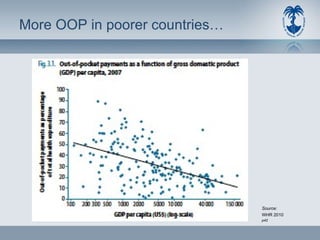
More OOP in poorer countries… Source: WHR 2010 p42
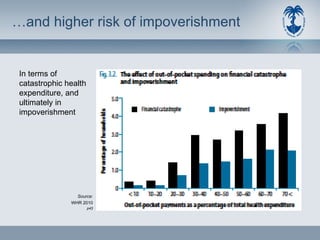
… and higher risk of impoverishment In terms of catastrophic health expenditure, and ultimately in impoverishment Source: WHR 2010 p43
Non-financial barriers also matter Distance Culture, language, gender Perceived quality of care … Discriminatory practices Stigma Lack of information … J.T Hart  (The Lancet, 1971) : the  inverse care law The availability of good medical care tends to vary inversely with the need for it in the population served
‘ Omnio’ programme in Belgium Belgium: 15% of its population is ‘BPL’ Omnio  is a government programme that aims at enhancing financial access to health care in Belgian Social Health Insurance system for highly vulnerable population groups  Benefit for BPL: reduced co-payments when using care Only 25% of total entitled population (800.000 HH) makes use of  Omnio  after several years of operation   Why?   Lack of information People have to apply for it themselves Complex administrative procedures
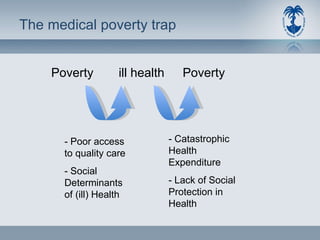
The medical poverty trap Poverty   ill health   Poverty - Poor access to quality care - Social Determinants of (ill) Health  - Catastrophic Health Expenditure - Lack of Social Protection in Health
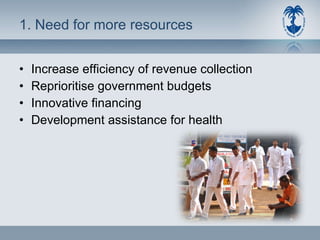
1. Need for more resources Increase efficiency of revenue collection Reprioritise government budgets Innovative financing Development assistance for health
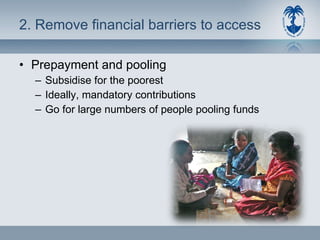
2. Remove financial barriers to access Prepayment and pooling Subsidise for the poorest Ideally, mandatory contributions Go for large numbers of people pooling funds
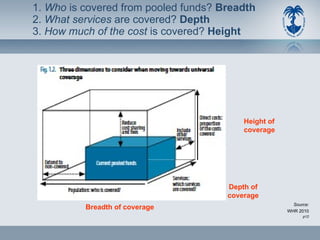
1.  Who  is covered from pooled funds?  Breadth 2.  What services  are covered?  Depth 3.  How much of the cost  is covered?  Height Breadth of coverage Height of coverage Depth of coverage Source: WHR 2010 p12
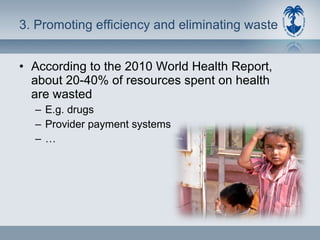
3. Promoting efficiency and eliminating waste According to the 2010 World Health Report, about 20-40% of resources spent on health are wasted E.g. drugs Provider payment systems …
Change is possible: yes, we can Countries with similar levels of health expenditure achieve sometimes strikingly different results No single mix of policies works well in every setting Need for home-grown strategies - Path-dependency - Pragmatism  vs  dogmas -  No  copy and paste ‘ Succes stories’ Brazil, Chile, China, Mexico, Rwanda, Thailand, Gabon, Cambodia, Lebanon, Ghana…  … have made substantial progress
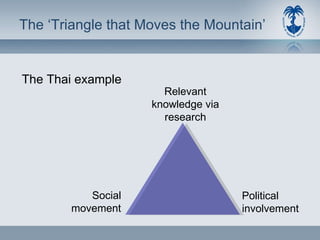
The ‘Triangle that Moves the Mountain’ Relevant knowledge via research Social movement Political involvement The Thai example
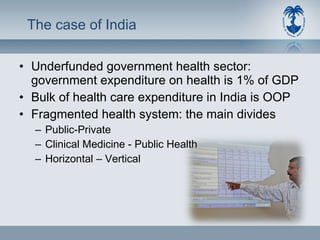
The case of India Underfunded government health sector: government expenditure on health is 1% of GDP Bulk of health care expenditure in India is OOP Fragmented health system: the main divides Public-Private Clinical Medicine - Public Health  Horizontal – Vertical
Policy priorities in India Messages for policy-makers More financial resources Increase funding to public sector More resources raised in a fair way Reduce reliance on direct payments and shift further to prepayment and pooled funds More efficient use of scarce resources Rationalisation measures at supply-side of care A number of current public programmes already go in that direction:  NRHM (Health) RSBY (Labour) …
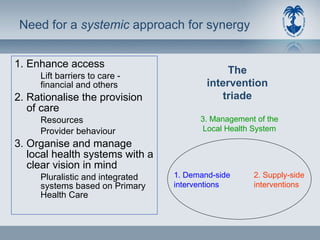
Need for a  systemic  approach for synergy 1. Enhance access Lift barriers to care - financial and others 2. Rationalise the provision of care Resources Provider behaviour 3. Organise and manage local health systems with a clear vision in mind Pluralistic and integrated systems based on Primary Health Care 1. Demand-side interventions 2. Supply-side interventions 3. Management of the Local Health System The intervention triade
1 st  Global Symposium on Health Systems Research Montreux, Switserland, 16-19 November 2010 Universal health coverage with equity: what we know, don’t know and need to know (Frenz & Vega, background paper)  www.hsr-symposium.org   Messages for researchers: Important gaps in knowledge about  why  health needs for some groups are not being met by UHC programs… Research should go beyond just reporting inequities in health care utilisation to  explaining the causes of differential access Need for a more comprehensive understanding of equitable care, which integrates a  sociological perspective  and uses  mixed quantitative and qualitative methodologies
Research on CHI in India: not only an effective strategy,  also a social investment Community health insurance contributes to universal health coverage in India  PhD thesis 2010 (Devadasan) If well designed and implemented, CHI schemes in India can increase access to hospital care and protect households from Catastrophic Health Expenditure Community Health Insurance and Universal Coverage: Multiple paths, many rivers to cross World Health Report (2010)  Background Paper 48 (Soors, Devadasan, Durairaj and Criel) Research in Mumbai and Pune confirms the potential for bottom-up empowering of CHI members The government – in addition to its top-down approach – should tap the potential of community organisations to transform the RSBY target groups from passive beneficiaries into active participants
Socially Inclusive Health Care Financing in West Africa  and India ( Health Inc .): a EU-funded research project  Hypothesis: Social exclusion is an important cause of the limited success of recent health financing reforms Health Inc.  will analyse:  (i) whether financing arrangements  can overcome social exclusion  to successfully cover poorer population groups  (ii) whether these arrangements succeed in increasing social inclusion  by empowering socially marginalised groups .  Fields:   India (Karnataka, Maharashtra) Ghana  Senegal Partners:   India: IPH Bangalore & TISS Mumbai Ghana: ISSER Accra Senegal: CREPOS Dakar Europe: LSE London & ITM Antwerp Start: May 2011
Way forward: what is needed? More resources More fairness in raising these resources More efficiency in using these resources But  financing is a means to an end: What are the resources for? Need for a clear and shared vision on  how  to organise (local) health care delivery systems that offer accessible  quality  care to all who need it
Thank you
5 presentations  Gautam Chakraborty : Patterns of Public Health expenditure in India: Analysis of State and Central Health Budgets in pre- and post-NRHM period K. Gayithri : District fund flow under NRHM and service delivery. Some insights from Karnataka KG Santhya : Conditional cash transfers and quality of care of maternal and newborn care. Womens’ experiences of Janani Surksha Yojana in Rajastan Sulakshana Nandi : A study to analyse implementation of RSBY in Chattisgarh Shridar Kadam : A Rapid Evaluation of the Rajiv Aarogyasri Community Health Insurance Scheme in Andhra Pradesh
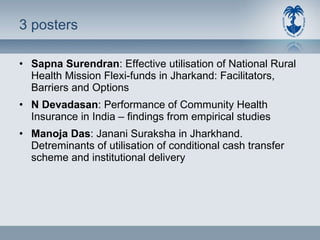
3 posters Sapna Surendran : Effective utilisation of National Rural Health Mission Flexi-funds in Jharkand: Facilitators, Barriers and Options N Devadasan : Performance of Community Health Insurance in India – findings from empirical studies Manoja Das : Janani Suraksha in Jharkhand. Detreminants of utilisation of conditional cash transfer scheme and institutional delivery

Keynote address: Financing for Universal Coverage - Bart Criel

  • 1.
    Financing for UniversalHealth Coverage (UHC) EPHP 2010 Bart Criel Institute of Tropical Medicine Antwerp, Belgium
  • 2.
    Contents What isUHC about? World Health Report 2010 Health systems financing: the path to universal coverage What are the challenges for Indian policy-makers? Which role for what kind of research? Which way forward towards towards UHC?
  • 3.
    UHC: what isit about? Everyone should be able to access health services and not be subject to financial hardship in doing so Call for UHC consistent with… Alma-Ata declaration (1978) World Health Assembly resolution 58.33 (2005) World Health Report PHC, now more than ever (2008) Commission on Social Determinants of Health report (2008) …
  • 4.
    Changing global policyenvironment Sociological changes Growing public demand and expectations More vocal civil society Medical-clinical changes Epidemiological transition: NCD, aging,… with increasing costs of health care New treatments Policy / Political changes Equity (back) high on the agenda (following SDH)
  • 5.
    Use of curativecare consultation as indicator for access: facts are stronger than a Lord Mayor Average sub-Saharan country - less than 0.5 contacts per capita per year at level of first line health services - less than 10 hospital admissions per 1000 inhabitants per year -> considerable under-utilisation (of modern care in formal services) Belgium: approx. 10x higher - 4 to 5 contacts per capita per year at general practice level - 150 hospital admissions per 1000 inhabitants per year
  • 6.
    Health care financingneeds What to do (in low-, middle- and high-income countries) ? 1. Need for more resources 2. Need to raise them in a more fair manner 3. Need to spend / allocate these resources in a more efficient way
  • 7.
    How much isspent? How much needed? OECD countries spend on health on average US$ 3600 per capita per year 31 of WHO’s member states spend less than US$ 35 4 member states spend less than US$ 10 India spends approximately US$ 50, of which 80% is out-of-pocket Recent estimates of financing needs: On average US$ 60 per capita per year will be needed in 2015 (including antiretrovirals and care for non-communicable diseases)
  • 8.
    Limitations of directpayments Direct payments (user fees, out-of-pocket payments) Regressive by nature Deter poor people from (needed) utilisation Source of impoverishment Dr Margaret Chan: User fees have punished the poor Exemptions often do not work Loss of income for providers Stigma, discriminating behaviour, bureaucracy
  • 9.
    More OOP inpoorer countries… Source: WHR 2010 p42
  • 10.
    … and higherrisk of impoverishment In terms of catastrophic health expenditure, and ultimately in impoverishment Source: WHR 2010 p43
  • 11.
    Non-financial barriers alsomatter Distance Culture, language, gender Perceived quality of care … Discriminatory practices Stigma Lack of information … J.T Hart (The Lancet, 1971) : the inverse care law The availability of good medical care tends to vary inversely with the need for it in the population served
  • 12.
    ‘ Omnio’ programmein Belgium Belgium: 15% of its population is ‘BPL’ Omnio is a government programme that aims at enhancing financial access to health care in Belgian Social Health Insurance system for highly vulnerable population groups Benefit for BPL: reduced co-payments when using care Only 25% of total entitled population (800.000 HH) makes use of Omnio after several years of operation Why? Lack of information People have to apply for it themselves Complex administrative procedures
  • 13.
    The medical povertytrap Poverty ill health Poverty - Poor access to quality care - Social Determinants of (ill) Health - Catastrophic Health Expenditure - Lack of Social Protection in Health
  • 14.
    1. Need formore resources Increase efficiency of revenue collection Reprioritise government budgets Innovative financing Development assistance for health
  • 15.
    2. Remove financialbarriers to access Prepayment and pooling Subsidise for the poorest Ideally, mandatory contributions Go for large numbers of people pooling funds
  • 16.
    1. Who is covered from pooled funds? Breadth 2. What services are covered? Depth 3. How much of the cost is covered? Height Breadth of coverage Height of coverage Depth of coverage Source: WHR 2010 p12
  • 17.
    3. Promoting efficiencyand eliminating waste According to the 2010 World Health Report, about 20-40% of resources spent on health are wasted E.g. drugs Provider payment systems …
  • 18.
    Change is possible:yes, we can Countries with similar levels of health expenditure achieve sometimes strikingly different results No single mix of policies works well in every setting Need for home-grown strategies - Path-dependency - Pragmatism vs dogmas - No copy and paste ‘ Succes stories’ Brazil, Chile, China, Mexico, Rwanda, Thailand, Gabon, Cambodia, Lebanon, Ghana… … have made substantial progress
  • 19.
    The ‘Triangle thatMoves the Mountain’ Relevant knowledge via research Social movement Political involvement The Thai example
  • 20.
    The case ofIndia Underfunded government health sector: government expenditure on health is 1% of GDP Bulk of health care expenditure in India is OOP Fragmented health system: the main divides Public-Private Clinical Medicine - Public Health Horizontal – Vertical
  • 21.
    Policy priorities inIndia Messages for policy-makers More financial resources Increase funding to public sector More resources raised in a fair way Reduce reliance on direct payments and shift further to prepayment and pooled funds More efficient use of scarce resources Rationalisation measures at supply-side of care A number of current public programmes already go in that direction: NRHM (Health) RSBY (Labour) …
  • 22.
    Need for a systemic approach for synergy 1. Enhance access Lift barriers to care - financial and others 2. Rationalise the provision of care Resources Provider behaviour 3. Organise and manage local health systems with a clear vision in mind Pluralistic and integrated systems based on Primary Health Care 1. Demand-side interventions 2. Supply-side interventions 3. Management of the Local Health System The intervention triade
  • 23.
    1 st Global Symposium on Health Systems Research Montreux, Switserland, 16-19 November 2010 Universal health coverage with equity: what we know, don’t know and need to know (Frenz & Vega, background paper) www.hsr-symposium.org Messages for researchers: Important gaps in knowledge about why health needs for some groups are not being met by UHC programs… Research should go beyond just reporting inequities in health care utilisation to explaining the causes of differential access Need for a more comprehensive understanding of equitable care, which integrates a sociological perspective and uses mixed quantitative and qualitative methodologies
  • 24.
    Research on CHIin India: not only an effective strategy, also a social investment Community health insurance contributes to universal health coverage in India PhD thesis 2010 (Devadasan) If well designed and implemented, CHI schemes in India can increase access to hospital care and protect households from Catastrophic Health Expenditure Community Health Insurance and Universal Coverage: Multiple paths, many rivers to cross World Health Report (2010) Background Paper 48 (Soors, Devadasan, Durairaj and Criel) Research in Mumbai and Pune confirms the potential for bottom-up empowering of CHI members The government – in addition to its top-down approach – should tap the potential of community organisations to transform the RSBY target groups from passive beneficiaries into active participants
  • 25.
    Socially Inclusive HealthCare Financing in West Africa and India ( Health Inc .): a EU-funded research project Hypothesis: Social exclusion is an important cause of the limited success of recent health financing reforms Health Inc. will analyse: (i) whether financing arrangements can overcome social exclusion to successfully cover poorer population groups (ii) whether these arrangements succeed in increasing social inclusion by empowering socially marginalised groups . Fields: India (Karnataka, Maharashtra) Ghana Senegal Partners: India: IPH Bangalore & TISS Mumbai Ghana: ISSER Accra Senegal: CREPOS Dakar Europe: LSE London & ITM Antwerp Start: May 2011
  • 26.
    Way forward: whatis needed? More resources More fairness in raising these resources More efficiency in using these resources But financing is a means to an end: What are the resources for? Need for a clear and shared vision on how to organise (local) health care delivery systems that offer accessible quality care to all who need it
  • 27.
  • 28.
    5 presentations Gautam Chakraborty : Patterns of Public Health expenditure in India: Analysis of State and Central Health Budgets in pre- and post-NRHM period K. Gayithri : District fund flow under NRHM and service delivery. Some insights from Karnataka KG Santhya : Conditional cash transfers and quality of care of maternal and newborn care. Womens’ experiences of Janani Surksha Yojana in Rajastan Sulakshana Nandi : A study to analyse implementation of RSBY in Chattisgarh Shridar Kadam : A Rapid Evaluation of the Rajiv Aarogyasri Community Health Insurance Scheme in Andhra Pradesh
  • 29.
    3 posters SapnaSurendran : Effective utilisation of National Rural Health Mission Flexi-funds in Jharkand: Facilitators, Barriers and Options N Devadasan : Performance of Community Health Insurance in India – findings from empirical studies Manoja Das : Janani Suraksha in Jharkhand. Detreminants of utilisation of conditional cash transfer scheme and institutional delivery