Low coverage of Janani Suraksha Yojana (JSY) among mothers, South 24 Parganas, India, 2009 Dr. Dilip Kumar Mandal West Bengal
Background Globally, >0.5 million mothers dies annually, 99% in developing countries >0.1 million deaths in India, MMR: 254/100000 live births In West Bengal, MMR: 141 & Institutional delivery 49.2%  In south 24 parganas, 69.1% completed 3 ante-natal care Institutional delivery: 33.3% rural area Infant mortality:  46/1000 live birth  Janani Suraksha Yojana (JSY) aims to reduce maternal and infant mortality and to promote institutional delivery among underprivileged groups by: Promoting antenatal care with financial support for nutrition Cash incentive and Transport support for institutional delivery
Objectives of the study Primary: Estimate the coverage of JSY in the district.  Secondary: Determine the factors affecting the JSY coverage
Methodology-1  Community survey:  Eligible mothers of JSY (BPL & SC-ST), having child below one year of age by cluster sampling using PPS (population proportionate to size) method.  Sample size:  256 mothers, in 32 cluster(8/cluster) Assumption: utilization of JSY among 70% mothers, 95% CI , 80% power, roh 0.03 (design effect as 3.1) using Right size software In each cluster, randomly selected mothers.  Trained interviewer collected the data using semi-structured questionnaire
Methodology-2 Survey of Stake-holders :  Randomly selected 97 Health Worker (Female) (Assumption: Knowledge 50%, 95% CI, 80% Power) 32 Block Medical Officers of Health (BMOH) & Public Health Nurses (PHN)  12 Gram Panchayat Pradhans District Nodal Officer for JSY  Interviewed using semi-structured questionnaire. Analysis of performance reports of RCH and JSY :  Secondary data from the records, registers and reports at different levels
Result   Survey of rural eligible women  Under JSY,  pregnant mothers of poor ( BPL ), scheduled caste and tribes  got  Rs 500 after completing three ante-natal Check-ups (ANC) Rs.150-350 for transport to government or accredited health institution Rs.500 for opting institutional delivery
Characteristics of mothers
Knowledge about JSY
Quality of Ante-Natal Checkups
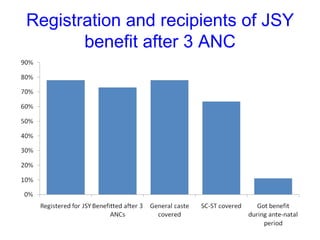
Registration and recipients of JSY benefit after 3 ANC
Result-  Cont’d Institutional delivery among eligible: 50% (128/256) Institutional delivery among benefited for 3 ANC: 49% (99/188) Got incentives after delivery for referral transport and institutional delivery: 51% (51/99)  incentives before discharge from hospital: 57% (29/51)  Husband’s education primary or more (Odds Ratio-2.48, 95%CI: 1.22-5.07) and knowledge of JSY (OR-11.17, 95%CI: 5.9-21.9) associated with getting JSY benefits.  Institutional delivery was low in Muslims (OR- 0.41, 95% CI: 0.23-0.72). Reasons for opting home delivery:  Family tradition in 34% (43/128),  Sudden labour pain-no time to go to hospital in 14%  Transport problem in 11%.
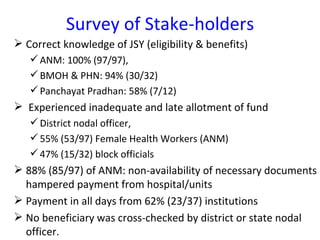
Survey of Stake-holders Correct knowledge of JSY (eligibility & benefits) ANM: 100% (97/97),  BMOH & PHN: 94% (30/32)  Panchayat Pradhan: 58% (7/12) Experienced inadequate and late allotment of fund  District nodal officer,  55% (53/97) Female Health Workers (ANM) 47% (15/32) block officials  88% (85/97) of ANM: non-availability of necessary documents hampered payment from hospital/units Payment in all days from 62% (23/37) institutions  No beneficiary was cross-checked by district or state nodal officer.
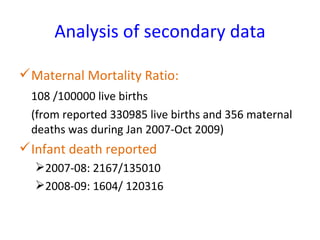
Analysis of secondary data Maternal Mortality Ratio: 108 /100000 live births  (from reported 330985 live births and 356 maternal deaths was during Jan 2007-Oct 2009) Infant death reported  2007-08: 2167/135010 2008-09: 1604/ 120316
Trend of payment of JSY benefits to mothers, June 2007 to October 2009, South 24 Parganas
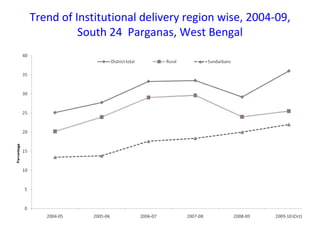
Trend of Institutional delivery region wise, 2004-09, South 24  Parganas, West Bengal
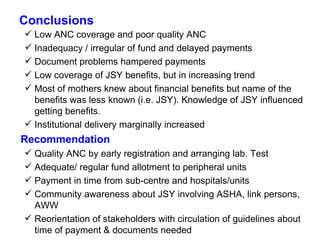
Conclusions Low ANC coverage and poor quality ANC Inadequacy / irregular of fund and delayed payments Document problems hampered payments Low coverage of JSY benefits, but in increasing trend Most of mothers knew about financial benefits but name of the benefits was less known (i.e. JSY). Knowledge of JSY influenced getting benefits.  Institutional delivery marginally increased Recommendation Quality ANC by early registration and arranging lab. Test Adequate/ regular fund allotment to peripheral units Payment in time from sub-centre and hospitals/units Community awareness about JSY involving ASHA, link persons, AWW Reorientation of stakeholders with circulation of guidelines about time of payment & documents needed

Low coverage of Janani Suraksha Yojana(Maternal Protection Scheme) among mothers,south 24 Parganas,West Bengal in 2009Dilip kumar mandal

  • 1.
    Low coverage ofJanani Suraksha Yojana (JSY) among mothers, South 24 Parganas, India, 2009 Dr. Dilip Kumar Mandal West Bengal
  • 2.
    Background Globally, >0.5million mothers dies annually, 99% in developing countries >0.1 million deaths in India, MMR: 254/100000 live births In West Bengal, MMR: 141 & Institutional delivery 49.2% In south 24 parganas, 69.1% completed 3 ante-natal care Institutional delivery: 33.3% rural area Infant mortality: 46/1000 live birth Janani Suraksha Yojana (JSY) aims to reduce maternal and infant mortality and to promote institutional delivery among underprivileged groups by: Promoting antenatal care with financial support for nutrition Cash incentive and Transport support for institutional delivery
  • 3.
    Objectives of thestudy Primary: Estimate the coverage of JSY in the district. Secondary: Determine the factors affecting the JSY coverage
  • 4.
    Methodology-1 Communitysurvey: Eligible mothers of JSY (BPL & SC-ST), having child below one year of age by cluster sampling using PPS (population proportionate to size) method. Sample size: 256 mothers, in 32 cluster(8/cluster) Assumption: utilization of JSY among 70% mothers, 95% CI , 80% power, roh 0.03 (design effect as 3.1) using Right size software In each cluster, randomly selected mothers. Trained interviewer collected the data using semi-structured questionnaire
  • 5.
    Methodology-2 Survey ofStake-holders : Randomly selected 97 Health Worker (Female) (Assumption: Knowledge 50%, 95% CI, 80% Power) 32 Block Medical Officers of Health (BMOH) & Public Health Nurses (PHN) 12 Gram Panchayat Pradhans District Nodal Officer for JSY Interviewed using semi-structured questionnaire. Analysis of performance reports of RCH and JSY : Secondary data from the records, registers and reports at different levels
  • 6.
    Result Survey of rural eligible women Under JSY, pregnant mothers of poor ( BPL ), scheduled caste and tribes got Rs 500 after completing three ante-natal Check-ups (ANC) Rs.150-350 for transport to government or accredited health institution Rs.500 for opting institutional delivery
  • 7.
  • 8.
  • 9.
  • 10.
    Registration and recipientsof JSY benefit after 3 ANC
  • 11.
    Result- Cont’dInstitutional delivery among eligible: 50% (128/256) Institutional delivery among benefited for 3 ANC: 49% (99/188) Got incentives after delivery for referral transport and institutional delivery: 51% (51/99) incentives before discharge from hospital: 57% (29/51) Husband’s education primary or more (Odds Ratio-2.48, 95%CI: 1.22-5.07) and knowledge of JSY (OR-11.17, 95%CI: 5.9-21.9) associated with getting JSY benefits. Institutional delivery was low in Muslims (OR- 0.41, 95% CI: 0.23-0.72). Reasons for opting home delivery: Family tradition in 34% (43/128), Sudden labour pain-no time to go to hospital in 14% Transport problem in 11%.
  • 12.
    Survey of Stake-holdersCorrect knowledge of JSY (eligibility & benefits) ANM: 100% (97/97), BMOH & PHN: 94% (30/32) Panchayat Pradhan: 58% (7/12) Experienced inadequate and late allotment of fund District nodal officer, 55% (53/97) Female Health Workers (ANM) 47% (15/32) block officials 88% (85/97) of ANM: non-availability of necessary documents hampered payment from hospital/units Payment in all days from 62% (23/37) institutions No beneficiary was cross-checked by district or state nodal officer.
  • 13.
    Analysis of secondarydata Maternal Mortality Ratio: 108 /100000 live births (from reported 330985 live births and 356 maternal deaths was during Jan 2007-Oct 2009) Infant death reported 2007-08: 2167/135010 2008-09: 1604/ 120316
  • 14.
    Trend of paymentof JSY benefits to mothers, June 2007 to October 2009, South 24 Parganas
  • 15.
    Trend of Institutionaldelivery region wise, 2004-09, South 24 Parganas, West Bengal
  • 16.
    Conclusions Low ANCcoverage and poor quality ANC Inadequacy / irregular of fund and delayed payments Document problems hampered payments Low coverage of JSY benefits, but in increasing trend Most of mothers knew about financial benefits but name of the benefits was less known (i.e. JSY). Knowledge of JSY influenced getting benefits. Institutional delivery marginally increased Recommendation Quality ANC by early registration and arranging lab. Test Adequate/ regular fund allotment to peripheral units Payment in time from sub-centre and hospitals/units Community awareness about JSY involving ASHA, link persons, AWW Reorientation of stakeholders with circulation of guidelines about time of payment & documents needed