Key
Performance
Indicators (KPI’s)
• What are KPI’s
• Why integrate KPI
with goal setting
• Aligning your goals
and KPI’s
Why Integrate KPIs
with Goal Setting?
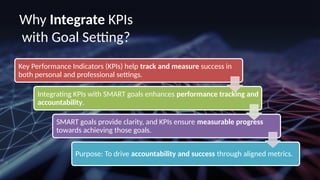
Key Performance Indicators (KPIs) help track and measure success in
both personal and professional settings.
Integrating KPIs with SMART goals enhances performance tracking and
accountability.
SMART goals provide clarity, and KPIs ensure measurable progress
towards achieving those goals.
Purpose: To drive accountability and success through aligned metrics.
Understanding KPIs
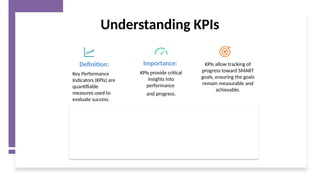
Definition:
Key Performance
Indicators (KPIs) are
quantifiable
measures used to
evaluate success.
Importance:
KPIs provide critical
insights into
performance
and progress.
Examples of
KPIs:
Sales
Revenue
Customer
Satisfaction
(NPS)
Employee
Retention
Rate
Profit
Margin
KPIs allow tracking of
progress toward SMART
goals, ensuring the goals
remain measurable and
achievable.
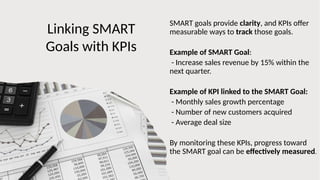
Linking SMART
Goals with KPIs
SMART goals provide clarity, and KPIs offer
measurable ways to track those goals.
Example of SMART Goal:
- Increase sales revenue by 15% within the
next quarter.
Example of KPI linked to the SMART Goal:
- Monthly sales growth percentage
- Number of new customers acquired
- Average deal size
By monitoring these KPIs, progress toward
the SMART goal can be effectively measured.
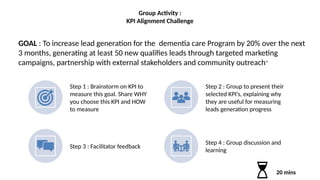
Group Activity :
KPI Alignment Challenge
Step 1 : Brainstorm on KPI to
measure this goal. Share WHY
you choose this KPI and HOW
to measure
Step 2 : Group to present their
selected KPI’s, explaining why
they are useful for measuring
leads generation progress
Step 3 : Facilitator feedback
Step 4 : Group discussion and
learning
GOAL : To increase lead generation for the dementia care Program by 20% over the next
3 months, generating at least 50 new qualifies leads through targeted marketing
campaigns, partnership with external stakeholders and community outreach”
20 mins
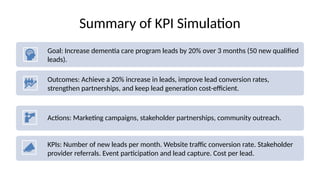
Summary of KPI Simulation
Goal: Increase dementia care program leads by 20% over 3 months (50 new qualified
leads).
Actions: Marketing campaigns, stakeholder partnerships, community outreach.
KPIs: Number of new leads per month. Website traffic conversion rate. Stakeholder
provider referrals. Event participation and lead capture. Cost per lead.
Outcomes: Achieve a 20% increase in leads, improve lead conversion rates,
strengthen partnerships, and keep lead generation cost-efficient.
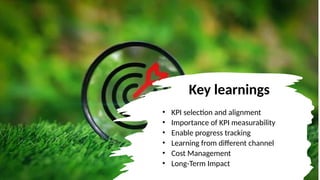
Key learnings
• KPI selection and alignment
• Importance of KPI measurability
• Enable progress tracking
• Learning from different channel
• Cost Management
• Long-Term Impact

KPI alignment with goals....why is it importantpptx

  • 1.
    Key Performance Indicators (KPI’s) • Whatare KPI’s • Why integrate KPI with goal setting • Aligning your goals and KPI’s
  • 2.
    Why Integrate KPIs withGoal Setting? Key Performance Indicators (KPIs) help track and measure success in both personal and professional settings. Integrating KPIs with SMART goals enhances performance tracking and accountability. SMART goals provide clarity, and KPIs ensure measurable progress towards achieving those goals. Purpose: To drive accountability and success through aligned metrics.
  • 3.
    Understanding KPIs Definition: Key Performance Indicators(KPIs) are quantifiable measures used to evaluate success. Importance: KPIs provide critical insights into performance and progress. Examples of KPIs: Sales Revenue Customer Satisfaction (NPS) Employee Retention Rate Profit Margin KPIs allow tracking of progress toward SMART goals, ensuring the goals remain measurable and achievable.
  • 4.
    Linking SMART Goals withKPIs SMART goals provide clarity, and KPIs offer measurable ways to track those goals. Example of SMART Goal: - Increase sales revenue by 15% within the next quarter. Example of KPI linked to the SMART Goal: - Monthly sales growth percentage - Number of new customers acquired - Average deal size By monitoring these KPIs, progress toward the SMART goal can be effectively measured.
  • 5.
    Group Activity : KPIAlignment Challenge Step 1 : Brainstorm on KPI to measure this goal. Share WHY you choose this KPI and HOW to measure Step 2 : Group to present their selected KPI’s, explaining why they are useful for measuring leads generation progress Step 3 : Facilitator feedback Step 4 : Group discussion and learning GOAL : To increase lead generation for the dementia care Program by 20% over the next 3 months, generating at least 50 new qualifies leads through targeted marketing campaigns, partnership with external stakeholders and community outreach” 20 mins
  • 6.
    Summary of KPISimulation Goal: Increase dementia care program leads by 20% over 3 months (50 new qualified leads). Actions: Marketing campaigns, stakeholder partnerships, community outreach. KPIs: Number of new leads per month. Website traffic conversion rate. Stakeholder provider referrals. Event participation and lead capture. Cost per lead. Outcomes: Achieve a 20% increase in leads, improve lead conversion rates, strengthen partnerships, and keep lead generation cost-efficient.
  • 7.
    Key learnings • KPIselection and alignment • Importance of KPI measurability • Enable progress tracking • Learning from different channel • Cost Management • Long-Term Impact

Editor's Notes

  • #5 KPIs (How will you measure success?): Here are the specific KPIs to measure progress toward the goal. These KPIs focus on lead generation and marketing performance. Number of New Leads per Month: What it measures: The number of qualified leads generated each month from all initiatives. Target: 50 new leads over 3 months (approximately 17 per month). Conversion Rate from Website Traffic to Leads: What it measures: The percentage of visitors to the dementia care program’s landing page who submit their information as leads. Target: Aim for a 5-10% conversion rate depending on current website traffic. Stakeholder Referrals: What it measures: The number of leads referred by stakeholder providers each month. Target: Establish 2-3 new referral partners, generating at least 5 leads per month. Event Participation and Lead Capture: What it measures: The number of new leads collected at events (community outreach, workshops, webinars). Target: Collect at least 10 leads from each event.
  • #7 4. Learning Points (What participants will learn from the exercise): KPI Selection and Alignment:Participants will learn how to choose relevant KPIs that align with the goal. They’ll see that each KPI serves a different aspect of lead generation—whether through direct marketing, partnerships, or events. Importance of Measurability:This simulation emphasizes how measurable KPIs give clarity. For example, tracking conversion rates or number of new leads per month allows teams to monitor performance in real-time and make adjustments. Tracking Progress:Participants will see the importance of tracking KPIs continuously to adapt strategies quickly. For instance, if conversion rates are low after the first month, they might tweak the landing page or improve ad targeting. Learning from Different Channels:Teams will understand that different strategies (marketing campaigns, healthcare referrals, community events) will yield different lead generation results. This encourages flexibility and creative thinking when evaluating which channels work best. Cost Management:By measuring Cost per Lead (CPL), the team can learn how to balance cost-efficiency with lead quality. This is critical when working within budget constraints. Long-Term Impact:The exercise demonstrates that while the goal is focused on a 3-month period, building partnerships and optimizing marketing can lead to sustainable lead generation beyond the immediate timeframe.