IPE 4101: Industrial and Business
Management
Lecture Series on Marketing Management
Course Instructor:
Md. Zahidul Islam
Lecturer, Department of IPE, RUET
Kotler • Keller
Phillip Kevin Lane
Marketing Management • 14e
Analyzing Business
Markets
Copyright © 2012 Pearson Education, Inc. Publishing as Prentice Hall Slide 4 of 27
Discussion Questions
1. What is the business market, and how does it differ
from the consumer market?
2. What buying situations do organizational buyers face?
3. Who participates in the B2B buying process?
4. How do business buyers make their decisions?
5. How can companies build strong relationships with
business customers?
6. How do institutional buyers and government agencies
do their buying?
Copyright © 2012 Pearson Education, Inc. Publishing as Prentice Hall Slide 5 of 27
The decision-making process by which
formal organizations establish the need
for purchased products and services and
identify, evaluate, and choose among
alternative brands and suppliers.
-- F. Webster Jr and Y. Wind
Organizational Buying
Copyright © 2012 Pearson Education, Inc. Publishing as Prentice Hall Slide 6 of 27
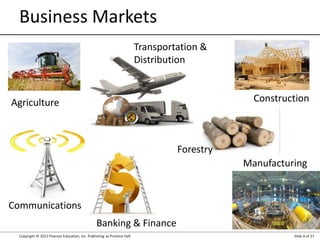
Business Markets
Agriculture
Communications
Banking & Finance
Transportation &
Distribution
Construction
Forestry
Manufacturing
Copyright © 2012 Pearson Education, Inc. Publishing as Prentice Hall Slide 7 of 27
Business Markets
• Understanding deep customer needs
• Identify areas for growth
• Improving value management techniques
• Calculating better marketing metrics
• Competing and growing in global markets
• Countering product commoditization
• Gain support for the marketing concept
Similarities to the Consumer Market
Copyright © 2012 Pearson Education, Inc. Publishing as Prentice Hall Slide 8 of 27
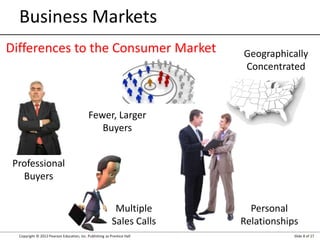
Business Markets
Professional
Buyers
Geographically
Concentrated
Multiple
Sales Calls
Differences to the Consumer Market
Personal
Relationships
Fewer, Larger
Buyers
Copyright © 2012 Pearson Education, Inc. Publishing as Prentice Hall Slide 9 of 27
Business Markets
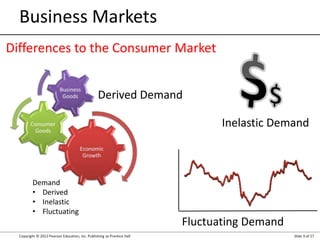
Demand
• Derived
• Inelastic
• Fluctuating
Derived Demand
Differences to the Consumer Market
Fluctuating Demand
Inelastic Demand
Copyright © 2012 Pearson Education, Inc. Publishing as Prentice Hall Slide 10 of 27
Buying Situations
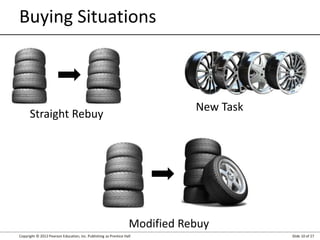
Straight Rebuy
New Task
Modified Rebuy
Copyright © 2012 Pearson Education, Inc. Publishing as Prentice Hall Slide 11 of 27
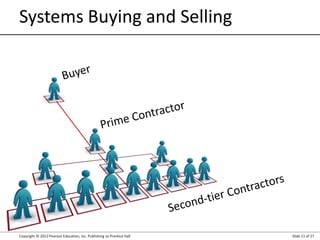
Systems Buying and Selling
Copyright © 2012 Pearson Education, Inc. Publishing as Prentice Hall Slide 12 of 27
Business Buying Participants
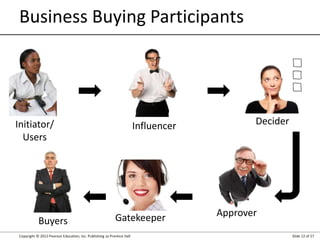
Influencer
Buyers Gatekeeper
Decider
Initiator/
Users
Approver
Copyright © 2012 Pearson Education, Inc. Publishing as Prentice Hall Slide 13 of 27
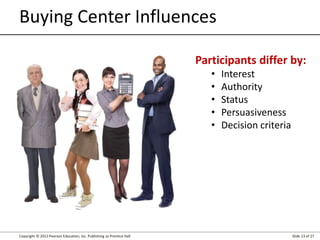
Buying Center Influences
Participants differ by:
• Interest
• Authority
• Status
• Persuasiveness
• Decision criteria
Copyright © 2012 Pearson Education, Inc. Publishing as Prentice Hall Slide 14 of 27
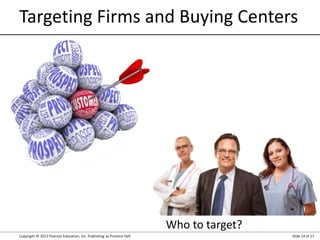
Targeting Firms and Buying Centers
Who to target?
Copyright © 2012 Pearson Education, Inc. Publishing as Prentice Hall Slide 15 of 27
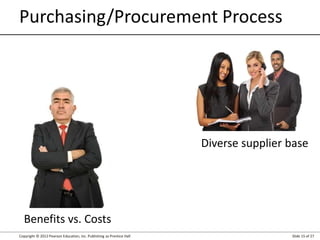
Purchasing/Procurement Process
Diverse supplier base
Benefits vs. Costs
Copyright © 2012 Pearson Education, Inc. Publishing as Prentice Hall Slide 16 of 27
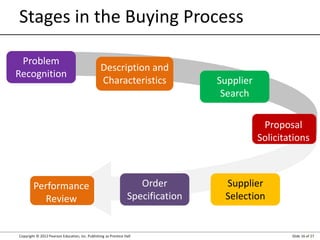
Stages in the Buying Process
Problem
Recognition
Description and
Characteristics Supplier
Search
Proposal
Solicitations
Supplier
Selection
Order
Specification
Performance
Review
Copyright © 2012 Pearson Education, Inc. Publishing as Prentice Hall Slide 17 of 27
Stages in the Buying Process
Problem
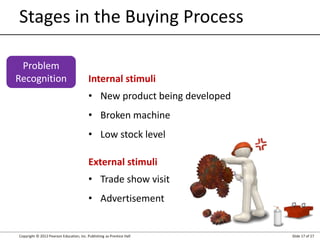
Recognition Internal stimuli
• New product being developed
• Broken machine
• Low stock level
External stimuli
• Trade show visit
• Advertisement
Copyright © 2012 Pearson Education, Inc. Publishing as Prentice Hall Slide 18 of 27
Stages in the Buying Process
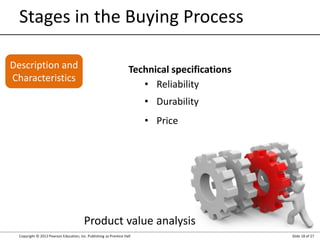
Technical specifications
• Reliability
• Durability
• Price
Description and
Characteristics
Product value analysis
Copyright © 2012 Pearson Education, Inc. Publishing as Prentice Hall Slide 19 of 27
Stages in the Buying Process
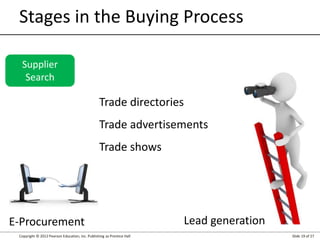
Trade directories
Trade advertisements
Trade shows
Supplier
Search
E-Procurement Lead generation
Copyright © 2012 Pearson Education, Inc. Publishing as Prentice Hall Slide 20 of 27
Proposal
Solicitations
Stages in the Buying Process
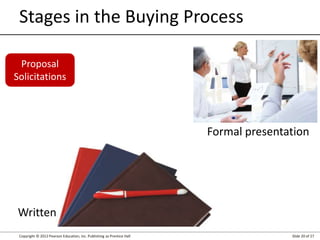
Formal presentation
Written
Copyright © 2012 Pearson Education, Inc. Publishing as Prentice Hall Slide 21 of 27
Supplier
Selection
Stages in the Buying Process
Supplier-evaluation model
Number of suppliers
Copyright © 2012 Pearson Education, Inc. Publishing as Prentice Hall Slide 22 of 27
Order
Specification
Stages in the Buying Process
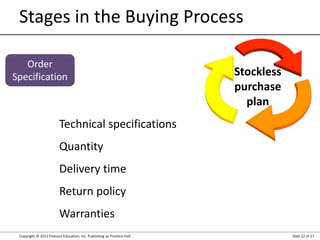
Technical specifications
Quantity
Delivery time
Return policy
Warranties
Stockless
purchase
plan
Copyright © 2012 Pearson Education, Inc. Publishing as Prentice Hall Slide 23 of 27
Stages in the Buying Process
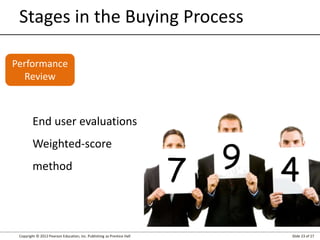
End user evaluations
Weighted-score
method
Performance
Review
7 9 4
Copyright © 2012 Pearson Education, Inc. Publishing as Prentice Hall Slide 24 of 27
Managing B2B Relationships
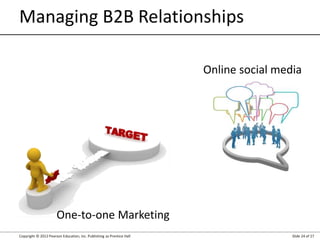
One-to-one Marketing
Online social media
Copyright © 2012 Pearson Education, Inc. Publishing as Prentice Hall Slide 25 of 27
Managing B2B Relationships
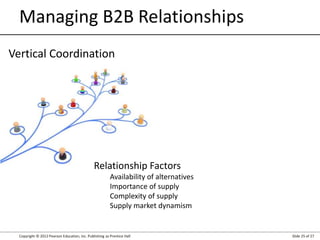
Vertical Coordination
Relationship Factors
Availability of alternatives
Importance of supply
Complexity of supply
Supply market dynamism

MM Chapter 7.ppt

  • 1.
    IPE 4101: Industrialand Business Management Lecture Series on Marketing Management Course Instructor: Md. Zahidul Islam Lecturer, Department of IPE, RUET
  • 2.
    Kotler • Keller PhillipKevin Lane Marketing Management • 14e
  • 3.
  • 4.
    Copyright © 2012Pearson Education, Inc. Publishing as Prentice Hall Slide 4 of 27 Discussion Questions 1. What is the business market, and how does it differ from the consumer market? 2. What buying situations do organizational buyers face? 3. Who participates in the B2B buying process? 4. How do business buyers make their decisions? 5. How can companies build strong relationships with business customers? 6. How do institutional buyers and government agencies do their buying?
  • 5.
    Copyright © 2012Pearson Education, Inc. Publishing as Prentice Hall Slide 5 of 27 The decision-making process by which formal organizations establish the need for purchased products and services and identify, evaluate, and choose among alternative brands and suppliers. -- F. Webster Jr and Y. Wind Organizational Buying
  • 6.
    Copyright © 2012Pearson Education, Inc. Publishing as Prentice Hall Slide 6 of 27 Business Markets Agriculture Communications Banking & Finance Transportation & Distribution Construction Forestry Manufacturing
  • 7.
    Copyright © 2012Pearson Education, Inc. Publishing as Prentice Hall Slide 7 of 27 Business Markets • Understanding deep customer needs • Identify areas for growth • Improving value management techniques • Calculating better marketing metrics • Competing and growing in global markets • Countering product commoditization • Gain support for the marketing concept Similarities to the Consumer Market
  • 8.
    Copyright © 2012Pearson Education, Inc. Publishing as Prentice Hall Slide 8 of 27 Business Markets Professional Buyers Geographically Concentrated Multiple Sales Calls Differences to the Consumer Market Personal Relationships Fewer, Larger Buyers
  • 9.
    Copyright © 2012Pearson Education, Inc. Publishing as Prentice Hall Slide 9 of 27 Business Markets Demand • Derived • Inelastic • Fluctuating Derived Demand Differences to the Consumer Market Fluctuating Demand Inelastic Demand
  • 10.
    Copyright © 2012Pearson Education, Inc. Publishing as Prentice Hall Slide 10 of 27 Buying Situations Straight Rebuy New Task Modified Rebuy
  • 11.
    Copyright © 2012Pearson Education, Inc. Publishing as Prentice Hall Slide 11 of 27 Systems Buying and Selling
  • 12.
    Copyright © 2012Pearson Education, Inc. Publishing as Prentice Hall Slide 12 of 27 Business Buying Participants Influencer Buyers Gatekeeper Decider Initiator/ Users Approver
  • 13.
    Copyright © 2012Pearson Education, Inc. Publishing as Prentice Hall Slide 13 of 27 Buying Center Influences Participants differ by: • Interest • Authority • Status • Persuasiveness • Decision criteria
  • 14.
    Copyright © 2012Pearson Education, Inc. Publishing as Prentice Hall Slide 14 of 27 Targeting Firms and Buying Centers Who to target?
  • 15.
    Copyright © 2012Pearson Education, Inc. Publishing as Prentice Hall Slide 15 of 27 Purchasing/Procurement Process Diverse supplier base Benefits vs. Costs
  • 16.
    Copyright © 2012Pearson Education, Inc. Publishing as Prentice Hall Slide 16 of 27 Stages in the Buying Process Problem Recognition Description and Characteristics Supplier Search Proposal Solicitations Supplier Selection Order Specification Performance Review
  • 17.
    Copyright © 2012Pearson Education, Inc. Publishing as Prentice Hall Slide 17 of 27 Stages in the Buying Process Problem Recognition Internal stimuli • New product being developed • Broken machine • Low stock level External stimuli • Trade show visit • Advertisement
  • 18.
    Copyright © 2012Pearson Education, Inc. Publishing as Prentice Hall Slide 18 of 27 Stages in the Buying Process Technical specifications • Reliability • Durability • Price Description and Characteristics Product value analysis
  • 19.
    Copyright © 2012Pearson Education, Inc. Publishing as Prentice Hall Slide 19 of 27 Stages in the Buying Process Trade directories Trade advertisements Trade shows Supplier Search E-Procurement Lead generation
  • 20.
    Copyright © 2012Pearson Education, Inc. Publishing as Prentice Hall Slide 20 of 27 Proposal Solicitations Stages in the Buying Process Formal presentation Written
  • 21.
    Copyright © 2012Pearson Education, Inc. Publishing as Prentice Hall Slide 21 of 27 Supplier Selection Stages in the Buying Process Supplier-evaluation model Number of suppliers
  • 22.
    Copyright © 2012Pearson Education, Inc. Publishing as Prentice Hall Slide 22 of 27 Order Specification Stages in the Buying Process Technical specifications Quantity Delivery time Return policy Warranties Stockless purchase plan
  • 23.
    Copyright © 2012Pearson Education, Inc. Publishing as Prentice Hall Slide 23 of 27 Stages in the Buying Process End user evaluations Weighted-score method Performance Review 7 9 4
  • 24.
    Copyright © 2012Pearson Education, Inc. Publishing as Prentice Hall Slide 24 of 27 Managing B2B Relationships One-to-one Marketing Online social media
  • 25.
    Copyright © 2012Pearson Education, Inc. Publishing as Prentice Hall Slide 25 of 27 Managing B2B Relationships Vertical Coordination Relationship Factors Availability of alternatives Importance of supply Complexity of supply Supply market dynamism

Editor's Notes

  • #7 The business market consists of all the organizations that acquire goods and services used in the production of other products or services that are sold, rented, or supplied to others.
  • #8 B2B marketers face similar challenges as do B2C marketers.
  • #9 Other differences include: Multiple buying influences – Such as buying committees, which can be comprised of technical experts and senior management. Direct purchasing – Often large volume customers purchase directly from manufacturer, rather than intermediaries
  • #10 B2B markets also differ from the consumer market in demand functions. Derived Demand – Demand in the business market depends on demand from the consumer market. Inelastic Demand – Total demand for many business goods and services is inelastic – that is, not affected too much by changes in price. Fluctuating Demand – Demand for business goods tends to be more volatile than the demand for consumer goods. At times, a rise of 10% in consumer demand can result in a rise in business demand by as much as 200%.
  • #12 Systems buying originated with the government awarding contracts for weapons and communications systems. The firm (buyer) solicits bids from prime contractors that, if awarded the bid, would be responsible for assembling the subcomponents of the system from second-tier contractors. Many organizations have turned the process around by adopting systems selling as a marketing tool. The contractor (seller) approaches a potential buyer and offers to provide all of the organizations MRO (maintenance, repair, and operating) supplies. Systems selling is a key strategy in bidding on large-scale industrial projects such as dams, pipelines, factories, etc.
  • #13 Initiators Users Influences Deciders Approvers Buyers Gatekeepers
  • #14 Buying centers can have multiple participants, with a variety of backgrounds, such as finance, engineering, production staff, and/or senior managers. These differences must be taken into account as sales messages must be structure not to overly appeal to one participant, at the risk of alienating another.
  • #15 Firms should uncover those business sectors that have high future growth potential, most profitable customers, and the most promising opportunities. Once target firms are identified the firm must determine how best to sell to them. Marketers must determine: Who are the major decision makers? What decisions do the influence? What is their level of influence? What evaluation criteria do they use?
  • #16 Buyers typically seek to obtain the highest benefit package from the products and services they purchase, in relation to the overall costs of the offering. To compare the offerings of one company to another, they will translate the costs and benefits into monetary terms. As such, the marketer must develop a profitable offering that delivers superior customer value. Purchasing departments have been elevated in the hierarchy of many organizations. Firms are actively seeking out women and minority owned firms in order to diversify their supplier base.
  • #18 Problems can be discovered from internal or external stimuli. A broken machine, low stock levels, or a new product being developed. External stimuli can trigger the process as well.
  • #19 Product value analysis is an approach to cost reduction that studies whether components can be redesigned or standardized or made by cheaper methods of production without affecting the product performance.
  • #20 Electronic marketplaces take numerous forms including: Catalog sites, Vertical markets, “Pure Play” auction sites, Spot markets, Private exchanges, Barter markets, and Buying alliances. The suppliers task is to ensure that they are considered when customers are– our could be – in the market and searching for a supplier. Marketing must work together with sales to define what makes a “sales ready” prospect and cooperate to send the right messages via sales calls, trade shows, online activities, PR, events, direct mail, and referrals.
  • #21 Buyers next invites suppliers to submit proposals. Complex or expensive items will require written and detail proposals and suppliers who make the cut may often be required to make formal presentations of their proposals. Marketers must be skilled in researching, writing, and presenting proposals. Materials should stress the value and benefits in customer terms.
  • #22 Buyers will often specify and rank desired supplier attributes, often using a supplier-evaluation model. In some cases, companies are reducing the overall number of suppliers they deal with. They want to choose suppliers who can be responsible for large component systems. Marketers should develop compelling value propositions and understand how buyers arrive at their valuations.
  • #23 After selecting suppliers, the buyer negotiates the final order. Depending on the product, the buyer may end up leasing the product. Advantages of leasing include: Latest product, better service, conservation of capital, and tax advantages. For maintenance, repair, and operating (MRO) items, buyers are beginning to use stockless purchase plans, (blanket contracts) that establish long-term relationships. Here the supplier agrees to resupply the buyer as needed, at agreed upon prices, over a specific period of time.
  • #24 Buyers periodically review the performance of chosen suppliers using one of three methods. Buyers contact end users and ask for their evaluations of the product/supplier Rate the supplier on several criteria using a weighted-score method. Aggregate the cost of poor performance to come up with adjusted costs of purchase, including price.
  • #25 Buyers and sellers are exploring different ways to manage their relationships. Closer relationships are driven in part by supply chain management, early supplier involvement, and purchasing alliances. Cultivating the right relationships is paramount for any holistic marketing program. Marketers are focusing more on attracting and retaining the right customers, developing one-to-one marketing approaches.
  • #26 Companies are looking to move away from transactional relationships and instead focusing on activities that create value for both parties. One key factor in greater vertical coordination is building trust between parties.