ChapterChapter
11
Defining
Marketing
for the
New Realities
Copyright © 2016 Pearson Education Ltd. 1-1
Learning ObjectivesLearning Objectives
1. Why is marketing important?
2. What is the scope of marketing?
3. What are some core marketing concepts?
4. What forces are defining the new marketing
realities?
5. What new capabilities have these forces given
consumers and companies?
6. What does a holistic marketing philosophy include?
7. What tasks are necessary for successful marketing
management?
Copyright © 2016 Pearson Education Ltd. 1-2
The Value of MarketingThe Value of Marketing
• Financial success often depends on marketing
ability
• Successful marketing builds demand for
products and services, which, in turn, creates
jobs
• Marketing builds strong brands and a loyal
customer base, intangible assets that contribute
heavily to the value of a firm
Copyright © 2016 Pearson Education Ltd. 1-3
The Scope of MarketingThe Scope of Marketing
• Marketing is about identifying and meeting
human and social needs
• AMA’s formal definition: Marketing is the activity,
set of institutions, and processes for creating,
communicating, delivering, and exchanging
offerings that have value for customers, clients,
partners, and society at large
Copyright © 2016 Pearson Education Ltd. 1-4
Marketing ManagementMarketing Management
• The art and science of choosing target
markets and getting, keeping, and growing
customers through creating, delivering,
and communicating superior customer
value
COPYRIGHT © 2016 PEARSON EDUCATION, INC. 1-5Copyright © 2016 Pearson Education Ltd. 1-5
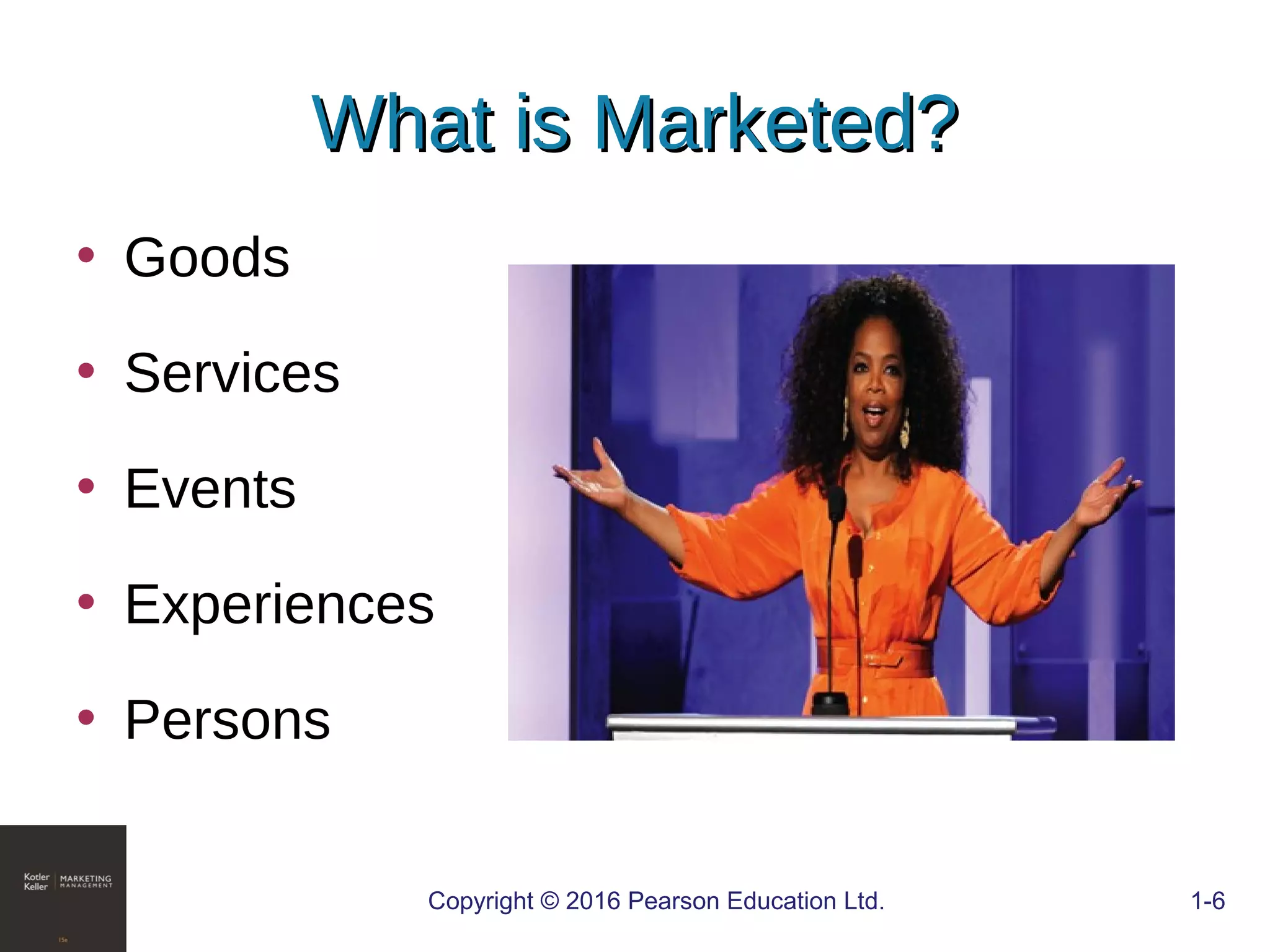
What is Marketed?What is Marketed?
• Goods
• Services
• Events
• Experiences
• Persons
COPYRIGHT © 2016 PEARSON EDUCATION, INC. 1-6Copyright © 2016 Pearson Education Ltd. 1-6
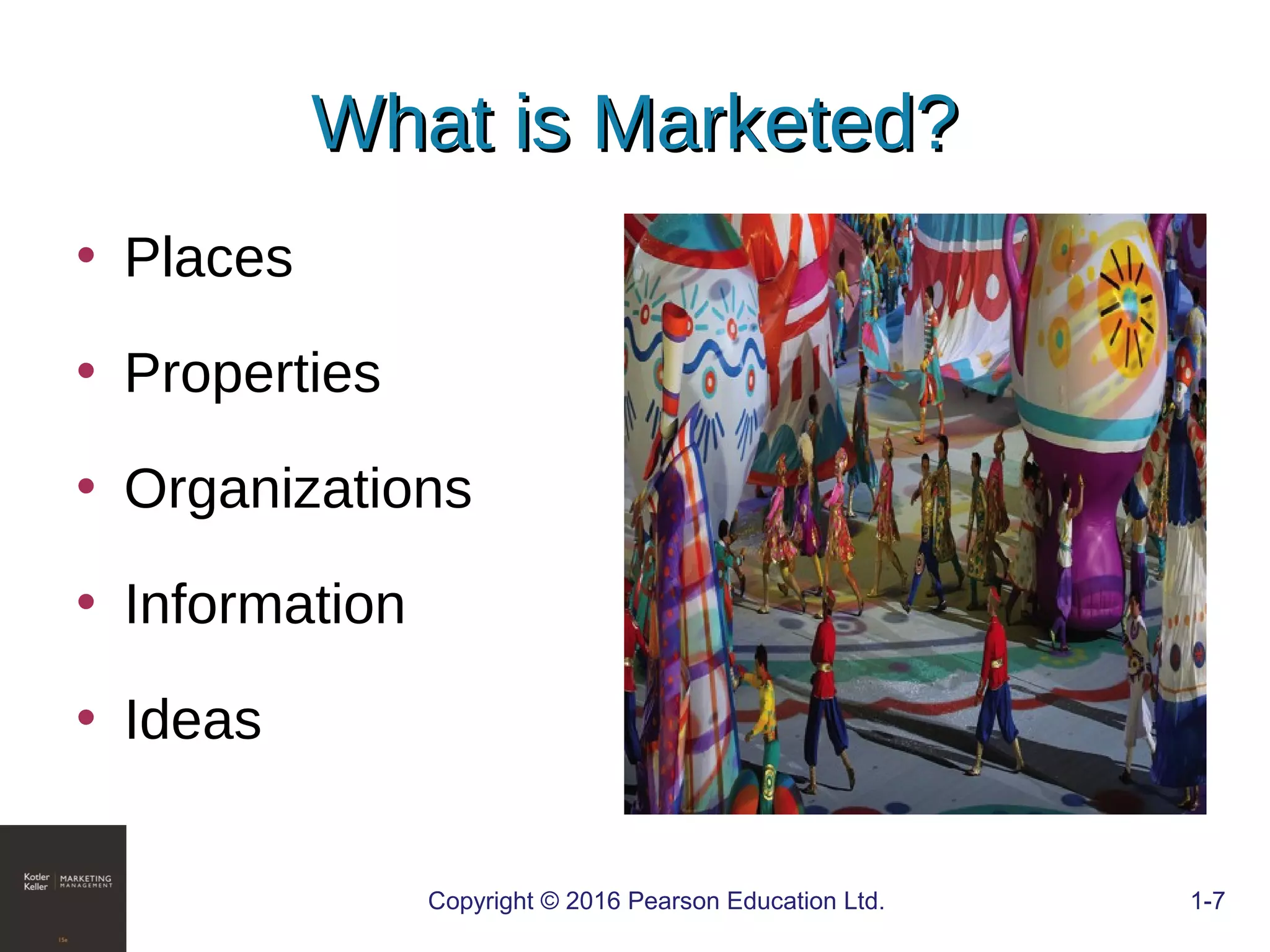
• Places
• Properties
• Organizations
• Information
• Ideas
COPYRIGHT © 2016 PEARSON EDUCATION, INC. 1-7Copyright © 2016 Pearson Education Ltd. 1-7
What is Marketed?What is Marketed?
Who Markets?Who Markets?
• A marketer is someone who seeks a
response—attention, a purchase, a vote, a
donation—from another party, called the
prospect
COPYRIGHT © 2016 PEARSON EDUCATION, INC. 1-8Copyright © 2016 Pearson Education Ltd. 1-8
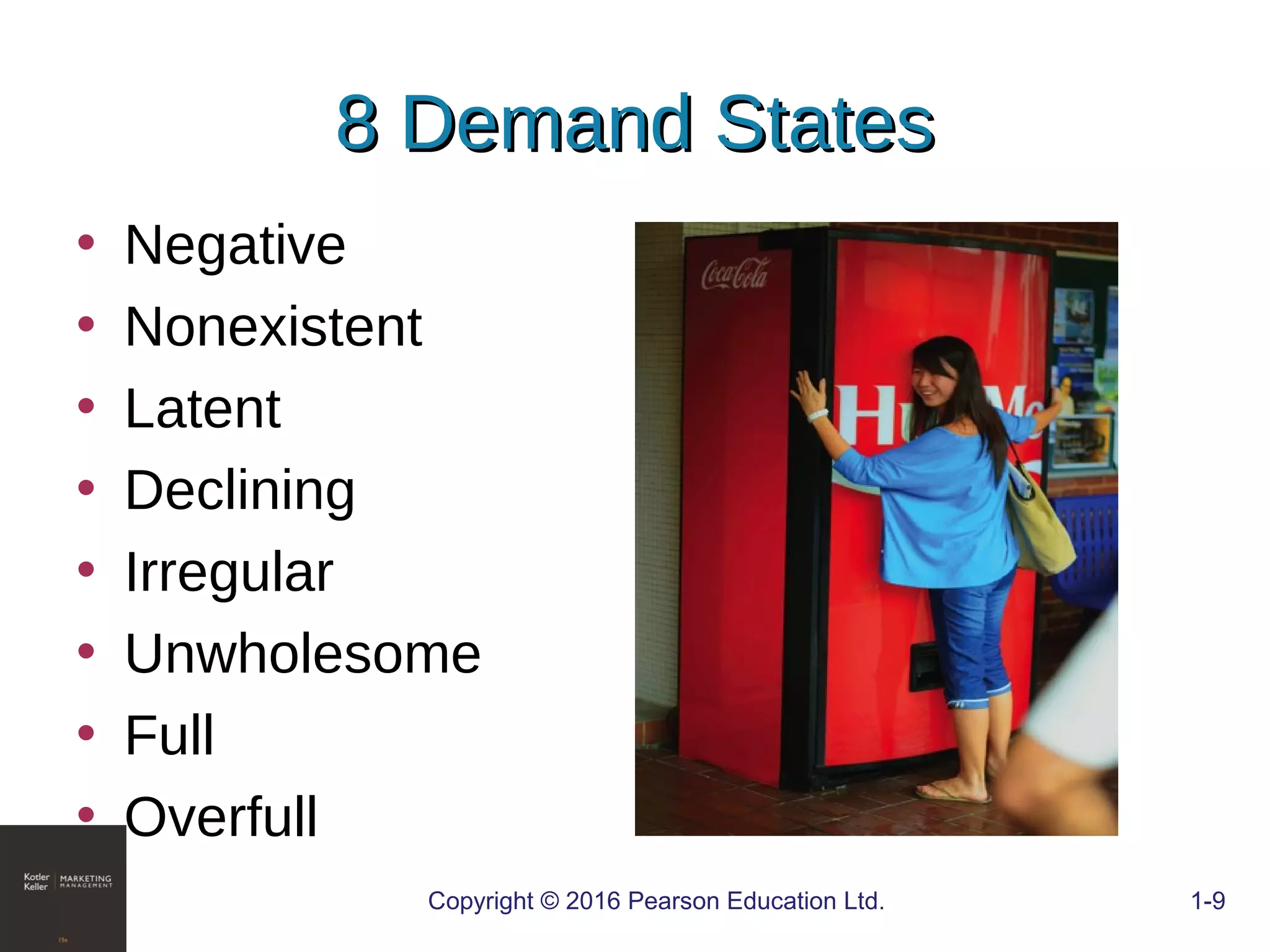
8 Demand States8 Demand States
• Negative
• Nonexistent
• Latent
• Declining
• Irregular
• Unwholesome
• Full
• Overfull
COPYRIGHT © 2016 PEARSON EDUCATION, INC. 1-9Copyright © 2016 Pearson Education Ltd. 1-9
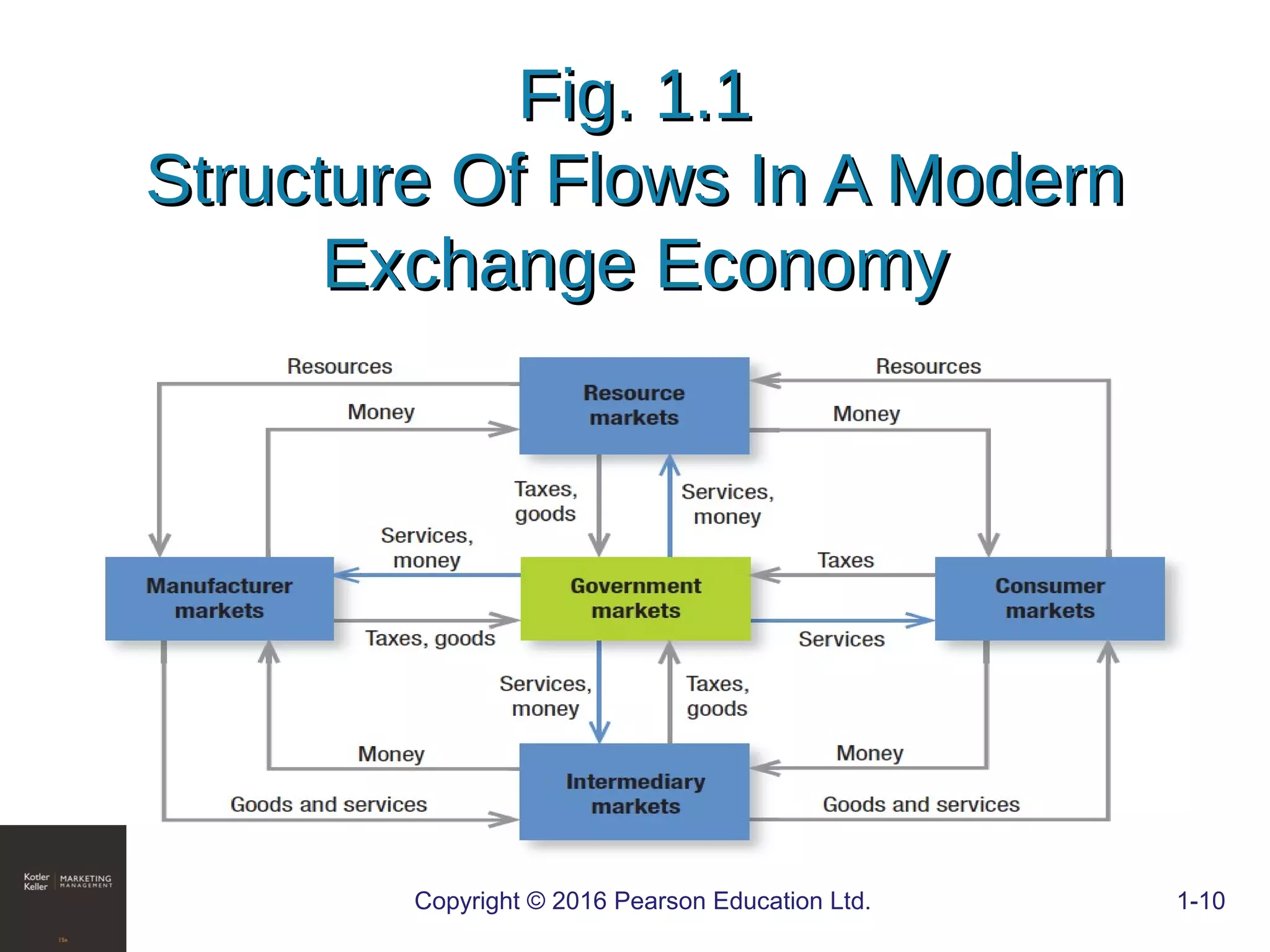
Fig. 1.1Fig. 1.1
Structure Of Flows In A ModernStructure Of Flows In A Modern
Exchange EconomyExchange Economy
COPYRIGHT © 2016 PEARSON EDUCATION, INC. 1-10Copyright © 2016 Pearson Education Ltd. 1-10
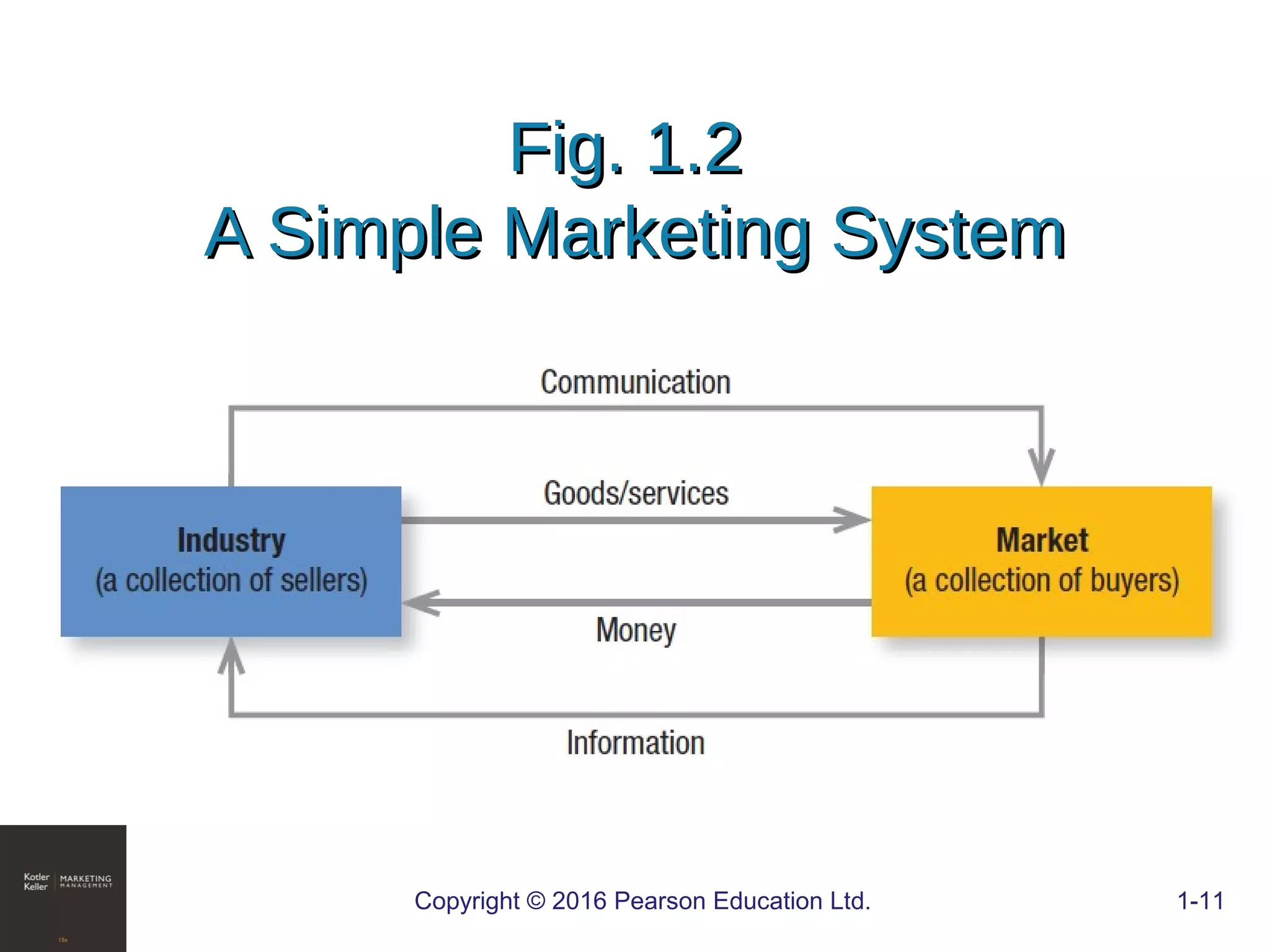
Fig. 1.2Fig. 1.2
A Simple Marketing SystemA Simple Marketing System
Copyright © 2016 Pearson Education Ltd. 1-11
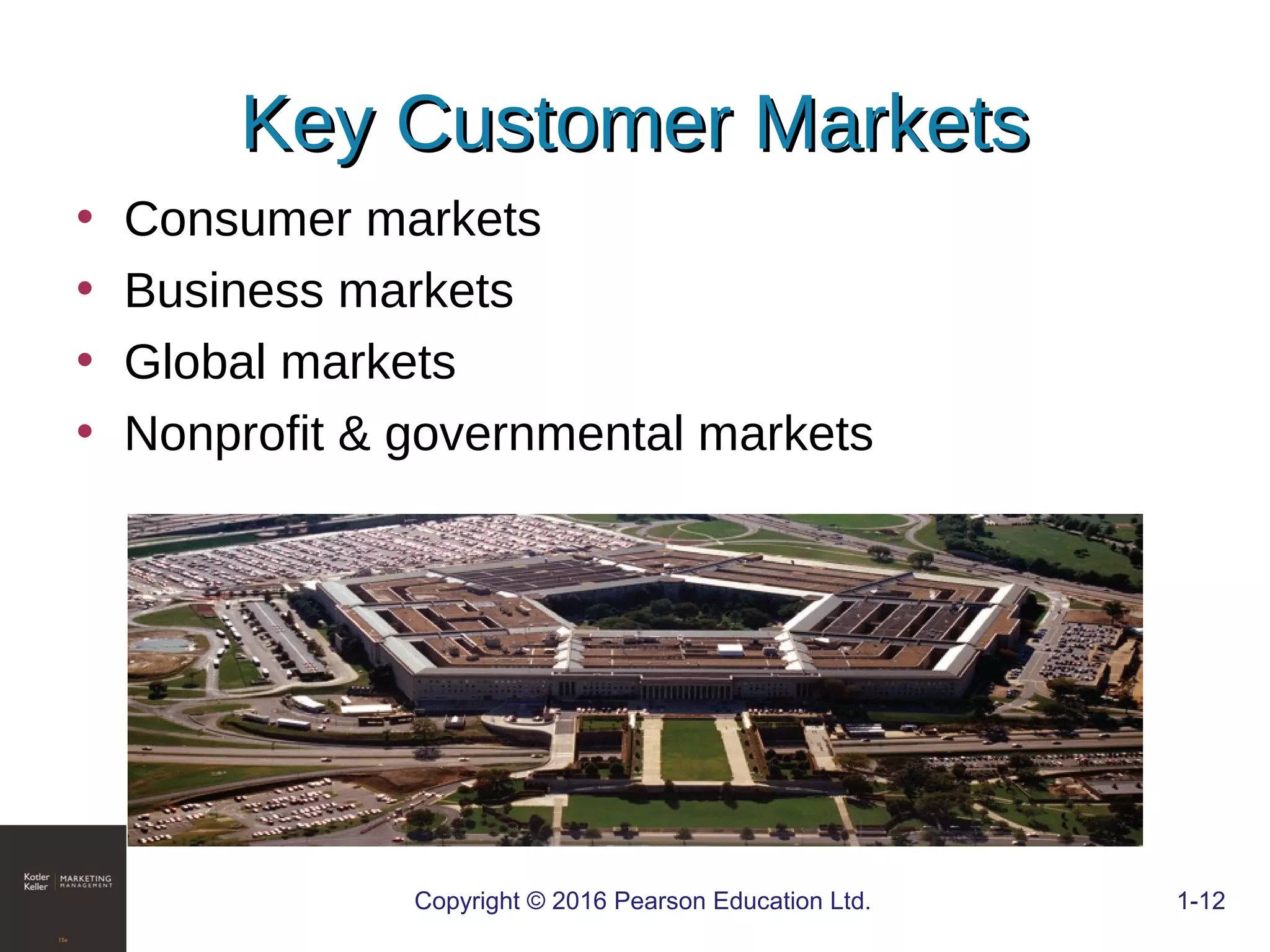
Key Customer MarketsKey Customer Markets
• Consumer markets
• Business markets
• Global markets
• Nonprofit & governmental markets
COPYRIGHT © 2016 PEARSON EDUCATION, INC. 1-12Copyright © 2016 Pearson Education Ltd. 1-12
Core Marketing ConceptsCore Marketing Concepts
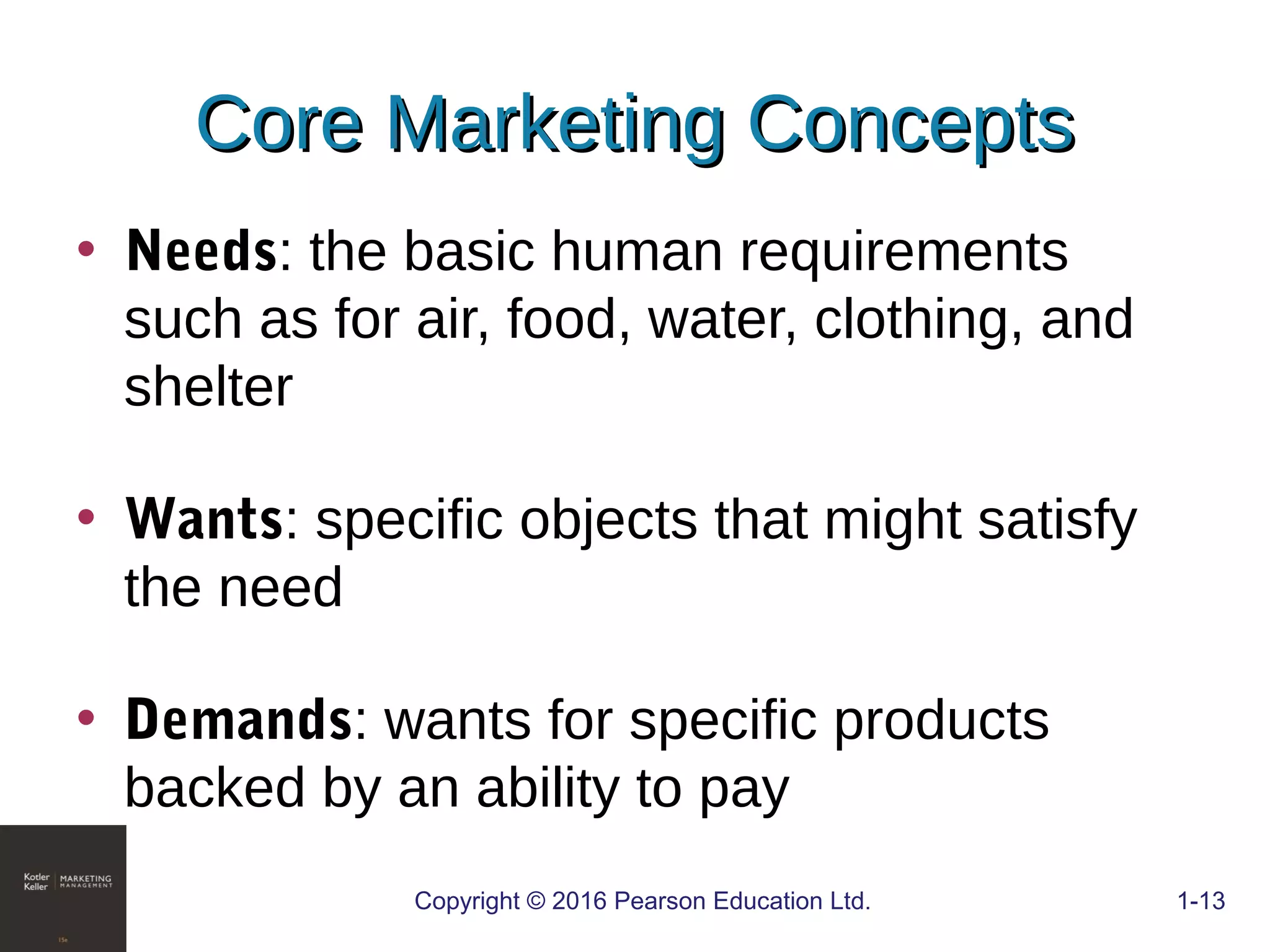
• Needs: the basic human requirements
such as for air, food, water, clothing, and
shelter
• Wants: specific objects that might satisfy
the need
• Demands: wants for specific products
backed by an ability to pay
COPYRIGHT © 2016 PEARSON EDUCATION, INC. 1-13Copyright © 2016 Pearson Education Ltd. 1-13
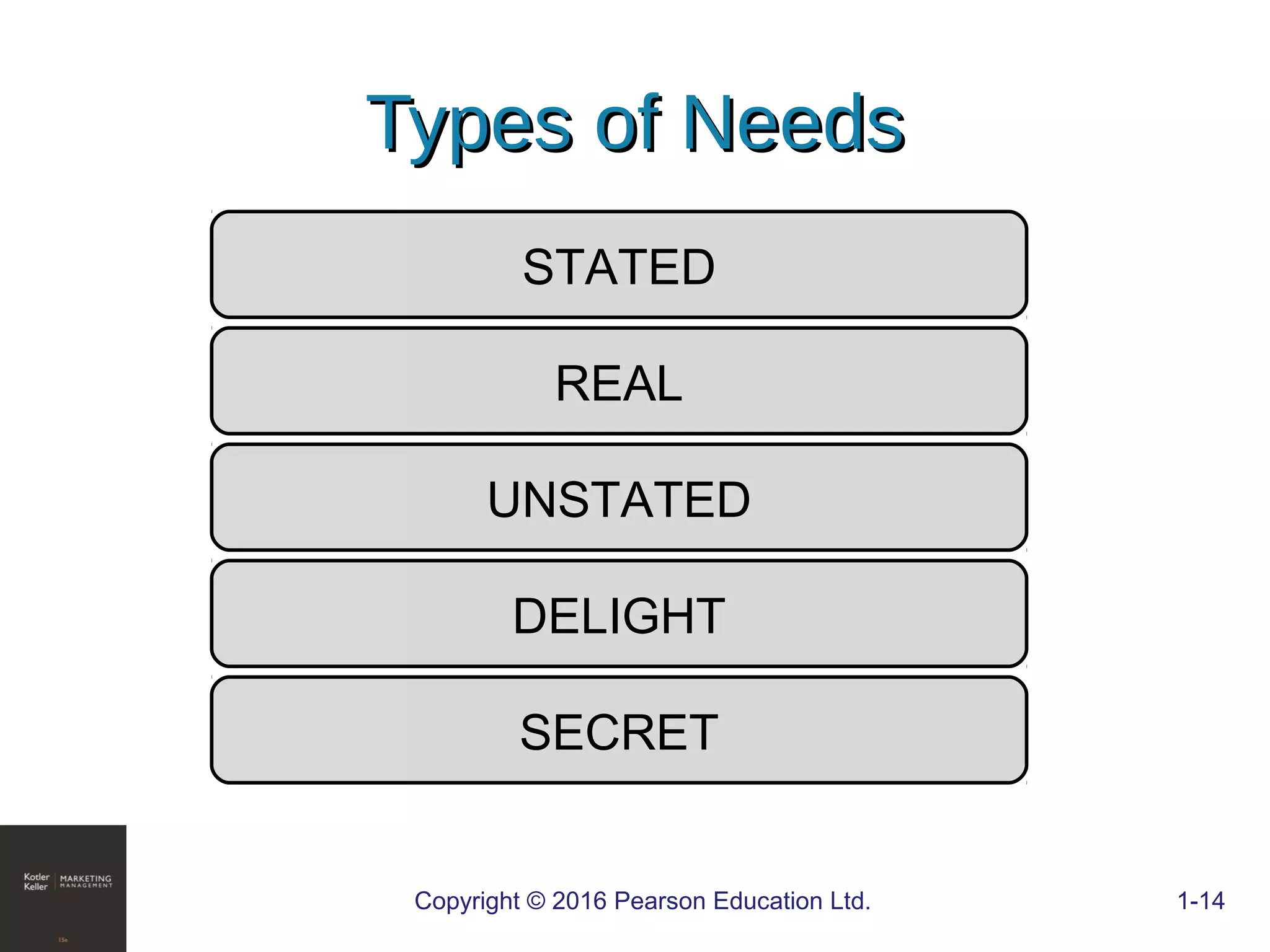
Types of NeedsTypes of Needs
STATED
REAL
UNSTATED
DELIGHT
SECRET
COPYRIGHT © 2016 PEARSON EDUCATION, INC. 1-14Copyright © 2016 Pearson Education Ltd. 1-14
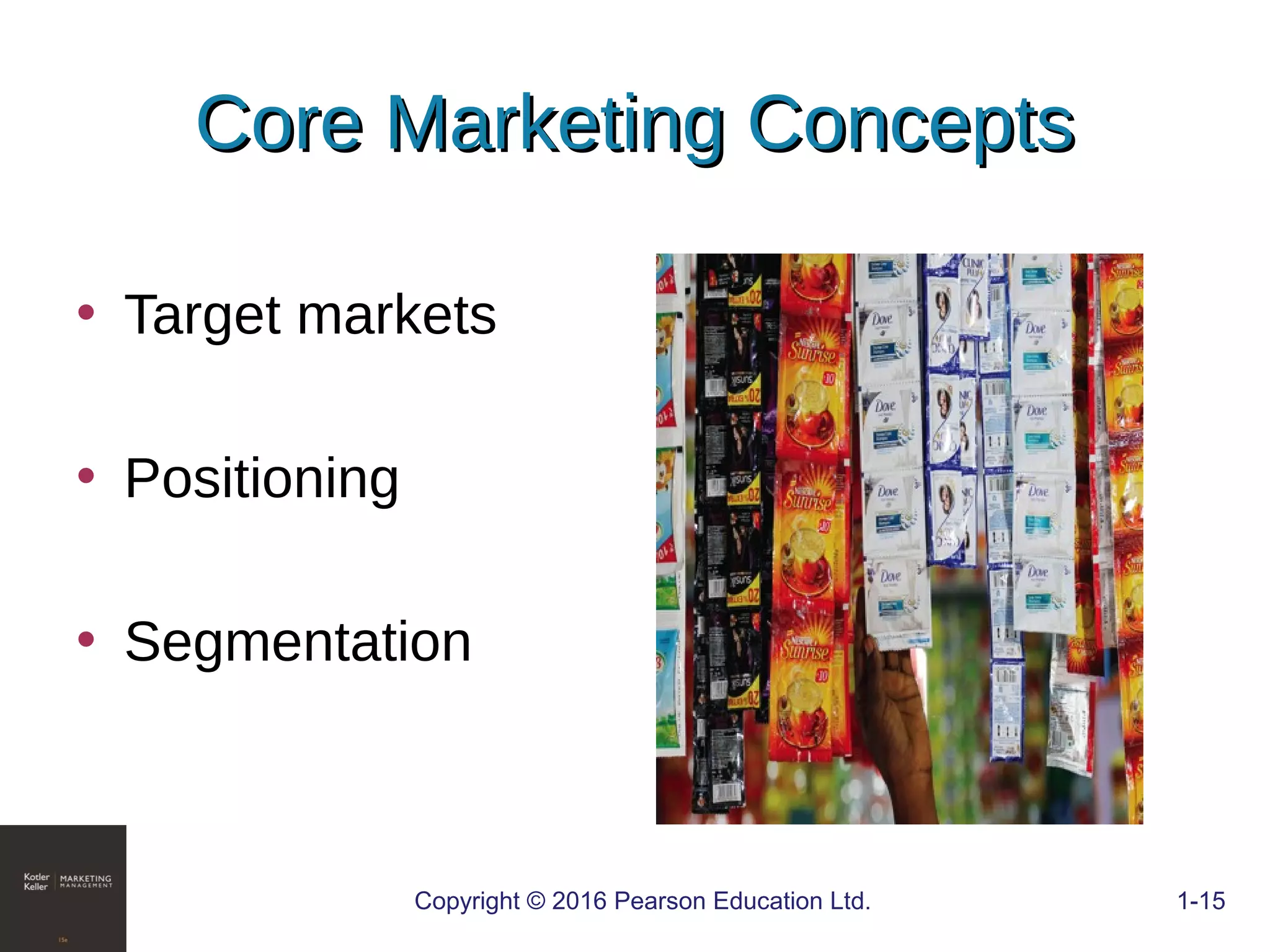
• Target markets
• Positioning
• Segmentation
COPYRIGHT © 2016 PEARSON EDUCATION, INC. 1-15Copyright © 2016 Pearson Education Ltd. 1-15
Core Marketing ConceptsCore Marketing Concepts
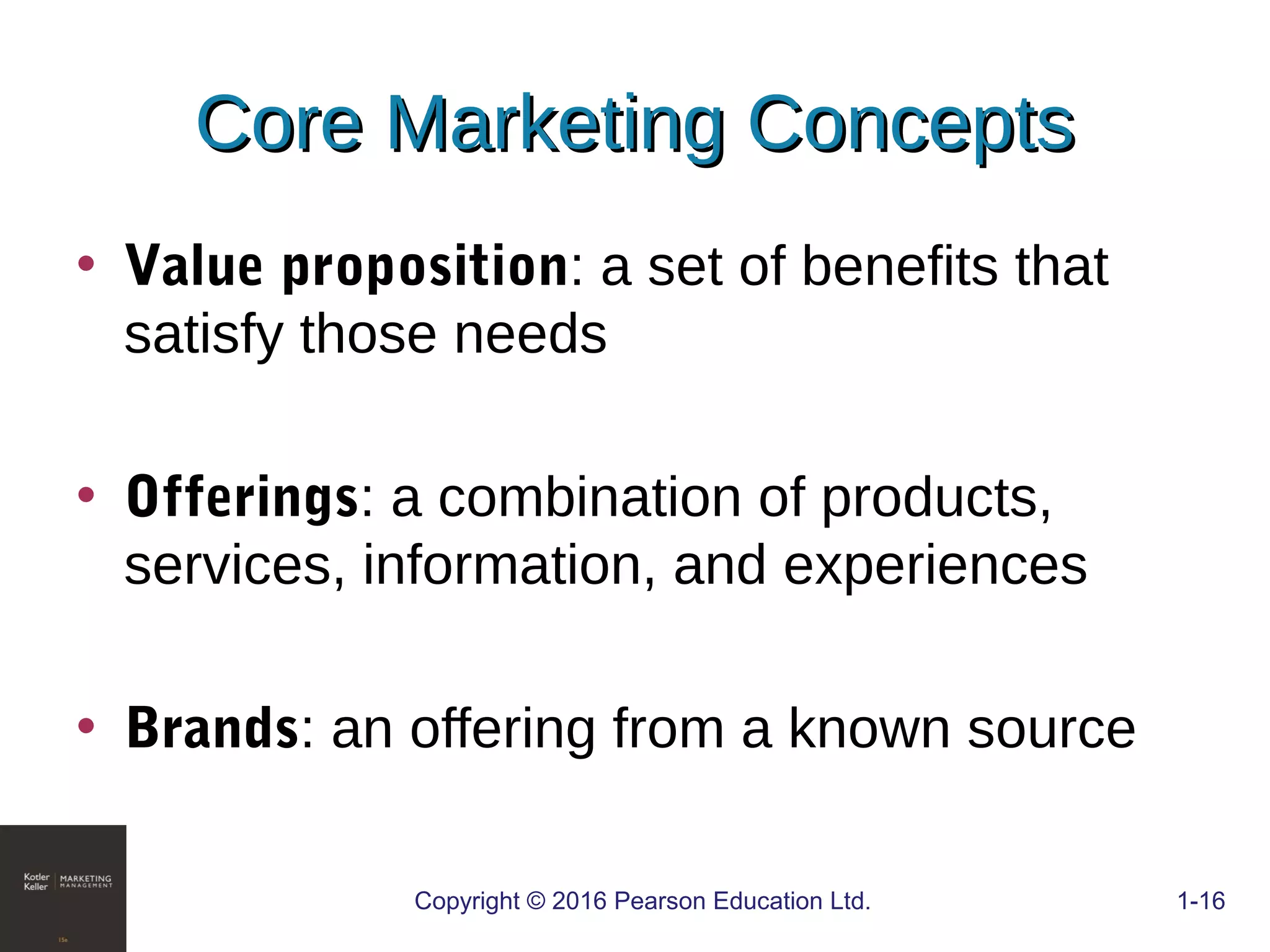
• Value proposition: a set of benefits that
satisfy those needs
• Offerings: a combination of products,
services, information, and experiences
• Brands: an offering from a known source
COPYRIGHT © 2016 PEARSON EDUCATION, INC. 1-16Copyright © 2016 Pearson Education Ltd. 1-16
Core Marketing ConceptsCore Marketing Concepts
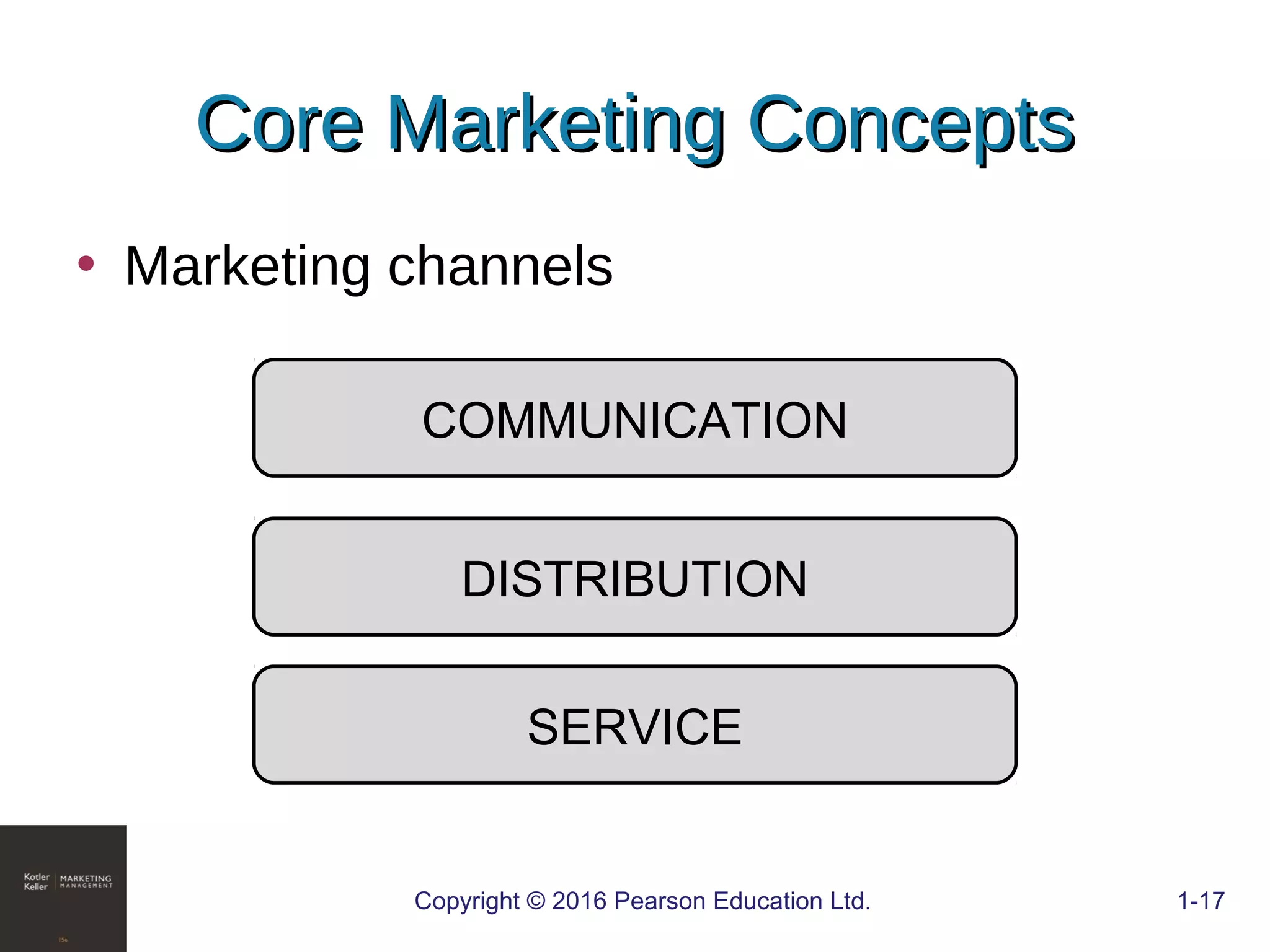
• Marketing channels
COMMUNICATION
DISTRIBUTION
SERVICE
COPYRIGHT © 2016 PEARSON EDUCATION, INC. 1-17Copyright © 2016 Pearson Education Ltd. 1-17
Core Marketing ConceptsCore Marketing Concepts
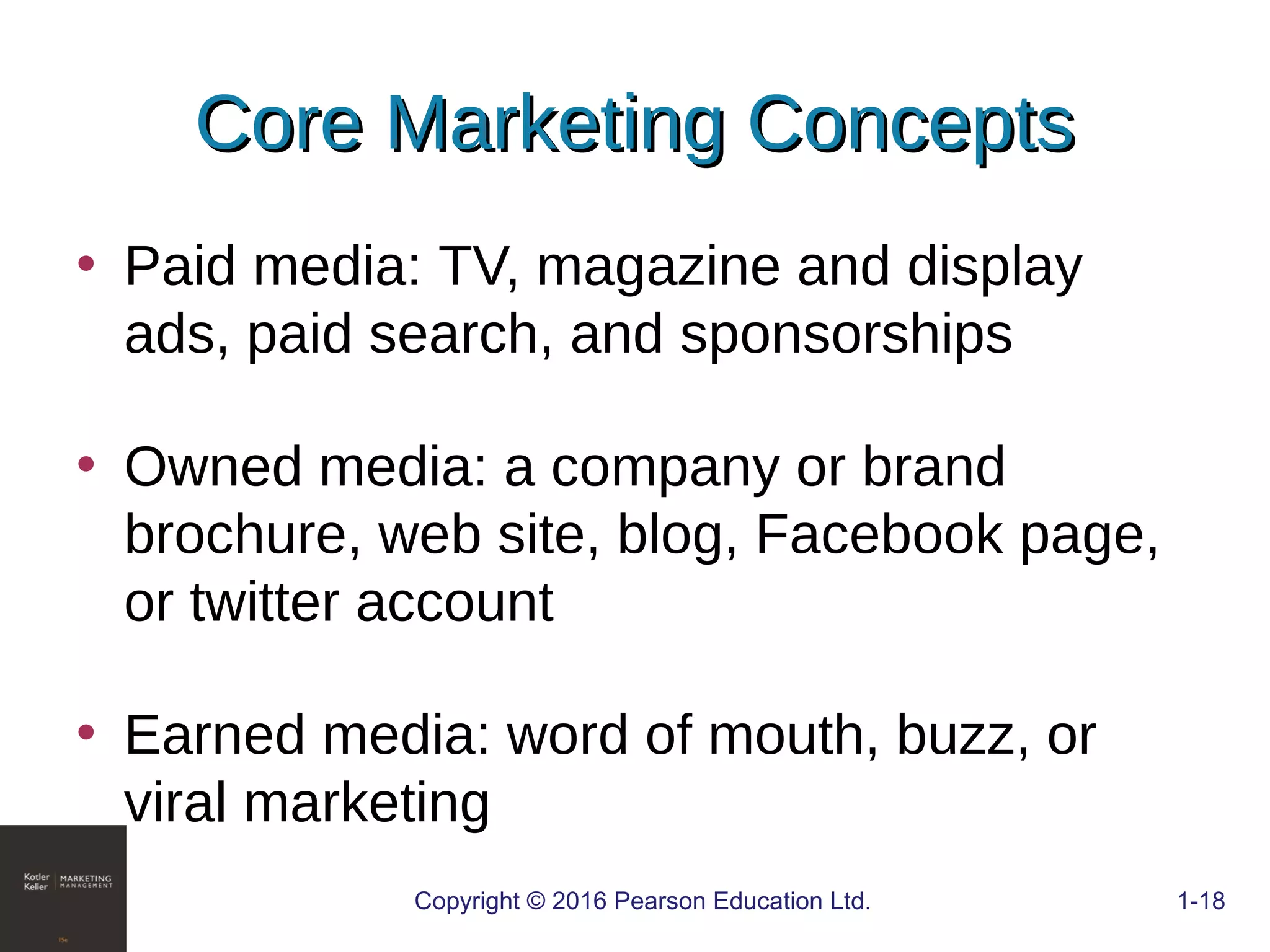
• Paid media: TV, magazine and display
ads, paid search, and sponsorships
• Owned media: a company or brand
brochure, web site, blog, Facebook page,
or twitter account
• Earned media: word of mouth, buzz, or
viral marketing
COPYRIGHT © 2016 PEARSON EDUCATION, INC. 1-18Copyright © 2016 Pearson Education Ltd. 1-18
Core Marketing ConceptsCore Marketing Concepts
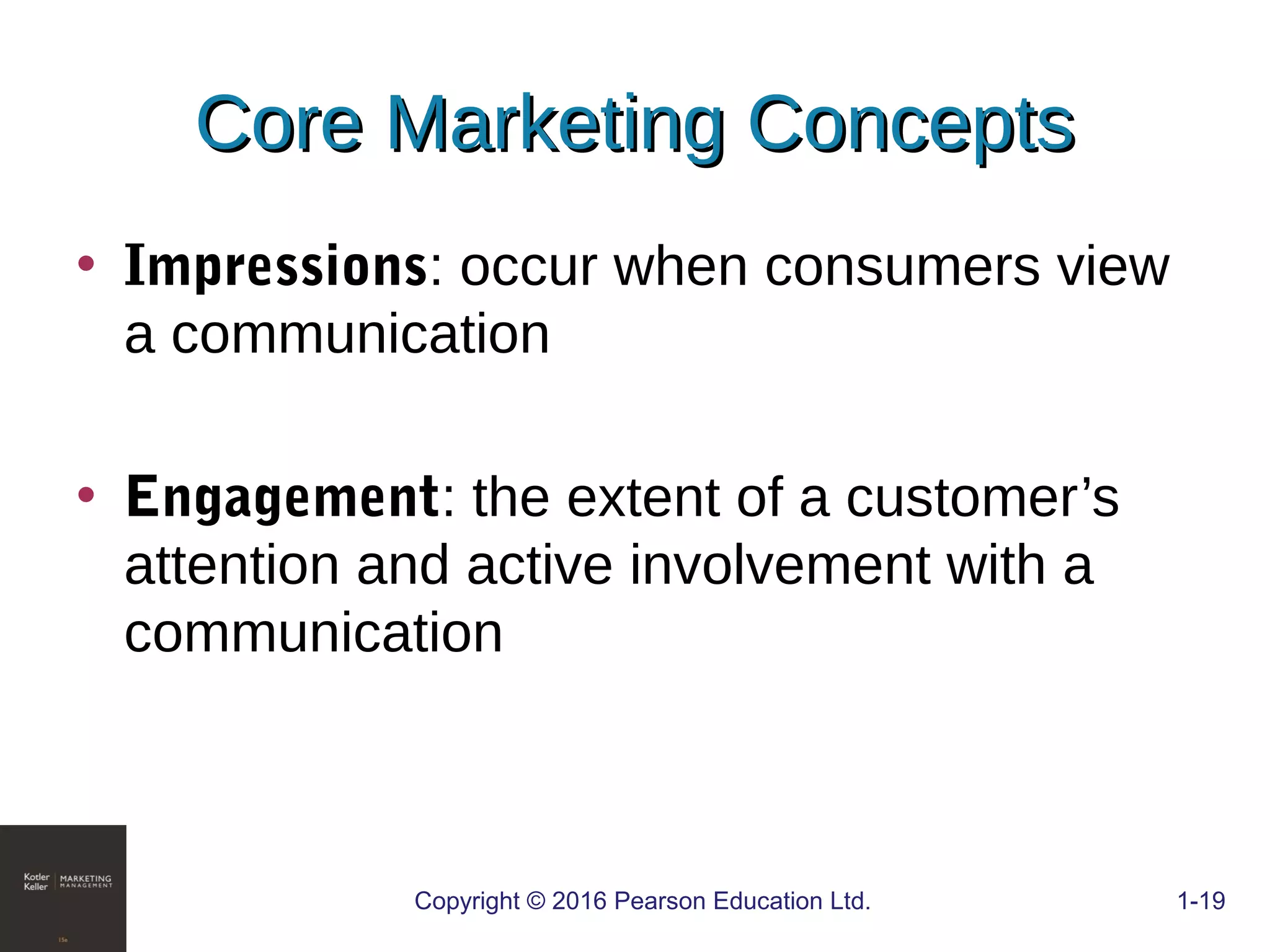
• Impressions: occur when consumers view
a communication
• Engagement: the extent of a customer’s
attention and active involvement with a
communication
COPYRIGHT © 2016 PEARSON EDUCATION, INC. 1-19Copyright © 2016 Pearson Education Ltd. 1-19
Core Marketing ConceptsCore Marketing Concepts
• Value: a combination of quality, service,
and price (qsp: the customer value triad)
• Satisfaction: a person’s judgment of a
product’s perceived performance in
relationship to expectations
COPYRIGHT © 2016 PEARSON EDUCATION, INC. 1-20Copyright © 2016 Pearson Education Ltd. 1-20
Core Marketing ConceptsCore Marketing Concepts
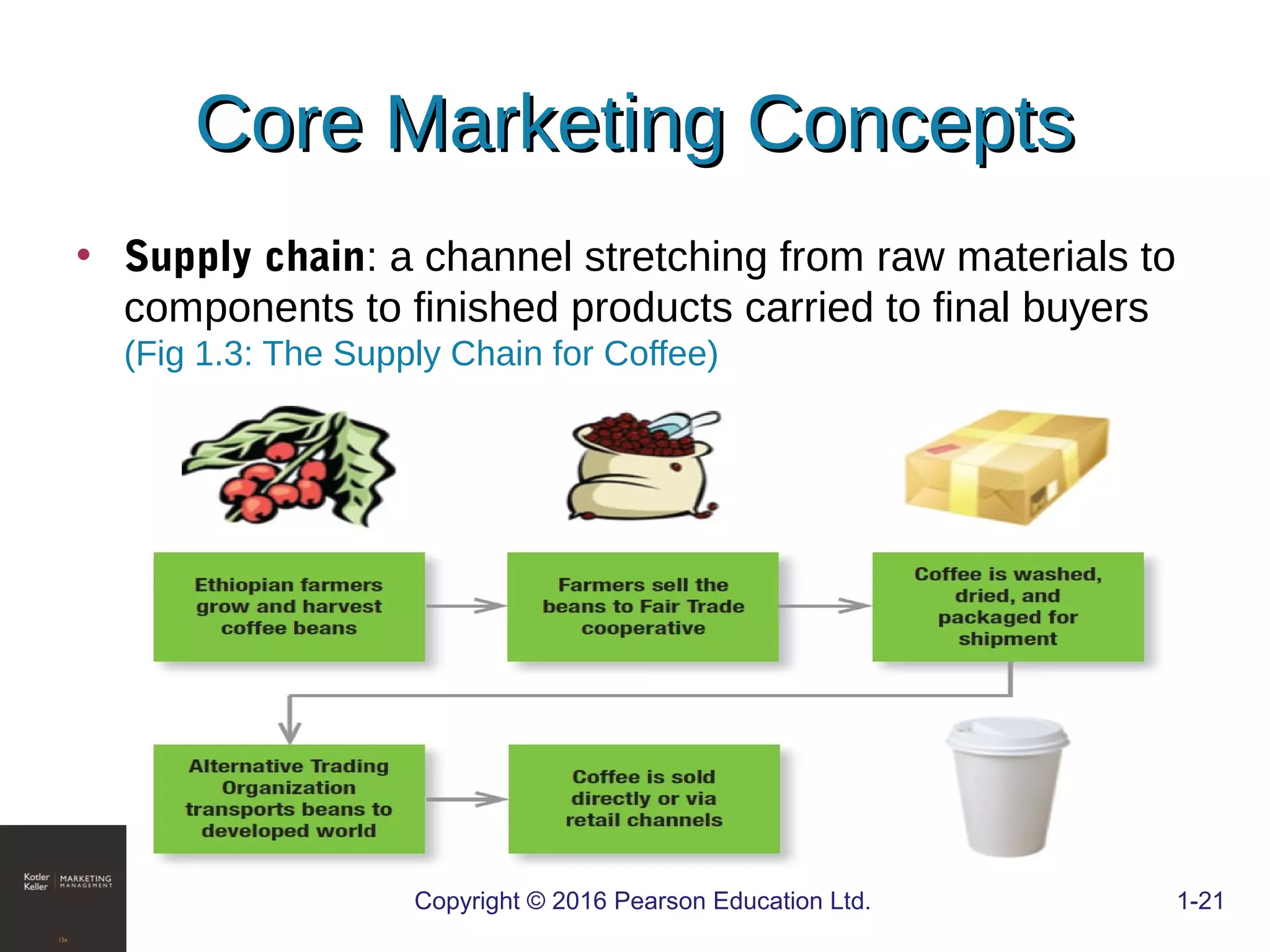
• Supply chain: a channel stretching from raw materials to
components to finished products carried to final buyers
(Fig 1.3: The Supply Chain for Coffee)
COPYRIGHT © 2016 PEARSON EDUCATION, INC. 1-21Copyright © 2016 Pearson Education Ltd. 1-21
Core Marketing ConceptsCore Marketing Concepts
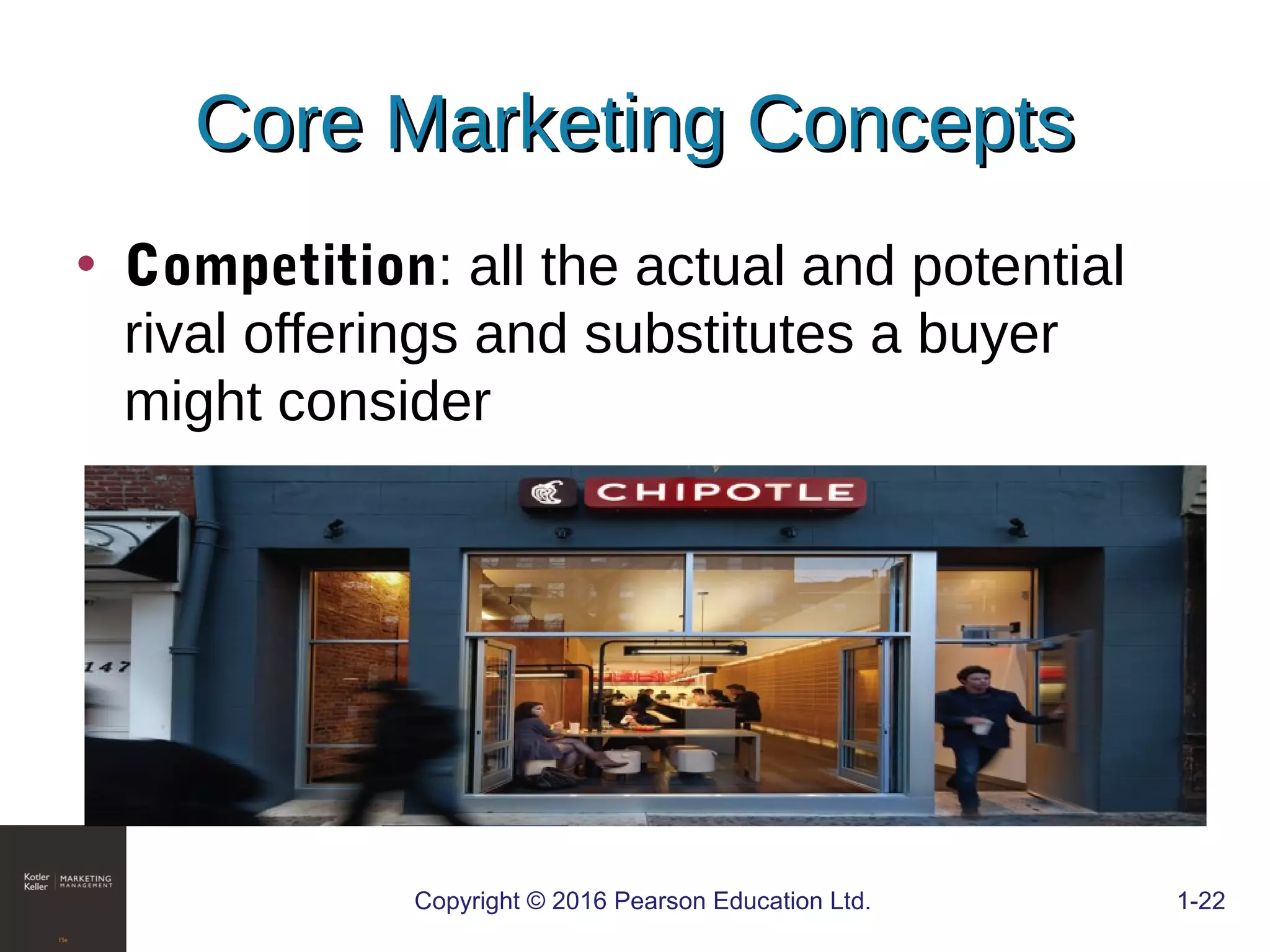
• Competition: all the actual and potential
rival offerings and substitutes a buyer
might consider
COPYRIGHT © 2016 PEARSON EDUCATION, INC. 1-22Copyright © 2016 Pearson Education Ltd. 1-22
Core Marketing ConceptsCore Marketing Concepts
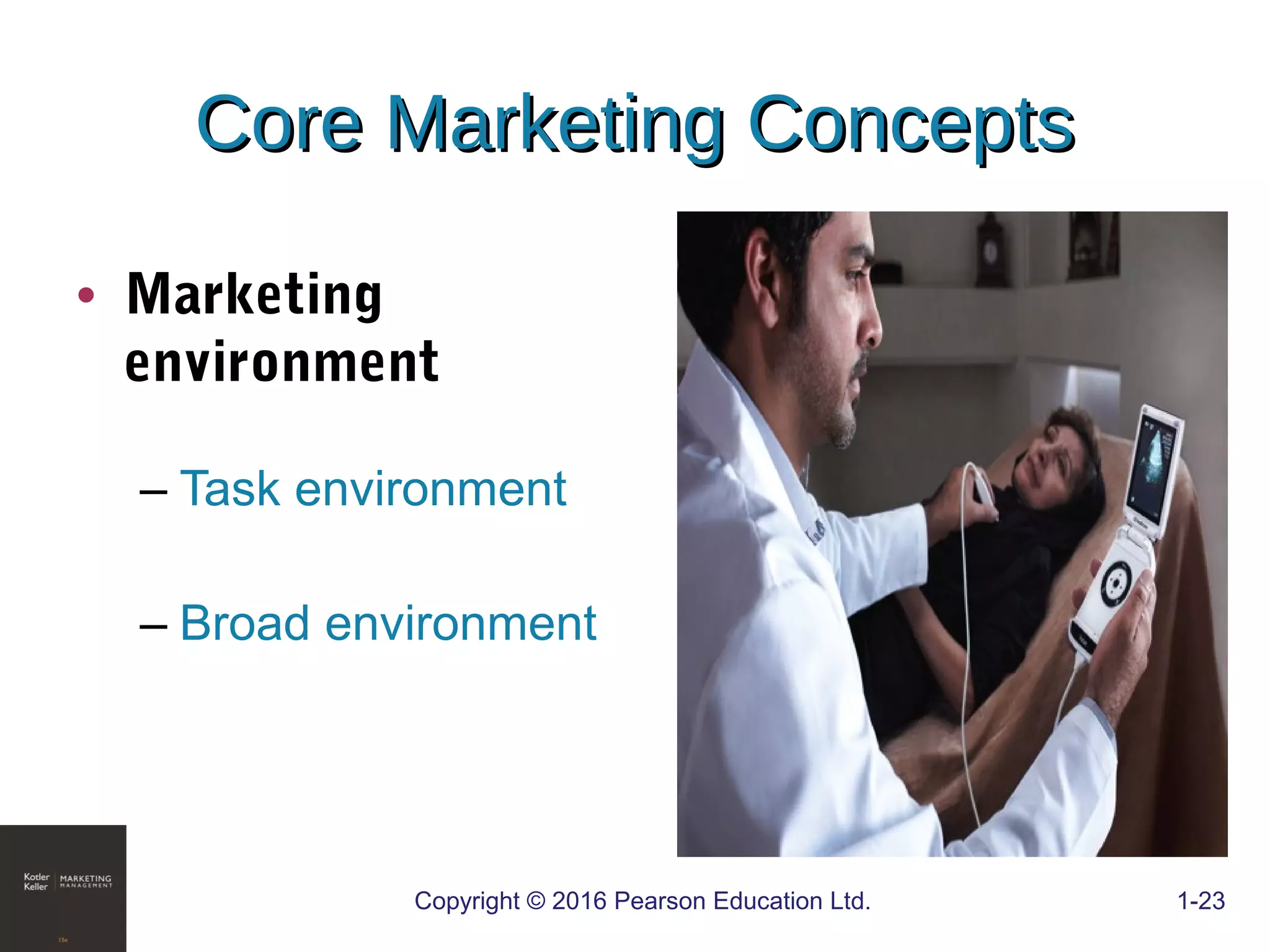
• Marketing
environment
– Task environment
– Broad environment
COPYRIGHT © 2016 PEARSON EDUCATION, INC. 1-23Copyright © 2016 Pearson Education Ltd. 1-23
Core Marketing ConceptsCore Marketing Concepts
The New Marketing RealitiesThe New Marketing Realities
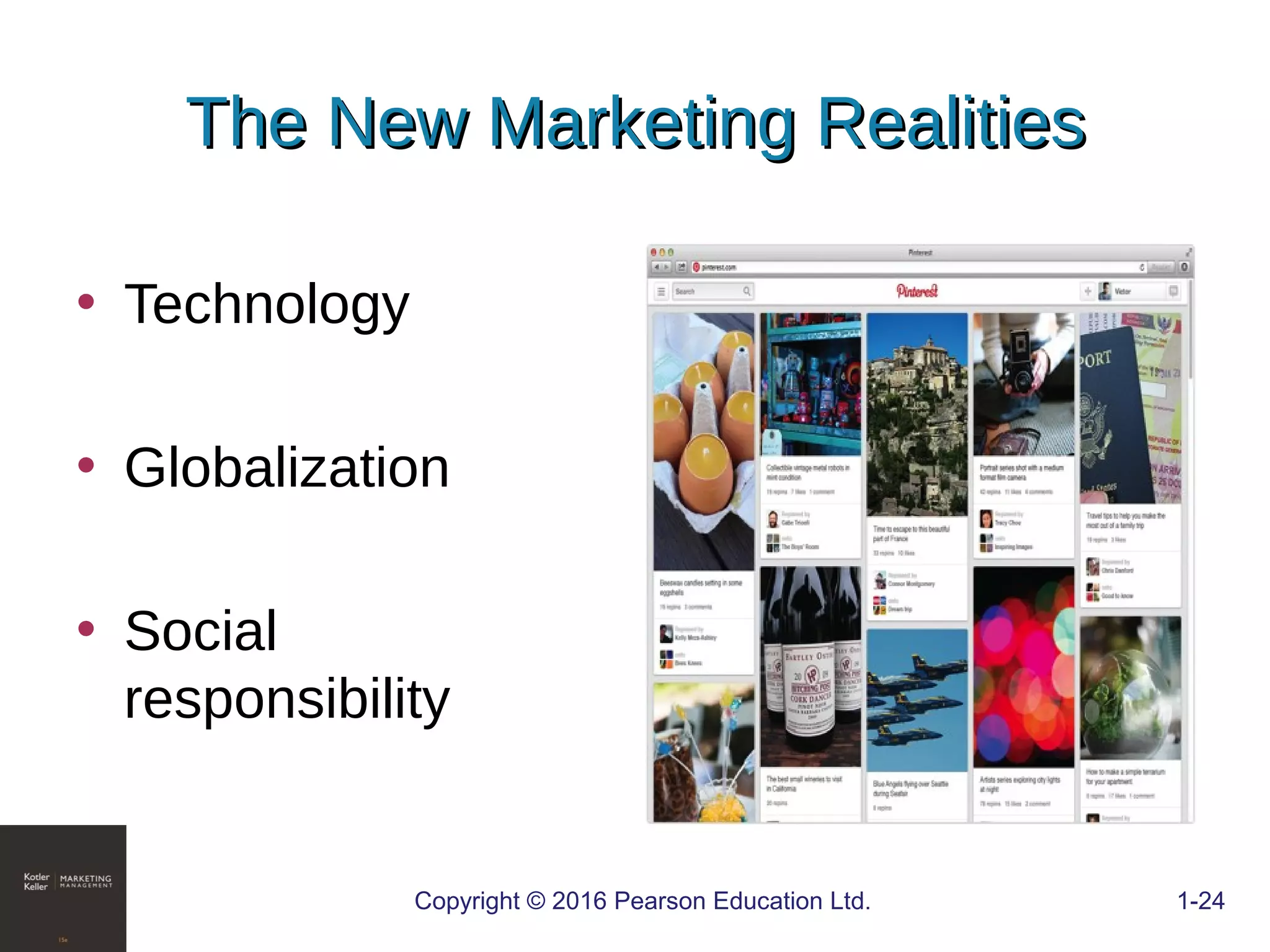
• Technology
• Globalization
• Social
responsibility
COPYRIGHT © 2016 PEARSON EDUCATION, INC. 1-24Copyright © 2016 Pearson Education Ltd. 1-24
A dramatically changedA dramatically changed
marketplacemarketplace
• New consumer capabilities
– Can use the internet as a powerful information
and purchasing aid
– Can search, communicate, and purchase on
the move
– Can tap into social media to share opinions
and express loyalty
COPYRIGHT © 2016 PEARSON EDUCATION, INC. 1-25Copyright © 2016 Pearson Education Ltd. 1-25
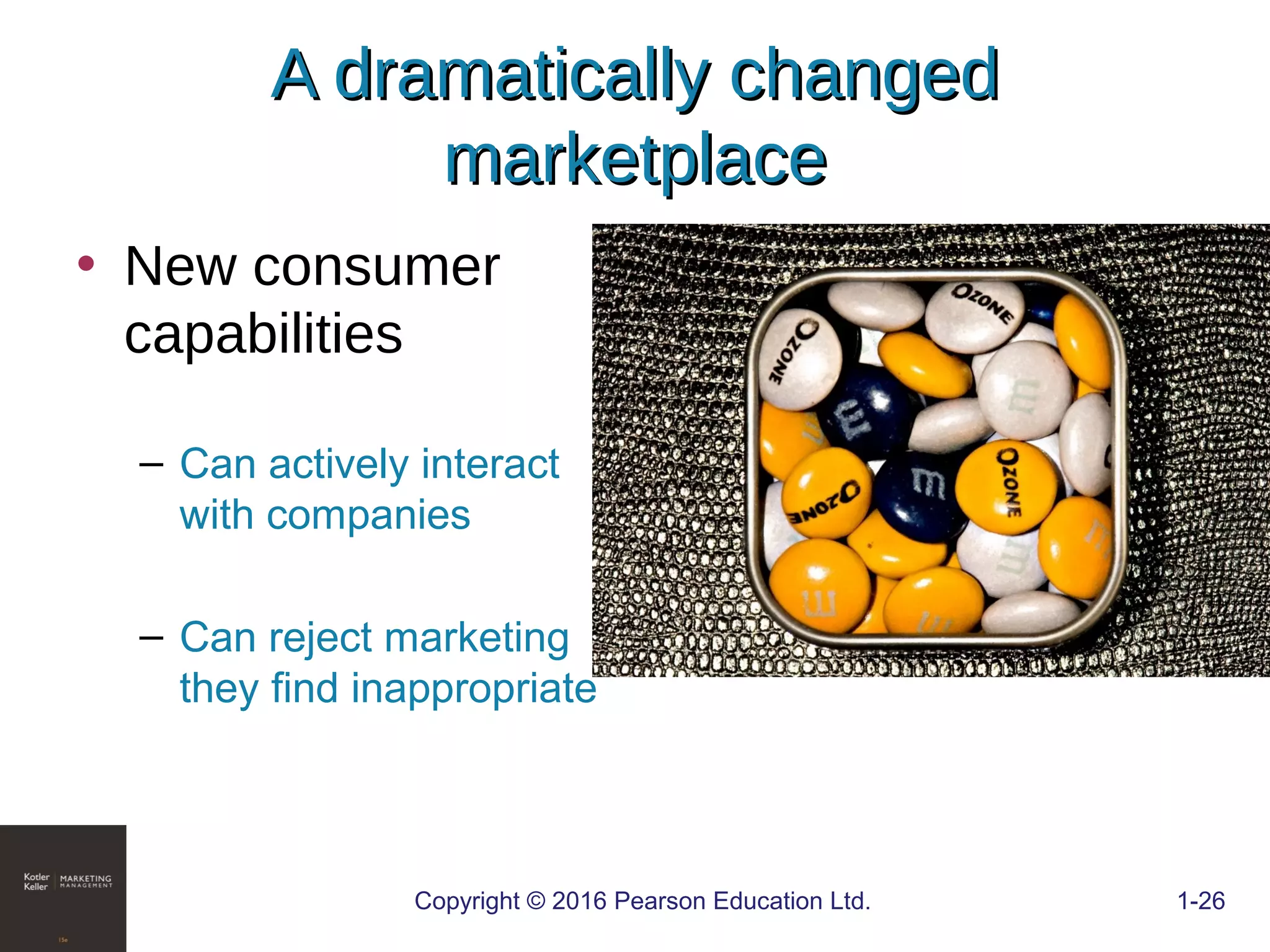
• New consumer
capabilities
– Can actively interact
with companies
– Can reject marketing
they find inappropriate
COPYRIGHT © 2016 PEARSON EDUCATION, INC. 1-26Copyright © 2016 Pearson Education Ltd. 1-26
A dramatically changedA dramatically changed
marketplacemarketplace
• New company capabilities
– Can use the internet as a powerful information and
sales channel, including for individually differentiated
goods
– Can collect fuller and richer information about
markets, customers, prospects, and competitors
– Can reach customers quickly and efficiently via social
media and mobile marketing, sending targeted ads,
coupons, and information
COPYRIGHT © 2016 PEARSON EDUCATION, INC. 1-27Copyright © 2016 Pearson Education Ltd. 1-27
A dramatically changedA dramatically changed
marketplacemarketplace
• New company capabilities
– Can improve purchasing, recruiting, training, and
internal and external communications
– Can improve cost efficiency
COPYRIGHT © 2016 PEARSON EDUCATION, INC. 1-28Copyright © 2016 Pearson Education Ltd. 1-28
A dramatically changedA dramatically changed
marketplacemarketplace
• Changing channels
– Retail
transformation
– Disintermediation
COPYRIGHT © 2016 PEARSON EDUCATION, INC. 1-29Copyright © 2016 Pearson Education Ltd. 1-29
A dramatically changedA dramatically changed
marketplacemarketplace
• Heightened competition
– Private brands
– Mega-brands
– Deregulation
– Privatization
COPYRIGHT © 2016 PEARSON EDUCATION, INC. 1-30Copyright © 2016 Pearson Education Ltd. 1-30
A dramatically changedA dramatically changed
marketplacemarketplace
Marketing in practiceMarketing in practice
• Marketing balance
• Marketing accountability
• Marketing in the organization
COPYRIGHT © 2016 PEARSON EDUCATION, INC. 1-31Copyright © 2016 Pearson Education Ltd. 1-31
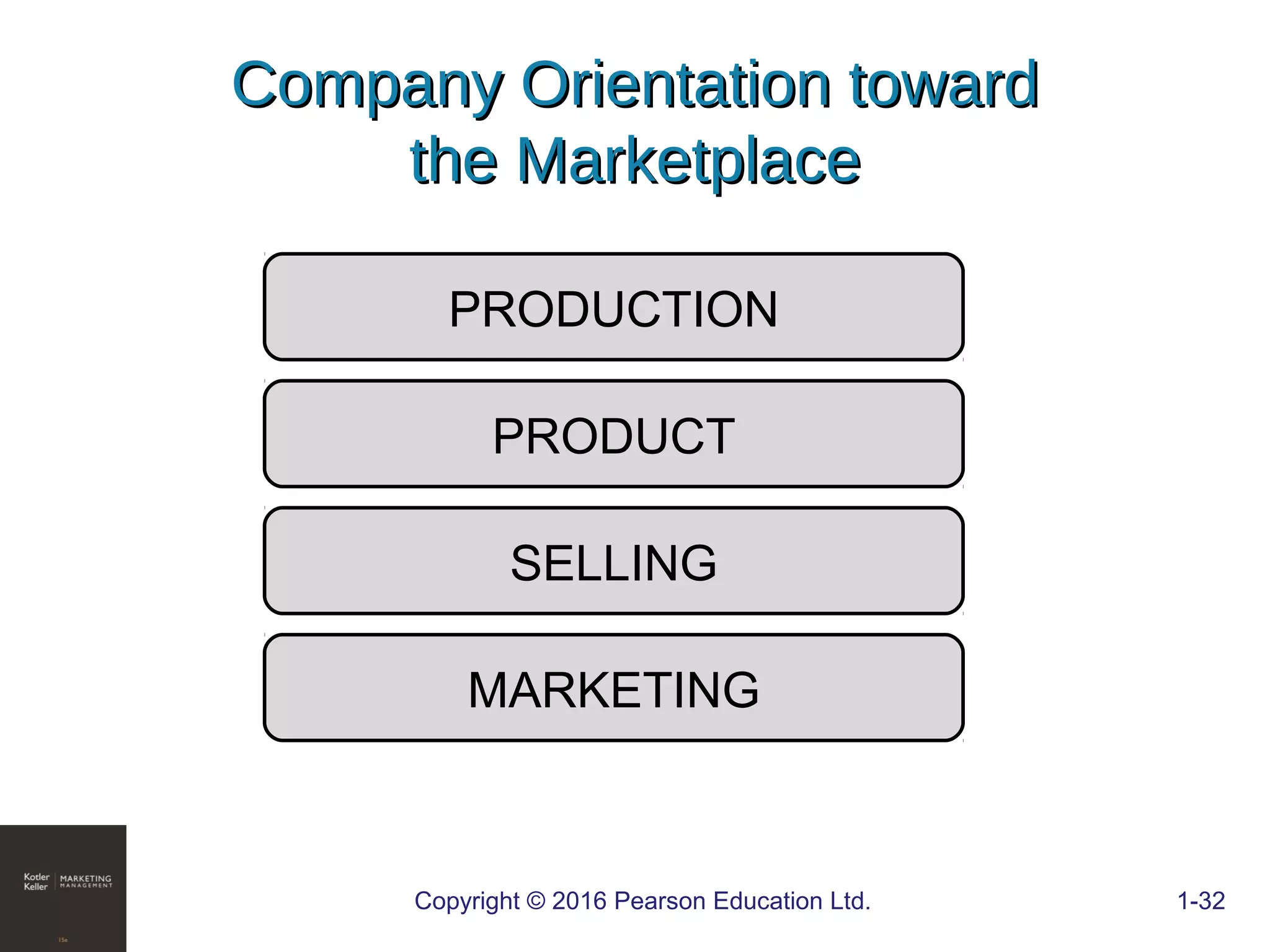
Company Orientation towardCompany Orientation toward
the Marketplacethe Marketplace
PRODUCTION
PRODUCT
SELLING
MARKETING
COPYRIGHT © 2016 PEARSON EDUCATION, INC. 1-32Copyright © 2016 Pearson Education Ltd. 1-32
Fig. 1.4Fig. 1.4
Holistic Marketing DimensionsHolistic Marketing Dimensions
Copyright © 2016 Pearson Education Ltd. 1-33
Relationship marketingRelationship marketing
CUSTOMERS
EMPLOYEES
MARKETING
PARTNERS
FINANCIAL
COMMUNITY
Copyright © 2016 Pearson Education Ltd. 1-34
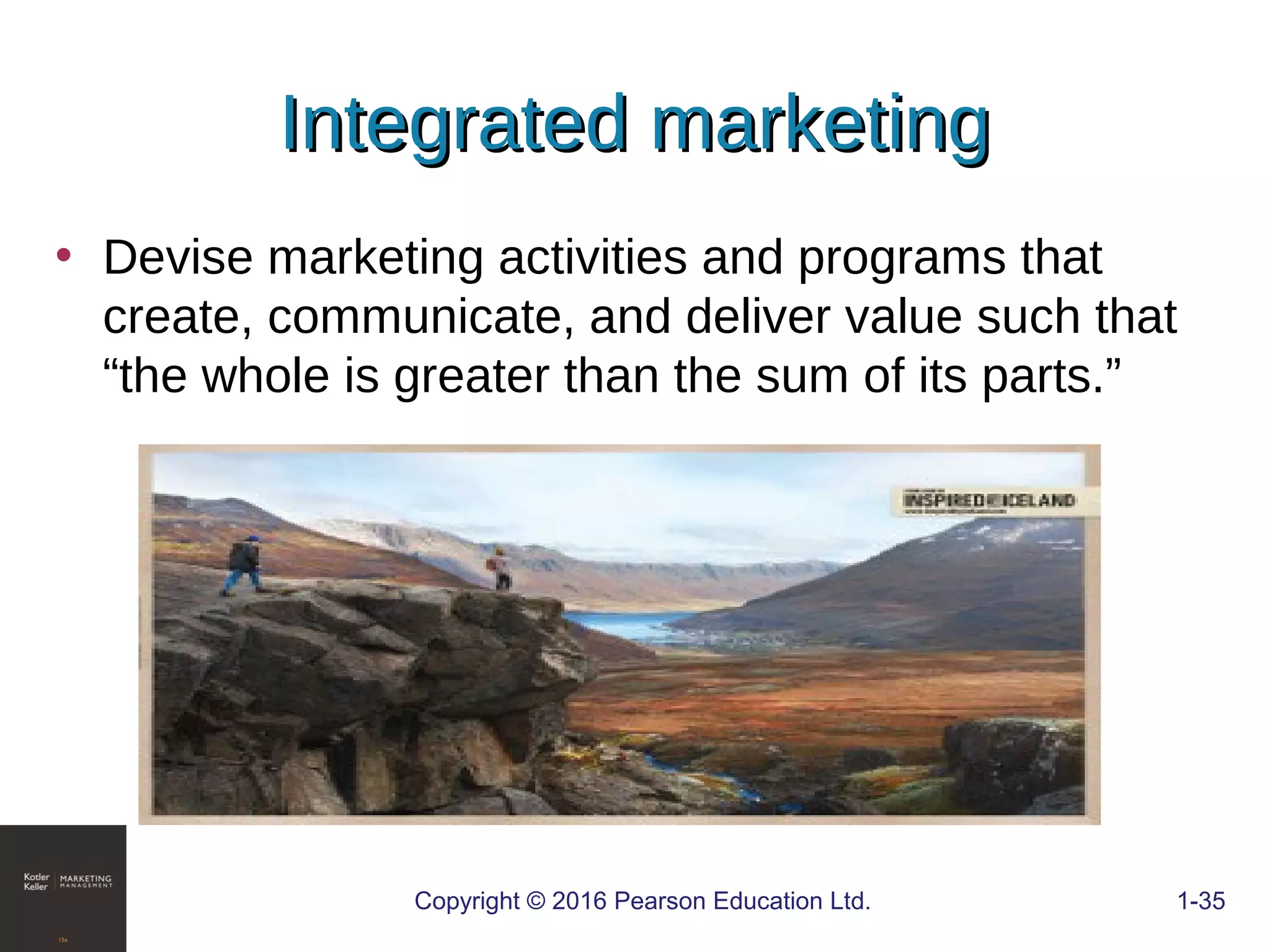
Integrated marketingIntegrated marketing
Copyright © 2016 Pearson Education Ltd. 1-35
• Devise marketing activities and programs that
create, communicate, and deliver value such that
“the whole is greater than the sum of its parts.”
Internal marketingInternal marketing
• The task of hiring, training, and motivating
able employees who want to serve
customers well
Copyright © 2016 Pearson Education Ltd. 1-36
Performance marketingPerformance marketing
FINANCIAL
ACCOUNTABILITY
ENVIRONMENTAL
IMPACT
SOCIAL IMPACT
Copyright © 2016 Pearson Education Ltd. 1-37
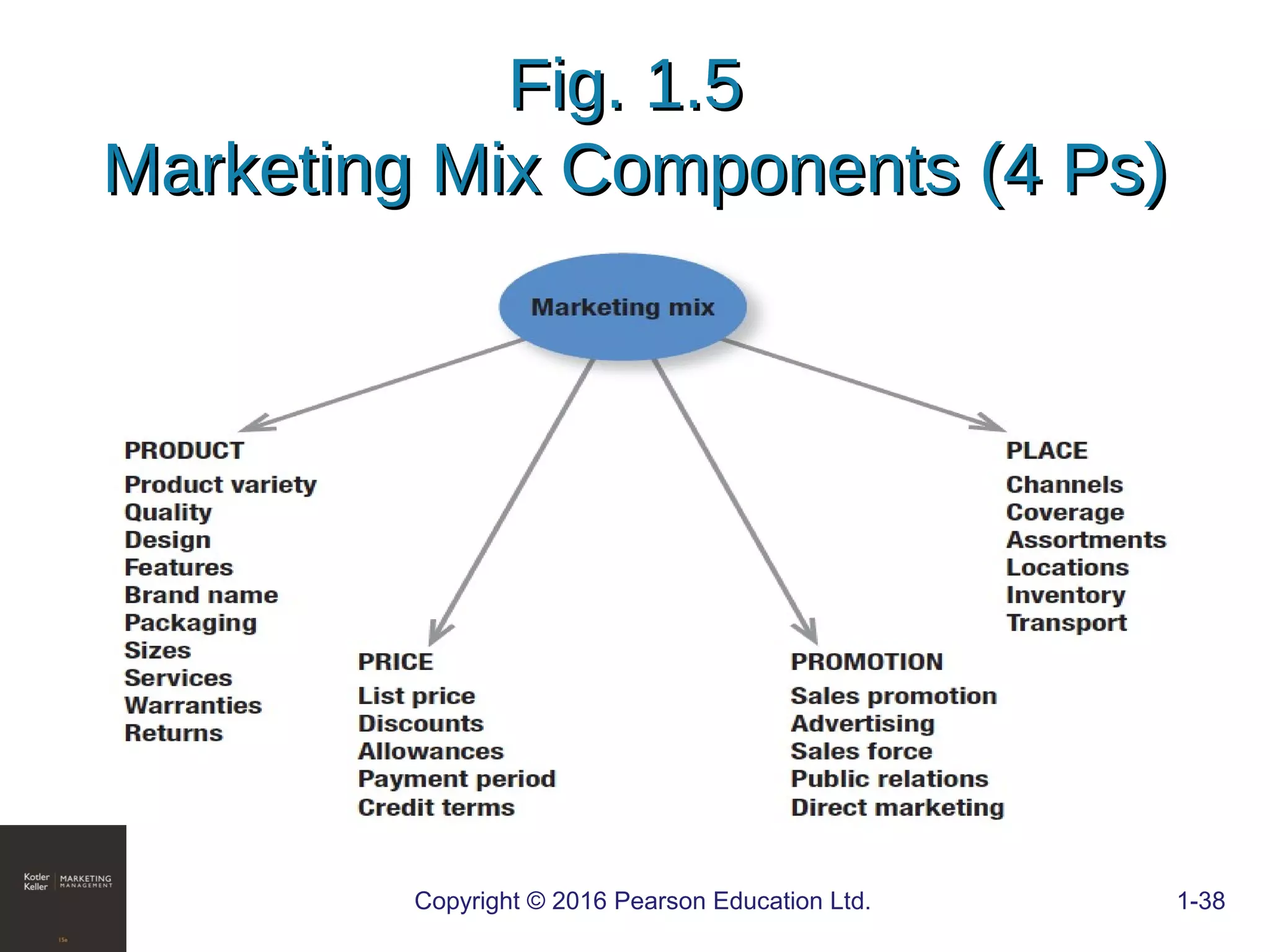
Fig. 1.5Fig. 1.5
Marketing Mix Components (4 Ps)Marketing Mix Components (4 Ps)
Copyright © 2016 Pearson Education Ltd. 1-38
MODERN MARKETINGMODERN MARKETING
MANAGEMENTMANAGEMENT
PROCESSES
PEOPLE
PROGRAMS
PERFORMANCE
Copyright © 2016 Pearson Education Ltd. 1-39
MARKETINGMARKETING
MANAGEMENT TASKSMANAGEMENT TASKS
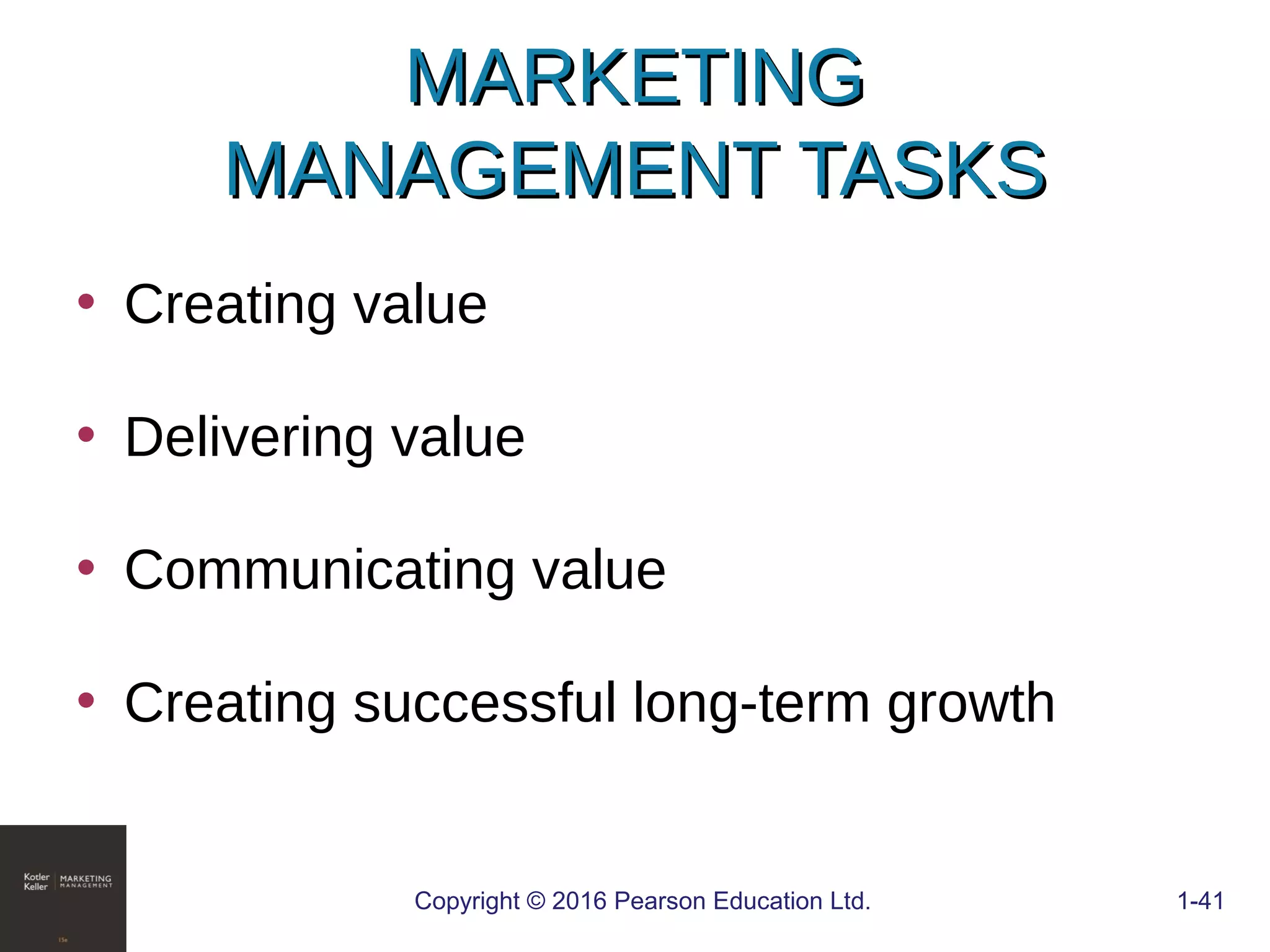
• Developing market strategies and plans
• Capturing marketing insights
• Connecting with customers
• Building strong brands
Copyright © 2016 Pearson Education Ltd. 1-40
MARKETINGMARKETING
MANAGEMENT TASKSMANAGEMENT TASKS
• Creating value
• Delivering value
• Communicating value
• Creating successful long-term growth
Copyright © 2016 Pearson Education Ltd. 1-41
Copyright © 2016 Pearson Education Ltd. 1-42

Kotler mm15e inppt_01

  • 1.
  • 2.
    Learning ObjectivesLearning Objectives 1.Why is marketing important? 2. What is the scope of marketing? 3. What are some core marketing concepts? 4. What forces are defining the new marketing realities? 5. What new capabilities have these forces given consumers and companies? 6. What does a holistic marketing philosophy include? 7. What tasks are necessary for successful marketing management? Copyright © 2016 Pearson Education Ltd. 1-2
  • 3.
    The Value ofMarketingThe Value of Marketing • Financial success often depends on marketing ability • Successful marketing builds demand for products and services, which, in turn, creates jobs • Marketing builds strong brands and a loyal customer base, intangible assets that contribute heavily to the value of a firm Copyright © 2016 Pearson Education Ltd. 1-3
  • 4.
    The Scope ofMarketingThe Scope of Marketing • Marketing is about identifying and meeting human and social needs • AMA’s formal definition: Marketing is the activity, set of institutions, and processes for creating, communicating, delivering, and exchanging offerings that have value for customers, clients, partners, and society at large Copyright © 2016 Pearson Education Ltd. 1-4
  • 5.
    Marketing ManagementMarketing Management •The art and science of choosing target markets and getting, keeping, and growing customers through creating, delivering, and communicating superior customer value COPYRIGHT © 2016 PEARSON EDUCATION, INC. 1-5Copyright © 2016 Pearson Education Ltd. 1-5
  • 6.
    What is Marketed?Whatis Marketed? • Goods • Services • Events • Experiences • Persons COPYRIGHT © 2016 PEARSON EDUCATION, INC. 1-6Copyright © 2016 Pearson Education Ltd. 1-6
  • 7.
    • Places • Properties •Organizations • Information • Ideas COPYRIGHT © 2016 PEARSON EDUCATION, INC. 1-7Copyright © 2016 Pearson Education Ltd. 1-7 What is Marketed?What is Marketed?
  • 8.
    Who Markets?Who Markets? •A marketer is someone who seeks a response—attention, a purchase, a vote, a donation—from another party, called the prospect COPYRIGHT © 2016 PEARSON EDUCATION, INC. 1-8Copyright © 2016 Pearson Education Ltd. 1-8
  • 9.
    8 Demand States8Demand States • Negative • Nonexistent • Latent • Declining • Irregular • Unwholesome • Full • Overfull COPYRIGHT © 2016 PEARSON EDUCATION, INC. 1-9Copyright © 2016 Pearson Education Ltd. 1-9
  • 10.
    Fig. 1.1Fig. 1.1 StructureOf Flows In A ModernStructure Of Flows In A Modern Exchange EconomyExchange Economy COPYRIGHT © 2016 PEARSON EDUCATION, INC. 1-10Copyright © 2016 Pearson Education Ltd. 1-10
  • 11.
    Fig. 1.2Fig. 1.2 ASimple Marketing SystemA Simple Marketing System Copyright © 2016 Pearson Education Ltd. 1-11
  • 12.
    Key Customer MarketsKeyCustomer Markets • Consumer markets • Business markets • Global markets • Nonprofit & governmental markets COPYRIGHT © 2016 PEARSON EDUCATION, INC. 1-12Copyright © 2016 Pearson Education Ltd. 1-12
  • 13.
    Core Marketing ConceptsCoreMarketing Concepts • Needs: the basic human requirements such as for air, food, water, clothing, and shelter • Wants: specific objects that might satisfy the need • Demands: wants for specific products backed by an ability to pay COPYRIGHT © 2016 PEARSON EDUCATION, INC. 1-13Copyright © 2016 Pearson Education Ltd. 1-13
  • 14.
    Types of NeedsTypesof Needs STATED REAL UNSTATED DELIGHT SECRET COPYRIGHT © 2016 PEARSON EDUCATION, INC. 1-14Copyright © 2016 Pearson Education Ltd. 1-14
  • 15.
    • Target markets •Positioning • Segmentation COPYRIGHT © 2016 PEARSON EDUCATION, INC. 1-15Copyright © 2016 Pearson Education Ltd. 1-15 Core Marketing ConceptsCore Marketing Concepts
  • 16.
    • Value proposition:a set of benefits that satisfy those needs • Offerings: a combination of products, services, information, and experiences • Brands: an offering from a known source COPYRIGHT © 2016 PEARSON EDUCATION, INC. 1-16Copyright © 2016 Pearson Education Ltd. 1-16 Core Marketing ConceptsCore Marketing Concepts
  • 17.
    • Marketing channels COMMUNICATION DISTRIBUTION SERVICE COPYRIGHT© 2016 PEARSON EDUCATION, INC. 1-17Copyright © 2016 Pearson Education Ltd. 1-17 Core Marketing ConceptsCore Marketing Concepts
  • 18.
    • Paid media:TV, magazine and display ads, paid search, and sponsorships • Owned media: a company or brand brochure, web site, blog, Facebook page, or twitter account • Earned media: word of mouth, buzz, or viral marketing COPYRIGHT © 2016 PEARSON EDUCATION, INC. 1-18Copyright © 2016 Pearson Education Ltd. 1-18 Core Marketing ConceptsCore Marketing Concepts
  • 19.
    • Impressions: occurwhen consumers view a communication • Engagement: the extent of a customer’s attention and active involvement with a communication COPYRIGHT © 2016 PEARSON EDUCATION, INC. 1-19Copyright © 2016 Pearson Education Ltd. 1-19 Core Marketing ConceptsCore Marketing Concepts
  • 20.
    • Value: acombination of quality, service, and price (qsp: the customer value triad) • Satisfaction: a person’s judgment of a product’s perceived performance in relationship to expectations COPYRIGHT © 2016 PEARSON EDUCATION, INC. 1-20Copyright © 2016 Pearson Education Ltd. 1-20 Core Marketing ConceptsCore Marketing Concepts
  • 21.
    • Supply chain:a channel stretching from raw materials to components to finished products carried to final buyers (Fig 1.3: The Supply Chain for Coffee) COPYRIGHT © 2016 PEARSON EDUCATION, INC. 1-21Copyright © 2016 Pearson Education Ltd. 1-21 Core Marketing ConceptsCore Marketing Concepts
  • 22.
    • Competition: allthe actual and potential rival offerings and substitutes a buyer might consider COPYRIGHT © 2016 PEARSON EDUCATION, INC. 1-22Copyright © 2016 Pearson Education Ltd. 1-22 Core Marketing ConceptsCore Marketing Concepts
  • 23.
    • Marketing environment – Taskenvironment – Broad environment COPYRIGHT © 2016 PEARSON EDUCATION, INC. 1-23Copyright © 2016 Pearson Education Ltd. 1-23 Core Marketing ConceptsCore Marketing Concepts
  • 24.
    The New MarketingRealitiesThe New Marketing Realities • Technology • Globalization • Social responsibility COPYRIGHT © 2016 PEARSON EDUCATION, INC. 1-24Copyright © 2016 Pearson Education Ltd. 1-24
  • 25.
    A dramatically changedAdramatically changed marketplacemarketplace • New consumer capabilities – Can use the internet as a powerful information and purchasing aid – Can search, communicate, and purchase on the move – Can tap into social media to share opinions and express loyalty COPYRIGHT © 2016 PEARSON EDUCATION, INC. 1-25Copyright © 2016 Pearson Education Ltd. 1-25
  • 26.
    • New consumer capabilities –Can actively interact with companies – Can reject marketing they find inappropriate COPYRIGHT © 2016 PEARSON EDUCATION, INC. 1-26Copyright © 2016 Pearson Education Ltd. 1-26 A dramatically changedA dramatically changed marketplacemarketplace
  • 27.
    • New companycapabilities – Can use the internet as a powerful information and sales channel, including for individually differentiated goods – Can collect fuller and richer information about markets, customers, prospects, and competitors – Can reach customers quickly and efficiently via social media and mobile marketing, sending targeted ads, coupons, and information COPYRIGHT © 2016 PEARSON EDUCATION, INC. 1-27Copyright © 2016 Pearson Education Ltd. 1-27 A dramatically changedA dramatically changed marketplacemarketplace
  • 28.
    • New companycapabilities – Can improve purchasing, recruiting, training, and internal and external communications – Can improve cost efficiency COPYRIGHT © 2016 PEARSON EDUCATION, INC. 1-28Copyright © 2016 Pearson Education Ltd. 1-28 A dramatically changedA dramatically changed marketplacemarketplace
  • 29.
    • Changing channels –Retail transformation – Disintermediation COPYRIGHT © 2016 PEARSON EDUCATION, INC. 1-29Copyright © 2016 Pearson Education Ltd. 1-29 A dramatically changedA dramatically changed marketplacemarketplace
  • 30.
    • Heightened competition –Private brands – Mega-brands – Deregulation – Privatization COPYRIGHT © 2016 PEARSON EDUCATION, INC. 1-30Copyright © 2016 Pearson Education Ltd. 1-30 A dramatically changedA dramatically changed marketplacemarketplace
  • 31.
    Marketing in practiceMarketingin practice • Marketing balance • Marketing accountability • Marketing in the organization COPYRIGHT © 2016 PEARSON EDUCATION, INC. 1-31Copyright © 2016 Pearson Education Ltd. 1-31
  • 32.
    Company Orientation towardCompanyOrientation toward the Marketplacethe Marketplace PRODUCTION PRODUCT SELLING MARKETING COPYRIGHT © 2016 PEARSON EDUCATION, INC. 1-32Copyright © 2016 Pearson Education Ltd. 1-32
  • 33.
    Fig. 1.4Fig. 1.4 HolisticMarketing DimensionsHolistic Marketing Dimensions Copyright © 2016 Pearson Education Ltd. 1-33
  • 34.
  • 35.
    Integrated marketingIntegrated marketing Copyright© 2016 Pearson Education Ltd. 1-35 • Devise marketing activities and programs that create, communicate, and deliver value such that “the whole is greater than the sum of its parts.”
  • 36.
    Internal marketingInternal marketing •The task of hiring, training, and motivating able employees who want to serve customers well Copyright © 2016 Pearson Education Ltd. 1-36
  • 37.
  • 38.
    Fig. 1.5Fig. 1.5 MarketingMix Components (4 Ps)Marketing Mix Components (4 Ps) Copyright © 2016 Pearson Education Ltd. 1-38
  • 39.
  • 40.
    MARKETINGMARKETING MANAGEMENT TASKSMANAGEMENT TASKS •Developing market strategies and plans • Capturing marketing insights • Connecting with customers • Building strong brands Copyright © 2016 Pearson Education Ltd. 1-40
  • 41.
    MARKETINGMARKETING MANAGEMENT TASKSMANAGEMENT TASKS •Creating value • Delivering value • Communicating value • Creating successful long-term growth Copyright © 2016 Pearson Education Ltd. 1-41
  • 42.
    Copyright © 2016Pearson Education Ltd. 1-42

Editor's Notes

  • #4 There is little margin for error in marketing. Just a short time ago, MySpace, Yahoo!, Blockbuster, and Barnes & Noble were admired leaders in their industries. What a difference a few years can make! Each of these brands has been completely overtaken by an upstart challenger—Facebook, Google, Netflix, and Amazon—and they now struggle, sometimes unsuccessfully, for mere survival.
  • #5 One of the shortest good definitions of marketing is “meeting needs profitably.”
  • #6 Marketing management takes place when at least one party to a potential exchange thinks about the means of achieving desired responses from other parties.
  • #7 Marketers market 10 main types of entities: goods, services, events, experiences, persons, places, properties, organizations, information, and ideas.
  • #8 Marketers market 10 main types of entities: goods, services, events, experiences, persons, places, properties, orga- nizations, information, and ideas.
  • #9 If two parties are seeking to sell something to each other, we call them both marketers.
  • #10 Negative demand—Consumers dislike the product and may even pay to avoid it. Nonexistent demand—Consumers may be unaware of or uninterested in the product. Latent demand—Consumers may share a strong need that cannot be satisfied by an existing product. Declining demand—Consumers begin to buy the product less frequently or not at all. Irregular demand—Consumer purchases vary on a seasonal, monthly, weekly, daily, or even hourly basis. Full demand—Consumers are adequately buying all products put into the marketplace. Overfull demand—More consumers would like to buy the product than can be satisfied. Unwholesome demand—Consumers may be attracted to products that have undesirable social consequences.
  • #11 Five basic markets and their connecting flows are shown in Figure 1.1. Manufacturers go to resource markets (raw material markets, labor markets, money markets), buy resources and turn them into goods and services, and sell finished products to intermediaries, who sell them to consumers. Consumers sell their labor and receive money with which they pay for goods and services. The government collects tax revenues to buy goods from resource, manufacturer, and intermediary markets and uses these goods and services to provide public services. Each nation’s economy, and the global economy, consists of interacting sets of markets linked through exchange processes.
  • #12 Figure 1.2 shows how sellers and buyers are connected by four flows. Sellers send goods and services and com- munications such as ads and direct mail to the market; in return they receive money and information such as cus- tomer attitudes and sales data. The inner loop shows an exchange of money for goods and services; the outer loop shows an exchange of information.
  • #13 Consumer Markets Companies selling mass consumer goods and services such as juices, cosmetics, athletic shoes, and air travel establish a strong brand image by developing a superior product or service, ensuring its availability, and backing it with engaging communications and reliable performance. Business Markets Companies selling business goods and services often face well-informed professional buyers skilled at evaluating competitive offerings. Advertising and Web sites can play a role, but the sales force, the price, and the seller’s reputation may play a greater one. Global Markets Companies in the global marketplace navigate cultural, language, legal, and political differences while deciding which countries to enter, how to enter each (as exporter, licenser, joint venture partner, contract manufacturer, or solo manufacturer), how to adapt product and service features to each country, how to set prices, and how to communicate in different cultures. Nonprofit and Governmental Markets Companies selling to nonprofit organizations with limited purchasing power such as churches, universities, charitable organizations, and government agencies need to price carefully. Much government purchasing requires bids; buyers often focus on practical solutions and favor the lowest bid, other things equal.
  • #14 A U.S. consumer needs food but may want a Chicago-style “deep-dish” pizza and a craft beer. A person in Afghanistan needs food but may want rice, lamb, and carrots. Our wants are shaped by our society. Many people want a Mercedes; only a few can buy one. Companies must measure not only how many people want their product, but also how many are will- ing and able to buy it.
  • #15 Stated needs (The customer wants an inexpensive car.) Real needs (The customer wants a car whose operating cost, not initial price, is low.) Unstated needs (The customer expects good service from the dealer.) Delight needs (The customer would like the dealer to include an onboard GPS system.) Secret needs (The customer wants friends to see him or her as a savvy consumer.)
  • #16 Not everyone likes the same cereal, restaurant, university, or movie. Marketers therefore identify distinct segments of buyers by identifying demographic, psychographic, and behavioral differences between them. They then decide which segment(s) present the greatest opportunities. For each of these target markets, the firm develops a market offering that it positions in target buyers’ minds as delivering some key benefit(s). Volvo develops its cars for the buyer to whom safety is a major concern, positioning them as the safest a customer can buy. Porsche targets buyers who seek pleasure and excitement in driving and want to make a statement about their wheels.
  • #17 A brand name such as Apple carries many different kinds of associations in people’s minds that make up its image: creative, innovative, easy-to-use, fun, cool, iPod, iPhone, and iPad to name just a few. All companies strive to build a brand image with as many strong, favorable, and unique brand associations as possible.
  • #18 To reach a target market, the marketer uses three kinds of marketing channels. Communication channels deliver and receive messages from target buyers and include newspapers, magazines, radio, television, mail, telephone, smart phone, billboards, posters, fliers, CDs, audiotapes, and the Internet. Distribution channels help display, sell, or deliver the physical product or service(s) to the buyer or user. To carry out transactions with potential buyers, the marketer also uses service channels that include warehouses, transportation companies, banks, and insurance companies.
  • #19 Paid media allow marketers to show their ad or brand for a fee. Owned media are communication channels marketers actually own. Earned media are streams in which consumers, the press, or other outsiders voluntarily communicate something about the brand.
  • #20 Marketers now think of three “screens” or means to reach consumers: TV, Internet, and mobile.
  • #21 The buyer chooses the offerings he or she perceives to deliver the most value, the sum of the tangible and intangible benefits and costs. If performance falls short of expectations, the customer is disappointed. If it matches expectations, the customer is satisfied. If it exceeds them, the customer is delighted.
  • #22 Each company in the chain captures only a certain percentage of the total value generated by the supply chain’s value delivery system. When a company acquires competitors or expands upstream or downstream, its aim is to capture a higher percentage of supply chain value.
  • #23 An automobile manufacturer can buy steel from U.S. Steel in the United States, from a foreign firm in Japan or Korea, or from a mini-mill such as Nucor at a cost savings, or it can buy aluminum parts from Alcoa to reduce the car’s weight or engineered plastics from Saudi Basic Industries Corporation (SABIC) instead of steel.
  • #24 Marketers must pay close attention to the trends and developments in these and adjust their marketing strategies as needed. New opportunities are constantly emerging that await the right marketing savvy and ingenuity. Task environment: the actors engaged in producing, distributing, and promoting the offering Broad environment: demographic environment, economic environment, social-cultural environment, natural environment, technological environment, and political-legal environment
  • #25 Technology: Massive amounts of information and data about almost everything are now available to consumers and marketers. The old credo “information is power” is giving way to the new idea that “sharing information is power.” Even traditional marketing activities are profoundly affected by technology. Globalization: The world has become a smaller place. Globalization has made countries increasingly multicultural and changes innovation and product development as companies take ideas and lessons from one country and apply them to another. Social responsibility: The private sector is taking some responsibility for improving living conditions, and firms all over the world have elevated the role of corporate social responsibility. Because marketing’s effects extend to society as a whole, marketers must consider the ethical, environmental, legal, and social context of their activities. Social responsibility is a way to differentiate from competitors, build consumer preference, and achieve notable sales and profit gains.
  • #26 Social media is an explosive worldwide phenomenon. Empowerment is not just about technology, though. Consumers are willing to move to another brand if they think they are not being treated right or do not like what they are seeing. Expanded information, communication, and mobility enable customers to make better choices and share their preferences and opinions with others around the world.
  • #27 Social media is an explosive worldwide phenomenon. Empowerment is not just about technology, though. Consumers are willing to move to another brand if they think they are not being treated right or do not like what they are seeing. Expanded information, communication, and mobility enable customers to make better choices and share their preferences and opinions with others around the world.
  • #28 At the same time, globalization, social responsibility, and technology have also generated a new set of capabilities to help companies cope and respond.
  • #29 At the same time, globalization, social responsibility, and technology have also generated a new set of capabilities to help companies cope and respond.
  • #30 One of the reasons consumers have more choices is that channels of distribution have changed as a result of retail transformation and disintermediation. Entrepreneurial retailers are building entertainment into their stores with coffee bars, demonstrations, and performances, marketing an “experience” rather than a product assortment. Traditional companies engaged in reintermediation and became “brick-and-click” retailers, adding online services to their offerings. Some with plentiful resources and established brand names became stronger contenders than pure-click firms.
  • #31 While globalization has created intense competition among domestic and foreign brands, the rise of private labels and mega-brands and a trend toward deregulation and privatization have also increased competition.
  • #32 Companies must always move forward, innovating products and services, staying in touch with customer needs, and seeking new advantages rather than relying on past strengths. Moving forward especially means incorporating the Internet and digital efforts into marketing plans. Marketers are increasingly asked to justify their investments in financial and profitability terms, as well as in terms of building the brand and growing the customer base. They are thus applying more metrics—brand equity, customer lifetime value, return on marketing investment (ROMI)—to understand and measure their marketing and business performance and a broader variety of financial measures to assess the direct and indirect value their marketing efforts create. Increasingly, marketing is not done only by the marketing department; every employee has an impact on the customer. To create a strong marketing organization, marketers must think like executives in other departments, and executives in other departments must think more like marketers.
  • #33 The production concept is one of the oldest concepts in business. It holds that consumers prefer products that are widely available and inexpensive. Managers of production-oriented businesses concentrate on achieving high production efficiency, low costs, and mass distribution. The product concept proposes that consumers favor products offering the most quality, performance, or innovative features. The selling concept holds that consumers and businesses, if left alone, won’t buy enough of the organization’s products. It is practiced most aggressively with unsought goods—goods buyers don’t normally think of buying such as insurance and cemetery plots—and when firms with overcapacity aim to sell what they make, rather than make what the market wants. The marketing concept emerged in the mid-1950s as a customer-centered, sense-and respond philosophy. The job is to find not the right customers for your products, but the right products for your customers.
  • #34 The holistic marketing concept is based on the development, design, and implementation of marketing programs, processes, and activities that recognize their breadth and interdependencies. Holistic marketing acknowledges that everything matters in marketing—and that a broad, integrated perspective is often necessary. Figure 1.4 provides a schematic overview of four broad components characterizing holistic marketing: relationship marketing, integrated marketing, internal marketing, and performance marketing.
  • #35 Relationship marketing aims to build mutually satisfying long-term relationships with key constituents in order to earn and retain their business. Four key constituents for relationship marketing are customers, employees, marketing partners (channels, suppliers, distributors, dealers, agencies), and members of the financial community (shareholders, investors, analysts). Marketers must create prosperity among all these constituents and balance the returns to all key stakeholders. To develop strong relationships with them requires understanding their capabilities and resources, needs, goals, and desires. The ultimate outcome of relationship marketing is a unique company asset called a marketing network, consisting of the company and its supporting stakeholders—customers, employees, suppliers, distributors, retailers, and others—with whom it has built mutually profitable business relationships. The operating principle is simple: build an effective network of relationships with key stakeholders, and profits will follow.
  • #36 Two key themes of integrated marketing are that (1) many different marketing activities can create, communicate, and deliver value and (2) marketers should design and implement any one marketing activity with all other activities in mind.
  • #37 Marketing succeeds only when all departments work together to achieve customer goals (see Table 1.4): when engineering designs the right products, finance furnishes the right amount of funding, purchasing buys the right materials, production makes the right products in the right time horizon, and accounting measures profitability in the right ways. Internal marketing requires vertical alignment with senior management and horizontal alignment with other departments so everyone understands, appreciates, and supports the marketing effort.
  • #38 Performance marketing requires understanding the financial and nonfinancial returns to business and society from marketing activities and programs. When they founded Ben & Jerry’s, Ben Cohen and Jerry Greenfield embraced the performance marketing concept by dividing the traditional financial bottom line into a “double bottom line” that also measured the environmental impact of their products and processes. That later expanded into a “triple bottom line” to represent the social impacts, negative and positive, of the firm’s entire range of business activities.
  • #39 Many years ago, McCarthy classified various marketing activities into marketing-mix tools of four broad kinds, which he called the four Ps of marketing: product, price, place, and promotion. The marketing variables under each P are shown in Figure 1.5.
  • #40 The holistic marketing concept encompasses modern marketing realities: people, processes, programs, and performance, as in Figure 1.6. People reflects, in part, internal marketing and the fact that employees are critical to marketing success. Marketing will only be as good as the people inside the organization. Processes reflects all the creativity, discipline, and structure brought to marketing management. Programs reflects all the firm’s consumer-directed activities. We define performance as in holistic marketing, to capture the range of possible outcome measures that have financial and nonfinancial implications (profitability as well as brand and customer equity) and implications beyond the company itself (social responsibility, legal, ethical, and the environment).
  • #41 With the holistic marketing philosophy as a backdrop, we can identify a specific set of tasks that make up successful marketing management and marketing leadership.
  • #42 With the holistic marketing philosophy as a backdrop, we can identify a specific set of tasks that make up successful marketing management and marketing leadership.