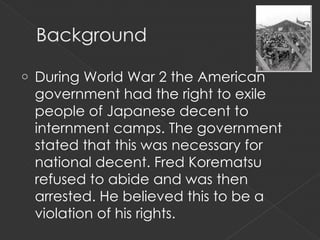
o   During World War 2 the American
    government had the right to exile
    people of Japanese decent to
    internment camps. The government
    stated that this was necessary for
    national decent. Fred Korematsu
    refused to abide and was then
    arrested. He believed this to be a
    violation of his rights.
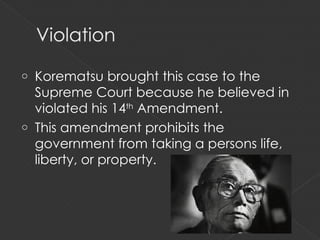
o Korematsu brought this case to the
  Supreme Court because he believed in
  violated his 14th Amendment.
o This amendment prohibits the
  government from taking a persons life,
  liberty, or property.
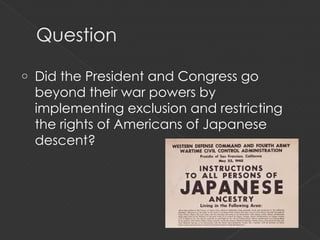
o   Did the President and Congress go
    beyond their war powers by
    implementing exclusion and restricting
    the rights of Americans of Japanese
    descent?
o This case was heard by the Supreme
  Court on October 11, 1944.
o The court made its decision on
  December 18, 1944.
o The Supreme Court agreed with the
  government.
o Supreme Court judge Hugo Black stated
  that the need to protect against
  espionage was more important than
  people of Japanese decent and
  Korematsu’s rights.
o Total, there were 6 votes for the United
  States and 3 against.
o The people in these camps remained
  confined as the war continued.
o Confirmed by the American People who
  were afraid that the people of Japanese
  decent were spying. They believe the
  government had reason because it was
  a time of war.
o Others were appalled that the
  government overruled an amendment.

Korematsu v united_states

  • 2.
    o During World War 2 the American government had the right to exile people of Japanese decent to internment camps. The government stated that this was necessary for national decent. Fred Korematsu refused to abide and was then arrested. He believed this to be a violation of his rights.
  • 3.
    o Korematsu broughtthis case to the Supreme Court because he believed in violated his 14th Amendment. o This amendment prohibits the government from taking a persons life, liberty, or property.
  • 4.
    o Did the President and Congress go beyond their war powers by implementing exclusion and restricting the rights of Americans of Japanese descent?
  • 5.
    o This casewas heard by the Supreme Court on October 11, 1944. o The court made its decision on December 18, 1944.
  • 6.
    o The SupremeCourt agreed with the government. o Supreme Court judge Hugo Black stated that the need to protect against espionage was more important than people of Japanese decent and Korematsu’s rights. o Total, there were 6 votes for the United States and 3 against.
  • 7.
    o The peoplein these camps remained confined as the war continued. o Confirmed by the American People who were afraid that the people of Japanese decent were spying. They believe the government had reason because it was a time of war. o Others were appalled that the government overruled an amendment.