Case Study :
Komatsu Ltd. and Project G (A)
Presented To : Mr. Tarun Anand
Presented By : The Challengers
Aishwarya
Garima
Karthik
Mubashshir
Pranav
Sohel
Sharan
Sukhmani
Varuna
Vimla
Case Synopsis
 Positioning : “ Total Technologies Enterprise”.
 Competition : Competitive Advantage
 Market dynamics : Currency fluctuation,
demand-fluctuation.
 Market Positions : Market Share, Presence in
Domestic & International Markets
 Pricing decisions : Increased Product Prices
 Ineffective & Unstable Management :
Autocratic,
Diplomatic and Participatory
Case Problems
 Unstable Management & Different
Leadership Style
 Autocratic Leader
 Diplomatic Leader
 Participatory Leader
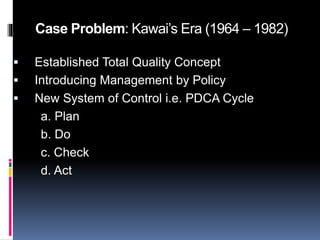
Case Problem: Kawai’s Era (1964 – 1982)
 Established Total Quality Concept
 Introducing Management by Policy
 New System of Control i.e. PDCA Cycle
a. Plan
b. Do
c. Check
d. Act
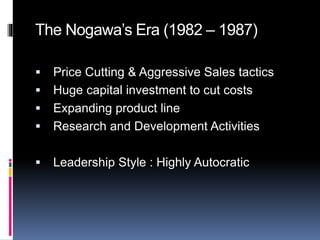
The Nogawa’s Era (1982 – 1987)
 Price Cutting & Aggressive Sales tactics
 Huge capital investment to cut costs
 Expanding product line
 Research and Development Activities
 Leadership Style : Highly Autocratic
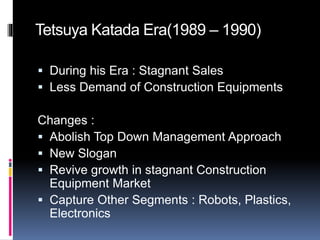
Tetsuya Katada Era(1989 – 1990)
 During his Era : Stagnant Sales
 Less Demand of Construction Equipments
Changes :
 Abolish Top Down Management Approach
 New Slogan
 Revive growth in stagnant Construction
Equipment Market
 Capture Other Segments : Robots, Plastics,
Electronics
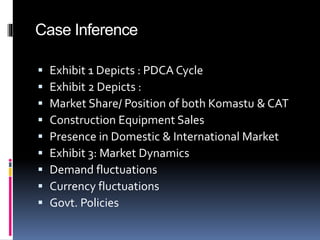
Case Inference
 Exhibit 1 Depicts : PDCA Cycle
 Exhibit 2 Depicts :
 Market Share/ Position of both Komastu & CAT
 Construction Equipment Sales
 Presence in Domestic & International Market
 Exhibit 3: Market Dynamics
 Demand fluctuations
 Currency fluctuations
 Govt. Policies
Tanaka’s Era (1987 – 1989)
 Focus on Domestic Market.
 Pricing Decisions
 Focus on Internationalization
Leadership Style : Diplomatic
Conclusion and Recommendation
 Impact of Leaders decisions i.e. bottom
line and top line
Recommendation :
 Strong Foot fold in their Domestic Market.
 More stable and transparent
management.
 Product Diversification & portfolio of
assets.
CONCLUSION
 THANKYOU ALL!

KOMATSU Case Study

  • 1.
    Case Study : KomatsuLtd. and Project G (A) Presented To : Mr. Tarun Anand Presented By : The Challengers Aishwarya Garima Karthik Mubashshir Pranav Sohel Sharan Sukhmani Varuna Vimla
  • 2.
    Case Synopsis  Positioning: “ Total Technologies Enterprise”.  Competition : Competitive Advantage  Market dynamics : Currency fluctuation, demand-fluctuation.  Market Positions : Market Share, Presence in Domestic & International Markets  Pricing decisions : Increased Product Prices  Ineffective & Unstable Management : Autocratic, Diplomatic and Participatory
  • 3.
    Case Problems  UnstableManagement & Different Leadership Style  Autocratic Leader  Diplomatic Leader  Participatory Leader
  • 4.
    Case Problem: Kawai’sEra (1964 – 1982)  Established Total Quality Concept  Introducing Management by Policy  New System of Control i.e. PDCA Cycle a. Plan b. Do c. Check d. Act
  • 5.
    The Nogawa’s Era(1982 – 1987)  Price Cutting & Aggressive Sales tactics  Huge capital investment to cut costs  Expanding product line  Research and Development Activities  Leadership Style : Highly Autocratic
  • 6.
    Tetsuya Katada Era(1989– 1990)  During his Era : Stagnant Sales  Less Demand of Construction Equipments Changes :  Abolish Top Down Management Approach  New Slogan  Revive growth in stagnant Construction Equipment Market  Capture Other Segments : Robots, Plastics, Electronics
  • 7.
    Case Inference  Exhibit1 Depicts : PDCA Cycle  Exhibit 2 Depicts :  Market Share/ Position of both Komastu & CAT  Construction Equipment Sales  Presence in Domestic & International Market  Exhibit 3: Market Dynamics  Demand fluctuations  Currency fluctuations  Govt. Policies
  • 8.
    Tanaka’s Era (1987– 1989)  Focus on Domestic Market.  Pricing Decisions  Focus on Internationalization Leadership Style : Diplomatic
  • 9.
    Conclusion and Recommendation Impact of Leaders decisions i.e. bottom line and top line Recommendation :  Strong Foot fold in their Domestic Market.  More stable and transparent management.  Product Diversification & portfolio of assets.
  • 10.