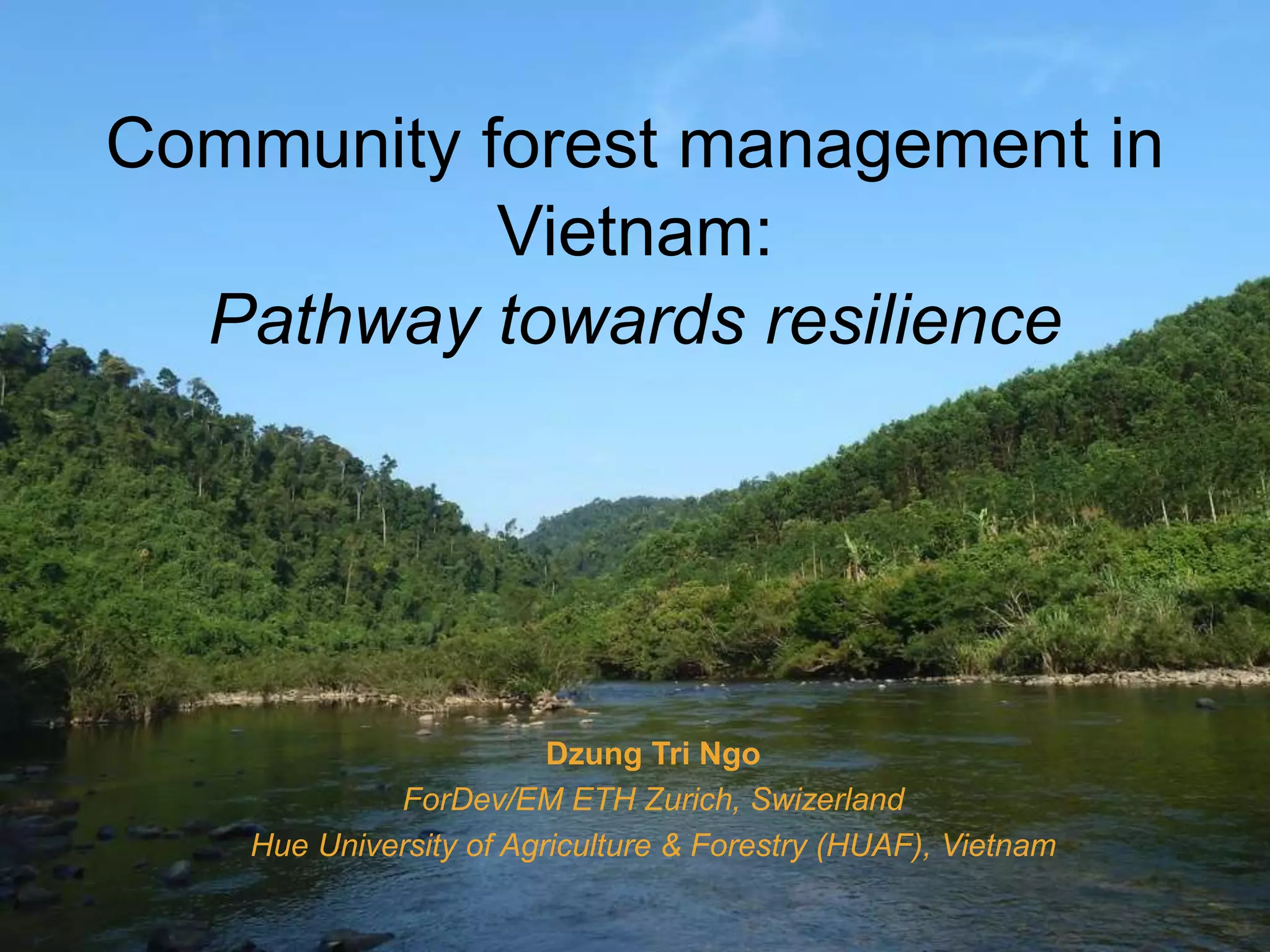
Community forest management in
Vietnam:
Pathway towards resilience
Dzung Tri Ngo
ForDev/EM ETH Zurich, Swizerland
Hue University of Agriculture & Forestry (HUAF), Vietnam
Outline
Vietnam forestry sector
Concept of the study
Main findings
Follow-up research
Vietnam
Beautiful landscapes
Proactive people
Dynamic institutions
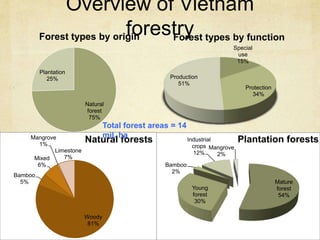
Overview of Vietnam
forestry
Natural
forest
75%
Plantation
25%
Forest types by origin
Special
use
15%
Protection
34%
Production
51%
Forest types by function
Woody
81%
Bamboo
5%
Mixed
6%
Mangrove
1%
Limestone
7%
Natural forests
Mature
forest
54%
Young
forest
30%
Bamboo
2%
Industrial
crops
12%
Mangrove
2%
Plantation forests
Total forest areas = 14
mil. ha
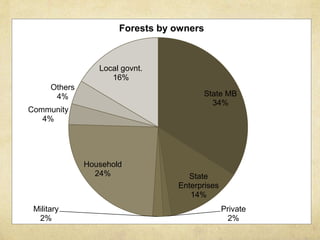
State MB
34%
State
Enterprises
14%
Private
2%
Military
2%
Household
24%
Community
4%
Others
4%
Local govnt.
16%
Forests by owners
CFM in Vietnam
1990s decentralization in forest management: state forestry 
social forestry: multiple stakeholders in forest management (Sikor &
Nguyen, 2006)
Forest allocation: hand over forest tenure to local people for 50 year
cycle.
Forest owners vs. forest types:
State forest management boards (protected areas), Military, local
governments, private companies, state forest companies.
Village communities, household groups, individual households;
Natural forest, plantation; special-use forest (protected areas),
watershed protection forests, production forest.
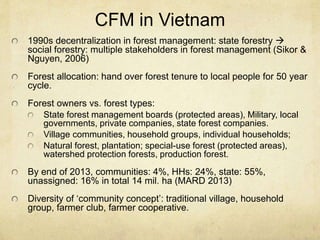
By end of 2013, communities: 4%, HHs: 24%, state: 55%,
unassigned: 16% in total 14 mil. ha (MARD 2013)
Diversity of ‘community concept’: traditional village, household
group, farmer club, farmer cooperative.
Emerging issues
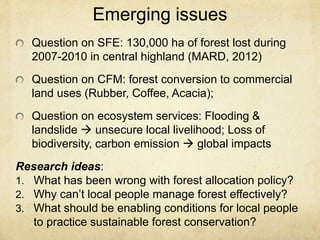
Question on SFE: 130,000 ha of forest lost during
2007-2010 in central highland (MARD, 2012)
Question on CFM: forest conversion to commercial
land uses (Rubber, Coffee, Acacia);
Question on ecosystem services: Flooding &
landslide  unsecure local livelihood; Loss of
biodiversity, carbon emission  global impacts
Research ideas:
1. What has been wrong with forest allocation policy?
2. Why can’t local people manage forest effectively?
3. What should be enabling conditions for local people
to practice sustainable forest conservation?
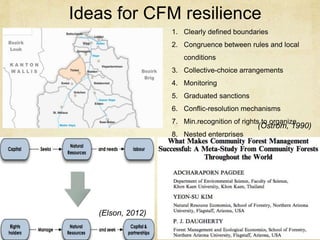
1. Clearly defined boundaries
2. Congruence between rules and local
conditions
3. Collective-choice arrangements
4. Monitoring
5. Graduated sanctions
6. Conflic-resolution mechanisms
7. Min.recognition of rights to organize
8. Nested enterprises
Ideas for CFM resilience
(Ostrom, 1990)
(Elson, 2012)
(Ostrom, 1990)
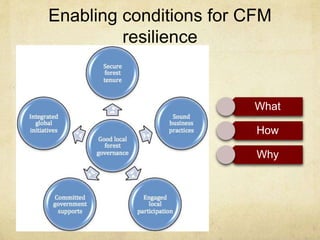
Enabling conditions for CFM
resilience
What
How
Why
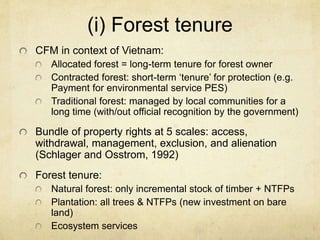
(i) Forest tenure
CFM in context of Vietnam:
Allocated forest = long-term tenure for forest owner
Contracted forest: short-term ‘tenure’ for protection (e.g.
Payment for environmental service PES)
Traditional forest: managed by local communities for a
long time (with/out official recognition by the government)
Bundle of property rights at 5 scales: access,
withdrawal, management, exclusion, and alienation
(Schlager and Osstrom, 1992)
Forest tenure:
Natural forest: only incremental stock of timber + NTFPs
Plantation: all trees & NTFPs (new investment on bare
land)
Ecosystem services
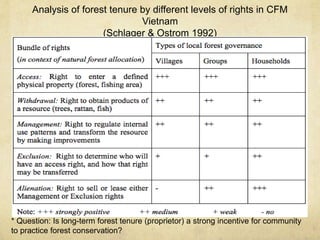
Analysis of forest tenure by different levels of rights in CFM
Vietnam
(Schlager & Ostrom 1992)
* Question: Is long-term forest tenure (proprietor) a strong incentive for community
to practice forest conservation?
Why tenure is important for
resilience?
Incentives for long-term investment in allocated
areas without concerns on inheritance/transfer to
others;
Better planning for forestry sector: long-term cycle
of production of timber & services;
Favorable conditions for resource mobilization;
Encourage sustainable uses of natural resources
(due to long-term profit) vs. destructed harvesting;
Easily adapted with new change due to full rights
of decision making power.
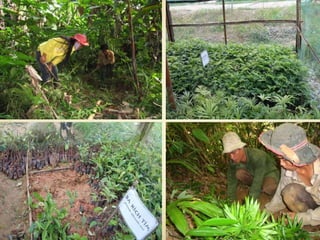
(2) Business practices
Sets of activities that local people apply to generate
incomes for short-and-medium term benefits while
investing in long-term benefits derived from their
resources;
Various examples on business activities include NTFP
cultivation, tourism, hunting, recreation;
Collaboration between private/NGOs with local people:
rattan plantation, Acacia, medicinal herbs, and
community-based ecotourism;
Recent initiatives: Community Forest Enterprises
(Macqueen 2013, Donovan 2010, WWF 2014)
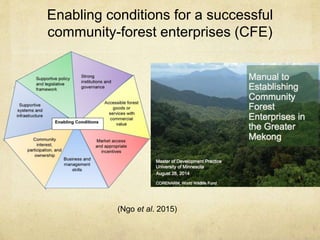
Enabling conditions for a successful
community-forest enterprises (CFE)
(Ngo et al. 2015)
Why need business in
CFM?
Allocated forests to local people = degraded
forests  rehabilitation/protection only;
Local livelihood: high rate of poverty  income
generation vitally important as forest protection;
Incentives for immediate and long-term effort for
forest protection.
Forest can only be protected well if they are part
of local livelihood strategy (FAO, 2003)
(3) Local participation &
institutions
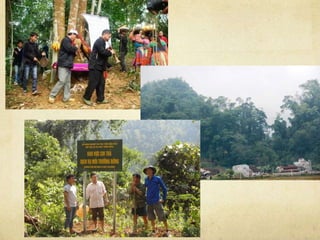
Participation in forest allocation = decision making
power in forest areas, types, management scheme,
benefit sharing, and investment.
Institutions = Formal/informal rules and norms that
shape human interactions with other and nature
(Hodgson, 2006)
Local institutions can be in various forms/modalities:
Informal institutions: traditional regulations that exist in
communities and recognized by most of people;
Formal institutions: designed by a village/tribal council
and acknowledged by county/province/state through
process of legislation;
Formal institutions: functioning or non-functioning
(3) Findings
Low level of community participation in forest allocation: forest
types, forest areas, property rights, benefit sharing.
Inactive attitude of communities towards forest management:
consequence of long-term state management  less
ownership over forest tenure.
Traditional regulations (Katu and Pako ethnic minorities) exist
but less active role in shaping local behaviors toward forest
management.
Reasons: conflict with ‘modern admin structure’ i.e. commune
office, village board.
Weak local institution (less collective action) in the household
or group of household given economic and political setting.
 Compared principles 3 & 7 (Ostrom, 1990), local participation
& institutions are not viable enough for a self-sustaining
community
(4) Gov. & Non-Gov. supports
Supports aim at creating more ‘incentives’ for local people to
actively participate in forest management, protection, and
utilization;
Two types of supports:
Create legal framework to enable local communities effectively
manage forests; E.g. Rights and responsibilities of forest owners
(Decision 178)
Conduct particular programs/projects to support local initiatives in
forest management. E.g., buffer-zone development, subsidy for
plantation (Program 147)
Somehow government supports can lead to ‘perverse’
incentives: good intention may create negative impacts on
land, forest, and other resources (externalities). E.g.
improving local livelihoods by transforming poor forest to
rubber plantation caused thousands hectares of deforestation
in central highland of Vietnam (Forest Trends 2013).
(4) Findings
Lack of support in forest inventory – due to insufficient technical &
financial support  caused inappropriate management plan;
Benefit sharing mechanism: unclear between communities (& among
members)  Low incentives for forest protection. (I get the meat, you
eat the bone!)
No support for business activities after allocation as well as market
development, learning network  isolated communities/initiatives.
Long-term payment for environmental service: available only with
communities protecting watershed forest.
Very low and weak support from the government (central and local
authorities) in order to improve the livelihood of local forest recipients:
incapable supporting staff.
 Weak incentives and low capacity for community resilience in forest
management.
(5) Global initiatives
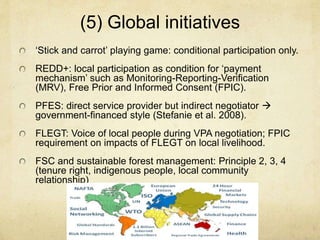
‘Stick and carrot’ playing game: conditional participation only.
REDD+: local participation as condition for ‘payment
mechanism’ such as Monitoring-Reporting-Verification
(MRV), Free Prior and Informed Consent (FPIC).
PFES: direct service provider but indirect negotiator 
government-financed style (Stefanie et al. 2008).
FLEGT: Voice of local people during VPA negotiation; FPIC
requirement on impacts of FLEGT on local livelihood.
FSC and sustainable forest management: Principle 2, 3, 4
(tenure right, indigenous people, local community
relationship)
(5) Findings
REDD+ program 2nd phase in Vietnam: still in ‘capacity
building’ step (US$ 30 mil. 2013-2018)
PES: not yet operated in Hue province. Even when
operation, very low payment estimated: US$ 8 –
10/ha/yr (vs. US$ 15,000/ha of rubber trees).
VPA/FLEGT: in process of negotiation, but potentially to
have negative impacts to forest dependent
communities, esp. for communities without land tenure
(VNGO-FLEGT, 2012).
FSC: budget for maintenance of small group
certification (FPD Quang Tri, 2012).
 Strong movement of supporting CFM in forest
Case study: PFES in Vietnam
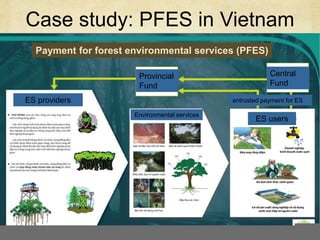
Payment for forest environmental services (PFES)
Provincial
Fund
Central
Fund
entrusted payment for ESES providers
ES users
Environmental services
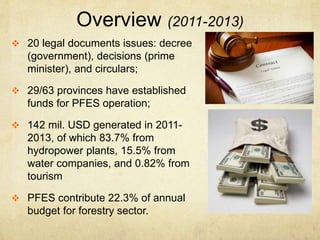
Overview (2011-2013)
 20 legal documents issues: decree
(government), decisions (prime
minister), and circulars;
 29/63 provinces have established
funds for PFES operation;
 142 mil. USD generated in 2011-
2013, of which 83.7% from
hydropower plants, 15.5% from
water companies, and 0.82% from
tourism
 PFES contribute 22.3% of annual
budget for forestry sector.
1. Low rate of disbursement (46%)
 Incomplete forest
inventory
 Slow/insecure land tenure
 Too many & scattered
numbers of ES providers
 high transaction costs
 Weak coordination among
agencies
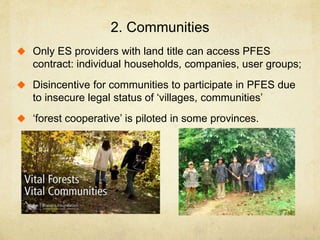
2. Communities
 Only ES providers with land title can access PFES
contract: individual households, companies, user groups;
 Disincentive for communities to participate in PFES due
to insecure legal status of ‘villages, communities’
 ‘forest cooperative’ is piloted in some provinces.
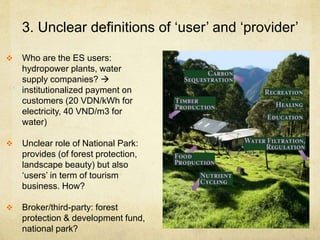
3. Unclear definitions of ‘user’ and ‘provider’
 Who are the ES users:
hydropower plants, water
supply companies? 
institutionalized payment on
customers (20 VDN/kWh for
electricity, 40 VND/m3 for
water)
 Unclear role of National Park:
provides (of forest protection,
landscape beauty) but also
‘users’ in term of tourism
business. How?
 Broker/third-party: forest
protection & development fund,
national park?
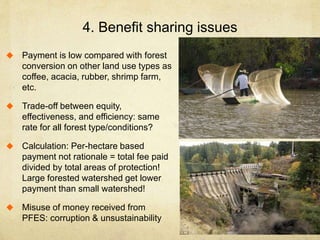
4. Benefit sharing issues
 Payment is low compared with forest
conversion on other land use types as
coffee, acacia, rubber, shrimp farm,
etc.
 Trade-off between equity,
effectiveness, and efficiency: same
rate for all forest type/conditions?
 Calculation: Per-hectare based
payment not rationale = total fee paid
divided by total areas of protection!
Large forested watershed get lower
payment than small watershed!
 Misuse of money received from
PFES: corruption & unsustainability
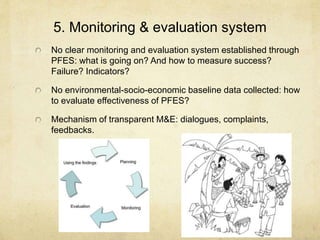
5. Monitoring & evaluation system
No clear monitoring and evaluation system established through
PFES: what is going on? And how to measure success?
Failure? Indicators?
No environmental-socio-economic baseline data collected: how
to evaluate effectiveness of PFES?
Mechanism of transparent M&E: dialogues, complaints,
feedbacks.
Changing contexts that affect
CFM traditional approach
Legality of forest tenure required by most of multilateral
funding projects (KfW, WB, PES, REDD, FLEGT)
Capacity of technical and financial viability to manage
forest ecosystem (i.e. monitoring forest growth,
calculating CO2, conditionality of PES)
Well-structured community organizations and institutions
Strong law/institution enforcement in forest protection vs.
commercial plantation (forest encroachment)
Conflict resolution between members and among
communities in local context.
Questions for group
discussionGroup 1: Forest Protection Department (FPD)
 Being FPD, how could you help to promote local communities
to gain access to forest tenure under context of land use
competition?
Group 2: PES agency
 Describe approach to get payment from ES buyer
(hydropower plants & water companies) and pay/transfer that
payment to local communities for forest conservation.
Group 3: Local communities
 What challenges do you foresee in managing forests in context
of: degraded forests, high risk of conversion, low payment, and
weak in law enforcement?

Resilience of CFM Vietnam

  • 1.
    Community forest managementin Vietnam: Pathway towards resilience Dzung Tri Ngo ForDev/EM ETH Zurich, Swizerland Hue University of Agriculture & Forestry (HUAF), Vietnam
  • 2.
    Outline Vietnam forestry sector Conceptof the study Main findings Follow-up research
  • 3.
  • 4.
    Overview of Vietnam forestry Natural forest 75% Plantation 25% Foresttypes by origin Special use 15% Protection 34% Production 51% Forest types by function Woody 81% Bamboo 5% Mixed 6% Mangrove 1% Limestone 7% Natural forests Mature forest 54% Young forest 30% Bamboo 2% Industrial crops 12% Mangrove 2% Plantation forests Total forest areas = 14 mil. ha
  • 5.
  • 6.
    CFM in Vietnam 1990sdecentralization in forest management: state forestry  social forestry: multiple stakeholders in forest management (Sikor & Nguyen, 2006) Forest allocation: hand over forest tenure to local people for 50 year cycle. Forest owners vs. forest types: State forest management boards (protected areas), Military, local governments, private companies, state forest companies. Village communities, household groups, individual households; Natural forest, plantation; special-use forest (protected areas), watershed protection forests, production forest. By end of 2013, communities: 4%, HHs: 24%, state: 55%, unassigned: 16% in total 14 mil. ha (MARD 2013) Diversity of ‘community concept’: traditional village, household group, farmer club, farmer cooperative.
  • 7.
    Emerging issues Question onSFE: 130,000 ha of forest lost during 2007-2010 in central highland (MARD, 2012) Question on CFM: forest conversion to commercial land uses (Rubber, Coffee, Acacia); Question on ecosystem services: Flooding & landslide  unsecure local livelihood; Loss of biodiversity, carbon emission  global impacts Research ideas: 1. What has been wrong with forest allocation policy? 2. Why can’t local people manage forest effectively? 3. What should be enabling conditions for local people to practice sustainable forest conservation?
  • 8.
    1. Clearly definedboundaries 2. Congruence between rules and local conditions 3. Collective-choice arrangements 4. Monitoring 5. Graduated sanctions 6. Conflic-resolution mechanisms 7. Min.recognition of rights to organize 8. Nested enterprises Ideas for CFM resilience (Ostrom, 1990) (Elson, 2012) (Ostrom, 1990)
  • 9.
    Enabling conditions forCFM resilience What How Why
  • 10.
    (i) Forest tenure CFMin context of Vietnam: Allocated forest = long-term tenure for forest owner Contracted forest: short-term ‘tenure’ for protection (e.g. Payment for environmental service PES) Traditional forest: managed by local communities for a long time (with/out official recognition by the government) Bundle of property rights at 5 scales: access, withdrawal, management, exclusion, and alienation (Schlager and Osstrom, 1992) Forest tenure: Natural forest: only incremental stock of timber + NTFPs Plantation: all trees & NTFPs (new investment on bare land) Ecosystem services
  • 11.
    Analysis of foresttenure by different levels of rights in CFM Vietnam (Schlager & Ostrom 1992) * Question: Is long-term forest tenure (proprietor) a strong incentive for community to practice forest conservation?
  • 12.
    Why tenure isimportant for resilience? Incentives for long-term investment in allocated areas without concerns on inheritance/transfer to others; Better planning for forestry sector: long-term cycle of production of timber & services; Favorable conditions for resource mobilization; Encourage sustainable uses of natural resources (due to long-term profit) vs. destructed harvesting; Easily adapted with new change due to full rights of decision making power.
  • 13.
    (2) Business practices Setsof activities that local people apply to generate incomes for short-and-medium term benefits while investing in long-term benefits derived from their resources; Various examples on business activities include NTFP cultivation, tourism, hunting, recreation; Collaboration between private/NGOs with local people: rattan plantation, Acacia, medicinal herbs, and community-based ecotourism; Recent initiatives: Community Forest Enterprises (Macqueen 2013, Donovan 2010, WWF 2014)
  • 15.
    Enabling conditions fora successful community-forest enterprises (CFE) (Ngo et al. 2015)
  • 16.
    Why need businessin CFM? Allocated forests to local people = degraded forests  rehabilitation/protection only; Local livelihood: high rate of poverty  income generation vitally important as forest protection; Incentives for immediate and long-term effort for forest protection. Forest can only be protected well if they are part of local livelihood strategy (FAO, 2003)
  • 17.
    (3) Local participation& institutions Participation in forest allocation = decision making power in forest areas, types, management scheme, benefit sharing, and investment. Institutions = Formal/informal rules and norms that shape human interactions with other and nature (Hodgson, 2006) Local institutions can be in various forms/modalities: Informal institutions: traditional regulations that exist in communities and recognized by most of people; Formal institutions: designed by a village/tribal council and acknowledged by county/province/state through process of legislation; Formal institutions: functioning or non-functioning
  • 19.
    (3) Findings Low levelof community participation in forest allocation: forest types, forest areas, property rights, benefit sharing. Inactive attitude of communities towards forest management: consequence of long-term state management  less ownership over forest tenure. Traditional regulations (Katu and Pako ethnic minorities) exist but less active role in shaping local behaviors toward forest management. Reasons: conflict with ‘modern admin structure’ i.e. commune office, village board. Weak local institution (less collective action) in the household or group of household given economic and political setting.  Compared principles 3 & 7 (Ostrom, 1990), local participation & institutions are not viable enough for a self-sustaining community
  • 20.
    (4) Gov. &Non-Gov. supports Supports aim at creating more ‘incentives’ for local people to actively participate in forest management, protection, and utilization; Two types of supports: Create legal framework to enable local communities effectively manage forests; E.g. Rights and responsibilities of forest owners (Decision 178) Conduct particular programs/projects to support local initiatives in forest management. E.g., buffer-zone development, subsidy for plantation (Program 147) Somehow government supports can lead to ‘perverse’ incentives: good intention may create negative impacts on land, forest, and other resources (externalities). E.g. improving local livelihoods by transforming poor forest to rubber plantation caused thousands hectares of deforestation in central highland of Vietnam (Forest Trends 2013).
  • 21.
    (4) Findings Lack ofsupport in forest inventory – due to insufficient technical & financial support  caused inappropriate management plan; Benefit sharing mechanism: unclear between communities (& among members)  Low incentives for forest protection. (I get the meat, you eat the bone!) No support for business activities after allocation as well as market development, learning network  isolated communities/initiatives. Long-term payment for environmental service: available only with communities protecting watershed forest. Very low and weak support from the government (central and local authorities) in order to improve the livelihood of local forest recipients: incapable supporting staff.  Weak incentives and low capacity for community resilience in forest management.
  • 22.
    (5) Global initiatives ‘Stickand carrot’ playing game: conditional participation only. REDD+: local participation as condition for ‘payment mechanism’ such as Monitoring-Reporting-Verification (MRV), Free Prior and Informed Consent (FPIC). PFES: direct service provider but indirect negotiator  government-financed style (Stefanie et al. 2008). FLEGT: Voice of local people during VPA negotiation; FPIC requirement on impacts of FLEGT on local livelihood. FSC and sustainable forest management: Principle 2, 3, 4 (tenure right, indigenous people, local community relationship)
  • 23.
    (5) Findings REDD+ program2nd phase in Vietnam: still in ‘capacity building’ step (US$ 30 mil. 2013-2018) PES: not yet operated in Hue province. Even when operation, very low payment estimated: US$ 8 – 10/ha/yr (vs. US$ 15,000/ha of rubber trees). VPA/FLEGT: in process of negotiation, but potentially to have negative impacts to forest dependent communities, esp. for communities without land tenure (VNGO-FLEGT, 2012). FSC: budget for maintenance of small group certification (FPD Quang Tri, 2012).  Strong movement of supporting CFM in forest
  • 24.
    Case study: PFESin Vietnam Payment for forest environmental services (PFES) Provincial Fund Central Fund entrusted payment for ESES providers ES users Environmental services
  • 25.
    Overview (2011-2013)  20legal documents issues: decree (government), decisions (prime minister), and circulars;  29/63 provinces have established funds for PFES operation;  142 mil. USD generated in 2011- 2013, of which 83.7% from hydropower plants, 15.5% from water companies, and 0.82% from tourism  PFES contribute 22.3% of annual budget for forestry sector.
  • 26.
    1. Low rateof disbursement (46%)  Incomplete forest inventory  Slow/insecure land tenure  Too many & scattered numbers of ES providers  high transaction costs  Weak coordination among agencies
  • 27.
    2. Communities  OnlyES providers with land title can access PFES contract: individual households, companies, user groups;  Disincentive for communities to participate in PFES due to insecure legal status of ‘villages, communities’  ‘forest cooperative’ is piloted in some provinces.
  • 28.
    3. Unclear definitionsof ‘user’ and ‘provider’  Who are the ES users: hydropower plants, water supply companies?  institutionalized payment on customers (20 VDN/kWh for electricity, 40 VND/m3 for water)  Unclear role of National Park: provides (of forest protection, landscape beauty) but also ‘users’ in term of tourism business. How?  Broker/third-party: forest protection & development fund, national park?
  • 29.
    4. Benefit sharingissues  Payment is low compared with forest conversion on other land use types as coffee, acacia, rubber, shrimp farm, etc.  Trade-off between equity, effectiveness, and efficiency: same rate for all forest type/conditions?  Calculation: Per-hectare based payment not rationale = total fee paid divided by total areas of protection! Large forested watershed get lower payment than small watershed!  Misuse of money received from PFES: corruption & unsustainability
  • 30.
    5. Monitoring &evaluation system No clear monitoring and evaluation system established through PFES: what is going on? And how to measure success? Failure? Indicators? No environmental-socio-economic baseline data collected: how to evaluate effectiveness of PFES? Mechanism of transparent M&E: dialogues, complaints, feedbacks.
  • 31.
    Changing contexts thataffect CFM traditional approach Legality of forest tenure required by most of multilateral funding projects (KfW, WB, PES, REDD, FLEGT) Capacity of technical and financial viability to manage forest ecosystem (i.e. monitoring forest growth, calculating CO2, conditionality of PES) Well-structured community organizations and institutions Strong law/institution enforcement in forest protection vs. commercial plantation (forest encroachment) Conflict resolution between members and among communities in local context.
  • 32.
    Questions for group discussionGroup1: Forest Protection Department (FPD)  Being FPD, how could you help to promote local communities to gain access to forest tenure under context of land use competition? Group 2: PES agency  Describe approach to get payment from ES buyer (hydropower plants & water companies) and pay/transfer that payment to local communities for forest conservation. Group 3: Local communities  What challenges do you foresee in managing forests in context of: degraded forests, high risk of conversion, low payment, and weak in law enforcement?