iMinds 2011

Variability in the Cloud

    Multi-tenancy
          vs
    Virtualisation


           Koen.Handekyn@unifiedpost.com
Agenda

UnifiedPost


The Challange: Service Product Lines in a Cloud Context


Architectural Variations


Application Level Multitenancy challanges


Project Results
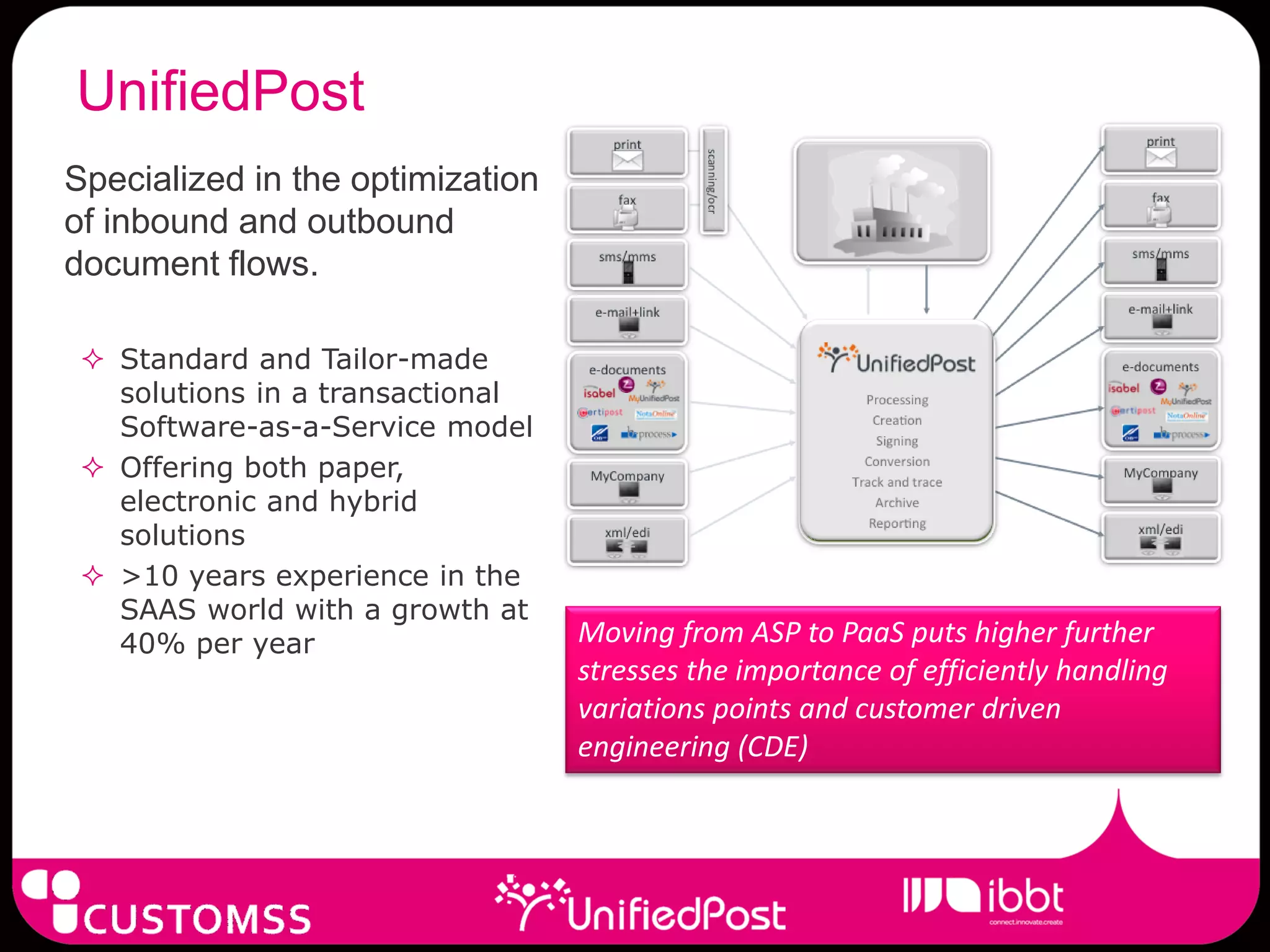
UnifiedPost
Specialized in the optimization
of inbound and outbound
document flows.

  Standard and Tailor-made
   solutions in a transactional
   Software-as-a-Service model
  Offering both paper,
   electronic and hybrid
   solutions
  >10 years experience in the
   SAAS world with a growth at
   40% per year                   Moving from ASP to PaaS puts higher further
                                  stresses the importance of efficiently handling
                                  variations points and customer driven
                                  engineering (CDE)
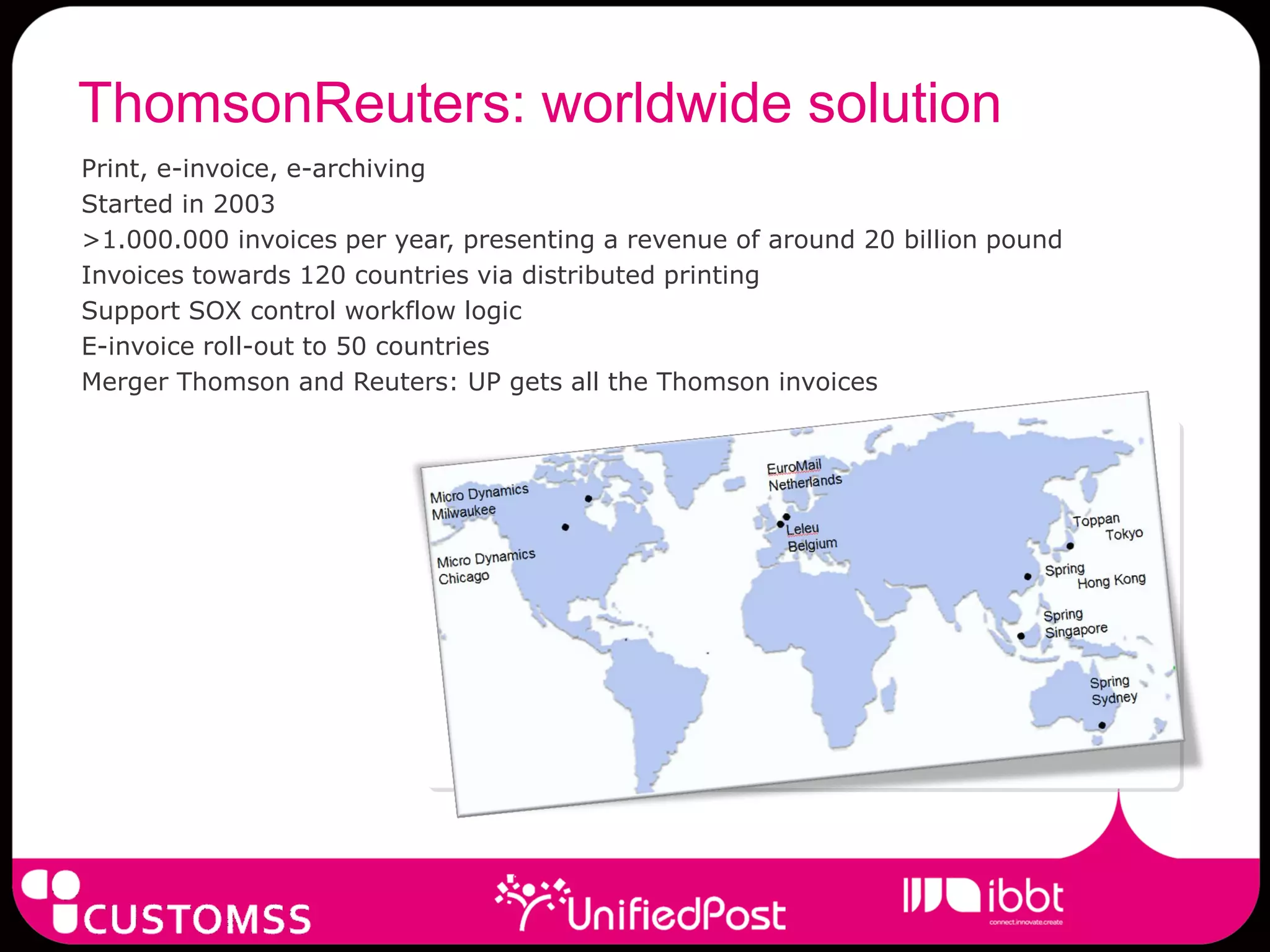
ThomsonReuters: worldwide solution
Print, e-invoice, e-archiving
Started in 2003
>1.000.000 invoices per year, presenting a revenue of around 20 billion pound
Invoices towards 120 countries via distributed printing
Support SOX control workflow logic
E-invoice roll-out to 50 countries
Merger Thomson and Reuters: UP gets all the Thomson invoices
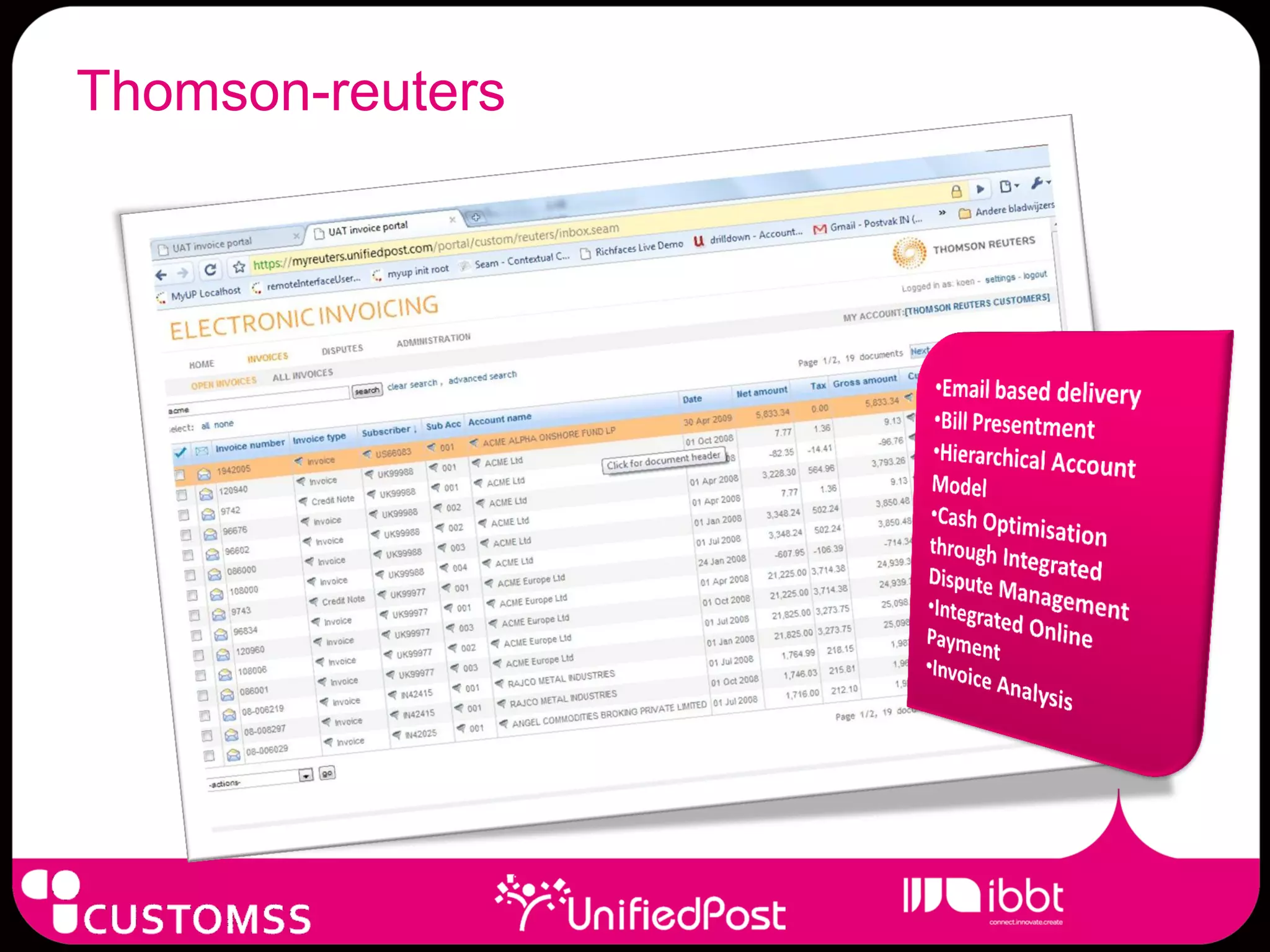
Thomson-reuters
MultiTenant Platform Overview

 refers to a principle in software


                                                                                                         Community


                                                                                                                             Convert
                                                                Receive


                                                                          Receive


                                                                                    Archive


                                                                                                                                                              Render
                                                                                                SocSec
  architecture where a single instance of


                                                                                                           Closed
                                                                           Portal
                                                     Send


                                                                           Send


                                                                                                                                                      Send
                                                                                                                                               Sign
                                                                                                                      CAS


                                                                                                                                       Pay
                                                      UP


                                                                  UP


                                                                            UP


                                                                                      UP


                                                                                                  UP


                                                                                                             UP
  the software runs on a server, serving multiple
  client organizations (tenants).                                         Solutions                                             Services
                                                                                                              Docstore
                                                        DocFlow:                  [receive]                                            User Manager: Multi
 is contrasted with a multi-instance architecture   batch processing          Input Channels
                                                                                                             Alexandria
                                                                                                                Temp
                                                                                                                                          Identity, SSO
                                                                                                                                        Space auth. model
                                                                                                           Static Content
  where separate software instances (or               ReatTime Doc
                                                        Services
                                                                                  [send]
                                                                              Output Channels
                                                                                                         Resource Mngmnt
                                                                                                                                                 Docs:
                                                                                                                Triples
                                                                                                                                             List, Actions,
  hardware systems) are set up for different         Realtime Payment         [offline payments]
                                                                                                                 SQL
                                                                                                          Distributed Hash
                                                                                                                                               Workflow
                                                          Services            Payment Channels
  client organizations. With a multitenant
  architecture, a software application is                                             Core Services
                                                        Processing                Channels                   Persistence
                                                                                                                                                 App
  designed to virtually partition its data and           & Service
                                                         Platform
                                                                                     &
                                                                                 Connectors
                                                                                                                  &
                                                                                                              Streaming
                                                                                                                                               Platform

  configuration, and each client organization                               Foundation Middleware
  works with a customized virtual application               Development :                     Operations :                       Business Intelligence

  instance.                                                                   Support Components
 is also regarded as one of the essential
  attributes of Cloud Computing.

[ wikipedia ]
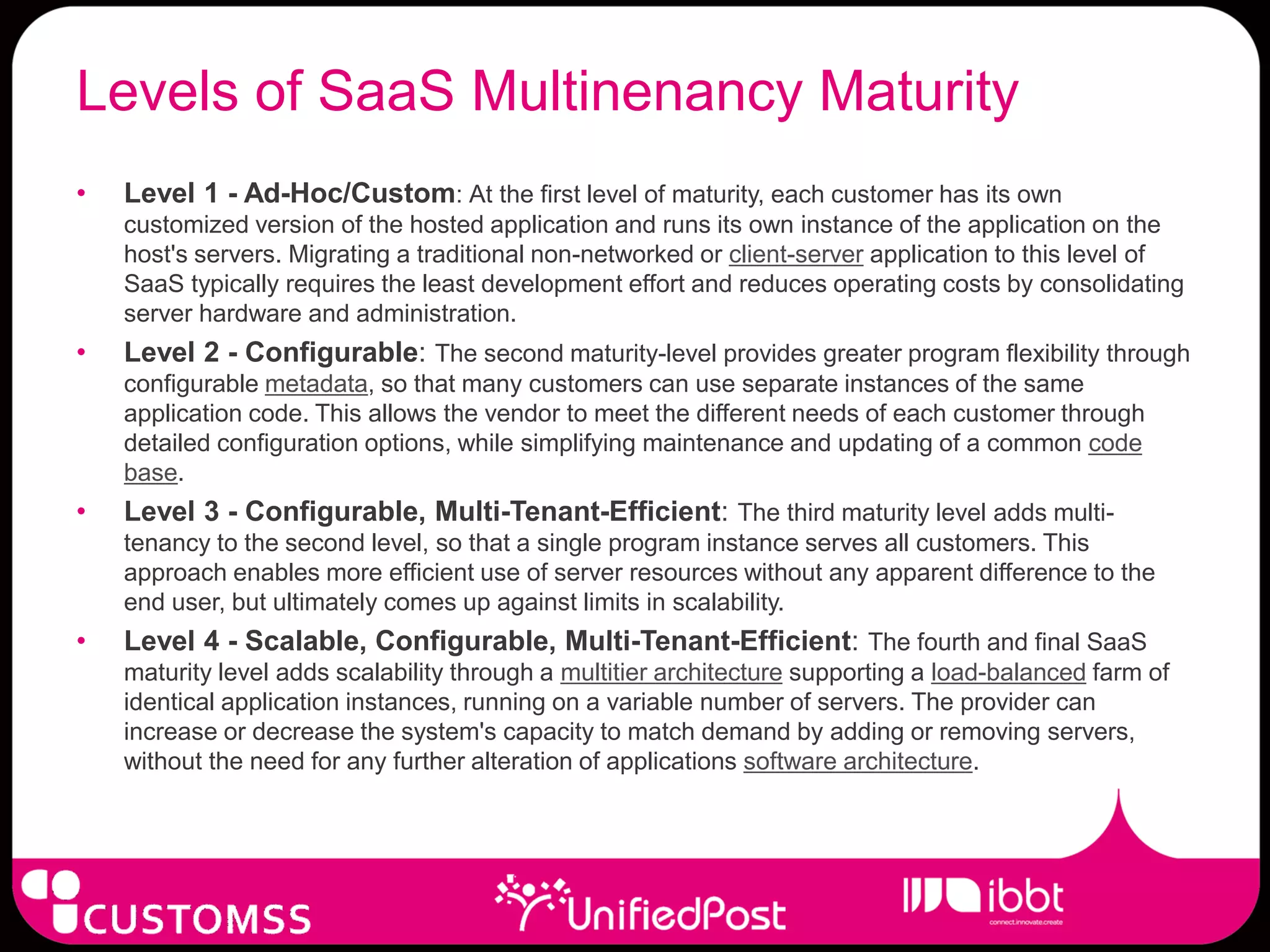
Levels of SaaS Multinenancy Maturity
•   Level 1 - Ad-Hoc/Custom: At the first level of maturity, each customer has its own
    customized version of the hosted application and runs its own instance of the application on the
    host's servers. Migrating a traditional non-networked or client-server application to this level of
    SaaS typically requires the least development effort and reduces operating costs by consolidating
    server hardware and administration.
•   Level 2 - Configurable: The second maturity-level provides greater program flexibility through
    configurable metadata, so that many customers can use separate instances of the same
    application code. This allows the vendor to meet the different needs of each customer through
    detailed configuration options, while simplifying maintenance and updating of a common code
    base.
•   Level 3 - Configurable, Multi-Tenant-Efficient: The third maturity level adds multi-
    tenancy to the second level, so that a single program instance serves all customers. This
    approach enables more efficient use of server resources without any apparent difference to the
    end user, but ultimately comes up against limits in scalability.
•   Level 4 - Scalable, Configurable, Multi-Tenant-Efficient: The fourth and final SaaS
    maturity level adds scalability through a multitier architecture supporting a load-balanced farm of
    identical application instances, running on a variable number of servers. The provider can
    increase or decrease the system's capacity to match demand by adding or removing servers,
    without the need for any further alteration of applications software architecture.
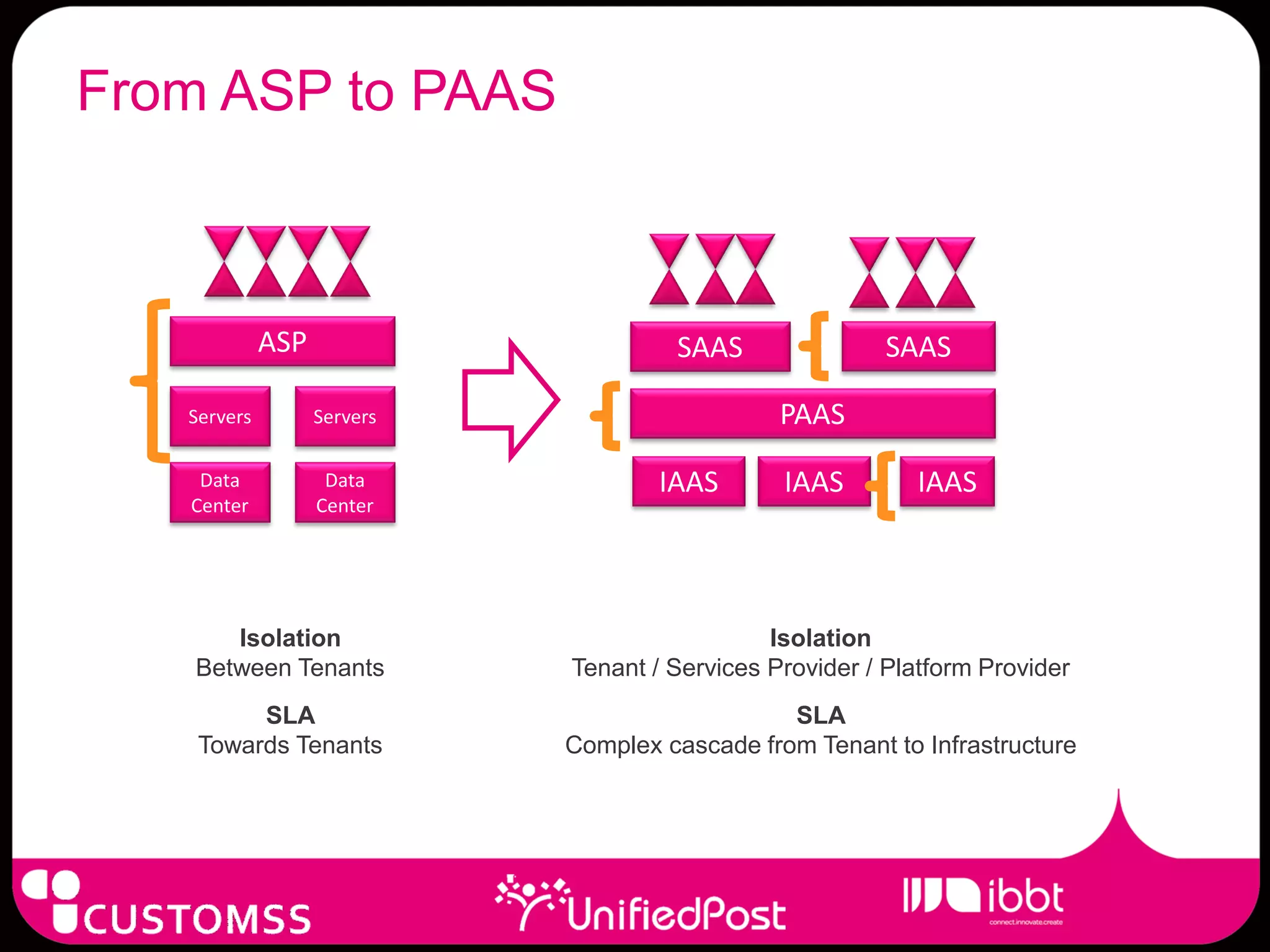
From ASP to PAAS


             ASP                      SAAS               SAAS

   Servers         Servers                      PAAS
    Data            Data             IAAS       IAAS        IAAS
   Center          Center


      Isolation                                Isolation
   Between Tenants           Tenant / Services Provider / Platform Provider
         SLA                                    SLA
    Towards Tenants          Complex cascade from Tenant to Infrastructure
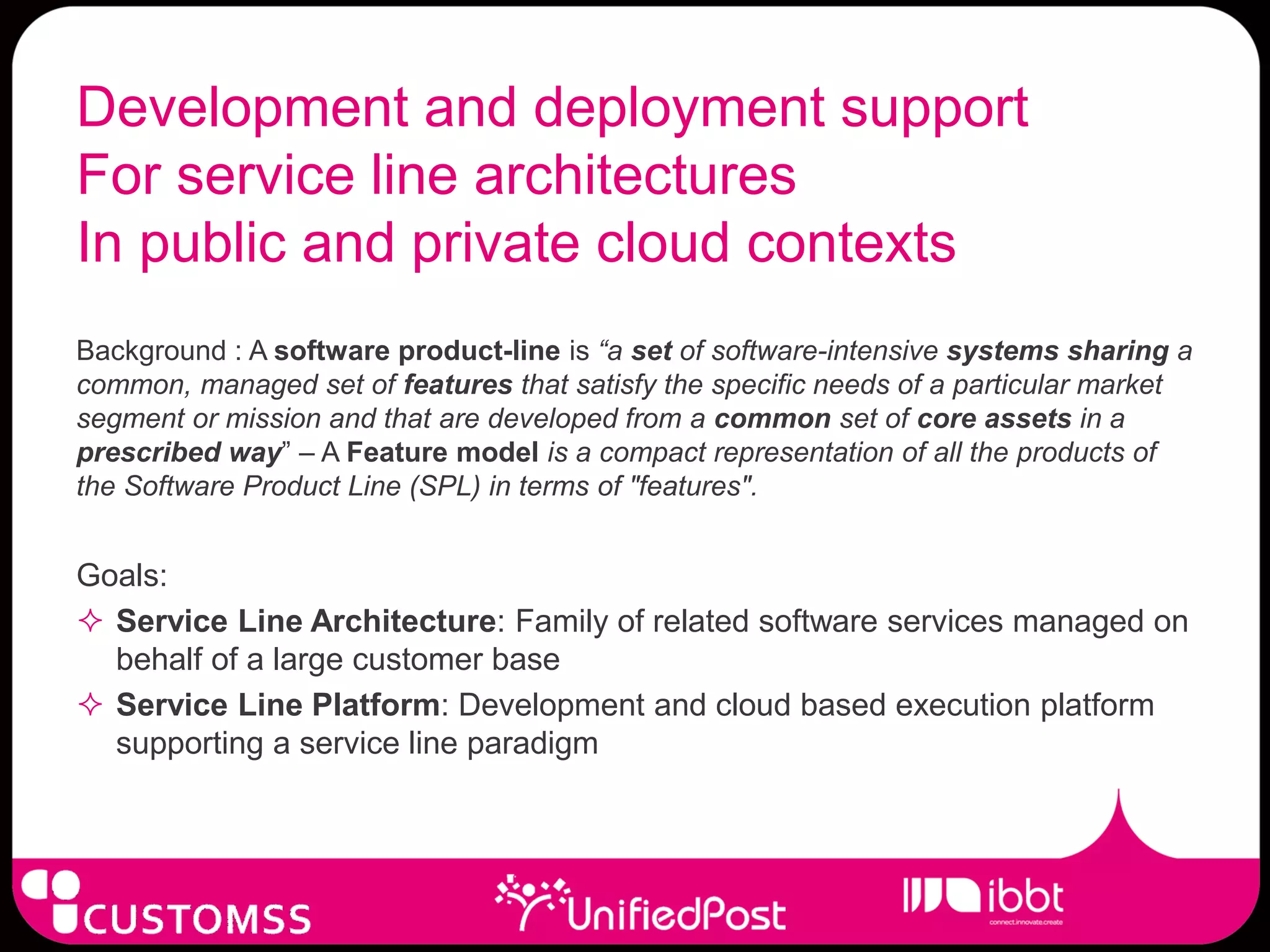
Development and deployment support
For service line architectures
In public and private cloud contexts
Background : A software product-line is “a set of software-intensive systems sharing a
common, managed set of features that satisfy the specific needs of a particular market
segment or mission and that are developed from a common set of core assets in a
prescribed way” – A Feature model is a compact representation of all the products of
the Software Product Line (SPL) in terms of "features".


Goals:
 Service Line Architecture: Family of related software services managed on
  behalf of a large customer base
 Service Line Platform: Development and cloud based execution platform
  supporting a service line paradigm
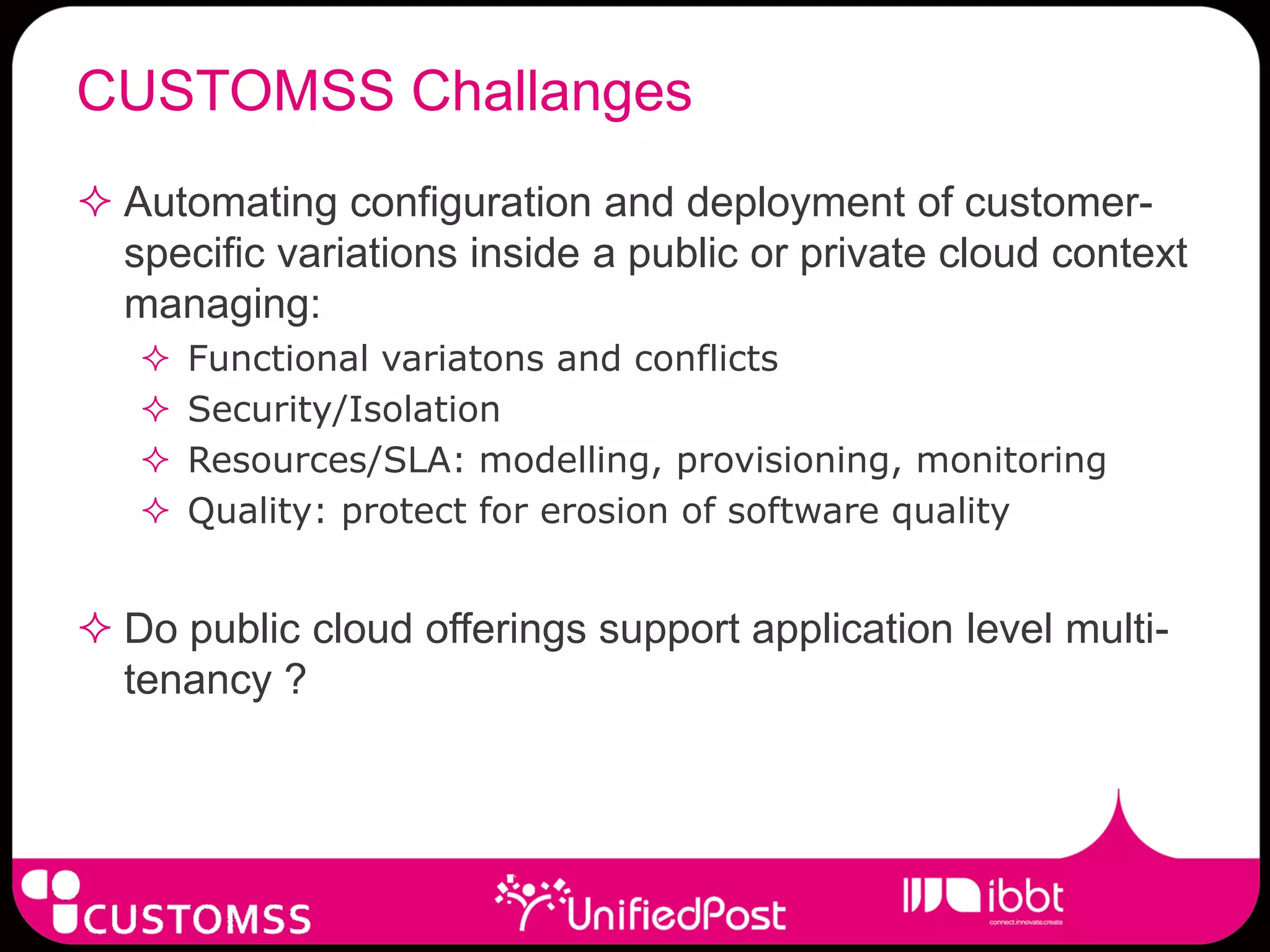
CUSTOMSS Challanges
 Automating configuration and deployment of customer-
  specific variations inside a public or private cloud context
  managing:
      Functional variatons and conflicts
      Security/Isolation
      Resources/SLA: modelling, provisioning, monitoring
      Quality: protect for erosion of software quality


 Do public cloud offerings support application level multi-
  tenancy ?
Solving Variability through
    Virtualisation
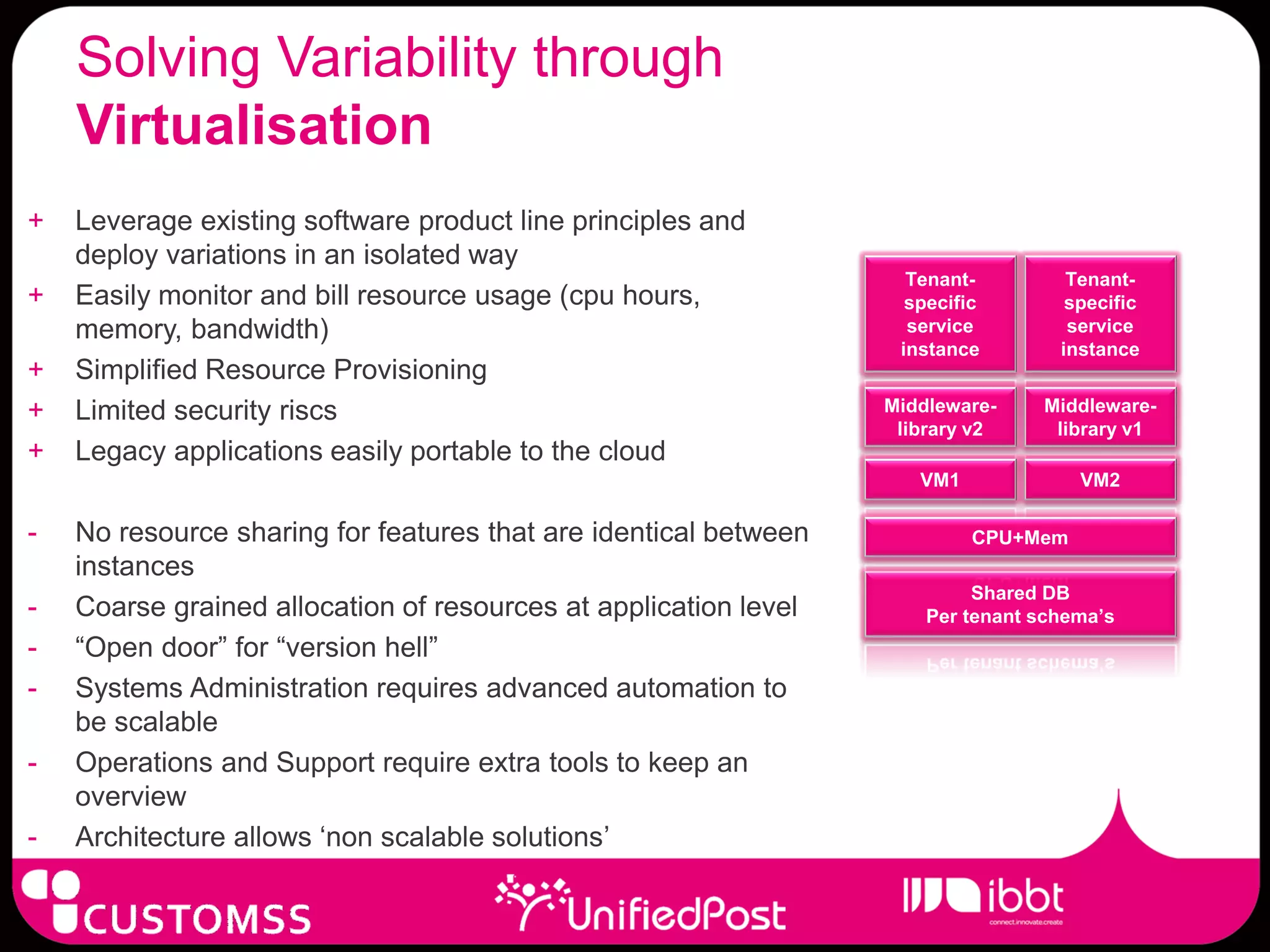
+   Leverage existing software product line principles and
    deploy variations in an isolated way
                                                                    Tenant-         Tenant-
+   Easily monitor and bill resource usage (cpu hours,              specific        specific
    memory, bandwidth)                                              service         service
                                                                   instance        instance
+   Simplified Resource Provisioning
+   Limited security riscs                                        Middleware-    Middleware-
                                                                   library v2     library v1
+   Legacy applications easily portable to the cloud
                                                                     VM1             VM2

-   No resource sharing for features that are identical between            CPU+Mem
    instances
                                                                           Shared DB
-   Coarse grained allocation of resources at application level       Per tenant schema’s
-   “Open door” for “version hell”
-   Systems Administration requires advanced automation to
    be scalable
-   Operations and Support require extra tools to keep an
    overview
-   Architecture allows „non scalable solutions‟
Solving Variability through
    Application Level Multitenancy
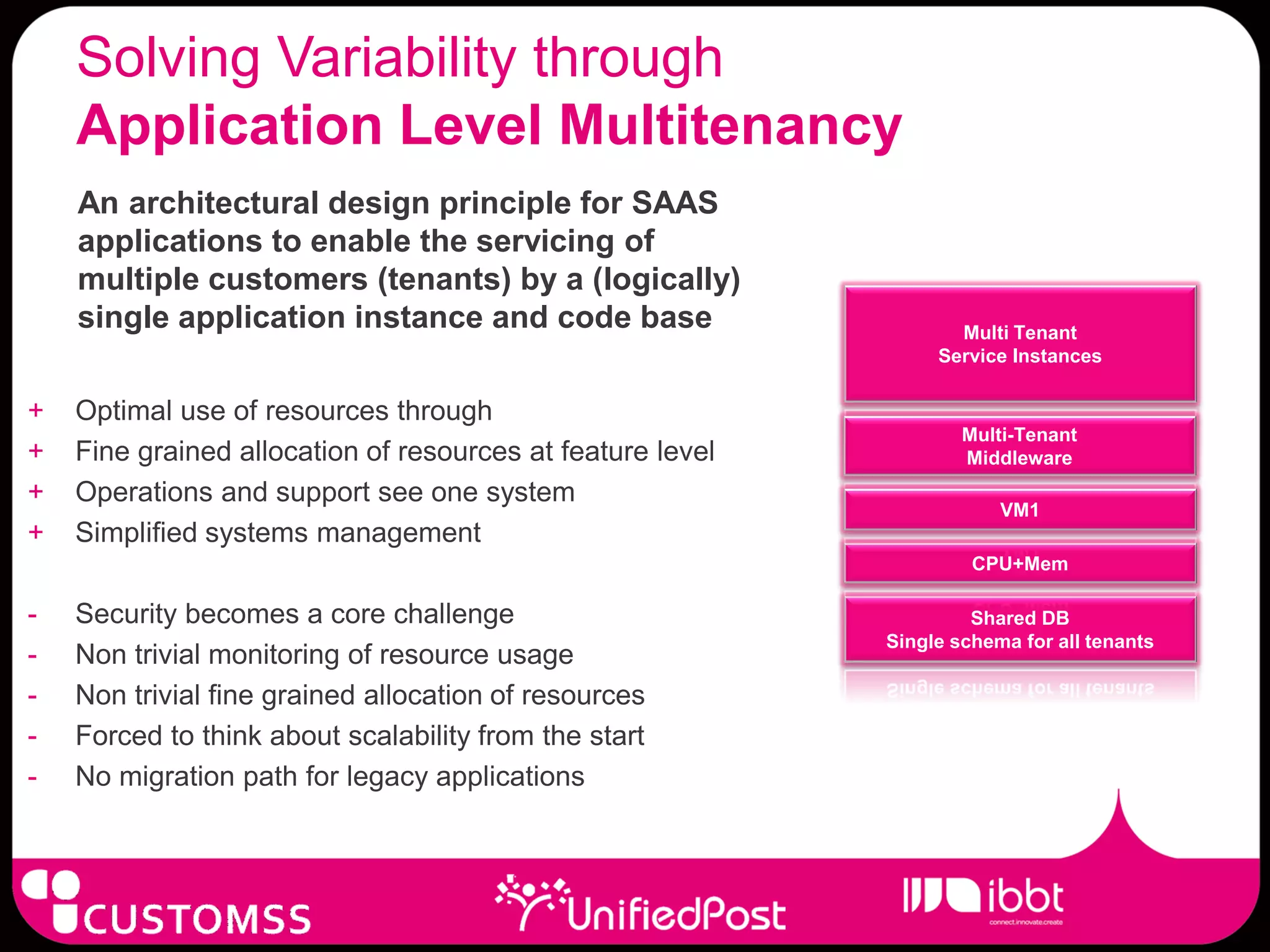
    An architectural design principle for SAAS
    applications to enable the servicing of
    multiple customers (tenants) by a (logically)
    single application instance and code base                      Multi Tenant
                                                                 Service Instances

+   Optimal use of resources through
                                                                    Multi-Tenant
+   Fine grained allocation of resources at feature level           Middleware
+   Operations and support see one system
                                                                        VM1
+   Simplified systems management
                                                                     CPU+Mem

-   Security becomes a core challenge                                Shared DB
                                                            Single schema for all tenants
-   Non trivial monitoring of resource usage
-   Non trivial fine grained allocation of resources
-   Forced to think about scalability from the start
-   No migration path for legacy applications
GAE Experiment (KULeuven)
with an on-line booking application
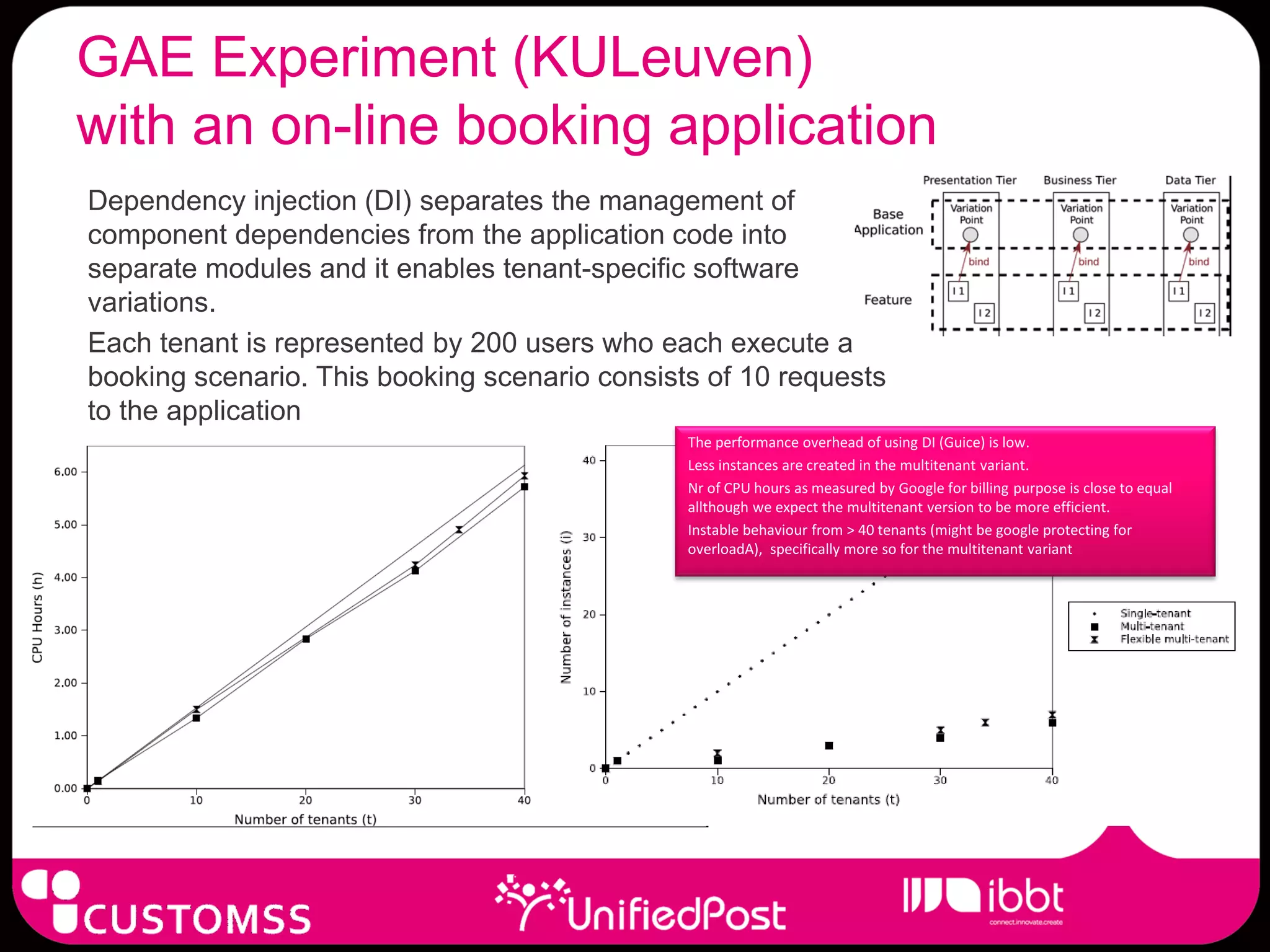
Dependency injection (DI) separates the management of
component dependencies from the application code into
separate modules and it enables tenant-specific software
variations.
Each tenant is represented by 200 users who each execute a
booking scenario. This booking scenario consists of 10 requests
to the application
                                               The performance overhead of using DI (Guice) is low.
                                               Less instances are created in the multitenant variant.
                                               Nr of CPU hours as measured by Google for billing purpose is close to equal
                                               allthough we expect the multitenant version to be more efficient.
                                               Instable behaviour from > 40 tenants (might be google protecting for
                                               overloadA), specifically more so for the multitenant variant
Reference Platform Architecture Java/.NET
(KULeuven)
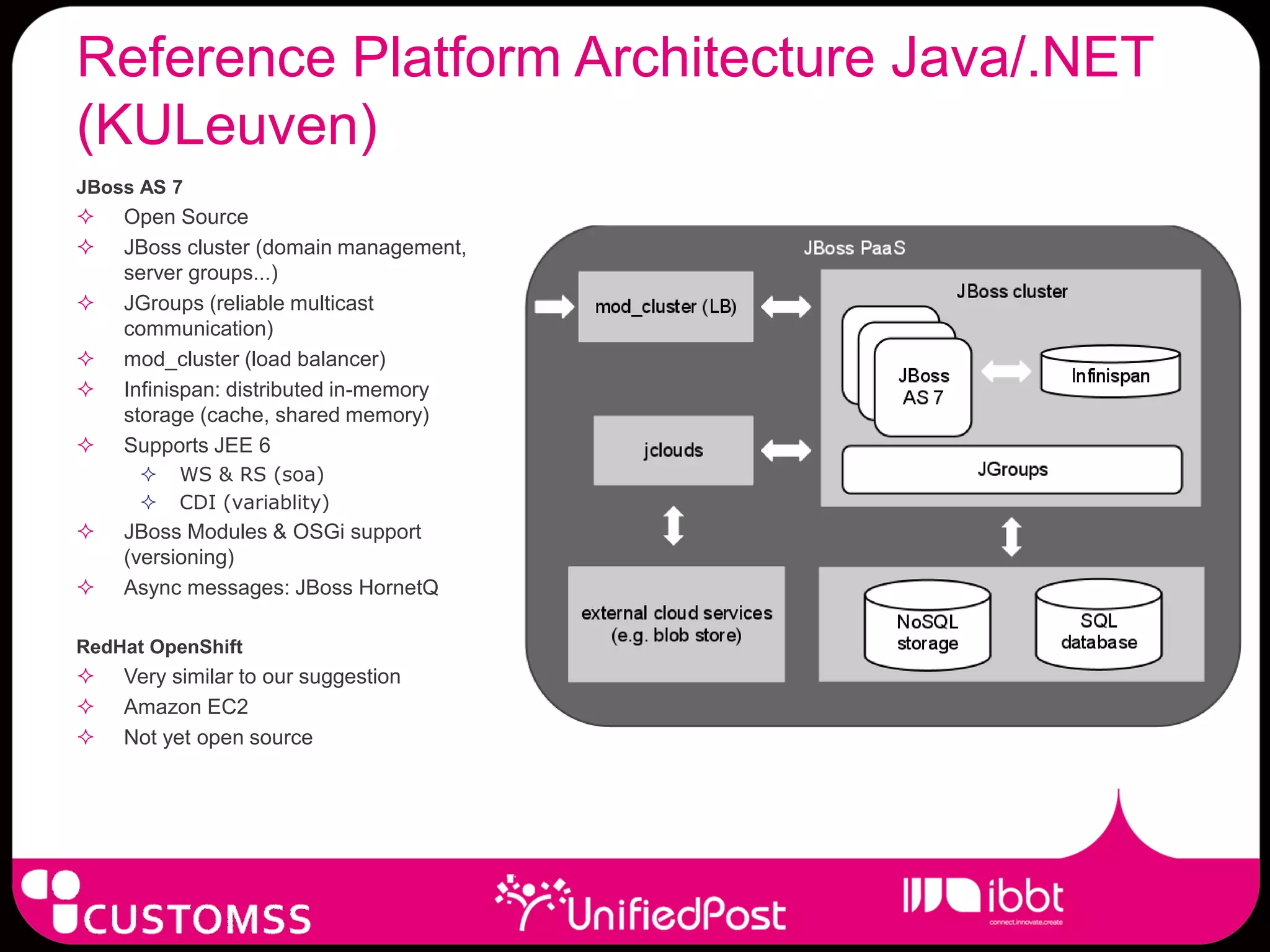
JBoss AS 7
   Open Source
   JBoss cluster (domain management,
    server groups...)
   JGroups (reliable multicast
    communication)
   mod_cluster (load balancer)
   Infinispan: distributed in-memory
    storage (cache, shared memory)
   Supports JEE 6
         WS & RS (soa)
         CDI (variablity)
   JBoss Modules & OSGi support
    (versioning)
   Async messages: JBoss HornetQ

RedHat OpenShift
   Very similar to our suggestion
   Amazon EC2
   Not yet open source
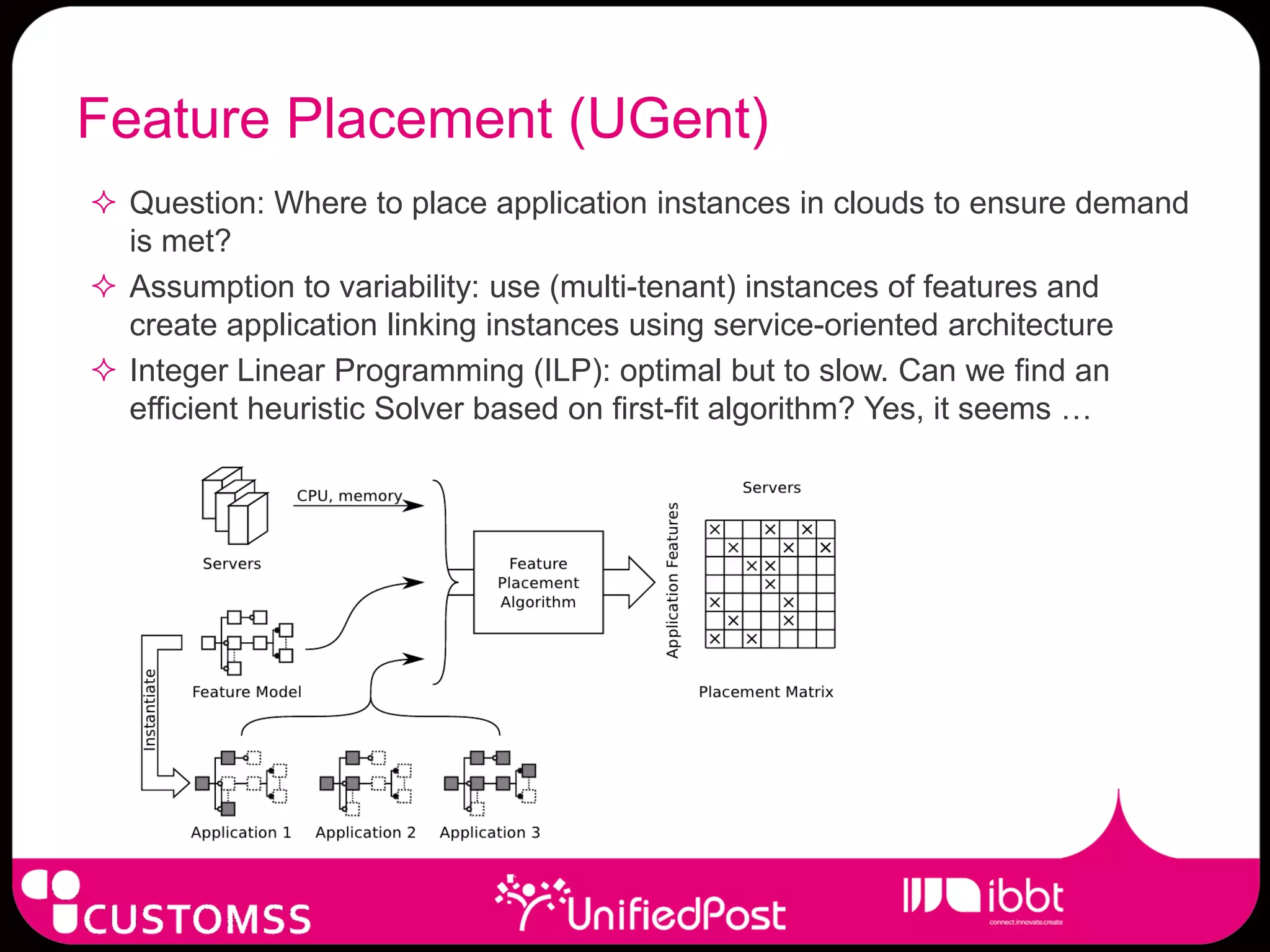
Feature Placement (UGent)
 Question: Where to place application instances in clouds to ensure demand
  is met?
 Assumption to variability: use (multi-tenant) instances of features and
  create application linking instances using service-oriented architecture
 Integer Linear Programming (ILP): optimal but to slow. Can we find an
  efficient heuristic Solver based on first-fit algorithm? Yes, it seems …
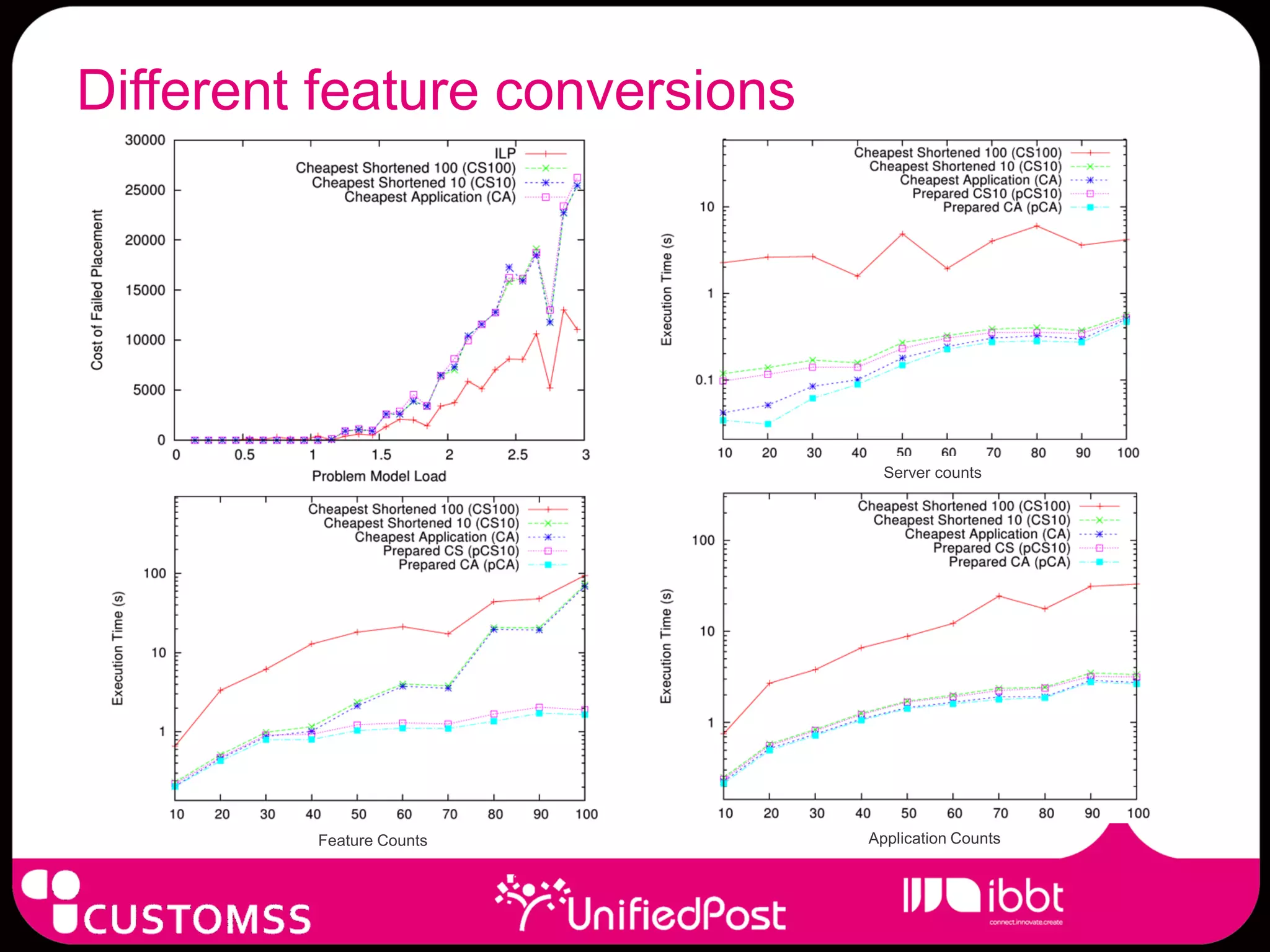
Different feature conversions


                                  Server counts


         Feature Counts         Application Counts

Koen Handekyn - Variability in the Cloud

  • 1.
    iMinds 2011 Variability inthe Cloud Multi-tenancy vs Virtualisation Koen.Handekyn@unifiedpost.com
  • 2.
    Agenda UnifiedPost The Challange: ServiceProduct Lines in a Cloud Context Architectural Variations Application Level Multitenancy challanges Project Results
  • 3.
    UnifiedPost Specialized in theoptimization of inbound and outbound document flows.  Standard and Tailor-made solutions in a transactional Software-as-a-Service model  Offering both paper, electronic and hybrid solutions  >10 years experience in the SAAS world with a growth at 40% per year Moving from ASP to PaaS puts higher further stresses the importance of efficiently handling variations points and customer driven engineering (CDE)
  • 4.
    ThomsonReuters: worldwide solution Print,e-invoice, e-archiving Started in 2003 >1.000.000 invoices per year, presenting a revenue of around 20 billion pound Invoices towards 120 countries via distributed printing Support SOX control workflow logic E-invoice roll-out to 50 countries Merger Thomson and Reuters: UP gets all the Thomson invoices
  • 5.
  • 6.
    MultiTenant Platform Overview refers to a principle in software Community Convert Receive Receive Archive Render SocSec architecture where a single instance of Closed Portal Send Send Send Sign CAS Pay UP UP UP UP UP UP the software runs on a server, serving multiple client organizations (tenants). Solutions Services Docstore DocFlow: [receive] User Manager: Multi  is contrasted with a multi-instance architecture batch processing Input Channels Alexandria Temp Identity, SSO Space auth. model Static Content where separate software instances (or ReatTime Doc Services [send] Output Channels Resource Mngmnt Docs: Triples List, Actions, hardware systems) are set up for different Realtime Payment [offline payments] SQL Distributed Hash Workflow Services Payment Channels client organizations. With a multitenant architecture, a software application is Core Services Processing Channels Persistence App designed to virtually partition its data and & Service Platform & Connectors & Streaming Platform configuration, and each client organization Foundation Middleware works with a customized virtual application Development : Operations : Business Intelligence instance. Support Components  is also regarded as one of the essential attributes of Cloud Computing. [ wikipedia ]
  • 7.
    Levels of SaaSMultinenancy Maturity • Level 1 - Ad-Hoc/Custom: At the first level of maturity, each customer has its own customized version of the hosted application and runs its own instance of the application on the host's servers. Migrating a traditional non-networked or client-server application to this level of SaaS typically requires the least development effort and reduces operating costs by consolidating server hardware and administration. • Level 2 - Configurable: The second maturity-level provides greater program flexibility through configurable metadata, so that many customers can use separate instances of the same application code. This allows the vendor to meet the different needs of each customer through detailed configuration options, while simplifying maintenance and updating of a common code base. • Level 3 - Configurable, Multi-Tenant-Efficient: The third maturity level adds multi- tenancy to the second level, so that a single program instance serves all customers. This approach enables more efficient use of server resources without any apparent difference to the end user, but ultimately comes up against limits in scalability. • Level 4 - Scalable, Configurable, Multi-Tenant-Efficient: The fourth and final SaaS maturity level adds scalability through a multitier architecture supporting a load-balanced farm of identical application instances, running on a variable number of servers. The provider can increase or decrease the system's capacity to match demand by adding or removing servers, without the need for any further alteration of applications software architecture.
  • 8.
    From ASP toPAAS ASP SAAS SAAS Servers Servers PAAS Data Data IAAS IAAS IAAS Center Center Isolation Isolation Between Tenants Tenant / Services Provider / Platform Provider SLA SLA Towards Tenants Complex cascade from Tenant to Infrastructure
  • 9.
    Development and deploymentsupport For service line architectures In public and private cloud contexts Background : A software product-line is “a set of software-intensive systems sharing a common, managed set of features that satisfy the specific needs of a particular market segment or mission and that are developed from a common set of core assets in a prescribed way” – A Feature model is a compact representation of all the products of the Software Product Line (SPL) in terms of "features". Goals:  Service Line Architecture: Family of related software services managed on behalf of a large customer base  Service Line Platform: Development and cloud based execution platform supporting a service line paradigm
  • 10.
    CUSTOMSS Challanges  Automatingconfiguration and deployment of customer- specific variations inside a public or private cloud context managing:  Functional variatons and conflicts  Security/Isolation  Resources/SLA: modelling, provisioning, monitoring  Quality: protect for erosion of software quality  Do public cloud offerings support application level multi- tenancy ?
  • 11.
    Solving Variability through Virtualisation + Leverage existing software product line principles and deploy variations in an isolated way Tenant- Tenant- + Easily monitor and bill resource usage (cpu hours, specific specific memory, bandwidth) service service instance instance + Simplified Resource Provisioning + Limited security riscs Middleware- Middleware- library v2 library v1 + Legacy applications easily portable to the cloud VM1 VM2 - No resource sharing for features that are identical between CPU+Mem instances Shared DB - Coarse grained allocation of resources at application level Per tenant schema’s - “Open door” for “version hell” - Systems Administration requires advanced automation to be scalable - Operations and Support require extra tools to keep an overview - Architecture allows „non scalable solutions‟
  • 12.
    Solving Variability through Application Level Multitenancy An architectural design principle for SAAS applications to enable the servicing of multiple customers (tenants) by a (logically) single application instance and code base Multi Tenant Service Instances + Optimal use of resources through Multi-Tenant + Fine grained allocation of resources at feature level Middleware + Operations and support see one system VM1 + Simplified systems management CPU+Mem - Security becomes a core challenge Shared DB Single schema for all tenants - Non trivial monitoring of resource usage - Non trivial fine grained allocation of resources - Forced to think about scalability from the start - No migration path for legacy applications
  • 13.
    GAE Experiment (KULeuven) withan on-line booking application Dependency injection (DI) separates the management of component dependencies from the application code into separate modules and it enables tenant-specific software variations. Each tenant is represented by 200 users who each execute a booking scenario. This booking scenario consists of 10 requests to the application The performance overhead of using DI (Guice) is low. Less instances are created in the multitenant variant. Nr of CPU hours as measured by Google for billing purpose is close to equal allthough we expect the multitenant version to be more efficient. Instable behaviour from > 40 tenants (might be google protecting for overloadA), specifically more so for the multitenant variant
  • 14.
    Reference Platform ArchitectureJava/.NET (KULeuven) JBoss AS 7  Open Source  JBoss cluster (domain management, server groups...)  JGroups (reliable multicast communication)  mod_cluster (load balancer)  Infinispan: distributed in-memory storage (cache, shared memory)  Supports JEE 6  WS & RS (soa)  CDI (variablity)  JBoss Modules & OSGi support (versioning)  Async messages: JBoss HornetQ RedHat OpenShift  Very similar to our suggestion  Amazon EC2  Not yet open source
  • 15.
    Feature Placement (UGent) Question: Where to place application instances in clouds to ensure demand is met?  Assumption to variability: use (multi-tenant) instances of features and create application linking instances using service-oriented architecture  Integer Linear Programming (ILP): optimal but to slow. Can we find an efficient heuristic Solver based on first-fit algorithm? Yes, it seems …
  • 16.
    Different feature conversions Server counts Feature Counts Application Counts