What is Cellular Respiration?
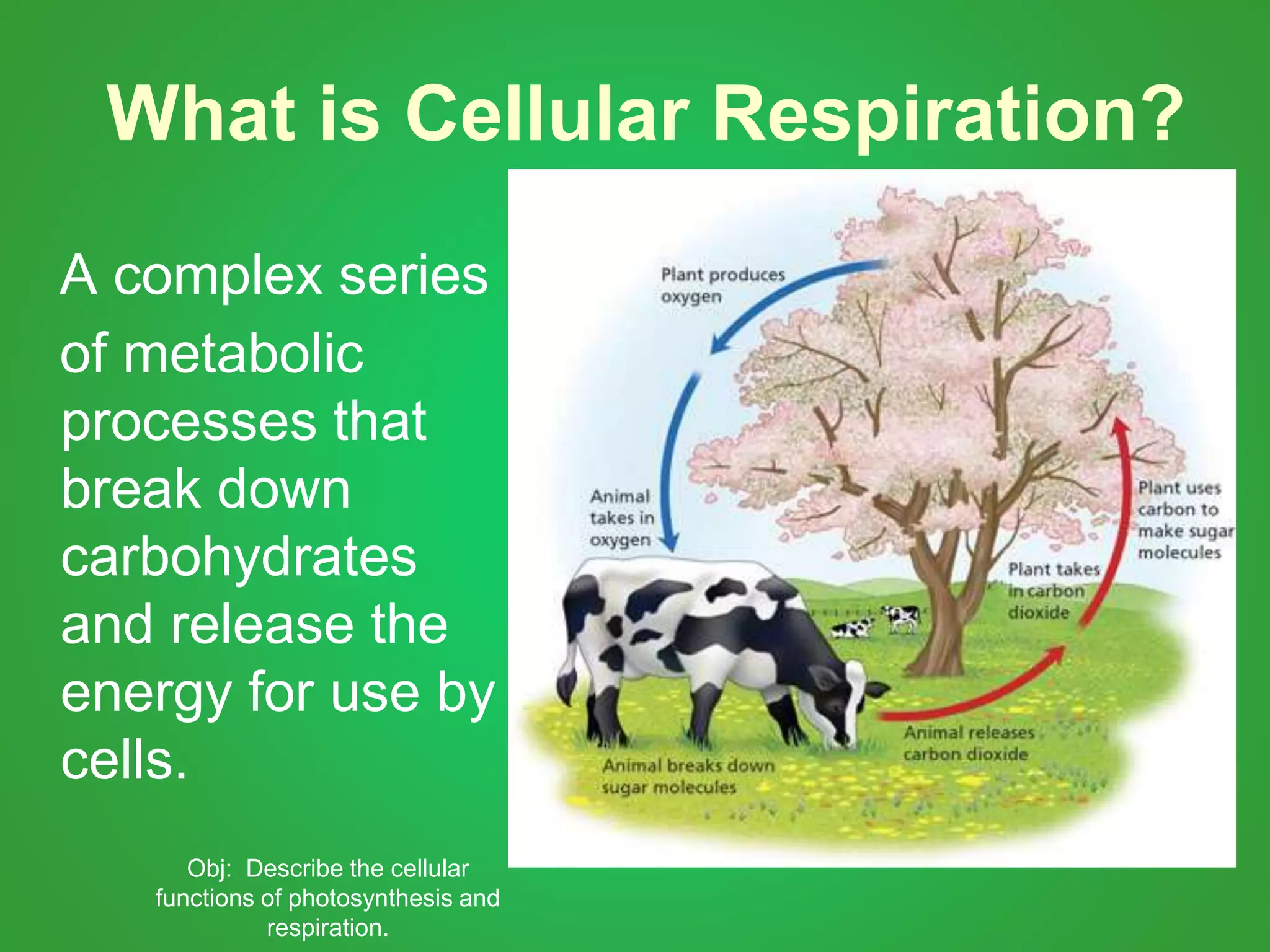
A complex series
of metabolic
processes that
break down
carbohydrates
and release the
energy for use by
cells.
Obj: Describe the cellular
functions of photosynthesis and
respiration.
9.1 Cellular Respiration: An Overview
• Food provides living things with the chemical
building blocks they need to grow &
reproduce
• For ALL organisms, food molecules contain
chemical energy that is released when
chemical bonds are broken!!
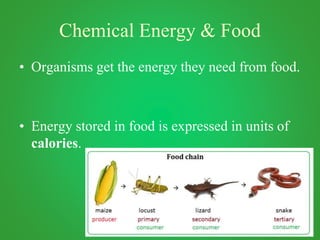
Chemical Energy & Food
• Organisms get the energy they need from food.
• Energy stored in food is expressed in units of
calories.
Chemical Energy & Food
• Food serves as a source of raw materials from
which cells can make new molecules (ATP=
energy)
• How much energy is in food?
– A calorie is the amount of energy needed to raise
the temperature of 1 gram of water 1 Celsius
degree
– A Calorie (used on food labels) is a kilocalorie or
1000 calories
Chemical Energy & Food
• Cells can use all sorts of food molecules
including fats, proteins, & carbohydrates.
• Example:
– 1 gram of glucose releases 3811 calories of heat
energy
– 1 gram of fat from beef releases 8893 calories of
heat energy
• SO- you get more energy per gram from
burning fats compared to burning glucose
Chemical Energy & Food
• Cells break down food gradually, capturing a
little bit of energy at key steps.
• This enables cells to use the energy stored in
the chemical bonds of foods like glucose to
produce compounds such as ATP that directly
power the activities of the cell.
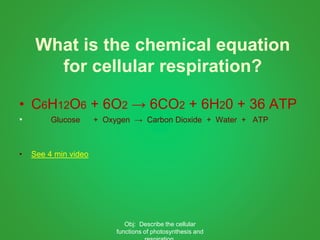
What is the chemical equation
for cellular respiration?
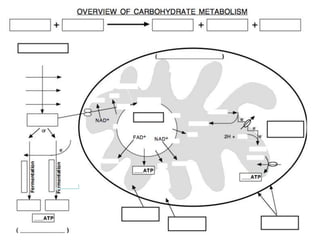
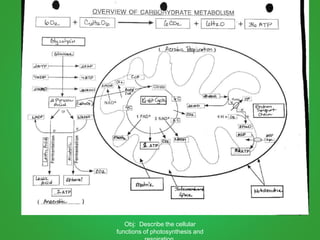
• C6H12O6 + 6O2 → 6CO2 + 6H20 + 36 ATP
• Glucose + Oxygen → Carbon Dioxide + Water + ATP
• See 4 min video
Obj: Describe the cellular
functions of photosynthesis and
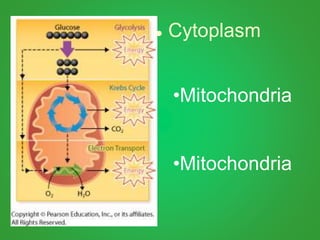
Overview of Cellular Respiration
In the presence of oxygen, glycolysis is followed
by the Krebs Cycle and electron transport chain
GLYCOLYSIS, KREBS CYCLE, & ETC make up
a process called cellular respiration or aerobic
respiration
Cellular respiration is the process that releases
energy by breaking down food molecules in the
presence of oxygen
● Cytoplasm
•Mitochondria
•Mitochondria
Oxygen & Energy
• Oxygen is required at the very end of the
ETC
• Most of the energy-releasing pathways within
cells require oxygen, and that is the reason
we need to breathe (respire)
• Pathways that require oxygen as said to be
aerobic (Ex. Krebs Cycle & ETC)
• Pathways that do not require oxygen are
anaerobic (Ex. Glycolysis & Fermentation)
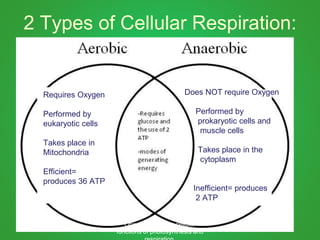
2 Types of Cellular Respiration:
Requires Oxygen
Performed by
eukaryotic cells
Takes place in
Mitochondria
Efficient=
produces 36 ATP
Does NOT require Oxygen
Performed by
prokaryotic cells and
muscle cells
Takes place in the
cytoplasm
Inefficient= produces
2 ATP
Obj: Describe the cellular
functions of photosynthesis and
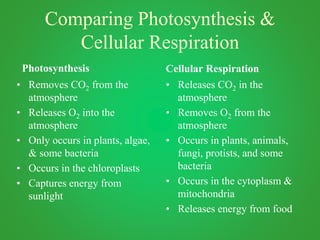
Comparing Photosynthesis &
Cellular Respiration
Photosynthesis
• Removes CO2 from the
atmosphere
• Releases O2 into the
atmosphere
• Only occurs in plants, algae,
& some bacteria
• Occurs in the chloroplasts
• Captures energy from
sunlight
Cellular Respiration
• Releases CO2 in the
atmosphere
• Removes O2 from the
atmosphere
• Occurs in plants, animals,
fungi, protists, and some
bacteria
• Occurs in the cytoplasm &
mitochondria
• Releases energy from food
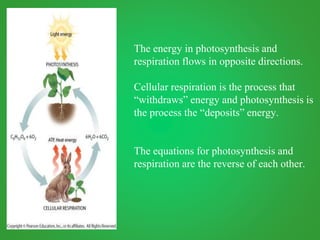
The energy in photosynthesis and
respiration flows in opposite directions.
Cellular respiration is the process that
“withdraws” energy and photosynthesis is
the process the “deposits” energy.
The equations for photosynthesis and
respiration are the reverse of each other.
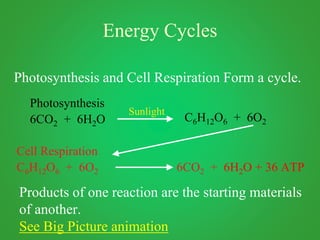
Energy Cycles
Photosynthesis and Cell Respiration Form a cycle.
Photosynthesis
6CO2 + 6H2O
Cell Respiration
C6H12O6 + 6O2 6CO2 + 6H2O + 36 ATP
Products of one reaction are the starting materials
of another.
See Big Picture animation
C6H12O6 + 6O2
Sunlight
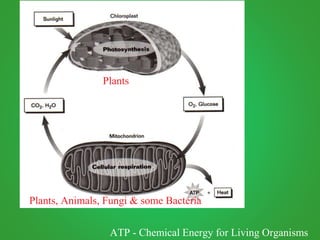
ATP - Chemical Energy for Living Organisms
Plants
Plants, Animals, Fungi & some Bacteria
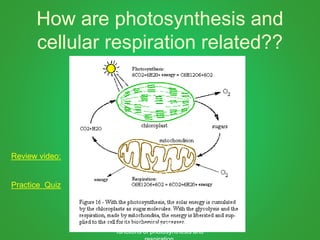
How are photosynthesis and
cellular respiration related??
Review video:
Practice Quiz
Obj: Describe the cellular
functions of photosynthesis and
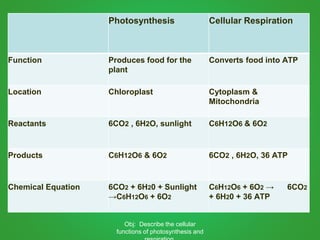
Photosynthesis Cellular Respiration
Function Produces food for the
plant
Converts food into ATP
Location Chloroplast Cytoplasm &
Mitochondria
Reactants 6CO2 , 6H2O, sunlight C6H12O6 & 6O2
Products C6H12O6 & 6O2 6CO2 , 6H2O, 36 ATP
Chemical Equation 6CO2 + 6H20 + Sunlight
→C6H12O6 + 6O2
C6H12O6 + 6O2 → 6CO2
+ 6H20 + 36 ATP
Obj: Describe the cellular
functions of photosynthesis and
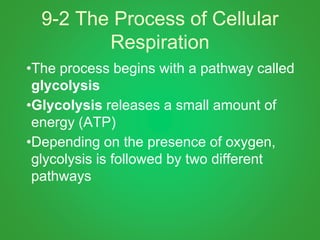
9-2 The Process of Cellular
Respiration
•The process begins with a pathway called
glycolysis
•Glycolysis releases a small amount of
energy (ATP)
•Depending on the presence of oxygen,
glycolysis is followed by two different
pathways
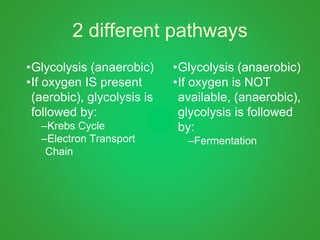
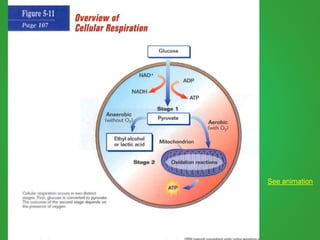
2 different pathways
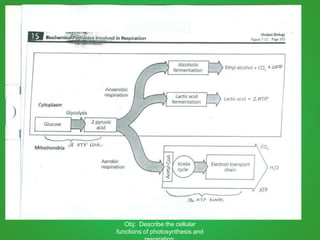
•Glycolysis (anaerobic)
•If oxygen IS present
(aerobic), glycolysis is
followed by:
–Krebs Cycle
–Electron Transport
Chain
•Glycolysis (anaerobic)
•If oxygen is NOT
available, (anaerobic),
glycolysis is followed
by:
–Fermentation
See animation
Glycolysis
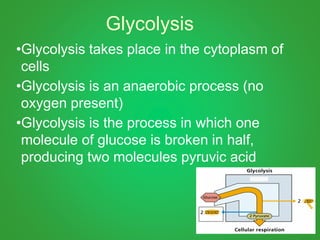
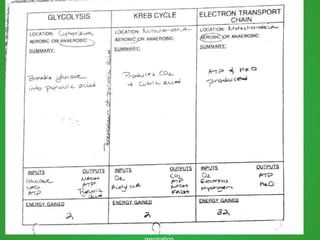
•Glycolysis takes place in the cytoplasm of
cells
•Glycolysis is an anaerobic process (no
oxygen present)
•Glycolysis is the process in which one
molecule of glucose is broken in half,
producing two molecules pyruvic acid
Glycolysis
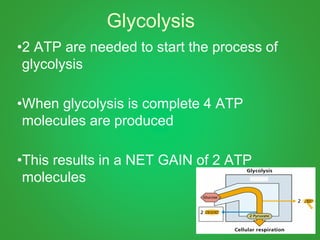
•2 ATP are needed to start the process of
glycolysis
•When glycolysis is complete 4 ATP
molecules are produced
•This results in a NET GAIN of 2 ATP
molecules
Glycolysis
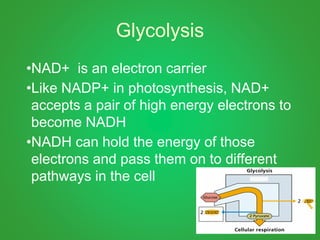
•NAD+ is an electron carrier
•Like NADP+ in photosynthesis, NAD+
accepts a pair of high energy electrons to
become NADH
•NADH can hold the energy of those
electrons and pass them on to different
pathways in the cell
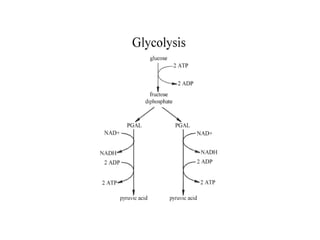
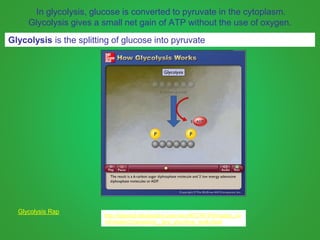
In glycolysis, glucose is converted to pyruvate in the cytoplasm.
Glycolysis gives a small net gain of ATP without the use of oxygen.
Glycolysis is the splitting of glucose into pyruvate
http://highered.mheducation.com/sites/0072507470/student_vie
w0/chapter25/animation__how_glycolysis_works.html
Glycolysis Rap
Fermentation
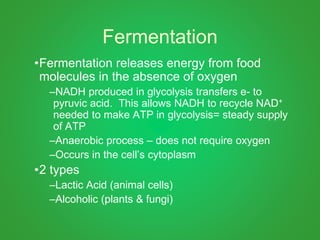
•Fermentation releases energy from food
molecules in the absence of oxygen
–NADH produced in glycolysis transfers e- to
pyruvic acid. This allows NADH to recycle NAD+
needed to make ATP in glycolysis= steady supply
of ATP
–Anaerobic process – does not require oxygen
–Occurs in the cell’s cytoplasm
•2 types
–Lactic Acid (animal cells)
–Alcoholic (plants & fungi)
•c
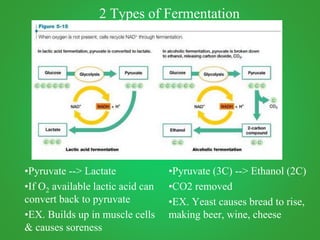
•Pyruvate (3C) --> Ethanol (2C)
•CO2 removed
•EX. Yeast causes bread to rise,
making beer, wine, cheese
•Pyruvate --> Lactate
•If O2 available lactic acid can
convert back to pyruvate
•EX. Builds up in muscle cells
& causes soreness
2 Types of Fermentation
Anaerobic Respiration/
Fermentation
• Two Types of Fermentation:
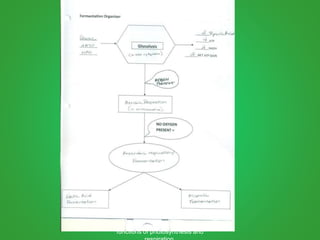
• 1. Alcoholic Fermentation: When oxygen is
not present, fermentation follows glycolysis,
regenerating NAD+ needed for glycolysis to
continue.
• 2. Lactic Acid Fermentation: In lactic acid
fermentation, pyruvate is converted to lactate.
Obj: Describe the cellular
functions of photosynthesis and
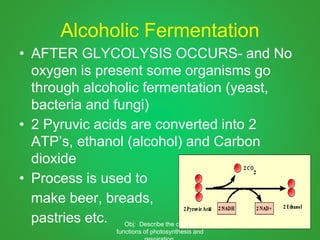
Alcoholic Fermentation
• AFTER GLYCOLYSIS OCCURS- and No
oxygen is present some organisms go
through alcoholic fermentation (yeast,
bacteria and fungi)
• 2 Pyruvic acids are converted into 2
ATP’s, ethanol (alcohol) and Carbon
dioxide
• Process is used to
make beer, breads,
pastries etc. Obj: Describe the cellular
functions of photosynthesis and
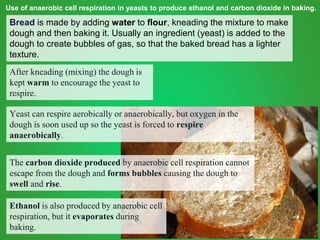
Use of anaerobic cell respiration in yeasts to produce ethanol and carbon dioxide in baking.
Ethanol is also produced by anaerobic cell
respiration, but it evaporates during
baking.
Bread is made by adding water to flour, kneading the mixture to make
dough and then baking it. Usually an ingredient (yeast) is added to the
dough to create bubbles of gas, so that the baked bread has a lighter
texture.
After kneading (mixing) the dough is
kept warm to encourage the yeast to
respire.
Yeast can respire aerobically or anaerobically, but oxygen in the
dough is soon used up so the yeast is forced to respire
anaerobically.
The carbon dioxide produced by anaerobic cell respiration cannot
escape from the dough and forms bubbles causing the dough to
swell and rise.
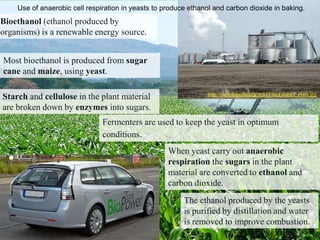
http://en.wikipedia.org/wiki/File:Ethanol_plant.jpg
Bioethanol (ethanol produced by
organisms) is a renewable energy source.
Use of anaerobic cell respiration in yeasts to produce ethanol and carbon dioxide in baking.
Most bioethanol is produced from sugar
cane and maize, using yeast.
Fermenters are used to keep the yeast in optimum
conditions.
When yeast carry out anaerobic
respiration the sugars in the plant
material are converted to ethanol and
carbon dioxide.
Starch and cellulose in the plant material
are broken down by enzymes into sugars.
The ethanol produced by the yeasts
is purified by distillation and water
is removed to improve combustion.
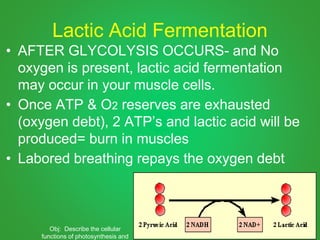
Lactic Acid Fermentation
• AFTER GLYCOLYSIS OCCURS- and No
oxygen is present, lactic acid fermentation
may occur in your muscle cells.
• Once ATP & O2 reserves are exhausted
(oxygen debt), 2 ATP’s and lactic acid will be
produced= burn in muscles
• Labored breathing repays the oxygen debt
Obj: Describe the cellular
functions of photosynthesis and
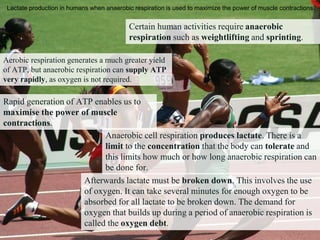
Lactate production in humans when anaerobic respiration is used to maximize the power of muscle contractions.
Certain human activities require anaerobic
respiration such as weightlifting and sprinting.
Rapid generation of ATP enables us to
maximise the power of muscle
contractions.
Aerobic respiration generates a much greater yield
of ATP, but anaerobic respiration can supply ATP
very rapidly, as oxygen is not required.
Anaerobic cell respiration produces lactate. There is a
limit to the concentration that the body can tolerate and
this limits how much or how long anaerobic respiration can
be done for.
Afterwards lactate must be broken down. This involves the use
of oxygen. It can take several minutes for enough oxygen to be
absorbed for all lactate to be broken down. The demand for
oxygen that builds up during a period of anaerobic respiration is
called the oxygen debt.
Obj: Describe the cellular
functions of photosynthesis and
Obj: Describe the cellular
functions of photosynthesis and
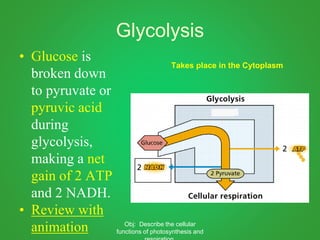
Glycolysis
• Glucose is
broken down
to pyruvate or
pyruvic acid
during
glycolysis,
making a net
gain of 2 ATP
and 2 NADH.
• Review with
animation
Takes place in the Cytoplasm
Obj: Describe the cellular
functions of photosynthesis and
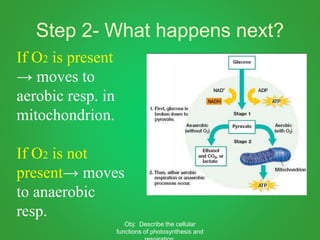
Step 2- What happens next?
If O2 is present
→ moves to
aerobic resp. in
mitochondrion.
If O2 is not
present→ moves
to anaerobic
resp.
Obj: Describe the cellular
functions of photosynthesis and
.
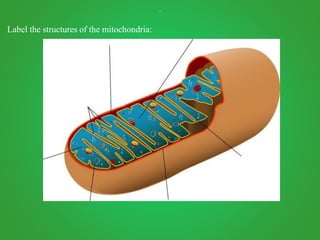
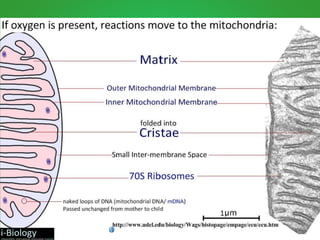
Label the structures of the mitochondria:
.
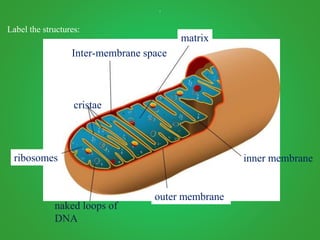
Label the structures:
matrix
Inter-membrane space
ribosomes inner membrane
outer membrane
naked loops of
DNA
cristae
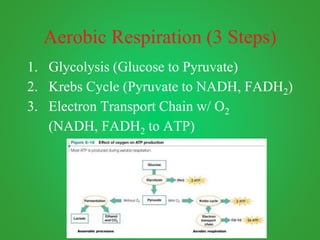
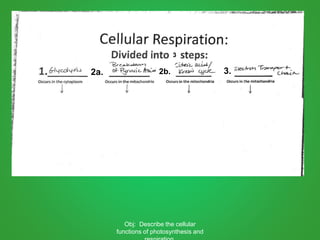
Aerobic Respiration (3 Steps)
1. Glycolysis (Glucose to Pyruvate)
2. Krebs Cycle (Pyruvate to NADH, FADH2)
3. Electron Transport Chain w/ O2
(NADH, FADH2 to ATP)
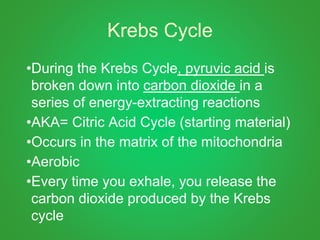
Krebs Cycle
•During the Krebs Cycle, pyruvic acid is
broken down into carbon dioxide in a
series of energy-extracting reactions
•AKA= Citric Acid Cycle (starting material)
•Occurs in the matrix of the mitochondria
•Aerobic
•Every time you exhale, you release the
carbon dioxide produced by the Krebs
cycle
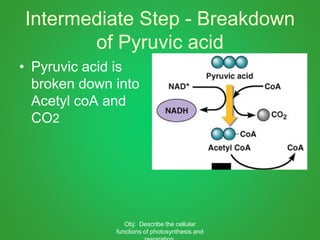
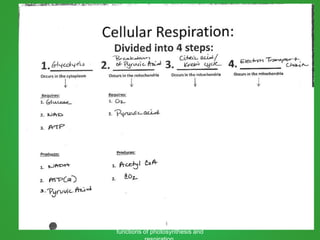
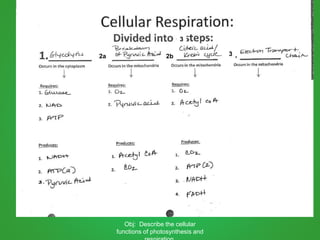
Intermediate Step - Breakdown
of Pyruvic acid
• Pyruvic acid is
broken down into
Acetyl coA and
CO2
Obj: Describe the cellular
functions of photosynthesis and
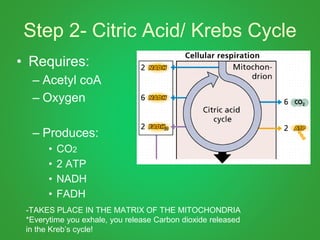
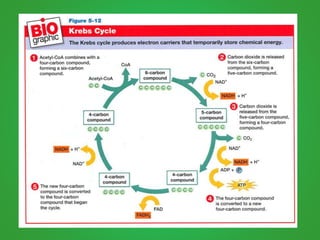
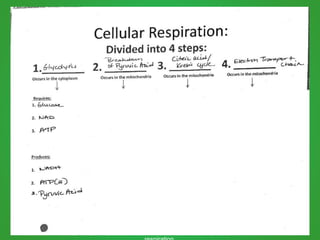
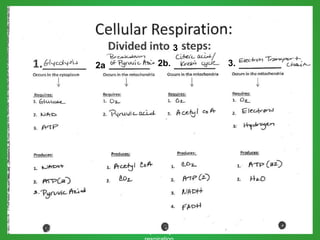
Step 2- Citric Acid/ Krebs Cycle
• Requires:
– Acetyl coA
– Oxygen
– Produces:
• CO2
• 2 ATP
• NADH
• FADH
-TAKES PLACE IN THE MATRIX OF THE MITOCHONDRIA
*Everytime you exhale, you release Carbon dioxide released
in the Kreb’s cycle!
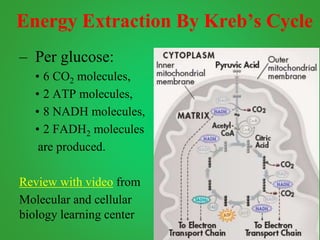
Energy Extraction By Kreb’s Cycle
– Per glucose:
• 6 CO2 molecules,
• 2 ATP molecules,
• 8 NADH molecules,
• 2 FADH2 molecules
are produced.
Review with video from
Molecular and cellular
biology learning center
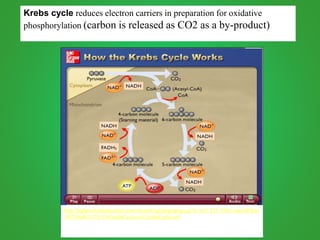
Krebs cycle reduces electron carriers in preparation for oxidative
phosphorylation (carbon is released as CO2 as a by-product)
http://highered.mheducation.com/olcweb/cgi/pluginpop.cgi?it=swf::525::530::/sites/dl/free
/0072464631/291136/krebsCycle.swf::krebsCycle.swf
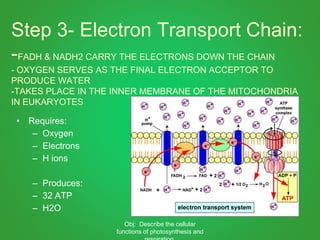
Step 3- Electron Transport Chain:
-FADH & NADH2 CARRY THE ELECTRONS DOWN THE CHAIN
- OXYGEN SERVES AS THE FINAL ELECTRON ACCEPTOR TO
PRODUCE WATER
-TAKES PLACE IN THE INNER MEMBRANE OF THE MITOCHONDRIA
IN EUKARYOTES
• Requires:
– Oxygen
– Electrons
– H ions
– Produces:
– 32 ATP
– H2O
Obj: Describe the cellular
functions of photosynthesis and
Electron Transport Chain
• Occurs in the cristae (inner folds) of the
mitochondria
• Aerobic
• Uses high-energy electrons from NADH
and FADH2 to convert ADP to ATP
• Oxygen serves as the final electron acceptor
in the ETC. It is essential for getting rid of
low-energy electrons & hydrogen ions
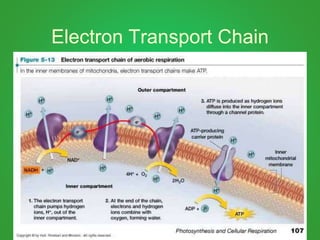
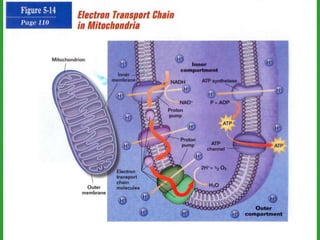
Electron Transport Chain
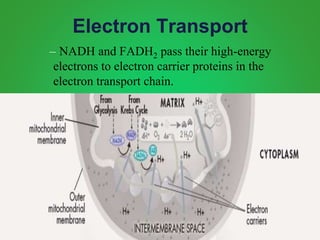
Electron Transport
– NADH and FADH2 pass their high-energy
electrons to electron carrier proteins in the
electron transport chain.
Electron Transport
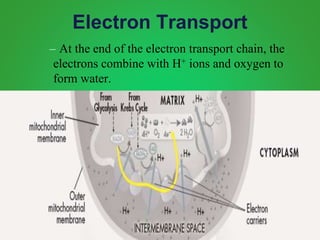
– At the end of the electron transport chain, the
electrons combine with H+ ions and oxygen to
form water.
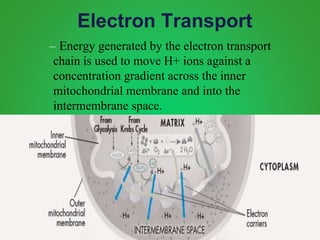
Electron Transport
– Energy generated by the electron transport
chain is used to move H+ ions against a
concentration gradient across the inner
mitochondrial membrane and into the
intermembrane space.
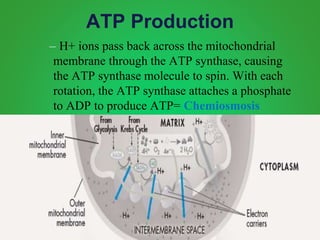
ATP Production
– H+ ions pass back across the mitochondrial
membrane through the ATP synthase, causing
the ATP synthase molecule to spin. With each
rotation, the ATP synthase attaches a phosphate
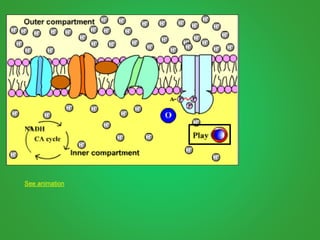
to ADP to produce ATP= Chemiosmosis
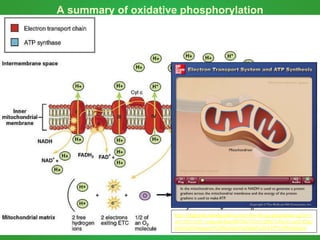
A summary of oxidative phosphorylation
http://highered.mheducation.com/olcweb/cgi/pluginpop.cgi?it=s
wf::535::535::/sites/dl/free/0072437316/120071/bio11.swf::Elec
tron%20Transport%20System%20and%20ATP%20Synthesis
Use the animations to learn to check your
understanding of oxidative phosphorylation.
See animation
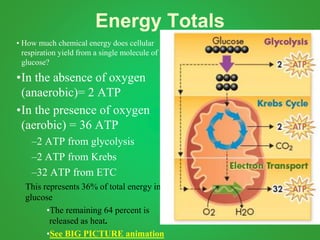
Energy Totals
• How much chemical energy does cellular
respiration yield from a single molecule of
glucose?
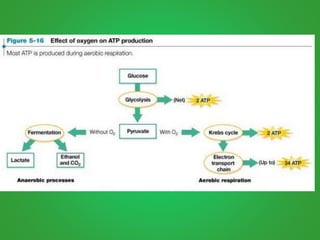
•In the absence of oxygen
(anaerobic)= 2 ATP
•In the presence of oxygen
(aerobic) = 36 ATP
–2 ATP from glycolysis
–2 ATP from Krebs
–32 ATP from ETC
This represents 36% of total energy in
glucose
•The remaining 64 percent is
released as heat.
•See BIG PICTURE animation
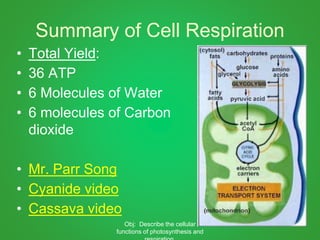
Summary of Cell Respiration
• Total Yield:
• 36 ATP
• 6 Molecules of Water
• 6 molecules of Carbon
dioxide
• Mr. Parr Song
• Cyanide video
• Cassava video
Obj: Describe the cellular
functions of photosynthesis and
Energy & Exercise
Quick Energy
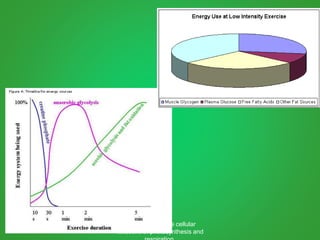
•Cells contain a small
amount of ATP produced
during glycolysis- enough
for a few seconds of
intense activity
•After roughly 50 meters,
stored ATP is gone, at
that point muscles will
produce ATP through
lactic acid fermentation=
enough ATP for 90
seconds
Long- Term Energy
•For exercise longer than
90 seconds, cell
respiration is the only way
to generate a constant
supply of ATP
•Your body stores energy
as glycogen- this usually
lasts for 15-20 minutes of
activity
•After that your body starts
to break down other
stored molecules like fat-
beneficial for weight
control
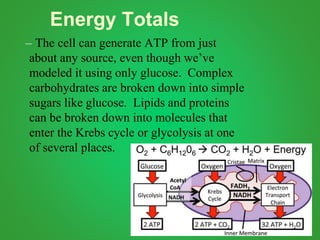
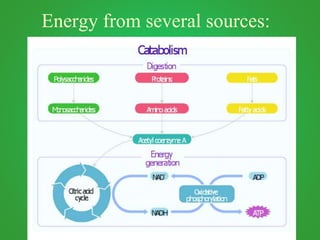
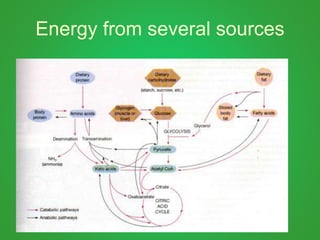
Energy Totals
– The cell can generate ATP from just
about any source, even though we’ve
modeled it using only glucose. Complex
carbohydrates are broken down into simple
sugars like glucose. Lipids and proteins
can be broken down into molecules that
enter the Krebs cycle or glycolysis at one
of several places.
Energy from several sources:
Energy from several sources
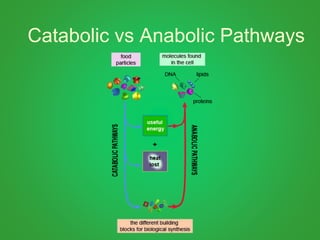
Catabolic vs Anabolic Pathways
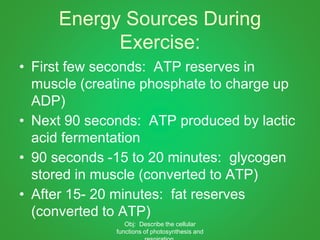
Energy Sources During
Exercise:
• First few seconds: ATP reserves in
muscle (creatine phosphate to charge up
ADP)
• Next 90 seconds: ATP produced by lactic
acid fermentation
• 90 seconds -15 to 20 minutes: glycogen
stored in muscle (converted to ATP)
• After 15- 20 minutes: fat reserves
(converted to ATP)
Obj: Describe the cellular
functions of photosynthesis and
Obj: Describe the cellular
functions of photosynthesis and
Obj: Describe the cellular
functions of photosynthesis and
2a. 2b. 3.
3
Obj: Describe the cellular
functions of photosynthesis and
Obj: Describe the cellular
functions of photosynthesis and
Obj: Describe the cellular
functions of photosynthesis and
2a 2b 3
3
Obj: Describe the cellular
functions of photosynthesis and
2a 2b. 3.
3
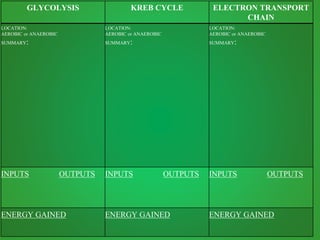
GLYCOLYSIS KREB CYCLE ELECTRON TRANSPORT
CHAIN
LOCATION:
AEROBIC or ANAEROBIC
SUMMARY:
LOCATION:
AEROBIC or ANAEROBIC
SUMMARY:
LOCATION:
AEROBIC or ANAEROBIC
SUMMARY:
INPUTS OUTPUTS INPUTS OUTPUTS INPUTS OUTPUTS
ENERGY GAINED ENERGY GAINED ENERGY GAINED
Obj: Describe the cellular
functions of photosynthesis and
Obj: Describe the cellular
functions of photosynthesis and
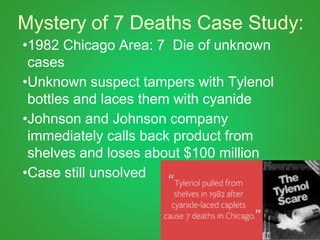
Mystery of 7 Deaths Case Study:
•1982 Chicago Area: 7 Die of unknown
cases
•Unknown suspect tampers with Tylenol
bottles and laces them with cyanide
•Johnson and Johnson company
immediately calls back product from
shelves and loses about $100 million
•Case still unsolved
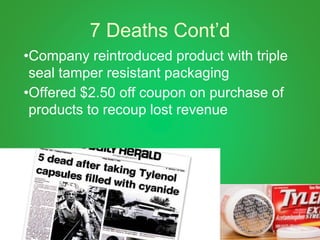
7 Deaths Cont’d
•Company reintroduced product with triple
seal tamper resistant packaging
•Offered $2.50 off coupon on purchase of
products to recoup lost revenue

knowyou.pptx

  • 1.
    What is CellularRespiration? A complex series of metabolic processes that break down carbohydrates and release the energy for use by cells. Obj: Describe the cellular functions of photosynthesis and respiration.
  • 2.
    9.1 Cellular Respiration:An Overview • Food provides living things with the chemical building blocks they need to grow & reproduce • For ALL organisms, food molecules contain chemical energy that is released when chemical bonds are broken!!
  • 3.
    Chemical Energy &Food • Organisms get the energy they need from food. • Energy stored in food is expressed in units of calories.
  • 4.
    Chemical Energy &Food • Food serves as a source of raw materials from which cells can make new molecules (ATP= energy) • How much energy is in food? – A calorie is the amount of energy needed to raise the temperature of 1 gram of water 1 Celsius degree – A Calorie (used on food labels) is a kilocalorie or 1000 calories
  • 5.
    Chemical Energy &Food • Cells can use all sorts of food molecules including fats, proteins, & carbohydrates. • Example: – 1 gram of glucose releases 3811 calories of heat energy – 1 gram of fat from beef releases 8893 calories of heat energy • SO- you get more energy per gram from burning fats compared to burning glucose
  • 6.
    Chemical Energy &Food • Cells break down food gradually, capturing a little bit of energy at key steps. • This enables cells to use the energy stored in the chemical bonds of foods like glucose to produce compounds such as ATP that directly power the activities of the cell.
  • 7.
    What is thechemical equation for cellular respiration? • C6H12O6 + 6O2 → 6CO2 + 6H20 + 36 ATP • Glucose + Oxygen → Carbon Dioxide + Water + ATP • See 4 min video Obj: Describe the cellular functions of photosynthesis and
  • 8.
    Overview of CellularRespiration In the presence of oxygen, glycolysis is followed by the Krebs Cycle and electron transport chain GLYCOLYSIS, KREBS CYCLE, & ETC make up a process called cellular respiration or aerobic respiration Cellular respiration is the process that releases energy by breaking down food molecules in the presence of oxygen
  • 9.
  • 10.
    Oxygen & Energy •Oxygen is required at the very end of the ETC • Most of the energy-releasing pathways within cells require oxygen, and that is the reason we need to breathe (respire) • Pathways that require oxygen as said to be aerobic (Ex. Krebs Cycle & ETC) • Pathways that do not require oxygen are anaerobic (Ex. Glycolysis & Fermentation)
  • 11.
    2 Types ofCellular Respiration: Requires Oxygen Performed by eukaryotic cells Takes place in Mitochondria Efficient= produces 36 ATP Does NOT require Oxygen Performed by prokaryotic cells and muscle cells Takes place in the cytoplasm Inefficient= produces 2 ATP Obj: Describe the cellular functions of photosynthesis and
  • 12.
    Comparing Photosynthesis & CellularRespiration Photosynthesis • Removes CO2 from the atmosphere • Releases O2 into the atmosphere • Only occurs in plants, algae, & some bacteria • Occurs in the chloroplasts • Captures energy from sunlight Cellular Respiration • Releases CO2 in the atmosphere • Removes O2 from the atmosphere • Occurs in plants, animals, fungi, protists, and some bacteria • Occurs in the cytoplasm & mitochondria • Releases energy from food
  • 13.
    The energy inphotosynthesis and respiration flows in opposite directions. Cellular respiration is the process that “withdraws” energy and photosynthesis is the process the “deposits” energy. The equations for photosynthesis and respiration are the reverse of each other.
  • 14.
    Energy Cycles Photosynthesis andCell Respiration Form a cycle. Photosynthesis 6CO2 + 6H2O Cell Respiration C6H12O6 + 6O2 6CO2 + 6H2O + 36 ATP Products of one reaction are the starting materials of another. See Big Picture animation C6H12O6 + 6O2 Sunlight
  • 15.
    ATP - ChemicalEnergy for Living Organisms Plants Plants, Animals, Fungi & some Bacteria
  • 16.
    How are photosynthesisand cellular respiration related?? Review video: Practice Quiz Obj: Describe the cellular functions of photosynthesis and
  • 17.
    Photosynthesis Cellular Respiration FunctionProduces food for the plant Converts food into ATP Location Chloroplast Cytoplasm & Mitochondria Reactants 6CO2 , 6H2O, sunlight C6H12O6 & 6O2 Products C6H12O6 & 6O2 6CO2 , 6H2O, 36 ATP Chemical Equation 6CO2 + 6H20 + Sunlight →C6H12O6 + 6O2 C6H12O6 + 6O2 → 6CO2 + 6H20 + 36 ATP Obj: Describe the cellular functions of photosynthesis and
  • 18.
    9-2 The Processof Cellular Respiration •The process begins with a pathway called glycolysis •Glycolysis releases a small amount of energy (ATP) •Depending on the presence of oxygen, glycolysis is followed by two different pathways
  • 19.
    2 different pathways •Glycolysis(anaerobic) •If oxygen IS present (aerobic), glycolysis is followed by: –Krebs Cycle –Electron Transport Chain •Glycolysis (anaerobic) •If oxygen is NOT available, (anaerobic), glycolysis is followed by: –Fermentation
  • 20.
  • 21.
    Glycolysis •Glycolysis takes placein the cytoplasm of cells •Glycolysis is an anaerobic process (no oxygen present) •Glycolysis is the process in which one molecule of glucose is broken in half, producing two molecules pyruvic acid
  • 22.
    Glycolysis •2 ATP areneeded to start the process of glycolysis •When glycolysis is complete 4 ATP molecules are produced •This results in a NET GAIN of 2 ATP molecules
  • 23.
    Glycolysis •NAD+ is anelectron carrier •Like NADP+ in photosynthesis, NAD+ accepts a pair of high energy electrons to become NADH •NADH can hold the energy of those electrons and pass them on to different pathways in the cell
  • 25.
    In glycolysis, glucoseis converted to pyruvate in the cytoplasm. Glycolysis gives a small net gain of ATP without the use of oxygen. Glycolysis is the splitting of glucose into pyruvate http://highered.mheducation.com/sites/0072507470/student_vie w0/chapter25/animation__how_glycolysis_works.html Glycolysis Rap
  • 26.
    Fermentation •Fermentation releases energyfrom food molecules in the absence of oxygen –NADH produced in glycolysis transfers e- to pyruvic acid. This allows NADH to recycle NAD+ needed to make ATP in glycolysis= steady supply of ATP –Anaerobic process – does not require oxygen –Occurs in the cell’s cytoplasm •2 types –Lactic Acid (animal cells) –Alcoholic (plants & fungi)
  • 27.
    •c •Pyruvate (3C) -->Ethanol (2C) •CO2 removed •EX. Yeast causes bread to rise, making beer, wine, cheese •Pyruvate --> Lactate •If O2 available lactic acid can convert back to pyruvate •EX. Builds up in muscle cells & causes soreness 2 Types of Fermentation
  • 28.
    Anaerobic Respiration/ Fermentation • TwoTypes of Fermentation: • 1. Alcoholic Fermentation: When oxygen is not present, fermentation follows glycolysis, regenerating NAD+ needed for glycolysis to continue. • 2. Lactic Acid Fermentation: In lactic acid fermentation, pyruvate is converted to lactate. Obj: Describe the cellular functions of photosynthesis and
  • 29.
    Alcoholic Fermentation • AFTERGLYCOLYSIS OCCURS- and No oxygen is present some organisms go through alcoholic fermentation (yeast, bacteria and fungi) • 2 Pyruvic acids are converted into 2 ATP’s, ethanol (alcohol) and Carbon dioxide • Process is used to make beer, breads, pastries etc. Obj: Describe the cellular functions of photosynthesis and
  • 30.
    Use of anaerobiccell respiration in yeasts to produce ethanol and carbon dioxide in baking. Ethanol is also produced by anaerobic cell respiration, but it evaporates during baking. Bread is made by adding water to flour, kneading the mixture to make dough and then baking it. Usually an ingredient (yeast) is added to the dough to create bubbles of gas, so that the baked bread has a lighter texture. After kneading (mixing) the dough is kept warm to encourage the yeast to respire. Yeast can respire aerobically or anaerobically, but oxygen in the dough is soon used up so the yeast is forced to respire anaerobically. The carbon dioxide produced by anaerobic cell respiration cannot escape from the dough and forms bubbles causing the dough to swell and rise.
  • 31.
    http://en.wikipedia.org/wiki/File:Ethanol_plant.jpg Bioethanol (ethanol producedby organisms) is a renewable energy source. Use of anaerobic cell respiration in yeasts to produce ethanol and carbon dioxide in baking. Most bioethanol is produced from sugar cane and maize, using yeast. Fermenters are used to keep the yeast in optimum conditions. When yeast carry out anaerobic respiration the sugars in the plant material are converted to ethanol and carbon dioxide. Starch and cellulose in the plant material are broken down by enzymes into sugars. The ethanol produced by the yeasts is purified by distillation and water is removed to improve combustion.
  • 32.
    Lactic Acid Fermentation •AFTER GLYCOLYSIS OCCURS- and No oxygen is present, lactic acid fermentation may occur in your muscle cells. • Once ATP & O2 reserves are exhausted (oxygen debt), 2 ATP’s and lactic acid will be produced= burn in muscles • Labored breathing repays the oxygen debt Obj: Describe the cellular functions of photosynthesis and
  • 33.
    Lactate production inhumans when anaerobic respiration is used to maximize the power of muscle contractions. Certain human activities require anaerobic respiration such as weightlifting and sprinting. Rapid generation of ATP enables us to maximise the power of muscle contractions. Aerobic respiration generates a much greater yield of ATP, but anaerobic respiration can supply ATP very rapidly, as oxygen is not required. Anaerobic cell respiration produces lactate. There is a limit to the concentration that the body can tolerate and this limits how much or how long anaerobic respiration can be done for. Afterwards lactate must be broken down. This involves the use of oxygen. It can take several minutes for enough oxygen to be absorbed for all lactate to be broken down. The demand for oxygen that builds up during a period of anaerobic respiration is called the oxygen debt.
  • 34.
    Obj: Describe thecellular functions of photosynthesis and
  • 35.
    Obj: Describe thecellular functions of photosynthesis and
  • 36.
    Glycolysis • Glucose is brokendown to pyruvate or pyruvic acid during glycolysis, making a net gain of 2 ATP and 2 NADH. • Review with animation Takes place in the Cytoplasm Obj: Describe the cellular functions of photosynthesis and
  • 37.
    Step 2- Whathappens next? If O2 is present → moves to aerobic resp. in mitochondrion. If O2 is not present→ moves to anaerobic resp. Obj: Describe the cellular functions of photosynthesis and
  • 39.
    . Label the structuresof the mitochondria:
  • 40.
    . Label the structures: matrix Inter-membranespace ribosomes inner membrane outer membrane naked loops of DNA cristae
  • 42.
    Aerobic Respiration (3Steps) 1. Glycolysis (Glucose to Pyruvate) 2. Krebs Cycle (Pyruvate to NADH, FADH2) 3. Electron Transport Chain w/ O2 (NADH, FADH2 to ATP)
  • 43.
    Krebs Cycle •During theKrebs Cycle, pyruvic acid is broken down into carbon dioxide in a series of energy-extracting reactions •AKA= Citric Acid Cycle (starting material) •Occurs in the matrix of the mitochondria •Aerobic •Every time you exhale, you release the carbon dioxide produced by the Krebs cycle
  • 44.
    Intermediate Step -Breakdown of Pyruvic acid • Pyruvic acid is broken down into Acetyl coA and CO2 Obj: Describe the cellular functions of photosynthesis and
  • 45.
    Step 2- CitricAcid/ Krebs Cycle • Requires: – Acetyl coA – Oxygen – Produces: • CO2 • 2 ATP • NADH • FADH -TAKES PLACE IN THE MATRIX OF THE MITOCHONDRIA *Everytime you exhale, you release Carbon dioxide released in the Kreb’s cycle!
  • 46.
    Energy Extraction ByKreb’s Cycle – Per glucose: • 6 CO2 molecules, • 2 ATP molecules, • 8 NADH molecules, • 2 FADH2 molecules are produced. Review with video from Molecular and cellular biology learning center
  • 48.
    Krebs cycle reduceselectron carriers in preparation for oxidative phosphorylation (carbon is released as CO2 as a by-product) http://highered.mheducation.com/olcweb/cgi/pluginpop.cgi?it=swf::525::530::/sites/dl/free /0072464631/291136/krebsCycle.swf::krebsCycle.swf
  • 49.
    Step 3- ElectronTransport Chain: -FADH & NADH2 CARRY THE ELECTRONS DOWN THE CHAIN - OXYGEN SERVES AS THE FINAL ELECTRON ACCEPTOR TO PRODUCE WATER -TAKES PLACE IN THE INNER MEMBRANE OF THE MITOCHONDRIA IN EUKARYOTES • Requires: – Oxygen – Electrons – H ions – Produces: – 32 ATP – H2O Obj: Describe the cellular functions of photosynthesis and
  • 50.
    Electron Transport Chain •Occurs in the cristae (inner folds) of the mitochondria • Aerobic • Uses high-energy electrons from NADH and FADH2 to convert ADP to ATP • Oxygen serves as the final electron acceptor in the ETC. It is essential for getting rid of low-energy electrons & hydrogen ions
  • 51.
  • 53.
    Electron Transport – NADHand FADH2 pass their high-energy electrons to electron carrier proteins in the electron transport chain.
  • 54.
    Electron Transport – Atthe end of the electron transport chain, the electrons combine with H+ ions and oxygen to form water.
  • 55.
    Electron Transport – Energygenerated by the electron transport chain is used to move H+ ions against a concentration gradient across the inner mitochondrial membrane and into the intermembrane space.
  • 56.
    ATP Production – H+ions pass back across the mitochondrial membrane through the ATP synthase, causing the ATP synthase molecule to spin. With each rotation, the ATP synthase attaches a phosphate to ADP to produce ATP= Chemiosmosis
  • 57.
    A summary ofoxidative phosphorylation http://highered.mheducation.com/olcweb/cgi/pluginpop.cgi?it=s wf::535::535::/sites/dl/free/0072437316/120071/bio11.swf::Elec tron%20Transport%20System%20and%20ATP%20Synthesis Use the animations to learn to check your understanding of oxidative phosphorylation.
  • 58.
  • 59.
    Energy Totals • Howmuch chemical energy does cellular respiration yield from a single molecule of glucose? •In the absence of oxygen (anaerobic)= 2 ATP •In the presence of oxygen (aerobic) = 36 ATP –2 ATP from glycolysis –2 ATP from Krebs –32 ATP from ETC This represents 36% of total energy in glucose •The remaining 64 percent is released as heat. •See BIG PICTURE animation
  • 60.
    Summary of CellRespiration • Total Yield: • 36 ATP • 6 Molecules of Water • 6 molecules of Carbon dioxide • Mr. Parr Song • Cyanide video • Cassava video Obj: Describe the cellular functions of photosynthesis and
  • 62.
    Energy & Exercise QuickEnergy •Cells contain a small amount of ATP produced during glycolysis- enough for a few seconds of intense activity •After roughly 50 meters, stored ATP is gone, at that point muscles will produce ATP through lactic acid fermentation= enough ATP for 90 seconds Long- Term Energy •For exercise longer than 90 seconds, cell respiration is the only way to generate a constant supply of ATP •Your body stores energy as glycogen- this usually lasts for 15-20 minutes of activity •After that your body starts to break down other stored molecules like fat- beneficial for weight control
  • 63.
    Energy Totals – Thecell can generate ATP from just about any source, even though we’ve modeled it using only glucose. Complex carbohydrates are broken down into simple sugars like glucose. Lipids and proteins can be broken down into molecules that enter the Krebs cycle or glycolysis at one of several places.
  • 64.
  • 65.
  • 66.
  • 67.
    Energy Sources During Exercise: •First few seconds: ATP reserves in muscle (creatine phosphate to charge up ADP) • Next 90 seconds: ATP produced by lactic acid fermentation • 90 seconds -15 to 20 minutes: glycogen stored in muscle (converted to ATP) • After 15- 20 minutes: fat reserves (converted to ATP) Obj: Describe the cellular functions of photosynthesis and
  • 68.
    Obj: Describe thecellular functions of photosynthesis and
  • 69.
    Obj: Describe thecellular functions of photosynthesis and 2a. 2b. 3. 3
  • 70.
    Obj: Describe thecellular functions of photosynthesis and
  • 71.
    Obj: Describe thecellular functions of photosynthesis and
  • 72.
    Obj: Describe thecellular functions of photosynthesis and 2a 2b 3 3
  • 73.
    Obj: Describe thecellular functions of photosynthesis and 2a 2b. 3. 3
  • 78.
    GLYCOLYSIS KREB CYCLEELECTRON TRANSPORT CHAIN LOCATION: AEROBIC or ANAEROBIC SUMMARY: LOCATION: AEROBIC or ANAEROBIC SUMMARY: LOCATION: AEROBIC or ANAEROBIC SUMMARY: INPUTS OUTPUTS INPUTS OUTPUTS INPUTS OUTPUTS ENERGY GAINED ENERGY GAINED ENERGY GAINED
  • 80.
    Obj: Describe thecellular functions of photosynthesis and
  • 81.
    Obj: Describe thecellular functions of photosynthesis and
  • 82.
    Mystery of 7Deaths Case Study: •1982 Chicago Area: 7 Die of unknown cases •Unknown suspect tampers with Tylenol bottles and laces them with cyanide •Johnson and Johnson company immediately calls back product from shelves and loses about $100 million •Case still unsolved
  • 83.
    7 Deaths Cont’d •Companyreintroduced product with triple seal tamper resistant packaging •Offered $2.50 off coupon on purchase of products to recoup lost revenue