Regulation E
Training Material for FinTech Employees
What is Regulation E?
Regulation E protects consumers
when they use electronic fund transfers.
Issued initially by the Federal Reserve in 1978 as an implementation
of the Electronic Funds Transfers Act.
Latest revision issued in April 2019 by the Bureau of Consumer Financial Protection.
© Financial Strides 2020 2
How Does it Concern You?
As a FinTech, you are the “front-end” for financial services sold to customers, which are also the
customers of your partner bank. Your interacting with customers results in responsibilities regarding
their protection against unauthorized transactions and errors.
You need to know:
• Your obligations to assist customers reporting errors impacting their account balances.
• Scope of requirements and risks of non-compliance.
• Contents and timing requirements for Reg. E disclosures
• Specific content requirements of periodic statements or electronic/online transaction histories.
• What constitutes an error, common types of errors, and what is an effective notice of error.
• How to document evidencing compliance with Reg. E and supporting rationale for decisioning of claims.
NOTE: this material is not a substitute for professional legal advice
3© Financial Strides 2020
What Does Regulation E Cover?
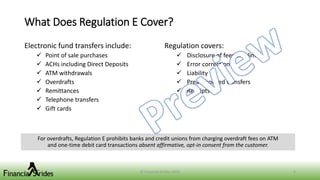
Electronic fund transfers include:
 Point of sale purchases
 ACHs including Direct Deposits
 ATM withdrawals
 Overdrafts
 Remittances
 Telephone transfers
 Gift cards
Regulation covers:
 Disclosure of fees and limits
 Error correction
 Liability
 Preauthorized transfers
 Receipts
4
For overdrafts, Regulation E prohibits banks and credit unions from charging overdraft fees on ATM
and one-time debit card transactions absent affirmative, opt-in consent from the customer.
© Financial Strides 2020
Not Covered by Regulation E
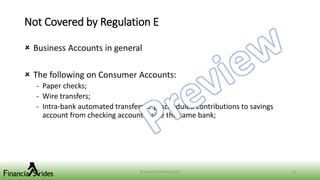
 Business Accounts in general
 The following on Consumer Accounts:
‐ Paper checks;
‐ Wire transfers;
‐ Intra-bank automated transfers, e.g. scheduled contributions to savings
account from checking account inside the same bank;
5© Financial Strides 2020
In The Critical Path Between Consumer and Bank
Customers FinTech + Bank*
• Make purchases
• Withdraw cash
• Receive statements
• Investigate to
confirm errors /
unauthorized Tx
• Resolve as needed
and provides refund
applicable
* Unless FinTech is a state-licensed lender and
does not use a partner bank
6
Lost or
Stolen Card
Erroneous
Transaction
© Financial Strides 2020
Signal loss or theft or card
and/or unauthorized/
erroneous transactions
Coordinate
resolution
For the complete training…
Contact us at info@finstrides.com
(c) Financial Strides 2020 7

Reg E training preview

  • 1.
    Regulation E Training Materialfor FinTech Employees
  • 2.
    What is RegulationE? Regulation E protects consumers when they use electronic fund transfers. Issued initially by the Federal Reserve in 1978 as an implementation of the Electronic Funds Transfers Act. Latest revision issued in April 2019 by the Bureau of Consumer Financial Protection. © Financial Strides 2020 2
  • 3.
    How Does itConcern You? As a FinTech, you are the “front-end” for financial services sold to customers, which are also the customers of your partner bank. Your interacting with customers results in responsibilities regarding their protection against unauthorized transactions and errors. You need to know: • Your obligations to assist customers reporting errors impacting their account balances. • Scope of requirements and risks of non-compliance. • Contents and timing requirements for Reg. E disclosures • Specific content requirements of periodic statements or electronic/online transaction histories. • What constitutes an error, common types of errors, and what is an effective notice of error. • How to document evidencing compliance with Reg. E and supporting rationale for decisioning of claims. NOTE: this material is not a substitute for professional legal advice 3© Financial Strides 2020
  • 4.
    What Does RegulationE Cover? Electronic fund transfers include:  Point of sale purchases  ACHs including Direct Deposits  ATM withdrawals  Overdrafts  Remittances  Telephone transfers  Gift cards Regulation covers:  Disclosure of fees and limits  Error correction  Liability  Preauthorized transfers  Receipts 4 For overdrafts, Regulation E prohibits banks and credit unions from charging overdraft fees on ATM and one-time debit card transactions absent affirmative, opt-in consent from the customer. © Financial Strides 2020
  • 5.
    Not Covered byRegulation E  Business Accounts in general  The following on Consumer Accounts: ‐ Paper checks; ‐ Wire transfers; ‐ Intra-bank automated transfers, e.g. scheduled contributions to savings account from checking account inside the same bank; 5© Financial Strides 2020
  • 6.
    In The CriticalPath Between Consumer and Bank Customers FinTech + Bank* • Make purchases • Withdraw cash • Receive statements • Investigate to confirm errors / unauthorized Tx • Resolve as needed and provides refund applicable * Unless FinTech is a state-licensed lender and does not use a partner bank 6 Lost or Stolen Card Erroneous Transaction © Financial Strides 2020 Signal loss or theft or card and/or unauthorized/ erroneous transactions Coordinate resolution
  • 7.
    For the completetraining… Contact us at info@finstrides.com (c) Financial Strides 2020 7