A summary of major improvements in the financial sector, and consequent challenges
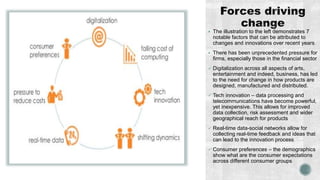
 The illustration to the left demonstrates 7
notable factors that can be attributed to
changes and innovations over recent years.
 There has been unprecedented pressure for
firms, especially those in the financial sector
 Digitalization across all aspects of arts,
entertainment and indeed, business, has led
to the need for change in how products are
designed, manufactured and distributed.
 Tech innovation – data processing and
telecommunications have become powerful,
yet inexpensive. This allows for improved
data collection, risk assessment and wider
geographical reach for products
 Real-time data-social networks allow for
collecting real-time feedback and ideas that
can lead to the innovation process
 Consumer preferences – the demographics
show what are the consumer expectations
across different consumer groups
This presentation covers :-
1. Digitization
2. Security
3. Data analytics
4. Financial management
5. Capital raising
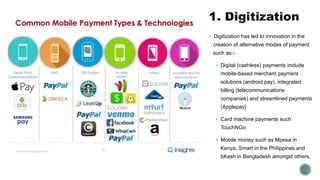
 Digitization has led to innovation in the
creation of alternative modes of payment
such as:-
 Digital (cashless) payments include
mobile-based merchant payment
solutions (android pay), integrated
billing (telecommunications
companies) and streamlined payments
(Applepay}
 Card machine payments such
TouchNGo
 Mobile money such as Mpesa in
Kenya, Smart in the Philippines and
bKash in Bangladesh amongst others.
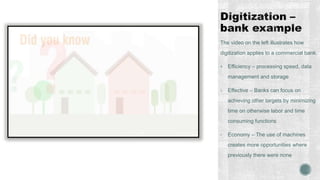
The video on the left illustrates how
digitization applies to a commercial bank.
 Efficiency – processing speed, data
management and storage
• Effective – Banks can focus on
achieving other targets by minimizing
time on otherwise labor and time
consuming functions
• Economy – The use of machines
creates more opportunities where
previously there were none
 Cyber security in financial services combats cyber threats by
staying current with vulnerabilities that affect these companies
everyday
 The likelihood and potential impact of newer more sophisticated
attacks has created a need for innovation
 The challenge for financial sector is therefore to:-
 Remain alert because cyber security is dynamic; the threats are
unknown, and are designed to attack the weakest link at any
time.
 Mitigate data recovery, that is, how much downtime and data
loss that the cyber security efforts can be able to restore. This is
a challenge given that threats are unpredictable, unmeasurable
and can be very detrimental for any entity in the financial sector.
 Maintain an integrated approach to security measures by
classifying and disclosing highly sensitive data, and
understanding the risks at hand.
 The Payment Card Industry Data Security Standard has set a specific set of controls required to
demonstrate acceptable security for cardholder data.
 This is a regulatory requirement aimed at preventing cyber crime through credit card fraud
 Any business taking payment through credit cards should protect their information and transactions
 This standard protects organizations that handle branded credit cards from major card schemes including Visa,
MasterCard and American Express
 The above card companies started their own respective programs with one intention: to create an additional
level of protection for card issuers by ensuring that merchants meet minimal levels of security when they store,
process and transmit cardholder data.
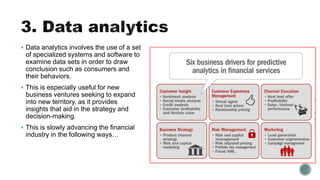
 Data analytics involves the use of a set
of specialized systems and software to
examine data sets in order to draw
conclusion such as consumers and
their behaviors.
 This is especially useful for new
business ventures seeking to expand
into new territory, as it provides
insights that aid in the strategy and
decision-making.
 This is slowly advancing the financial
industry in the following ways…
 Financial management innovations have created the need for process externalization
 This entails the use of highly flexible cloud-based platforms to provide financial institutions, as
well as investors, with new levels of efficiency and sophistication.
 The current trend is the externalization of non-core processes such as HR and finance, in a bid
to achieve operational excellence
 However, this has resulted in a few challenges:-
 The loss of negotiating power and continuity – the vulnerable state that a company finds itself if it
externalizes all its capabilities, technologies and processes
 Workforce with loss of skill over a period of time. The longer the externalization process continues, the
higher the risk that skills will not be applied, and that the workforce can’t develop a holistic view of
business.
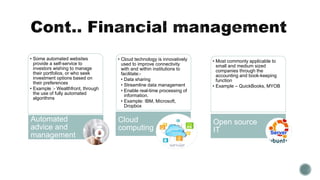
• Some automated websites
provide a self-service to
investors wishing to manage
their portfolios, or who seek
investment options based on
their preferences
• Example :- Wealthfront, through
the use of fully automated
algorithms
Automated
advice and
management
• Cloud technology is innovatively
used to improve connectivity
with and within institutions to
facilitate:-
• Data sharing
• Streamline data management
• Enable real-time processing of
information.
• Example: IBM, Microsoft,
Dropbox
Cloud
computing
• Most commonly applicable to
small and medium sized
companies through the
accounting and book-keeping
function
• Example – QuickBooks, MYOB
Open source
IT
 Traditionally, raising capital was facilitated by financial institutions which limited accessibility of funds to
selected beneficiaries, which often excluded small business owners.
 Start-ups and new business ventures have led to creation of a series of alternative funding platforms.
 In the future:-
 Alternative funding platforms are going to solidify their position as a key capital raising intermediary aside
from banks
 Alternative funding platforms will help fund opportunities that would otherwise not qualify for investment
from traditional venture capitalists
 However, the limitation likely to arise is that businesses might not receive specialized advice as they
normally would from more specialized intermediaries
 Illustration :-
 Crowdfunding is a capital raising innovation that entails funding a project or venture by raising monetary
contributions from a large number of people.
 It is a form of crowdsourcing and alternative finance
Kickstarter: A funding
platform focused on
bringing creative projects
to life.
The figure to the left is a
sample Kickstarter page,
where the initiator has
surpassed the pledged
amount by short of
$25000. 1,562 people
have ‘backed’ the project,
and there are 39 more
days to contribute to this
project.
https://www.gartner.com/imagesrv/media-products/pdf/red_hat/redhat-1-
31ERJ3D.pdf?70160000000ldoJAAQ
http://www3.weforum.org/docs/WEF_The_future__of_financial_services.pdf
http://www.csc.com/cybersecurity/insights/119469-
cybersecurity_in_financial_services_a_csc_point_of_view
https://thefinancialbrand.com/46320/big-data-advanced-analytics-banking/
https://en.wikipedia.org/wiki/Payment_Card_Industry_Data_Security_Standard
Finance Industry Innovations

Finance Industry Innovations

  • 1.
    A summary ofmajor improvements in the financial sector, and consequent challenges
  • 2.
     The illustrationto the left demonstrates 7 notable factors that can be attributed to changes and innovations over recent years.  There has been unprecedented pressure for firms, especially those in the financial sector  Digitalization across all aspects of arts, entertainment and indeed, business, has led to the need for change in how products are designed, manufactured and distributed.  Tech innovation – data processing and telecommunications have become powerful, yet inexpensive. This allows for improved data collection, risk assessment and wider geographical reach for products  Real-time data-social networks allow for collecting real-time feedback and ideas that can lead to the innovation process  Consumer preferences – the demographics show what are the consumer expectations across different consumer groups
  • 3.
    This presentation covers:- 1. Digitization 2. Security 3. Data analytics 4. Financial management 5. Capital raising
  • 4.
     Digitization hasled to innovation in the creation of alternative modes of payment such as:-  Digital (cashless) payments include mobile-based merchant payment solutions (android pay), integrated billing (telecommunications companies) and streamlined payments (Applepay}  Card machine payments such TouchNGo  Mobile money such as Mpesa in Kenya, Smart in the Philippines and bKash in Bangladesh amongst others.
  • 5.
    The video onthe left illustrates how digitization applies to a commercial bank.  Efficiency – processing speed, data management and storage • Effective – Banks can focus on achieving other targets by minimizing time on otherwise labor and time consuming functions • Economy – The use of machines creates more opportunities where previously there were none
  • 6.
     Cyber securityin financial services combats cyber threats by staying current with vulnerabilities that affect these companies everyday  The likelihood and potential impact of newer more sophisticated attacks has created a need for innovation  The challenge for financial sector is therefore to:-  Remain alert because cyber security is dynamic; the threats are unknown, and are designed to attack the weakest link at any time.  Mitigate data recovery, that is, how much downtime and data loss that the cyber security efforts can be able to restore. This is a challenge given that threats are unpredictable, unmeasurable and can be very detrimental for any entity in the financial sector.  Maintain an integrated approach to security measures by classifying and disclosing highly sensitive data, and understanding the risks at hand.
  • 7.
     The PaymentCard Industry Data Security Standard has set a specific set of controls required to demonstrate acceptable security for cardholder data.  This is a regulatory requirement aimed at preventing cyber crime through credit card fraud  Any business taking payment through credit cards should protect their information and transactions  This standard protects organizations that handle branded credit cards from major card schemes including Visa, MasterCard and American Express  The above card companies started their own respective programs with one intention: to create an additional level of protection for card issuers by ensuring that merchants meet minimal levels of security when they store, process and transmit cardholder data.
  • 8.
     Data analyticsinvolves the use of a set of specialized systems and software to examine data sets in order to draw conclusion such as consumers and their behaviors.  This is especially useful for new business ventures seeking to expand into new territory, as it provides insights that aid in the strategy and decision-making.  This is slowly advancing the financial industry in the following ways…
  • 9.
     Financial managementinnovations have created the need for process externalization  This entails the use of highly flexible cloud-based platforms to provide financial institutions, as well as investors, with new levels of efficiency and sophistication.  The current trend is the externalization of non-core processes such as HR and finance, in a bid to achieve operational excellence  However, this has resulted in a few challenges:-  The loss of negotiating power and continuity – the vulnerable state that a company finds itself if it externalizes all its capabilities, technologies and processes  Workforce with loss of skill over a period of time. The longer the externalization process continues, the higher the risk that skills will not be applied, and that the workforce can’t develop a holistic view of business.
  • 10.
    • Some automatedwebsites provide a self-service to investors wishing to manage their portfolios, or who seek investment options based on their preferences • Example :- Wealthfront, through the use of fully automated algorithms Automated advice and management • Cloud technology is innovatively used to improve connectivity with and within institutions to facilitate:- • Data sharing • Streamline data management • Enable real-time processing of information. • Example: IBM, Microsoft, Dropbox Cloud computing • Most commonly applicable to small and medium sized companies through the accounting and book-keeping function • Example – QuickBooks, MYOB Open source IT
  • 11.
     Traditionally, raisingcapital was facilitated by financial institutions which limited accessibility of funds to selected beneficiaries, which often excluded small business owners.  Start-ups and new business ventures have led to creation of a series of alternative funding platforms.  In the future:-  Alternative funding platforms are going to solidify their position as a key capital raising intermediary aside from banks  Alternative funding platforms will help fund opportunities that would otherwise not qualify for investment from traditional venture capitalists  However, the limitation likely to arise is that businesses might not receive specialized advice as they normally would from more specialized intermediaries  Illustration :-  Crowdfunding is a capital raising innovation that entails funding a project or venture by raising monetary contributions from a large number of people.  It is a form of crowdsourcing and alternative finance
  • 12.
    Kickstarter: A funding platformfocused on bringing creative projects to life. The figure to the left is a sample Kickstarter page, where the initiator has surpassed the pledged amount by short of $25000. 1,562 people have ‘backed’ the project, and there are 39 more days to contribute to this project.
  • 13.

Editor's Notes

  • #3 Falling cost of computing and pressure to reduce costs – can be seen as a bi-product of digitization. When the digital revolution came in, small companies could now deploy resources which previously could only be done by big companies. Hence, by breaking down this barrier of entry, computing costs fell too. As computing costs fell and costs could be spread out among more users.This led to lower operating costs, increased IT capabilities and further improvement in business models by creating better products and services at lower prices.
  • #5 http://www.forbes.com/sites/danielrunde/2015/08/12/m-pesa-and-the-rise-of-the-global-mobile-money-market/#1111266b23f5
  • #7 http://assets1.csc.com/cybersecurity/downloads/0892-15_Financial_Service_Cyber_Security_PoV_final.pdf