Knowledge Exchange Consensus on monitoring OA:
Recommendations from the Copenhagen workshop
Open Access Mötesplats, Karlstad
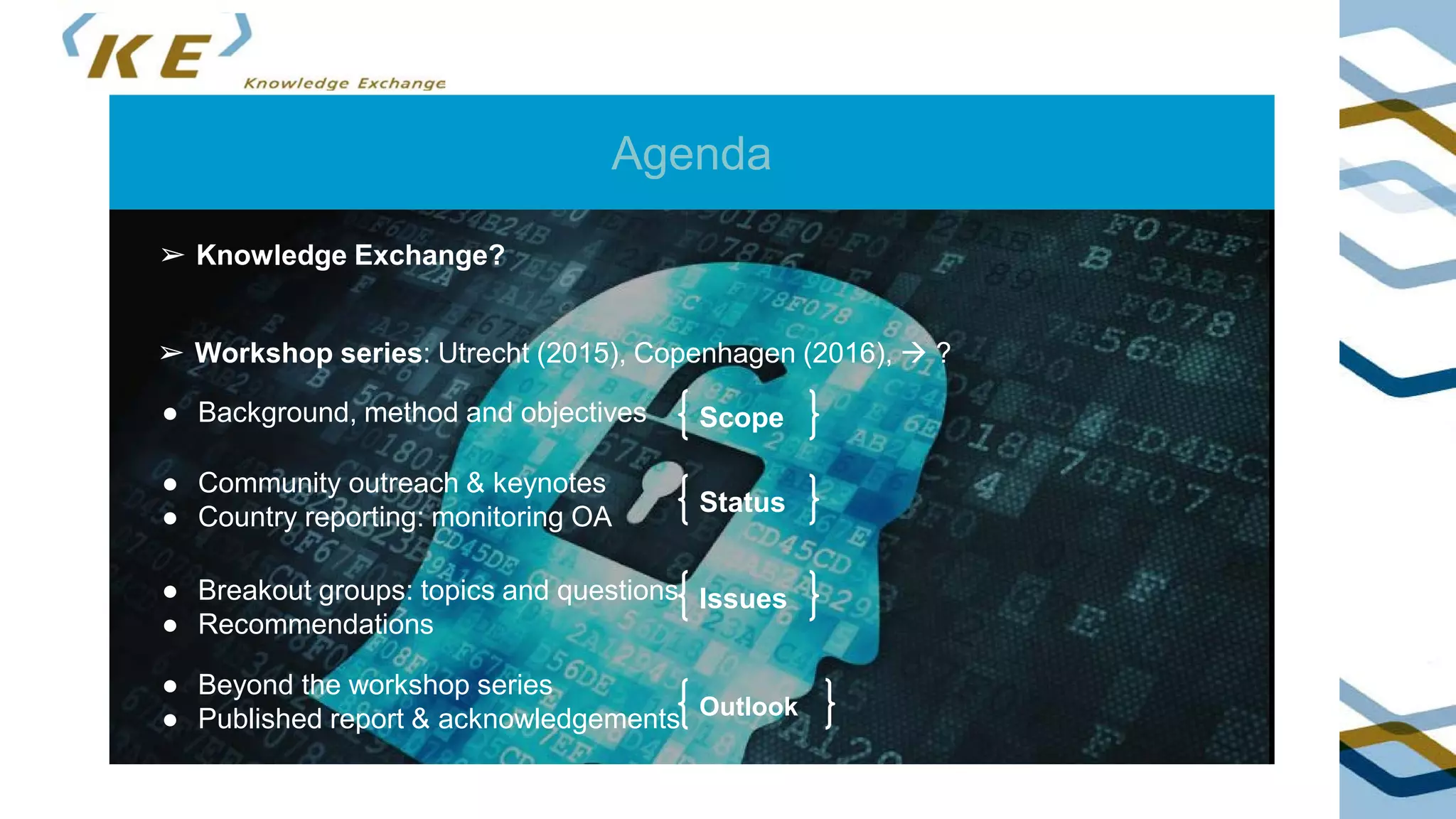
● Beyond the workshop series
● Published report & acknowledgements
Agenda
➢ Knowledge Exchange?
➢ Workshop series: Utrecht (2015), Copenhagen (2016),  ?
Status
Issues
Scope
Outlook
● Background, method and objectives
● Community outreach & keynotes
● Country reporting: monitoring OA
● Breakout groups: topics and questions
● Recommendations
Knowledge Exchange - collaboration, expertise & network
DFG German Research Foundation
Jisc (United Kingdom)
DEFF Denmark’s Electronic Research Library
SURF (Netherlands)
CSC IT Centre for Science (Finland)
CNRS Centre national de la recherche scientifique (France)
KE are six national organisations working together in Europe to support
the development of digital infrastructure to enable open scholarship.
http://www.knowledge-exchange.info
Knowledge Exchange - collaboration, expertise & network
Christian Hagen Thomasen
Project coordinator, DEFF
+
Representative in Knowledge Exchange
Co-lead of Knowledge Exchanges OA expert group
Denmark’s Electronic Research Library is both national consortium in
Denmark and a cooperation between among others Danish Reseach
Libraries.
http://www.knowledge-exchange.info
Background & method{Scope}
➔ Mission
Planning & scoping a workshop series around international collaboration
addressing challenges & recommendations to monitoring of OA publications
& derived cost data
➔ Activity: Monitoring Open Access
Project initiated by KE Open Access Expert Group
➔ “Mixed method”
● Integration of qualitative & quantitative data based on KE partners’ status
reporting & relevant community keynotes on monitoring OA
● Provide baseline for breakout groups to discuss KE scoped topics & questions
& come up with practice-based recommendations on how to solve the challenges
Objectives{Scope}
Goal: pushing transparency in exchange of OA metadata and cost data
Aim: influencing evidence based policy making &
promote better outcomes in negotiations with publishers
Workshop meta-monitoring {Scope}
#KEOA16
@knowexchange
• 57 participants from 11 countries and 41 organisations.
• Librarians, politicians, bureaucrats, consultants, researchers,
managers…
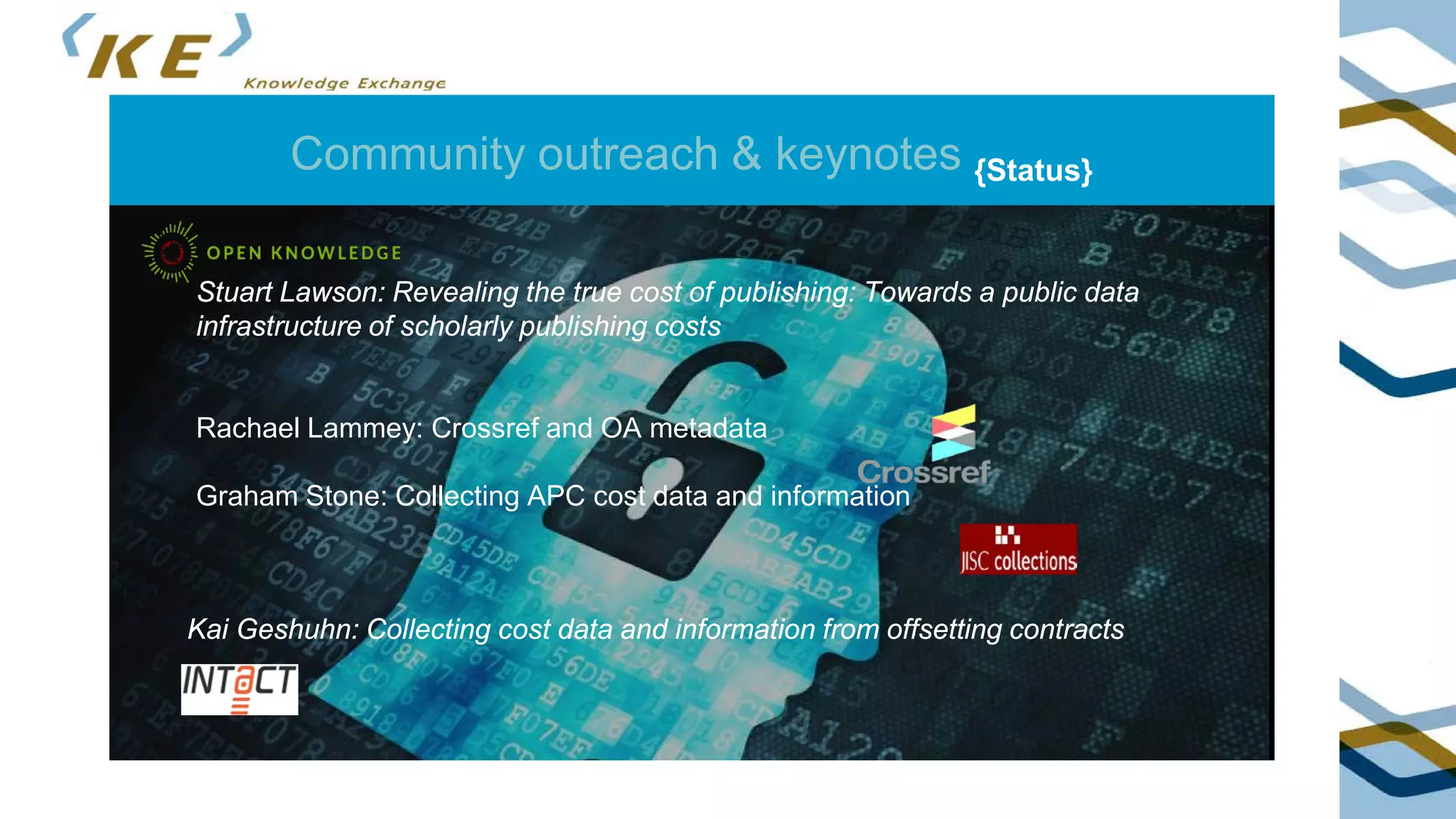
Community outreach & keynotes {Status}
Collecting and disseminating OA metadata from publishers at Crossref: the story so
far
(by: Rachael Lammey, CrossRef)
Stuart Lawson: Revealing the true cost of publishing: Towards a public data
infrastructure of scholarly publishing costs
Rachael Lammey: Crossref and OA metadata
Graham Stone: Collecting APC cost data and information
Kai Geshuhn: Collecting cost data and information from offsetting contracts
Country reporting on OA monitoring {Status}
[GER]: The contribution of INTACT to the international monitoring of OA publication and cost data
(by: Dirk Pieper, Bielefeld University Library)
All presentations are available for reading and further examination: http://bit.ly/2jY9jDp
[UK]: Monitor Local & Monitor UK (by: Frank Manista, Jisc)
[DK]: The Danish Open Access Indicator (by: Mogens Sandfær, DTU)
[NL]: Monitoring Open Access articles in the Netherlands (by: Just de Leeuwe, UKB)
+ Open Access (Robert van der Vooren, VSNU)
[FIN]: OA publication and cost data in Finland (by: Jyrki Ilva, National Library of Finland)
[FR]: Monitoring OA publication & cost data in France? (by: Sandrine Malotaux, Couperin) +
Gold OA publishing & APC in a University (by: Jean-François Lutz, Université de Lorraine)
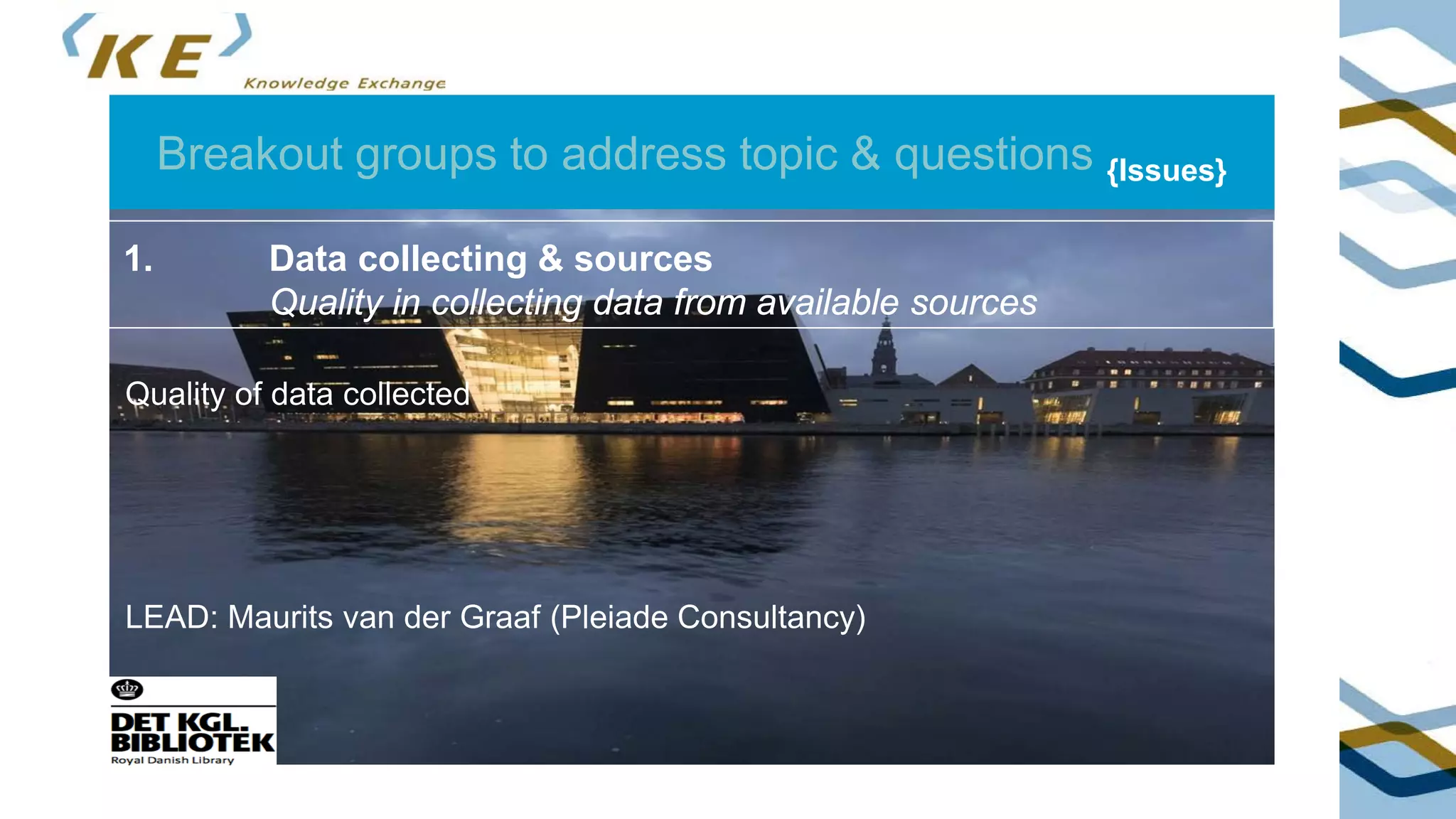
Breakout groups to address topic & questions {Issues}
1. Data collecting & sources
Quality in collecting data from available sources
Quality of data collected
LEAD: Maurits van der Graaf (Pleiade Consultancy)
Breakout groups to address topic & questions {Issues}
2. Workflows
Efficiency in monitoring workflows
Efficiency on monitoring workflows
LEAD: Kai Karin Geschuhn (MPDL)
Breakout groups to address topic & questions {Issues}
3. Standards
Aggregation of OA publications & costs via standards
Aggregation of OA publications and derived costs via standards
LEAD: Frank Manista (Jisc)
Breakout groups to address topics & questions {Issues}
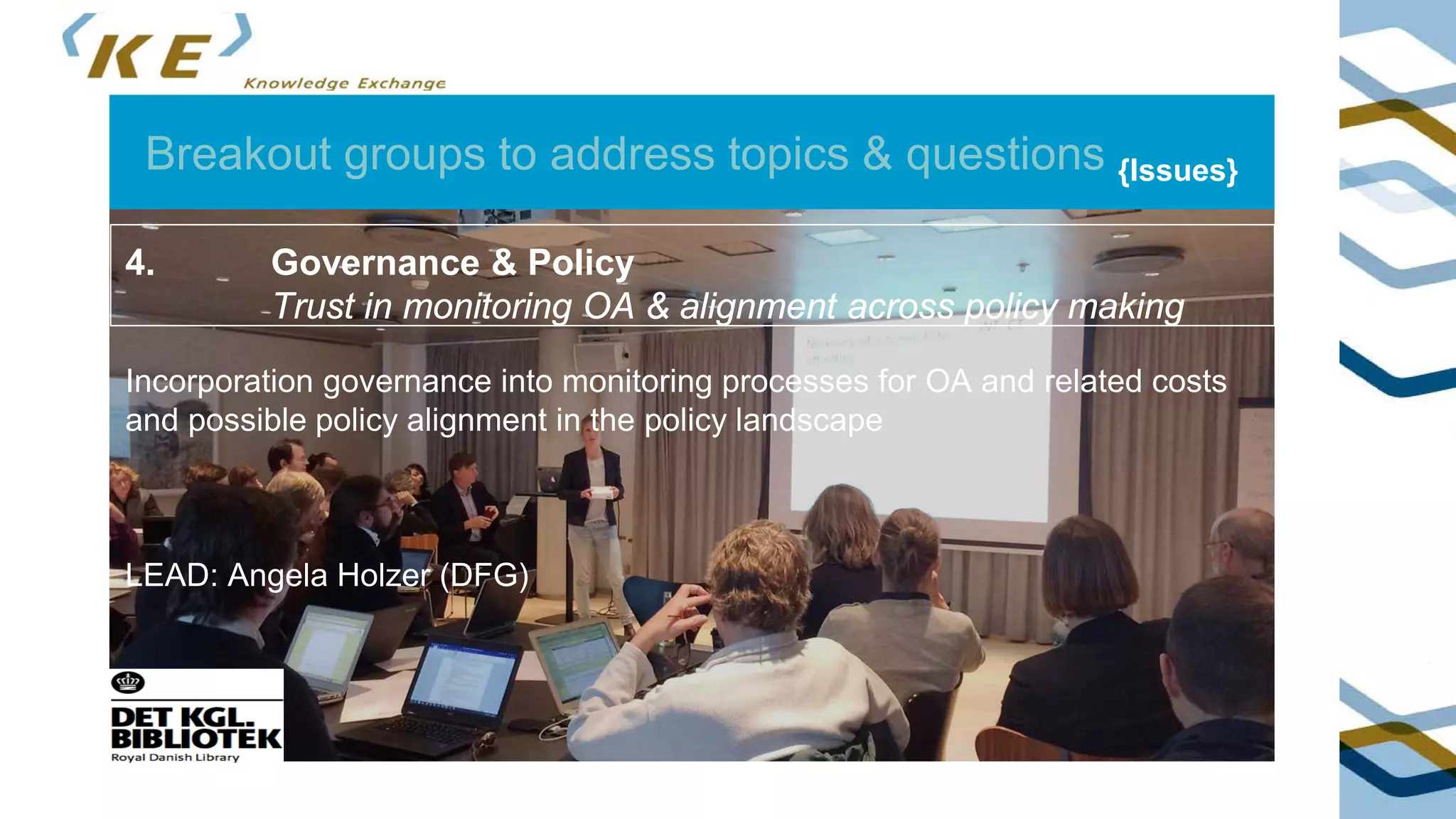
4. Governance & Policy
Trust in monitoring OA & alignment across policy making
Incorporation governance into monitoring processes for OA and related costs
and possible policy alignment in the policy landscape
LEAD: Angela Holzer (DFG)
Recommendations {Issues}
Green OA
• identify corresponding author in metadata schema
• identify potential green OA via Sherpa/RoMEO API
• monitoring of OA after end of embargo
Monitoring of OA (%)
★ Transparent definitions of what is measured are key!
★ Monitoring data should be open trough API’s – no pre-filtering!
★ Metadata form the repositories: Register green, hybrid and gold
★ Show the corresponding author
★ Matching metadata from the CRIS with DOAJ or ISSN-Gold-OA list in order to identify
pure Gold articles
★ SherpaRomeo can help identify the green
★ DOI’s and ORCID are essentiel anchors
Recommendations {Issues}
Green OA
• identify corresponding author in metadata schema
• identify potential green OA via Sherpa/RoMEO API
• monitoring of OA after end of embargo
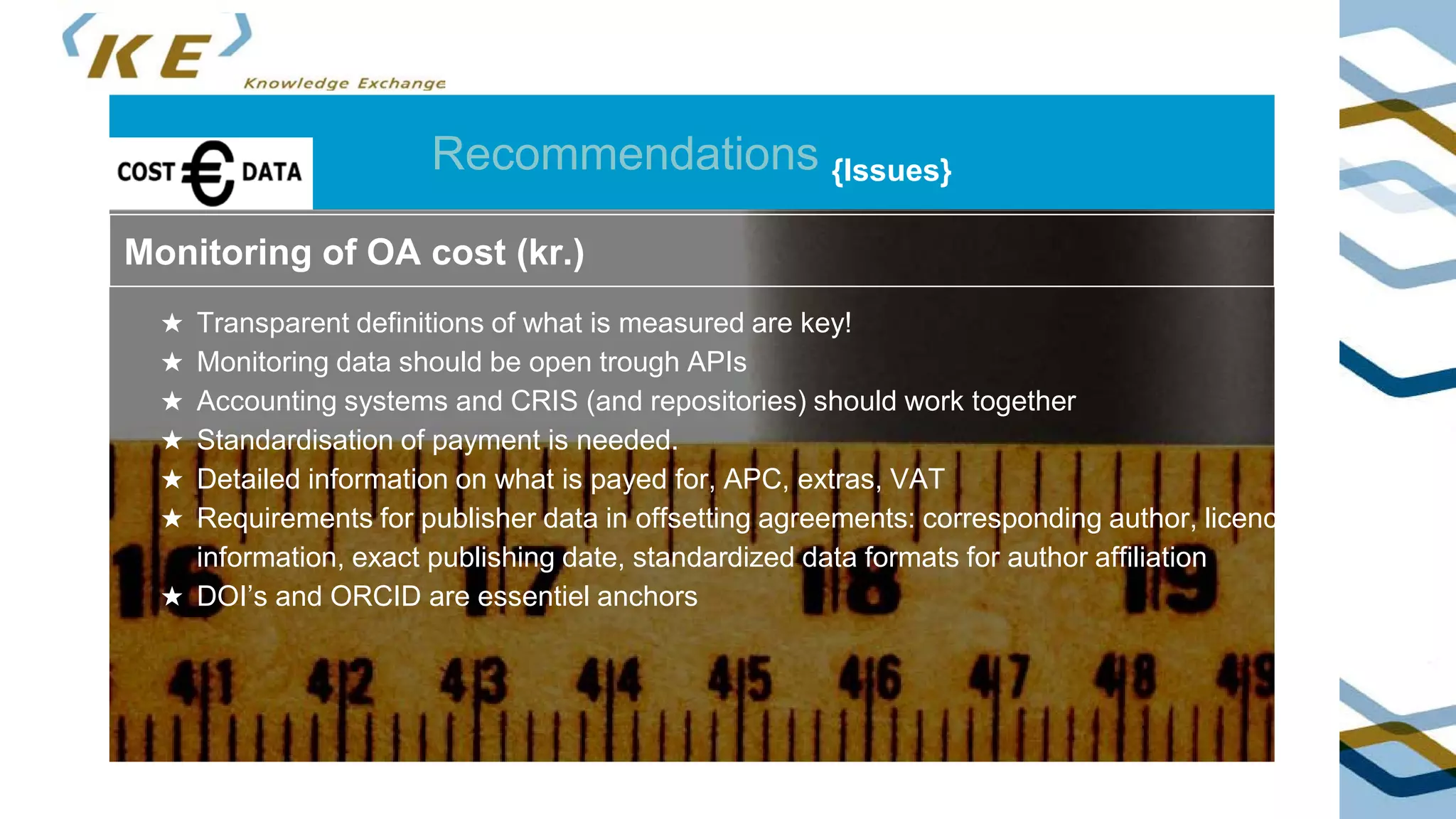
Monitoring of OA cost (kr.)
★ Transparent definitions of what is measured are key!
★ Monitoring data should be open trough APIs
★ Accounting systems and CRIS (and repositories) should work together
★ Standardisation of payment is needed.
★ Detailed information on what is payed for, APC, extras, VAT
★ Requirements for publisher data in offsetting agreements: corresponding author, licence
information, exact publishing date, standardized data formats for author affiliation
★ DOI’s and ORCID are essentiel anchors
Recommendations {Issues}
• in offsetting contracts (e.g. in terms & conditions) publishers should include in
Crossref a license statement for each publication
Next steps
★ CRIS-development
★ Publishers
★ Libraries and the managerial level
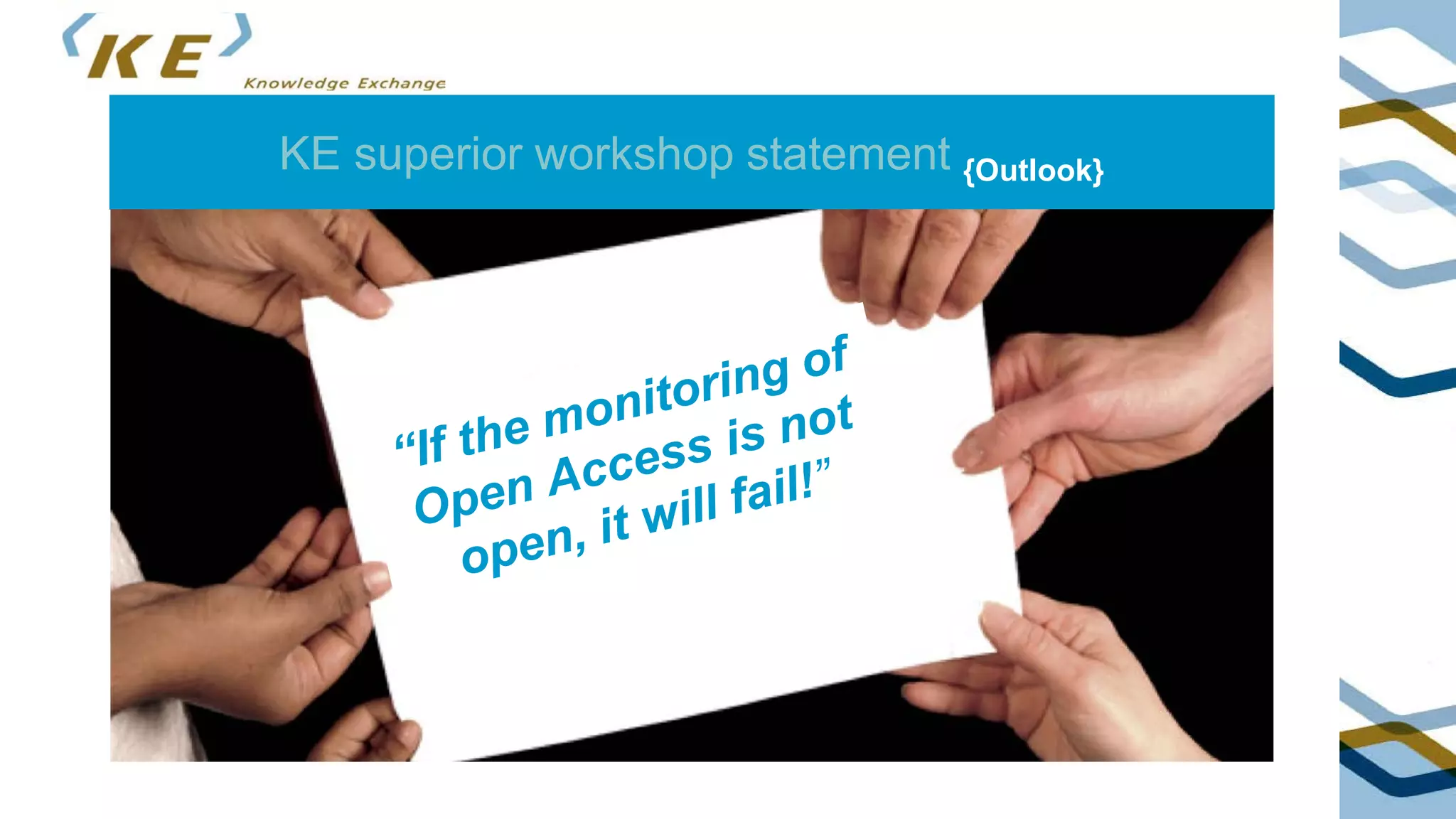
KE superior workshop statement {Outlook}
Published report out (sort of) now. I’ll share it with you!
Follow KE on @knowexchange
Acknowledgements
The work presented in these slides was funded by Knowledge
Exchange (http://www.knowledge-exchange.info/) and was
performed by the contributions and constructive discussions by
all participants in the workshop series.

Knowledge exchange consensus on monitoring OA: recommendations from the Copenhagen workshop

  • 1.
    Knowledge Exchange Consensuson monitoring OA: Recommendations from the Copenhagen workshop Open Access Mötesplats, Karlstad
  • 2.
    ● Beyond theworkshop series ● Published report & acknowledgements Agenda ➢ Knowledge Exchange? ➢ Workshop series: Utrecht (2015), Copenhagen (2016),  ? Status Issues Scope Outlook ● Background, method and objectives ● Community outreach & keynotes ● Country reporting: monitoring OA ● Breakout groups: topics and questions ● Recommendations
  • 3.
    Knowledge Exchange -collaboration, expertise & network DFG German Research Foundation Jisc (United Kingdom) DEFF Denmark’s Electronic Research Library SURF (Netherlands) CSC IT Centre for Science (Finland) CNRS Centre national de la recherche scientifique (France) KE are six national organisations working together in Europe to support the development of digital infrastructure to enable open scholarship. http://www.knowledge-exchange.info
  • 4.
    Knowledge Exchange -collaboration, expertise & network Christian Hagen Thomasen Project coordinator, DEFF + Representative in Knowledge Exchange Co-lead of Knowledge Exchanges OA expert group Denmark’s Electronic Research Library is both national consortium in Denmark and a cooperation between among others Danish Reseach Libraries. http://www.knowledge-exchange.info
  • 5.
    Background & method{Scope} ➔Mission Planning & scoping a workshop series around international collaboration addressing challenges & recommendations to monitoring of OA publications & derived cost data ➔ Activity: Monitoring Open Access Project initiated by KE Open Access Expert Group ➔ “Mixed method” ● Integration of qualitative & quantitative data based on KE partners’ status reporting & relevant community keynotes on monitoring OA ● Provide baseline for breakout groups to discuss KE scoped topics & questions & come up with practice-based recommendations on how to solve the challenges
  • 6.
    Objectives{Scope} Goal: pushing transparencyin exchange of OA metadata and cost data Aim: influencing evidence based policy making & promote better outcomes in negotiations with publishers
  • 7.
    Workshop meta-monitoring {Scope} #KEOA16 @knowexchange •57 participants from 11 countries and 41 organisations. • Librarians, politicians, bureaucrats, consultants, researchers, managers…
  • 8.
    Community outreach &keynotes {Status} Collecting and disseminating OA metadata from publishers at Crossref: the story so far (by: Rachael Lammey, CrossRef) Stuart Lawson: Revealing the true cost of publishing: Towards a public data infrastructure of scholarly publishing costs Rachael Lammey: Crossref and OA metadata Graham Stone: Collecting APC cost data and information Kai Geshuhn: Collecting cost data and information from offsetting contracts
  • 9.
    Country reporting onOA monitoring {Status} [GER]: The contribution of INTACT to the international monitoring of OA publication and cost data (by: Dirk Pieper, Bielefeld University Library) All presentations are available for reading and further examination: http://bit.ly/2jY9jDp [UK]: Monitor Local & Monitor UK (by: Frank Manista, Jisc) [DK]: The Danish Open Access Indicator (by: Mogens Sandfær, DTU) [NL]: Monitoring Open Access articles in the Netherlands (by: Just de Leeuwe, UKB) + Open Access (Robert van der Vooren, VSNU) [FIN]: OA publication and cost data in Finland (by: Jyrki Ilva, National Library of Finland) [FR]: Monitoring OA publication & cost data in France? (by: Sandrine Malotaux, Couperin) + Gold OA publishing & APC in a University (by: Jean-François Lutz, Université de Lorraine)
  • 10.
    Breakout groups toaddress topic & questions {Issues} 1. Data collecting & sources Quality in collecting data from available sources Quality of data collected LEAD: Maurits van der Graaf (Pleiade Consultancy)
  • 11.
    Breakout groups toaddress topic & questions {Issues} 2. Workflows Efficiency in monitoring workflows Efficiency on monitoring workflows LEAD: Kai Karin Geschuhn (MPDL)
  • 12.
    Breakout groups toaddress topic & questions {Issues} 3. Standards Aggregation of OA publications & costs via standards Aggregation of OA publications and derived costs via standards LEAD: Frank Manista (Jisc)
  • 13.
    Breakout groups toaddress topics & questions {Issues} 4. Governance & Policy Trust in monitoring OA & alignment across policy making Incorporation governance into monitoring processes for OA and related costs and possible policy alignment in the policy landscape LEAD: Angela Holzer (DFG)
  • 14.
    Recommendations {Issues} Green OA •identify corresponding author in metadata schema • identify potential green OA via Sherpa/RoMEO API • monitoring of OA after end of embargo Monitoring of OA (%) ★ Transparent definitions of what is measured are key! ★ Monitoring data should be open trough API’s – no pre-filtering! ★ Metadata form the repositories: Register green, hybrid and gold ★ Show the corresponding author ★ Matching metadata from the CRIS with DOAJ or ISSN-Gold-OA list in order to identify pure Gold articles ★ SherpaRomeo can help identify the green ★ DOI’s and ORCID are essentiel anchors
  • 15.
    Recommendations {Issues} Green OA •identify corresponding author in metadata schema • identify potential green OA via Sherpa/RoMEO API • monitoring of OA after end of embargo Monitoring of OA cost (kr.) ★ Transparent definitions of what is measured are key! ★ Monitoring data should be open trough APIs ★ Accounting systems and CRIS (and repositories) should work together ★ Standardisation of payment is needed. ★ Detailed information on what is payed for, APC, extras, VAT ★ Requirements for publisher data in offsetting agreements: corresponding author, licence information, exact publishing date, standardized data formats for author affiliation ★ DOI’s and ORCID are essentiel anchors
  • 16.
    Recommendations {Issues} • inoffsetting contracts (e.g. in terms & conditions) publishers should include in Crossref a license statement for each publication Next steps ★ CRIS-development ★ Publishers ★ Libraries and the managerial level
  • 17.
    KE superior workshopstatement {Outlook}
  • 18.
    Published report out(sort of) now. I’ll share it with you! Follow KE on @knowexchange Acknowledgements The work presented in these slides was funded by Knowledge Exchange (http://www.knowledge-exchange.info/) and was performed by the contributions and constructive discussions by all participants in the workshop series.