


Subterranean Rhizome Injection of
Herbicides for Knotweeds and Other
          Invasive Species
    Midwest-Great Lakes Chapter, Society for Ecological Restoration
                  Fourth Annual Chapter Meeting
                       University of Michigan


                      John Lampe
                   Green Shoots, LLC
                 Saint Paul, Minnesota
                      May 5, 2012

                                                                      1
Knotweed – Why Control?
• It is listed by the World Conservation Union as
  one of the world's 100 worst invasive species.
• This is not precise ranking but does show
  recognition of how problematic species is.
Outline of Talk

• Knotweed Background

• Current Control Methods

• Rhizome Injection
Knotweed Background
Pioneer species in native habitat – for example,
Mt. Fuji
Common Species of Knotweed
• Japanese knotweed (Polygonum cuspidatum)
• Giant knotweed (Polygonum sachalinense)
• Bohemian knotweed (Polygonum x
  bohemicum) – hybrid
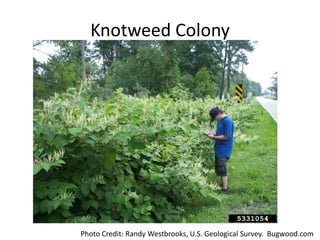
Knotweed Colony


Photo Credit: Randy Westbrooks, U.S. Geological Survey. Bugwood.com
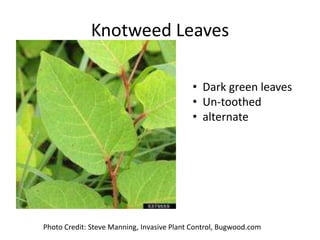
Knotweed Leaves

                                           • Dark green leaves
                                           • Un-toothed
                                           • alternate


Photo Credit: Steve Manning, Invasive Plant Control, Bugwood.com
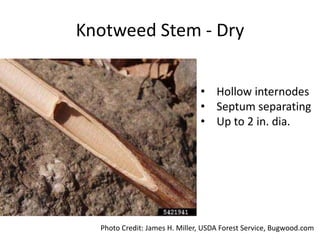
Knotweed Stem - Dry


                               • Hollow internodes
                               • Septum separating
                               • Up to 2 in. dia.


  Photo Credit: James H. Miller, USDA Forest Service, Bugwood.com
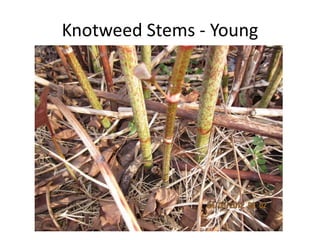
Knotweed Stems - Young
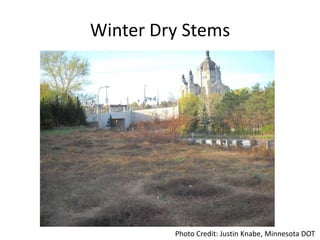
Winter Dry Stems


         Photo Credit: Justin Knabe, Minnesota DOT
Common Features of Knotweed (con.)


Rhizome
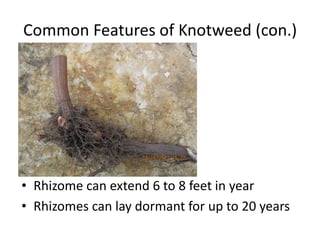
• Rhizome can extend 6 to 8 feet in year
• Rhizomes can lay dormant for up to 20 years
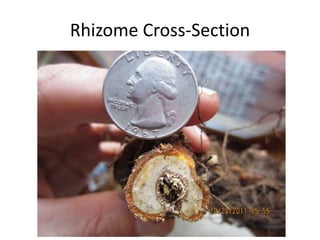
Rhizome Cross-Section
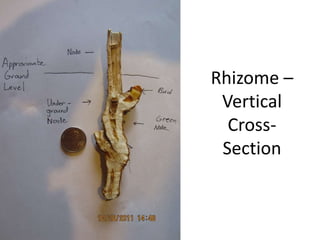
Rhizome –
 Vertical
  Cross-
 Section
Common Features of Knotweed (con.)
• Spread by:
  – Rhizome extension
  – Distribution of plant parts
     • Rhizome pieces – as small as 0.7 g (Brock & Wade 1992)
     • Node pieces
  – Seeds – not major source in WA. (Miller 2005)
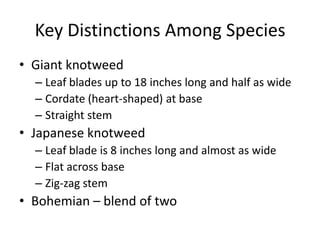
Key Distinctions Among Species
• Giant knotweed
  – Leaf blades up to 18 inches long and half as wide
  – Cordate (heart-shaped) at base
  – Straight stem
• Japanese knotweed
  – Leaf blade is 8 inches long and almost as wide
  – Flat across base
  – Zig-zag stem
• Bohemian – blend of two
Identification
Good source: Prather TS, Miller TW, Robins
SS, Knotweed shrubs: identification, biology, and
management, Pacific Northwest Extension
Publication 2009
Knotweed Badness
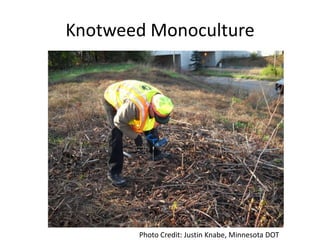
• Riparian areas especially vulnerable
• Out-compete other plants => monoculture
• Tree Absence leads to:
  – Loss of shade
  – Loss of woody debris
• Changes in soil fertility
• Erosion along streambeds and stream banks
Knotweed Monoculture


       Photo Credit: Justin Knabe, Minnesota DOT
Current Control Methods
• Cutting or Removal
• Coverage or Burial
• Chemical
Cutting, Removal, Coverage, Burial
• Cutting or removal – probably not practical
  except on small scale; high risk of spread.

• Coverage or burial – probably not practical
  except on small scale.
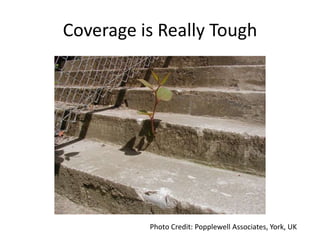
Coverage is Really Tough


          Photo Credit: Popplewell Associates, York, UK
Control – Chemical
•   Foliar
•   Cut stem
•   Stem injection
•   Stem wipe
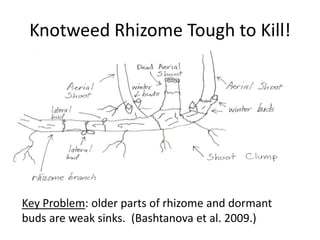
Knotweed Rhizome Tough to Kill!


Key Problem: older parts of rhizome and dormant
buds are weak sinks. (Bashtanova et al. 2009.)
Foliar
• Best to treat after July 1
• Backpack sprayer
• Typical chemicals used are:
  glyphosate, triclopyr, and imazapyr
Foliar
• Advantages
  – Fastest
  – Treat small-stemmed plants
  – Good control: 81%. (Miller 2005)
• Disadvantages
  – Off-target harm: Avg. injury: 68%. (Miller 2005)
  – Hard to treat large plants
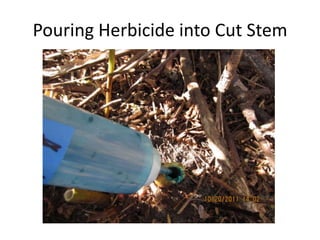
Cut Stem
• Cut stem 5 to 10 inches off ground
• Immediately pour up to 5 ml into hollow of
  stem
Pouring Herbicide into Cut Stem
Cut Stem
• Advantages
  – Low cost equipment
  – Good control


• Disadvantages
  – Time-consuming
  – Disposal of green aerial shoots
  – Amount of herbicide used
Stem Injection
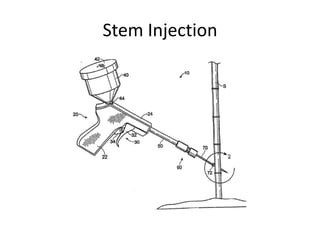
• Use hypodermic or special injector
• Inject up to 5 ml into stem
• Between 1st and 2nd node above ground
Stem Injection
Stem Injection
• Advantages
  – Precision
  – No stem disposal
  – Efficacy; Avg control: 88% (Miller 2005)
• Disadvantages
  –   Time-consuming
  –   Id of treated stems
  –   Amount of herbicide used
  –   Cost of equipment
  –   Non-target injury: 26% (Miller 2005)
Stem Wipe
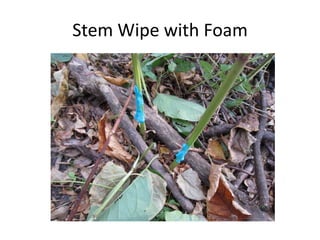
• Either cut stem or leave stem whole
• Abrade stem in some manner near base
• Wipe onto exposed inner tissue
Stem Wipe with Foam
Stem Wipe
• Advantages
  – Low cost equipment
  – Efficacy is good; control: 89%. (Miller 2005)


• Disadvantages
  – Time-consuming
  – Off-target injury: avg = 13% (Miller 2005)
Follow-Up Applications
• It seems that all methods of application currently
  used require follow-ups for many years
• According to Washington State Dept Agriculture:
  “The trend of this data shows a significant
  decrease in knotweed following six years of
  annual treatments. Despite these dramatic
  reductions, knotweed is still present at each
  monitoring site.” (Statewide Knotweed Control
  Program; 2010 Progress Report)
Can We Do a Better Job of
  Killing the Knotweed
         Rhizome?
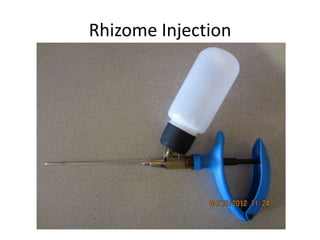
Rhizome Injection
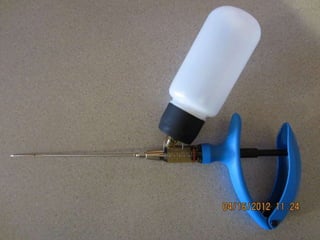
Rhizome Injector
• 6 in. blunt tipped needle
• Metered dosing
• 250 ml capacity (treatment for approximately
  125 plants)
Rhizome Injection – the Concept


First Premise: Efficacy of any method depends
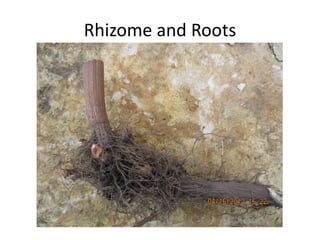
on herbicide reaching rhizome and roots.
Rhizome and Roots
Rhizome Injection – the Concept


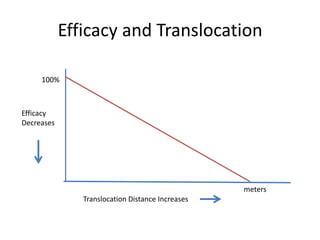
Second Premise: Efficacy decreases as trans-
location distance increases.
Efficacy and Translocation

     100%


Efficacy
Decreases


                                                  meters
               Translocation Distance Increases
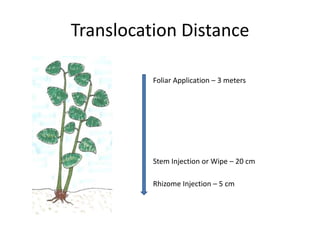
Translocation Distance

          Foliar Application – 3 meters


          Stem Injection or Wipe – 20 cm

          Rhizome Injection – 5 cm
Rhizome Injection – 1st Step
• Access inside hollow stem near ground level

  – Cut stem at ground level – dead or living stem; or

  – Bend stem at ground level and create opening into
    the stem hollow
Rhizome Injection – 2nd Step
• Insert needle of injector through septum in
  hollow of stem
• Probe down into rhizome hollow as far as
  possible
Rhizome Injection – 3rd Step
• Inject Herbicide
• I set dose at 2ml
• AquaMaster label, for example, forbids
  injection in excess of 5 ml into stem
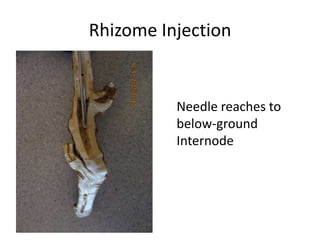
Rhizome Injection


          Needle reaches to
          below-ground
          Internode
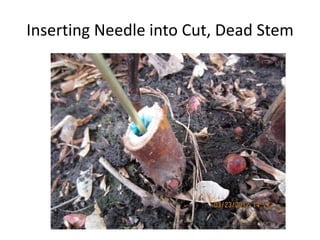
Inserting Needle into Cut, Dead Stem
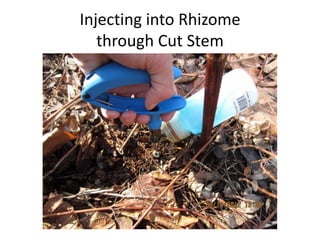
Injecting into Rhizome
   through Cut Stem
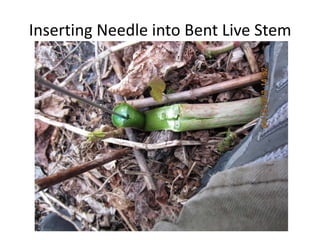
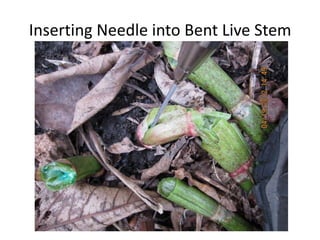
Inserting Needle into Bent Live Stem
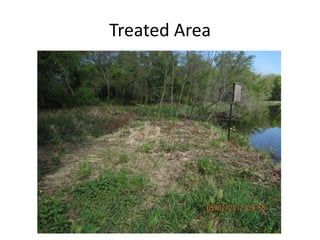
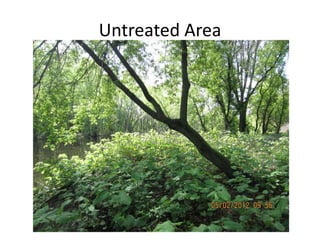
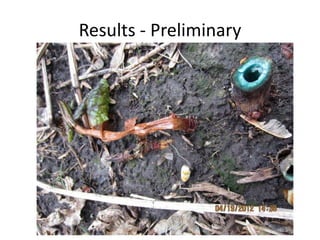
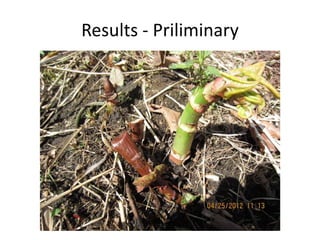
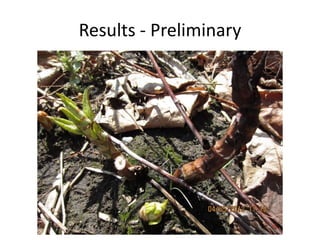
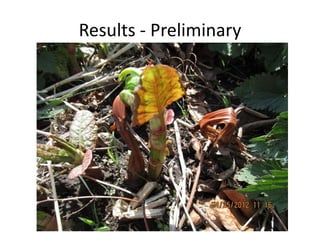
Results?
Treated Area
Untreated Area
Results - Preliminary
Results - Priliminary
Results - Preliminary
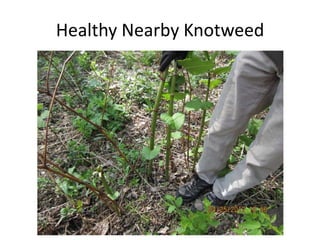
Healthy Nearby Knotweed
Potential Advantages – Rhizome
                Injection
1. Injection directly into rhizome – the part of
   plant that herbicide must reach
2. Amount of herbicide can potentially be less
3. Eliminate disposal problems – leave live
   aerial shoots attached or treat when aerial
   shoots are dead
Potential Advantages – Rhizome
                  Injection
4. Extend application season:
  –   Summer – after July 1 or so
  –   Fall
  –   Late fall – after stems have died
  –   winter
5. Treat fewer stems?
  – Depends on amount of translocation
Green Shoots
John Lampe – contact:
• john@greenshootsonline.com
• 651-245-4682 (cell)
Website:
www.greenshootsonline.com
• Email or call for copy of
  presentation

                               64

Injections of Herbicide into Rhizomes of Knotweeds and Other Invasive Plant Species

  • 1.
    Subterranean Rhizome Injectionof Herbicides for Knotweeds and Other Invasive Species Midwest-Great Lakes Chapter, Society for Ecological Restoration Fourth Annual Chapter Meeting University of Michigan John Lampe Green Shoots, LLC Saint Paul, Minnesota May 5, 2012 1
  • 3.
    Knotweed – WhyControl? • It is listed by the World Conservation Union as one of the world's 100 worst invasive species. • This is not precise ranking but does show recognition of how problematic species is.
  • 4.
    Outline of Talk •Knotweed Background • Current Control Methods • Rhizome Injection
  • 6.
    Knotweed Background Pioneer speciesin native habitat – for example, Mt. Fuji
  • 7.
    Common Species ofKnotweed • Japanese knotweed (Polygonum cuspidatum) • Giant knotweed (Polygonum sachalinense) • Bohemian knotweed (Polygonum x bohemicum) – hybrid
  • 8.
    Knotweed Colony Photo Credit:Randy Westbrooks, U.S. Geological Survey. Bugwood.com
  • 9.
    Knotweed Leaves • Dark green leaves • Un-toothed • alternate Photo Credit: Steve Manning, Invasive Plant Control, Bugwood.com
  • 10.
    Knotweed Stem -Dry • Hollow internodes • Septum separating • Up to 2 in. dia. Photo Credit: James H. Miller, USDA Forest Service, Bugwood.com
  • 11.
  • 12.
    Winter Dry Stems Photo Credit: Justin Knabe, Minnesota DOT
  • 13.
    Common Features ofKnotweed (con.) Rhizome • Rhizome can extend 6 to 8 feet in year • Rhizomes can lay dormant for up to 20 years
  • 14.
  • 15.
    Rhizome – Vertical Cross- Section
  • 16.
    Common Features ofKnotweed (con.) • Spread by: – Rhizome extension – Distribution of plant parts • Rhizome pieces – as small as 0.7 g (Brock & Wade 1992) • Node pieces – Seeds – not major source in WA. (Miller 2005)
  • 17.
    Key Distinctions AmongSpecies • Giant knotweed – Leaf blades up to 18 inches long and half as wide – Cordate (heart-shaped) at base – Straight stem • Japanese knotweed – Leaf blade is 8 inches long and almost as wide – Flat across base – Zig-zag stem • Bohemian – blend of two
  • 18.
    Identification Good source: PratherTS, Miller TW, Robins SS, Knotweed shrubs: identification, biology, and management, Pacific Northwest Extension Publication 2009
  • 19.
    Knotweed Badness • Riparianareas especially vulnerable • Out-compete other plants => monoculture • Tree Absence leads to: – Loss of shade – Loss of woody debris • Changes in soil fertility • Erosion along streambeds and stream banks
  • 20.
    Knotweed Monoculture Photo Credit: Justin Knabe, Minnesota DOT
  • 21.
    Current Control Methods •Cutting or Removal • Coverage or Burial • Chemical
  • 22.
    Cutting, Removal, Coverage,Burial • Cutting or removal – probably not practical except on small scale; high risk of spread. • Coverage or burial – probably not practical except on small scale.
  • 23.
    Coverage is ReallyTough Photo Credit: Popplewell Associates, York, UK
  • 24.
    Control – Chemical • Foliar • Cut stem • Stem injection • Stem wipe
  • 25.
    Knotweed Rhizome Toughto Kill! Key Problem: older parts of rhizome and dormant buds are weak sinks. (Bashtanova et al. 2009.)
  • 26.
    Foliar • Best totreat after July 1 • Backpack sprayer • Typical chemicals used are: glyphosate, triclopyr, and imazapyr
  • 27.
    Foliar • Advantages – Fastest – Treat small-stemmed plants – Good control: 81%. (Miller 2005) • Disadvantages – Off-target harm: Avg. injury: 68%. (Miller 2005) – Hard to treat large plants
  • 28.
    Cut Stem • Cutstem 5 to 10 inches off ground • Immediately pour up to 5 ml into hollow of stem
  • 29.
  • 30.
    Cut Stem • Advantages – Low cost equipment – Good control • Disadvantages – Time-consuming – Disposal of green aerial shoots – Amount of herbicide used
  • 31.
    Stem Injection • Usehypodermic or special injector • Inject up to 5 ml into stem • Between 1st and 2nd node above ground
  • 32.
  • 33.
    Stem Injection • Advantages – Precision – No stem disposal – Efficacy; Avg control: 88% (Miller 2005) • Disadvantages – Time-consuming – Id of treated stems – Amount of herbicide used – Cost of equipment – Non-target injury: 26% (Miller 2005)
  • 34.
    Stem Wipe • Eithercut stem or leave stem whole • Abrade stem in some manner near base • Wipe onto exposed inner tissue
  • 35.
  • 36.
    Stem Wipe • Advantages – Low cost equipment – Efficacy is good; control: 89%. (Miller 2005) • Disadvantages – Time-consuming – Off-target injury: avg = 13% (Miller 2005)
  • 37.
    Follow-Up Applications • Itseems that all methods of application currently used require follow-ups for many years • According to Washington State Dept Agriculture: “The trend of this data shows a significant decrease in knotweed following six years of annual treatments. Despite these dramatic reductions, knotweed is still present at each monitoring site.” (Statewide Knotweed Control Program; 2010 Progress Report)
  • 38.
    Can We Doa Better Job of Killing the Knotweed Rhizome?
  • 39.
  • 40.
    Rhizome Injector • 6in. blunt tipped needle • Metered dosing • 250 ml capacity (treatment for approximately 125 plants)
  • 41.
    Rhizome Injection –the Concept First Premise: Efficacy of any method depends on herbicide reaching rhizome and roots.
  • 42.
  • 43.
    Rhizome Injection –the Concept Second Premise: Efficacy decreases as trans- location distance increases.
  • 44.
    Efficacy and Translocation 100% Efficacy Decreases meters Translocation Distance Increases
  • 45.
    Translocation Distance Foliar Application – 3 meters Stem Injection or Wipe – 20 cm Rhizome Injection – 5 cm
  • 46.
    Rhizome Injection –1st Step • Access inside hollow stem near ground level – Cut stem at ground level – dead or living stem; or – Bend stem at ground level and create opening into the stem hollow
  • 47.
    Rhizome Injection –2nd Step • Insert needle of injector through septum in hollow of stem • Probe down into rhizome hollow as far as possible
  • 48.
    Rhizome Injection –3rd Step • Inject Herbicide • I set dose at 2ml • AquaMaster label, for example, forbids injection in excess of 5 ml into stem
  • 49.
    Rhizome Injection Needle reaches to below-ground Internode
  • 50.
    Inserting Needle intoCut, Dead Stem
  • 51.
    Injecting into Rhizome through Cut Stem
  • 52.
    Inserting Needle intoBent Live Stem
  • 53.
    Inserting Needle intoBent Live Stem
  • 54.
  • 55.
  • 56.
  • 57.
  • 58.
  • 59.
  • 60.
  • 61.
  • 62.
    Potential Advantages –Rhizome Injection 1. Injection directly into rhizome – the part of plant that herbicide must reach 2. Amount of herbicide can potentially be less 3. Eliminate disposal problems – leave live aerial shoots attached or treat when aerial shoots are dead
  • 63.
    Potential Advantages –Rhizome Injection 4. Extend application season: – Summer – after July 1 or so – Fall – Late fall – after stems have died – winter 5. Treat fewer stems? – Depends on amount of translocation
  • 64.
    Green Shoots John Lampe– contact: • john@greenshootsonline.com • 651-245-4682 (cell) Website: www.greenshootsonline.com • Email or call for copy of presentation 64