Japanese Knotweed Ian Gower IG Horticulture Ian Gower Associates Ltd
Introduction Japanese knotweed – Fallopia japonica, is native to Japan, Taiwan and China, and was introduced to Europe by Philipp von Siebold as an ornamental plant in the early 19th century.  In 1879 ‘The Garden’ magazine described it as ‘one of the most beautiful herbaceous plants in civilisation. It is now the most aggressive alien weed in the UK.
Introduction It is a large vigorous weed that appears to have no natural enemies in Britain.  It is pollution resistant. It can colonise most habitats and even grows in poor soil. It is regarded as a troublesome pest in many parts of the country because of its rapid invasion and domination of habitats, which results in the exclusion of other plants.
Introduction It can damage property (for example by growing through tarmac or even the floors of houses) and therefore needs to be cleared from development sites.  High street banks often refuse mortgages on properties where knotweed is growing in the garden.  It cost the contractor on the Olympics site around £9 million to get rid of it.
Introduction The species also causes problems in terms of flood management. It increases the risk of riverbank erosion when the dense growth of the plant dies back in the autumn exposing bare soil.  It can also create a flooding hazard if the dead stems are washed into the streams and clog up the channel.
Other Invasive Knotweeds Fallopia sachilensis Giant knotweed Fallopia x bohemica Hybrid knotweed, a cross between Japanese and Giant knotweed
Background It is an offence under section 14(2) of the Wildlife and Countryside Act 1981 to "plant or otherwise cause to grow in the wild" any plant listed in Schedule 9, Part II to the Act.  This includes Japanese knotweed.   Both the Police and local authorities have enforcement functions for the 1981 Act.
Background It is  not  an offence to simply have it growing in your garden or on your land and there is no legal requirement to control it if it is (unless doing so forms part of a legally binding contract or agreement with another party).  There is no need to report its presence on your land (unless doing so forms part of a legally binding contract or agreement with another party).
Background Japanese knotweed is not amongst the five species listed in the Weeds Act 1959. Those species are Common Ragwort, Spear Thistle, Creeping or Field Thistle, Broad leaved Dock and Curled Dock.
Background Any Japanese knotweed contaminated soil or plant material that you intend to dispose of is likely to be classified as 'controlled waste' under the Environmental Protection Act 1990.  Therefore it has to be disposed of at licensed sites or by burning on site. Untreated knotweed is  not  regarded as a 'hazardous waste' under the Hazardous Waste Regulations 2005 but material containing knotweed that has been treated with certain herbicides could be.  Also, soil that could have knotweed roots in it, whether dead or alive, is regarded as ‘hazardous waste’.
Benefits Late season pollination for bees Can serve as a nesting site for birds
Government Action The cost of a national eradication programme using current techniques is prohibitively expensive, estimated in the Defra Review of Non-native Species Policy to be in the region of £1.56 billion.  However, the Environment Agency does take local measures if flood defences are compromised (using risk assessment and local knowledge).  In Cornwall, a more proactive programme has been implemented by the Agency in association with the Cornwall Knotweed Forum.
Knotweed Code of Practice The Environment Agency (in partnership with Defra and Network Rail) has published the Knotweed Code of Practice for those involved in the development industry, who face the problem on a large scale.   Page 6 sets out the relevant legislation under the Wildlife and Countryside Act 1981 and "controlled waste" issues in more detail.  The code also gives practical advice on the use of herbicides and other control methods.
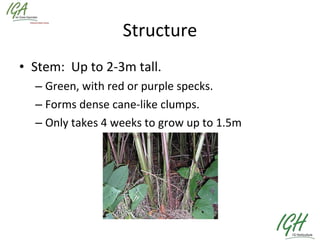
Structure Stem:  Up to 2-3m tall.  Green, with red or purple specks.  Forms dense cane-like clumps. Only takes 4 weeks to grow up to 1.5m
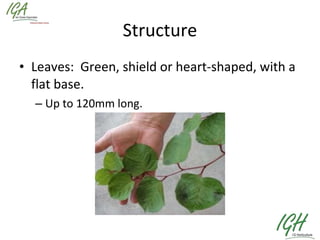
Structure Leaves:  Green, shield or heart-shaped, with a flat base. Up to 120mm long.
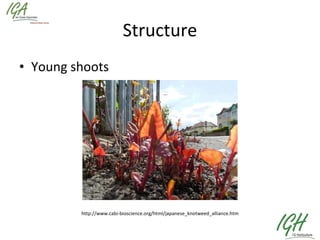
Structure Young shoots http://www.cabi-bioscience.org/html/japanese_knotweed_alliance.htm
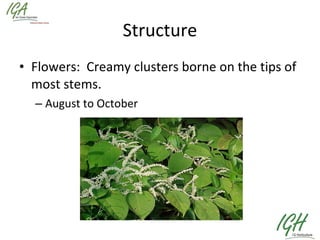
Structure Flowers:  Creamy clusters borne on the tips of most stems. August to October
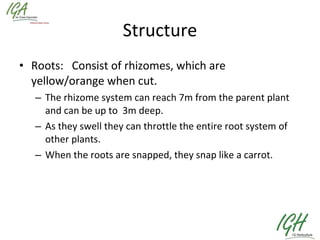
Structure Roots:  Consist of rhizomes, which are yellow/orange when cut. http://www.projects.ex.ac.uk/knotweed/knotweed_facts.htm
Structure Roots:  Consist of rhizomes, which are yellow/orange when cut. The rhizome system can reach 7m from the parent plant and can be up to  3m deep. As they swell they can throttle the entire root system of other plants. When the roots are snapped, they snap like a carrot.
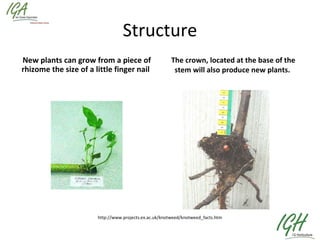
Structure New plants can grow from a piece of rhizome the size of a little finger nail   The crown, located at the base of the stem will also produce new plants.  http://www.projects.ex.ac.uk/knotweed/knotweed_facts.htm
Propagation Humans! Make sure that you do not take anything off site that could be contaminated with even the smallest piece of knotweed
Control Cutting:  should be done extremely carefully using a hand scythe or other simple blade to avoid spreading stem fragments.  Flail mowing must not be carried out.  Continue cutting every 2-4 weeks to reduce both above and below ground biomass. Pulling:  best done from June onwards by uprooting stems, pulling from the base.  This regular pulling exhausts the plant by forcing the rhizomes to expand their reserves.
Control Grazing:  Grazing of shoots by horses, sheep and goats keeps the plants in check, provided previous dead growth is removed.  Digging:  Digging out rhizomes and disposing of the spoil is an expensive option and often impracticable.  The spoil can be removed from a site as special waste, disposed on-site at least 10m deep, or the material can be sieved through a 20mm mesh and the spoil reused on site. 
Disposal The stems die back in winter but take up to 3 years to decompose.  The crowns should neither be composted nor removed from a site without a waste license. Burn cut stems on site, ideally in a cage incinerator. Otherwise, bury 10m deep.
Preventing the Spread of Knotweed Ensure that everyone who is working on the site, or around the site, has been notified about and clearly understands the concerns and threats that Japanese Knotweed causes. All contaminated areas must be fenced off and ideally notices posted. All tools and vehicles bought on-site must be washed before leaving the site. Remember that cutting Japanese Knotweed causes the roots to spread. Also, when bringing in new top-soil, ensure that it is not contaminated with Japanese Knotweed!
Chemical Control The Control of Pesticides Regulations 1986 require any person who uses a pesticide to take all reasonable precautions to protect the health of human beings, creatures and plants, safeguard the environment and in particular avoid the pollution of water. 
Chemical Control Approval from the Environment Agency should be sought before application of pesticides in or near water using form AqHerb01. (This used to be form WQM1).  Near water, chemical control can be achieved with herbicides containing glyphosate.  Spraying both the top and underside of leaves improves control. The most effective treatment time is the summer when the stem diameter is 20mm or more. Treatment will need to be re-done for 2 to 3 years and spot treatments may be required.
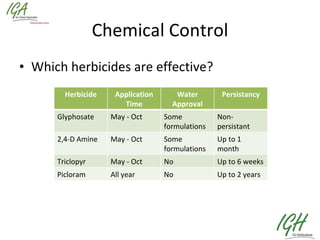
Chemical Control Which herbicides are effective? Herbicide Application Time Water Approval Persistancy Glyphosate May - Oct Some formulations Non-persistant 2,4-D Amine May - Oct Some formulations Up to 1 month Triclopyr May - Oct No Up to 6 weeks Picloram All year No Up to 2 years
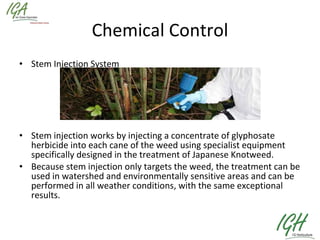
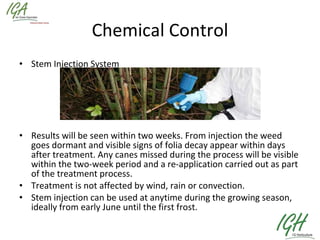
Chemical Control Stem Injection System Stem injection works by injecting a concentrate of glyphosate herbicide into each cane of the weed using specialist equipment specifically designed in the treatment of Japanese Knotweed.  Because stem injection only targets the weed, the treatment can be used in watershed and environmentally sensitive areas and can be performed in all weather conditions, with the same exceptional results.
Chemical Control Stem Injection System Results will be seen within two weeks. From injection the weed goes dormant and visible signs of folia decay appear within days after treatment. Any canes missed during the process will be visible within the two-week period and a re-application carried out as part of the treatment process.  Treatment is not affected by wind, rain or convection.  Stem injection can be used at anytime during the growing season, ideally from early June until the first frost.
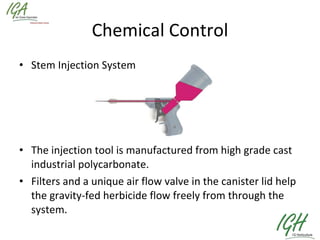
Chemical Control Stem Injection System The injection tool is manufactured from high grade cast industrial polycarbonate.  Filters and a unique air flow valve in the canister lid help the gravity-fed herbicide flow freely from through the system.
PPE For Use With Stem Injectors Coverall Nitrile Gloves Face Shield Rubber Boots Stem Injector Holster
Preparing to use a Stem Injector Risk assessment COSHH Risk Assessment Environmental Risk assessment Equipment Assembly Calibration Needle Types Injection Process
Stem Injector Needles Standard Needle For use with Japanese Knotweed and Himalayan Balsam. Heavy Duty Needle Stronger than the standard needle Shortened Needle For late season injections. Cavity Needle For use injecting into the cavity of hollow cane plants such as Giant Hogweed.
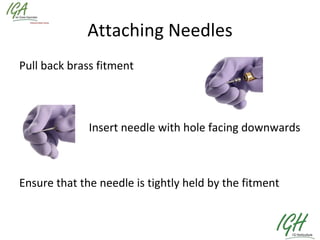
Attaching Needles Pull back brass fitment     Insert needle with hole facing downwards Ensure that the needle is tightly held by the fitment
Cleaning and Maintenance of  Stem Injectors Record keeping Triple rinsing Disassemble Maintenance checks
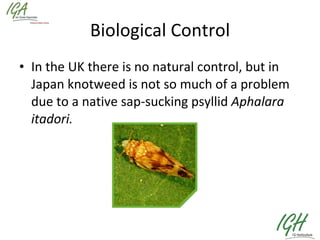
Biological Control In the UK there is no natural control, but in Japan knotweed is not so much of a problem due to a native sap-sucking psyllid  Aphalara itadori.
Biological Control Ten years ago a scientist – Richard Shaw – found out about this psyllid. He discovered that it only liked Japanese Knotweed. The female lays around 500 eggs and the nymphs that emerge love to suck the sap, just like aphids who are well known for sap sucking.
Biological Control This sucking causes stumpy leaves and shorter plants that are in the end less invasive and aggressive. The bugs were quarantined for several years before permission was given for their release into the UK at specially controlled sites. Research shows that adult psyllids simply cannot survive even on the most closely related species to Japanese knotweed in Britain.
Biological Control Based on this research, the psyllid should pose no threat to anything other than Japanese knotweed and the damaging hybrid variety – bohemian knotweed ( Fallopia  x  bohemica ).  It should also be possible to integrate the psyllid control programme with current management regimes which would improve control efficacy at sites where traditional control remains necessary. 
Biological Control It could take up to 10 years to fully control knotweed  once enough psyllids have been bulked up and permission has been given to release them throughout the UK. This is the first time that biological control has been used in the UK for weed control.
Biological Control Press release, 13 June 2011 Acting under licences granted by the Food and Environment Research Agency (Fera) in England, and the Welsh Government in  Wales, CABI has released the psyllid at a small number of carefully selected sites containing Japanese knotweed in England and Wales. These sites, together with a number of control sites on which the psyllid has not been released, will be closely monitored for five years.
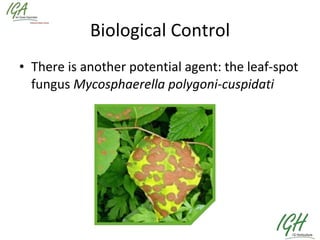
Biological Control There is another potential agent: the leaf-spot fungus  Mycosphaerella polygoni-cuspidati
Biological Control This leaf-spot fungus devastates Japanese knotweed in the field in the warmer months from June to October. It again has never been recorded on any plant other than Japanese knotweed.
Biological Control   The fungus has proven to be much harder to work on than many of the potential insect agents since its lifecycle is complex and the infection process is intricately linked to environmental conditions.  While research has shown the leaf-spot fungus could be a viable option, further studies are required and work in the UK is focussed on the psyllid.  
Links The Environment Agency guide to Knotweed – including a link to the Knotweed Code of Practice http://www.environment-agency.gov.uk/business/sectors/31364.aspx Form AqHerb01: Agreement to use herbicides in or near water http://publications.environment-agency.gov.uk/PDF/GEHO0110BRZI-E-E.pdf Japanese knotweed, giant hogweed and other invasive plants - Spraying invasive plants with herbicide http://www.businesslink.gov.uk/bdotg/action/detail?itemId=1086737527&r.l1=1079068363&r.l2=1082900123&r.l3=1086726920&r.s=sc&type=RESOURCES Japanese Knotweed Alliance – including further information on the psyllid http://www.cabi.org/japaneseknotweedalliance/ Cornwall Knotweed Forum http://www.cornwall.gov.uk/default.aspx?page=13789 Stem Injection Systems - importer of the Stem Injector http://www.steminjectionsystems.com/
Any Questions?

Japanese Knotweed 2011 - updated

  • 1.
    Japanese Knotweed IanGower IG Horticulture Ian Gower Associates Ltd
  • 2.
    Introduction Japanese knotweed– Fallopia japonica, is native to Japan, Taiwan and China, and was introduced to Europe by Philipp von Siebold as an ornamental plant in the early 19th century. In 1879 ‘The Garden’ magazine described it as ‘one of the most beautiful herbaceous plants in civilisation. It is now the most aggressive alien weed in the UK.
  • 3.
    Introduction It isa large vigorous weed that appears to have no natural enemies in Britain. It is pollution resistant. It can colonise most habitats and even grows in poor soil. It is regarded as a troublesome pest in many parts of the country because of its rapid invasion and domination of habitats, which results in the exclusion of other plants.
  • 4.
    Introduction It candamage property (for example by growing through tarmac or even the floors of houses) and therefore needs to be cleared from development sites. High street banks often refuse mortgages on properties where knotweed is growing in the garden. It cost the contractor on the Olympics site around £9 million to get rid of it.
  • 5.
    Introduction The speciesalso causes problems in terms of flood management. It increases the risk of riverbank erosion when the dense growth of the plant dies back in the autumn exposing bare soil. It can also create a flooding hazard if the dead stems are washed into the streams and clog up the channel.
  • 6.
    Other Invasive KnotweedsFallopia sachilensis Giant knotweed Fallopia x bohemica Hybrid knotweed, a cross between Japanese and Giant knotweed
  • 7.
    Background It isan offence under section 14(2) of the Wildlife and Countryside Act 1981 to "plant or otherwise cause to grow in the wild" any plant listed in Schedule 9, Part II to the Act.  This includes Japanese knotweed.  Both the Police and local authorities have enforcement functions for the 1981 Act.
  • 8.
    Background It is not an offence to simply have it growing in your garden or on your land and there is no legal requirement to control it if it is (unless doing so forms part of a legally binding contract or agreement with another party). There is no need to report its presence on your land (unless doing so forms part of a legally binding contract or agreement with another party).
  • 9.
    Background Japanese knotweedis not amongst the five species listed in the Weeds Act 1959. Those species are Common Ragwort, Spear Thistle, Creeping or Field Thistle, Broad leaved Dock and Curled Dock.
  • 10.
    Background Any Japaneseknotweed contaminated soil or plant material that you intend to dispose of is likely to be classified as 'controlled waste' under the Environmental Protection Act 1990.  Therefore it has to be disposed of at licensed sites or by burning on site. Untreated knotweed is not regarded as a 'hazardous waste' under the Hazardous Waste Regulations 2005 but material containing knotweed that has been treated with certain herbicides could be. Also, soil that could have knotweed roots in it, whether dead or alive, is regarded as ‘hazardous waste’.
  • 11.
    Benefits Late seasonpollination for bees Can serve as a nesting site for birds
  • 12.
    Government Action Thecost of a national eradication programme using current techniques is prohibitively expensive, estimated in the Defra Review of Non-native Species Policy to be in the region of £1.56 billion. However, the Environment Agency does take local measures if flood defences are compromised (using risk assessment and local knowledge). In Cornwall, a more proactive programme has been implemented by the Agency in association with the Cornwall Knotweed Forum.
  • 13.
    Knotweed Code ofPractice The Environment Agency (in partnership with Defra and Network Rail) has published the Knotweed Code of Practice for those involved in the development industry, who face the problem on a large scale.  Page 6 sets out the relevant legislation under the Wildlife and Countryside Act 1981 and "controlled waste" issues in more detail.  The code also gives practical advice on the use of herbicides and other control methods.
  • 14.
    Structure Stem: Up to 2-3m tall. Green, with red or purple specks. Forms dense cane-like clumps. Only takes 4 weeks to grow up to 1.5m
  • 15.
    Structure Leaves: Green, shield or heart-shaped, with a flat base. Up to 120mm long.
  • 16.
    Structure Young shootshttp://www.cabi-bioscience.org/html/japanese_knotweed_alliance.htm
  • 17.
    Structure Flowers: Creamy clusters borne on the tips of most stems. August to October
  • 18.
    Structure Roots: Consist of rhizomes, which are yellow/orange when cut. http://www.projects.ex.ac.uk/knotweed/knotweed_facts.htm
  • 19.
    Structure Roots: Consist of rhizomes, which are yellow/orange when cut. The rhizome system can reach 7m from the parent plant and can be up to 3m deep. As they swell they can throttle the entire root system of other plants. When the roots are snapped, they snap like a carrot.
  • 20.
    Structure New plantscan grow from a piece of rhizome the size of a little finger nail The crown, located at the base of the stem will also produce new plants.  http://www.projects.ex.ac.uk/knotweed/knotweed_facts.htm
  • 21.
    Propagation Humans! Makesure that you do not take anything off site that could be contaminated with even the smallest piece of knotweed
  • 22.
    Control Cutting: should be done extremely carefully using a hand scythe or other simple blade to avoid spreading stem fragments. Flail mowing must not be carried out. Continue cutting every 2-4 weeks to reduce both above and below ground biomass. Pulling: best done from June onwards by uprooting stems, pulling from the base. This regular pulling exhausts the plant by forcing the rhizomes to expand their reserves.
  • 23.
    Control Grazing: Grazing of shoots by horses, sheep and goats keeps the plants in check, provided previous dead growth is removed. Digging: Digging out rhizomes and disposing of the spoil is an expensive option and often impracticable. The spoil can be removed from a site as special waste, disposed on-site at least 10m deep, or the material can be sieved through a 20mm mesh and the spoil reused on site. 
  • 24.
    Disposal The stemsdie back in winter but take up to 3 years to decompose. The crowns should neither be composted nor removed from a site without a waste license. Burn cut stems on site, ideally in a cage incinerator. Otherwise, bury 10m deep.
  • 25.
    Preventing the Spreadof Knotweed Ensure that everyone who is working on the site, or around the site, has been notified about and clearly understands the concerns and threats that Japanese Knotweed causes. All contaminated areas must be fenced off and ideally notices posted. All tools and vehicles bought on-site must be washed before leaving the site. Remember that cutting Japanese Knotweed causes the roots to spread. Also, when bringing in new top-soil, ensure that it is not contaminated with Japanese Knotweed!
  • 26.
    Chemical Control TheControl of Pesticides Regulations 1986 require any person who uses a pesticide to take all reasonable precautions to protect the health of human beings, creatures and plants, safeguard the environment and in particular avoid the pollution of water. 
  • 27.
    Chemical Control Approvalfrom the Environment Agency should be sought before application of pesticides in or near water using form AqHerb01. (This used to be form WQM1). Near water, chemical control can be achieved with herbicides containing glyphosate. Spraying both the top and underside of leaves improves control. The most effective treatment time is the summer when the stem diameter is 20mm or more. Treatment will need to be re-done for 2 to 3 years and spot treatments may be required.
  • 28.
    Chemical Control Whichherbicides are effective? Herbicide Application Time Water Approval Persistancy Glyphosate May - Oct Some formulations Non-persistant 2,4-D Amine May - Oct Some formulations Up to 1 month Triclopyr May - Oct No Up to 6 weeks Picloram All year No Up to 2 years
  • 29.
    Chemical Control StemInjection System Stem injection works by injecting a concentrate of glyphosate herbicide into each cane of the weed using specialist equipment specifically designed in the treatment of Japanese Knotweed. Because stem injection only targets the weed, the treatment can be used in watershed and environmentally sensitive areas and can be performed in all weather conditions, with the same exceptional results.
  • 30.
    Chemical Control StemInjection System Results will be seen within two weeks. From injection the weed goes dormant and visible signs of folia decay appear within days after treatment. Any canes missed during the process will be visible within the two-week period and a re-application carried out as part of the treatment process. Treatment is not affected by wind, rain or convection. Stem injection can be used at anytime during the growing season, ideally from early June until the first frost.
  • 31.
    Chemical Control StemInjection System The injection tool is manufactured from high grade cast industrial polycarbonate. Filters and a unique air flow valve in the canister lid help the gravity-fed herbicide flow freely from through the system.
  • 32.
    PPE For UseWith Stem Injectors Coverall Nitrile Gloves Face Shield Rubber Boots Stem Injector Holster
  • 33.
    Preparing to usea Stem Injector Risk assessment COSHH Risk Assessment Environmental Risk assessment Equipment Assembly Calibration Needle Types Injection Process
  • 34.
    Stem Injector NeedlesStandard Needle For use with Japanese Knotweed and Himalayan Balsam. Heavy Duty Needle Stronger than the standard needle Shortened Needle For late season injections. Cavity Needle For use injecting into the cavity of hollow cane plants such as Giant Hogweed.
  • 35.
    Attaching Needles Pullback brass fitment Insert needle with hole facing downwards Ensure that the needle is tightly held by the fitment
  • 36.
    Cleaning and Maintenanceof Stem Injectors Record keeping Triple rinsing Disassemble Maintenance checks
  • 37.
    Biological Control Inthe UK there is no natural control, but in Japan knotweed is not so much of a problem due to a native sap-sucking psyllid Aphalara itadori.
  • 38.
    Biological Control Tenyears ago a scientist – Richard Shaw – found out about this psyllid. He discovered that it only liked Japanese Knotweed. The female lays around 500 eggs and the nymphs that emerge love to suck the sap, just like aphids who are well known for sap sucking.
  • 39.
    Biological Control Thissucking causes stumpy leaves and shorter plants that are in the end less invasive and aggressive. The bugs were quarantined for several years before permission was given for their release into the UK at specially controlled sites. Research shows that adult psyllids simply cannot survive even on the most closely related species to Japanese knotweed in Britain.
  • 40.
    Biological Control Basedon this research, the psyllid should pose no threat to anything other than Japanese knotweed and the damaging hybrid variety – bohemian knotweed ( Fallopia x bohemica ). It should also be possible to integrate the psyllid control programme with current management regimes which would improve control efficacy at sites where traditional control remains necessary. 
  • 41.
    Biological Control Itcould take up to 10 years to fully control knotweed once enough psyllids have been bulked up and permission has been given to release them throughout the UK. This is the first time that biological control has been used in the UK for weed control.
  • 42.
    Biological Control Pressrelease, 13 June 2011 Acting under licences granted by the Food and Environment Research Agency (Fera) in England, and the Welsh Government in Wales, CABI has released the psyllid at a small number of carefully selected sites containing Japanese knotweed in England and Wales. These sites, together with a number of control sites on which the psyllid has not been released, will be closely monitored for five years.
  • 43.
    Biological Control Thereis another potential agent: the leaf-spot fungus Mycosphaerella polygoni-cuspidati
  • 44.
    Biological Control Thisleaf-spot fungus devastates Japanese knotweed in the field in the warmer months from June to October. It again has never been recorded on any plant other than Japanese knotweed.
  • 45.
    Biological Control  The fungus has proven to be much harder to work on than many of the potential insect agents since its lifecycle is complex and the infection process is intricately linked to environmental conditions.  While research has shown the leaf-spot fungus could be a viable option, further studies are required and work in the UK is focussed on the psyllid.  
  • 46.
    Links The EnvironmentAgency guide to Knotweed – including a link to the Knotweed Code of Practice http://www.environment-agency.gov.uk/business/sectors/31364.aspx Form AqHerb01: Agreement to use herbicides in or near water http://publications.environment-agency.gov.uk/PDF/GEHO0110BRZI-E-E.pdf Japanese knotweed, giant hogweed and other invasive plants - Spraying invasive plants with herbicide http://www.businesslink.gov.uk/bdotg/action/detail?itemId=1086737527&r.l1=1079068363&r.l2=1082900123&r.l3=1086726920&r.s=sc&type=RESOURCES Japanese Knotweed Alliance – including further information on the psyllid http://www.cabi.org/japaneseknotweedalliance/ Cornwall Knotweed Forum http://www.cornwall.gov.uk/default.aspx?page=13789 Stem Injection Systems - importer of the Stem Injector http://www.steminjectionsystems.com/
  • 47.

Editor's Notes

  • #33 Washing up liquids prevents faceshield steaming up
  • #39 The psyllid Aphalara itadori is a true knotweed specialist that sucks the sap from the plant. It is about 2mm in length and capable of causing significant damage to the target weed. It is the juvenile nymphs that cause the most damage to the plant and so where the adult psyllids choose to lay their eggs is highly important. In order to find out where the psyllid lays its eggs and whether any damage results, extensive tests were carried out on over 90 species of plants. In total, the location of more than 145,000 eggs were recorded. Only 0.6% of these were laid on non-target species or varieties and not one of those eggs was able to develop successfully to adulthood.   These findings were supported by further studies in which nymphs were physically transferred onto non-target plants and again, no adults developed. Research also shows that adult psyllids simply cannot survive even on the most closely related species to Japanese knotweed in Britain.