Accelera'ng 
Local 
Search 
With 
PostgreSQL 
9.1 
Jonathan 
S. 
Katz 
Exco 
Ventures 
PGConf.eu 
2011 
– 
Oct 
21, 
2011
Local 
Search? 
• Not 
necessarily 
loca'on 
based 
on 
places 
• “How 
close 
are 
two 
en''es 
to 
one 
another?” 
• “What 
are 
the 
closest 
en''es 
to 
me?” 
• “What 
are 
my 
nearest 
neighbors?” 
2
Nearest 
Neighbor 
Overview 
• Want 
to 
know 
“how 
similar” 
objects 
are 
rela've 
to 
each 
other 
– What 
are 
the 
top 
“k” 
choices 
near 
me? 
• Need 
to 
define 
a 
“metric” 
for 
similarity 
– “distance” 
3
K-­‐Nearest 
Neighbor 
• Given 
a 
collec'on 
of 
n 
objects 
• When 
trying 
to 
classify 
an 
unknown 
object 
– compute 
the 
distance 
between 
all 
known 
objects 
– find 
the 
k 
(k 
≥ 
1) 
closest 
objects 
to 
the 
unknown 
object 
– classify 
the 
object 
based 
on 
class 
of 
k 
closest 
objects 
• When 
k=1, 
then 
unknown 
object 
is 
given 
same 
classifica'on 
as 
object 
it 
is 
closest 
to 
4
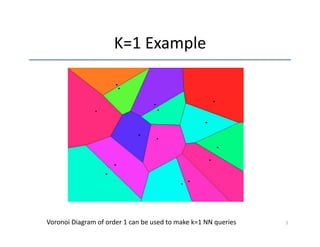
K=1 
Example 
Voronoi 
Diagram 
of 
order 
1 
can 
be 
used 
to 
make 
k=1 
NN 
queries 
5
Just 
a 
bit 
more 
theory… 
• Voronoi 
diagrams 
of 
order-­‐1 
are 
created 
in 
O(n 
log 
n) 
'me 
– Looks 
similar 
to…? 
:-­‐) 
• Queried 
in 
O(1) 
'me 
• Therefore: 
– Pay 
the 
'me 
penalty 
to 
build 
the 
index 
– Query 
against 
index 
quickly 
6
Applica'ons 
• Geoloca'on 
+ 
Op'mizing 
Posi'oning 
• Classifica'on 
• Similarity 
• Recommenda'on 
systems 
• Content-­‐based 
image 
retrieval 
• etc. 
7
So 
what 
about 
PostgreSQL? 
• As 
of 
PostgreSQL 
9.0 
– supports 
geometric 
types 
and 
distances 
• Points, 
circles, 
lines, 
boxes, 
polygons 
• Distance 
operator: 
<-­‐> 
– pg_trgm 
– 
supplied 
module 
for 
determining 
text 
similarity 
• similarity(“abc”, 
“ade”) 
computes 
similarity 
score 
• <-­‐> 
defines 
distance 
(opposite 
if 
similarity), 
not 
defined 
(in 
9.0) 
8
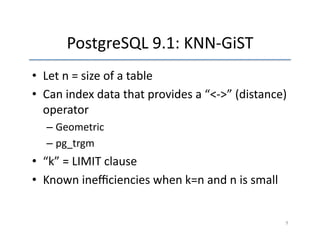
PostgreSQL 
9.1: 
KNN-­‐GiST 
• Let 
n 
= 
size 
of 
a 
table 
• Can 
index 
data 
that 
provides 
a 
“<-­‐>” 
(distance) 
operator 
– Geometric 
– pg_trgm 
• “k” 
= 
LIMIT 
clause 
• Known 
inefficiencies 
when 
k=n 
and 
n 
is 
small 
9
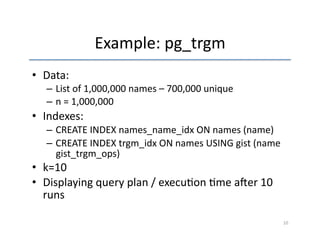
Example: 
pg_trgm 
• Data: 
– List 
of 
1,000,000 
names 
– 
700,000 
unique 
– n 
= 
1,000,000 
• Indexes: 
– CREATE 
INDEX 
names_name_idx 
ON 
names 
(name) 
– CREATE 
INDEX 
trgm_idx 
ON 
names 
USING 
gist 
(name 
gist_trgm_ops) 
• k=10 
• Displaying 
query 
plan 
/ 
execu'on 
'me 
aqer 
10 
runs 
10
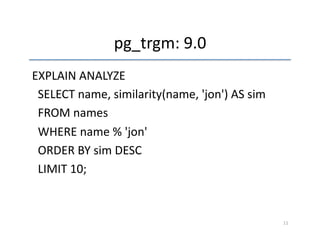
pg_trgm: 
9.0 
EXPLAIN 
ANALYZE 
SELECT 
name, 
similarity(name, 
'jon') 
AS 
sim 
FROM 
names 
WHERE 
name 
% 
'jon' 
ORDER 
BY 
sim 
DESC 
LIMIT 
10; 
11
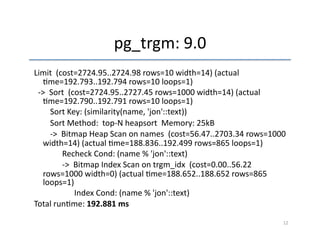
pg_trgm: 
9.0 
Limit 
(cost=2724.95..2724.98 
rows=10 
width=14) 
(actual 
'me=192.793..192.794 
rows=10 
loops=1) 
-­‐> 
Sort 
(cost=2724.95..2727.45 
rows=1000 
width=14) 
(actual 
'me=192.790..192.791 
rows=10 
loops=1) 
Sort 
Key: 
(similarity(name, 
'jon'::text)) 
Sort 
Method: 
top-­‐N 
heapsort 
Memory: 
25kB 
-­‐> 
Bitmap 
Heap 
Scan 
on 
names 
(cost=56.47..2703.34 
rows=1000 
width=14) 
(actual 
'me=188.836..192.499 
rows=865 
loops=1) 
Recheck 
Cond: 
(name 
% 
'jon'::text) 
-­‐> 
Bitmap 
Index 
Scan 
on 
trgm_idx 
(cost=0.00..56.22 
rows=1000 
width=0) 
(actual 
'me=188.652..188.652 
rows=865 
loops=1) 
Index 
Cond: 
(name 
% 
'jon'::text) 
Total 
run'me: 
192.881 
ms 
12
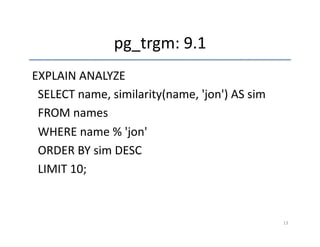
pg_trgm: 
9.1 
EXPLAIN 
ANALYZE 
SELECT 
name, 
similarity(name, 
'jon') 
AS 
sim 
FROM 
names 
WHERE 
name 
% 
'jon' 
ORDER 
BY 
sim 
DESC 
LIMIT 
10; 
13
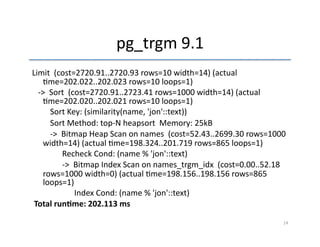
pg_trgm 
9.1 
Limit 
(cost=2720.91..2720.93 
rows=10 
width=14) 
(actual 
'me=202.022..202.023 
rows=10 
loops=1) 
-­‐> 
Sort 
(cost=2720.91..2723.41 
rows=1000 
width=14) 
(actual 
'me=202.020..202.021 
rows=10 
loops=1) 
Sort 
Key: 
(similarity(name, 
'jon'::text)) 
Sort 
Method: 
top-­‐N 
heapsort 
Memory: 
25kB 
-­‐> 
Bitmap 
Heap 
Scan 
on 
names 
(cost=52.43..2699.30 
rows=1000 
width=14) 
(actual 
'me=198.324..201.719 
rows=865 
loops=1) 
Recheck 
Cond: 
(name 
% 
'jon'::text) 
-­‐> 
Bitmap 
Index 
Scan 
on 
names_trgm_idx 
(cost=0.00..52.18 
rows=1000 
width=0) 
(actual 
'me=198.156..198.156 
rows=865 
loops=1) 
Index 
Cond: 
(name 
% 
'jon'::text) 
Total 
run1me: 
202.113 
ms 
14
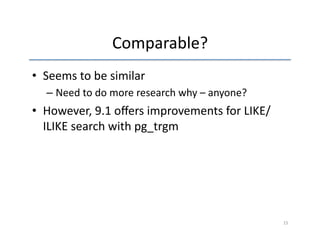
Comparable? 
• Seems 
to 
be 
similar 
– Need 
to 
do 
more 
research 
why 
– 
anyone? 
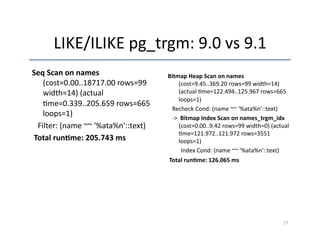
• However, 
9.1 
offers 
improvements 
for 
LIKE/ 
ILIKE 
search 
with 
pg_trgm 
15
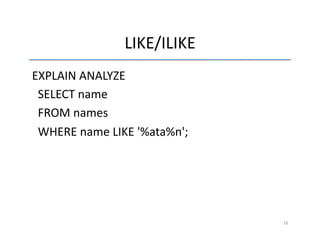
LIKE/ILIKE 
EXPLAIN 
ANALYZE 
SELECT 
name 
FROM 
names 
WHERE 
name 
LIKE 
'%ata%n'; 
16
LIKE/ILIKE 
pg_trgm: 
9.0 
vs 
9.1 
Seq 
Scan 
on 
names 
(cost=0.00..18717.00 
rows=99 
width=14) 
(actual 
'me=0.339..205.659 
rows=665 
loops=1) 
Filter: 
(name 
~~ 
'%ata%n'::text) 
Total 
run1me: 
205.743 
ms 
Bitmap 
Heap 
Scan 
on 
names 
(cost=9.45..369.20 
rows=99 
width=14) 
(actual 
'me=122.494..125.967 
rows=665 
loops=1) 
Recheck 
Cond: 
(name 
~~ 
'%ata%n'::text) 
-­‐> 
Bitmap 
Index 
Scan 
on 
names_trgm_idx 
(cost=0.00..9.42 
rows=99 
width=0) 
(actual 
'me=121.972..121.972 
rows=3551 
loops=1) 
Index 
Cond: 
(name 
~~ 
'%ata%n'::text) 
Total 
run1me: 
126.065 
ms 
17
Geometry 
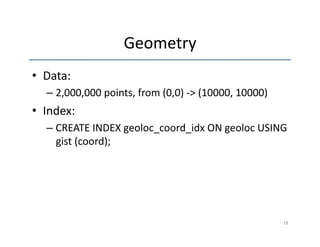
• Data: 
– 2,000,000 
points, 
from 
(0,0) 
-­‐> 
(10000, 
10000) 
• Index: 
– CREATE 
INDEX 
geoloc_coord_idx 
ON 
geoloc 
USING 
gist 
(coord); 
18
Geometry 
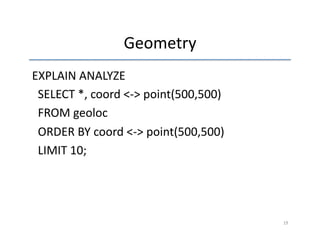
EXPLAIN 
ANALYZE 
SELECT 
*, 
coord 
<-­‐> 
point(500,500) 
FROM 
geoloc 
ORDER 
BY 
coord 
<-­‐> 
point(500,500) 
LIMIT 
10; 
19
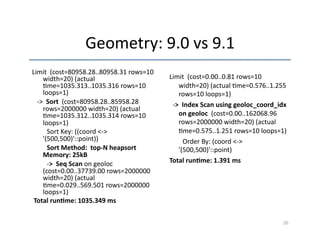
Geometry: 
9.0 
vs 
9.1 
Limit 
(cost=80958.28..80958.31 
rows=10 
width=20) 
(actual 
'me=1035.313..1035.316 
rows=10 
loops=1) 
-­‐> 
Sort 
(cost=80958.28..85958.28 
rows=2000000 
width=20) 
(actual 
'me=1035.312..1035.314 
rows=10 
loops=1) 
Sort 
Key: 
((coord 
<-­‐> 
'(500,500)'::point)) 
Sort 
Method: 
top-­‐N 
heapsort 
Memory: 
25kB 
-­‐> 
Seq 
Scan 
on 
geoloc 
(cost=0.00..37739.00 
rows=2000000 
width=20) 
(actual 
'me=0.029..569.501 
rows=2000000 
loops=1) 
Total 
run1me: 
1035.349 
ms 
Limit 
(cost=0.00..0.81 
rows=10 
width=20) 
(actual 
'me=0.576..1.255 
rows=10 
loops=1) 
-­‐> 
Index 
Scan 
using 
geoloc_coord_idx 
on 
geoloc 
(cost=0.00..162068.96 
rows=2000000 
width=20) 
(actual 
'me=0.575..1.251 
rows=10 
loops=1) 
Order 
By: 
(coord 
<-­‐> 
'(500,500)'::point) 
Total 
run1me: 
1.391 
ms 
20
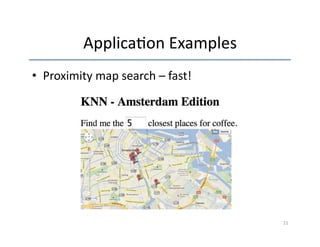
Applica'on 
Examples 
• Proximity 
map 
search 
– 
fast! 
21
Drawbacks 
• Performance 
benefits 
are 
limited 
when: 
– LIMIT 
is 
close 
to 
size 
of 
data 
set 
and 
data 
set 
is 
large 
– Data 
set 
is 
small 
• Time 
to 
build 
index 
– High 
transac'on 
table 
22
Conclusions 
• GiST: 
“Generalized 
Search 
Tree” 
– 
index 
is 
there, 
up 
to 
developers 
to 
define 
access 
methods 
of 
data 
types 
– e.g. 
yields 
KNN-­‐GiST 
• Different 
types 
of 
applica'ons 
can 
be 
built 
– 
performance 
enhancements 
• Next 
steps? 
23
My 
Wish 
List 
• Further 
geometric-­‐type 
support 
in 
Postgres 
– N-­‐dimensional 
points 
– ‘=‘ 
operator 
for 
point 
type 
– (PostGIS 
s'll 
champion 
of 
complex 
geometric 
+ 
geographic 
data 
types) 
• Define 
“distance” 
over 
mul'columns 
with 
different 
types? 
– SELECT 
(a.name, 
a.geocode) 
<-­‐> 
(b.name, 
b.geocode) 
FROM 
x 
a, 
x 
b; 
24
References 
• Oleg 
Bartunov 
– 
“Efficient 
K-­‐nearest 
neighbour 
search 
in 
PostgreSQL” 
(h~p://www.sai.msu.su/~megera/ 
postgres/talks/pgday-­‐2010.pdf) 
• Oleg 
Bartunov 
and 
Teodor 
Sigaev 
for 
work 
on 
KNN-­‐ 
GiST 
and 
notes 
on 
pg_trgm 
(h~p:// 
developer.postgresql.org/pgdocs/postgres/ 
pgtrgm.html) 
• Hubert 
“depesz” 
Lubaczewski 
– 
pa~erned 
benchmarks 
off 
of 
his 
work 
-­‐ 
h~p://www.depesz.com/index.php/ 
2010/12/11/wai'ng-­‐for-­‐9-­‐1-­‐knngist/ 
25
Contact 
• jonathan.katz@excoventures.com 
• @jkatz05 
• Feedback 
Please! 
– h~p://2011.pgconf.eu/feedback 
26

Accelerating Local Search with PostgreSQL (KNN-Search)

  • 1.
    Accelera'ng Local Search With PostgreSQL 9.1 Jonathan S. Katz Exco Ventures PGConf.eu 2011 – Oct 21, 2011
  • 2.
    Local Search? •Not necessarily loca'on based on places • “How close are two en''es to one another?” • “What are the closest en''es to me?” • “What are my nearest neighbors?” 2
  • 3.
    Nearest Neighbor Overview • Want to know “how similar” objects are rela've to each other – What are the top “k” choices near me? • Need to define a “metric” for similarity – “distance” 3
  • 4.
    K-­‐Nearest Neighbor •Given a collec'on of n objects • When trying to classify an unknown object – compute the distance between all known objects – find the k (k ≥ 1) closest objects to the unknown object – classify the object based on class of k closest objects • When k=1, then unknown object is given same classifica'on as object it is closest to 4
  • 5.
    K=1 Example Voronoi Diagram of order 1 can be used to make k=1 NN queries 5
  • 6.
    Just a bit more theory… • Voronoi diagrams of order-­‐1 are created in O(n log n) 'me – Looks similar to…? :-­‐) • Queried in O(1) 'me • Therefore: – Pay the 'me penalty to build the index – Query against index quickly 6
  • 7.
    Applica'ons • Geoloca'on + Op'mizing Posi'oning • Classifica'on • Similarity • Recommenda'on systems • Content-­‐based image retrieval • etc. 7
  • 8.
    So what about PostgreSQL? • As of PostgreSQL 9.0 – supports geometric types and distances • Points, circles, lines, boxes, polygons • Distance operator: <-­‐> – pg_trgm – supplied module for determining text similarity • similarity(“abc”, “ade”) computes similarity score • <-­‐> defines distance (opposite if similarity), not defined (in 9.0) 8
  • 9.
    PostgreSQL 9.1: KNN-­‐GiST • Let n = size of a table • Can index data that provides a “<-­‐>” (distance) operator – Geometric – pg_trgm • “k” = LIMIT clause • Known inefficiencies when k=n and n is small 9
  • 10.
    Example: pg_trgm •Data: – List of 1,000,000 names – 700,000 unique – n = 1,000,000 • Indexes: – CREATE INDEX names_name_idx ON names (name) – CREATE INDEX trgm_idx ON names USING gist (name gist_trgm_ops) • k=10 • Displaying query plan / execu'on 'me aqer 10 runs 10
  • 11.
    pg_trgm: 9.0 EXPLAIN ANALYZE SELECT name, similarity(name, 'jon') AS sim FROM names WHERE name % 'jon' ORDER BY sim DESC LIMIT 10; 11
  • 12.
    pg_trgm: 9.0 Limit (cost=2724.95..2724.98 rows=10 width=14) (actual 'me=192.793..192.794 rows=10 loops=1) -­‐> Sort (cost=2724.95..2727.45 rows=1000 width=14) (actual 'me=192.790..192.791 rows=10 loops=1) Sort Key: (similarity(name, 'jon'::text)) Sort Method: top-­‐N heapsort Memory: 25kB -­‐> Bitmap Heap Scan on names (cost=56.47..2703.34 rows=1000 width=14) (actual 'me=188.836..192.499 rows=865 loops=1) Recheck Cond: (name % 'jon'::text) -­‐> Bitmap Index Scan on trgm_idx (cost=0.00..56.22 rows=1000 width=0) (actual 'me=188.652..188.652 rows=865 loops=1) Index Cond: (name % 'jon'::text) Total run'me: 192.881 ms 12
  • 13.
    pg_trgm: 9.1 EXPLAIN ANALYZE SELECT name, similarity(name, 'jon') AS sim FROM names WHERE name % 'jon' ORDER BY sim DESC LIMIT 10; 13
  • 14.
    pg_trgm 9.1 Limit (cost=2720.91..2720.93 rows=10 width=14) (actual 'me=202.022..202.023 rows=10 loops=1) -­‐> Sort (cost=2720.91..2723.41 rows=1000 width=14) (actual 'me=202.020..202.021 rows=10 loops=1) Sort Key: (similarity(name, 'jon'::text)) Sort Method: top-­‐N heapsort Memory: 25kB -­‐> Bitmap Heap Scan on names (cost=52.43..2699.30 rows=1000 width=14) (actual 'me=198.324..201.719 rows=865 loops=1) Recheck Cond: (name % 'jon'::text) -­‐> Bitmap Index Scan on names_trgm_idx (cost=0.00..52.18 rows=1000 width=0) (actual 'me=198.156..198.156 rows=865 loops=1) Index Cond: (name % 'jon'::text) Total run1me: 202.113 ms 14
  • 15.
    Comparable? • Seems to be similar – Need to do more research why – anyone? • However, 9.1 offers improvements for LIKE/ ILIKE search with pg_trgm 15
  • 16.
    LIKE/ILIKE EXPLAIN ANALYZE SELECT name FROM names WHERE name LIKE '%ata%n'; 16
  • 17.
    LIKE/ILIKE pg_trgm: 9.0 vs 9.1 Seq Scan on names (cost=0.00..18717.00 rows=99 width=14) (actual 'me=0.339..205.659 rows=665 loops=1) Filter: (name ~~ '%ata%n'::text) Total run1me: 205.743 ms Bitmap Heap Scan on names (cost=9.45..369.20 rows=99 width=14) (actual 'me=122.494..125.967 rows=665 loops=1) Recheck Cond: (name ~~ '%ata%n'::text) -­‐> Bitmap Index Scan on names_trgm_idx (cost=0.00..9.42 rows=99 width=0) (actual 'me=121.972..121.972 rows=3551 loops=1) Index Cond: (name ~~ '%ata%n'::text) Total run1me: 126.065 ms 17
  • 18.
    Geometry • Data: – 2,000,000 points, from (0,0) -­‐> (10000, 10000) • Index: – CREATE INDEX geoloc_coord_idx ON geoloc USING gist (coord); 18
  • 19.
    Geometry EXPLAIN ANALYZE SELECT *, coord <-­‐> point(500,500) FROM geoloc ORDER BY coord <-­‐> point(500,500) LIMIT 10; 19
  • 20.
    Geometry: 9.0 vs 9.1 Limit (cost=80958.28..80958.31 rows=10 width=20) (actual 'me=1035.313..1035.316 rows=10 loops=1) -­‐> Sort (cost=80958.28..85958.28 rows=2000000 width=20) (actual 'me=1035.312..1035.314 rows=10 loops=1) Sort Key: ((coord <-­‐> '(500,500)'::point)) Sort Method: top-­‐N heapsort Memory: 25kB -­‐> Seq Scan on geoloc (cost=0.00..37739.00 rows=2000000 width=20) (actual 'me=0.029..569.501 rows=2000000 loops=1) Total run1me: 1035.349 ms Limit (cost=0.00..0.81 rows=10 width=20) (actual 'me=0.576..1.255 rows=10 loops=1) -­‐> Index Scan using geoloc_coord_idx on geoloc (cost=0.00..162068.96 rows=2000000 width=20) (actual 'me=0.575..1.251 rows=10 loops=1) Order By: (coord <-­‐> '(500,500)'::point) Total run1me: 1.391 ms 20
  • 21.
    Applica'on Examples •Proximity map search – fast! 21
  • 22.
    Drawbacks • Performance benefits are limited when: – LIMIT is close to size of data set and data set is large – Data set is small • Time to build index – High transac'on table 22
  • 23.
    Conclusions • GiST: “Generalized Search Tree” – index is there, up to developers to define access methods of data types – e.g. yields KNN-­‐GiST • Different types of applica'ons can be built – performance enhancements • Next steps? 23
  • 24.
    My Wish List • Further geometric-­‐type support in Postgres – N-­‐dimensional points – ‘=‘ operator for point type – (PostGIS s'll champion of complex geometric + geographic data types) • Define “distance” over mul'columns with different types? – SELECT (a.name, a.geocode) <-­‐> (b.name, b.geocode) FROM x a, x b; 24
  • 25.
    References • Oleg Bartunov – “Efficient K-­‐nearest neighbour search in PostgreSQL” (h~p://www.sai.msu.su/~megera/ postgres/talks/pgday-­‐2010.pdf) • Oleg Bartunov and Teodor Sigaev for work on KNN-­‐ GiST and notes on pg_trgm (h~p:// developer.postgresql.org/pgdocs/postgres/ pgtrgm.html) • Hubert “depesz” Lubaczewski – pa~erned benchmarks off of his work -­‐ h~p://www.depesz.com/index.php/ 2010/12/11/wai'ng-­‐for-­‐9-­‐1-­‐knngist/ 25
  • 26.
    Contact • jonathan.katz@excoventures.com • @jkatz05 • Feedback Please! – h~p://2011.pgconf.eu/feedback 26