The Toyota Production System
A Transition from Mass Production to
Lean Manufacturing and Supply Chain Management
Gunjan Tiwari
D-19
SIMS
MBA 2015-17
TOYOTA
• Toyota Motor Corporation is a Japanese automotive
manufacturer headquartered in Toyota, Aichi, Japan.
• In March 2014 the multinational corporation consisted of
338,875 employees worldwideand, as of November 2014, is
the fourteenth-largest company in the world by revenue.
• Toyota was the largest automobile manufacturer in 2012
(by production) ahead of the Volkswagen Group and
General Motors.
• Toyota is the world's first automobile manufacturer to
produce more than 10 million vehicles per year.
• As of July 2014, Toyota was the largest listed company in
Japan by market capitalization and by revenue.
Major Revolutions in
Manufacturing
• 1776, Adam Smith “The Wealth of Nations”
• 1910, Henry Ford and Mass Manufacturing.
• 1980, The Toyota Production System.
• Lean Manufacturing.
• Supply Chain Management.
The Gestation of TPS
• Eiji Toyoda visit to Henry Ford’s factory in 1950.
• The SMED (Single-digit in Minutes Exchange of Dice)
program at the stamping plant.
• Deming’s quality movement in Japan.
• The Engineers: Taiichi Ohno and Shigeo Shingo
• “Japanese” Manufacturing hits America in 1970
Main Features of TPS
• Greater Product Variety
• Fast Response (Flexibility)
• “Stable” Production Schedules
• Supply Chain Integration
• Demand Management
Elements of TPS
• The SMED Program.
• Highlight Problems (Jidoka).
• Gradual Elimination of Waste.
• Continuous Improvement (Kaizen), Root-Cause Analysis (5-whys?) and Fool-
proofing (Poka-Yoke).
• Cross-Trained Workers.
• Just-In-Time Production.
• Stable Production Schedules (Heijunka)
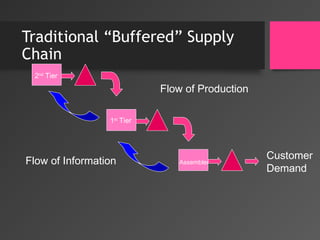
Traditional “Buffered” Supply
Chain
Assembler
2nd
Tier
1st
Tier
Flow of Production
Flow of Information
Customer
Demand
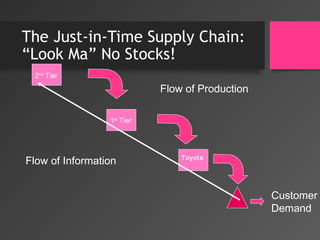
The Just-in-Time Supply Chain:
“Look Ma” No Stocks!
Toyota
2nd
Tier
1st
Tier
Flow of Production
Flow of Information
Customer
Demand
Expectations from Suppliers
• Frequent deliveries.
• Hours (not days) lead time.
• Rapid response capability (not from stocks).
• Delivery to assembly line at the right time in the
right sequence without inspection.
• Reliability (quality and timing).
Supplier Relationships
• Long-term, steady relationships with a few
suppliers.
• Negotiation based on a long term commitment to
productivity and quality improvement.
• Interested in supplier capabilities.
• Continuous improvement.
• Product/process technology.
• Design for manufacturability.
What’s in it for a supplier?
• A Stable Manufacturing Environment.
• Steady production volume.
• Leaner Processes.
• Cost/Flexibility/Quality
• Profits.
•THANK YOU

Km bs process

  • 1.
    The Toyota ProductionSystem A Transition from Mass Production to Lean Manufacturing and Supply Chain Management Gunjan Tiwari D-19 SIMS MBA 2015-17
  • 2.
    TOYOTA • Toyota MotorCorporation is a Japanese automotive manufacturer headquartered in Toyota, Aichi, Japan. • In March 2014 the multinational corporation consisted of 338,875 employees worldwideand, as of November 2014, is the fourteenth-largest company in the world by revenue. • Toyota was the largest automobile manufacturer in 2012 (by production) ahead of the Volkswagen Group and General Motors. • Toyota is the world's first automobile manufacturer to produce more than 10 million vehicles per year. • As of July 2014, Toyota was the largest listed company in Japan by market capitalization and by revenue.
  • 3.
    Major Revolutions in Manufacturing •1776, Adam Smith “The Wealth of Nations” • 1910, Henry Ford and Mass Manufacturing. • 1980, The Toyota Production System. • Lean Manufacturing. • Supply Chain Management.
  • 4.
    The Gestation ofTPS • Eiji Toyoda visit to Henry Ford’s factory in 1950. • The SMED (Single-digit in Minutes Exchange of Dice) program at the stamping plant. • Deming’s quality movement in Japan. • The Engineers: Taiichi Ohno and Shigeo Shingo • “Japanese” Manufacturing hits America in 1970
  • 5.
    Main Features ofTPS • Greater Product Variety • Fast Response (Flexibility) • “Stable” Production Schedules • Supply Chain Integration • Demand Management
  • 6.
    Elements of TPS •The SMED Program. • Highlight Problems (Jidoka). • Gradual Elimination of Waste. • Continuous Improvement (Kaizen), Root-Cause Analysis (5-whys?) and Fool- proofing (Poka-Yoke). • Cross-Trained Workers. • Just-In-Time Production. • Stable Production Schedules (Heijunka)
  • 7.
    Traditional “Buffered” Supply Chain Assembler 2nd Tier 1st Tier Flowof Production Flow of Information Customer Demand
  • 8.
    The Just-in-Time SupplyChain: “Look Ma” No Stocks! Toyota 2nd Tier 1st Tier Flow of Production Flow of Information Customer Demand
  • 9.
    Expectations from Suppliers •Frequent deliveries. • Hours (not days) lead time. • Rapid response capability (not from stocks). • Delivery to assembly line at the right time in the right sequence without inspection. • Reliability (quality and timing).
  • 10.
    Supplier Relationships • Long-term,steady relationships with a few suppliers. • Negotiation based on a long term commitment to productivity and quality improvement. • Interested in supplier capabilities. • Continuous improvement. • Product/process technology. • Design for manufacturability.
  • 11.
    What’s in itfor a supplier? • A Stable Manufacturing Environment. • Steady production volume. • Leaner Processes. • Cost/Flexibility/Quality • Profits.
  • 12.