Drone
Technologies and
Applications
Seminar Presentation On
Presented By-
Abhinav Vishwa
(21EEAEC002)
Submitted To-
Dr. Uma Shankar Modani
Department of Electronics and Communication
Engineering, Engineering College Ajmer.
Contents
 Introduction to Drones – Definition, history, types (fixed-wing, rotary-wing, hybrid).
 Drone Technologies – Hardware (motors, sensors, battery), software (AI, autopilot, communication).
 Applications of Drones
Military – Surveillance, combat drones.
Agriculture – Crop monitoring, pesticide spraying.
Infrastructure – Construction, power line inspections.
Environment – Disaster management, wildlife tracking.
Logistics – Parcel & medical supply delivery.
Photography – Filmmaking, real estate.
Urban Planning – Traffic monitoring, land mapping.
 Emerging Trends – Swarm drones, AI-powered autonomy, 5G connectivity, drone taxis.
 Challenges & Concerns – Regulations, privacy, security risks, environmental impact.
 Future of Drones – IoT integration, hydrogen-powered drones, space exploration potential.
0 4 / 1 5 / 2 0 2 5
Introduction to Drones
Drones, also known as Unmanned Aerial Vehicles (UAVs), are aircraft that operate
without a human pilot onboard. They can be controlled remotely or programmed to
fly autonomously using onboard computers and sensors. Initially developed for
military reconnaissance during World War I, drones have since evolved into
versatile tools used in various industries. Today, they are widely employed in
agriculture, logistics, surveillance, photography, and disaster management. Drones
come in different types, including fixed-wing models for long-range operations and
rotary-wing (multi-copter) designs for precision tasks. Advances in AI, GPS, and
battery technology have significantly enhanced their capabilities, making them an
integral part of modern technological innovations.
0 4 / 1 5 / 2 0 2 5
Drone Technologies
 Hardware Components of a Drone
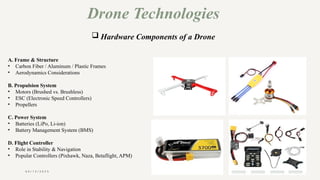
A. Frame & Structure
• Carbon Fiber / Aluminum / Plastic Frames
• Aerodynamics Considerations
B. Propulsion System
• Motors (Brushed vs. Brushless)
• ESC (Electronic Speed Controllers)
• Propellers
C. Power System
• Batteries (LiPo, Li-ion)
• Battery Management System (BMS)
D. Flight Controller
• Role in Stability & Navigation
• Popular Controllers (Pixhawk, Naza, Betaflight, APM)
0 4 / 1 5 / 2 0 2 5
E. Sensors & Navigation
• IMU (Gyroscope + Accelerometer)
• GPS, Magnetometer, Barometer
• Obstacle Avoidance Sensors (LiDAR, Ultrasonic, Infrared, Cameras)
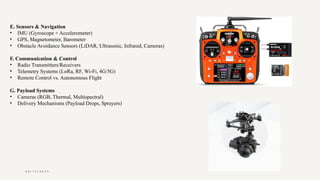
F. Communication & Control
• Radio Transmitters/Receivers
• Telemetry Systems (LoRa, RF, Wi-Fi, 4G/5G)
• Remote Control vs. Autonomous Flight
G. Payload Systems
• Cameras (RGB, Thermal, Multispectral)
• Delivery Mechanisms (Payload Drops, Sprayers)
0 4 / 1 5 / 2 0 2 5
 Software in Drones
A. Embedded Software (Firmware)
 Flight Control Algorithms (PID Controllers, AI-based Navigation)
 Open-Source Firmware (ArduPilot, PX4, INAV, Betaflight)
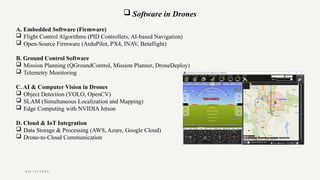
B. Ground Control Software
 Mission Planning (QGroundControl, Mission Planner, DroneDeploy)
 Telemetry Monitoring
C. AI & Computer Vision in Drones
 Object Detection (YOLO, OpenCV)
 SLAM (Simultaneous Localization and Mapping)
 Edge Computing with NVIDIA Jetson
D. Cloud & IoT Integration
 Data Storage & Processing (AWS, Azure, Google Cloud)
 Drone-to-Cloud Communication
0 4 / 1 5 / 2 0 2 5
Types of Drones
 Fixed-Wing Drones
🔹 Structure: Looks like an airplane with wings.
🔹 Pros:
 Long flight duration (up to several hours)
 Higher speeds and long-range capabilities
 More efficient in terms of battery usage

🔹 Cons:
 Requires a runway or launcher for takeoff
 Cannot hover in place

🔹 Examples:
 Military Reconnaissance Drones (RQ-4 Global Hawk)
 Agricultural Spraying Drones
 Surveillance & Mapping Drones
0 4 / 1 5 / 2 0 2 5
 Rotary-Wing Drones
🔹 Structure: Uses rotors (propellers) like a helicopter.
🔹 Types:
 Single-Rotor Drones (Helicopter-like)
• Longer endurance than multi-rotors
• More stable than multi-rotors in high winds
• Example: Yamaha RMAX (Agriculture, Surveying)
 Multi-Rotor Drones (Most Common)
• Includes Quadcopters, Hexacopters, Octocopters
• Easy to control, great for aerial photography
• Limited flight time due to battery constraints
• Examples: DJI Phantom, DJI Inspire, Parrot Anafi
0 4 / 1 5 / 2 0 2 5
 Military Drones
Types:
 Combat Drones (UCAVs - Unmanned Combat Aerial Vehicles)
• Armed drones for warfare
• Example: MQ-9 Reaper, DRDO Ghatak
 Reconnaissance Drones
• Used for surveillance & intelligence gathering
• Example: RQ-4 Global Hawk
0 4 / 1 5 / 2 0 2 5
 Agriculture Drones (Agri-Drones)
Purpose: Used for precision farming, crop monitoring, and spraying.
🔹 Types:
 Spraying Drones – Apply fertilizers, pesticides (e.g., DJI Agras T30).
 Survey & Mapping Drones – Use multispectral cameras for crop health analysis (e.g., SenseFly eBee).
 Seeding & Pollination Drones – Help in reforestation and plant pollination.
0 4 / 1 5 / 2 0 2 5
Emerging Trends
1 ️
1️⃣AI & Machine Learning
• Autonomous navigation & obstacle avoidance
• AI-powered crop analysis & surveillance
• Swarm intelligence (coordinated drone fleets)
2 ️
2️⃣5G & Edge Computing
• Faster real-time data transmission
• Remote drone operation with low latency
• Enhanced AI processing on the drone itself
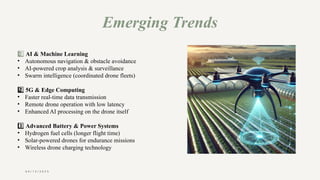
3️⃣Advanced Battery & Power Systems
• Hydrogen fuel cells (longer flight time)
• Solar-powered drones for endurance missions
• Wireless drone charging technology
0 4 / 1 5 / 2 0 2 5
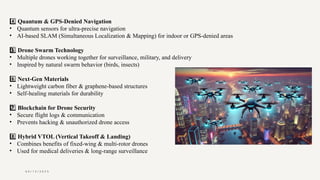
4️⃣Quantum & GPS-Denied Navigation
• Quantum sensors for ultra-precise navigation
• AI-based SLAM (Simultaneous Localization & Mapping) for indoor or GPS-denied areas
5 ️
5️⃣Drone Swarm Technology
• Multiple drones working together for surveillance, military, and delivery
• Inspired by natural swarm behavior (birds, insects)
6️⃣Next-Gen Materials
• Lightweight carbon fiber & graphene-based structures
• Self-healing materials for durability
7 ️
7️⃣Blockchain for Drone Security
• Secure flight logs & communication
• Prevents hacking & unauthorized drone access
8️⃣Hybrid VTOL (Vertical Takeoff & Landing)
• Combines benefits of fixed-wing & multi-rotor drones
• Used for medical deliveries & long-range surveillance
0 4 / 1 5 / 2 0 2 5
Challenges and Concerns of Drone
Technology
1. Technical Challenges
a. Battery Life & Power Efficiency
• Most drones have limited flight time due to battery constraints.
• Heavy payloads reduce endurance.
b. Signal & Connectivity Issues
• Drones rely on GPS and radio signals, which can be jammed or interrupted.
• Long-range communication can be challenging, especially in remote areas.
c. Collision Avoidance & Navigation
• Autonomous drones need advanced AI and sensors to detect and avoid obstacles.
• Flying in dynamic environments (urban areas, forests) is difficult.
d. Weather Conditions
• Strong winds, rain, and extreme temperatures can affect drone stability and performance.
0 4 / 1 5 / 2 0 2 5
2. Regulatory & Legal Challenges
a. Airspace Regulations
• Many countries have strict laws on drone usage, requiring licenses or flight restrictions.
• Integration with traditional air traffic control is still evolving.
b. Privacy Concerns
• Unauthorized surveillance and data collection raise ethical and legal questions.
• Governments and companies may misuse drone-collected data.
c. Drone Swarm Control
• Managing multiple autonomous drones in coordinated missions is complex.
• Preventing mid-air collisions in swarms is a significant challenge.
0 4 / 1 5 / 2 0 2 5
3. Security Concerns
a. Cybersecurity Threats
• Drones can be hacked, hijacked, or manipulated by cybercriminals.
• Sensitive data collected by drones can be intercepted.
b. Terrorism & Malicious Use
• Drones can be weaponized for attacks, smuggling, or espionage.
• Unauthorized drones can disrupt airports and critical infrastructure.
c. Counter-Drone Measures
• Detecting and neutralizing rogue drones is challenging.
• Jamming or shooting down drones can have unintended consequences.
0 4 / 1 5 / 2 0 2 5
Future of Drones
1. Technological Advancements
a. AI & Autonomous Navigation
• AI-powered drones will make real-time decisions, avoiding obstacles and optimizing flight paths.
• Fully autonomous drones will handle complex tasks like urban deliveries and search-and-rescue missions.
b. Longer Battery Life & Alternative Power Sources
• New battery technologies (solid-state, hydrogen fuel cells) will increase flight duration.
• Solar-powered drones may enable indefinite flight for surveillance and environmental monitoring.
c. Swarm Technology
• Coordinated drone swarms will perform tasks more efficiently, from disaster response to agriculture.
• Military applications will involve autonomous drone formations for reconnaissance and combat.
•d. 5G & Enhanced Connectivity
•Faster, low-latency communication will allow real-time remote control over vast distances.
•5G-enabled drones will improve real-time data transmission for industries like logistics and security.
0 4 / 1 5 / 2 0 2 5
2. Commercial & Industrial Applications
a. Drone Delivery Services
• Companies like Amazon, Zipline, and Wing are pushing for widespread drone-based deliveries.
• Expect more drones handling medical supplies, food, and e-commerce packages.
b. Agriculture & Precision Farming
• AI-powered drones will monitor crops, detect diseases, and optimize pesticide use.
• Automated farming systems will include drone-based irrigation and soil analysis.
c. Infrastructure & Construction
• Drones will inspect bridges, roads, and buildings, reducing risks for human workers.
• 3D mapping and real-time monitoring will enhance construction efficiency.
d. Healthcare & Emergency Response
• Medical drones will transport blood, organs, and emergency kits to remote areas.
• Search-and-rescue drones equipped with thermal cameras will assist in disaster zones.
0 4 / 1 5 / 2 0 2 5
3. Military & Security Developments
a. AI-Powered Combat Drones
• Autonomous combat drones will perform reconnaissance, targeting, and battlefield support.
• Ethical concerns over autonomous weapons (killer drones) will drive new regulations.
b. Anti-Drone Technologies
• Governments and private firms will invest in drone-detection and neutralization systems.
• Laser-based and electromagnetic countermeasures will evolve to tackle rogue drones.
0 4 / 1 5 / 2 0 2 5
4. Smart Cities & Urban Integration
a. Traffic & Infrastructure Monitoring
• Drones will monitor traffic, detect accidents, and assist law enforcement.
• Integration with IoT and smart city systems will enable automated urban management.
b. Personal Drones & Urban Mobility
• Drone taxis (eVTOLs) will revolutionize urban transport, reducing congestion.
• Regulations for passenger drones will evolve as companies like Joby and EHang expand testing.
0 4 / 1 5 / 2 0 2 5
"Any sufficiently advanced
technology is indistinguishable
from magic."
0 4 / 1 5 / 2 0 2 5
Thank You!

Drone and technologiesPresentation 6.pptx

  • 1.
    Drone Technologies and Applications Seminar PresentationOn Presented By- Abhinav Vishwa (21EEAEC002) Submitted To- Dr. Uma Shankar Modani Department of Electronics and Communication Engineering, Engineering College Ajmer.
  • 2.
    Contents  Introduction toDrones – Definition, history, types (fixed-wing, rotary-wing, hybrid).  Drone Technologies – Hardware (motors, sensors, battery), software (AI, autopilot, communication).  Applications of Drones Military – Surveillance, combat drones. Agriculture – Crop monitoring, pesticide spraying. Infrastructure – Construction, power line inspections. Environment – Disaster management, wildlife tracking. Logistics – Parcel & medical supply delivery. Photography – Filmmaking, real estate. Urban Planning – Traffic monitoring, land mapping.  Emerging Trends – Swarm drones, AI-powered autonomy, 5G connectivity, drone taxis.  Challenges & Concerns – Regulations, privacy, security risks, environmental impact.  Future of Drones – IoT integration, hydrogen-powered drones, space exploration potential.
  • 3.
    0 4 /1 5 / 2 0 2 5 Introduction to Drones Drones, also known as Unmanned Aerial Vehicles (UAVs), are aircraft that operate without a human pilot onboard. They can be controlled remotely or programmed to fly autonomously using onboard computers and sensors. Initially developed for military reconnaissance during World War I, drones have since evolved into versatile tools used in various industries. Today, they are widely employed in agriculture, logistics, surveillance, photography, and disaster management. Drones come in different types, including fixed-wing models for long-range operations and rotary-wing (multi-copter) designs for precision tasks. Advances in AI, GPS, and battery technology have significantly enhanced their capabilities, making them an integral part of modern technological innovations.
  • 4.
    0 4 /1 5 / 2 0 2 5 Drone Technologies  Hardware Components of a Drone A. Frame & Structure • Carbon Fiber / Aluminum / Plastic Frames • Aerodynamics Considerations B. Propulsion System • Motors (Brushed vs. Brushless) • ESC (Electronic Speed Controllers) • Propellers C. Power System • Batteries (LiPo, Li-ion) • Battery Management System (BMS) D. Flight Controller • Role in Stability & Navigation • Popular Controllers (Pixhawk, Naza, Betaflight, APM)
  • 5.
    0 4 /1 5 / 2 0 2 5 E. Sensors & Navigation • IMU (Gyroscope + Accelerometer) • GPS, Magnetometer, Barometer • Obstacle Avoidance Sensors (LiDAR, Ultrasonic, Infrared, Cameras) F. Communication & Control • Radio Transmitters/Receivers • Telemetry Systems (LoRa, RF, Wi-Fi, 4G/5G) • Remote Control vs. Autonomous Flight G. Payload Systems • Cameras (RGB, Thermal, Multispectral) • Delivery Mechanisms (Payload Drops, Sprayers)
  • 6.
    0 4 /1 5 / 2 0 2 5  Software in Drones A. Embedded Software (Firmware)  Flight Control Algorithms (PID Controllers, AI-based Navigation)  Open-Source Firmware (ArduPilot, PX4, INAV, Betaflight) B. Ground Control Software  Mission Planning (QGroundControl, Mission Planner, DroneDeploy)  Telemetry Monitoring C. AI & Computer Vision in Drones  Object Detection (YOLO, OpenCV)  SLAM (Simultaneous Localization and Mapping)  Edge Computing with NVIDIA Jetson D. Cloud & IoT Integration  Data Storage & Processing (AWS, Azure, Google Cloud)  Drone-to-Cloud Communication
  • 7.
    0 4 /1 5 / 2 0 2 5 Types of Drones  Fixed-Wing Drones 🔹 Structure: Looks like an airplane with wings. 🔹 Pros:  Long flight duration (up to several hours)  Higher speeds and long-range capabilities  More efficient in terms of battery usage  🔹 Cons:  Requires a runway or launcher for takeoff  Cannot hover in place  🔹 Examples:  Military Reconnaissance Drones (RQ-4 Global Hawk)  Agricultural Spraying Drones  Surveillance & Mapping Drones
  • 8.
    0 4 /1 5 / 2 0 2 5  Rotary-Wing Drones 🔹 Structure: Uses rotors (propellers) like a helicopter. 🔹 Types:  Single-Rotor Drones (Helicopter-like) • Longer endurance than multi-rotors • More stable than multi-rotors in high winds • Example: Yamaha RMAX (Agriculture, Surveying)  Multi-Rotor Drones (Most Common) • Includes Quadcopters, Hexacopters, Octocopters • Easy to control, great for aerial photography • Limited flight time due to battery constraints • Examples: DJI Phantom, DJI Inspire, Parrot Anafi
  • 9.
    0 4 /1 5 / 2 0 2 5  Military Drones Types:  Combat Drones (UCAVs - Unmanned Combat Aerial Vehicles) • Armed drones for warfare • Example: MQ-9 Reaper, DRDO Ghatak  Reconnaissance Drones • Used for surveillance & intelligence gathering • Example: RQ-4 Global Hawk
  • 10.
    0 4 /1 5 / 2 0 2 5  Agriculture Drones (Agri-Drones) Purpose: Used for precision farming, crop monitoring, and spraying. 🔹 Types:  Spraying Drones – Apply fertilizers, pesticides (e.g., DJI Agras T30).  Survey & Mapping Drones – Use multispectral cameras for crop health analysis (e.g., SenseFly eBee).  Seeding & Pollination Drones – Help in reforestation and plant pollination.
  • 11.
    0 4 /1 5 / 2 0 2 5 Emerging Trends 1 ️ 1️⃣AI & Machine Learning • Autonomous navigation & obstacle avoidance • AI-powered crop analysis & surveillance • Swarm intelligence (coordinated drone fleets) 2 ️ 2️⃣5G & Edge Computing • Faster real-time data transmission • Remote drone operation with low latency • Enhanced AI processing on the drone itself 3️⃣Advanced Battery & Power Systems • Hydrogen fuel cells (longer flight time) • Solar-powered drones for endurance missions • Wireless drone charging technology
  • 12.
    0 4 /1 5 / 2 0 2 5 4️⃣Quantum & GPS-Denied Navigation • Quantum sensors for ultra-precise navigation • AI-based SLAM (Simultaneous Localization & Mapping) for indoor or GPS-denied areas 5 ️ 5️⃣Drone Swarm Technology • Multiple drones working together for surveillance, military, and delivery • Inspired by natural swarm behavior (birds, insects) 6️⃣Next-Gen Materials • Lightweight carbon fiber & graphene-based structures • Self-healing materials for durability 7 ️ 7️⃣Blockchain for Drone Security • Secure flight logs & communication • Prevents hacking & unauthorized drone access 8️⃣Hybrid VTOL (Vertical Takeoff & Landing) • Combines benefits of fixed-wing & multi-rotor drones • Used for medical deliveries & long-range surveillance
  • 13.
    0 4 /1 5 / 2 0 2 5 Challenges and Concerns of Drone Technology 1. Technical Challenges a. Battery Life & Power Efficiency • Most drones have limited flight time due to battery constraints. • Heavy payloads reduce endurance. b. Signal & Connectivity Issues • Drones rely on GPS and radio signals, which can be jammed or interrupted. • Long-range communication can be challenging, especially in remote areas. c. Collision Avoidance & Navigation • Autonomous drones need advanced AI and sensors to detect and avoid obstacles. • Flying in dynamic environments (urban areas, forests) is difficult. d. Weather Conditions • Strong winds, rain, and extreme temperatures can affect drone stability and performance.
  • 14.
    0 4 /1 5 / 2 0 2 5 2. Regulatory & Legal Challenges a. Airspace Regulations • Many countries have strict laws on drone usage, requiring licenses or flight restrictions. • Integration with traditional air traffic control is still evolving. b. Privacy Concerns • Unauthorized surveillance and data collection raise ethical and legal questions. • Governments and companies may misuse drone-collected data. c. Drone Swarm Control • Managing multiple autonomous drones in coordinated missions is complex. • Preventing mid-air collisions in swarms is a significant challenge.
  • 15.
    0 4 /1 5 / 2 0 2 5 3. Security Concerns a. Cybersecurity Threats • Drones can be hacked, hijacked, or manipulated by cybercriminals. • Sensitive data collected by drones can be intercepted. b. Terrorism & Malicious Use • Drones can be weaponized for attacks, smuggling, or espionage. • Unauthorized drones can disrupt airports and critical infrastructure. c. Counter-Drone Measures • Detecting and neutralizing rogue drones is challenging. • Jamming or shooting down drones can have unintended consequences.
  • 16.
    0 4 /1 5 / 2 0 2 5 Future of Drones 1. Technological Advancements a. AI & Autonomous Navigation • AI-powered drones will make real-time decisions, avoiding obstacles and optimizing flight paths. • Fully autonomous drones will handle complex tasks like urban deliveries and search-and-rescue missions. b. Longer Battery Life & Alternative Power Sources • New battery technologies (solid-state, hydrogen fuel cells) will increase flight duration. • Solar-powered drones may enable indefinite flight for surveillance and environmental monitoring. c. Swarm Technology • Coordinated drone swarms will perform tasks more efficiently, from disaster response to agriculture. • Military applications will involve autonomous drone formations for reconnaissance and combat. •d. 5G & Enhanced Connectivity •Faster, low-latency communication will allow real-time remote control over vast distances. •5G-enabled drones will improve real-time data transmission for industries like logistics and security.
  • 17.
    0 4 /1 5 / 2 0 2 5 2. Commercial & Industrial Applications a. Drone Delivery Services • Companies like Amazon, Zipline, and Wing are pushing for widespread drone-based deliveries. • Expect more drones handling medical supplies, food, and e-commerce packages. b. Agriculture & Precision Farming • AI-powered drones will monitor crops, detect diseases, and optimize pesticide use. • Automated farming systems will include drone-based irrigation and soil analysis. c. Infrastructure & Construction • Drones will inspect bridges, roads, and buildings, reducing risks for human workers. • 3D mapping and real-time monitoring will enhance construction efficiency. d. Healthcare & Emergency Response • Medical drones will transport blood, organs, and emergency kits to remote areas. • Search-and-rescue drones equipped with thermal cameras will assist in disaster zones.
  • 18.
    0 4 /1 5 / 2 0 2 5 3. Military & Security Developments a. AI-Powered Combat Drones • Autonomous combat drones will perform reconnaissance, targeting, and battlefield support. • Ethical concerns over autonomous weapons (killer drones) will drive new regulations. b. Anti-Drone Technologies • Governments and private firms will invest in drone-detection and neutralization systems. • Laser-based and electromagnetic countermeasures will evolve to tackle rogue drones.
  • 19.
    0 4 /1 5 / 2 0 2 5 4. Smart Cities & Urban Integration a. Traffic & Infrastructure Monitoring • Drones will monitor traffic, detect accidents, and assist law enforcement. • Integration with IoT and smart city systems will enable automated urban management. b. Personal Drones & Urban Mobility • Drone taxis (eVTOLs) will revolutionize urban transport, reducing congestion. • Regulations for passenger drones will evolve as companies like Joby and EHang expand testing.
  • 20.
    0 4 /1 5 / 2 0 2 5 "Any sufficiently advanced technology is indistinguishable from magic."
  • 21.
    0 4 /1 5 / 2 0 2 5 Thank You!