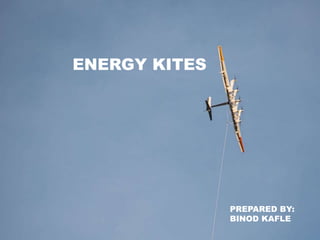


ENERGY KITES
PREPARED BY:
BINOD KAFLE
PRESENTATION OVERVIEW
 Introduction
 Limits of present renewable technologies
 The problem
 Cross wind kite power
 Construction detail
 Operating principle
 Design capacity
 Limitations
 Advantages
 Comparison with other renewable resources
 Summary
 References
INTRODUCTION
 An American engineer Miles L. Loyd described the
mathematics and potential of crosswind kite power in
1980.
 Wind power has the potential to power the world 100 times
over, yet only 5% of the world’s power comes from wind.
 Airborne wind energy replaces the traditional structure of
wind turbine by kites tethered to ground.
 Makani built 600kw energy kite in Alameda, California in
2016 which power up to 300 homes.
 Kitegen was an Italian company which also generate
electricity commercially from kite.
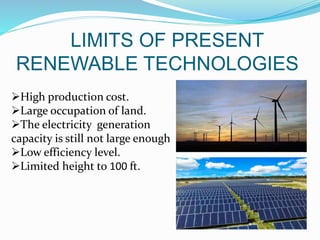
LIMITS OF PRESENT
RENEWABLE TECHNOLOGIES
High production cost.
Large occupation of land.
The electricity generation
capacity is still not large enough
Low efficiency level.
Limited height to 100 ft.
THE PROBLEM
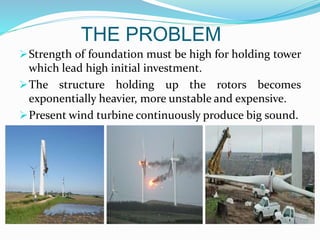
Strength of foundation must be high for holding tower
which lead high initial investment.
The structure holding up the rotors becomes
exponentially heavier, more unstable and expensive.
Present wind turbine continuously produce big sound.
CROSSWIND KITE ENERGY
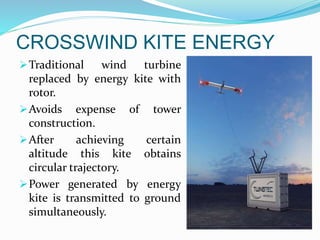
Traditional wind turbine
replaced by energy kite with
rotor.
Avoids expense of tower
construction.
After achieving certain
altitude this kite obtains
circular trajectory.
Power generated by energy
kite is transmitted to ground
simultaneously.
CONSTRUCTION DETAIL
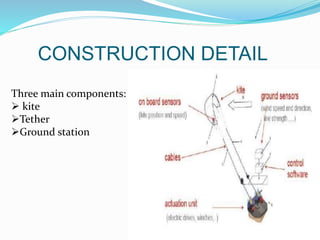
Three main components:
 kite
Tether
Ground station
 Kite:
 The main component of the power generation system.
 Material used must be light as well as strong to sustain various
types of forces acting on it.
 Consists of turbines that generate power by using the velocity of
wind.
 Increase in number of rotor increases power output.
• Tether:
 Acts as a link for kite to ground contact.
 Used to transmit energy generated by energy kite to the ground
station.
 Made of thick Aluminium wires surrounded by a high strength
composite fiber covering.
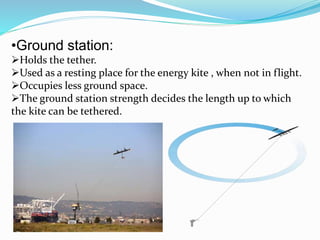
•Ground station:
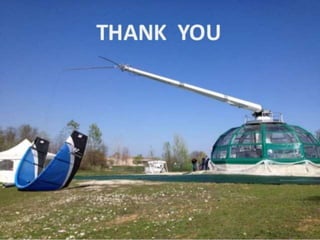
Holds the tether.
Used as a resting place for the energy kite , when not in flight.
Occupies less ground space.
The ground station strength decides the length up to which
the kite can be tethered.
OPERATING PRINCIPLE
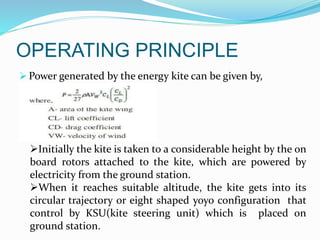
 Power generated by the energy kite can be given by,
Initially the kite is taken to a considerable height by the on
board rotors attached to the kite, which are powered by
electricity from the ground station.
When it reaches suitable altitude, the kite gets into its
circular trajectory or eight shaped yoyo configuration that
control by KSU(kite steering unit) which is placed on
ground station.
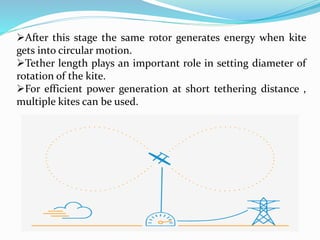
After this stage the same rotor generates energy when kite
gets into circular motion.
Tether length plays an important role in setting diameter of
rotation of the kite.
For efficient power generation at short tethering distance ,
multiple kites can be used.
DESIGN CAPACITY
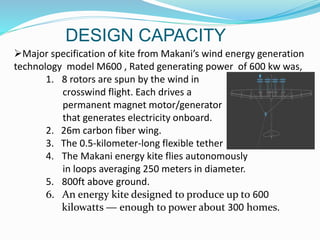
Major specification of kite from Makani’s wind energy generation
technology model M600 , Rated generating power of 600 kw was,
1. 8 rotors are spun by the wind in
crosswind flight. Each drives a
permanent magnet motor/generator
that generates electricity onboard.
2. 26m carbon fiber wing.
3. The 0.5-kilometer-long flexible tether
4. The Makani energy kite flies autonomously
in loops averaging 250 meters in diameter.
5. 800ft above ground.
6. An energy kite designed to produce up to 600
kilowatts ― enough to power about 300 homes.
LIMITATIONS
The none aerodynamic forces acting on the kite reduces the
total usable power that can be harvested to a great extent.
A prohibited airspace zone is required.
During bad weather condition, kite must be brought back
down to the ground and covered.
Requires continuous monitoring.
ADVANTAGES
Minimal efforts in terms of
•Generator structure
•Cost
•Land occupation
Operates at significantly higher altitude above the
ground where stronger and more constant winds can be
found and thus higher amounts of energy is generated.
Low initial investment, low maintenance cost .
High power with low input.
Eco friendly with pollution free. Effectively silent.
Generates 50% more power from 90% less materials.
Can be used in areas not suitable for conventional
turbines.
Easy of whole system transportation.
COMPARISON WITH OTHER
RENEWABLE SOURCES
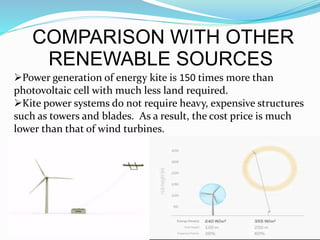
Power generation of energy kite is 150 times more than
photovoltaic cell with much less land required.
Kite power systems do not require heavy, expensive structures
such as towers and blades. As a result, the cost price is much
lower than that of wind turbines.
SUMMARY
Use of energy kites opens a new world of opportunities in
the field of wind power generation by making complete use
of air at high altitude too.
If such technology is implemented on a large scale, the
use of power plants that burn out conventional resources
could be decreased to a great extent, thereby decreasing air
pollution.
Use of this clean energy will decrease the rate of global
warming significantly by replacing conventional energy
sources like coal, petroleum, fuel woods, nuclear energy.
High altitude wind power using tethered wind turbine
devices has the potential to open up a new wind resource
in areas that are not served by conventional turbine.
REFERENCES
• http://www.creativeworld.com/2011/04/abstract-
and-full-paper-on-renewable
• http://www.kiteenergy.net/technology-2/key-points/
•http://www.x.company/makani/journey/
•http://www.alternative-energy-news.info/makani-
energy-kite/
•http://www.kitenergy.net/technology-2/
•https://www.mathworks.com/company/mathworks-
stories/high-winds.html
•M. L. loyd, crosswind kite power, journal of Energy 4-
3, pp. 106-111 (1980).
Kite energy
Kite energy

Kite energy

  • 1.
  • 2.
    PRESENTATION OVERVIEW  Introduction Limits of present renewable technologies  The problem  Cross wind kite power  Construction detail  Operating principle  Design capacity  Limitations  Advantages  Comparison with other renewable resources  Summary  References
  • 3.
    INTRODUCTION  An Americanengineer Miles L. Loyd described the mathematics and potential of crosswind kite power in 1980.  Wind power has the potential to power the world 100 times over, yet only 5% of the world’s power comes from wind.  Airborne wind energy replaces the traditional structure of wind turbine by kites tethered to ground.  Makani built 600kw energy kite in Alameda, California in 2016 which power up to 300 homes.  Kitegen was an Italian company which also generate electricity commercially from kite.
  • 4.
    LIMITS OF PRESENT RENEWABLETECHNOLOGIES High production cost. Large occupation of land. The electricity generation capacity is still not large enough Low efficiency level. Limited height to 100 ft.
  • 5.
    THE PROBLEM Strength offoundation must be high for holding tower which lead high initial investment. The structure holding up the rotors becomes exponentially heavier, more unstable and expensive. Present wind turbine continuously produce big sound.
  • 6.
    CROSSWIND KITE ENERGY Traditionalwind turbine replaced by energy kite with rotor. Avoids expense of tower construction. After achieving certain altitude this kite obtains circular trajectory. Power generated by energy kite is transmitted to ground simultaneously.
  • 7.
    CONSTRUCTION DETAIL Three maincomponents:  kite Tether Ground station
  • 8.
     Kite:  Themain component of the power generation system.  Material used must be light as well as strong to sustain various types of forces acting on it.  Consists of turbines that generate power by using the velocity of wind.  Increase in number of rotor increases power output. • Tether:  Acts as a link for kite to ground contact.  Used to transmit energy generated by energy kite to the ground station.  Made of thick Aluminium wires surrounded by a high strength composite fiber covering.
  • 9.
    •Ground station: Holds thetether. Used as a resting place for the energy kite , when not in flight. Occupies less ground space. The ground station strength decides the length up to which the kite can be tethered.
  • 10.
    OPERATING PRINCIPLE  Powergenerated by the energy kite can be given by, Initially the kite is taken to a considerable height by the on board rotors attached to the kite, which are powered by electricity from the ground station. When it reaches suitable altitude, the kite gets into its circular trajectory or eight shaped yoyo configuration that control by KSU(kite steering unit) which is placed on ground station.
  • 11.
    After this stagethe same rotor generates energy when kite gets into circular motion. Tether length plays an important role in setting diameter of rotation of the kite. For efficient power generation at short tethering distance , multiple kites can be used.
  • 12.
    DESIGN CAPACITY Major specificationof kite from Makani’s wind energy generation technology model M600 , Rated generating power of 600 kw was, 1. 8 rotors are spun by the wind in crosswind flight. Each drives a permanent magnet motor/generator that generates electricity onboard. 2. 26m carbon fiber wing. 3. The 0.5-kilometer-long flexible tether 4. The Makani energy kite flies autonomously in loops averaging 250 meters in diameter. 5. 800ft above ground. 6. An energy kite designed to produce up to 600 kilowatts ― enough to power about 300 homes.
  • 13.
    LIMITATIONS The none aerodynamicforces acting on the kite reduces the total usable power that can be harvested to a great extent. A prohibited airspace zone is required. During bad weather condition, kite must be brought back down to the ground and covered. Requires continuous monitoring.
  • 14.
    ADVANTAGES Minimal efforts interms of •Generator structure •Cost •Land occupation Operates at significantly higher altitude above the ground where stronger and more constant winds can be found and thus higher amounts of energy is generated. Low initial investment, low maintenance cost . High power with low input. Eco friendly with pollution free. Effectively silent. Generates 50% more power from 90% less materials. Can be used in areas not suitable for conventional turbines. Easy of whole system transportation.
  • 15.
    COMPARISON WITH OTHER RENEWABLESOURCES Power generation of energy kite is 150 times more than photovoltaic cell with much less land required. Kite power systems do not require heavy, expensive structures such as towers and blades. As a result, the cost price is much lower than that of wind turbines.
  • 16.
    SUMMARY Use of energykites opens a new world of opportunities in the field of wind power generation by making complete use of air at high altitude too. If such technology is implemented on a large scale, the use of power plants that burn out conventional resources could be decreased to a great extent, thereby decreasing air pollution. Use of this clean energy will decrease the rate of global warming significantly by replacing conventional energy sources like coal, petroleum, fuel woods, nuclear energy. High altitude wind power using tethered wind turbine devices has the potential to open up a new wind resource in areas that are not served by conventional turbine.
  • 18.