D R . T A R E K A . T U T U N J I
M E C H A T R O N I C S E N G I N E E R I N G D E P A R T M E N T
P H I L A D E L P H I A U N I V E R S I T Y , J O R D A N
2018
Robotics: Kinematics
Outline
 Description and Transformation
 Rigid Body Pose
 Rotation Matrix
 Euler Angles
 Homogeneous Transformation
 Direct Kinematics
 DH Convention
 Manipulator Kinematics
 Work Space
 Inverse Kinematics
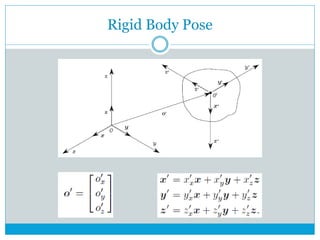
Rigid Body Pose
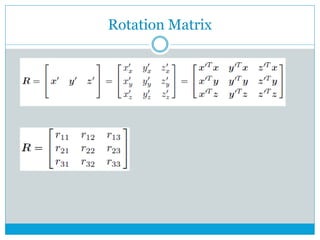
Rotation Matrix
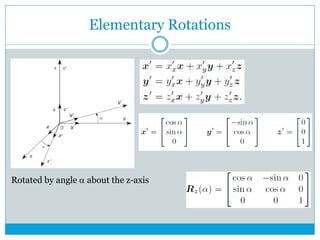
Elementary Rotations
Rotated by angle a about the z-axis
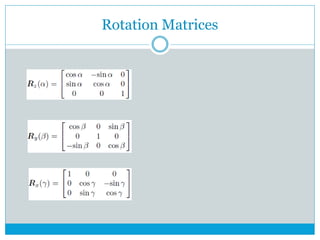
Rotation Matrices
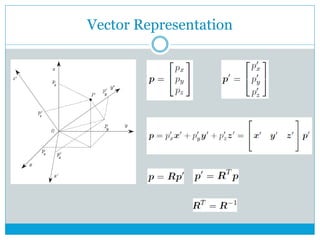
Vector Representation
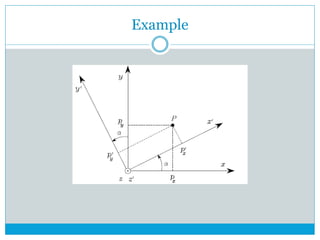
Example
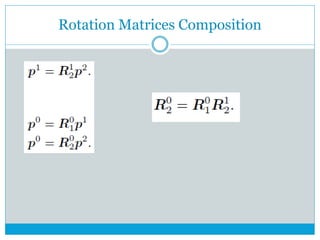
Rotation Matrices Composition
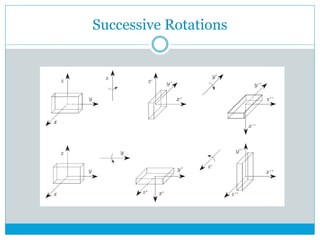
Successive Rotations
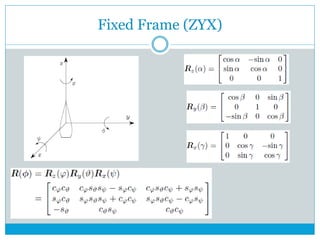
Fixed Frame (ZYX)
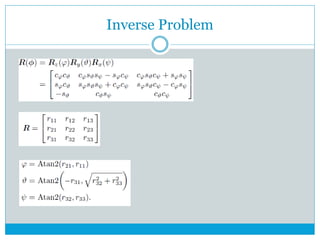
Inverse Problem
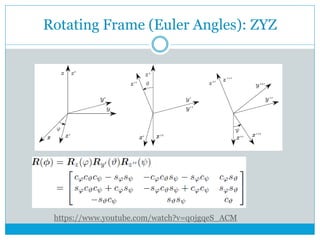
Rotating Frame (Euler Angles): ZYZ
https://www.youtube.com/watch?v=q0jgqeS_ACM
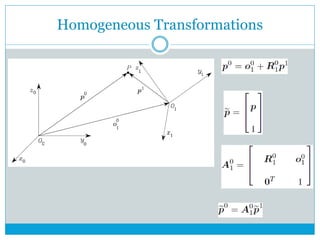
Homogeneous Transformations
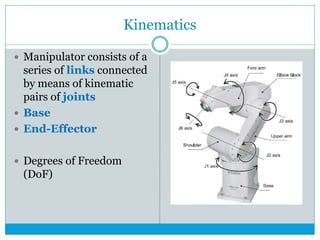
Kinematics
 Manipulator consists of a
series of links connected
by means of kinematic
pairs of joints
 Base
 End-Effector
 Degrees of Freedom
(DoF)
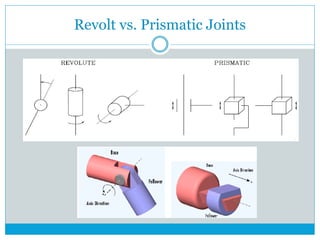
Revolt vs. Prismatic Joints
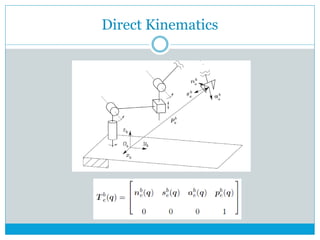
Direct Kinematics
The objective of direct kinematics is to
compute the position and orientation of the
end-effector as a function of joint variables.
https://www.youtube.com/watch?v=jTAtaPrN2CI
Direct Kinematics
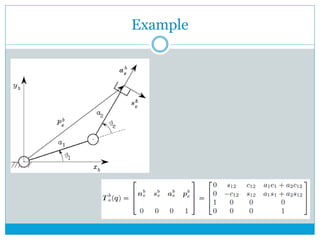
Example
Open vs. Closed Chain
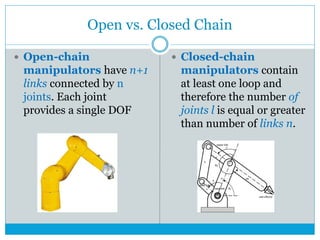
 Open-chain
manipulators have n+1
links connected by n
joints. Each joint
provides a single DOF
 Closed-chain
manipulators contain
at least one loop and
therefore the number of
joints l is equal or greater
than number of links n.
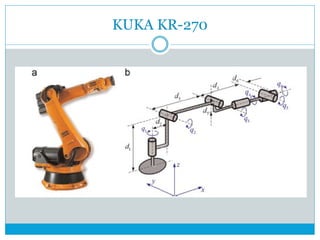
KUKA KR-270
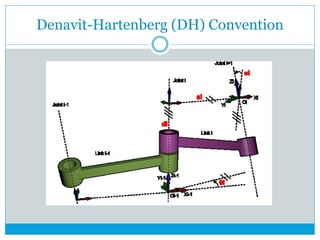
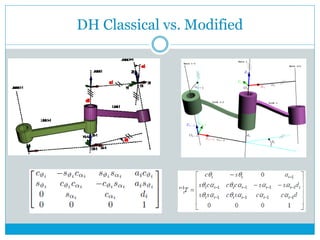
Denavit-Hartenberg (DH) Convention
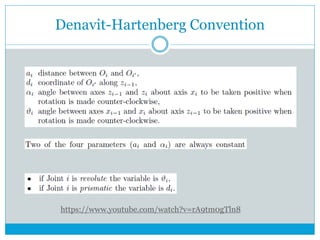
Denavit-Hartenberg Convention
https://www.youtube.com/watch?v=rA9tm0gTln8
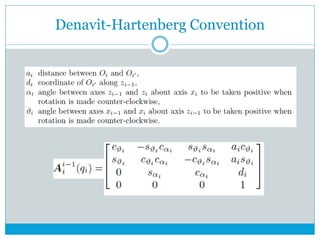
Denavit-Hartenberg Convention
DH Classical vs. Modified
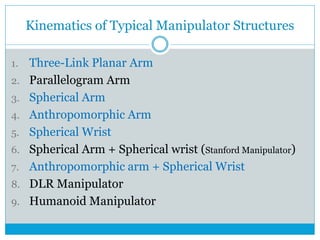
Kinematics of Typical Manipulator Structures
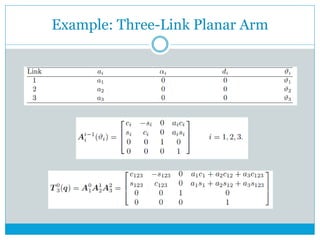
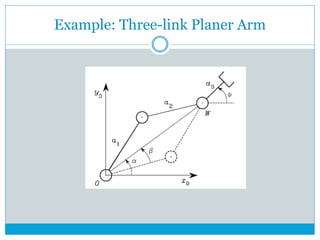
1. Three-Link Planar Arm
2. Parallelogram Arm
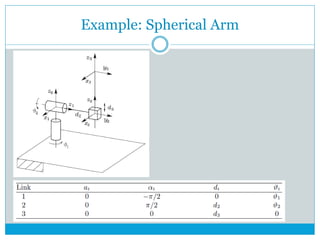
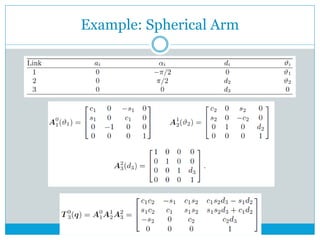
3. Spherical Arm
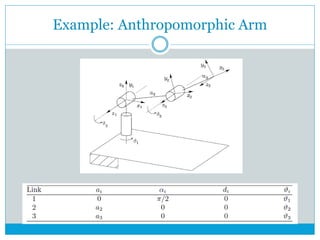
4. Anthropomorphic Arm
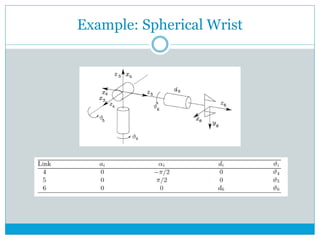
5. Spherical Wrist
6. Spherical Arm + Spherical wrist (Stanford Manipulator)
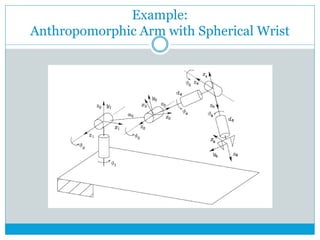
7. Anthropomorphic arm + Spherical Wrist
8. DLR Manipulator
9. Humanoid Manipulator
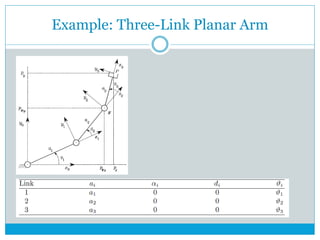
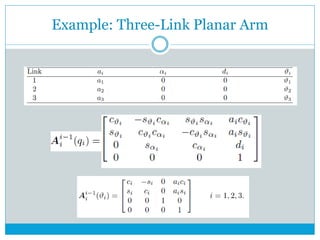
Example: Three-Link Planar Arm
Example: Spherical Arm
Example: Anthropomorphic Arm
Example: Spherical Wrist
Example:
Anthropomorphic Arm with Spherical Wrist
Joint Space and Operational Space
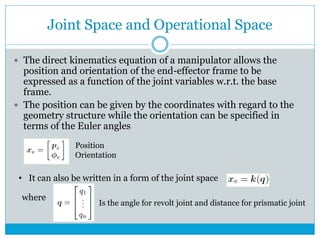
 The direct kinematics equation of a manipulator allows the
position and orientation of the end-effector frame to be
expressed as a function of the joint variables w.r.t. the base
frame.
 The position can be given by the coordinates with regard to the
geometry structure while the orientation can be specified in
terms of the Euler angles
Position
Orientation
• It can also be written in a form of the joint space
where
Is the angle for revolt joint and distance for prismatic joint
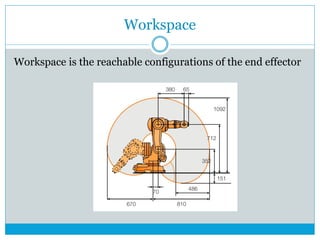
Workspace
Workspace is the reachable configurations of the end effector
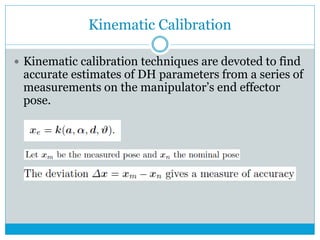
Kinematic Calibration
 Kinematic calibration techniques are devoted to find
accurate estimates of DH parameters from a series of
measurements on the manipulator’s end effector
pose.
Inverse Kinematics
Objective is the determination of the joint
variables corresponding to a given end-
effector position and orientation.
 This is a much more complex problem when
compared to direct kinematics
Inverse Kinematic Examples
1. Three-link Planar Arm
2. Manipulators with Spherical Wrists
3. Spherical Arm
4. Anthropomorphic Arm
5. Spherical Wrist
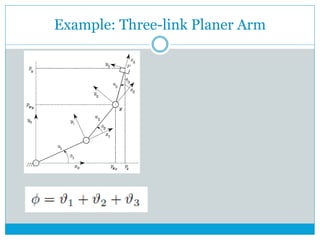
Example: Three-link Planer Arm
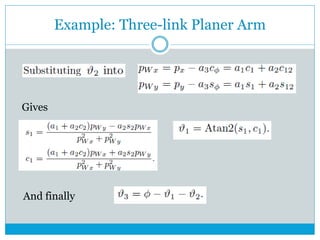
And finally
Gives
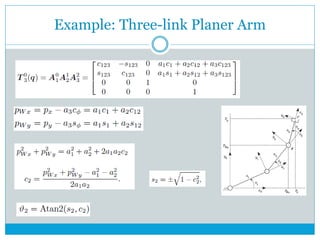
Example: Three-link Planer Arm
Reference
 Siciliano, Sciavicco, Villani, and Oriolo. Robotics:
Modeling, Planning, and Control. Advanced
Textbooks in Control and Signal Processing.
Springer 2009

Kinematics for robotics inverse and forward