BY NIYA WATKINS, SARAH GIMONT, AND JACKIE PFEIFFER Kinematic Equations
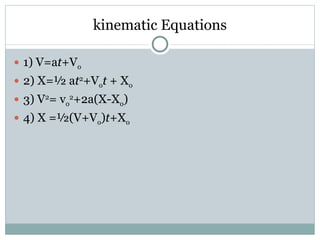
kinematic Equations 1) V=a t +V o 2) X=½ a t 2 +V o t  + X o   3) V 2 = v o 2 +2a(X-X o ) 4) X =½(V+V o ) t +X o
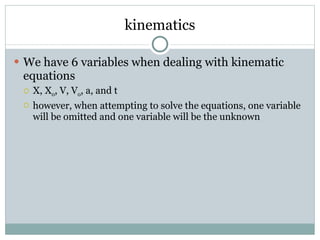
kinematics We have 6 variables when dealing with kinematic equations X, X o , V, V o , a, and t however, when attempting to solve the equations, one variable will be omitted and one variable will be the unknown
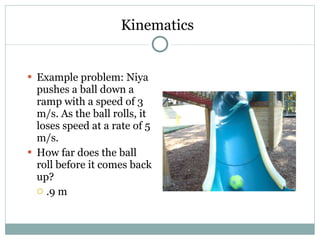
Kinematics Example problem: Niya pushes a ball down a ramp with a speed of 3 m/s. As the ball rolls, it loses speed at a rate of 5 m/s.  How far does the ball roll before it comes back up? .9 m
kinematics Sample Problem: explanation  First, we must figure out which variables we have we know Vo=3(the starting speed), that Vo=0(the starting point), X=?(how far...), and a=-5(the rate the speed decreases at) We now know we can use equation 3 0=9 + -10(x)
free fall A special case of constant acceleration. Secrets: Acceleration is -9.8 m/s 2 Stop at the top Symmetry (time up = time down)
free fall Example Problem: Sarah drops a ball off a building that it 200m tall. How long does it take it to fall halfway? 4.52s
free fall Example Problem: Explanation First, we must figure out which variables we have We know X o =0(the origin), X=200(the height of the building), V o =0(the ball is dropped), a=-9.8(rule of free fall), and t=?(how long…) So we would use equation 2 200=-4.9t 2* * remember we need to have a real answer

Kinematicequations

  • 1.
    BY NIYA WATKINS,SARAH GIMONT, AND JACKIE PFEIFFER Kinematic Equations
  • 2.
    kinematic Equations 1)V=a t +V o 2) X=½ a t 2 +V o t + X o 3) V 2 = v o 2 +2a(X-X o ) 4) X =½(V+V o ) t +X o
  • 3.
    kinematics We have6 variables when dealing with kinematic equations X, X o , V, V o , a, and t however, when attempting to solve the equations, one variable will be omitted and one variable will be the unknown
  • 4.
    Kinematics Example problem:Niya pushes a ball down a ramp with a speed of 3 m/s. As the ball rolls, it loses speed at a rate of 5 m/s. How far does the ball roll before it comes back up? .9 m
  • 5.
    kinematics Sample Problem:explanation First, we must figure out which variables we have we know Vo=3(the starting speed), that Vo=0(the starting point), X=?(how far...), and a=-5(the rate the speed decreases at) We now know we can use equation 3 0=9 + -10(x)
  • 6.
    free fall Aspecial case of constant acceleration. Secrets: Acceleration is -9.8 m/s 2 Stop at the top Symmetry (time up = time down)
  • 7.
    free fall ExampleProblem: Sarah drops a ball off a building that it 200m tall. How long does it take it to fall halfway? 4.52s
  • 8.
    free fall ExampleProblem: Explanation First, we must figure out which variables we have We know X o =0(the origin), X=200(the height of the building), V o =0(the ball is dropped), a=-9.8(rule of free fall), and t=?(how long…) So we would use equation 2 200=-4.9t 2* * remember we need to have a real answer