Kinematics in One Dimension
Chapter 2
Kinematics deals with the concepts that
are needed to describe motion.
Dynamics deals with the effect that forces
have on motion.
Together, kinematics and dynamics form
the branch of physics known as Mechanics.
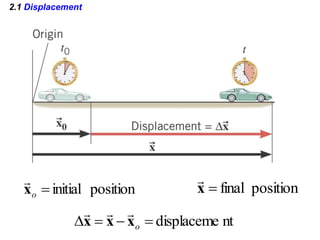
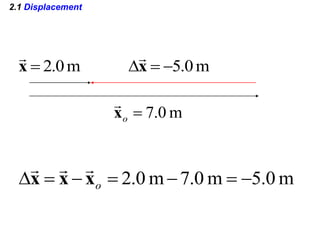
2.1 Displacement
position
initial

o
x

position
final

x

nt
displaceme



 o
x
x
x



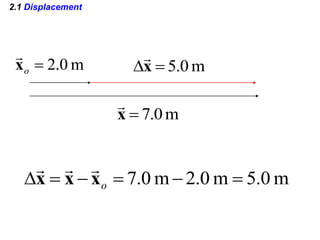
2.1 Displacement
m
0
.
2

o
x

m
0
.
7

x

m
0
.
5

x

m
0
.
5
m
2.0
m
7.0 




 o
x
x
x



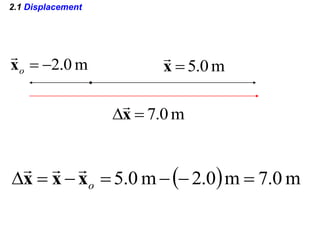
2.1 Displacement
m
0
.
2

x

m
0
.
7

o
x

m
0
.
5


x

m
0
.
5
m
7.0
m
2.0 





 o
x
x
x



2.1 Displacement
m
0
.
2


o
x

m
0
.
7

x

m
0
.
5

x

  m
0
.
7
m
.0
2
m
5.0 





 o
x
x
x



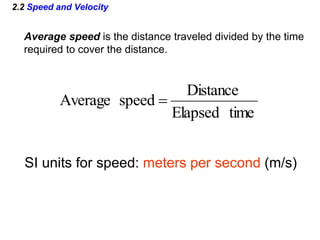
2.2 Speed and Velocity
Average speed is the distance traveled divided by the time
required to cover the distance.
time
Elapsed
Distance
speed
Average 
SI units for speed: meters per second (m/s)
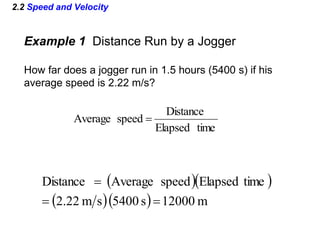
2.2 Speed and Velocity
Example 1 Distance Run by a Jogger
How far does a jogger run in 1.5 hours (5400 s) if his
average speed is 2.22 m/s?
time
Elapsed
Distance
speed
Average 
  
   m
12000
s
5400
s
m
22
.
2
time
Elapsed
speed
Average
Distance



2.2 Speed and Velocity
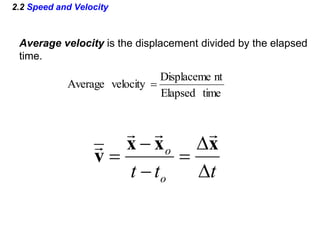
Average velocity is the displacement divided by the elapsed
time.
time
Elapsed
nt
Displaceme
velocity
Average 
t
t
t o
o






x
x
x
v




2.2 Speed and Velocity
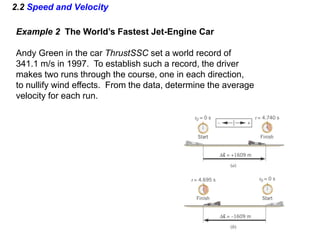
Example 2 The World’s Fastest Jet-Engine Car
Andy Green in the car ThrustSSC set a world record of
341.1 m/s in 1997. To establish such a record, the driver
makes two runs through the course, one in each direction,
to nullify wind effects. From the data, determine the average
velocity for each run.
2.2 Speed and Velocity
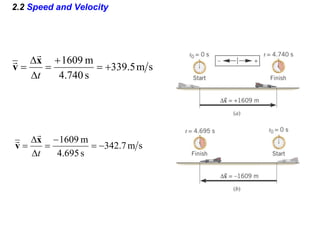
s
m
5
.
339
s
4.740
m
1609







t
x
v


s
m
7
.
342
s
4.695
m
1609







t
x
v


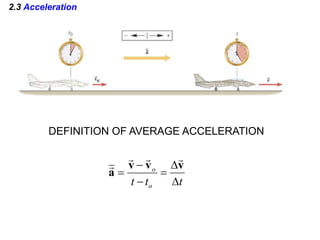
2.3 Acceleration
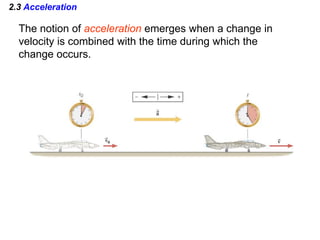
The notion of acceleration emerges when a change in
velocity is combined with the time during which the
change occurs.
2.3 Acceleration
t
t
t o
o






v
v
v
a




DEFINITION OF AVERAGE ACCELERATION
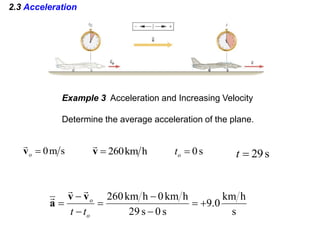
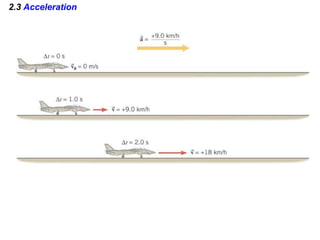
2.3 Acceleration
Example 3 Acceleration and Increasing Velocity
Determine the average acceleration of the plane.
s
m
0

o
v

h
km
260

v

s
0

o
t s
29

t
s
h
km
0
.
9
s
0
s
29
h
km
0
h
km
260








o
o
t
t
v
v
a



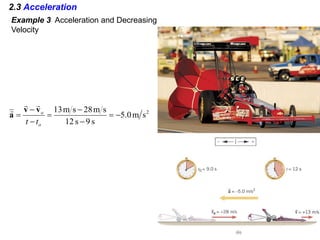
2.3 Acceleration
2.3 Acceleration
Example 3 Acceleration and Decreasing
Velocity
2
s
m
0
.
5
s
9
s
12
s
m
28
s
m
13








o
o
t
t
v
v
a



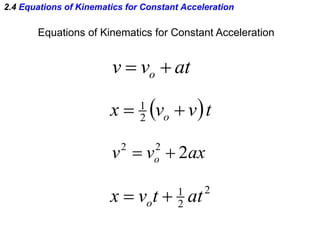
2.4 Equations of Kinematics for Constant Acceleration
Equations of Kinematics for Constant Acceleration
 t
v
v
x o 
 2
1
2
2
1
at
t
v
x o 

at
v
v o 

ax
v
v o 2
2
2


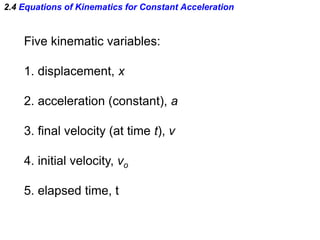
2.4 Equations of Kinematics for Constant Acceleration
Five kinematic variables:
1. displacement, x
2. acceleration (constant), a
3. final velocity (at time t), v
4. initial velocity, vo
5. elapsed time, t
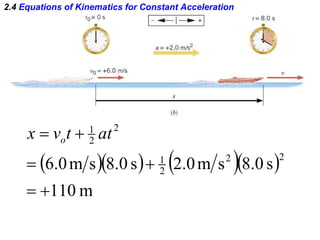
2.4 Equations of Kinematics for Constant Acceleration
     
m
110
s
0
.
8
s
m
0
.
2
s
0
.
8
s
m
0
.
6
2
2
2
1
2
2
1





 at
t
v
x o
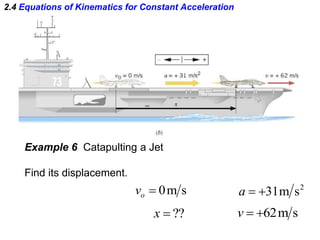
2.4 Equations of Kinematics for Constant Acceleration
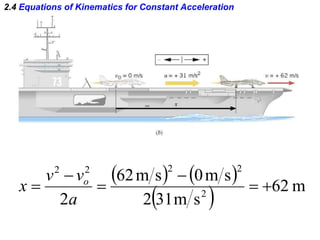
Example 6 Catapulting a Jet
Find its displacement.
s
m
0

o
v
??

x
2
s
m
31


a
s
m
62


v
2.4 Equations of Kinematics for Constant Acceleration
   
  m
62
s
m
31
2
s
m
0
s
m
62
2 2
2
2
2
2






a
v
v
x o
2.5 Applications of the Equations of Kinematics
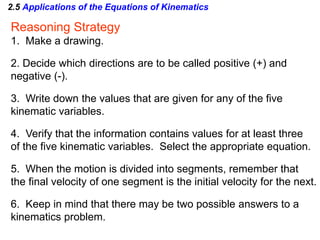
Reasoning Strategy
1. Make a drawing.
2. Decide which directions are to be called positive (+) and
negative (-).
3. Write down the values that are given for any of the five
kinematic variables.
4. Verify that the information contains values for at least three
of the five kinematic variables. Select the appropriate equation.
5. When the motion is divided into segments, remember that
the final velocity of one segment is the initial velocity for the next.
6. Keep in mind that there may be two possible answers to a
kinematics problem.
2.5 Applications of the Equations of Kinematics
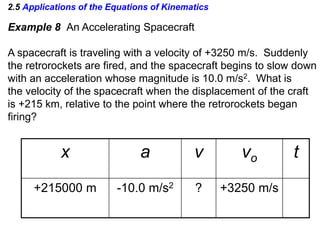
Example 8 An Accelerating Spacecraft
A spacecraft is traveling with a velocity of +3250 m/s. Suddenly
the retrorockets are fired, and the spacecraft begins to slow down
with an acceleration whose magnitude is 10.0 m/s2. What is
the velocity of the spacecraft when the displacement of the craft
is +215 km, relative to the point where the retrorockets began
firing?
x a v vo t
+215000 m -10.0 m/s2 ? +3250 m/s
2.5 Applications of the Equations of Kinematics
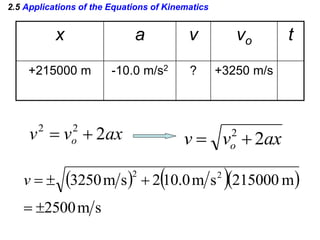
ax
v
v o 2
2
2


x a v vo t
+215000 m -10.0 m/s2 ? +3250 m/s
ax
v
v o 2
2


    
s
m
2500
m
215000
s
m
0
.
10
2
s
m
3250 2
2





v
2.6 Freely Falling Bodies
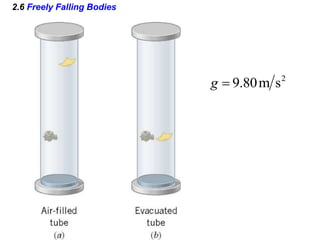
In the absence of air resistance, it is found that all bodies
at the same location above the Earth fall vertically with
the same acceleration.
This idealized motion is called free-fall and the acceleration
of a freely falling body is called the acceleration due to
gravity.
2
2
s
ft
2
.
32
or
s
m
80
.
9

g
2.6 Freely Falling Bodies
2
s
m
80
.
9

g
2.6 Freely Falling Bodies
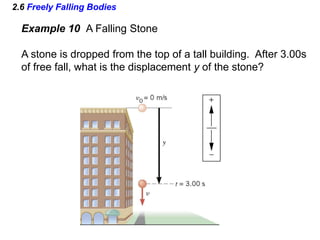
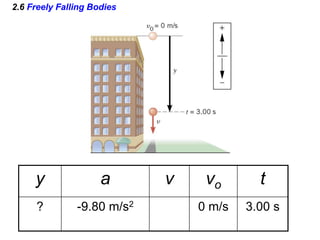
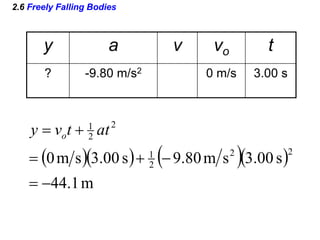
Example 10 A Falling Stone
A stone is dropped from the top of a tall building. After 3.00s
of free fall, what is the displacement y of the stone?
2.6 Freely Falling Bodies
y a v vo t
? -9.80 m/s2 0 m/s 3.00 s
2.6 Freely Falling Bodies
y a v vo t
? -9.80 m/s2 0 m/s 3.00 s
     
m
1
.
44
s
00
.
3
s
m
80
.
9
s
00
.
3
s
m
0
2
2
2
1
2
2
1






 at
t
v
y o
2.6 Freely Falling Bodies
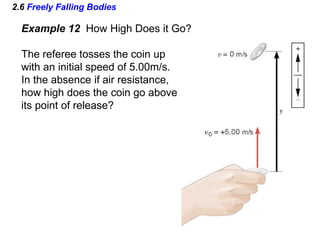
Example 12 How High Does it Go?
The referee tosses the coin up
with an initial speed of 5.00m/s.
In the absence if air resistance,
how high does the coin go above
its point of release?
2.6 Freely Falling Bodies
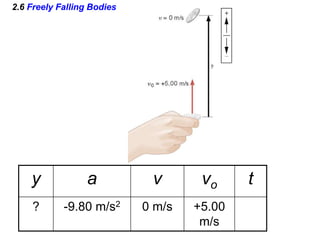
y a v vo t
? -9.80 m/s2 0 m/s +5.00
m/s
2.6 Freely Falling Bodies
y a v vo t
? -9.80 m/s2 0 m/s +5.00
m/s
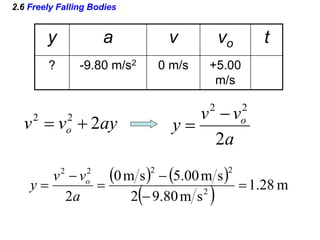
ay
v
v o 2
2
2


a
v
v
y o
2
2
2


   
  m
28
.
1
s
m
80
.
9
2
s
m
00
.
5
s
m
0
2 2
2
2
2
2






a
v
v
y o
2.6 Freely Falling Bodies
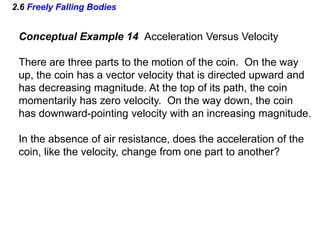
Conceptual Example 14 Acceleration Versus Velocity
There are three parts to the motion of the coin. On the way
up, the coin has a vector velocity that is directed upward and
has decreasing magnitude. At the top of its path, the coin
momentarily has zero velocity. On the way down, the coin
has downward-pointing velocity with an increasing magnitude.
In the absence of air resistance, does the acceleration of the
coin, like the velocity, change from one part to another?
2.6 Freely Falling Bodies
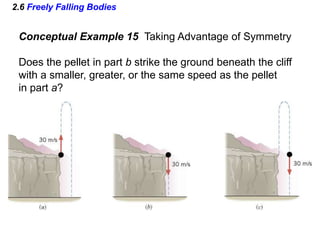
Conceptual Example 15 Taking Advantage of Symmetry
Does the pellet in part b strike the ground beneath the cliff
with a smaller, greater, or the same speed as the pellet
in part a?
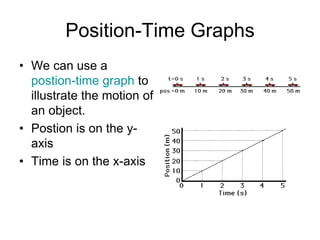
Position-Time Graphs
• We can use a
postion-time graph to
illustrate the motion of
an object.
• Postion is on the y-
axis
• Time is on the x-axis
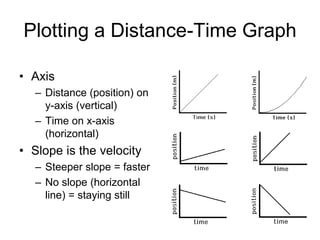
Plotting a Distance-Time Graph
• Axis
– Distance (position) on
y-axis (vertical)
– Time on x-axis
(horizontal)
• Slope is the velocity
– Steeper slope = faster
– No slope (horizontal
line) = staying still
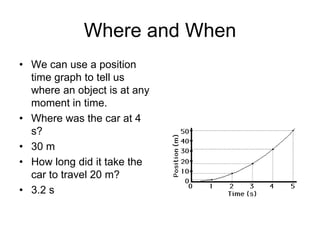
Where and When
• We can use a position
time graph to tell us
where an object is at any
moment in time.
• Where was the car at 4
s?
• 30 m
• How long did it take the
car to travel 20 m?
• 3.2 s
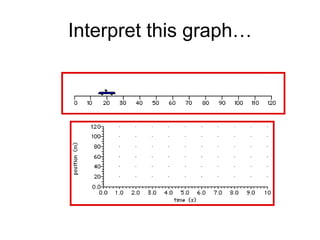
Interpret this graph…
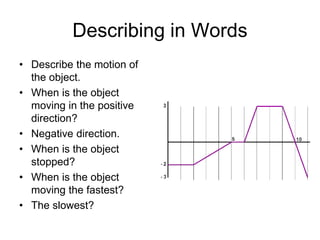
Describing in Words
Describing in Words
• Describe the motion of
the object.
• When is the object
moving in the positive
direction?
• Negative direction.
• When is the object
stopped?
• When is the object
moving the fastest?
• The slowest?
Accelerated Motion
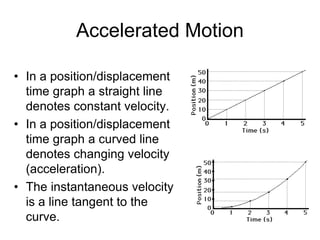
• In a position/displacement
time graph a straight line
denotes constant velocity.
• In a position/displacement
time graph a curved line
denotes changing velocity
(acceleration).
• The instantaneous velocity
is a line tangent to the

curve.
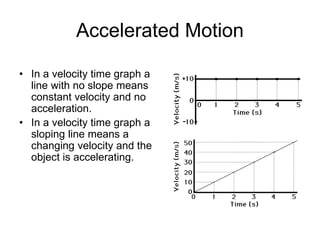
Accelerated Motion
• In a velocity time graph a
line with no slope means
constant velocity and no
acceleration.
• In a velocity time graph a
sloping line means a
changing velocity and the
object is accelerating.
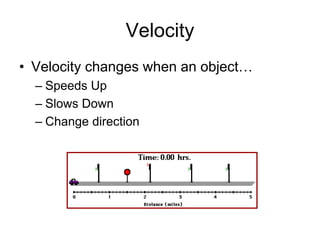
Velocity
• Velocity changes when an object…
– Speeds Up
– Slows Down
– Change direction
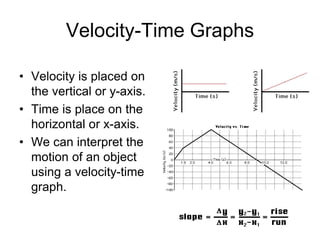
Velocity-Time Graphs
• Velocity is placed on
the vertical or y-axis.
• Time is place on the
horizontal or x-axis.
• We can interpret the
motion of an object
using a velocity-time
graph.
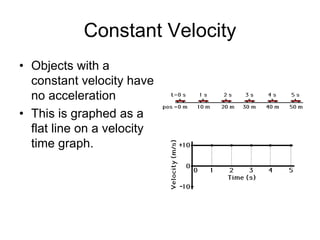
Constant Velocity
• Objects with a
constant velocity have
no acceleration
• This is graphed as a
flat line on a velocity
time graph.
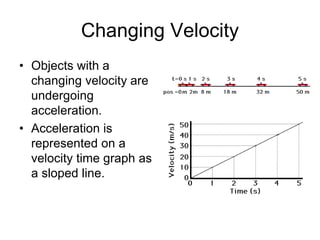
Changing Velocity
• Objects with a
changing velocity are
undergoing
acceleration.
• Acceleration is
represented on a
velocity time graph as
a sloped line.
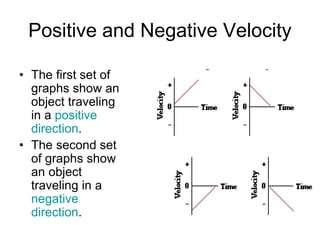
Positive and Negative Velocity
• The first set of
graphs show an
object traveling
in a positive
direction.
• The second set
of graphs show
an object
traveling in a
negative
direction.
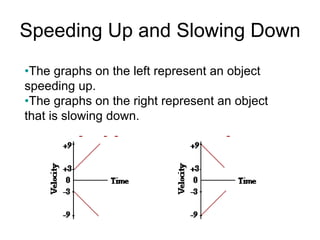
Speeding Up and Slowing Down
•The graphs on the left represent an object
speeding up.
•The graphs on the right represent an object
that is slowing down.
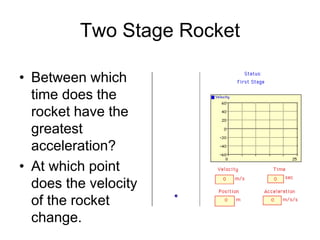
Two Stage Rocket
• Between which
time does the
rocket have the
greatest
acceleration?
• At which point
does the velocity
of the rocket
change.
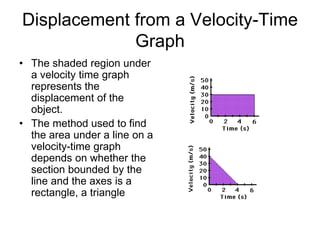
Displacement from a Velocity-Time
Graph
• The shaded region under
a velocity time graph
represents the
displacement of the
object.
• The method used to find
the area under a line on a
velocity-time graph
depends on whether the
section bounded by the
line and the axes is a
rectangle, a triangle
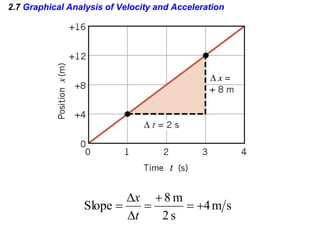
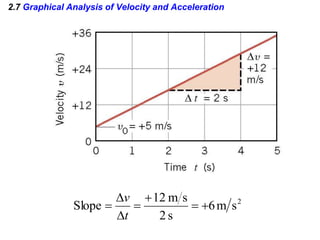
2.7 Graphical Analysis of Velocity and Acceleration
s
m
4
s
2
m
8
Slope 






t
x
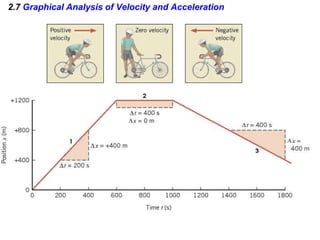
2.7 Graphical Analysis of Velocity and Acceleration
2
s
m
6
s
2
s
m
12
Slope 






t
v

chapter2powerpoint-090816163937-phpapp02.ppt

  • 1.
    Kinematics in OneDimension Chapter 2
  • 2.
    Kinematics deals withthe concepts that are needed to describe motion. Dynamics deals with the effect that forces have on motion. Together, kinematics and dynamics form the branch of physics known as Mechanics.
  • 3.
  • 4.
  • 5.
  • 6.
    2.1 Displacement m 0 . 2   o x  m 0 . 7  x  m 0 . 5  x   m 0 . 7 m .0 2 m 5.0        o x x x   
  • 7.
    2.2 Speed andVelocity Average speed is the distance traveled divided by the time required to cover the distance. time Elapsed Distance speed Average  SI units for speed: meters per second (m/s)
  • 8.
    2.2 Speed andVelocity Example 1 Distance Run by a Jogger How far does a jogger run in 1.5 hours (5400 s) if his average speed is 2.22 m/s? time Elapsed Distance speed Average        m 12000 s 5400 s m 22 . 2 time Elapsed speed Average Distance   
  • 9.
    2.2 Speed andVelocity Average velocity is the displacement divided by the elapsed time. time Elapsed nt Displaceme velocity Average  t t t o o       x x x v    
  • 10.
    2.2 Speed andVelocity Example 2 The World’s Fastest Jet-Engine Car Andy Green in the car ThrustSSC set a world record of 341.1 m/s in 1997. To establish such a record, the driver makes two runs through the course, one in each direction, to nullify wind effects. From the data, determine the average velocity for each run.
  • 11.
    2.2 Speed andVelocity s m 5 . 339 s 4.740 m 1609        t x v   s m 7 . 342 s 4.695 m 1609        t x v  
  • 12.
    2.3 Acceleration The notionof acceleration emerges when a change in velocity is combined with the time during which the change occurs.
  • 13.
  • 14.
    2.3 Acceleration Example 3Acceleration and Increasing Velocity Determine the average acceleration of the plane. s m 0  o v  h km 260  v  s 0  o t s 29  t s h km 0 . 9 s 0 s 29 h km 0 h km 260         o o t t v v a   
  • 15.
  • 16.
    2.3 Acceleration Example 3Acceleration and Decreasing Velocity 2 s m 0 . 5 s 9 s 12 s m 28 s m 13         o o t t v v a   
  • 17.
    2.4 Equations ofKinematics for Constant Acceleration Equations of Kinematics for Constant Acceleration  t v v x o   2 1 2 2 1 at t v x o   at v v o   ax v v o 2 2 2  
  • 18.
    2.4 Equations ofKinematics for Constant Acceleration Five kinematic variables: 1. displacement, x 2. acceleration (constant), a 3. final velocity (at time t), v 4. initial velocity, vo 5. elapsed time, t
  • 19.
    2.4 Equations ofKinematics for Constant Acceleration       m 110 s 0 . 8 s m 0 . 2 s 0 . 8 s m 0 . 6 2 2 2 1 2 2 1       at t v x o
  • 20.
    2.4 Equations ofKinematics for Constant Acceleration Example 6 Catapulting a Jet Find its displacement. s m 0  o v ??  x 2 s m 31   a s m 62   v
  • 21.
    2.4 Equations ofKinematics for Constant Acceleration       m 62 s m 31 2 s m 0 s m 62 2 2 2 2 2 2       a v v x o
  • 22.
    2.5 Applications ofthe Equations of Kinematics Reasoning Strategy 1. Make a drawing. 2. Decide which directions are to be called positive (+) and negative (-). 3. Write down the values that are given for any of the five kinematic variables. 4. Verify that the information contains values for at least three of the five kinematic variables. Select the appropriate equation. 5. When the motion is divided into segments, remember that the final velocity of one segment is the initial velocity for the next. 6. Keep in mind that there may be two possible answers to a kinematics problem.
  • 23.
    2.5 Applications ofthe Equations of Kinematics Example 8 An Accelerating Spacecraft A spacecraft is traveling with a velocity of +3250 m/s. Suddenly the retrorockets are fired, and the spacecraft begins to slow down with an acceleration whose magnitude is 10.0 m/s2. What is the velocity of the spacecraft when the displacement of the craft is +215 km, relative to the point where the retrorockets began firing? x a v vo t +215000 m -10.0 m/s2 ? +3250 m/s
  • 24.
    2.5 Applications ofthe Equations of Kinematics ax v v o 2 2 2   x a v vo t +215000 m -10.0 m/s2 ? +3250 m/s ax v v o 2 2        s m 2500 m 215000 s m 0 . 10 2 s m 3250 2 2      v
  • 25.
    2.6 Freely FallingBodies In the absence of air resistance, it is found that all bodies at the same location above the Earth fall vertically with the same acceleration. This idealized motion is called free-fall and the acceleration of a freely falling body is called the acceleration due to gravity. 2 2 s ft 2 . 32 or s m 80 . 9  g
  • 26.
    2.6 Freely FallingBodies 2 s m 80 . 9  g
  • 27.
    2.6 Freely FallingBodies Example 10 A Falling Stone A stone is dropped from the top of a tall building. After 3.00s of free fall, what is the displacement y of the stone?
  • 28.
    2.6 Freely FallingBodies y a v vo t ? -9.80 m/s2 0 m/s 3.00 s
  • 29.
    2.6 Freely FallingBodies y a v vo t ? -9.80 m/s2 0 m/s 3.00 s       m 1 . 44 s 00 . 3 s m 80 . 9 s 00 . 3 s m 0 2 2 2 1 2 2 1        at t v y o
  • 30.
    2.6 Freely FallingBodies Example 12 How High Does it Go? The referee tosses the coin up with an initial speed of 5.00m/s. In the absence if air resistance, how high does the coin go above its point of release?
  • 31.
    2.6 Freely FallingBodies y a v vo t ? -9.80 m/s2 0 m/s +5.00 m/s
  • 32.
    2.6 Freely FallingBodies y a v vo t ? -9.80 m/s2 0 m/s +5.00 m/s ay v v o 2 2 2   a v v y o 2 2 2         m 28 . 1 s m 80 . 9 2 s m 00 . 5 s m 0 2 2 2 2 2 2       a v v y o
  • 33.
    2.6 Freely FallingBodies Conceptual Example 14 Acceleration Versus Velocity There are three parts to the motion of the coin. On the way up, the coin has a vector velocity that is directed upward and has decreasing magnitude. At the top of its path, the coin momentarily has zero velocity. On the way down, the coin has downward-pointing velocity with an increasing magnitude. In the absence of air resistance, does the acceleration of the coin, like the velocity, change from one part to another?
  • 34.
    2.6 Freely FallingBodies Conceptual Example 15 Taking Advantage of Symmetry Does the pellet in part b strike the ground beneath the cliff with a smaller, greater, or the same speed as the pellet in part a?
  • 35.
    Position-Time Graphs • Wecan use a postion-time graph to illustrate the motion of an object. • Postion is on the y- axis • Time is on the x-axis
  • 36.
    Plotting a Distance-TimeGraph • Axis – Distance (position) on y-axis (vertical) – Time on x-axis (horizontal) • Slope is the velocity – Steeper slope = faster – No slope (horizontal line) = staying still
  • 37.
    Where and When •We can use a position time graph to tell us where an object is at any moment in time. • Where was the car at 4 s? • 30 m • How long did it take the car to travel 20 m? • 3.2 s
  • 38.
  • 39.
  • 40.
    Describing in Words •Describe the motion of the object. • When is the object moving in the positive direction? • Negative direction. • When is the object stopped? • When is the object moving the fastest? • The slowest?
  • 41.
    Accelerated Motion • Ina position/displacement time graph a straight line denotes constant velocity. • In a position/displacement time graph a curved line denotes changing velocity (acceleration). • The instantaneous velocity is a line tangent to the curve.
  • 42.
    Accelerated Motion • Ina velocity time graph a line with no slope means constant velocity and no acceleration. • In a velocity time graph a sloping line means a changing velocity and the object is accelerating.
  • 43.
    Velocity • Velocity changeswhen an object… – Speeds Up – Slows Down – Change direction
  • 44.
    Velocity-Time Graphs • Velocityis placed on the vertical or y-axis. • Time is place on the horizontal or x-axis. • We can interpret the motion of an object using a velocity-time graph.
  • 45.
    Constant Velocity • Objectswith a constant velocity have no acceleration • This is graphed as a flat line on a velocity time graph.
  • 46.
    Changing Velocity • Objectswith a changing velocity are undergoing acceleration. • Acceleration is represented on a velocity time graph as a sloped line.
  • 47.
    Positive and NegativeVelocity • The first set of graphs show an object traveling in a positive direction. • The second set of graphs show an object traveling in a negative direction.
  • 48.
    Speeding Up andSlowing Down •The graphs on the left represent an object speeding up. •The graphs on the right represent an object that is slowing down.
  • 49.
    Two Stage Rocket •Between which time does the rocket have the greatest acceleration? • At which point does the velocity of the rocket change.
  • 50.
    Displacement from aVelocity-Time Graph • The shaded region under a velocity time graph represents the displacement of the object. • The method used to find the area under a line on a velocity-time graph depends on whether the section bounded by the line and the axes is a rectangle, a triangle
  • 51.
    2.7 Graphical Analysisof Velocity and Acceleration s m 4 s 2 m 8 Slope        t x
  • 52.
    2.7 Graphical Analysisof Velocity and Acceleration
  • 53.
    2.7 Graphical Analysisof Velocity and Acceleration 2 s m 6 s 2 s m 12 Slope        t v