
Presented By,
Dhanunjaya
09F51A0515
Intellectual Institute of Technology, (IIT-ATP).
Anantapur.
Architecture, Challenges and Advantages
» We propose a new
architecture for the
networked robots to
increase the efficiency
of the robots.
• We discuss the
challenges issues
related to Technical,
Communication,
Security.
• We also discuss the
Robotic Advantages
Elastic computing models for cloud robotics
1. Peer-Based Model: Every robot in network
communicates with every Robot in the cloud
2. Proxy Based Model:A particular Robot acts as the Leader and
controls the communication between cloud and other robots.
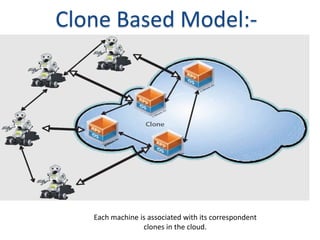
3. Clone Based Model:Each robot in the network is associated
with its corresponding system level clone in the cloud.
A task can be executed in the robot or in its clone.
Peer Based Model:-
Here two or more machine is connected with the cloud.
Proxy Based Model:-
Here a machine is connected with the cloud, which is called as the “Leader”, It would be
the interface between cloud and machines.
Clone Based Model:-
Each machine is associated with its correspondent
clones in the cloud.
Technical Challenges
Property
of being
strong
Ability to
exchange
info
Free
moving
nature
εr* ~ L(L/T), Stand alone execution by robot.
εc* ~ L(L/T)(n–1).  Cloud execution.
L=no of bits to transmit
T=delay dead line
N=no of robots
We assure the security through
1. Trust Establishment Algorithms.
2. Trust Measurement Algorithms.
3. Reputation-Based Trust approaches.
Future Robotic Applications will be in
terms of Could Robotics.
 Ability to offload computation intensive
task to cloud.
Access to shared knowledge and new
skills.
Access to vast amount of data .
The whole is grater than its parts.
Cloud Robotics> Cloud
computing + Robotics.
REFERENCES:
 [1] B. Sicilian and O. Khatib, Eds., Springer Handbook of Robotics, Springer, 2008.
 [2] IEEE Society of Robotics and Automation’s Technical Committee on Networked
 Robots, available: http://www-users.cs.umn.edu/~isler/tc/
 [3] P. Jacquet et al., “Optimized Link State Routing Protocol for Ad Hoc Networks,”
Multi Topic Conf. 2001, IEEE INMIC 2001, Technology for the 21st Century, Proc.
IEEE Int’l., 2001, pp. 62–68.
 [4] C. Perkins et al., “Performance Comparison of Two On-Demand Routing
Protocols
 for Ad Hoc Networks,” IEEE Personal Commun., vol. 8, no. 1, Feb. 2001, pp. 16–28.
Cloud computing slids

Cloud computing slids

  • 1.
    Presented By, Dhanunjaya 09F51A0515 Intellectual Instituteof Technology, (IIT-ATP). Anantapur. Architecture, Challenges and Advantages
  • 2.
    » We proposea new architecture for the networked robots to increase the efficiency of the robots. • We discuss the challenges issues related to Technical, Communication, Security. • We also discuss the Robotic Advantages
  • 6.
    Elastic computing modelsfor cloud robotics 1. Peer-Based Model: Every robot in network communicates with every Robot in the cloud 2. Proxy Based Model:A particular Robot acts as the Leader and controls the communication between cloud and other robots. 3. Clone Based Model:Each robot in the network is associated with its corresponding system level clone in the cloud. A task can be executed in the robot or in its clone.
  • 7.
    Peer Based Model:- Heretwo or more machine is connected with the cloud.
  • 8.
    Proxy Based Model:- Herea machine is connected with the cloud, which is called as the “Leader”, It would be the interface between cloud and machines.
  • 9.
    Clone Based Model:- Eachmachine is associated with its correspondent clones in the cloud.
  • 10.
    Technical Challenges Property of being strong Abilityto exchange info Free moving nature
  • 11.
    εr* ~ L(L/T),Stand alone execution by robot. εc* ~ L(L/T)(n–1).  Cloud execution. L=no of bits to transmit T=delay dead line N=no of robots We assure the security through 1. Trust Establishment Algorithms. 2. Trust Measurement Algorithms. 3. Reputation-Based Trust approaches.
  • 12.
    Future Robotic Applicationswill be in terms of Could Robotics.  Ability to offload computation intensive task to cloud. Access to shared knowledge and new skills. Access to vast amount of data .
  • 13.
    The whole isgrater than its parts. Cloud Robotics> Cloud computing + Robotics.
  • 14.
    REFERENCES:  [1] B.Sicilian and O. Khatib, Eds., Springer Handbook of Robotics, Springer, 2008.  [2] IEEE Society of Robotics and Automation’s Technical Committee on Networked  Robots, available: http://www-users.cs.umn.edu/~isler/tc/  [3] P. Jacquet et al., “Optimized Link State Routing Protocol for Ad Hoc Networks,” Multi Topic Conf. 2001, IEEE INMIC 2001, Technology for the 21st Century, Proc. IEEE Int’l., 2001, pp. 62–68.  [4] C. Perkins et al., “Performance Comparison of Two On-Demand Routing Protocols  for Ad Hoc Networks,” IEEE Personal Commun., vol. 8, no. 1, Feb. 2001, pp. 16–28.