Starting Agile SCRUM Kanban
Draft version
WWW.IRP-MANAGEMENT.COM
Date: 14 November 2016
Kick Start Agile SCRUM-version 0.1-
1
Hans Oosterling
November 2016
Version 0.1 14 November 2016
Starting Agile SCRUM Kanban
Draft version
WWW.IRP-MANAGEMENT.COM
Date: 7 november 2016
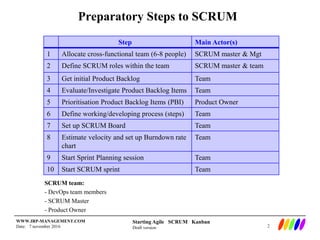
Preparatory Steps to SCRUM
Step Main Actor(s)
1 Allocate cross-functional team (6-8 people) SCRUM master & Mgt
2 Define SCRUM roles within the team SCRUM master & team
3 Get initial Product Backlog Team
4 Evaluate/Investigate Product Backlog Items Team
5 Prioritisation Product Backlog Items (PBI) Product Owner
6 Define working/developing process (steps) Team
7 Set up SCRUM Board Team
8 Estimate velocity and set up Burndown rate
chart
Team
9 Start Sprint Planning session Team
10 Start SCRUM sprint Team
SCRUM team:
- DevOps team members
- SCRUM Master
- Product Owner
2
Starting Agile SCRUM Kanban
Draft version
WWW.IRP-MANAGEMENT.COM
Date: 7 november 2016
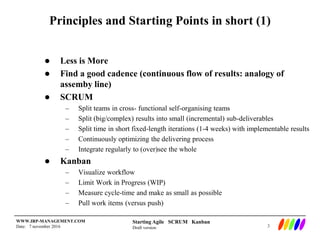
Principles and Starting Points in short (1)
 Less is More
 Find a good cadence (continuous flow of results: analogy of
assemby line)
 SCRUM
– Split teams in cross- functional self-organising teams
– Split (big/complex) results into small (incremental) sub-deliverables
– Split time in short fixed-length iterations (1-4 weeks) with implementable results
– Continuously optimizing the delivering process
– Integrate regularly to (over)see the whole
 Kanban
– Visualize workflow
– Limit Work in Progress (WIP)
– Measure cycle-time and make as small as possible
– Pull work items (versus push)
3
Starting Agile SCRUM Kanban
Draft version
WWW.IRP-MANAGEMENT.COM
Date: 7 november 2016
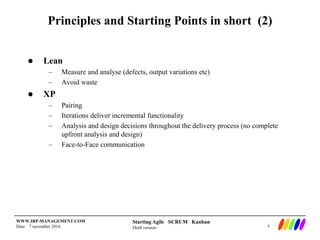
Principles and Starting Points in short (2)
 Lean
– Measure and analyse (defects, output variations etc)
– Avoid waste
 XP
– Pairing
– Iterations deliver incremental functionality
– Analysis and design decisions throughout the delivery process (no complete
upfront analysis and design)
– Face-to-Face communication
4
Starting Agile SCRUM Kanban
Draft version
WWW.IRP-MANAGEMENT.COM
Date: 7 november 2016
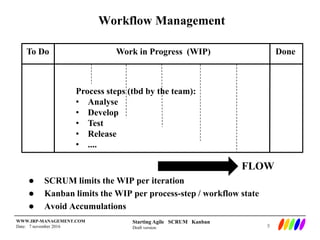
Workflow Management
 SCRUM limits the WIP per iteration
 Kanban limits the WIP per process-step / workflow state
 Avoid Accumulations
To Do DoneWork in Progress (WIP)
Process steps (tbd by the team):
• Analyse
• Develop
• Test
• Release
• ....
FLOW
5
Starting Agile SCRUM Kanban
Draft version
WWW.IRP-MANAGEMENT.COM
Date: 7 november 2016
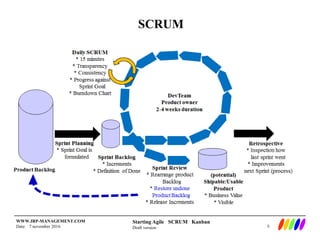
SCRUM
6
Starting Agile SCRUM Kanban
Draft version
WWW.IRP-MANAGEMENT.COM
Date: 7 november 2016
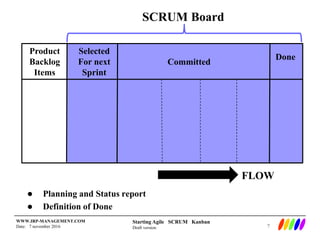
SCRUM Board
Product
Backlog
Items
Done
Committed
FLOW
Selected
For next
Sprint
 Planning and Status report
 Definition of Done
7
Starting Agile SCRUM Kanban
Draft version
WWW.IRP-MANAGEMENT.COM
Date: 7 november 2016
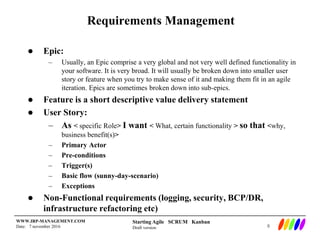
Requirements Management
 Epic:
– Usually, an Epic comprise a very global and not very well defined functionality in
your software. It is very broad. It will usually be broken down into smaller user
story or feature when you try to make sense of it and making them fit in an agile
iteration. Epics are sometimes broken down into sub-epics.
 Feature is a short descriptive value delivery statement
 User Story:
– As < specific Role> I want < What, certain functionality > so that <why,
business benefit(s)>
– Primary Actor
– Pre-conditions
– Trigger(s)
– Basic flow (sunny-day-scenario)
– Exceptions
 Non-Functional requirements (logging, security, BCP/DR,
infrastructure refactoring etc)
8
Starting Agile SCRUM Kanban
Draft version
WWW.IRP-MANAGEMENT.COM
Date: 7 november 2016
SCRUM: Velocity
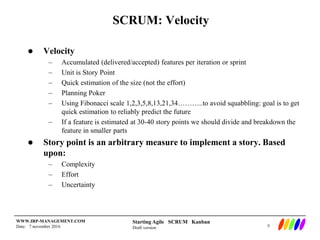
 Velocity
– Accumulated (delivered/accepted) features per iteration or sprint
– Unit is Story Point
– Quick estimation of the size (not the effort)
– Planning Poker
– Using Fibonacci scale 1,2,3,5,8,13,21,34………..to avoid squabbling: goal is to get
quick estimation to reliably predict the future
– If a feature is estimated at 30-40 story points we should divide and breakdown the
feature in smaller parts
 Story point is an arbitrary measure to implement a story. Based
upon:
– Complexity
– Effort
– Uncertainty
9
Starting Agile SCRUM Kanban
Draft version
WWW.IRP-MANAGEMENT.COM
Date: 7 november 2016
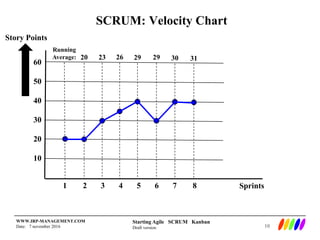
SCRUM: Velocity Chart
60
50
40
30
20
10
Story Points
Sprints1 2 3 4 5 6 7 8
Running
Average: 20 3123 3026 29 29
10
Starting Agile SCRUM Kanban
Draft version
WWW.IRP-MANAGEMENT.COM
Date: 7 november 2016
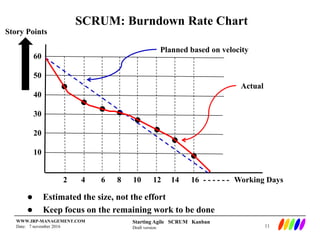
SCRUM: Burndown Rate Chart
60
50
40
30
20
10
Story Points
Working Days2 4 6 8 10 12 14 16 - - - - - -
Planned based on velocity
Actual
 Estimated the size, not the effort
 Keep focus on the remaining work to be done
11
Starting Agile SCRUM Kanban
Draft version
WWW.IRP-MANAGEMENT.COM
Date: 7 november 2016
Kanban
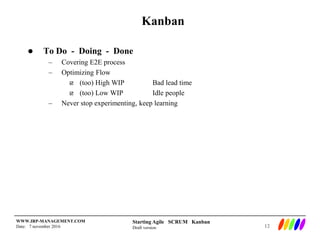
 To Do - Doing - Done
– Covering E2E process
– Optimizing Flow
 (too) High WIP Bad lead time
 (too) Low WIP Idle people
– Never stop experimenting, keep learning
12
Starting Agile SCRUM Kanban
Draft version
WWW.IRP-MANAGEMENT.COM
Date: 7 november 2016
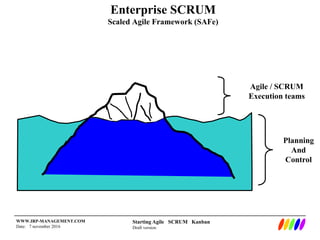
Enterprise SCRUM
Scaled Agile Framework (SAFe)
Agile / SCRUM
Execution teams
Planning
And
Control
Starting Agile SCRUM Kanban
Draft version
WWW.IRP-MANAGEMENT.COM
Date: 7 november 2016
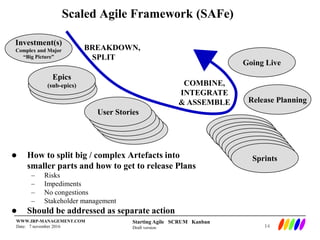
Scaled Agile Framework (SAFe)
 How to split big / complex Artefacts into
smaller parts and how to get to release Plans
– Risks
– Impediments
– No congestions
– Stakeholder management
 Should be addressed as separate action
Investment(s)
Complex and Major
“Big Picture”
Epics
(sub-epics)
User Stories
Release Planning
Going Live
Sprints
BREAKDOWN,
SPLIT
14
COMBINE,
INTEGRATE
& ASSEMBLE
Starting Agile SCRUM Kanban
Draft version
WWW.IRP-MANAGEMENT.COM
Date: 7 november 2016
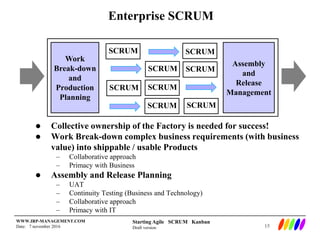
Enterprise SCRUM
 Collective ownership of the Factory is needed for success!
 Work Break-down complex business requirements (with business
value) into shippable / usable Products
– Collaborative approach
– Primacy with Business
 Assembly and Release Planning
– UAT
– Continuity Testing (Business and Technology)
– Collaborative approach
– Primacy with IT
Work
Break-down
and
Production
Planning
SCRUM
SCRUM
SCRUM
SCRUMSCRUM
SCRUM
SCRUM
SCRUM
Assembly
and
Release
Management
15
Starting Agile SCRUM Kanban
Draft version
WWW.IRP-MANAGEMENT.COM
Date: 7 november 2016
References
 Leffingwell, Dean. 2011. Agile Software Requirements: Lean
Requirements Practices for Teams, Programs, and the Enterprise
 Leffingwell, Dean. 2007. Scaling Software Agility: Best Practices
for Large Enterprises
 Cohn, Mike. 2009. Succeeding with Agile: Software Development
Using Scrum
 Cohn, Mike. 2005. Agile Estimating and Planning
 Rally Software. 2013. Scaled Agile Programs with SAFe.
16

KICK START AGILE/SCRUM

  • 1.
    Starting Agile SCRUMKanban Draft version WWW.IRP-MANAGEMENT.COM Date: 14 November 2016 Kick Start Agile SCRUM-version 0.1- 1 Hans Oosterling November 2016 Version 0.1 14 November 2016
  • 2.
    Starting Agile SCRUMKanban Draft version WWW.IRP-MANAGEMENT.COM Date: 7 november 2016 Preparatory Steps to SCRUM Step Main Actor(s) 1 Allocate cross-functional team (6-8 people) SCRUM master & Mgt 2 Define SCRUM roles within the team SCRUM master & team 3 Get initial Product Backlog Team 4 Evaluate/Investigate Product Backlog Items Team 5 Prioritisation Product Backlog Items (PBI) Product Owner 6 Define working/developing process (steps) Team 7 Set up SCRUM Board Team 8 Estimate velocity and set up Burndown rate chart Team 9 Start Sprint Planning session Team 10 Start SCRUM sprint Team SCRUM team: - DevOps team members - SCRUM Master - Product Owner 2
  • 3.
    Starting Agile SCRUMKanban Draft version WWW.IRP-MANAGEMENT.COM Date: 7 november 2016 Principles and Starting Points in short (1)  Less is More  Find a good cadence (continuous flow of results: analogy of assemby line)  SCRUM – Split teams in cross- functional self-organising teams – Split (big/complex) results into small (incremental) sub-deliverables – Split time in short fixed-length iterations (1-4 weeks) with implementable results – Continuously optimizing the delivering process – Integrate regularly to (over)see the whole  Kanban – Visualize workflow – Limit Work in Progress (WIP) – Measure cycle-time and make as small as possible – Pull work items (versus push) 3
  • 4.
    Starting Agile SCRUMKanban Draft version WWW.IRP-MANAGEMENT.COM Date: 7 november 2016 Principles and Starting Points in short (2)  Lean – Measure and analyse (defects, output variations etc) – Avoid waste  XP – Pairing – Iterations deliver incremental functionality – Analysis and design decisions throughout the delivery process (no complete upfront analysis and design) – Face-to-Face communication 4
  • 5.
    Starting Agile SCRUMKanban Draft version WWW.IRP-MANAGEMENT.COM Date: 7 november 2016 Workflow Management  SCRUM limits the WIP per iteration  Kanban limits the WIP per process-step / workflow state  Avoid Accumulations To Do DoneWork in Progress (WIP) Process steps (tbd by the team): • Analyse • Develop • Test • Release • .... FLOW 5
  • 6.
    Starting Agile SCRUMKanban Draft version WWW.IRP-MANAGEMENT.COM Date: 7 november 2016 SCRUM 6
  • 7.
    Starting Agile SCRUMKanban Draft version WWW.IRP-MANAGEMENT.COM Date: 7 november 2016 SCRUM Board Product Backlog Items Done Committed FLOW Selected For next Sprint  Planning and Status report  Definition of Done 7
  • 8.
    Starting Agile SCRUMKanban Draft version WWW.IRP-MANAGEMENT.COM Date: 7 november 2016 Requirements Management  Epic: – Usually, an Epic comprise a very global and not very well defined functionality in your software. It is very broad. It will usually be broken down into smaller user story or feature when you try to make sense of it and making them fit in an agile iteration. Epics are sometimes broken down into sub-epics.  Feature is a short descriptive value delivery statement  User Story: – As < specific Role> I want < What, certain functionality > so that <why, business benefit(s)> – Primary Actor – Pre-conditions – Trigger(s) – Basic flow (sunny-day-scenario) – Exceptions  Non-Functional requirements (logging, security, BCP/DR, infrastructure refactoring etc) 8
  • 9.
    Starting Agile SCRUMKanban Draft version WWW.IRP-MANAGEMENT.COM Date: 7 november 2016 SCRUM: Velocity  Velocity – Accumulated (delivered/accepted) features per iteration or sprint – Unit is Story Point – Quick estimation of the size (not the effort) – Planning Poker – Using Fibonacci scale 1,2,3,5,8,13,21,34………..to avoid squabbling: goal is to get quick estimation to reliably predict the future – If a feature is estimated at 30-40 story points we should divide and breakdown the feature in smaller parts  Story point is an arbitrary measure to implement a story. Based upon: – Complexity – Effort – Uncertainty 9
  • 10.
    Starting Agile SCRUMKanban Draft version WWW.IRP-MANAGEMENT.COM Date: 7 november 2016 SCRUM: Velocity Chart 60 50 40 30 20 10 Story Points Sprints1 2 3 4 5 6 7 8 Running Average: 20 3123 3026 29 29 10
  • 11.
    Starting Agile SCRUMKanban Draft version WWW.IRP-MANAGEMENT.COM Date: 7 november 2016 SCRUM: Burndown Rate Chart 60 50 40 30 20 10 Story Points Working Days2 4 6 8 10 12 14 16 - - - - - - Planned based on velocity Actual  Estimated the size, not the effort  Keep focus on the remaining work to be done 11
  • 12.
    Starting Agile SCRUMKanban Draft version WWW.IRP-MANAGEMENT.COM Date: 7 november 2016 Kanban  To Do - Doing - Done – Covering E2E process – Optimizing Flow  (too) High WIP Bad lead time  (too) Low WIP Idle people – Never stop experimenting, keep learning 12
  • 13.
    Starting Agile SCRUMKanban Draft version WWW.IRP-MANAGEMENT.COM Date: 7 november 2016 Enterprise SCRUM Scaled Agile Framework (SAFe) Agile / SCRUM Execution teams Planning And Control
  • 14.
    Starting Agile SCRUMKanban Draft version WWW.IRP-MANAGEMENT.COM Date: 7 november 2016 Scaled Agile Framework (SAFe)  How to split big / complex Artefacts into smaller parts and how to get to release Plans – Risks – Impediments – No congestions – Stakeholder management  Should be addressed as separate action Investment(s) Complex and Major “Big Picture” Epics (sub-epics) User Stories Release Planning Going Live Sprints BREAKDOWN, SPLIT 14 COMBINE, INTEGRATE & ASSEMBLE
  • 15.
    Starting Agile SCRUMKanban Draft version WWW.IRP-MANAGEMENT.COM Date: 7 november 2016 Enterprise SCRUM  Collective ownership of the Factory is needed for success!  Work Break-down complex business requirements (with business value) into shippable / usable Products – Collaborative approach – Primacy with Business  Assembly and Release Planning – UAT – Continuity Testing (Business and Technology) – Collaborative approach – Primacy with IT Work Break-down and Production Planning SCRUM SCRUM SCRUM SCRUMSCRUM SCRUM SCRUM SCRUM Assembly and Release Management 15
  • 16.
    Starting Agile SCRUMKanban Draft version WWW.IRP-MANAGEMENT.COM Date: 7 november 2016 References  Leffingwell, Dean. 2011. Agile Software Requirements: Lean Requirements Practices for Teams, Programs, and the Enterprise  Leffingwell, Dean. 2007. Scaling Software Agility: Best Practices for Large Enterprises  Cohn, Mike. 2009. Succeeding with Agile: Software Development Using Scrum  Cohn, Mike. 2005. Agile Estimating and Planning  Rally Software. 2013. Scaled Agile Programs with SAFe. 16