Management of Agile / SCRUM teams
Draft version
WWW.IRP-MANAGEMENT.COM
page: 1 Date: 6/24/2016
Management of Agile / SCRUM teams
Draft version
WWW.IRP-MANAGEMENT.COM
page: ‹#› Date: 24-6-2016
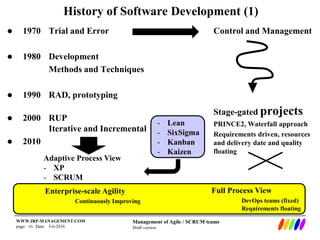
 1970 Trial and Error
 1980 Development
Methods and Techniques
 1990 RAD, prototyping
 2000 RUP
Iterative and Incremental
 2010
History of Software Development (1)
Control and Management
Stage-gated projects
PRINCE2, Waterfall approach
Requirements driven, resources
and delivery date and quality
floating
Adaptive Process View
- XP
- SCRUM
- CMM
- Lean
- SixSigma
- Kanban
- Kaizen
Enterprise-scale Agility
Continuously Improving
Full Process View
DevOps teams (fixed)
Requirements floating
Management of Agile / SCRUM teams
Draft version
WWW.IRP-MANAGEMENT.COM
page: ‹#› Date: 24-6-2016
History of Software Development (2)
 RAD
– Rapid Application Design
– Requirements by Prototyping
– Accelerate the availability of
working Software
– 4th generation language
 RUP
– Rational Unified Process (IBM)
– Requirements by graphics (UML)
 Structure (architecture)
 Behavior (Functionality)
– Model-driven development
– Soften the stage boundaries:
 Inception
 Elaboration
 Construction
 Transition
 Kanban
– To Do—Doing—Done
– Work in Progress (WIP)
– Define per unit the max WIP
– Pull next work item
– Avoiding accumulation in the
overall process
Management of Agile / SCRUM teams
Draft version
WWW.IRP-MANAGEMENT.COM
page: ‹#› Date: 24-6-2016
History of Software Development (3)
 XP
– Extreme Programming
– Small teams
– Analysis and design throughout the
development process
– Two programmers at one screen
(pairing)
– Face-to-face communication
– Simplicity
– Collective ownership
 SCRUM
– Sprints
– (potential) usable product
– Product backlog
– Epic: objective, “big vision”
– Feature: short descriptive value
delivery statement
– User stories: As <who> , at
<where>, I want <what> on
<when> because <why>
 Kaizen
– “Change for better”
– Deming PDCA cycle
– Root cause Analysis (5xWhy)
 Lean SixSigma
– Avoiding waste
– Measurement and metrics
Management of Agile / SCRUM teams
Draft version
WWW.IRP-MANAGEMENT.COM
page: ‹#› Date: 24-6-2016
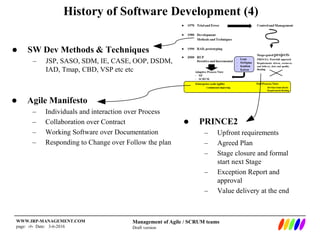
History of Software Development (4)
 Agile Manifesto
– Individuals and interaction over Process
– Collaboration over Contract
– Working Software over Documentation
– Responding to Change over Follow the plan
 PRINCE2
– Upfront requirements
– Agreed Plan
– Stage closure and formal
start next Stage
– Exception Report and
approval
– Value delivery at the end
 SW Dev Methods & Techniques
– JSP, SASO, SDM, IE, CASE, OOP, DSDM,
IAD, Tmap, CBD, VSP etc etc
 CMM: Capability Maturity Model
– Framework for growth and Evaluation
– CSF, Key Goal Indicators, KPI’s
Management of Agile / SCRUM teams
Draft version
WWW.IRP-MANAGEMENT.COM
page: ‹#› Date: 24-6-2016
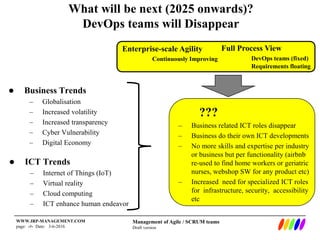
What will be next (2025 onwards)?
DevOps teams will Disappear
Enterprise-scale Agility
Continuously Improving
Full Process View
DevOps teams (fixed)
Requirements floating
 Business Trends
– Globalisation
– Increased volatility
– Increased transparency
– Cyber Vulnerability
– Digital Economy
 ICT Trends
– Internet of Things (IoT)
– Virtual reality
– Cloud computing
– ICT enhance human endeavor
– Business related ICT roles disappear
– Business do their own ICT developments
based on standardised application
development platforms and tools
– IT processing and system maintenance
will be fully serviced (no internal IT
skills needed anymore) SaaS, PaaS etc
– No more skills and expertise per industry
or business but per main functionality
(airbnb re-used to find home workers or
geriatric nurses, webshop SW for any
product / services etc)
“Every ICT performance
improvement for the last
decades never lasted more
than 6-9 years, so what will be next?”
?????

DevOpsteamsJune2016

  • 1.
    Management of Agile/ SCRUM teams Draft version WWW.IRP-MANAGEMENT.COM page: 1 Date: 6/24/2016
  • 2.
    Management of Agile/ SCRUM teams Draft version WWW.IRP-MANAGEMENT.COM page: ‹#› Date: 24-6-2016  1970 Trial and Error  1980 Development Methods and Techniques  1990 RAD, prototyping  2000 RUP Iterative and Incremental  2010 History of Software Development (1) Control and Management Stage-gated projects PRINCE2, Waterfall approach Requirements driven, resources and delivery date and quality floating Adaptive Process View - XP - SCRUM - CMM - Lean - SixSigma - Kanban - Kaizen Enterprise-scale Agility Continuously Improving Full Process View DevOps teams (fixed) Requirements floating
  • 3.
    Management of Agile/ SCRUM teams Draft version WWW.IRP-MANAGEMENT.COM page: ‹#› Date: 24-6-2016 History of Software Development (2)  RAD – Rapid Application Design – Requirements by Prototyping – Accelerate the availability of working Software – 4th generation language  RUP – Rational Unified Process (IBM) – Requirements by graphics (UML)  Structure (architecture)  Behavior (Functionality) – Model-driven development – Soften the stage boundaries:  Inception  Elaboration  Construction  Transition  Kanban – To Do—Doing—Done – Work in Progress (WIP) – Define per unit the max WIP – Pull next work item – Avoiding accumulation in the overall process
  • 4.
    Management of Agile/ SCRUM teams Draft version WWW.IRP-MANAGEMENT.COM page: ‹#› Date: 24-6-2016 History of Software Development (3)  XP – Extreme Programming – Small teams – Analysis and design throughout the development process – Two programmers at one screen (pairing) – Face-to-face communication – Simplicity – Collective ownership  SCRUM – Sprints – (potential) usable product – Product backlog – Epic: objective, “big vision” – Feature: short descriptive value delivery statement – User stories: As <who> , at <where>, I want <what> on <when> because <why>  Kaizen – “Change for better” – Deming PDCA cycle – Root cause Analysis (5xWhy)  Lean SixSigma – Avoiding waste – Measurement and metrics
  • 5.
    Management of Agile/ SCRUM teams Draft version WWW.IRP-MANAGEMENT.COM page: ‹#› Date: 24-6-2016 History of Software Development (4)  Agile Manifesto – Individuals and interaction over Process – Collaboration over Contract – Working Software over Documentation – Responding to Change over Follow the plan  PRINCE2 – Upfront requirements – Agreed Plan – Stage closure and formal start next Stage – Exception Report and approval – Value delivery at the end  SW Dev Methods & Techniques – JSP, SASO, SDM, IE, CASE, OOP, DSDM, IAD, Tmap, CBD, VSP etc etc  CMM: Capability Maturity Model – Framework for growth and Evaluation – CSF, Key Goal Indicators, KPI’s
  • 6.
    Management of Agile/ SCRUM teams Draft version WWW.IRP-MANAGEMENT.COM page: ‹#› Date: 24-6-2016 What will be next (2025 onwards)? DevOps teams will Disappear Enterprise-scale Agility Continuously Improving Full Process View DevOps teams (fixed) Requirements floating  Business Trends – Globalisation – Increased volatility – Increased transparency – Cyber Vulnerability – Digital Economy  ICT Trends – Internet of Things (IoT) – Virtual reality – Cloud computing – ICT enhance human endeavor – Business related ICT roles disappear – Business do their own ICT developments based on standardised application development platforms and tools – IT processing and system maintenance will be fully serviced (no internal IT skills needed anymore) SaaS, PaaS etc – No more skills and expertise per industry or business but per main functionality (airbnb re-used to find home workers or geriatric nurses, webshop SW for any product / services etc) “Every ICT performance improvement for the last decades never lasted more than 6-9 years, so what will be next?” ?????