Management of Agile / SCRUM teams
Draft version
WWW.IRP-MANAGEMENT.COM
page: 1 Date: 3/12/2015
Implementation of
Management Control
Agile / SCRUM teams-version 0.1-
Hans Oosterling
December 2014
Version 0.1 12-Mar-15
Management of Agile / SCRUM teams
Draft version
WWW.IRP-MANAGEMENT.COM
page: ‹#› Date: 12-3-2015
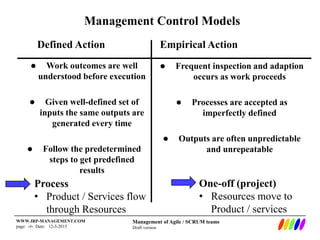
Management Control Models
 Work outcomes are well
understood before execution
 Given well-defined set of
inputs the same outputs are
generated every time
 Follow the predetermined
steps to get predefined
results
 Frequent inspection and adaption
occurs as work proceeds
 Processes are accepted as
imperfectly defined
 Outputs are often unpredictable
and unrepeatable
Defined Action Empirical Action
Process
• Product / Services flow
through Resources
One-off (project)
• Resources move to
Product / services
Management of Agile / SCRUM teams
Draft version
WWW.IRP-MANAGEMENT.COM
page: ‹#› Date: 12-3-2015
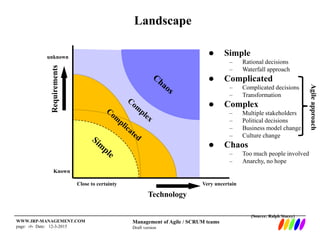
Landscape
Technology
Requirementsunknown
Very uncertainClose to certainty
Known
 Simple
– Rational decisions
– Waterfall approach
 Complicated
– Complicated decisions
– Transformation
 Complex
– Multiple stakeholders
– Political decisions
– Business model change
– Culture change
 Chaos
– Too much people involved
– Anarchy, no hope
(Source: Ralph Stacey)
Agileapproach
Management of Agile / SCRUM teams
Draft version
WWW.IRP-MANAGEMENT.COM
page: ‹#› Date: 12-3-2015
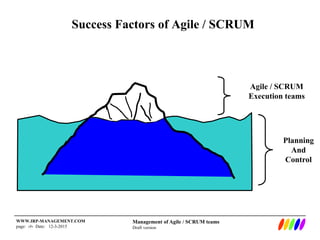
Success Factors of Agile / SCRUM
Agile / SCRUM
Execution teams
Planning
And
Control
Management of Agile / SCRUM teams
Draft version
WWW.IRP-MANAGEMENT.COM
page: ‹#› Date: 12-3-2015
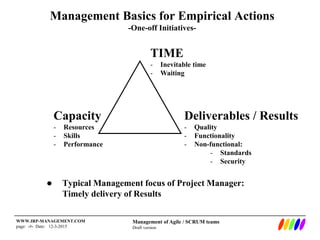
Management Basics for Empirical Actions
-One-off Initiatives-
TIME
- Inevitable time
- Waiting
Deliverables / Results
- Quality
- Functionality
- Non-functional:
- Standards
- Security
Capacity
- Resources
- Skills
- Performance
 Typical Management focus of Project Manager:
Timely delivery of Results
Management of Agile / SCRUM teams
Draft version
WWW.IRP-MANAGEMENT.COM
page: ‹#› Date: 12-3-2015
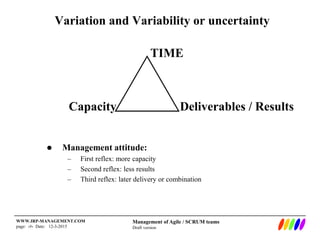
Variation and Variability or uncertainty
TIME
Deliverables / ResultsCapacity
 Management attitude:
– First reflex: more capacity
– Second reflex: less results
– Third reflex: later delivery or combination
Management of Agile / SCRUM teams
Draft version
WWW.IRP-MANAGEMENT.COM
page: ‹#› Date: 12-3-2015
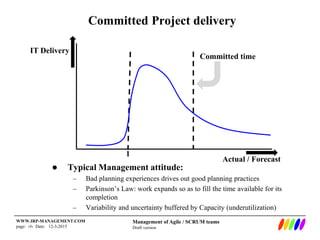
Committed Project delivery
 Typical Management attitude:
– Bad planning experiences drives out good planning practices
– Parkinson’s Law: work expands so as to fill the time available for its
completion
– Variability and uncertainty buffered by Capacity (underutilization)
IT Delivery
Actual / Forecast
1
Committed time
Management of Agile / SCRUM teams
Draft version
WWW.IRP-MANAGEMENT.COM
page: ‹#› Date: 12-3-2015
Management Focus on Project Delivery:
Operational
 IT Management:
– Methodology and Standards
– Project Planning and Control
– Exceptions / Escalations
– Status and Progress Monitoring
– Business Alignment
– IT Resources (skills) allocations
– Costs and Funding
 Business Management:
– Requirements Management
– Business Case / Project Justification
– Commissioning
– Accept Deliverables / Results
Management of Agile / SCRUM teams
Draft version
WWW.IRP-MANAGEMENT.COM
page: ‹#› Date: 12-3-2015
Management Focus on Project Delivery:
Tactical
 IT Management:
– IT Portfolio Management (supply)
– IT Headcount
– …………….
 Business Management:
– IT funding (annual budgets)
– IT Portfolio Management (demand)
– ……………...
Management of Agile / SCRUM teams
Draft version
WWW.IRP-MANAGEMENT.COM
page: ‹#› Date: 12-3-2015
Management Focus on Project Delivery:
Strategic
 IT Management:
– Make or Buy
– Sourcing
– …………….
 Business Management:
– IT Roadmap
– Alignment Strategic Objectives / Business Goals
– Determine Business Value through IT
– ……………...
Management of Agile / SCRUM teams
Draft version
WWW.IRP-MANAGEMENT.COM
page: ‹#› Date: 12-3-2015
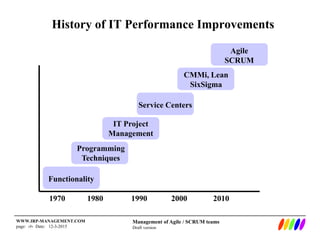
History of IT Performance Improvements
Functionality
Programming
Techniques
IT Project
Management
Service Centers
CMMi, Lean
SixSigma
Agile
SCRUM
1970 1980 1990 2000 2010
Management of Agile / SCRUM teams
Draft version
WWW.IRP-MANAGEMENT.COM
page: ‹#› Date: 12-3-2015
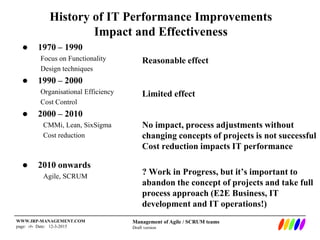
 1970 – 1990
Focus on Functionality
Design techniques
 1990 – 2000
Organisational Efficiency
Cost Control
 2000 – 2010
CMMi, Lean, SixSigma
Cost reduction
 2010 onwards
Agile, SCRUM
History of IT Performance Improvements
Impact and Effectiveness
Reasonable effect
Limited effect
No impact, process adjustments without
changing concepts of projects is not successful
Cost reduction impacts IT performance
? Work in Progress, but it’s important to
abandon the concept of projects and take full
process approach (E2E Business, IT
development and IT operations!)
Management of Agile / SCRUM teams
Draft version
WWW.IRP-MANAGEMENT.COM
page: ‹#› Date: 12-3-2015
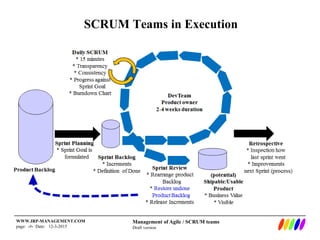
SCRUM Teams in Execution
Management of Agile / SCRUM teams
Draft version
WWW.IRP-MANAGEMENT.COM
page: ‹#› Date: 12-3-2015
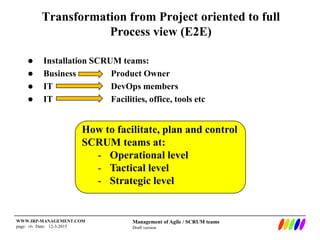
Transformation from Project oriented to full
Process view (E2E)
 Installation SCRUM teams:
 Business Product Owner
 IT DevOps members
 IT Facilities, office, tools etc
How to facilitate, plan and control
SCRUM teams at:
- Operational level
- Tactical level
- Strategic level
Management of Agile / SCRUM teams
Draft version
WWW.IRP-MANAGEMENT.COM
page: ‹#› Date: 12-3-2015
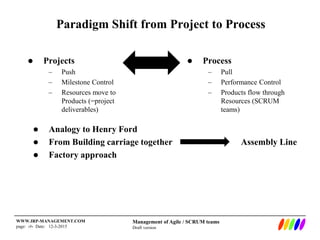
Paradigm Shift from Project to Process
 Projects
– Push
– Milestone Control
– Resources move to
Products (=project
deliverables)
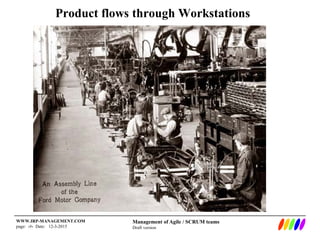
 Analogy to Henry Ford
 From Building carriage together Assembly Line
 Factory approach
 Process
– Pull
– Performance Control
– Products flow through
Resources (SCRUM
teams)
Management of Agile / SCRUM teams
Draft version
WWW.IRP-MANAGEMENT.COM
page: ‹#› Date: 12-3-2015
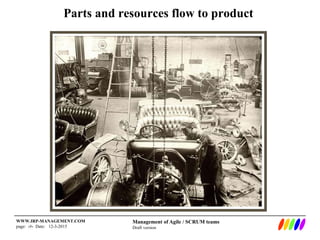
Parts and resources flow to product
Management of Agile / SCRUM teams
Draft version
WWW.IRP-MANAGEMENT.COM
page: ‹#› Date: 12-3-2015
Product flows through Workstations
Management of Agile / SCRUM teams
Draft version
WWW.IRP-MANAGEMENT.COM
page: ‹#› Date: 12-3-2015
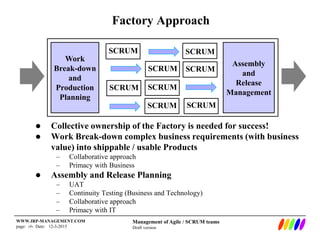
Factory Approach
 Collective ownership of the Factory is needed for success!
 Work Break-down complex business requirements (with business
value) into shippable / usable Products
– Collaborative approach
– Primacy with Business
 Assembly and Release Planning
– UAT
– Continuity Testing (Business and Technology)
– Collaborative approach
– Primacy with IT
Work
Break-down
and
Production
Planning
SCRUM
SCRUM
SCRUM
SCRUMSCRUM
SCRUM
SCRUM
SCRUM
Assembly
and
Release
Management
Management of Agile / SCRUM teams
Draft version
WWW.IRP-MANAGEMENT.COM
page: ‹#› Date: 12-3-2015
Changing IT Management
Factory Approach
 Operational
– Methodology and standards
– IT resource allocations to SCRUM teams
– Cost management of SCRUM teams
– Performance Management (Measure and Analysis)
– Defects and Quality
– Reduce uncertainty and variability
– Collaborate on
 Work Break-down and Production Planning
 Assembly and Release Planning
 Tactical
– Funding and Sizing SCRUM teams
– Process / Performance Improvements
– …………
 Strategic
– Make – Buy
– Sourcing
– ……….
Management of Agile / SCRUM teams
Draft version
WWW.IRP-MANAGEMENT.COM
page: ‹#› Date: 12-3-2015
Changing Business Management
Factory Approach
 Operational
– Business Case / Justification
– Allocate Product Owners
– Business commitment to Product Owners
– Reduce uncertainty and variability
– Collaborate on
 Work Break-down and Production Planning
 Assembly and Release Planning
 Tactical
– Funding IT (annual)
– IT Portfolio Management
– …………
 Strategic
– IT Roadmap
– Alignment to Strategic Objectives and Business Goals
– Determine Business Value through IT
– ……….
Management of Agile / SCRUM teams
Draft version
WWW.IRP-MANAGEMENT.COM
page: ‹#› Date: 12-3-2015
Change Management Obstacles
 IT Organisation
– There is often a culture of fire fighting and ad hoc decisions
– Every delivery is managed as unique result
– IT organisation functionally divided
– Many transfers of responsibilities / work (“don’t blame me” culture)
– ………
 Business Management:
– Limited involvement into IT projects
 Initiation
 Closure
 Acceptance of Results
– Changing requirements during execution
– Culture of Powerplay in the business-IT relationship
– ……….
 As-is situation is not always clear:
– Ownership of non-functional requirements
– Involvement of other (functional) departments
– Relationship to other developments
Management of Agile / SCRUM teams
Draft version
WWW.IRP-MANAGEMENT.COM
page: ‹#› Date: 12-3-2015
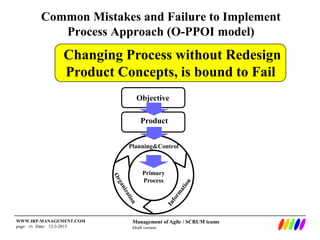
Common Mistakes and Failure to Implement
Process Approach (O-PPOI model)
Changing Process without Redesign
Product Concepts, is bound to Fail
Planning&Control
Primary
Process
Objective
Product
Management of Agile / SCRUM teams
Draft version
WWW.IRP-MANAGEMENT.COM
page: ‹#› Date: 12-3-2015
Process Design starts with clearly
defined Objective(s)
 Reduce time-to-market
 Increase customer satisfaction
 Increase employee satisfaction
 Be transparent
 Reduce costs of producing
 Reduce Overhead costs
 No inventory
 Be flexible
 Less Defects
 Reduce maintenance costs / running costs (Cost of Ownership)
 ………………..
Management of Agile / SCRUM teams
Draft version
WWW.IRP-MANAGEMENT.COM
page: ‹#› Date: 12-3-2015
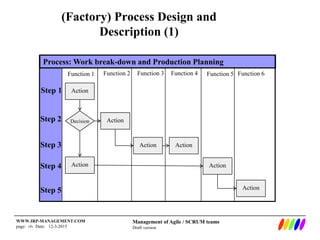
(Factory) Process Design and
Description (1)
Process: Work break-down and Production Planning
Function 1 Function 2 Function 3 Function 4 Function 5 Function 6
Action
Action
Action Action
Action
Action Action
Decision
Step 1
Step 2
Step 3
Step 4
Step 5
Management of Agile / SCRUM teams
Draft version
WWW.IRP-MANAGEMENT.COM
page: ‹#› Date: 12-3-2015
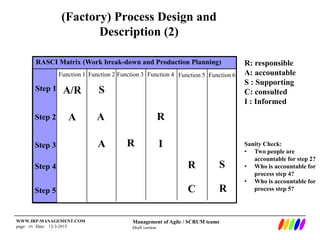
(Factory) Process Design and
Description (2)
RASCI Matrix (Work break-down and Production Planning)
Function 1 Function 2 Function 3 Function 4 Function 5 Function 6
Step 1
Step 2
Step 3
Step 4
Step 5
A/R
R
A
R
A R
IRA
C
S
R: responsible
A: accountable
S : Supporting
C: consulted
I : Informed
S
Sanity Check:
• Two people are
accountable for step 2?
• Who is accountable for
process step 4?
• Who is accountable for
process step 5?
Management of Agile / SCRUM teams
Draft version
WWW.IRP-MANAGEMENT.COM
page: ‹#› Date: 12-3-2015
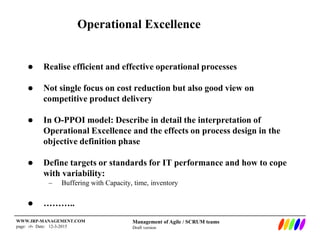
Operational Excellence
 Realise efficient and effective operational processes
 Not single focus on cost reduction but also good view on
competitive product delivery
 In O-PPOI model: Describe in detail the interpretation of
Operational Excellence and the effects on process design in the
objective definition phase
 Define targets or standards for IT performance and how to cope
with variability:
– Buffering with Capacity, time, inventory
 ………..
Management of Agile / SCRUM teams
Draft version
WWW.IRP-MANAGEMENT.COM
page: ‹#› Date: 12-3-2015
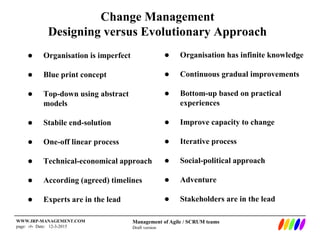
Change Management
Designing versus Evolutionary Approach
 Organisation is imperfect
 Blue print concept
 Top-down using abstract
models
 Stabile end-solution
 One-off linear process
 Technical-economical approach
 According (agreed) timelines
 Experts are in the lead
 Organisation has infinite knowledge
 Continuous gradual improvements
 Bottom-up based on practical
experiences
 Improve capacity to change
 Iterative process
 Social-political approach
 Adventure
 Stakeholders are in the lead
Management of Agile / SCRUM teams
Draft version
WWW.IRP-MANAGEMENT.COM
page: ‹#› Date: 12-3-2015
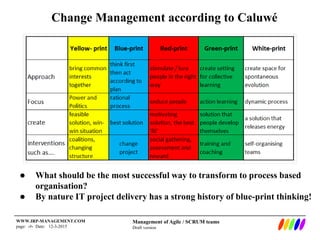
Change Management according to Caluwé
 What should be the most successful way to transform to process based
organisation?
 By nature IT project delivery has a strong history of blue-print thinking!

AgileImplementation10122014V1

  • 1.
    Management of Agile/ SCRUM teams Draft version WWW.IRP-MANAGEMENT.COM page: 1 Date: 3/12/2015 Implementation of Management Control Agile / SCRUM teams-version 0.1- Hans Oosterling December 2014 Version 0.1 12-Mar-15
  • 2.
    Management of Agile/ SCRUM teams Draft version WWW.IRP-MANAGEMENT.COM page: ‹#› Date: 12-3-2015 Management Control Models  Work outcomes are well understood before execution  Given well-defined set of inputs the same outputs are generated every time  Follow the predetermined steps to get predefined results  Frequent inspection and adaption occurs as work proceeds  Processes are accepted as imperfectly defined  Outputs are often unpredictable and unrepeatable Defined Action Empirical Action Process • Product / Services flow through Resources One-off (project) • Resources move to Product / services
  • 3.
    Management of Agile/ SCRUM teams Draft version WWW.IRP-MANAGEMENT.COM page: ‹#› Date: 12-3-2015 Landscape Technology Requirementsunknown Very uncertainClose to certainty Known  Simple – Rational decisions – Waterfall approach  Complicated – Complicated decisions – Transformation  Complex – Multiple stakeholders – Political decisions – Business model change – Culture change  Chaos – Too much people involved – Anarchy, no hope (Source: Ralph Stacey) Agileapproach
  • 4.
    Management of Agile/ SCRUM teams Draft version WWW.IRP-MANAGEMENT.COM page: ‹#› Date: 12-3-2015 Success Factors of Agile / SCRUM Agile / SCRUM Execution teams Planning And Control
  • 5.
    Management of Agile/ SCRUM teams Draft version WWW.IRP-MANAGEMENT.COM page: ‹#› Date: 12-3-2015 Management Basics for Empirical Actions -One-off Initiatives- TIME - Inevitable time - Waiting Deliverables / Results - Quality - Functionality - Non-functional: - Standards - Security Capacity - Resources - Skills - Performance  Typical Management focus of Project Manager: Timely delivery of Results
  • 6.
    Management of Agile/ SCRUM teams Draft version WWW.IRP-MANAGEMENT.COM page: ‹#› Date: 12-3-2015 Variation and Variability or uncertainty TIME Deliverables / ResultsCapacity  Management attitude: – First reflex: more capacity – Second reflex: less results – Third reflex: later delivery or combination
  • 7.
    Management of Agile/ SCRUM teams Draft version WWW.IRP-MANAGEMENT.COM page: ‹#› Date: 12-3-2015 Committed Project delivery  Typical Management attitude: – Bad planning experiences drives out good planning practices – Parkinson’s Law: work expands so as to fill the time available for its completion – Variability and uncertainty buffered by Capacity (underutilization) IT Delivery Actual / Forecast 1 Committed time
  • 8.
    Management of Agile/ SCRUM teams Draft version WWW.IRP-MANAGEMENT.COM page: ‹#› Date: 12-3-2015 Management Focus on Project Delivery: Operational  IT Management: – Methodology and Standards – Project Planning and Control – Exceptions / Escalations – Status and Progress Monitoring – Business Alignment – IT Resources (skills) allocations – Costs and Funding  Business Management: – Requirements Management – Business Case / Project Justification – Commissioning – Accept Deliverables / Results
  • 9.
    Management of Agile/ SCRUM teams Draft version WWW.IRP-MANAGEMENT.COM page: ‹#› Date: 12-3-2015 Management Focus on Project Delivery: Tactical  IT Management: – IT Portfolio Management (supply) – IT Headcount – …………….  Business Management: – IT funding (annual budgets) – IT Portfolio Management (demand) – ……………...
  • 10.
    Management of Agile/ SCRUM teams Draft version WWW.IRP-MANAGEMENT.COM page: ‹#› Date: 12-3-2015 Management Focus on Project Delivery: Strategic  IT Management: – Make or Buy – Sourcing – …………….  Business Management: – IT Roadmap – Alignment Strategic Objectives / Business Goals – Determine Business Value through IT – ……………...
  • 11.
    Management of Agile/ SCRUM teams Draft version WWW.IRP-MANAGEMENT.COM page: ‹#› Date: 12-3-2015 History of IT Performance Improvements Functionality Programming Techniques IT Project Management Service Centers CMMi, Lean SixSigma Agile SCRUM 1970 1980 1990 2000 2010
  • 12.
    Management of Agile/ SCRUM teams Draft version WWW.IRP-MANAGEMENT.COM page: ‹#› Date: 12-3-2015  1970 – 1990 Focus on Functionality Design techniques  1990 – 2000 Organisational Efficiency Cost Control  2000 – 2010 CMMi, Lean, SixSigma Cost reduction  2010 onwards Agile, SCRUM History of IT Performance Improvements Impact and Effectiveness Reasonable effect Limited effect No impact, process adjustments without changing concepts of projects is not successful Cost reduction impacts IT performance ? Work in Progress, but it’s important to abandon the concept of projects and take full process approach (E2E Business, IT development and IT operations!)
  • 13.
    Management of Agile/ SCRUM teams Draft version WWW.IRP-MANAGEMENT.COM page: ‹#› Date: 12-3-2015 SCRUM Teams in Execution
  • 14.
    Management of Agile/ SCRUM teams Draft version WWW.IRP-MANAGEMENT.COM page: ‹#› Date: 12-3-2015 Transformation from Project oriented to full Process view (E2E)  Installation SCRUM teams:  Business Product Owner  IT DevOps members  IT Facilities, office, tools etc How to facilitate, plan and control SCRUM teams at: - Operational level - Tactical level - Strategic level
  • 15.
    Management of Agile/ SCRUM teams Draft version WWW.IRP-MANAGEMENT.COM page: ‹#› Date: 12-3-2015 Paradigm Shift from Project to Process  Projects – Push – Milestone Control – Resources move to Products (=project deliverables)  Analogy to Henry Ford  From Building carriage together Assembly Line  Factory approach  Process – Pull – Performance Control – Products flow through Resources (SCRUM teams)
  • 16.
    Management of Agile/ SCRUM teams Draft version WWW.IRP-MANAGEMENT.COM page: ‹#› Date: 12-3-2015 Parts and resources flow to product
  • 17.
    Management of Agile/ SCRUM teams Draft version WWW.IRP-MANAGEMENT.COM page: ‹#› Date: 12-3-2015 Product flows through Workstations
  • 18.
    Management of Agile/ SCRUM teams Draft version WWW.IRP-MANAGEMENT.COM page: ‹#› Date: 12-3-2015 Factory Approach  Collective ownership of the Factory is needed for success!  Work Break-down complex business requirements (with business value) into shippable / usable Products – Collaborative approach – Primacy with Business  Assembly and Release Planning – UAT – Continuity Testing (Business and Technology) – Collaborative approach – Primacy with IT Work Break-down and Production Planning SCRUM SCRUM SCRUM SCRUMSCRUM SCRUM SCRUM SCRUM Assembly and Release Management
  • 19.
    Management of Agile/ SCRUM teams Draft version WWW.IRP-MANAGEMENT.COM page: ‹#› Date: 12-3-2015 Changing IT Management Factory Approach  Operational – Methodology and standards – IT resource allocations to SCRUM teams – Cost management of SCRUM teams – Performance Management (Measure and Analysis) – Defects and Quality – Reduce uncertainty and variability – Collaborate on  Work Break-down and Production Planning  Assembly and Release Planning  Tactical – Funding and Sizing SCRUM teams – Process / Performance Improvements – …………  Strategic – Make – Buy – Sourcing – ……….
  • 20.
    Management of Agile/ SCRUM teams Draft version WWW.IRP-MANAGEMENT.COM page: ‹#› Date: 12-3-2015 Changing Business Management Factory Approach  Operational – Business Case / Justification – Allocate Product Owners – Business commitment to Product Owners – Reduce uncertainty and variability – Collaborate on  Work Break-down and Production Planning  Assembly and Release Planning  Tactical – Funding IT (annual) – IT Portfolio Management – …………  Strategic – IT Roadmap – Alignment to Strategic Objectives and Business Goals – Determine Business Value through IT – ……….
  • 21.
    Management of Agile/ SCRUM teams Draft version WWW.IRP-MANAGEMENT.COM page: ‹#› Date: 12-3-2015 Change Management Obstacles  IT Organisation – There is often a culture of fire fighting and ad hoc decisions – Every delivery is managed as unique result – IT organisation functionally divided – Many transfers of responsibilities / work (“don’t blame me” culture) – ………  Business Management: – Limited involvement into IT projects  Initiation  Closure  Acceptance of Results – Changing requirements during execution – Culture of Powerplay in the business-IT relationship – ……….  As-is situation is not always clear: – Ownership of non-functional requirements – Involvement of other (functional) departments – Relationship to other developments
  • 22.
    Management of Agile/ SCRUM teams Draft version WWW.IRP-MANAGEMENT.COM page: ‹#› Date: 12-3-2015 Common Mistakes and Failure to Implement Process Approach (O-PPOI model) Changing Process without Redesign Product Concepts, is bound to Fail Planning&Control Primary Process Objective Product
  • 23.
    Management of Agile/ SCRUM teams Draft version WWW.IRP-MANAGEMENT.COM page: ‹#› Date: 12-3-2015 Process Design starts with clearly defined Objective(s)  Reduce time-to-market  Increase customer satisfaction  Increase employee satisfaction  Be transparent  Reduce costs of producing  Reduce Overhead costs  No inventory  Be flexible  Less Defects  Reduce maintenance costs / running costs (Cost of Ownership)  ………………..
  • 24.
    Management of Agile/ SCRUM teams Draft version WWW.IRP-MANAGEMENT.COM page: ‹#› Date: 12-3-2015 (Factory) Process Design and Description (1) Process: Work break-down and Production Planning Function 1 Function 2 Function 3 Function 4 Function 5 Function 6 Action Action Action Action Action Action Action Decision Step 1 Step 2 Step 3 Step 4 Step 5
  • 25.
    Management of Agile/ SCRUM teams Draft version WWW.IRP-MANAGEMENT.COM page: ‹#› Date: 12-3-2015 (Factory) Process Design and Description (2) RASCI Matrix (Work break-down and Production Planning) Function 1 Function 2 Function 3 Function 4 Function 5 Function 6 Step 1 Step 2 Step 3 Step 4 Step 5 A/R R A R A R IRA C S R: responsible A: accountable S : Supporting C: consulted I : Informed S Sanity Check: • Two people are accountable for step 2? • Who is accountable for process step 4? • Who is accountable for process step 5?
  • 26.
    Management of Agile/ SCRUM teams Draft version WWW.IRP-MANAGEMENT.COM page: ‹#› Date: 12-3-2015 Operational Excellence  Realise efficient and effective operational processes  Not single focus on cost reduction but also good view on competitive product delivery  In O-PPOI model: Describe in detail the interpretation of Operational Excellence and the effects on process design in the objective definition phase  Define targets or standards for IT performance and how to cope with variability: – Buffering with Capacity, time, inventory  ………..
  • 27.
    Management of Agile/ SCRUM teams Draft version WWW.IRP-MANAGEMENT.COM page: ‹#› Date: 12-3-2015 Change Management Designing versus Evolutionary Approach  Organisation is imperfect  Blue print concept  Top-down using abstract models  Stabile end-solution  One-off linear process  Technical-economical approach  According (agreed) timelines  Experts are in the lead  Organisation has infinite knowledge  Continuous gradual improvements  Bottom-up based on practical experiences  Improve capacity to change  Iterative process  Social-political approach  Adventure  Stakeholders are in the lead
  • 28.
    Management of Agile/ SCRUM teams Draft version WWW.IRP-MANAGEMENT.COM page: ‹#› Date: 12-3-2015 Change Management according to Caluwé  What should be the most successful way to transform to process based organisation?  By nature IT project delivery has a strong history of blue-print thinking!