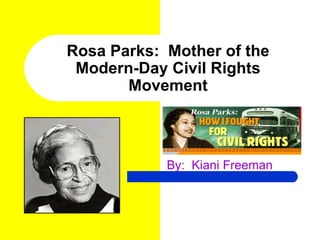
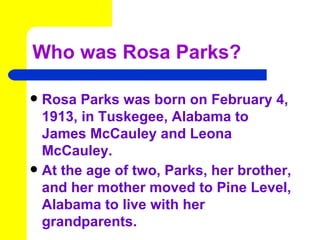
Rosa Parks: Mother of the
 Modern-Day Civil Rights
       Movement


            By: Kiani Freeman
Who was Rosa Parks?

 Rosa Parks was born on February 4,
  1913, in Tuskegee, Alabama to
  James McCauley and Leona
  McCauley.
 At the age of two, Parks, her brother,
  and her mother moved to Pine Level,
  Alabama to live with her
  grandparents.
Who was Rosa Parks?

 At the age of eleven, she began
  attending the Montgomery Industrial
  School for Girls, which was founded
  by women from the northern United
  States.
 She then went on to the Alabama
  State Teachers College.
More about Rosa Parks

   Upon completing Teaching College, she moved
    with her husband, civil rights activist Raymond
    Parks, to Montgomery.
   Parks and her husband joined the local chapter
    of the NAACP. She acted as the secretary from
    1943 to 1956. She also worked to help improve
    conditions for African Americans.
   (NAACP) = National Association for the Advancement of
                   Colored People
What Rosa did to take a stand

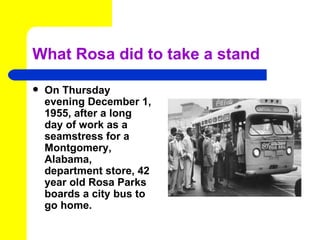
   On Thursday
    evening December 1,
    1955, after a long
    day of work as a
    seamstress for a
    Montgomery,
    Alabama,
    department store, 42
    year old Rosa Parks
    boards a city bus to
    go home.
What Rosa did to take a stand

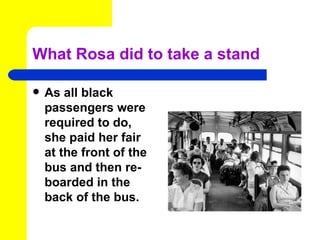
   As all black
    passengers were
    required to do,
    she paid her fair
    at the front of the
    bus and then re-
    boarded in the
    back of the bus.
What Rosa did to take a stand

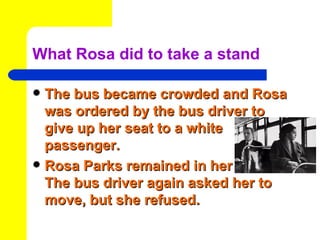
 The bus became crowded and Rosa
  was ordered by the bus driver to
  give up her seat to a white
  passenger.
 Rosa Parks remained in her seat.
  The bus driver again asked her to
  move, but she refused.
Mrs. Parks’ arrest and the Montgomery
Bus Boycott

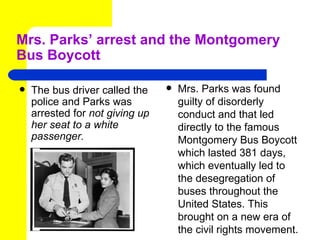
   The bus driver called the       Mrs. Parks was found
    police and Parks was             guilty of disorderly
    arrested for not giving up       conduct and that led
    her seat to a white              directly to the famous
    passenger.                       Montgomery Bus Boycott
                                     which lasted 381 days,
                                     which eventually led to
                                     the desegregation of
                                     buses throughout the
                                     United States. This
                                     brought on a new era of
                                     the civil rights movement.
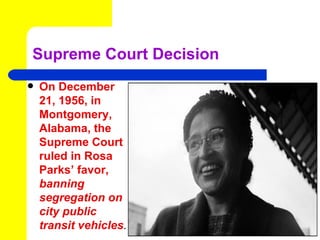
Supreme Court Decision
   On December
    21, 1956, in
    Montgomery,
    Alabama, the
    Supreme Court
    ruled in Rosa
    Parks’ favor,
    banning
    segregation on
    city public
    transit vehicles.
Parks accomplishments
   Parks worked as a receptionist and office
    assistant for United States Representative,
    John Conyers of Michigan from 1965 to 1988.
   In 1979, Parks won the Spingarn Medal for
    her civil rights work.
   Medal of Freedom Award, presented by
    President Clinton in 1996
   In 1999, she was awarded the Congressional
    Gold Medal of Honor, the highest honor a
    civilian can receive in the United States.

Kiani's rosa parks

  • 1.
    Rosa Parks: Motherof the Modern-Day Civil Rights Movement By: Kiani Freeman
  • 2.
    Who was RosaParks?  Rosa Parks was born on February 4, 1913, in Tuskegee, Alabama to James McCauley and Leona McCauley.  At the age of two, Parks, her brother, and her mother moved to Pine Level, Alabama to live with her grandparents.
  • 3.
    Who was RosaParks?  At the age of eleven, she began attending the Montgomery Industrial School for Girls, which was founded by women from the northern United States.  She then went on to the Alabama State Teachers College.
  • 4.
    More about RosaParks  Upon completing Teaching College, she moved with her husband, civil rights activist Raymond Parks, to Montgomery.  Parks and her husband joined the local chapter of the NAACP. She acted as the secretary from 1943 to 1956. She also worked to help improve conditions for African Americans.  (NAACP) = National Association for the Advancement of Colored People
  • 5.
    What Rosa didto take a stand  On Thursday evening December 1, 1955, after a long day of work as a seamstress for a Montgomery, Alabama, department store, 42 year old Rosa Parks boards a city bus to go home.
  • 6.
    What Rosa didto take a stand  As all black passengers were required to do, she paid her fair at the front of the bus and then re- boarded in the back of the bus.
  • 7.
    What Rosa didto take a stand  The bus became crowded and Rosa was ordered by the bus driver to give up her seat to a white passenger.  Rosa Parks remained in her seat. The bus driver again asked her to move, but she refused.
  • 8.
    Mrs. Parks’ arrestand the Montgomery Bus Boycott  The bus driver called the  Mrs. Parks was found police and Parks was guilty of disorderly arrested for not giving up conduct and that led her seat to a white directly to the famous passenger. Montgomery Bus Boycott which lasted 381 days, which eventually led to the desegregation of buses throughout the United States. This brought on a new era of the civil rights movement.
  • 9.
    Supreme Court Decision  On December 21, 1956, in Montgomery, Alabama, the Supreme Court ruled in Rosa Parks’ favor, banning segregation on city public transit vehicles.
  • 10.
    Parks accomplishments  Parks worked as a receptionist and office assistant for United States Representative, John Conyers of Michigan from 1965 to 1988.  In 1979, Parks won the Spingarn Medal for her civil rights work.  Medal of Freedom Award, presented by President Clinton in 1996  In 1999, she was awarded the Congressional Gold Medal of Honor, the highest honor a civilian can receive in the United States.