Keys to extract value from the data
analytics life cycle
The role of data analytics in business
Across industries, the applied use of data to inform
business decisions has become a foundational, if not
critical, element of business. In financial services, capital
itself is effectively deployed to banking activities —
from lending to product and service design, through the
optimization provided by institutionalized data
analytics. Mathematical models that forecast customer
profitability, segmentation models that simulate credit
losses driving regulatory capital, scorecards that assist in
credit originations, models that simulate balance sheet
impacts resulting from risk factor changes, and scenario
-based models (2) that project potential impacts from
broader operational or environmental risks (1) are now
commonplace. More and more, predictive analytics that
take forms such as key performance indicators (KPIs)
and key risk indicators (KRIs) have become the norm.
Certain global institutions are pioneering applications of
analytics to automate the cognitive processing of text-
based audit reports while increasing consistency over
human capacity (4). Others are exploring causal
relationships between the risk event, audit and indicator
data to reveal predictive insights. Analytics can be a
formidable, competitive advantage in any function,
whether used to reveal insights into revenue generation,
day-to-day operations or risk management. Leading
institutions are using data analytics at the enterprise
level to increase effectiveness of decision-making,
which can yield significant financial returns. It is
worthwhile noting that a new economy exemplified by
entire enterprises that rely on data, rather than tangible
assets to drive revenue such as Uber, Google,
Facebook, and Fintech, is on the rise. In financial
services, regulatory mandates driving transparency and
financial objectives requiring accurate understanding of
customer needs have heightened the importance of data
analytics to unprecedented levels
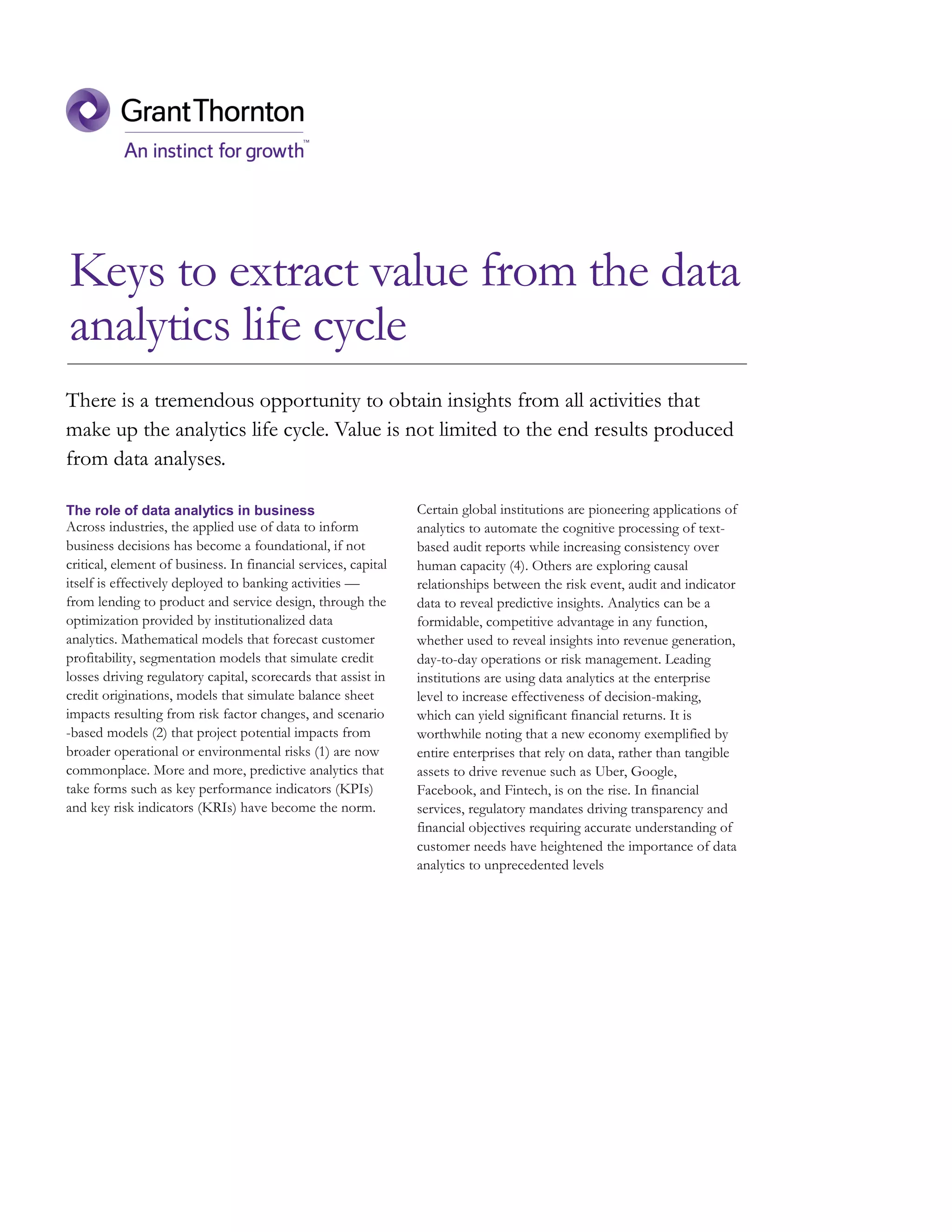
There is a tremendous opportunity to obtain insights from all activities that
make up the analytics life cycle. Value is not limited to the end results produced
from data analyses.
Keys to extract value from the data analytics life cycle
Performing data analyses
The purpose of any analysis is to simplify and derive
understanding from some event that has been
characterized through data. By deploying analytics, we
aspire to translate observed phenomena into metrics we
can understand and react to and then make
informed decisions.
There is, however, an element of human bias that we
inherently introduce. From this basic purpose, many
different characterizations or objectives are typically
pursued. These include but are not limited to (1)
collapsing multiple dimensions into one — such as a
scorecard or KRI, (2) introducing structure to enable
understanding of a complex situation, (3) identifying
causal drivers and types of outcomes, (4) seeking to
identify control levers, (5) quantifying extreme values
and limits, and (6) developing predictive and
actionable insights.
Scorecards collapse multiple data inputs and reduce an
analysis to one dimension. In credit scoring, for
example, an applicant’s credit attributes that could
include income, debt load, past history of repayment
and type of debt are combined to derive a single score
from which one can easily set approval-escalating
thresholds (5). Complex situations, such as the need to
understand purchasing behavior, are simplified by the
use of clustering — a technique used to define clusters
or groupings of customers who exhibit like behaviors.
Without this simplification, it would be very difficult or
impossible to discern the behavior of one customer
over the other based on tens if not hundreds of
customer attributes.
One basic activity of data analysis is establishing cause-
effect relationships between data. In fraud management,
financial transaction patterns are used to determine
potential for future fraud. In credit collections, data
analytics is applied to determine contact frequency and
defined procedures to optimize repayments. In effect,
analytics unveils control points from which financial
institutions can deploy resources or technology more
efficiently. In the current regulatory environment, banks
are employing scenario-based stress testing (6) to
quantify capital requirements given “severely adverse”
macroeconomic conditions (a type of extreme value
analysis). Many financial institutions are now exploring
“big data” as a way to reveal valuable and predictive
insights about customers, operations, and products
and services.
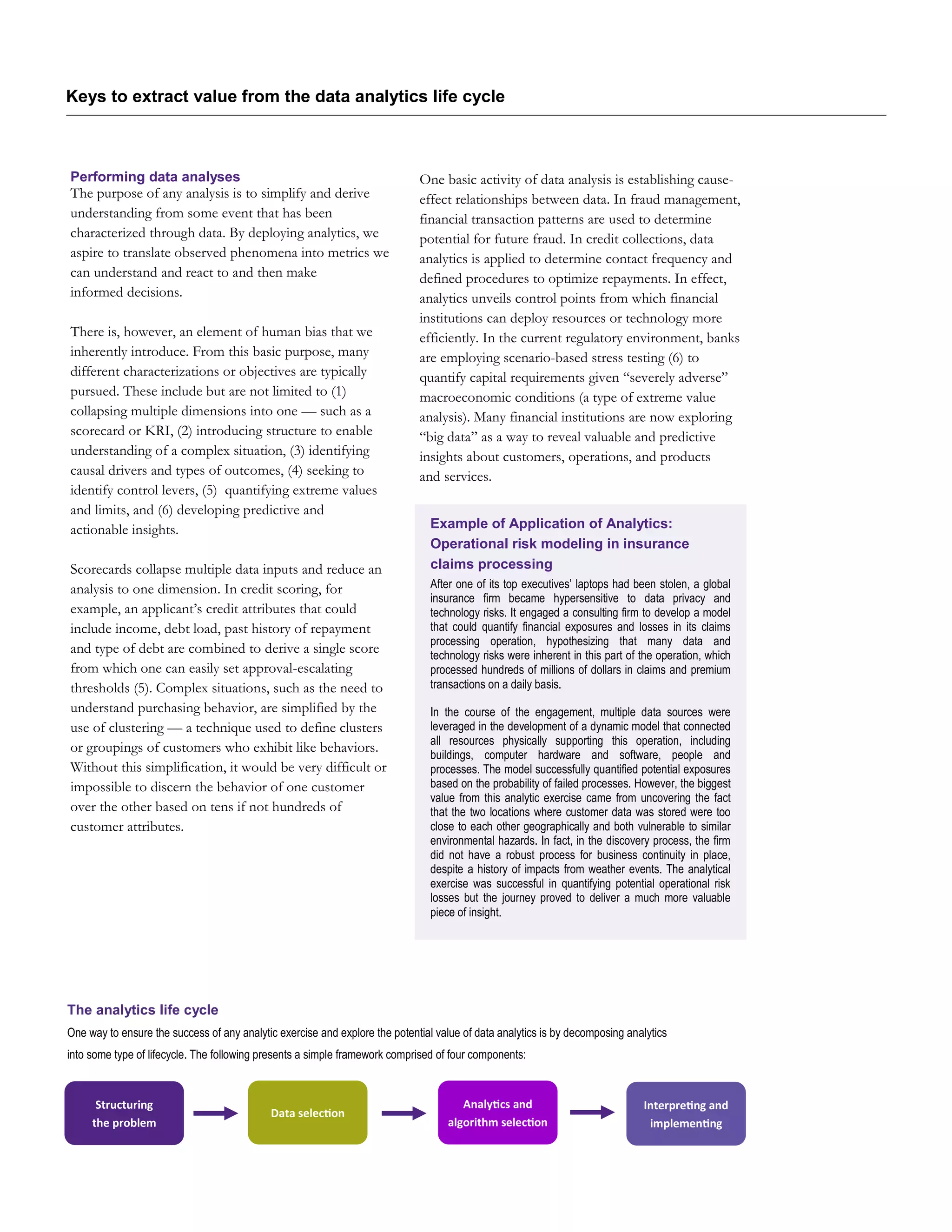
The analytics life cycle
One way to ensure the success of any analytic exercise and explore the potential value of data analytics is by decomposing analytics
into some type of lifecycle. The following presents a simple framework comprised of four components:
Structuring
the problem
Data selection
Analytics and
algorithm selection
Interpreting and
implementing
Example of Application of Analytics:
Operational risk modeling in insurance
claims processing
After one of its top executives’ laptops had been stolen, a global
insurance firm became hypersensitive to data privacy and
technology risks. It engaged a consulting firm to develop a model
that could quantify financial exposures and losses in its claims
processing operation, hypothesizing that many data and
technology risks were inherent in this part of the operation, which
processed hundreds of millions of dollars in claims and premium
transactions on a daily basis.
In the course of the engagement, multiple data sources were
leveraged in the development of a dynamic model that connected
all resources physically supporting this operation, including
buildings, computer hardware and software, people and
processes. The model successfully quantified potential exposures
based on the probability of failed processes. However, the biggest
value from this analytic exercise came from uncovering the fact
that the two locations where customer data was stored were too
close to each other geographically and both vulnerable to similar
environmental hazards. In fact, in the discovery process, the firm
did not have a robust process for business continuity in place,
despite a history of impacts from weather events. The analytical
exercise was successful in quantifying potential operational risk
losses but the journey proved to deliver a much more valuable
piece of insight.
Keys to extract value from the data analytics life cycle
Structuring the problem
Proper structuring or framing of the business challenge
is critical to achieving business-relevant and actionable
outcomes. A key consideration in this is defining the
unit of measure. In financial risk management analyses,
there is often the need to translate risk exposures or
impacts into a unit of measure that has some relevance
and suggests economic value in terms of dollars.
The nature of the decision to be supported by analytics
also needs to be considered. Take, for example, an
analysis intended to predict the likelihood of an
operational risk event occurring. A model could be
structured to produce a “yes” or “no” answer — each
with a certain probability. Alternatively, the problem
could be structured to produce a single probability,
which would be a more fitting structure. Oftentimes, in
the absence of historical data or experience, it is
difficult to place a dollar value on the potential impact
of an event. The problem is then usually structured to
produce a categorical output with a vague definition,
such as a high, medium, and low impact, which would
subsequently be difficult to develop
implementable actions.
Sometimes, analytics requires inputs via scenarios — as
is the case with regulatory stress testing. Organizations
need to define business-relevant macroeconomic
scenarios that will drive portfolio analyses. In
structuring these scenarios, it is important that key
stakeholders’ buy-in is obtained upfront. Ultimately, any
decision-making will depend on the trust stakeholders
have in the scenarios driving the analytics performed.
Data selection
Data deserves special attention when it comes to
deploying analytics. A critical analysis and examination
of the data itself needs to be considered. All too often,
data analyses make a number of presumptions about
the data being used, which can introduce a number of
biases and expensive mistakes. Selecting data that is
used in an analysis, proper filtering of irrelevant data,
ensuring high data integrity, and data element definition
are core in any analytics process.
For example, regulatory capital required for operational
risks mandate appropriate modeling of the tail in loss
frequency distributions. Practitioners in the field
recognize that to produce such accuracy would require
institutions to gather about 100 years’ worth of data,
just to get statistically sufficient data points. However,
one could then challenge the relevance of a data point
that is 60, 40, even 20 years old to a current analysis (3).
So lots of data or long histories don’t necessarily
translate into usable data for analytical purposes.
The characterization of data going into a model
presents interesting analytical opportunities. Often
missing values in data elements, which are typically seen
as challenges, could be structured as an opportunity to
“exercise” the model for extreme potential values. This
technique could introduce a type of synthetic
robustness in a model, which might otherwise be
limited by data sufficiency. In statistics, this could be a
bootstrapping-type technique to help smoothen holes in
data sets, rather than drive to a homogenization of data.
Finally, intuition should be exercised in selecting and
excluding certain data. In our experience, it is a healthy
component equal to any set of assumptions that
typically accompany any analysis. Wise analytics teams
also find business value along the way in the modeling
journey. Missing data becomes the opportunity to
deploy human intuition through scenario approaches.
Furthermore, sensitivity analyses may yield optimal
conclusions as well.
Analytics and algorithm selection
The analytic framework, approach or algorithm is really
the “lens through which the analyst chooses to view the
problem.” The analyst has a range of “funnels” through
which data will be processed. It is, therefore, imperative
that the analyst has an appreciation for a broad array of
options and select the most appropriate one for the
problem being analyzed. The analyst should also be
cognizant of the benefits and limitations of each
method and that problems are structured to produce
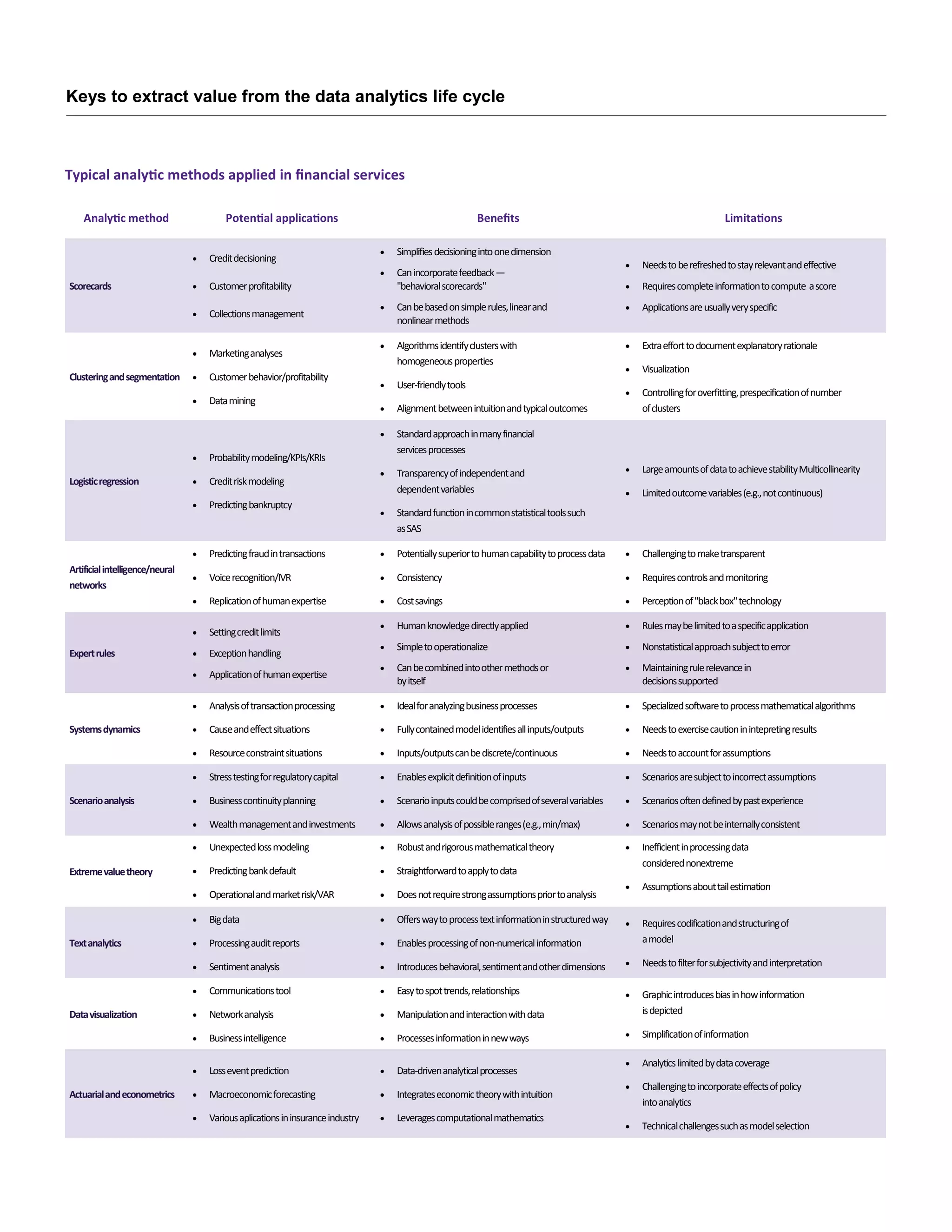
understandable solutions and results. The following
figure presents a selection of analytical approaches, as
well as their potential applications, benefits
and limitations.
Keys to extract value from the data analytics life cycle
Analytic method Potential applications Benefits Limitations
Scorecards
 Creditdecisioning
 Customerprofitability
 Collectionsmanagement
 Simplifiesdecisioningintoonedimension
 Canincorporatefeedback—
"behavioralscorecards"
 Canbebasedonsimplerules,linearand
nonlinearmethods
 Needstoberefreshedtostayrelevantandeffective
 Requirescompleteinformationtocompute ascore
 Applicationsareusuallyveryspecific
Clusteringandsegmentation
 Marketinganalyses
 Customerbehavior/profitability
 Datamining
 Algorithmsidentifyclusterswith
homogeneousproperties
 User-friendlytools
 Alignmentbetweenintuitionandtypicaloutcomes
 Extraefforttodocumentexplanatoryrationale
 Visualization
 Controllingforoverfitting,prespecificationofnumber
ofclusters
Logisticregression
 Probabilitymodeling/KPIs/KRIs
 Creditriskmodeling
 Predictingbankruptcy
 Standardapproachinmanyfinancial
servicesprocesses
 Transparencyofindependentand
dependentvariables
 Standardfunctionincommonstatisticaltoolssuch
asSAS
 LargeamountsofdatatoachievestabilityMulticollinearity
 Limitedoutcomevariables(e.g.,notcontinuous)
Artificialintelligence/neural
networks
 Predictingfraudintransactions
 Voicerecognition/IVR
 Replicationofhumanexpertise
 Potentiallysuperiortohumancapabilitytoprocessdata
 Consistency
 Costsavings
 Challengingtomaketransparent
 Requirescontrolsandmonitoring
 Perceptionof"blackbox"technology
Expertrules
 Settingcreditlimits
 Exceptionhandling
 Applicationofhumanexpertise
 Humanknowledgedirectlyapplied
 Simpletooperationalize
 Canbecombinedintoothermethodsor
byitself
 Rulesmaybelimitedtoaspecificapplication
 Nonstatisticalapproachsubjecttoerror
 Maintainingrulerelevancein
decisionssupported
Systemsdynamics
 Analysisoftransactionprocessing
 Causeandeffectsituations
 Resourceconstraintsituations
 Idealforanalyzingbusinessprocesses
 Fullycontainedmodelidentifiesallinputs/outputs
 Inputs/outputscanbediscrete/continuous
 Specializedsoftwaretoprocessmathematicalalgorithms
 Needstoexercisecautioninintepretingresults
 Needstoaccountforassumptions
Scenarioanalysis
 Stresstestingforregulatorycapital
 Businesscontinuityplanning
 Wealthmanagementandinvestments
 Enablesexplicitdefinitionofinputs
 Scenarioinputscouldbecomprisedofseveralvariables
 Allowsanalysisofpossibleranges(e.g.,min/max)
 Scenariosaresubjecttoincorrectassumptions
 Scenariosoftendefinedbypastexperience
 Scenariosmaynotbeinternallyconsistent
Extremevaluetheory
 Unexpectedlossmodeling
 Predictingbankdefault
 Operationalandmarketrisk/VAR
 Robustandrigorousmathematicaltheory
 Straightforwardtoapplytodata
 Doesnotrequirestrongassumptionspriortoanalysis
 Inefficientinprocessingdata
considerednonextreme
 Assumptionsabouttailestimation
Textanalytics
 Bigdata
 Processingauditreports
 Sentimentanalysis
 Offerswaytoprocesstextinformationinstructuredway
 Enablesprocessingofnon-numericalinformation
 Introducesbehavioral,sentimentandotherdimensions
 Requirescodificationandstructuringof
amodel
 Needstofilterforsubjectivityandinterpretation
Datavisualization
 Communicationstool
 Networkanalysis
 Businessintelligence
 Easytospottrends,relationships
 Manipulationandinteractionwithdata
 Processesinformationinnewways
 Graphicintroducesbiasinhowinformation
isdepicted
 Simplificationofinformation
Actuarialandeconometrics
 Losseventprediction
 Macroeconomicforecasting
 Variousaplicationsininsuranceindustry
 Data-drivenanalyticalprocesses
 Integrateseconomictheorywithintuition
 Leveragescomputationalmathematics
 Analyticslimitedbydatacoverage
 Challengingtoincorporateeffectsofpolicy
intoanalytics
 Technicalchallengessuchasmodelselection
Typical analytic methods applied in financial services
Keys to extract value from the data analytics life cycle
Interpreting and implementing results
Finally, the interpretation and implementation of the
results of an analysis or model are equally if not more
important than the analysis itself. This implies that the
results are properly translated into a business applica-
tion, and any analytical or limitation of model outputs
are recognized in the decision-making process. Any
analytics soundness assessment requires validation tech-
niques such as: (1) reviewing assumptions, (2) cross-
checking outputs, (3) ensuring appropriate implementa-
tion, and (4) ensuring analytic is timely monitored and
calibrated. This final stage in the life cycle of an analysis
is about aligning the analytic to the business problem.
Assumptions should be revisited to ensure that they
don’t disproportionately impact results in an unreasona-
ble manner. Where possible, results should be cross-
checked to ensure consistency. An analysis of severe
scenarios should exhibit the same type of trend in the
outputs. Implementation of the analytical solutions
should also be carefully operationalized, and staff
should be fully trained to execute decisions. Finally,
analytics should include defined provisions to be re-
freshed so that its application remains relevant and
under an acceptable operational risk appetite.
Interpreting and implementing results
Data analytics present a formidable tool for uncovering
business insights and optimizing decision-making in
financial services. There is an abundance of methods
and tools that can be utilized to process and exploit
data to provide insightful value in the decision-making
process. Going through systematic processes involved
in data analyses and modeling can provide valuable
insights as resulting outcomes. Analytical expertise,
along with an experienced-practitioner intuition, are
very valuable, both when supporting business decisions
derived from analytics outcomes and when managing
the inherent data and methodological limitations. An
effective internal control framework is essential in
providing reliability to any analytical construct.
Special notes
The authors of this article present insights gained from
extensive experience in the financial services sector
over the past two decades, particularly as the availability
of data, the emergence of analytics applied to financial
services functions, and the capacity of computing facili-
ties have created synergies in bringing these elements
together. The authors have brought forth unique ele-
ments of analytics as applied across a broader spectrum
of industries and functional decisioning applications
that include, but are not limited to: (1) banking: retail
credit decisioning; (2) public services: transportation
planning and modeling; (3) business continuity: pan-
demic business impact analytics; (4) supply chain: sys-
tems dynamics modeling and value-at-risk; (5) artificial
intelligence: neural networks; (6) marketing: cluster
analysis and direct-mail solicitations; (7) financial ser-
vices: loss forecasting and stress testing; and 8) aero-
space: thermo-structural analysis of space vehicles.
References
[1] Chen-Ritzo, Ching-Hua, An, Lianjun; Buckles, Stephen; et al. “Pandemic Business Impact Modeler,” Proceedings of the 2007 INFORMS Simulation Society Research Workshop.
[2] Cheng, Feng; Jengte, Nitin; Min, Wanli; Ramachandran, Bala; Gamarnik, David. “Modeling Operational Risk in Business Processes,” Journal of Operational Risk, IBM Thomas J. Watson Research Center
and MIT Sloan School of Management, Aug. 14, 2007.
[3] Cope, Eric; Mignola, Giulio; Antonini, Gianluca; Ugoccioni, Roberto. “Challenges in Measuring Operational Risk from Loss Data,” Global Association of Risk Professionals Conference, 2009.
[4] Finch, Glenn; Davidson, Steven; Kirschniak, Christian; et al. “Analytics: The Speed Advantage,” Executive Report, IBM Global Business Services, 2014.
[5] Saavedra-Lim, Frank, and Breeden, Joseph. “Global Best Practices Course on Credit Scoring,” Risk Management Association Course, 2005.
[6] Saavedra-Lim, Frank, and Molina, Jose. “CCAR/DFAST: Institutionalizing Stress Testing Into Everyday Banking Operations and Strategic Planning Processes,” Grant Thornton LLP, 2016.
Contacts
Jose Molina
Principal
Financial Services Advisory
Risk Center of Excellence
T 312.602.8330
E jose.molina@us.gt.com
Frank Saavedra-Lim
Director
Financial Services Advisory
Risk Center of Excellence
T 704.926.0365
E frank.saavedra-lim@us.gt.com
Nigel Smith
National Managing Principal
Financial Services Advisory
T 212.542.9920
E nigel.smith@us.gt.com
Grant Thornton” refers to Grant Thornton LLP, the U.S. member firm of Grant Thornton International Ltd (GTIL), and/or refers to the brand under which the
GTIL member firms provide audit, tax and advisory services to their clients, as the context requires. GTIL and each of its member firms are separate legal
entities and are not a worldwide partnership. GTIL does not provide services to clients. Services are delivered by the member firms in their respective countries.
GTIL and its member firms are not agents of, and do not obligate, one another and are not liable for one another’s acts or omissions. In the United States, visit
grantthornton.com for details.
© 2016 Grant Thornton LLP | All rights reserved | U.S. member firm of Grant Thornton International Ltd
Connect with us
grantthornton.com
@grantthorntonus
linkd.in/grantthorntonus

Keys to extract value from the data analytics life cycle

  • 1.
    Keys to extractvalue from the data analytics life cycle The role of data analytics in business Across industries, the applied use of data to inform business decisions has become a foundational, if not critical, element of business. In financial services, capital itself is effectively deployed to banking activities — from lending to product and service design, through the optimization provided by institutionalized data analytics. Mathematical models that forecast customer profitability, segmentation models that simulate credit losses driving regulatory capital, scorecards that assist in credit originations, models that simulate balance sheet impacts resulting from risk factor changes, and scenario -based models (2) that project potential impacts from broader operational or environmental risks (1) are now commonplace. More and more, predictive analytics that take forms such as key performance indicators (KPIs) and key risk indicators (KRIs) have become the norm. Certain global institutions are pioneering applications of analytics to automate the cognitive processing of text- based audit reports while increasing consistency over human capacity (4). Others are exploring causal relationships between the risk event, audit and indicator data to reveal predictive insights. Analytics can be a formidable, competitive advantage in any function, whether used to reveal insights into revenue generation, day-to-day operations or risk management. Leading institutions are using data analytics at the enterprise level to increase effectiveness of decision-making, which can yield significant financial returns. It is worthwhile noting that a new economy exemplified by entire enterprises that rely on data, rather than tangible assets to drive revenue such as Uber, Google, Facebook, and Fintech, is on the rise. In financial services, regulatory mandates driving transparency and financial objectives requiring accurate understanding of customer needs have heightened the importance of data analytics to unprecedented levels There is a tremendous opportunity to obtain insights from all activities that make up the analytics life cycle. Value is not limited to the end results produced from data analyses.
  • 2.
    Keys to extractvalue from the data analytics life cycle Performing data analyses The purpose of any analysis is to simplify and derive understanding from some event that has been characterized through data. By deploying analytics, we aspire to translate observed phenomena into metrics we can understand and react to and then make informed decisions. There is, however, an element of human bias that we inherently introduce. From this basic purpose, many different characterizations or objectives are typically pursued. These include but are not limited to (1) collapsing multiple dimensions into one — such as a scorecard or KRI, (2) introducing structure to enable understanding of a complex situation, (3) identifying causal drivers and types of outcomes, (4) seeking to identify control levers, (5) quantifying extreme values and limits, and (6) developing predictive and actionable insights. Scorecards collapse multiple data inputs and reduce an analysis to one dimension. In credit scoring, for example, an applicant’s credit attributes that could include income, debt load, past history of repayment and type of debt are combined to derive a single score from which one can easily set approval-escalating thresholds (5). Complex situations, such as the need to understand purchasing behavior, are simplified by the use of clustering — a technique used to define clusters or groupings of customers who exhibit like behaviors. Without this simplification, it would be very difficult or impossible to discern the behavior of one customer over the other based on tens if not hundreds of customer attributes. One basic activity of data analysis is establishing cause- effect relationships between data. In fraud management, financial transaction patterns are used to determine potential for future fraud. In credit collections, data analytics is applied to determine contact frequency and defined procedures to optimize repayments. In effect, analytics unveils control points from which financial institutions can deploy resources or technology more efficiently. In the current regulatory environment, banks are employing scenario-based stress testing (6) to quantify capital requirements given “severely adverse” macroeconomic conditions (a type of extreme value analysis). Many financial institutions are now exploring “big data” as a way to reveal valuable and predictive insights about customers, operations, and products and services. The analytics life cycle One way to ensure the success of any analytic exercise and explore the potential value of data analytics is by decomposing analytics into some type of lifecycle. The following presents a simple framework comprised of four components: Structuring the problem Data selection Analytics and algorithm selection Interpreting and implementing Example of Application of Analytics: Operational risk modeling in insurance claims processing After one of its top executives’ laptops had been stolen, a global insurance firm became hypersensitive to data privacy and technology risks. It engaged a consulting firm to develop a model that could quantify financial exposures and losses in its claims processing operation, hypothesizing that many data and technology risks were inherent in this part of the operation, which processed hundreds of millions of dollars in claims and premium transactions on a daily basis. In the course of the engagement, multiple data sources were leveraged in the development of a dynamic model that connected all resources physically supporting this operation, including buildings, computer hardware and software, people and processes. The model successfully quantified potential exposures based on the probability of failed processes. However, the biggest value from this analytic exercise came from uncovering the fact that the two locations where customer data was stored were too close to each other geographically and both vulnerable to similar environmental hazards. In fact, in the discovery process, the firm did not have a robust process for business continuity in place, despite a history of impacts from weather events. The analytical exercise was successful in quantifying potential operational risk losses but the journey proved to deliver a much more valuable piece of insight.
  • 3.
    Keys to extractvalue from the data analytics life cycle Structuring the problem Proper structuring or framing of the business challenge is critical to achieving business-relevant and actionable outcomes. A key consideration in this is defining the unit of measure. In financial risk management analyses, there is often the need to translate risk exposures or impacts into a unit of measure that has some relevance and suggests economic value in terms of dollars. The nature of the decision to be supported by analytics also needs to be considered. Take, for example, an analysis intended to predict the likelihood of an operational risk event occurring. A model could be structured to produce a “yes” or “no” answer — each with a certain probability. Alternatively, the problem could be structured to produce a single probability, which would be a more fitting structure. Oftentimes, in the absence of historical data or experience, it is difficult to place a dollar value on the potential impact of an event. The problem is then usually structured to produce a categorical output with a vague definition, such as a high, medium, and low impact, which would subsequently be difficult to develop implementable actions. Sometimes, analytics requires inputs via scenarios — as is the case with regulatory stress testing. Organizations need to define business-relevant macroeconomic scenarios that will drive portfolio analyses. In structuring these scenarios, it is important that key stakeholders’ buy-in is obtained upfront. Ultimately, any decision-making will depend on the trust stakeholders have in the scenarios driving the analytics performed. Data selection Data deserves special attention when it comes to deploying analytics. A critical analysis and examination of the data itself needs to be considered. All too often, data analyses make a number of presumptions about the data being used, which can introduce a number of biases and expensive mistakes. Selecting data that is used in an analysis, proper filtering of irrelevant data, ensuring high data integrity, and data element definition are core in any analytics process. For example, regulatory capital required for operational risks mandate appropriate modeling of the tail in loss frequency distributions. Practitioners in the field recognize that to produce such accuracy would require institutions to gather about 100 years’ worth of data, just to get statistically sufficient data points. However, one could then challenge the relevance of a data point that is 60, 40, even 20 years old to a current analysis (3). So lots of data or long histories don’t necessarily translate into usable data for analytical purposes. The characterization of data going into a model presents interesting analytical opportunities. Often missing values in data elements, which are typically seen as challenges, could be structured as an opportunity to “exercise” the model for extreme potential values. This technique could introduce a type of synthetic robustness in a model, which might otherwise be limited by data sufficiency. In statistics, this could be a bootstrapping-type technique to help smoothen holes in data sets, rather than drive to a homogenization of data. Finally, intuition should be exercised in selecting and excluding certain data. In our experience, it is a healthy component equal to any set of assumptions that typically accompany any analysis. Wise analytics teams also find business value along the way in the modeling journey. Missing data becomes the opportunity to deploy human intuition through scenario approaches. Furthermore, sensitivity analyses may yield optimal conclusions as well. Analytics and algorithm selection The analytic framework, approach or algorithm is really the “lens through which the analyst chooses to view the problem.” The analyst has a range of “funnels” through which data will be processed. It is, therefore, imperative that the analyst has an appreciation for a broad array of options and select the most appropriate one for the problem being analyzed. The analyst should also be cognizant of the benefits and limitations of each method and that problems are structured to produce understandable solutions and results. The following figure presents a selection of analytical approaches, as well as their potential applications, benefits and limitations.
  • 4.
    Keys to extractvalue from the data analytics life cycle Analytic method Potential applications Benefits Limitations Scorecards  Creditdecisioning  Customerprofitability  Collectionsmanagement  Simplifiesdecisioningintoonedimension  Canincorporatefeedback— "behavioralscorecards"  Canbebasedonsimplerules,linearand nonlinearmethods  Needstoberefreshedtostayrelevantandeffective  Requirescompleteinformationtocompute ascore  Applicationsareusuallyveryspecific Clusteringandsegmentation  Marketinganalyses  Customerbehavior/profitability  Datamining  Algorithmsidentifyclusterswith homogeneousproperties  User-friendlytools  Alignmentbetweenintuitionandtypicaloutcomes  Extraefforttodocumentexplanatoryrationale  Visualization  Controllingforoverfitting,prespecificationofnumber ofclusters Logisticregression  Probabilitymodeling/KPIs/KRIs  Creditriskmodeling  Predictingbankruptcy  Standardapproachinmanyfinancial servicesprocesses  Transparencyofindependentand dependentvariables  Standardfunctionincommonstatisticaltoolssuch asSAS  LargeamountsofdatatoachievestabilityMulticollinearity  Limitedoutcomevariables(e.g.,notcontinuous) Artificialintelligence/neural networks  Predictingfraudintransactions  Voicerecognition/IVR  Replicationofhumanexpertise  Potentiallysuperiortohumancapabilitytoprocessdata  Consistency  Costsavings  Challengingtomaketransparent  Requirescontrolsandmonitoring  Perceptionof"blackbox"technology Expertrules  Settingcreditlimits  Exceptionhandling  Applicationofhumanexpertise  Humanknowledgedirectlyapplied  Simpletooperationalize  Canbecombinedintoothermethodsor byitself  Rulesmaybelimitedtoaspecificapplication  Nonstatisticalapproachsubjecttoerror  Maintainingrulerelevancein decisionssupported Systemsdynamics  Analysisoftransactionprocessing  Causeandeffectsituations  Resourceconstraintsituations  Idealforanalyzingbusinessprocesses  Fullycontainedmodelidentifiesallinputs/outputs  Inputs/outputscanbediscrete/continuous  Specializedsoftwaretoprocessmathematicalalgorithms  Needstoexercisecautioninintepretingresults  Needstoaccountforassumptions Scenarioanalysis  Stresstestingforregulatorycapital  Businesscontinuityplanning  Wealthmanagementandinvestments  Enablesexplicitdefinitionofinputs  Scenarioinputscouldbecomprisedofseveralvariables  Allowsanalysisofpossibleranges(e.g.,min/max)  Scenariosaresubjecttoincorrectassumptions  Scenariosoftendefinedbypastexperience  Scenariosmaynotbeinternallyconsistent Extremevaluetheory  Unexpectedlossmodeling  Predictingbankdefault  Operationalandmarketrisk/VAR  Robustandrigorousmathematicaltheory  Straightforwardtoapplytodata  Doesnotrequirestrongassumptionspriortoanalysis  Inefficientinprocessingdata considerednonextreme  Assumptionsabouttailestimation Textanalytics  Bigdata  Processingauditreports  Sentimentanalysis  Offerswaytoprocesstextinformationinstructuredway  Enablesprocessingofnon-numericalinformation  Introducesbehavioral,sentimentandotherdimensions  Requirescodificationandstructuringof amodel  Needstofilterforsubjectivityandinterpretation Datavisualization  Communicationstool  Networkanalysis  Businessintelligence  Easytospottrends,relationships  Manipulationandinteractionwithdata  Processesinformationinnewways  Graphicintroducesbiasinhowinformation isdepicted  Simplificationofinformation Actuarialandeconometrics  Losseventprediction  Macroeconomicforecasting  Variousaplicationsininsuranceindustry  Data-drivenanalyticalprocesses  Integrateseconomictheorywithintuition  Leveragescomputationalmathematics  Analyticslimitedbydatacoverage  Challengingtoincorporateeffectsofpolicy intoanalytics  Technicalchallengessuchasmodelselection Typical analytic methods applied in financial services
  • 5.
    Keys to extractvalue from the data analytics life cycle Interpreting and implementing results Finally, the interpretation and implementation of the results of an analysis or model are equally if not more important than the analysis itself. This implies that the results are properly translated into a business applica- tion, and any analytical or limitation of model outputs are recognized in the decision-making process. Any analytics soundness assessment requires validation tech- niques such as: (1) reviewing assumptions, (2) cross- checking outputs, (3) ensuring appropriate implementa- tion, and (4) ensuring analytic is timely monitored and calibrated. This final stage in the life cycle of an analysis is about aligning the analytic to the business problem. Assumptions should be revisited to ensure that they don’t disproportionately impact results in an unreasona- ble manner. Where possible, results should be cross- checked to ensure consistency. An analysis of severe scenarios should exhibit the same type of trend in the outputs. Implementation of the analytical solutions should also be carefully operationalized, and staff should be fully trained to execute decisions. Finally, analytics should include defined provisions to be re- freshed so that its application remains relevant and under an acceptable operational risk appetite. Interpreting and implementing results Data analytics present a formidable tool for uncovering business insights and optimizing decision-making in financial services. There is an abundance of methods and tools that can be utilized to process and exploit data to provide insightful value in the decision-making process. Going through systematic processes involved in data analyses and modeling can provide valuable insights as resulting outcomes. Analytical expertise, along with an experienced-practitioner intuition, are very valuable, both when supporting business decisions derived from analytics outcomes and when managing the inherent data and methodological limitations. An effective internal control framework is essential in providing reliability to any analytical construct. Special notes The authors of this article present insights gained from extensive experience in the financial services sector over the past two decades, particularly as the availability of data, the emergence of analytics applied to financial services functions, and the capacity of computing facili- ties have created synergies in bringing these elements together. The authors have brought forth unique ele- ments of analytics as applied across a broader spectrum of industries and functional decisioning applications that include, but are not limited to: (1) banking: retail credit decisioning; (2) public services: transportation planning and modeling; (3) business continuity: pan- demic business impact analytics; (4) supply chain: sys- tems dynamics modeling and value-at-risk; (5) artificial intelligence: neural networks; (6) marketing: cluster analysis and direct-mail solicitations; (7) financial ser- vices: loss forecasting and stress testing; and 8) aero- space: thermo-structural analysis of space vehicles. References [1] Chen-Ritzo, Ching-Hua, An, Lianjun; Buckles, Stephen; et al. “Pandemic Business Impact Modeler,” Proceedings of the 2007 INFORMS Simulation Society Research Workshop. [2] Cheng, Feng; Jengte, Nitin; Min, Wanli; Ramachandran, Bala; Gamarnik, David. “Modeling Operational Risk in Business Processes,” Journal of Operational Risk, IBM Thomas J. Watson Research Center and MIT Sloan School of Management, Aug. 14, 2007. [3] Cope, Eric; Mignola, Giulio; Antonini, Gianluca; Ugoccioni, Roberto. “Challenges in Measuring Operational Risk from Loss Data,” Global Association of Risk Professionals Conference, 2009. [4] Finch, Glenn; Davidson, Steven; Kirschniak, Christian; et al. “Analytics: The Speed Advantage,” Executive Report, IBM Global Business Services, 2014. [5] Saavedra-Lim, Frank, and Breeden, Joseph. “Global Best Practices Course on Credit Scoring,” Risk Management Association Course, 2005. [6] Saavedra-Lim, Frank, and Molina, Jose. “CCAR/DFAST: Institutionalizing Stress Testing Into Everyday Banking Operations and Strategic Planning Processes,” Grant Thornton LLP, 2016. Contacts Jose Molina Principal Financial Services Advisory Risk Center of Excellence T 312.602.8330 E jose.molina@us.gt.com Frank Saavedra-Lim Director Financial Services Advisory Risk Center of Excellence T 704.926.0365 E frank.saavedra-lim@us.gt.com Nigel Smith National Managing Principal Financial Services Advisory T 212.542.9920 E nigel.smith@us.gt.com
  • 6.
    Grant Thornton” refersto Grant Thornton LLP, the U.S. member firm of Grant Thornton International Ltd (GTIL), and/or refers to the brand under which the GTIL member firms provide audit, tax and advisory services to their clients, as the context requires. GTIL and each of its member firms are separate legal entities and are not a worldwide partnership. GTIL does not provide services to clients. Services are delivered by the member firms in their respective countries. GTIL and its member firms are not agents of, and do not obligate, one another and are not liable for one another’s acts or omissions. In the United States, visit grantthornton.com for details. © 2016 Grant Thornton LLP | All rights reserved | U.S. member firm of Grant Thornton International Ltd Connect with us grantthornton.com @grantthorntonus linkd.in/grantthorntonus