Keynote Presentation 
How big data changes aviation efficiency 
Josh Marks 
Chief Executive Officer 
masFlight
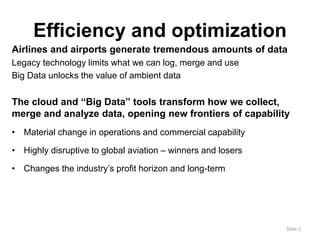
Efficiency and optimization 
Airlines and airports generate tremendous amounts of data 
Legacy technology limits what we can log, merge and use 
Big Data unlocks the value of ambient data 
The cloud and “Big Data” tools transform how we collect, 
merge and analyze data, opening new frontiers of capability 
• Material change in operations and commercial capability 
• Highly disruptive to global aviation – winners and losers 
• Changes the industry’s profit horizon and long-term 
Slide 2
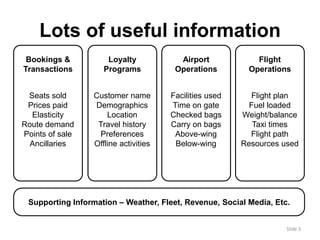
Operations 
Flight plan 
Fuel loaded 
Weight/balance 
Taxi times 
Flight path 
Resources used 
Slide 3 
Lots of useful information 
Bookings & 
Transactions 
Loyalty 
Programs 
Seats sold 
Prices paid 
Elasticity 
Route demand 
Points of sale 
Ancillaries 
Customer name 
Demographics 
Location 
Travel history 
Preferences 
Offline activities 
Airport 
Operations 
Flight 
Facilities used 
Time on gate 
Checked bags 
Carry on bags 
Above-wing 
Below-wing 
Supporting Information – Weather, Fleet, Revenue, Social Media, Etc.
Slide 4 
What’s the problem? 
Critical info is trapped in silos, crippling big data 
Needs structure, standardization and validation to be useful
Slide 5 
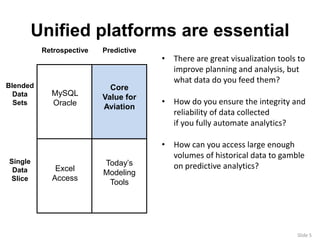
Unified platforms are essential 
Blended 
Data 
Sets 
Single 
Data 
Slice 
Retrospective Predictive 
MySQL 
Oracle 
Excel 
Access 
Core 
Value for 
Aviation 
Today’s 
Modeling 
Tools 
• There are great visualization tools to 
improve planning and analysis, but 
what data do you feed them? 
• How do you ensure the integrity and 
reliability of data collected 
if you fully automate analytics? 
• How can you access large enough 
volumes of historical data to gamble 
on predictive analytics?
Slide 6 
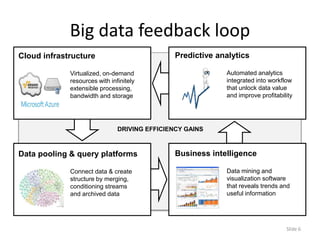
Big data feedback loop 
Cloud infrastructure 
Virtualized, on-demand 
resources with infinitely 
extensible processing, 
bandwidth and storage 
Data pooling & query platforms 
Connect data & create 
structure by merging, 
conditioning streams 
and archived data 
Predictive analytics 
Automated analytics 
integrated into workflow 
that unlock data value 
and improve profitability 
Business intelligence 
Data mining and 
visualization software 
that reveals trends and 
useful information 
DRIVING EFFICIENCY GAINS
Slide 7 
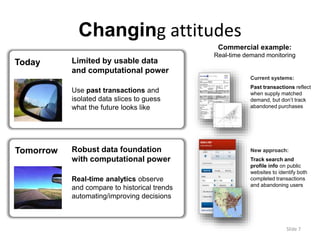
Changing attitudes 
Limited by usable data 
and computational power 
Use past transactions and 
isolated data slices to guess 
what the future looks like 
Today 
Tomorrow Robust data foundation 
with computational power 
Real-time analytics observe 
and compare to historical trends 
automating/improving decisions 
Commercial example: 
Real-time demand monitoring 
Current systems: 
Past transactions reflect 
when supply matched 
demand, but don’t track 
abandoned purchases 
New approach: 
Track search and 
profile info on public 
websites to identify both 
completed transactions 
and abandoning users
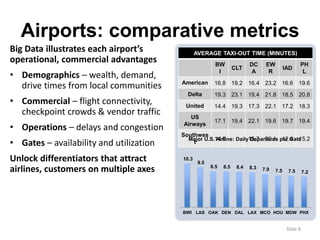
Airports: comparative metrics 
Major U.S. Airline: Daily Departures per Gate 
Slide 8 
Big Data illustrates each airport’s 
operational, commercial advantages 
• Demographics – wealth, demand, 
drive times from local communities 
• Commercial – flight connectivity, 
checkpoint crowds & vendor traffic 
• Operations – delays and congestion 
• Gates – availability and utilization 
Unlock differentiators that attract 
airlines, customers on multiple axes 
AVERAGE TAXI-OUT TIME (MINUTES) 
BW 
I 
CLT 
DC 
A 
EW 
R 
IAD 
PH 
L 
American 16.8 19.2 16.4 23.2 16.6 19.6 
Delta 19.3 23.1 19.4 21.8 18.5 20.8 
United 14.4 19.3 17.3 22.1 17.2 18.3 
US 
Airways 
17.1 19.4 22.1 19.6 19.7 19.4 
Southwes 
t 
14.0 15.7 20.1 12.4 15.2 
10.3 
9.5 
8.5 8.5 8.4 8.3 7.9 7.5 7.5 7.2 
BWI LAS OAK DEN DAL LAX MCO HOU MDW PHX
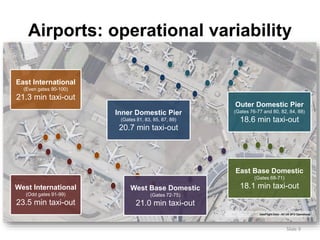
Airports: operational variability 
Outer Domestic Pier 
(Gates 76-77 and 80, 82, 84, 88) 
18.6 min taxi-out 
Slide 9 
East International 
(Even gates 90-100) 
21.3 min taxi-out 
West International 
(Odd gates 91-99) 
23.5 min taxi-out 
East Base Domestic 
(Gates 68-71) 
18.1 min taxi-out 
Inner Domestic Pier 
(Gates 81, 83, 85, 87, 89) 
20.7 min taxi-out 
masFlight Data - All UA SFO Operations 
West Base Domestic 
(Gates 72-75) 
21.0 min taxi-out
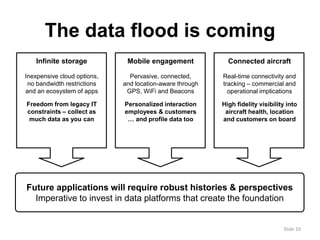
Connected aircraft 
Real-time connectivity and 
tracking – commercial and 
operational implications 
High fidelity visibility into 
aircraft health, location 
and customers on board 
Slide 10 
The data flood is coming 
Infinite storage 
Inexpensive cloud options, 
no bandwidth restrictions 
and an ecosystem of apps 
Freedom from legacy IT 
constraints – collect as 
much data as you can 
Mobile engagement 
Pervasive, connected, 
and location-aware through 
GPS, WiFi and Beacons 
Personalized interaction 
employees & customers 
… and profile data too 
Future applications will require robust histories & perspectives 
Imperative to invest in data platforms that create the foundation
Slide 11 
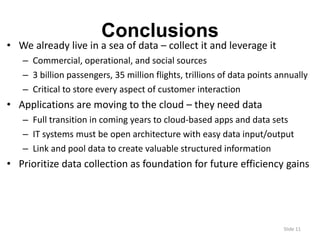
Conclusions 
• We already live in a sea of data – collect it and leverage it 
– Commercial, operational, and social sources 
– 3 billion passengers, 35 million flights, trillions of data points annually 
– Critical to store every aspect of customer interaction 
• Applications are moving to the cloud – they need data 
– Full transition in coming years to cloud-based apps and data sets 
– IT systems must be open architecture with easy data input/output 
– Link and pool data to create valuable structured information 
• Prioritize data collection as foundation for future efficiency gains
4833 Rugby Avenue, Suite 301, Bethesda, MD 20814 
www.masflight.com  +1 (888) 809-2750 
@joshmarks linkedin.com/in/joshuabmarks 
In partnership with

World Routes 2014 Keynote Presentation – How Big Date Changes Aviation Efficiency, Josh Marks, CEO, masFlight

  • 1.
    Keynote Presentation Howbig data changes aviation efficiency Josh Marks Chief Executive Officer masFlight
  • 2.
    Efficiency and optimization Airlines and airports generate tremendous amounts of data Legacy technology limits what we can log, merge and use Big Data unlocks the value of ambient data The cloud and “Big Data” tools transform how we collect, merge and analyze data, opening new frontiers of capability • Material change in operations and commercial capability • Highly disruptive to global aviation – winners and losers • Changes the industry’s profit horizon and long-term Slide 2
  • 3.
    Operations Flight plan Fuel loaded Weight/balance Taxi times Flight path Resources used Slide 3 Lots of useful information Bookings & Transactions Loyalty Programs Seats sold Prices paid Elasticity Route demand Points of sale Ancillaries Customer name Demographics Location Travel history Preferences Offline activities Airport Operations Flight Facilities used Time on gate Checked bags Carry on bags Above-wing Below-wing Supporting Information – Weather, Fleet, Revenue, Social Media, Etc.
  • 4.
    Slide 4 What’sthe problem? Critical info is trapped in silos, crippling big data Needs structure, standardization and validation to be useful
  • 5.
    Slide 5 Unifiedplatforms are essential Blended Data Sets Single Data Slice Retrospective Predictive MySQL Oracle Excel Access Core Value for Aviation Today’s Modeling Tools • There are great visualization tools to improve planning and analysis, but what data do you feed them? • How do you ensure the integrity and reliability of data collected if you fully automate analytics? • How can you access large enough volumes of historical data to gamble on predictive analytics?
  • 6.
    Slide 6 Bigdata feedback loop Cloud infrastructure Virtualized, on-demand resources with infinitely extensible processing, bandwidth and storage Data pooling & query platforms Connect data & create structure by merging, conditioning streams and archived data Predictive analytics Automated analytics integrated into workflow that unlock data value and improve profitability Business intelligence Data mining and visualization software that reveals trends and useful information DRIVING EFFICIENCY GAINS
  • 7.
    Slide 7 Changingattitudes Limited by usable data and computational power Use past transactions and isolated data slices to guess what the future looks like Today Tomorrow Robust data foundation with computational power Real-time analytics observe and compare to historical trends automating/improving decisions Commercial example: Real-time demand monitoring Current systems: Past transactions reflect when supply matched demand, but don’t track abandoned purchases New approach: Track search and profile info on public websites to identify both completed transactions and abandoning users
  • 8.
    Airports: comparative metrics Major U.S. Airline: Daily Departures per Gate Slide 8 Big Data illustrates each airport’s operational, commercial advantages • Demographics – wealth, demand, drive times from local communities • Commercial – flight connectivity, checkpoint crowds & vendor traffic • Operations – delays and congestion • Gates – availability and utilization Unlock differentiators that attract airlines, customers on multiple axes AVERAGE TAXI-OUT TIME (MINUTES) BW I CLT DC A EW R IAD PH L American 16.8 19.2 16.4 23.2 16.6 19.6 Delta 19.3 23.1 19.4 21.8 18.5 20.8 United 14.4 19.3 17.3 22.1 17.2 18.3 US Airways 17.1 19.4 22.1 19.6 19.7 19.4 Southwes t 14.0 15.7 20.1 12.4 15.2 10.3 9.5 8.5 8.5 8.4 8.3 7.9 7.5 7.5 7.2 BWI LAS OAK DEN DAL LAX MCO HOU MDW PHX
  • 9.
    Airports: operational variability Outer Domestic Pier (Gates 76-77 and 80, 82, 84, 88) 18.6 min taxi-out Slide 9 East International (Even gates 90-100) 21.3 min taxi-out West International (Odd gates 91-99) 23.5 min taxi-out East Base Domestic (Gates 68-71) 18.1 min taxi-out Inner Domestic Pier (Gates 81, 83, 85, 87, 89) 20.7 min taxi-out masFlight Data - All UA SFO Operations West Base Domestic (Gates 72-75) 21.0 min taxi-out
  • 10.
    Connected aircraft Real-timeconnectivity and tracking – commercial and operational implications High fidelity visibility into aircraft health, location and customers on board Slide 10 The data flood is coming Infinite storage Inexpensive cloud options, no bandwidth restrictions and an ecosystem of apps Freedom from legacy IT constraints – collect as much data as you can Mobile engagement Pervasive, connected, and location-aware through GPS, WiFi and Beacons Personalized interaction employees & customers … and profile data too Future applications will require robust histories & perspectives Imperative to invest in data platforms that create the foundation
  • 11.
    Slide 11 Conclusions • We already live in a sea of data – collect it and leverage it – Commercial, operational, and social sources – 3 billion passengers, 35 million flights, trillions of data points annually – Critical to store every aspect of customer interaction • Applications are moving to the cloud – they need data – Full transition in coming years to cloud-based apps and data sets – IT systems must be open architecture with easy data input/output – Link and pool data to create valuable structured information • Prioritize data collection as foundation for future efficiency gains
  • 12.
    4833 Rugby Avenue,Suite 301, Bethesda, MD 20814 www.masflight.com  +1 (888) 809-2750 @joshmarks linkedin.com/in/joshuabmarks In partnership with

Editor's Notes

  • #3 Let’s start with the basics. Airlines and airports generate tremendous data. Whether we’re talking about the 3 billion enplanements or the 35 million flights each year, or the dozens of times we “touch” a customer, we amass literally trillions of data points from different sources.   So what’s stopping us from creating a mosaic of data that illuminates our business decisions? Legacy technologies limit what we can log, merge and use. We all know we have a problem with modernization. But the silos created by our operations, commercial and financial systems limits what we can merge and contribute to business problems.   Industries further ahead in the e-commerce curve have discovered the value of ambient data. The data that we treat as disposable. Amazon collects unbelievable detail about you to personalize your experience - and make their operation more intelligent. As an industry, we’re big enough that simple data management really is a big data problem. But as an industry we haven’t embraced the potential of Big Data yet.   Big Data simply means the ability to make sense of very large, different and inconsistent data sets. Big Data tools exist today that open frontiers of knowledge, and are going to drive changes in both operational and commercial capability. Most importantly, big data can change our industry’s profit horizon – and differentiate those airlines and airports with new revenue and profitability sources.
  • #4 Let’s think about what information is really useful, and the scale of data involved. The first thing most people think about is booking and transactional data. That’s what people actually bought, how much they paid, and where they travelled. Soon, it may also include what ancillaries people buy.   There’s also loyalty program information that connects a passenger identity with actual flight data – while airlines starting to connect loyalty and transactional data to customize offers, customer relationship management is still new territory for airports.   There are additional dimensions of data around airport and flight operations. Every flight information display contains a wealth of statistically important information – what times flights arrived and departed, and what gates they used. And of course baggage tracking is relevant too. From the airline perspective, there is a wealth of data in flight planning systems that is far richer than just flight logs.   And of course, underlying all this are explanatory factors that provide context to what we collect – weather information and even social media logs that illustrate through tweets and posts.
  • #5 Every day we see these data sets flow past our eyes. But we haven’t built the platforms as an industry that pool and connect those information sources. The data may be collected today, sitting in log files or on local hard drives. But it’s trapped in silos, and it needs structure and validation to be useful.   That’s the real potential of big data platforms, and in particular in different data so we can use it to monitor the past and to provide a robust foundation for finding new efficiencies.
  • #6 Everything starts with a business case, and it’s important to define our objectives in more detail than just “efficiencies” and “optimization”.   Our industry is impossibly complex and seemingly random. The butterfly in China today that flaps its wings really does impact how many flights are going to cancel next month in New York. As an industry, we look to a future where complex pricing and operational decisions can be automated. That will require data sets built at the most granular level, taking into account information about specific passengers and flight operations, instead of blocky decisions today that are limited by our human capabilities and limited tools.   Predictive analytics involves modeling, learning and mining. It’s about exploiting patterns in historical data sets to track and capture relationships among factors. Predictive analytics goes far beyond our world of today, where we look retrospectively at single data slices or use expensive databases to mix limited pools of data. That allows assessment of risk and efficiency.   A great analogy is credit scoring. Every factor about you, as an individual, is mixed together. Historical behavior is the foundation to predict your likelihood of future default.   That’s essentially what we need to build in aviation to unlock efficiencies at the airport and airline level. Except instead of personal information, we’re mixing commercial, operational and contextual data.   We’re shooting for a future where we can use composite information to predict the future, based on relevant pools of historical data that drive our predictions. At core, predictive analytics is about identifying when history is repeating and optimizing our response.   So we get to the fundamental question: how do we take diverse grains of data and combine them into a reliable platform? How can we automate while maintaining integrity? While processing the volumes of historical data needed for predictive analytics?
  • #7 We can evolve and build the business case for new investment. At masFlight, we see an ongoing cycle of client cloud investment, driving systems that pool data and ultimately make predictive analytics a reality. There’s a positive feedback loop and real efficiency gains.   The first step is an organizational commitment to cloud resources so constraints of storage, bandwidth and engineering skills go away. Renting infrastructure from Google or Amazon can be cost effective, and you don’t need to worry about maintenance and reliability.   The second step is to leverage cloud systems to store lots of data, to connect them and create streams of integrated information. Doing that over time builds rich archives of what happened. The third step is make those archives relevant for business decisions. There are great third-party tools that do data mining and visualization. They are relatively inexpensive to deploy. But they are only as good as the data sources you feed them.   Once you have the foundation of data to work from, you can deploy business intelligence platforms with ease.   That builds to where the real money is going to be – automation of trend analysis and forward decision making. For airports, it’s about real-time visibility into checkpoint congestion, emergencies and delays. For airlines, it’s about using customer data to make more dynamic pricing decisions. That’s where the ROI for cloud and big data investments gets justified.
  • #8 And that’s the important quality in achieving big data efficiencies – a new organizational philosophy is needed. Think of it this way. Today we drive our businesses by looking in the rear-view mirror. We use past transactions and data history to guess what the future looks like.   First, that’s a pretty narrow view of the past. But we’re limited by our ability to focus on narrow slices. You can adjust the mirror and see different histories – but you’re inherently limited in what you can project.   The future is looking out the windshield – the windshield is a lot bigger and a lot more relevant to where you’re going. You know where you’ve been, you see where you’re going, and your speed and other vital metrics are in front of you. That’s the future – making course corrections based on the trends.   I have been talking at a high level, and we need to drill down to specifics. Let’s look at some specific use cases. Specifically, what are the implications of big data for the everyday challenges of airlines and airports?   Let’s start with airline pricing and sales. Airlines are huge e-commerce players. This year, U.S. airlines will transact more than $50 billion on their websites alone, and that doesn’t count what they sell through OTAs. They sell tickets online to more than 100 million people each year. Think about the number of searches that occur – if it takes ten flight searches to sell one ticket, then that’s a billion searches this year on airline websites alone.   Every single one of those searches carries information that’s useful. What airports, what times people wanted to fly, and what fares they were offered. How did search criteria change over time. You can track that information down to the IP address, cookie or frequent flyer number.   Critically, you can use that information to understand the real-time intersection of supply and demand. You can track it even if a ticket wasn’t purchased. You get a richer, broader picture of what’s happening long before it translates to a transaction record.   Harnessing that requires big data processing, because the volume of search data is real-time and overwhelming. But think of the implications for pricing and personalization – looking out the windshield, so to speak, instead of the rear-view mirror that just shows what was ticketed. You could spot instant changes in demand and understand when price sensitive customers are ready to purchase. And all of that can be achieved within the context of today’s booking systems.
  • #9 I just gave an airline example, but the same principles apply to airports. For air service development, access to big data processing will be critical to winning new airline business, because airlines will be processing many more dimensions of data as well.   Big data matters for air service development – tracking demographics, business, network connectivity and airport performance. Big data analytics of population data illustrates not only underserved routes, but also if the airport has a differential advantage. When you combine demographic data with network connectivity and quality of service models, you get more compelling results to win new airline service.   For airport operations, understanding how airlines schedule flights and use infrastructure is important. Airport congestion matters for service development, and big data illustrates factors for your own airport and for competitors. Knowing that United schedules longer turns than American helps in matching gate infrastructure and whether schedule changes will impact airport congestion.
  • #10 The last slide showed how big data can illuminate air service development. It’s also important for on-time performance and reliability. Airlines can get precise measurements of taxi times by gate, which is essential for understanding where airport changes can drive new performance efficiencies.   For example, here’s a view of United’s operation at San Francisco over a multi-year period. We’re looking at more than 200,000 flights and integrating gate, aircraft, and taxiway information. What we can see is that there’s a substantial difference in taxi time by gate.   Some of that is runway driven, but there are specific congestion issues caused by blocked alleyways and simultaneous pushes that are controllable by the airline and airport. Big data gives us visibility into factors that were hidden, or at least hard to see given the volume of data.
  • #11 Which brings us to the present. The data flood is coming – what should we be doing today to prepare for that future?   First, infinite storage from cloud architecture is the foundation on which these big data efficiencies reside. IT departments should be deploying in the cloud, or at least investigating how current infrastructure can be transitioned in coming years.   Second, expect an increasing ocean of customer data. For airports, new hardware that allows real-time customer mapping and tracking is illuminating – where are passengers congregating, when do they head to the gate – and relevant for retail optimization. SITA introduced beacon technology that’s worth a hard look. And any airport that isn’t offering free wifi in exchange for basic customer profile data is missing the boat – airports should be collecting whatever customer profile data they can, and the best way to do that is to offer something valuable like Internet access that incentivizes customers to participate.   Finally, for both airlines and airports, you want to be investing in big data today to prepare for the near future when aircraft are fully connected. Real-time aircraft tracking will have profound implications on flight disruptions.   The only certainty is that tomorrow’s applications and software tools will depend on robust, connected data platforms. Organizations that start to adapt now will have a smooth path to tomorrow’s analytics systems.
  • #12 As you can tell, organizational mindset is key. We’re in the exploratory phase where we recognize big data’s potential and foundational technology is available. As an industry, capturing that potential requires early investment and a change in organizational mindset.   You have the capacity to capture, archive and query everything in the course of business, from your information feeds to the siloed data across your organization. Intelligent archiving is critical, and it should be a priority. There is no such thing as bad data. Every data source contributes when blended, some more than others of course, but the point is you don’t know today what might be useful tomorrow. With trillions data points of data created each year, it’s critical to capture as many dimensions of your customer interaction as possible.   Second, there are many reasons why applications – the tools we use every day – are moving to the cloud. The cloud solves problems like expandability and bandwidth. As applications move to the cloud, so too must our data collection and processing.   Finally, I recognize that leaping into the cloud and embracing big data has a price tag, and that compelling businesses cases are needed to justify investments. You can see the impact in air service development, in on-time performance improvement, in gate and ramp optimization and in terminal retail, and with big data you can achieve higher performance. If you’re not looking at big data platforms as drivers of profit improvement in the future, you’re missing the boat.
  • #13 I’m going to post and tweet a copy of this presentation with hashtag #worldroutes. My twitter handle is @joshmarks. I’ll also be around this afternoon at the OAG booth. masFlight has had a multi-year partnership with OAG, the leader in airline schedules and flight status, and if you haven’t looked at their flight status solutions to feed your mobile applications and FIDS boards you should. Thank you again to the Routes team and I hope you enjoy your lunch!