International Journal of Latest Technology in Engineering, Management & Applied Science (IJLTEMAS)
Volume VI, Issue XII, December 2017 | ISSN 2278-2540
www.ijltemas.in Page 129
Application of Big Data Systems to Airline
Management
N. Sumathi, Gokulakrishnan S, Kaushik Ramana S, Muralitharan R, Ch.V.S Kamal
Dept of Aerospace Engineering, Amrita School of Engineering, Coimbatore, Amrita Vishwa Vidyapeetham, India
Abstract— The business world is in the midst of the next
revolution following the IT revolution – the Big Data revolution.
The sheer volume of data produced is a major reason for the big
data revolution. Aviation and aerospace are typical areas that
can apply big data systems due to the scale of data produced, not
only by the plane sensors and passengers, but also by the
prospective passengers. Data that need to be considered include,
but are not limited to, aircraft sensor data, passenger data,
weather data, aircraft maintenance data and air traffic data.
This paper aims at identifying areas in aviation where big data
systems can be utilized to enhance operational performances
improve customer relations and thereby aiding the ultimate goal
of increased profits at reduced costs. An improved management
model built on a strong big data infrastructure will reduce
operation costs, improve safety, bring down the cost and time
spent on maintenance and drastically improve customer
relations.
Keywords— include at least 5 keywords or phrases
I. INTRODUCTION
n the recent years, the aviation industry has undergone a
drastic growth, resulting in increased passenger flow and air
traffic. This sudden growth makes it more difficult to manage
operations and to ensure passenger and cargo safety. Most of
the data collected (onboard sensors, ground stations, satellite
sensors) goes unused unless an abnormality is found wherein
the person responsible is notified. This data can be put to use
in the presence of an effective computing system. But the data
generated in too much to be handled using traditional
computing systems using databases. An average trans-Atlantic
flight generates around 1000 gigabytes of data. Extracting
useful information from this ‘big data’ is an effective way of
improving management, ensuring safety and increasing
revenues while keeping expenses in check, even for the
current increased traffic.
II. BIG DATA
Information has been generated all through history. But the
IT revolution has made it possible to collect, store and analyse
considerably large amounts of data. With a variety of
provisions to generate data, like sensor networks, datasets
increase at an exponential rate and the conventional
techniques available to store and analyse data become
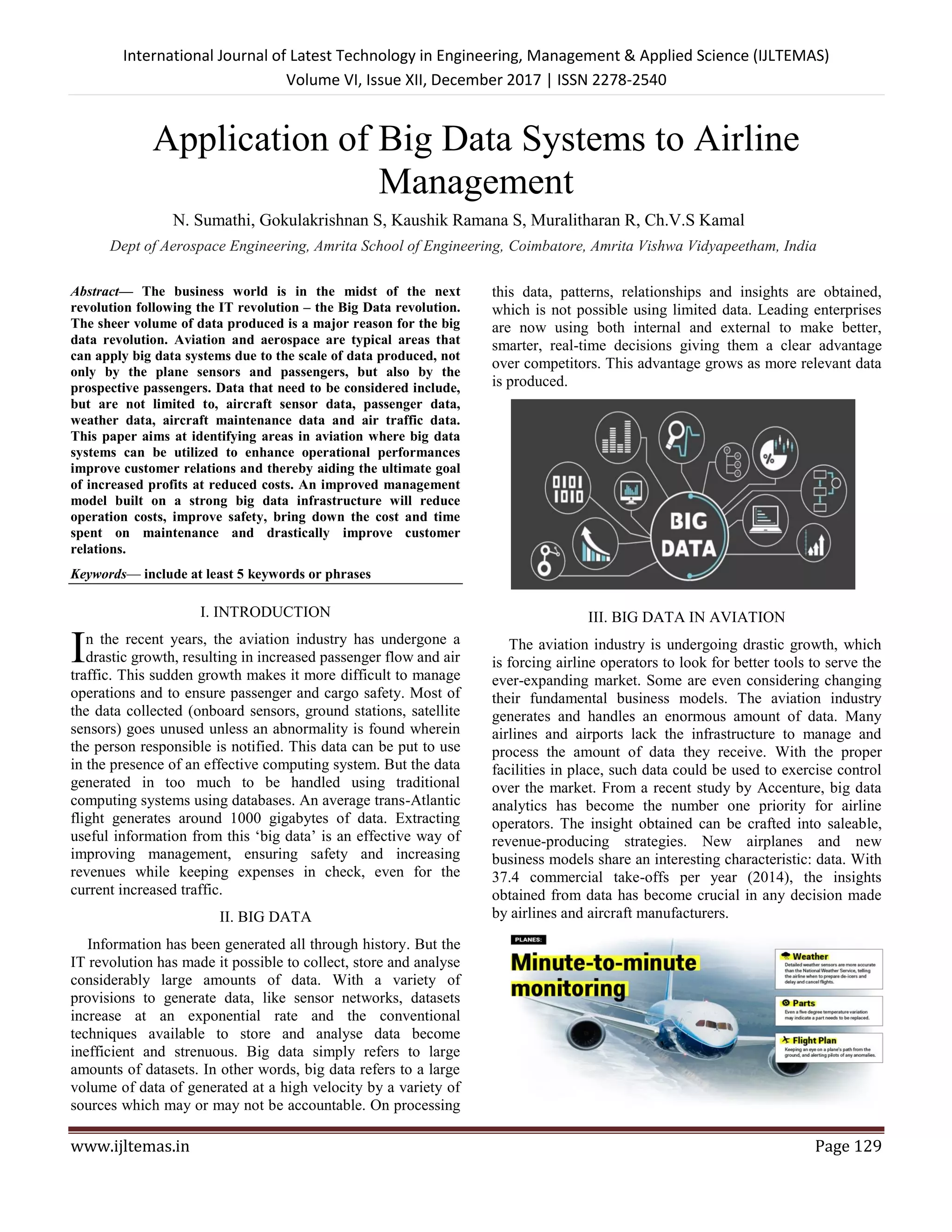
inefficient and strenuous. Big data simply refers to large
amounts of datasets. In other words, big data refers to a large
volume of data of generated at a high velocity by a variety of
sources which may or may not be accountable. On processing
this data, patterns, relationships and insights are obtained,
which is not possible using limited data. Leading enterprises
are now using both internal and external to make better,
smarter, real-time decisions giving them a clear advantage
over competitors. This advantage grows as more relevant data
is produced.
III. BIG DATA IN AVIATION
The aviation industry is undergoing drastic growth, which
is forcing airline operators to look for better tools to serve the
ever-expanding market. Some are even considering changing
their fundamental business models. The aviation industry
generates and handles an enormous amount of data. Many
airlines and airports lack the infrastructure to manage and
process the amount of data they receive. With the proper
facilities in place, such data could be used to exercise control
over the market. From a recent study by Accenture, big data
analytics has become the number one priority for airline
operators. The insight obtained can be crafted into saleable,
revenue-producing strategies. New airplanes and new
business models share an interesting characteristic: data. With
37.4 commercial take-offs per year (2014), the insights
obtained from data has become crucial in any decision made
by airlines and aircraft manufacturers.
I
International Journal of Latest Technology in Engineering, Management & Applied Science (IJLTEMAS)
Volume VI, Issue XII, December 2017 | ISSN 2278-2540
www.ijltemas.in Page 130
IV. ANALYTICS: THE ADVANTAGE
The idea of using data to improve business decisions has
caught the limelight, especially with the amount of data being
generated by consumers in the recent years. This has made the
idea of a service oriented business model even more
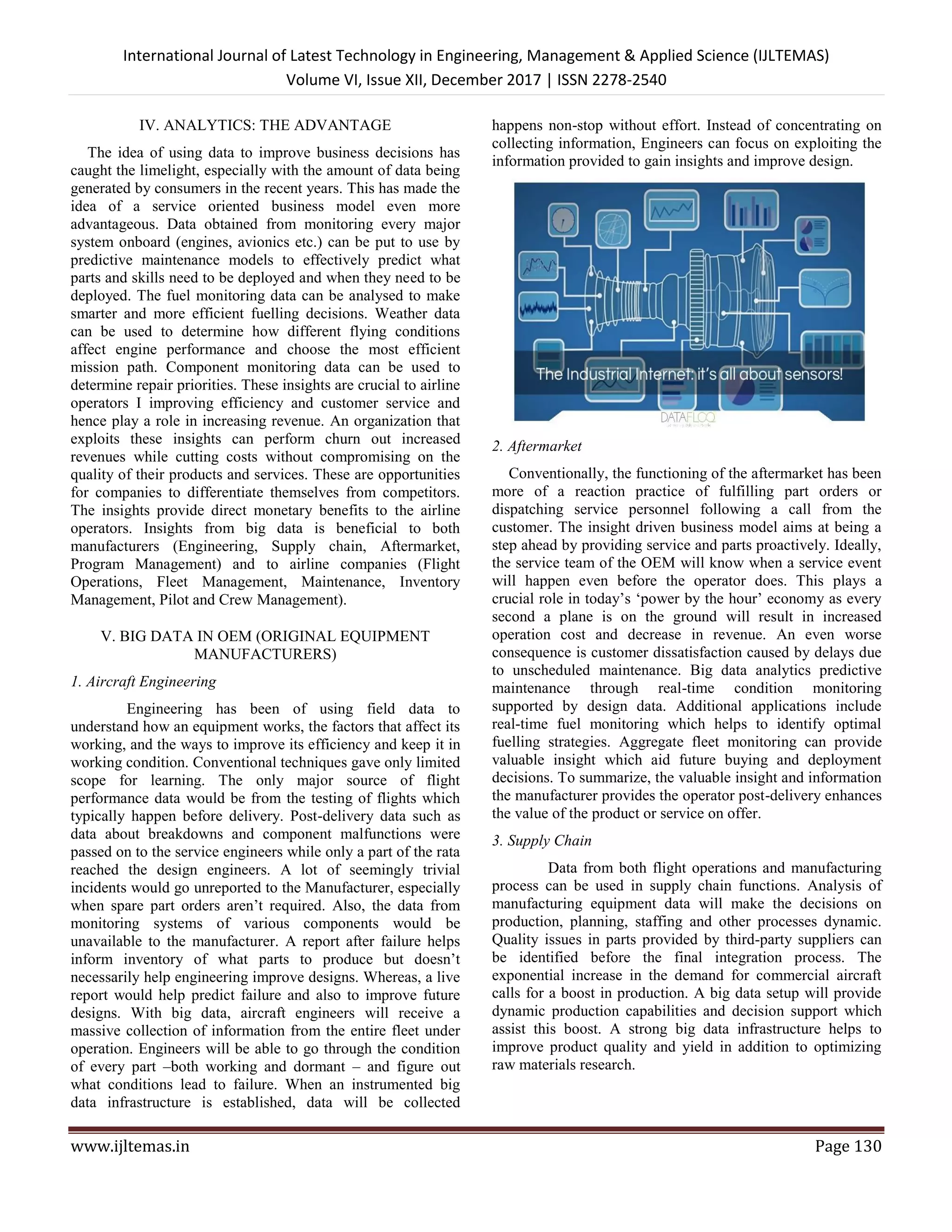
advantageous. Data obtained from monitoring every major
system onboard (engines, avionics etc.) can be put to use by
predictive maintenance models to effectively predict what
parts and skills need to be deployed and when they need to be
deployed. The fuel monitoring data can be analysed to make
smarter and more efficient fuelling decisions. Weather data
can be used to determine how different flying conditions
affect engine performance and choose the most efficient
mission path. Component monitoring data can be used to
determine repair priorities. These insights are crucial to airline
operators I improving efficiency and customer service and
hence play a role in increasing revenue. An organization that
exploits these insights can perform churn out increased
revenues while cutting costs without compromising on the
quality of their products and services. These are opportunities
for companies to differentiate themselves from competitors.
The insights provide direct monetary benefits to the airline
operators. Insights from big data is beneficial to both
manufacturers (Engineering, Supply chain, Aftermarket,
Program Management) and to airline companies (Flight
Operations, Fleet Management, Maintenance, Inventory
Management, Pilot and Crew Management).
V. BIG DATA IN OEM (ORIGINAL EQUIPMENT
MANUFACTURERS)
1. Aircraft Engineering
Engineering has been of using field data to
understand how an equipment works, the factors that affect its
working, and the ways to improve its efficiency and keep it in
working condition. Conventional techniques gave only limited
scope for learning. The only major source of flight
performance data would be from the testing of flights which
typically happen before delivery. Post-delivery data such as
data about breakdowns and component malfunctions were
passed on to the service engineers while only a part of the rata
reached the design engineers. A lot of seemingly trivial
incidents would go unreported to the Manufacturer, especially
when spare part orders aren’t required. Also, the data from
monitoring systems of various components would be
unavailable to the manufacturer. A report after failure helps
inform inventory of what parts to produce but doesn’t
necessarily help engineering improve designs. Whereas, a live
report would help predict failure and also to improve future
designs. With big data, aircraft engineers will receive a
massive collection of information from the entire fleet under
operation. Engineers will be able to go through the condition
of every part –both working and dormant – and figure out
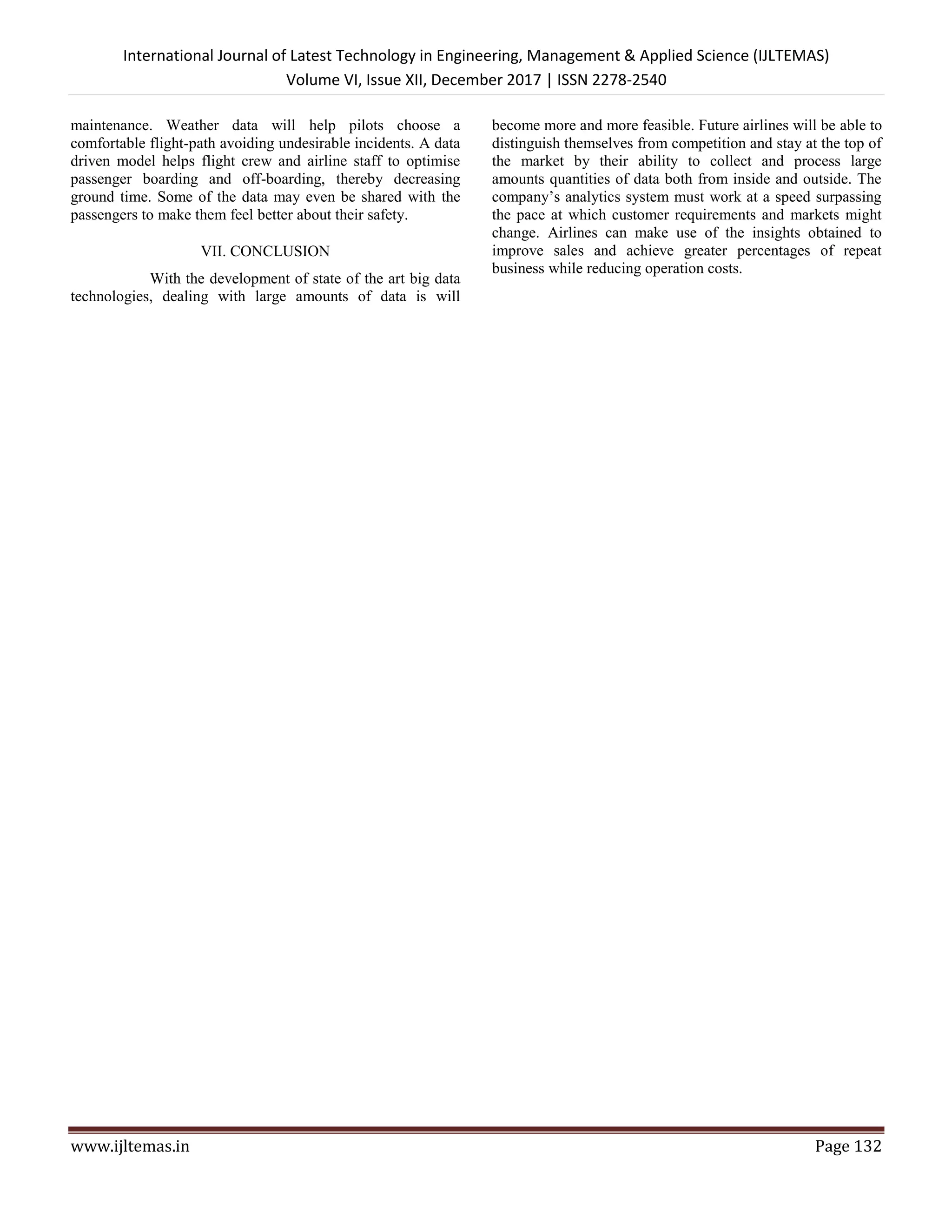
what conditions lead to failure. When an instrumented big
data infrastructure is established, data will be collected
happens non-stop without effort. Instead of concentrating on
collecting information, Engineers can focus on exploiting the
information provided to gain insights and improve design.
2. Aftermarket
Conventionally, the functioning of the aftermarket has been
more of a reaction practice of fulfilling part orders or
dispatching service personnel following a call from the
customer. The insight driven business model aims at being a
step ahead by providing service and parts proactively. Ideally,
the service team of the OEM will know when a service event
will happen even before the operator does. This plays a
crucial role in today’s ‘power by the hour’ economy as every
second a plane is on the ground will result in increased
operation cost and decrease in revenue. An even worse
consequence is customer dissatisfaction caused by delays due
to unscheduled maintenance. Big data analytics predictive
maintenance through real-time condition monitoring
supported by design data. Additional applications include
real-time fuel monitoring which helps to identify optimal
fuelling strategies. Aggregate fleet monitoring can provide
valuable insight which aid future buying and deployment
decisions. To summarize, the valuable insight and information
the manufacturer provides the operator post-delivery enhances
the value of the product or service on offer.
3. Supply Chain
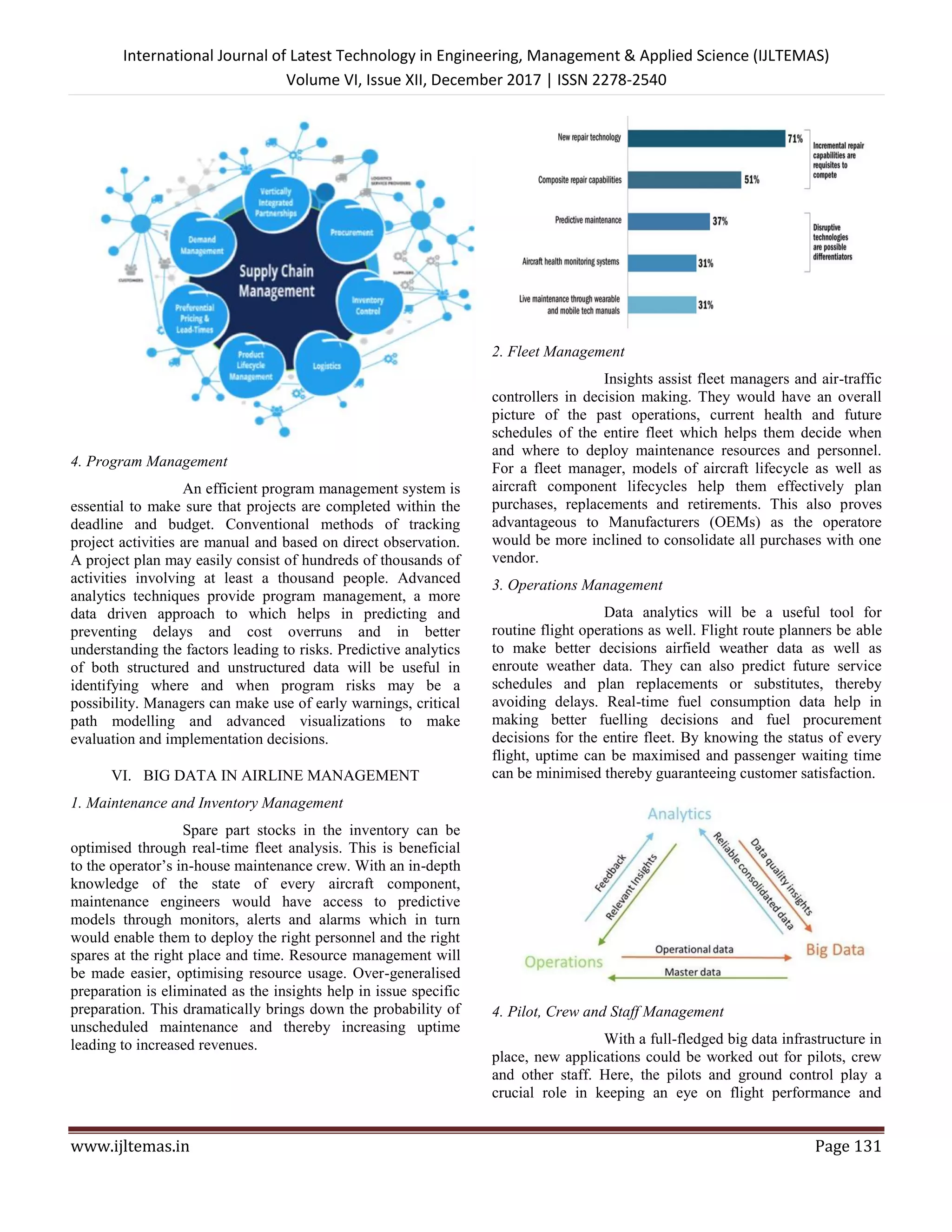
Data from both flight operations and manufacturing
process can be used in supply chain functions. Analysis of
manufacturing equipment data will make the decisions on
production, planning, staffing and other processes dynamic.
Quality issues in parts provided by third-party suppliers can
be identified before the final integration process. The
exponential increase in the demand for commercial aircraft
calls for a boost in production. A big data setup will provide
dynamic production capabilities and decision support which
assist this boost. A strong big data infrastructure helps to
improve product quality and yield in addition to optimizing
raw materials research.
International Journal of Latest Technology in Engineering, Management & Applied Science (IJLTEMAS)
Volume VI, Issue XII, December 2017 | ISSN 2278-2540
www.ijltemas.in Page 131
4. Program Management
An efficient program management system is
essential to make sure that projects are completed within the
deadline and budget. Conventional methods of tracking
project activities are manual and based on direct observation.
A project plan may easily consist of hundreds of thousands of
activities involving at least a thousand people. Advanced
analytics techniques provide program management, a more
data driven approach to which helps in predicting and
preventing delays and cost overruns and in better
understanding the factors leading to risks. Predictive analytics
of both structured and unstructured data will be useful in
identifying where and when program risks may be a
possibility. Managers can make use of early warnings, critical
path modelling and advanced visualizations to make
evaluation and implementation decisions.
VI. BIG DATA IN AIRLINE MANAGEMENT
1. Maintenance and Inventory Management
Spare part stocks in the inventory can be
optimised through real-time fleet analysis. This is beneficial
to the operator’s in-house maintenance crew. With an in-depth
knowledge of the state of every aircraft component,
maintenance engineers would have access to predictive
models through monitors, alerts and alarms which in turn
would enable them to deploy the right personnel and the right
spares at the right place and time. Resource management will
be made easier, optimising resource usage. Over-generalised
preparation is eliminated as the insights help in issue specific
preparation. This dramatically brings down the probability of
unscheduled maintenance and thereby increasing uptime
leading to increased revenues.
2. Fleet Management
Insights assist fleet managers and air-traffic
controllers in decision making. They would have an overall
picture of the past operations, current health and future
schedules of the entire fleet which helps them decide when
and where to deploy maintenance resources and personnel.
For a fleet manager, models of aircraft lifecycle as well as
aircraft component lifecycles help them effectively plan
purchases, replacements and retirements. This also proves
advantageous to Manufacturers (OEMs) as the operatore
would be more inclined to consolidate all purchases with one
vendor.
3. Operations Management
Data analytics will be a useful tool for
routine flight operations as well. Flight route planners be able
to make better decisions airfield weather data as well as
enroute weather data. They can also predict future service
schedules and plan replacements or substitutes, thereby
avoiding delays. Real-time fuel consumption data help in
making better fuelling decisions and fuel procurement
decisions for the entire fleet. By knowing the status of every
flight, uptime can be maximised and passenger waiting time
can be minimised thereby guaranteeing customer satisfaction.
4. Pilot, Crew and Staff Management
With a full-fledged big data infrastructure in
place, new applications could be worked out for pilots, crew
and other staff. Here, the pilots and ground control play a
crucial role in keeping an eye on flight performance and
International Journal of Latest Technology in Engineering, Management & Applied Science (IJLTEMAS)
Volume VI, Issue XII, December 2017 | ISSN 2278-2540
www.ijltemas.in Page 132
maintenance. Weather data will help pilots choose a
comfortable flight-path avoiding undesirable incidents. A data
driven model helps flight crew and airline staff to optimise
passenger boarding and off-boarding, thereby decreasing
ground time. Some of the data may even be shared with the
passengers to make them feel better about their safety.
VII. CONCLUSION
With the development of state of the art big data
technologies, dealing with large amounts of data is will
become more and more feasible. Future airlines will be able to
distinguish themselves from competition and stay at the top of
the market by their ability to collect and process large
amounts quantities of data both from inside and outside. The
company’s analytics system must work at a speed surpassing
the pace at which customer requirements and markets might
change. Airlines can make use of the insights obtained to
improve sales and achieve greater percentages of repeat
business while reducing operation costs.

Application of Big Data Systems to Airline Management

  • 1.
    International Journal ofLatest Technology in Engineering, Management & Applied Science (IJLTEMAS) Volume VI, Issue XII, December 2017 | ISSN 2278-2540 www.ijltemas.in Page 129 Application of Big Data Systems to Airline Management N. Sumathi, Gokulakrishnan S, Kaushik Ramana S, Muralitharan R, Ch.V.S Kamal Dept of Aerospace Engineering, Amrita School of Engineering, Coimbatore, Amrita Vishwa Vidyapeetham, India Abstract— The business world is in the midst of the next revolution following the IT revolution – the Big Data revolution. The sheer volume of data produced is a major reason for the big data revolution. Aviation and aerospace are typical areas that can apply big data systems due to the scale of data produced, not only by the plane sensors and passengers, but also by the prospective passengers. Data that need to be considered include, but are not limited to, aircraft sensor data, passenger data, weather data, aircraft maintenance data and air traffic data. This paper aims at identifying areas in aviation where big data systems can be utilized to enhance operational performances improve customer relations and thereby aiding the ultimate goal of increased profits at reduced costs. An improved management model built on a strong big data infrastructure will reduce operation costs, improve safety, bring down the cost and time spent on maintenance and drastically improve customer relations. Keywords— include at least 5 keywords or phrases I. INTRODUCTION n the recent years, the aviation industry has undergone a drastic growth, resulting in increased passenger flow and air traffic. This sudden growth makes it more difficult to manage operations and to ensure passenger and cargo safety. Most of the data collected (onboard sensors, ground stations, satellite sensors) goes unused unless an abnormality is found wherein the person responsible is notified. This data can be put to use in the presence of an effective computing system. But the data generated in too much to be handled using traditional computing systems using databases. An average trans-Atlantic flight generates around 1000 gigabytes of data. Extracting useful information from this ‘big data’ is an effective way of improving management, ensuring safety and increasing revenues while keeping expenses in check, even for the current increased traffic. II. BIG DATA Information has been generated all through history. But the IT revolution has made it possible to collect, store and analyse considerably large amounts of data. With a variety of provisions to generate data, like sensor networks, datasets increase at an exponential rate and the conventional techniques available to store and analyse data become inefficient and strenuous. Big data simply refers to large amounts of datasets. In other words, big data refers to a large volume of data of generated at a high velocity by a variety of sources which may or may not be accountable. On processing this data, patterns, relationships and insights are obtained, which is not possible using limited data. Leading enterprises are now using both internal and external to make better, smarter, real-time decisions giving them a clear advantage over competitors. This advantage grows as more relevant data is produced. III. BIG DATA IN AVIATION The aviation industry is undergoing drastic growth, which is forcing airline operators to look for better tools to serve the ever-expanding market. Some are even considering changing their fundamental business models. The aviation industry generates and handles an enormous amount of data. Many airlines and airports lack the infrastructure to manage and process the amount of data they receive. With the proper facilities in place, such data could be used to exercise control over the market. From a recent study by Accenture, big data analytics has become the number one priority for airline operators. The insight obtained can be crafted into saleable, revenue-producing strategies. New airplanes and new business models share an interesting characteristic: data. With 37.4 commercial take-offs per year (2014), the insights obtained from data has become crucial in any decision made by airlines and aircraft manufacturers. I
  • 2.
    International Journal ofLatest Technology in Engineering, Management & Applied Science (IJLTEMAS) Volume VI, Issue XII, December 2017 | ISSN 2278-2540 www.ijltemas.in Page 130 IV. ANALYTICS: THE ADVANTAGE The idea of using data to improve business decisions has caught the limelight, especially with the amount of data being generated by consumers in the recent years. This has made the idea of a service oriented business model even more advantageous. Data obtained from monitoring every major system onboard (engines, avionics etc.) can be put to use by predictive maintenance models to effectively predict what parts and skills need to be deployed and when they need to be deployed. The fuel monitoring data can be analysed to make smarter and more efficient fuelling decisions. Weather data can be used to determine how different flying conditions affect engine performance and choose the most efficient mission path. Component monitoring data can be used to determine repair priorities. These insights are crucial to airline operators I improving efficiency and customer service and hence play a role in increasing revenue. An organization that exploits these insights can perform churn out increased revenues while cutting costs without compromising on the quality of their products and services. These are opportunities for companies to differentiate themselves from competitors. The insights provide direct monetary benefits to the airline operators. Insights from big data is beneficial to both manufacturers (Engineering, Supply chain, Aftermarket, Program Management) and to airline companies (Flight Operations, Fleet Management, Maintenance, Inventory Management, Pilot and Crew Management). V. BIG DATA IN OEM (ORIGINAL EQUIPMENT MANUFACTURERS) 1. Aircraft Engineering Engineering has been of using field data to understand how an equipment works, the factors that affect its working, and the ways to improve its efficiency and keep it in working condition. Conventional techniques gave only limited scope for learning. The only major source of flight performance data would be from the testing of flights which typically happen before delivery. Post-delivery data such as data about breakdowns and component malfunctions were passed on to the service engineers while only a part of the rata reached the design engineers. A lot of seemingly trivial incidents would go unreported to the Manufacturer, especially when spare part orders aren’t required. Also, the data from monitoring systems of various components would be unavailable to the manufacturer. A report after failure helps inform inventory of what parts to produce but doesn’t necessarily help engineering improve designs. Whereas, a live report would help predict failure and also to improve future designs. With big data, aircraft engineers will receive a massive collection of information from the entire fleet under operation. Engineers will be able to go through the condition of every part –both working and dormant – and figure out what conditions lead to failure. When an instrumented big data infrastructure is established, data will be collected happens non-stop without effort. Instead of concentrating on collecting information, Engineers can focus on exploiting the information provided to gain insights and improve design. 2. Aftermarket Conventionally, the functioning of the aftermarket has been more of a reaction practice of fulfilling part orders or dispatching service personnel following a call from the customer. The insight driven business model aims at being a step ahead by providing service and parts proactively. Ideally, the service team of the OEM will know when a service event will happen even before the operator does. This plays a crucial role in today’s ‘power by the hour’ economy as every second a plane is on the ground will result in increased operation cost and decrease in revenue. An even worse consequence is customer dissatisfaction caused by delays due to unscheduled maintenance. Big data analytics predictive maintenance through real-time condition monitoring supported by design data. Additional applications include real-time fuel monitoring which helps to identify optimal fuelling strategies. Aggregate fleet monitoring can provide valuable insight which aid future buying and deployment decisions. To summarize, the valuable insight and information the manufacturer provides the operator post-delivery enhances the value of the product or service on offer. 3. Supply Chain Data from both flight operations and manufacturing process can be used in supply chain functions. Analysis of manufacturing equipment data will make the decisions on production, planning, staffing and other processes dynamic. Quality issues in parts provided by third-party suppliers can be identified before the final integration process. The exponential increase in the demand for commercial aircraft calls for a boost in production. A big data setup will provide dynamic production capabilities and decision support which assist this boost. A strong big data infrastructure helps to improve product quality and yield in addition to optimizing raw materials research.
  • 3.
    International Journal ofLatest Technology in Engineering, Management & Applied Science (IJLTEMAS) Volume VI, Issue XII, December 2017 | ISSN 2278-2540 www.ijltemas.in Page 131 4. Program Management An efficient program management system is essential to make sure that projects are completed within the deadline and budget. Conventional methods of tracking project activities are manual and based on direct observation. A project plan may easily consist of hundreds of thousands of activities involving at least a thousand people. Advanced analytics techniques provide program management, a more data driven approach to which helps in predicting and preventing delays and cost overruns and in better understanding the factors leading to risks. Predictive analytics of both structured and unstructured data will be useful in identifying where and when program risks may be a possibility. Managers can make use of early warnings, critical path modelling and advanced visualizations to make evaluation and implementation decisions. VI. BIG DATA IN AIRLINE MANAGEMENT 1. Maintenance and Inventory Management Spare part stocks in the inventory can be optimised through real-time fleet analysis. This is beneficial to the operator’s in-house maintenance crew. With an in-depth knowledge of the state of every aircraft component, maintenance engineers would have access to predictive models through monitors, alerts and alarms which in turn would enable them to deploy the right personnel and the right spares at the right place and time. Resource management will be made easier, optimising resource usage. Over-generalised preparation is eliminated as the insights help in issue specific preparation. This dramatically brings down the probability of unscheduled maintenance and thereby increasing uptime leading to increased revenues. 2. Fleet Management Insights assist fleet managers and air-traffic controllers in decision making. They would have an overall picture of the past operations, current health and future schedules of the entire fleet which helps them decide when and where to deploy maintenance resources and personnel. For a fleet manager, models of aircraft lifecycle as well as aircraft component lifecycles help them effectively plan purchases, replacements and retirements. This also proves advantageous to Manufacturers (OEMs) as the operatore would be more inclined to consolidate all purchases with one vendor. 3. Operations Management Data analytics will be a useful tool for routine flight operations as well. Flight route planners be able to make better decisions airfield weather data as well as enroute weather data. They can also predict future service schedules and plan replacements or substitutes, thereby avoiding delays. Real-time fuel consumption data help in making better fuelling decisions and fuel procurement decisions for the entire fleet. By knowing the status of every flight, uptime can be maximised and passenger waiting time can be minimised thereby guaranteeing customer satisfaction. 4. Pilot, Crew and Staff Management With a full-fledged big data infrastructure in place, new applications could be worked out for pilots, crew and other staff. Here, the pilots and ground control play a crucial role in keeping an eye on flight performance and
  • 4.
    International Journal ofLatest Technology in Engineering, Management & Applied Science (IJLTEMAS) Volume VI, Issue XII, December 2017 | ISSN 2278-2540 www.ijltemas.in Page 132 maintenance. Weather data will help pilots choose a comfortable flight-path avoiding undesirable incidents. A data driven model helps flight crew and airline staff to optimise passenger boarding and off-boarding, thereby decreasing ground time. Some of the data may even be shared with the passengers to make them feel better about their safety. VII. CONCLUSION With the development of state of the art big data technologies, dealing with large amounts of data is will become more and more feasible. Future airlines will be able to distinguish themselves from competition and stay at the top of the market by their ability to collect and process large amounts quantities of data both from inside and outside. The company’s analytics system must work at a speed surpassing the pace at which customer requirements and markets might change. Airlines can make use of the insights obtained to improve sales and achieve greater percentages of repeat business while reducing operation costs.