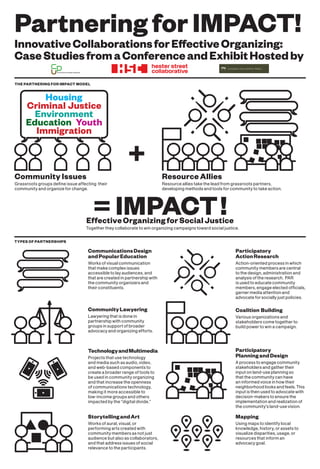
= IMPACT!EffectiveOrganizing for Social Justice
Together they collaborate to win organizing campaigns toward social justice.
THE PARTNERING FOR IMPACT MODEL
TYPES OF PARTNERSHIPS
Participatory
ActionResearch
Action-oriented process in which
community members are central
to the design, administration and
analysis of the research. PAR
is used to educate community
members, engage elected officials,
garner media attention and
advocate for socially just policies.
CommunicationsDesign
andPopularEducation
Works of visual communication
that make complex issues
accessible to lay audiences, and
that are created in partnership with
the community organizers and
their constituents.
+
Community Issues
Grassroots groups define issue affecting their
community and organize for change.
Resource Allies
Resource allies take the lead from grassroots partners,
developing methods and tools for community to take action.
Partnering for IMPACT!
InnovativeCollaborationsforEffectiveOrganizing:
CaseStudiesfromaConferenceandExhibitHostedby
CommunityLawyering
Lawyering that is done in
partnership with community
groups in support of broader
advocacy and organizing efforts.
StorytellingandArt
Works of aural, visual, or
performing arts created with
community members as not just
audience but also as collaborators,
and that address issues of social
relevance to the participants.
TechnologyandMultimedia
Projects that use technology
and media such as audio, video,
and web-based components to
create a broader range of tools to
be used in community organizing
and that increase the openness
of communications technology,
making it more accessible to
low-income groups and others
impacted by the “digital divide.”
Coalition Building
Various organizations and
stakeholders come together to
build power to win a campaign.
Participatory
PlanningandDesign
A process to engage community
stakeholders and gather their
input on land-use planning so
that the community can have
an informed voice in how their
neighborhood looks and feels. This
input is then used to advocate with
decision-makers to ensure the
implementation and realization of
the community’s land-use vision.
Mapping
Using maps to identify local
knowledge, history, or assets to
visualize disparities, usage, or
resources that inform an
advocacy goal.
Letter fromtheHostsof
Partnering forImpact
AlexaKasdan
Director of Research & Policy
Community Development Project
ChristineGaspar
Executive Director
Center for Urban Pedagogy
AnneFredrick
Executive Director
Hester Street Collaborative
On Tuesday, June 4th, 2013, the Center for Urban Pedagogy, the Community Development
Project at UJC and Hester Street Collaborative hosted Partnering for Impact, a conference
and exhibit, to explore how resource groups and community organizations can work together
towards effective organizing.
As three resource organizations that have collaborated with many community groups
using various methods—research, planning, and design—we have learned a lot about what
works and what doesn’t work when it comes to partnerships. We have seen the impact
of collaborative projects built from the ground up and driven by the needs and priorities
of communities. We have seen that partnerships that strengthen organizing efforts and
advance social change are effective and add value for community groups and resource
allies. We have also seen many talented researchers, artists, planners, and architects who
are eager to apply their skills where they will have real value and impact.
Our work has also shown us the challenges that can arise in partnerships: rocky funding
landscapes, resource organizations parachuting in and telling communities what is best,
collaborations that fail to build equal and lasting relationships, the mismatches between
needs and resources, and a reliance on pro-bono work that makes it hard for partners to
hold each other accountable.
These experiences, insights, and frustrations led us to develop Partnering for Impact, to
create a forum for elevating best practices, exploring challenges, forging new partnerships,
and seeding new ideas.
It turns out we were not alone. The conference and exhibit, which were co-sponsored
by the Surdna Foundation and the New School for Public Engagement, drew 210 people from
121 organizations—reaching full capacity for the event. These included participants from
grassroots organizations, artists, researchers, designers, policymakers and academics.
The day’s events included 9 workshops and panels highlighting participatory research,
planning and design tools for organizers and lessons learned from a wide variety of projects.
The workshops were hands-on, participatory and covered a range of resource partnerships.
The day ended with a reception and an exhibition of 17 multidisciplinary projects highlighting
the work of 55 organizations. Throughout the day, we also captured footage for the creation
of 15 mini-documentaries highlighting those projects.
We were thrilled to share and learn from others about what works and what doesn’t
work when it comes to partnerships. Through our 9 workshops and panels, we learned
about the impact of collaborative projects built from the ground up and driven by the needs
and priorities of communities. We heard from community organizers about ways they have
worked with resource allies to advance social change and we also learned from many talented
researchers, artists, planners, and architects about the best practices in their collaborations.
As we reflect on the conference, we realize that there is tremendous demand for
support, recognition, and information sharing around these issues. We have created this
publication in an effort to continue the dialogue and to share our results with a broader
audience. In the mean time, you can find out more about the conference and see the videos
online at: http://cdp-ny.org/pfi/.
We hope you find this publication helpful and we look forward to learning from and
sharing with you as we continue this important work into the future.
In solidarity,
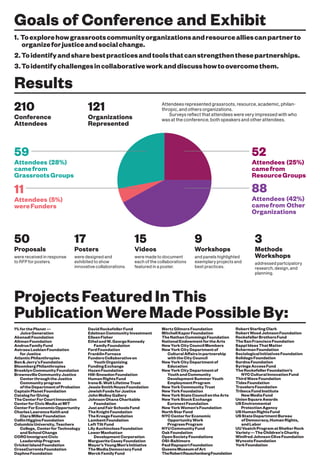
Goals of Conference and Exhibit
1. Toexplorehowgrassrootscommunityorganizationsandresourcealliescanpartnerto
organizeforjusticeandsocialchange.
2.Toidentifyandsharebestpracticesandtoolsthatcanstrengthenthesepartnerships.
3.Toidentifychallengesincollaborativeworkanddiscusshowtoovercomethem.
Results
50
Proposals
were received in response
to RFP for posters.
17
Posters
were designed and
exhibited to show
innovative collaborations.
15
Videos
were made to document
each of the collaborations
featured in a poster.
9
Workshops
and panels highlighted
exemplary projects and
best practices.
3
Methods
Workshops
addressed partcipatory
research, design, and
planning.
210
Conference
Attendees
59
Attendees (28%)
camefrom
GrassrootsGroups
11
Attendees (5%)
wereFunders
Attendees represented grassroots, resource, academic, philan-
thropic, and others organizations.
Surveys reflect that attendees were very impressed with who
was at the conference, both speakers and other attendees.
121
Organizations
Represented
ProjectsFeaturedInThis
PublicationWereMadePossibleBy:
1%forthePlanet—
JuiceGeneration
AkonadiFoundation
AltmanFoundation
AndrusFamilyFund
AstraeaLesbianFoundation
forJustice
AtlanticPhilanthropies
Ben&Jerry’sFoundation
BloombergPhilanthropies
BrooklynCommunityFoundation
BrownsvilleCommunityJustice
CenterthroughtheJustice
Communityprogram
oftheDepartmentofProbation
CaptainPlanetFoundation
CatalogforGiving
TheCenterForCourtInnovation
CenterforCivicMediaatMIT
CenterForEconomicOpportunity
CharlesLawrenceKeithand
ClaraMillerFoundation
CollinHigginsFoundation
ColumbiaUniversity,Teachers
College, CenterforTechnology
andSchoolChange
COROImmigrantCivic
LeadershipProgram
CricketIslandFoundation
CrossCurrentsFoundation
DaphneFoundation
DavidRockefellerFund
EdelmanCommunityInvestment
EileenFisher
EthelandW.GeorgeKennedy
FamilyFoundation
FordFoundation
FranklinFurnace
FundersCollaborativeon
YouthOrganizing
FundingExchange
HazenFoundation
Hill-SnowdonFoundation
HumanRightsFund
IreneB.WoltLifetimeTrust
JessieSmithNoyesFoundation
JewishFundsforJustice
JohnMolloyGallery
JohnsonOhanaCharitable
Foundation
JustandFairSchoolsFund
TheKnightFoundation
TheKresgeFoundation
LambentFoundation
LeftTiltFund
LilyAuchinclossFoundation
LowerManhattan
DevelopmentCorporation
MargueriteCaseyFoundation
Mayor’sYoungMen’sInitiative
TheMediaDemocracyFund
MerckFamilyFund
MertzGilmoreFoundation
MitchellKaporFoundation
TheNathanCummingsFoundation
NationalEndowmentfortheArts
NewYorkCityCouncilMembers
NewYorkCityDepartmentof
CulturalAffairsinpartnership
withtheCityCouncil
NewYorkCityDepartmentof
Education
NewYorkCityDepartmentof
YouthandCommunity
DevelopmentSummerYouth
EmploymentProgram
NewYorkCommunityTrust
NewYorkFoundation
NewYorkStateCouncilontheArts
NewYorkStockExchange
EuronextFoundation
NewYorkWomen’sFoundation
NorthStarFund
NYCCenterforEconomic
OpportunityWork
ProgressProgram
NYUCommunityFund
OakFoundation
OpenSocietyFoundations
OSI-Baltimore
PaulRapoportFoundation
QueensMuseumofArt
TheRobertRauschenbergFoundation
RobertSterlingClark
RobertWoodJohnsonFoundation
RockefellerBrothersFund
TheSanFranciscoFoundation
SappiIdeasThatMatter
SchermanFoundation
SociologicalInitiativesFoundation
SolidagoFoundation
SurdnaFoundation
SyringeAccessFund
TheRockefellerFoundation’s
NYCCulturalInnovationFund
ThirdWaveFoundation
TidesFoundation
TravelersFoundation
TribecaFundInstitute
NewMediaFund
UnionSquareAwards
USEnvironmental
ProtectionAgency
USHumanRightsFund
USStateDepartmentBureau
ofDemocracy,HumanRights,
andLabor
UUVeatchProgramatShelterRock
Variety—TheChildren’sCharity
WinifredJohnsonCliveFoundation
WyncoteFoundation
YorkFoundation
52
Attendees (25%)
camefrom
ResourceGroups
88
Attendees (42%)
camefrom Other
Organizations
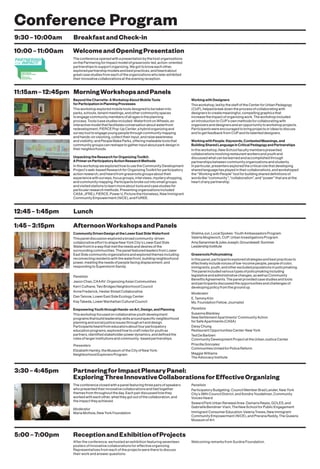
10:00–11:00am WelcomeandOpeningPresentation
Conference Program
9:30–10:00am BreakfastandCheck-in
Theconferenceopenedwithapresentationbythehostorganizations
onthePartneringforImpactmodelofgrassroots-led,action-oriented
partnershipstosupportorganizing.Wegottoknoweachother,
exploredpartnershipmodelsandbestpractices,andheardabout
greatcasestudiesfromeachoftheorganizationswholaterexhibited
theirinnovativecollaborationsattheeveningreception.
Welcoming remarks from Surdna Foundation.
5:00–7:00pm ReceptionandExhibitionofProjects
After the conference, we hosted an exhibition featuring seventeen
posters of innovative collaborations for effective organizing.
Representatives from each of the projects were there to discuss
their work and answer questions.
INNOVATIVE
COLLABORATIONS
FOR
EFFECTIVE
ORGANIZING
A CONFERENCE AND EXHIBIT
HOSTED BY:
Partnering for Impact is made possible
through the generous support of the
Surdna Foundation, and is co-sponsored by
The New School for Public Engagement
BeyondtheCharrette:AWorkshopAboutMobileTools
forParticipationinPlanningProcesses
Thisworkshopexploredmobiletoolsdesignedtobetakeninto
parks,schools,tenantmeetings,andothercommunityspaces
toengagecommunitymembersofallagesintheplanning
process.Tools/casestudiesincluded:WaterfrontonWheels,an
interactivemodelthatfacilitatesconversationaboutwaterfront
redevelopment;FIERCEPop-UpCenter,ahybridorganizingand
surveytooltoengageyoungpeoplethroughcommunitymapping
andhands-onvisioning,collecttheirinput,andraiseawareness
andvisibility;andPeopleMakeParks,offeringmalleabletoolsthat
communitygroupscanreshapetogatherinputaboutparkdesignin
theirneighborhoods.
UnpackingtheResearchforOrganizingToolkit:
APrimeronParticipatoryActionResearchMethods
InthisworkshopweexploredhowtousetheCommunityDevelopment
Project’sweb-basedResearchforOrganizingToolkitforparticipatory
actionresearch,andheardfromgrassrootsgroupsabouttheir
experiencewithsurveys,focusgroups,interviews,mysteryshopping,
andcommunitymapping.Participantsbrokeoutintosmallgroups
andvisitedstationstolearnmoreabouttoolsandcasestudiesfor
particularresearchmethods.Presentingorganizationsincluded
CASA,JFREJ,FIERCE,PowerU,PicturetheHomeless,NewImmigrant
CommunityEmpowerment(NICE),andFUREE.
11:15am–12:45pm MorningWorkshopsandPanels
WorkingwithDesigners
Thisworkshop,ledbythestaffoftheCenterforUrbanPedagogy
(CUP),helpedbreakdowntheprocessofcollaboratingwith
designerstocreatemeaningful,compellinggraphicsthat
increasetheimpactoforganizingwork.Theworkshopincluded
anintroductiontoCUP’sownmethodsforcollaboratingwith
organizersanddesignersandanopportunitytoworkshopprojects.
Participantswereencouragedtobringprojectsorideastodiscuss
andtogetfeedbackfromCUPanditstalenteddesigners.
WorkingwithPeople:Keywords,ContestedMeanings,and
BuildingSharedLanguageinCriticalPedagogyandPartnerships
Inthisworkshop,NewSchoolfacultymemberspresented
collaborationsinvolvingrestaurantworkersandyouthand
discussedwhatcanbelearnedandaccomplishedthrough
partnershipsbetweencommunityorganizationsandstudents.
Inparticular,presentersexploredthecriticalrolethatdeveloping
sharedlanguagehasplayedintheircollaborations,andworkshoped
the“WorkingwithPeople”toolforbuildingshareddefinitionsof
wordslike“community”,“collaboration”,and“power”thatareatthe
heartofanypartnership.
12:45–1:45pm Lunch
1:45–3:15pm AfternoonWorkshopsandPanels
ShelmaJun,LocalSpokes:YouthAmbassadorsProgram
ValeriaMogilevich,CUP:UrbanInvestigationsProgram
AmySananman&JulesJoseph,Groundswell:Summer
LeadershipInstitute
GrassrootsPolicymaking
Inthispanel,participantsexploredstrategiesandbestpracticesto
effectivelyincludevoicesoflow-incomepeople,peopleofcolor,
immigrants,youth,andotherexcludedpopulationsinpolicymaking.
Thepanelincludedvarioustypesofpolicymakingincluding
legislativeandadministrativechanges,aswellasCommunity
BenefitsAgreements.Thepanelprovidedcasestudiesandtools
andparticipantsdiscussedtheopportunitiesandchallengesof
developingpolicyfromthegroundup.
Moderator
E.TammyKim
Ms.FoundationFellow,Journalist
Panelists
SusannaBlankley
NewSettlementApartments’CommunityAction
forSafeApartments(CASA)
DaisyChung
RestaurantOpportunitiesCenter-NewYork
TedDeBarbieri
CommunityDevelopmentProjectattheUrbanJusticeCenter
PriscillaGonzalez
CommunitiesUnitedforPoliceReform
MaggieWilliams
TheAdvocacyInstitute
CommunityDrivenDesignattheLowerEastSideWaterfront
Thispaneldiscussionexploredabroadcommunity-driven
collaborativeefforttoshapeNewYorkCity’sLowerEastSide
Waterfrontinawaythatmettheneedsanddesiresofthe
surroundingcommunities.ThepanelfeaturedleadersfromLower
EastSidecommunityorganizationsandexploredthemesincluding:
reconnectingresidentswiththewaterfront,buildingneighborhood
power,meetingtheneedsofpeoplefacingdisplacement,and
respondingtoSuperstormSandy.
Panelists
JasonChan,CAAAV:OrganizingAsianCommunities
KerriCulhane,TwoBridgesNeighborhoodCouncil
AnneFrederick,HesterStreetCollaborative
DanTainow,LowerEastSideEcologyCenter
KayTakeda,LowerManhattanCulturalCouncil
EmpoweringYouththroughHands-onArt,Design,andPlanning
Thisworkshopfocusedoncollaborativeyouthdevelopment
programsthatbuildleadershipskillsaroundspecificneighborhood
planningandsocialjusticeissuesthroughartanddesign.
Participantsheardfromeducatorsaboutfourparticipatory
educationprograms,exploredhowtocraftrolesforyouthas
partners,identifiedstakeholderpowerdynamics,anddefinedthe
rolesoflargerinstitutionsandcommunity-basedpartnerships.
Presenters
ElizabethHamby,theMuseumoftheCityofNewYork:
NeighborhoodExplorersProgram
3:30–4:45pm PartneringforImpactPlenaryPanel:
ExploringThreeInnovativeCollaborationsforEffectiveOrganizing
Theconferenceclosedwithapanelfeaturingthreepairsofspeakers
whopresentedtheirinnovativecollaborationsandtiedtogether
themesfromthroughouttheday.Eachpairdiscussedhowthey
workedwitheachother,whattheygotoutofthecollaboration,and
theimpacttheyachieved.
Moderator
MariaMottola,NewYorkFoundation
Panelists
ParticipatoryBudgeting:CouncilMemberBradLander,NewYork
City’s39thCouncilDistrict,andSondraYoudelman,Community
VoicesHeard
SewardParkUrbanRenewalArea:DamarisReyes,GOLES,and
GabrielleBendiner-Viani,TheNewSchoolforPublicEngagement
ImmigrantConsumerEducation:ValeriaTreves,NewImmigrant
CommunityEmpowerment(NICE),andPreranaReddy,TheQueens
MuseumofArt
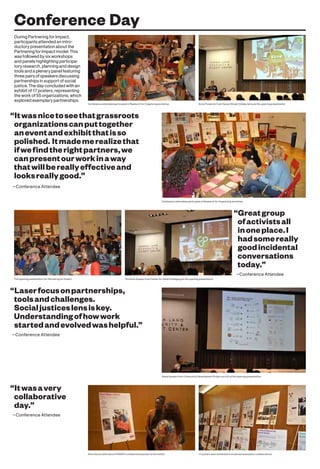
Conference Day
During Partnering for Impact,
participants attended an intro-
ductory presentation about the
Partnering for Impact model. This
was followed by six workshops
and panels highlighting participa-
tory research, planning and design
tools and a plenary panel featuring
three pairs of speakers discussing
partnerships in support of social
justice. The day concluded with an
exhibit of 17 posters, representing
the work of 55 organizations, which
explored exemplary partnerships.
“Itwasnicetoseethatgrassroots
organizationscanputtogether
aneventandexhibitthatisso
polished. Itmademerealizethat
ifwefindtherightpartners,we
canpresentourworkinaway
thatwillbereallyeffectiveand
looksreallygood.”
—Conference Attendee
“Laserfocusonpartnerships,
toolsandchallenges.
Socialjusticeslensiskey.
Understandingofhowwork
startedandevolvedwashelpful.”
—Conference Attendee
“Itwasavery
collaborative
day.”
—Conference Attendee
“Greatgroup
ofactivistsall
inoneplace.I
hadsomereally
goodincidental
conversations
today.”
—Conference Attendee
Conference attendees participate in Research for Organizing workshop Anne Frederick from Hester Street Collaborative at the opening presentation
Conference attendees participate in Research for Organizing workshop
The opening presentation for Partnering for Impact Christine Gaspar from Center for Urban Pedagogy at the opening presentation
Alexa Kasdan from Community Development Project at UJC at the opening presentation
Alicia Garza talks about POWER’s collaborative poster at the exhibit 17 posters were exhibited to showcase exemplary collaborations
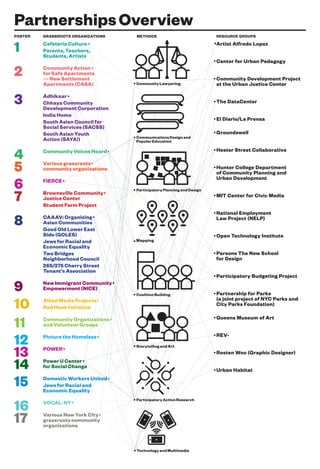
PartnershipsOverview
Artist Alfredo Lopez
Center for Urban Pedagogy
Community Development Project
at the Urban Justice Center
The DataCenter
El Diario/La Prensa
Groundswell
Hester Street Collaborative
Hunter College Department
of Community Planning and
Urban Development
MIT Center for Civic Media
National Employment
Law Project (NELP)
Open Technology Institute
Parsons The New School
for Design
Participatory Budgeting Project
Partnership for Parks
(a joint project of NYC Parks and
City Parks Foundation)
Queens Museum of Art
REV-
Rosten Woo (Graphic Designer)
Urban Habitat
Technology and Multimedia
Coalition Building
Community Lawyering
Communications Design and
Popular Education
Participatory Planning and Design
Mapping
Storytelling and Art
Participatory Action Research
GRASSROOTS ORGANIZATIONS METHODS RESOURCE GROUPSPOSTER
1
2
3
4
5
6
7
8
9
10
11
13
17
16
15
14
12
Cafeteria Culture
Parents, Teachers,
Students, Artists
Community Action
for Safe Apartments
—New Settlement
Apartments (CASA)
Adhikaar
Chhaya Community
Development Corporation
India Home
South Asian Council for
Social Services (SACSS)
South Asian Youth
Action (SAYA!)
Community Voices Heard
Various grassroots
community organizations
FIERCE
Brownsville Community
Justice Center
Student Farm Project
CAAAV: Organizing
Asian Communities
Good Old Lower East
Side (GOLES)
Jews for Racial and
Economic Equality
Two Bridges
Neighborhood Council
265/275 Cherry Street
Tenant’s Association
New Immigrant Community
Empowerment (NICE)
Allied Media Projects
Red Hook Initiative
Community Organizations
and Volunteer Groups
Picture the Homeless
POWER
Power U Center
for Social Change
Domestic Workers United
Jews for Racial and
Economic Equality
VOCAL-NY
Various New York City
grassroots community
organizations
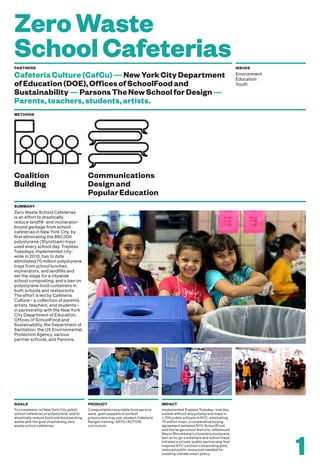
ZeroWaste
SchoolCafeteriasPARTNERS ISSUES
CafeteriaCulture(CafCu)—NewYorkCityDepartment
ofEducation(DOE),OfficesofSchoolFoodand
Sustainability—ParsonsTheNewSchoolforDesign—
Parents,teachers,students,artists.
Environment
Education
Youth
METHODS
Zero Waste School Cafeterias
is an effort to drastically
reduce landfill- and incinerator-
bound garbage from school
cafeterias in New York City, by
first eliminating the 860,000
polystyrene (Styrofoam) trays
used every school day. Trayless
Tuesdays, implemented city-
wide in 2010, has to date
eliminated 70 million polystyrene
trays from school lunches,
incinerators, and landfills and
set the stage for a citywide
school composting, and a ban on
polystyrene food containers in
both schools and restaurants.
The effort is led by Cafeteria
Culture— a collection of parents,
artists, teachers, and students—
in partnership with the New York
City Department of Education,
Offices of SchoolFood and
Sustainability, the Department of
Sanitation, the US Environmental
Protection Agency, various
partner schools, and Parsons.
SUMMARY
To completely rid New York City public
school cafeterias of polystyrene, and to
drastically reduce food and food packing
waste with the goal of achieving zero
waste school cafeterias.
GOALS
Compostable/recyclable food service
ware; giant puppets to protest
polystyrene tray use; student Cafeteria
Ranger training; ARTS+ACTION
curriculum.
PRODUCT
Implemented Trayless Tuesday—one day
a week without any polystyrene trays in
1,700 public schools in NYC, eliminating
70 million trays; a cooperative buying
agreement between NYC SchoolFood
and five large school districts; influenced
Mayor Bloomberg’s citywide polystyrene
ban on to-go containers and school trays;
initiated a private-public partnership that
inspired NYC’s school composting pilot;
reduced public resources needed for
creating climate smart policy.
IMPACT
1
Coalition
Building
Communications
Designand
PopularEducation
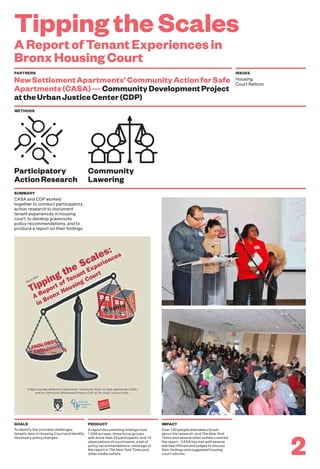
TippingtheScales
AReportofTenantExperiencesin
BronxHousingCourt
To identify the concrete challenges
tenants face in Housing Court and identify
necessary policy changes.
A report documenting findings from
1,055 surveys, three focus groups
with more than 25 participants, and 15
observations of courtrooms; a set of
policy recommendations; coverage of
the report in The New York Times and
other media outlets.
Over 120 people attended a forum
about the research, and The New York
Times and several other outlets covered
the report. CASA has met with several
elected officials and judges to discuss
their findings and suggested housing
court reforms.
GOALS PRODUCT IMPACT
2
PARTNERS ISSUES
NewSettlementApartments’CommunityActionforSafe
Apartments(CASA)—CommunityDevelopmentProject
attheUrbanJusticeCenter(CDP)
Housing
Court Reform
METHODS
CASA and CDP worked
together to conduct participatory
action research to document
tenant experiences in housing
court, to develop grassroots
policy recommendations, and to
produce a report on their findings.
SUMMARY
Participatory
ActionResearch
Community
Lawering
AShareSpacefor
SouthAsiansPARTNERS ISSUES
Adhikaar—ChhayaCommunityDevelopment
Corporation— HesterStreetCollaborative—IndiaHome
—SouthAsianCouncilforSocialServices(SACSS)—
SouthAsianYouthAction(SAYA!)
Land Use and Development
Civic Engagement
Immigration
Participatory
Planning
andDesign
Coalition
Building
Mapping
METHODS
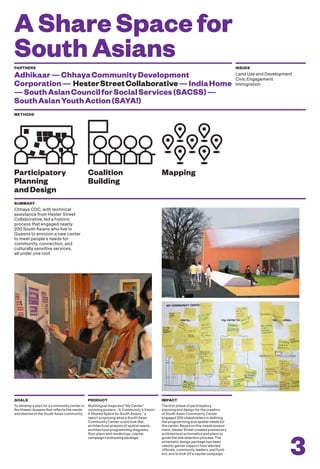
Chhaya CDC, with technical
assistance from Hester Street
Collaborative, led a historic
process that engaged nearly
200 South Asians who live in
Queens to envision a new center
to meet people’s needs for
community, connection, and
culturally sensitive services,
all under one roof.
SUMMARY
To develop a plan for a community center in
Northwest Queens that reflects the needs
and desires of the South Asian community.
Multilingual maps and “My Center”
visioning posters; “A Community’s Vision:
A Shared Space for South Asians,” a
report proposing what a South Asian
Community Center could look like;
architectural analysis of spatial needs;
architectural programming diagrams,
floor plans and renderings; capital
campaign fundraising package.
The first phase of participatory
planning and design for the creation
of South Asian Community Center
engaged 200 stakeholders in defining
the programming and spatial needs for
the center. Based on this needs assess-
ment, Hester Street created preliminary
architectural schematics and plans to
guide the site selection process. The
schematic design package has been
used to garner support from elected
officials, community leaders, and fund-
ers, and to kick off a capital campaign.
GOALS PRODUCT IMPACT
3
ParticipatoryBudgeting
inNewYorkCity
32
District 8
Council Member
Melissa Mark-Viverito
Brooklyn
Manhattan
Queens
Bronx
Transportation for Seniors
and Meals-on-Wheels
Delivery Van, $103,000
Playground Improvements
at Millbrook and Douglass
Houses, $500,000
New Technology for NY Public Library
Aguilar Branch, $60,000
A Home for Harlem RBI and
Dream Charter School, $513,000
Ultrasound System for
Metropolitan Hospital
Center, $105,000
Additional Project
New garbage cans for
specific corners, funded
by the Department of
Sanitation, $10,000
Installation of Security Cameras at
Public Housing Complexes, $525,000
CenterforUrbanPedagogy—CommunityDevelopment
ProjectattheUrbanJusticeCenter—Community
VoicesHeard—ParticipatoryBudgetingProject—
EightNewYorkCityCouncilMembers
PARTNERS ISSUES
METHODS
Land Use and Development
Civic Engagement
Coalition
Building
Participatory
Planning
and Design
Communications
Designand
PopularEducation
Mapping
SUMMARY
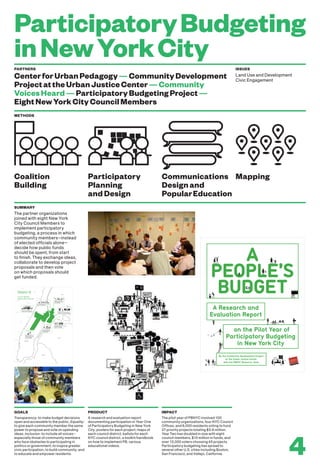
The partner organizations
joined with eight New York
City Council Members to
implement participatory
budgeting, a process in which
community members—instead
of elected officials alone—
decide how public funds
should be spent, from start
to finish. They exchange ideas,
collaborate to develop project
proposals and then vote
on which proposals should
get funded.
A
PeoPle’s
Budget
By the Community development Project
at the urban Justice Center
with the PBNYC Research team
on the Pilot Year of
Participatory Budgeting
in New York City
A Research and
evaluation Report
Transparency: to make budget decisions
open and accessible to the public; Equality:
to give each community member the same
power to propose and vote on spending
ideas; Inclusion: to include all voices—
especially those of community members
who face obstacles to participating in
politics or government; to inspire greater
civic participation; to build community; and
to educate and empower residents.
A research and evaluation report
documenting participation in Year One
of Participatory Budgeting in New York
City; posters for each project; maps of
each council district; ballots for each
NYC council district; a toolkit/handbook
on how to implement PB; various
educational videos.
The pilot year of PBNYC involved 100
community organizations, four NYC Council
Offices, and 6,000 residents voting to fund
27 priority projects totaling $5.6 million.
Year Two has doubled in size with eight
council members, $10 million in funds, and
over 13,000 voters choosing 45 projects.
Participatory budgeting has spread to
several other U.S. cities including Boston,
San Francisco, and Vallejo, California.
GOALS PRODUCT IMPACT
4
MakingPolicyPublic
To increase the capacity of individuals
to more effectively advocate for
themselves around an issue impacting
their community.
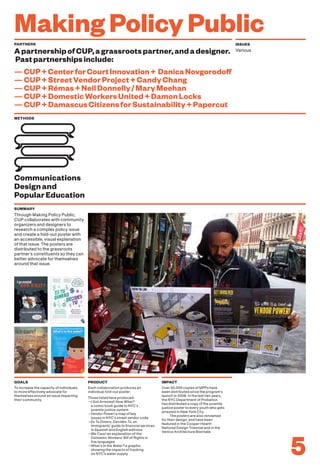
Each collaboration produces an
individual fold-out poster.
Those listed here produced:
—I Got Arrested! Now What?
a comic book guide to NYC’s
juvenile justice system
—Vendor Power! a map of key
issues in NYC’s street vendor code
—Es Tu Dinero, Decides Tú, an
immigrants’ guide to financial services
in Spanish and English editions
—We Care! an explanation of the
Domestic Workers’ Bill of Rights in
five languages
—What’s In the Water? a graphic
showing the impacts of fracking
on NYC’s water supply
Over 50,000 copies of MPPs have
been distributed since the program’s
launch in 2008. In the last two years,
the NYC Department of Probation
has distributed a copy of the juvenile
justice poster to every youth who gets
arrested in New York City.
The posters are also renowned
for their design, and have been
featured in the Cooper-Hewitt
National Design Triennial and in the
Venice Architecture Biennale.
GOALS PRODUCT IMPACT
5
PARTNERS ISSUES
ApartnershipofCUP,agrassrootspartner,andadesigner.
Pastpartnershipsinclude:
—CUP+CenterforCourtInnovation+ DanicaNovgorodoff
—CUP+StreetVendorProject+CandyChang
—CUP+Rémas+NeilDonnelly/MaryMeehan
—CUP+DomesticWorkersUnited+DamonLocks
—CUP+DamascusCitizensforSustainability+Papercut
Various
METHODS
Through Making Policy Public,
CUP collaborates with community
organizers and designers to
research a complex policy issue
and create a fold-out poster with
an accessible, visual explanation
of that issue. The posters are
distributed to the grassroots
partner’s constituents so they can
better advocate for themselves
around that issue.
SUMMARY
Communications
Designand
PopularEducation
OUR S.P.O.T.
(Safe Place to Organize Together)
To create a safe space for LGBTQ youth in
New York City’s West Village.
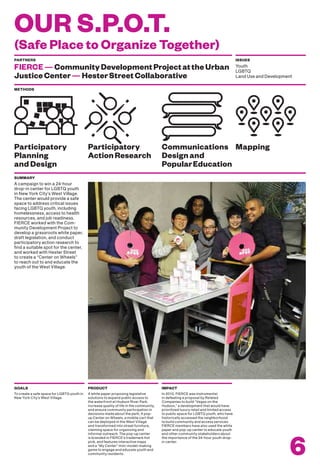
A white paper proposing legislative
solutions to expand public access to
the waterfront at Hudson River Park,
increase quality of life in the community,
and ensure community participation in
decisions made about the park; A pop-
up Center on Wheels, a mobile cart that
can be deployed in the West Village
and transformed into street furniture,
claiming space for organizing and
informal outreach. The pop-up center
is branded in FIERCE’s trademark hot
pink, and features interactive maps
and a “My Center” mini-model-making
game to engage and educate youth and
community residents.
In 2010, FIERCE was instrumental
in defeating a proposal by Related
Companies to build “Vegas on the
Hudson,” a development that would have
prioritized luxury retail and limited access
to public space for LGBTQ youth, who have
historically accessed the neighborhood
to build community and access services.
FIERCE members have also used the white
paper and pop-up center to educate youth
and other community stakeholders about
the importance of the 24-hour youth drop-
in center.
GOALS PRODUCT IMPACT
6
PARTNERS
FIERCE—CommunityDevelopmentProjectattheUrban
JusticeCenter—HesterStreetCollaborative
ISSUES
Youth
LGBTQ
Land Use and Development
METHODS
A campaign to win a 24-hour
drop-in center for LGBTQ youth
in New York City’s West Village.
The center would provide a safe
space to address critical issues
facing LGBTQ youth, including
homelessness, access to health
resources, and job readiness.
FIERCE worked with the Com-
munity Development Project to
develop a grassroots white paper,
draft legislation, and conduct
participatory action research to
find a suitable spot for the center,
and worked with Hester Street
to create a “Center on Wheels”
to reach out to and educate the
youth of the West Village.
SUMMARY
Participatory
ActionResearch
Participatory
Planning
and Design
Communications
Designand
PopularEducation
Mapping
PARTNERS
BrownsvilleCommunityJusticeCenter—Groundswell
—StudentFarmProject
ISSUES
Youth
Criminal Justice
Workers
Storytelling
andArt
METHODS
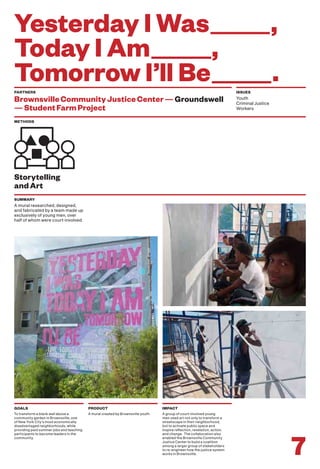
A mural researched, designed,
and fabricated by a team made up
exclusively of young men, over
half of whom were court-involved.
SUMMARY
To transform a blank wall above a
community garden in Brownsville, one
of New York City’s most economically
disadvantaged neighborhoods, while
providing paid summer jobs and teaching
participants to become leaders in the
community.
GOALS
A mural created by Brownsville youth.
PRODUCT
A group of court-involved young
men used art not only to transform a
streetscape in their neighborhood,
but to activate public space and
inspire reflection, revelation, action,
and change. The collaboration also
enabled the Brownsville Community
Justice Center to build a coalition
among a larger group of stakeholders
to re-engineer how the justice system
works in Brownsville.
IMPACT
7
Yesterday I Was ,
Today I Am ,
Tomorrow I’ll Be .
LowerEastSide
WaterfrontAlliancePARTNERS
CAAAV:OrganizingAsianCommunities—
CommunityDevelopmentProjectattheUrbanJustice
Center— dlandstudio—GoodOldLowerEastSide
(GOLES)—HesterStreetCollaborative—Jewsfor
RacialandEconomicJustice—LeroyStreetStudio—
LowerEastSideEcologyCenter—LowerManhattan
CulturalCouncil—NewYorkCityDepartmentofParks
&Recreation—OfficeofStateSenatorDanielSquadron
—TwoBridgesNeighborhoodCouncil—265/275Cherry
StreetTenant’sAssociation—UniversitySettlement
ISSUES
Land Use and Development
Civic Engagement
METHODS
After the New York City Economic
Development Corporation
proposed a redevelopment of
the East River waterfront on the
Lower East Side, the Waterfront
Alliance came together to push
for a redevelopment process that
prioritizes the needs and concerns
of residents and low-income and
immigrant communities.
SUMMARY
To create a development process that
puts residents at the forefront of land
use decisions in their community, and to
ensure the human, cultural, economic,
and environmental sustainability of the
East River waterfront areas adjacent to
the Lower East Side and Chinatown.
GOALS
“The People’s Plan,” a report summarizing
a comprehensive community visioning
process, highlighting residents’ needs
for affordable and culturally appropriate
services, recreation and programming,
and outlining site development strategies
for Piers 35, 36, and 42; a trilingual poster
campaign for local businesses and
residents to show their support for “The
People’s Plan”; Waterfront on Wheels,
an interactive mobile planning tool to
raise awareness about the ongoing
waterfront development; Paths to Pier 42,
a program of temporary art and design
installations and programming to create
interim access at Pier 42.
PRODUCT
Through this multi-phased campaign,
the alliance has been successful in
advocating for more community-
aligned recreational uses and less
high-end commercial development at
the waterfront. The Alliance has helped
raise $14 million in capital funds to
create new parkland at Pier 42, one of
the largest areas along the waterfront.
Community recommendations have
been successfully channeled into short-
and long-term improvements to the site.
The Alliance has attracted significant
media attention for the project.
IMPACT
8
Coalition
Building
Participatory
Planning and
Design
Storytelling
andArt
Participatory
Action
Research
ImmigrantConsumer
JusticeCampaign
To document the practices of employment
agencies and businesses that provide
immigration services, to document
immigrants’ experiences with agencies; to
develop policy recommendations; and to
educate new immigrants about common
types of fraud in immigration services and
at employment agencies.
GOALS
A graphic novel, “Jose Busca Legalizarse,”
and a report, “Dreams and Schemes in
Queens, New York: Immigrant Struggles
to Find Work and Get Status in the Face of
Consumer Fraud.”
PRODUCT
NICE has distributed over 2,000 copies
of the graphic novels to immigrants in
Queens and throughout New York City,
and is now working on a sequel that will
tell the story of a worker who experiences
fraud at an employment agency. The
report, “Dreams and Schemes,” was
covered in various media outlets,
including in an exclusive story in the New
York Daily News, and the release was
attended by various elected and agency
officials. Drawing from the research
and policy recommendations in the
report, NICE is now working on model
legislation for employment agency
reform, to enhance and strengthen the
enforcement capacities of the various
government agencies that regulate
employment agencies and immigration
service providers, and to raise broader
community awareness of these issues.
IMPACT
9
PARTNERS
CommunityDevelopmentProjectattheUrbanJustice
Center—ElDiario/LaPrensa—NewImmigrant
CommunityEmpowerment(NICE)—QueensMuseumof
Art—ArtistAlfredoLopez
ISSUES
Immigration
Workers
METHODS
Storytelling
andArt
Participatory
Action
Research
Communications
Designand
PopularEducation
Community
Lawering
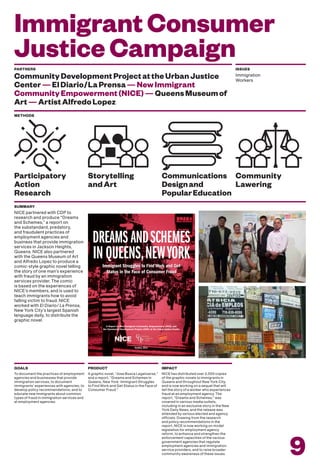
NICE partnered with CDP to
research and produce “Dreams
and Schemes,” a report on
the substandard, predatory,
and fraudulent practices of
employment agencies and
business that provide immigration
services in Jackson Heights,
Queens. NICE also partnered
with the Queens Museum of Art
and Alfredo Lopez to produce a
comic-style graphic novel telling
the story of one man’s experience
with fraud by an immigration
services provider. The comic
is based on the experiences of
NICE’s members, and is used to
teach immigrants how to avoid
falling victim to fraud. NICE
worked with El Diario/ La Prensa,
New York City’s largest Spanish
language daily, to distribute the
graphic novel.
SUMMARY
Dreams anDschemes
inQueens,newYorkImmigrant Struggles to Find Work and Get
Status in the Face of Consumer Fraud
A Report by New Immigrant Community Empowerment (NICE) and
the Community Development Project (CDP) at the Urban Justice Center
October, 2012
DigitalStewards
BuildingLocal
WirelessNetworksPARTNERS
AlliedMediaProjects—OpenTechnologyInstitute
—RedHookInitiative
ISSUES
Access to Information
Housing
Land Use and Development
Technology
andMultimedia
METHODS
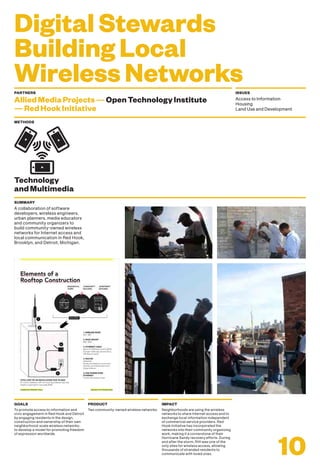
A collaboration of software
developers, wireless engineers,
urban planners, media educators
and community organizers to
build community-owned wireless
networks for Internet access and
local communication in Red Hook,
Brooklyn, and Detroit, Michigan.
SUMMARY
To promote access to information and
civic engagement in Red Hook and Detroit
by engaging residents in the design,
construction and ownership of their own
neighborhood-scale wireless networks;
to develop a model for promoting freedom
of expression worldwide.
GOALS
Two community-owned wireless networks.
PRODUCT
Neighborhoods are using the wireless
networks to share Internet access and to
exchange local information independent
of commercial service providers. Red
Hook Initiative has incorporated the
networks into their community organizing
work, making it a cornerstone of their
Hurricane Sandy recovery efforts. During
and after the storm, RHI was one of the
only sites for wireless access, allowing
thousands of stranded residents to
communicate with loved ones.
IMPACT
10
People Make Parks
To engage communities in the design and
development of New York City parks.
An online toolkit (PeopleMakeParks.org),
written publications and staff-supported
activities.
In the first phase of the project, over
a dozen parks-related groups have
received training and technical
assistance to participate in the
improvement of parks and public spaces;
NYC Parks has incorporated community
input generated by PMP into park
designs; and NYC Parks has encouraged
the use of PMP tools and processes as
part of the capital design process.
GOALS PRODUCT IMPACT
11
PARTNERS ISSUES
HesterStreetCollaborative—PartnershipforParks
(ajointprojectofNYCParksandCityParksFoundation)
—Communityorganizationsandvolunteergroups
Environment
Land Use and Development
METHODS
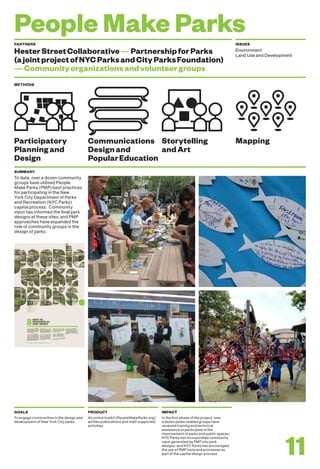
To date, over a dozen community
groups have utilized People
Make Parks (PMP) best practices
for participating in the New
York City Department of Parks
and Recreation (NYC Parks)
capital process. Community
input has informed the final park
designs at these sites, and PMP
approaches have expanded the
role of community groups in the
design of parks.
SUMMARY
Communications
Designand
PopularEducation
Participatory
Planning and
Design
Storytelling
andArt
Mapping
BankingonVacancy
HomelessnessandRealEstateSpeculation
To count the number of vacant properties
in New York City, and to show that
warehoused vacant property can play a
role in ending the city’s housing crisis.
A report: “Banking on Vacancy:
Homelessness and Real Estate
Speculation”
Over 130 people attended the release
of the report. Since then, PTH has held
over a dozen town hall meetings to share
the results of its count. PTH’s legislation
to institute an annual count of vacant
property (Intro 48) is one of the New
York City Council’s Progressive Caucus’
“bold new ideas” for 2013.
GOALS PRODUCT IMPACT
12
PARTNERS
HunterCollegeDepartmentofCommunityPlanning
andUrbanDevelopment—PicturetheHomeless
ISSUES
Housing
Land Use and Development
METHODS
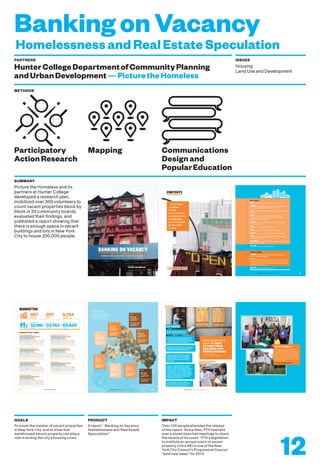
Picture the Homeless and its
partners at Hunter College
developed a research plan,
mobilized over 300 volunteers to
count vacant properties block by
block in 20 community boards,
evaluated their findings, and
published a report showing that
there is enough space in vacant
buildings and lots in New York
City to house 200,000 people.
SUMMARY
Communications
Designand
PopularEducation
MappingParticipatory
ActionResearch
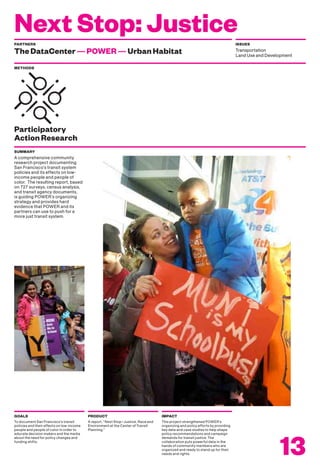
Next Stop: Justice
METHODS
A comprehensive community
research project documenting
San Francisco’s transit system
policies and its effects on low-
income people and people of
color. The resulting report, based
on 727 surveys, census analysis,
and transit agency documents,
is guiding POWER’s organizing
strategy and provides hard
evidence that POWER and its
partners can use to push for a
more just transit system.
SUMMARY
To document San Francisco’s transit
policies and their effects on low-income
people and people of color in order to
educate decision makers and the media
about the need for policy changes and
funding shifts.
GOALS
A report, “Next Stop—Justice, Race and
Environment at the Center of Transit
Planning.”
PRODUCT
This project strengthened POWER’s
organizing and policy efforts by providing
key data and case studies to help shape
policy recommendations and campaign
demands for transit justice. The
collaboration puts powerful data in the
hands of community members who are
organized and ready to stand up for their
needs and rights.
IMPACT
13
PARTNERS
TheDataCenter—POWER—UrbanHabitat
ISSUES
Transportation
Land Use and Development
Participatory
ActionResearch
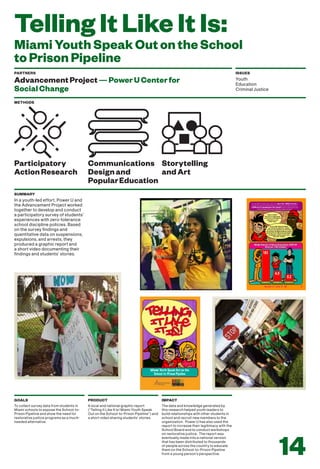
To collect survey data from students in
Miami schools to expose the School-to-
Prison Pipeline and show the need for
restorative justice programs as a much-
needed alternative.
GOALS
A local and national graphic report
(“Telling It Like It Is! Miami Youth Speak
Out on the School-to-Prison Pipeline”) and
a short video sharing students’ stories.
PRODUCT
The data and knowledge generated by
this research helped youth leaders to
build relationships with other students in
school and recruit new members to the
organization. Power U has also used the
report to increase their legitimacy with the
School Board and to conduct workshops
on restorative justice. The report was
eventually made into a national version
that has been distributed to thousands
of people across the country to educate
them on the School-to-Prison Pipeline
from a young person’s perspective.
IMPACT
14
Miami Youth Speak Out on the
School-to-Prison Pipeline
PARTNERS
AdvancementProject—PowerUCenterfor
SocialChange
ISSUES
Youth
Education
Criminal Justice
METHODS
In a youth-led effort, Power U and
the Advancement Project worked
together to develop and conduct
a participatory survey of students’
experiences with zero-tolerance
school discipline policies. Based
on the survey findings and
quantitative data on suspensions,
expulsions, and arrests, they
produced a graphic report and
a short video documenting their
findings and students’ stories.
SUMMARY
Participatory
ActionResearch
Communications
Designand
PopularEducation
Storytelling
andArt
Telling It Like It Is . . . 5Telling It Like It Is . . . 5
Source: Florida Department
of Education
4.5
3.2
Miami-Dade Out-of-School Suspensions 2008-09
Rates per 100 students
Miami-Dade Out-of-School Suspensions 2008-09
Rates per 100 students
BlackBlack LatinoLatino WhiteWhite
For the 2009-10 school year, there were more than 18,000 referrals of
Florida students to the Department of Juvenile Justice (DJJ), and over
12,000 were for misdemeanors (not felonies). Black students were sent
to the DJJ three times more often than White students.
How is it unfair?
This stuff is totally jacked
up, but if we’ re all facing the
same rules, it’ s not
unfair, right?
Do you really think all students
are treated the same? Sure, students
of all races and ethnicities are affected by
zero tolerance. But Black and Brown students
get the worst of it. We are far more likely to
be suspended, expelled, and arrested
than other students.
TellingItLikeItIs:
MiamiYouthSpeakOutontheSchool
toPrisonPipeline
New Day New Standard
(NDNS)PARTNERS
REV–—DomesticWorkersUnited—MITCenterforCivic
Media—CommunityDevelopmentProjectattheUrban
JusticeCenter—JewsforRacialandEconomicJustice
—NationalEmploymentLawProject
ISSUES
Workers
Immigration
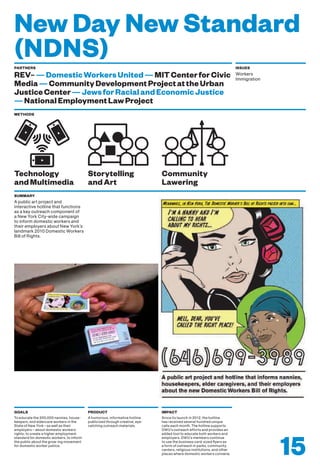
To educate the 200,000 nannies, house-
keepers, and eldercare workers in the
State of New York—as well as their
employers— about domestic workers’
rights; to create a higher employment
standard for domestic workers; to inform
the public about the grow-ing movement
for domestic worker justice.
GOALS
A humorous, informative hotline
publicized through creative, eye-
catching outreach materials.
PRODUCT
Since its launch in 2012, the hotline
has received several hundred unique
calls each month. The hotline supports
DWU’s outreach efforts and provides an
added tool to educate both workers and
employers. DWU’s members continue
to use the business card-sized flyers as
a form of outreach in parks, community
centers, religious institutions, and other
places where domestic workers convene.
IMPACT
METHODS
Storytelling
andArt
Community
Lawering
A public art project and
interactive hotline that functions
as a key outreach component of
a New York City-wide campaign
to inform domestic workers and
their employers about New York’s
landmark 2010 Domestic Workers
Bill of Rights.
SUMMARY
15
Technology
andMultimedia
Stuck in the System:
Community-Driven Research about Drug
Policy, Harm Reduction and Public Health
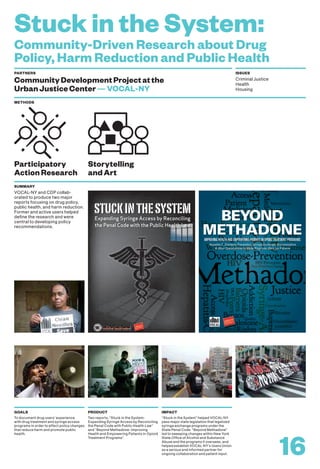
To document drug users’ experience
with drug treatment and syringe access
programs in order to effect policy changes
that reduce harm and promote public
health.
GOALS
Two reports, “Stuck in the System:
Expanding Syringe Access by Reconciling
the Penal Code with Public Health Law”
and “Beyond Methadone: Improving
Health and Empowering Patients in Opioid
Treatment Programs”.
PRODUCT
“Stuck in the System” helped VOCAL-NY
pass major state legislation that legalized
syringe exchange programs under the
State Penal Code. “Beyond Methadone”
led to sweeping changes within New York
State Office of Alcohol and Substance
Abuse and the programs it oversees, and
helped establish VOCAL-NY’s Users Union
as a serious and informed partner for
ongoing collaboration and patient input.
IMPACT
16
PARTNERS
CommunityDevelopmentProjectatthe
UrbanJusticeCenter—VOCAL-NY
ISSUES
Criminal Justice
Health
Housing
METHODS
VOCAL-NY and CDP collab-
orated to produce two major
reports focusing on drug policy,
public health, and harm reduction.
Former and active users helped
define the research and were
central to developing policy
recommendations.
SUMMARY
Participatory
ActionResearch
Storytelling
andArt
StuckintheSyStem
Expanding Syringe Access by Reconciling
the Penal Code with the Public Health Law
ImprovIng HealtHand empowerIng patIents In opIoIdtreatment programs
Hepatitis C, Overdose Prevention, Syringe Exchange, Buprenorphine
& Other Opportunities to Make Programs Work For Patients
ImprovIng HealtHand empowerIng patpatp Ients In opIoIdtreatment programs
Beyond
Methadone
Research for
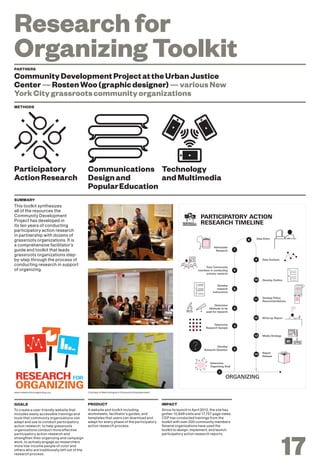
Organizing ToolkitPARTNERS
CommunityDevelopmentProjectattheUrbanJustice
Center—RostenWoo(graphicdesigner)—variousNew
YorkCitygrassrootscommunityorganizations
To create a user-friendly website that
includes easily accessible trainings and
tools that community organizations can
adapt and use to conduct participatory
action research; to help grassroots
organizations conduct more effective
participatory action research and
strengthen their organizing and campaign
work; to actively engage as researchers
more low-income people of color and
others who are traditionally left out of the
research process.
GOALS
A website and toolkit including
worksheets, facilitator’s guides, and
templates that users can download and
adapt for every phase of the participatory
action research process.
PRODUCT
Since its launch in April 2012, the site has
gotten 10,849 visits and 17,757 page views.
CDP has conducted trainings from the
toolkit with over 200 community members.
Several organizations have used the
toolkit to design, implement, and launch
participatory action research reports.
IMPACT
METHODS
17
This toolkit synthesizes
all of the resources the
Community Development
Project has developed in
its ten years of conducting
participatory action research
in partnership with dozens of
grassroots organizations. It is
a comprehensive facilitator’s
guide and toolkit that leads
grassroots organizations step-
by-step through the process of
conducting research in support
of organizing.
SUMMARY
1
2
4
5
6
7
8
9
10
11
12
13
14
3
PARTICIPATORY ACTION
RESEARCH TIMELINERESEARCHFOR
ORGANIZING
Determine
Organizing Goal
Develop
Research Question
Determine
Research Sample
Determine
Methods to be
used for research
Develop
research
instructions
Train Community
members in conducting
primary research
Administer
Research
Data Entry
Data Analysis
Develop Outline
Develop Policy
Recommendations
Write-up Report
Media Strategy
Report
Release
ORGANIZING
Courtesy of New Immigrant Community Empowerment
Research for Organizing
Toolkit
Facilitator’s Guide and Toolkit
Urban Justice Center
Community Development Project
Research and Organizing Initiative
RESEARCH FOR
ORGANIZINGwww.researchfororganizing.org
Technology
andMultimedia
Communications
Designand
PopularEducation
Participatory
ActionResearch
Sponsors,Acknowledgements,
andAttendees
ACKNOWLEDGEMENTS
The conference organizers would like to
thank the following people and institutions
for their generous support and assistance
in making this conference and reception
possible: from The New School, Pam
Tillis, Gabrielle Bendiner-Viani, Andrew
White, Andrea Marpillero-Colomina, and
the facilities staff at 55 West 13th Street;
the Surdna Foundation, particularly Jess
Garz, Judilee Reed and Christina Rupp;
the New York Foundation; the conference
advisory committee: Maria Mottola, Laine
Romero-Alston, Peter Gee, Michelle de la
Uz, and Seema Agnani; Manuel Miranda
for design of the conference posters;
videographers Charlotte Glynn and Eddie
Martinez; E. Tammy Kim; all the panelists,
presenters, and exhibitors at today’s
conference; and the volunteers who have
offered their time to help make the event a
success. We also extend a special thanks
to all of the community organizations and
members who inspire us to work for social
change. Lastly, very special thanks to Ben
Palmquist for the overall coordination of the
conference and exhibit.
ORGANIZATIONS IN ATTENDANCE
596 Acres
https://596acres.org
Advancement Project
www.advancementproject.org
Advocacy Institute
www.advocacyinstitute.org
Afscme
www.afscme.org
Albert Einstein-Montefiore Hospital
www.montefiore.org
Alliance for Climate Education (ACE)
www.acespace.org
ANHD
www.anhd.org
Artefacting
www.artefacting.com
Asian Americans for Equality
(AAFE)
www.aafe.org
Association of Legal Aid Attorneys /
UAW local 2325
www.alaa.org
Bernheimer Architect
www.bernheimerarchitecture.com
Blank Plate
www.blank-plate.com
Brooklyn Food Coalition
www.brooklynfoodcoalition.org
Brooklyn Movement Center
www.brooklynmovementcenter.org
Brownsville Community
Justice Center
www.brownsvillejusticecenter.blogspot.com
Brownsville Partnership
www.brownsvillepartnership.blogspot.com
Build It Green!NYC
www.bignyc.org
CAAAV: Organizing Asian
Communities
www.caaav.org
Cafeteria Culture
www.cafeteriaculture.org
CASA — New Settlement
Apartments
www.settlementhousingfund.org/index.html
Center for Urban Pedagogy
www.welcometocup.org
CFY-NYC
cfy.org
Chhaya CDC
www.chhayacdc.org
Child Welfare Organizing Project
www.cwop.org
Citizens Committee for
New York CIty
www.citizensnyc.org
CoFED
www.cofed.coop
College and Community Fellowship
www.collegeandcommunity.org
Columbia University GSAPP
www.arch.columbia.edu
CommunitiesUnitedforPoliceReform
www.changethenypd.org
CommunityDevelopmentProjectatUJC
www.cdp-ny.org
Community Voices Heard
www.cvhaction.org
Cooper Square Committee
www.coopersquare.org
Cooper Union Institute for
Sustainable Design
cooper.edu/isd
Cornell University
www.cornell.edu
CUNY
www.cuny.edu/index.html
Cypress Hills Local
Development Corporation
https://sites.google.com/a/cypresshills.org/cypress-hills-
local-development-corporation
Debevoise & Plimpton
www.debevoise.com
Design Trust for Public Space
www.designtrust.org
DWU Grassroots
www.domesticworkersunited.org/index.php/en
Eugene Lang College,
The New School
www.newschool.edu/lang
FIERCE
www.fiercenyc.org
Ford Foundation
www.fordfoundation.org
Friends of the High Line
www.thehighline.org
Girls for Gender Equity
www.ggenyc.org
GOLES
www.goles.org
Groundswell
www.groundswell.org
Hester Street Collaborative
www.hesterstreet.org
Homelessness Outreach and
Prevention Project
www.urbanjustice.org
Human Rights Project,
Urban Justice Center
www.urbanjustice.org/ujc/projects/human.html
IDEO
www.ideo.com
Inscape Publico
www.inscapepublico.org/index.html
Interaction Institute for
Social Change
www.interactioninstitute.org
Ironbound Community Corporation
www.ironboundcc.org
Jessie Smith Noyes Foundation
www.noyes.org
Jews for Racial & Economic Justice
www.jfrej.org
Labor Lines/CyTUnidos
www.laborlines.com
Lower Manhattan Cultural Council
www.lmcc.net
Lower East Side Ecology Center
www.lesecologycenter.org
MARP
www.myrtleavenue.org
Meerkat Media
Collective Resource
www.meerkatmedia.org
Mertz Gilmore Foundation
www.mertzgilmore.org
Mozilla Hive NYC
www.explorecreateshare.org
Ms. Foundation for Women
www.forwomen.org
Museum of the City of New York
www.mcny.org
National Economic and Social Rights
www.nesri.org
National Housing Institute Resource
www.nhi.org
New Immigrant Community
Empowerment (NICE)
www.nynice.org
New York City CouncilGovernment
www.council.nyc.gov/html/home/home.shtml
New York Foundation
www.nyf.org
New York School of Interior Design
www.nysid.edu
Northwest Bronx Community and
Clergy Coalition Grassroots
www.nyc.gov/html/dycd/html/home/home.shtml
NYC Dept. of Youth and
Community Development
www.nyc.gov/html/dycd/html/home/home.shtml
NYCpublic.org
www.nycpublic.org
Open Technology Institute
www.oti.newamerica.net
Parsons The New School for Design
www.newschool.edu/parsons
Partnerships for Parks
www.cityparksfoundation.org/partnerships-for-parks
Peoples MEDIA Center
www.peoplesmediacenter.net
Persist Health Project
www.persisthealthproject.org
Picture the Homeless
www.picturethehomeless.org
POWER
Power U Center for Social Change
www.poweru.org
Pratt Institute
www.pratt.edu
Project Pericles
www.projectpericles.org/projectpericles
PW Marketing
www.pwmarketing.com
Queens College CUNY
www.qc.cuny.edu/Pages/home.aspx
Queens Museum of Art
www.queensmuseum.org
Red Hook Initiative
www.rhicenter.org
Red Umbrella Project
www.redumbrellaproject.org
Respond and Rebuild
www.respondandrebuild.org
REV-
www.studiorev.org/index.html
Riders Alliance
www.ridersny.org
Right to the City Alliance
www.righttothecity.org
Rise
www.riseconference.org
Robin Hood Foundation
www.robinhood.org
ROC-NY
www.rocny.org
Rutgers University
www.rutgers.edu
Scherman Foundation
www.scherman.org
Surdna Foundation
www.surdna.org
SustyQ
www.sustyq.com
TCC Group
www.tccgrp.com
The Hudson Companies
www.hudsoninc.com
The Laundromat Project
www.laundromatproject.org
The Legal Aid Society
www.legal-aid.org/en/home.aspx
The Nathan Cummings Foundation
www.nathancummings.org
The New School
www.newschool.edu
The New School for
Public Engagement
www.newschool.edu/public-engagement
The Participatory Budgeting Project
www.participatorybudgeting.org
Transportation Alternatives
www.transalt.org
Two Bridges Neighborhood Council
www.twobridges.org
TWU
www.twu.org
UAW 2325 — Association of
Legal Aid Attorneys
www.alaa.org
Union Square Awards
www.unionsquareawards.org
University of Hawaii at Manoa
www.manoa.hawaii.edu
University of Richmond
www.richmond.edu
Urban Justice Center
www.urbanjustice.org
Urban Omnibus
www.urbanomnibus.net
Villanova University
www1.villanova.edu/villanova.html
VOCAL-NY
www.vocal-ny.org
WE ACT for Environmental Justice
www.weact.org
WHEDco
www.whedco.org
SPONSORS
Center for Urban Pedagogy
The Center for Urban Pedagogy (CUP)
is a nonprofit organization that uses
the power of design and art to increase
meaningful civic engagement, particularly
among historically under-represented
communities. CUP collaborates with
designers, educators, advocates, students,
and communities to make educational
tools that demystify complex policy and
planning issues. We believe that increasing
understanding of how these systems work is
the first step to better, more equitable, and
more diverse community participation.
welcometoCUP.org
Community Development Project
at the Urban Justice Center
The Community Development Project
(CDP) at the Urban Justice Center
strengthens the impact of grassroots
organizations in New York City’s low-income
and other excluded communities. We
partner with community organizations to
win legal cases, publish community-driven
research reports, assist with the formation
of new organizations and cooperatives, and
provide technical assistance in support of
their work towards social justice.
cdp-ny.org
Hester Street Collaborative
Hester Street Collaborative’s (HSC) mission
is to empower residents of underserved
communities by providing them with the
tools and resources necessary to have
a direct impact on shaping their built
environment. We do this through a hands-on
approach that combines design, education,
and advocacy. HSC seeks to create
more equitable, sustainable, and vibrant
neighborhoods where community voices
lead the way in improving their environment
and neglected public spaces.
hesterstreet.org
The New School for
Public Engagement
The New School for Public Engagement
is the university’s founding division, and is
now one of seven divisions that compose
The New School. The mission of The New
School for Public Engagement is to create
and nurture a learning community marked
by interdisciplinary engagement with
real-world issues and the integration of
professional, civic, and liberal learning.
The division’s diverse programs share
a commitment to learning that makes
a difference in the world. NSPE’s Civic
Engagement initiatives and the Center for
New York City Affairs have supported this
event.
www.newschool.edu/public-engagement
Surdna Foundation
The Surdna Foundation seeks to foster
sustainable communities in the United
States—communities guided by principles
of social justice and distinguished by
healthy environments, strong local
economies, and thriving cultures. We seek
to dismantle the structural barriers that
limit opportunity for many, helping to create
communities that are prosperous, culturally
enriching, and sustainable.
www.surdna.org

pfi_booklet_1

  • 1.
    = IMPACT!EffectiveOrganizing forSocial Justice Together they collaborate to win organizing campaigns toward social justice. THE PARTNERING FOR IMPACT MODEL TYPES OF PARTNERSHIPS Participatory ActionResearch Action-oriented process in which community members are central to the design, administration and analysis of the research. PAR is used to educate community members, engage elected officials, garner media attention and advocate for socially just policies. CommunicationsDesign andPopularEducation Works of visual communication that make complex issues accessible to lay audiences, and that are created in partnership with the community organizers and their constituents. + Community Issues Grassroots groups define issue affecting their community and organize for change. Resource Allies Resource allies take the lead from grassroots partners, developing methods and tools for community to take action. Partnering for IMPACT! InnovativeCollaborationsforEffectiveOrganizing: CaseStudiesfromaConferenceandExhibitHostedby CommunityLawyering Lawyering that is done in partnership with community groups in support of broader advocacy and organizing efforts. StorytellingandArt Works of aural, visual, or performing arts created with community members as not just audience but also as collaborators, and that address issues of social relevance to the participants. TechnologyandMultimedia Projects that use technology and media such as audio, video, and web-based components to create a broader range of tools to be used in community organizing and that increase the openness of communications technology, making it more accessible to low-income groups and others impacted by the “digital divide.” Coalition Building Various organizations and stakeholders come together to build power to win a campaign. Participatory PlanningandDesign A process to engage community stakeholders and gather their input on land-use planning so that the community can have an informed voice in how their neighborhood looks and feels. This input is then used to advocate with decision-makers to ensure the implementation and realization of the community’s land-use vision. Mapping Using maps to identify local knowledge, history, or assets to visualize disparities, usage, or resources that inform an advocacy goal.
  • 2.
    Letter fromtheHostsof Partnering forImpact AlexaKasdan Directorof Research & Policy Community Development Project ChristineGaspar Executive Director Center for Urban Pedagogy AnneFredrick Executive Director Hester Street Collaborative On Tuesday, June 4th, 2013, the Center for Urban Pedagogy, the Community Development Project at UJC and Hester Street Collaborative hosted Partnering for Impact, a conference and exhibit, to explore how resource groups and community organizations can work together towards effective organizing. As three resource organizations that have collaborated with many community groups using various methods—research, planning, and design—we have learned a lot about what works and what doesn’t work when it comes to partnerships. We have seen the impact of collaborative projects built from the ground up and driven by the needs and priorities of communities. We have seen that partnerships that strengthen organizing efforts and advance social change are effective and add value for community groups and resource allies. We have also seen many talented researchers, artists, planners, and architects who are eager to apply their skills where they will have real value and impact. Our work has also shown us the challenges that can arise in partnerships: rocky funding landscapes, resource organizations parachuting in and telling communities what is best, collaborations that fail to build equal and lasting relationships, the mismatches between needs and resources, and a reliance on pro-bono work that makes it hard for partners to hold each other accountable. These experiences, insights, and frustrations led us to develop Partnering for Impact, to create a forum for elevating best practices, exploring challenges, forging new partnerships, and seeding new ideas. It turns out we were not alone. The conference and exhibit, which were co-sponsored by the Surdna Foundation and the New School for Public Engagement, drew 210 people from 121 organizations—reaching full capacity for the event. These included participants from grassroots organizations, artists, researchers, designers, policymakers and academics. The day’s events included 9 workshops and panels highlighting participatory research, planning and design tools for organizers and lessons learned from a wide variety of projects. The workshops were hands-on, participatory and covered a range of resource partnerships. The day ended with a reception and an exhibition of 17 multidisciplinary projects highlighting the work of 55 organizations. Throughout the day, we also captured footage for the creation of 15 mini-documentaries highlighting those projects. We were thrilled to share and learn from others about what works and what doesn’t work when it comes to partnerships. Through our 9 workshops and panels, we learned about the impact of collaborative projects built from the ground up and driven by the needs and priorities of communities. We heard from community organizers about ways they have worked with resource allies to advance social change and we also learned from many talented researchers, artists, planners, and architects about the best practices in their collaborations. As we reflect on the conference, we realize that there is tremendous demand for support, recognition, and information sharing around these issues. We have created this publication in an effort to continue the dialogue and to share our results with a broader audience. In the mean time, you can find out more about the conference and see the videos online at: http://cdp-ny.org/pfi/. We hope you find this publication helpful and we look forward to learning from and sharing with you as we continue this important work into the future. In solidarity,
  • 3.
    Goals of Conferenceand Exhibit 1. Toexplorehowgrassrootscommunityorganizationsandresourcealliescanpartnerto organizeforjusticeandsocialchange. 2.Toidentifyandsharebestpracticesandtoolsthatcanstrengthenthesepartnerships. 3.Toidentifychallengesincollaborativeworkanddiscusshowtoovercomethem. Results 50 Proposals were received in response to RFP for posters. 17 Posters were designed and exhibited to show innovative collaborations. 15 Videos were made to document each of the collaborations featured in a poster. 9 Workshops and panels highlighted exemplary projects and best practices. 3 Methods Workshops addressed partcipatory research, design, and planning. 210 Conference Attendees 59 Attendees (28%) camefrom GrassrootsGroups 11 Attendees (5%) wereFunders Attendees represented grassroots, resource, academic, philan- thropic, and others organizations. Surveys reflect that attendees were very impressed with who was at the conference, both speakers and other attendees. 121 Organizations Represented ProjectsFeaturedInThis PublicationWereMadePossibleBy: 1%forthePlanet— JuiceGeneration AkonadiFoundation AltmanFoundation AndrusFamilyFund AstraeaLesbianFoundation forJustice AtlanticPhilanthropies Ben&Jerry’sFoundation BloombergPhilanthropies BrooklynCommunityFoundation BrownsvilleCommunityJustice CenterthroughtheJustice Communityprogram oftheDepartmentofProbation CaptainPlanetFoundation CatalogforGiving TheCenterForCourtInnovation CenterforCivicMediaatMIT CenterForEconomicOpportunity CharlesLawrenceKeithand ClaraMillerFoundation CollinHigginsFoundation ColumbiaUniversity,Teachers College, CenterforTechnology andSchoolChange COROImmigrantCivic LeadershipProgram CricketIslandFoundation CrossCurrentsFoundation DaphneFoundation DavidRockefellerFund EdelmanCommunityInvestment EileenFisher EthelandW.GeorgeKennedy FamilyFoundation FordFoundation FranklinFurnace FundersCollaborativeon YouthOrganizing FundingExchange HazenFoundation Hill-SnowdonFoundation HumanRightsFund IreneB.WoltLifetimeTrust JessieSmithNoyesFoundation JewishFundsforJustice JohnMolloyGallery JohnsonOhanaCharitable Foundation JustandFairSchoolsFund TheKnightFoundation TheKresgeFoundation LambentFoundation LeftTiltFund LilyAuchinclossFoundation LowerManhattan DevelopmentCorporation MargueriteCaseyFoundation Mayor’sYoungMen’sInitiative TheMediaDemocracyFund MerckFamilyFund MertzGilmoreFoundation MitchellKaporFoundation TheNathanCummingsFoundation NationalEndowmentfortheArts NewYorkCityCouncilMembers NewYorkCityDepartmentof CulturalAffairsinpartnership withtheCityCouncil NewYorkCityDepartmentof Education NewYorkCityDepartmentof YouthandCommunity DevelopmentSummerYouth EmploymentProgram NewYorkCommunityTrust NewYorkFoundation NewYorkStateCouncilontheArts NewYorkStockExchange EuronextFoundation NewYorkWomen’sFoundation NorthStarFund NYCCenterforEconomic OpportunityWork ProgressProgram NYUCommunityFund OakFoundation OpenSocietyFoundations OSI-Baltimore PaulRapoportFoundation QueensMuseumofArt TheRobertRauschenbergFoundation RobertSterlingClark RobertWoodJohnsonFoundation RockefellerBrothersFund TheSanFranciscoFoundation SappiIdeasThatMatter SchermanFoundation SociologicalInitiativesFoundation SolidagoFoundation SurdnaFoundation SyringeAccessFund TheRockefellerFoundation’s NYCCulturalInnovationFund ThirdWaveFoundation TidesFoundation TravelersFoundation TribecaFundInstitute NewMediaFund UnionSquareAwards USEnvironmental ProtectionAgency USHumanRightsFund USStateDepartmentBureau ofDemocracy,HumanRights, andLabor UUVeatchProgramatShelterRock Variety—TheChildren’sCharity WinifredJohnsonCliveFoundation WyncoteFoundation YorkFoundation 52 Attendees (25%) camefrom ResourceGroups 88 Attendees (42%) camefrom Other Organizations
  • 4.
    10:00–11:00am WelcomeandOpeningPresentation Conference Program 9:30–10:00amBreakfastandCheck-in Theconferenceopenedwithapresentationbythehostorganizations onthePartneringforImpactmodelofgrassroots-led,action-oriented partnershipstosupportorganizing.Wegottoknoweachother, exploredpartnershipmodelsandbestpractices,andheardabout greatcasestudiesfromeachoftheorganizationswholaterexhibited theirinnovativecollaborationsattheeveningreception. Welcoming remarks from Surdna Foundation. 5:00–7:00pm ReceptionandExhibitionofProjects After the conference, we hosted an exhibition featuring seventeen posters of innovative collaborations for effective organizing. Representatives from each of the projects were there to discuss their work and answer questions. INNOVATIVE COLLABORATIONS FOR EFFECTIVE ORGANIZING A CONFERENCE AND EXHIBIT HOSTED BY: Partnering for Impact is made possible through the generous support of the Surdna Foundation, and is co-sponsored by The New School for Public Engagement BeyondtheCharrette:AWorkshopAboutMobileTools forParticipationinPlanningProcesses Thisworkshopexploredmobiletoolsdesignedtobetakeninto parks,schools,tenantmeetings,andothercommunityspaces toengagecommunitymembersofallagesintheplanning process.Tools/casestudiesincluded:WaterfrontonWheels,an interactivemodelthatfacilitatesconversationaboutwaterfront redevelopment;FIERCEPop-UpCenter,ahybridorganizingand surveytooltoengageyoungpeoplethroughcommunitymapping andhands-onvisioning,collecttheirinput,andraiseawareness andvisibility;andPeopleMakeParks,offeringmalleabletoolsthat communitygroupscanreshapetogatherinputaboutparkdesignin theirneighborhoods. UnpackingtheResearchforOrganizingToolkit: APrimeronParticipatoryActionResearchMethods InthisworkshopweexploredhowtousetheCommunityDevelopment Project’sweb-basedResearchforOrganizingToolkitforparticipatory actionresearch,andheardfromgrassrootsgroupsabouttheir experiencewithsurveys,focusgroups,interviews,mysteryshopping, andcommunitymapping.Participantsbrokeoutintosmallgroups andvisitedstationstolearnmoreabouttoolsandcasestudiesfor particularresearchmethods.Presentingorganizationsincluded CASA,JFREJ,FIERCE,PowerU,PicturetheHomeless,NewImmigrant CommunityEmpowerment(NICE),andFUREE. 11:15am–12:45pm MorningWorkshopsandPanels WorkingwithDesigners Thisworkshop,ledbythestaffoftheCenterforUrbanPedagogy (CUP),helpedbreakdowntheprocessofcollaboratingwith designerstocreatemeaningful,compellinggraphicsthat increasetheimpactoforganizingwork.Theworkshopincluded anintroductiontoCUP’sownmethodsforcollaboratingwith organizersanddesignersandanopportunitytoworkshopprojects. Participantswereencouragedtobringprojectsorideastodiscuss andtogetfeedbackfromCUPanditstalenteddesigners. WorkingwithPeople:Keywords,ContestedMeanings,and BuildingSharedLanguageinCriticalPedagogyandPartnerships Inthisworkshop,NewSchoolfacultymemberspresented collaborationsinvolvingrestaurantworkersandyouthand discussedwhatcanbelearnedandaccomplishedthrough partnershipsbetweencommunityorganizationsandstudents. Inparticular,presentersexploredthecriticalrolethatdeveloping sharedlanguagehasplayedintheircollaborations,andworkshoped the“WorkingwithPeople”toolforbuildingshareddefinitionsof wordslike“community”,“collaboration”,and“power”thatareatthe heartofanypartnership. 12:45–1:45pm Lunch 1:45–3:15pm AfternoonWorkshopsandPanels ShelmaJun,LocalSpokes:YouthAmbassadorsProgram ValeriaMogilevich,CUP:UrbanInvestigationsProgram AmySananman&JulesJoseph,Groundswell:Summer LeadershipInstitute GrassrootsPolicymaking Inthispanel,participantsexploredstrategiesandbestpracticesto effectivelyincludevoicesoflow-incomepeople,peopleofcolor, immigrants,youth,andotherexcludedpopulationsinpolicymaking. Thepanelincludedvarioustypesofpolicymakingincluding legislativeandadministrativechanges,aswellasCommunity BenefitsAgreements.Thepanelprovidedcasestudiesandtools andparticipantsdiscussedtheopportunitiesandchallengesof developingpolicyfromthegroundup. Moderator E.TammyKim Ms.FoundationFellow,Journalist Panelists SusannaBlankley NewSettlementApartments’CommunityAction forSafeApartments(CASA) DaisyChung RestaurantOpportunitiesCenter-NewYork TedDeBarbieri CommunityDevelopmentProjectattheUrbanJusticeCenter PriscillaGonzalez CommunitiesUnitedforPoliceReform MaggieWilliams TheAdvocacyInstitute CommunityDrivenDesignattheLowerEastSideWaterfront Thispaneldiscussionexploredabroadcommunity-driven collaborativeefforttoshapeNewYorkCity’sLowerEastSide Waterfrontinawaythatmettheneedsanddesiresofthe surroundingcommunities.ThepanelfeaturedleadersfromLower EastSidecommunityorganizationsandexploredthemesincluding: reconnectingresidentswiththewaterfront,buildingneighborhood power,meetingtheneedsofpeoplefacingdisplacement,and respondingtoSuperstormSandy. Panelists JasonChan,CAAAV:OrganizingAsianCommunities KerriCulhane,TwoBridgesNeighborhoodCouncil AnneFrederick,HesterStreetCollaborative DanTainow,LowerEastSideEcologyCenter KayTakeda,LowerManhattanCulturalCouncil EmpoweringYouththroughHands-onArt,Design,andPlanning Thisworkshopfocusedoncollaborativeyouthdevelopment programsthatbuildleadershipskillsaroundspecificneighborhood planningandsocialjusticeissuesthroughartanddesign. Participantsheardfromeducatorsaboutfourparticipatory educationprograms,exploredhowtocraftrolesforyouthas partners,identifiedstakeholderpowerdynamics,anddefinedthe rolesoflargerinstitutionsandcommunity-basedpartnerships. Presenters ElizabethHamby,theMuseumoftheCityofNewYork: NeighborhoodExplorersProgram 3:30–4:45pm PartneringforImpactPlenaryPanel: ExploringThreeInnovativeCollaborationsforEffectiveOrganizing Theconferenceclosedwithapanelfeaturingthreepairsofspeakers whopresentedtheirinnovativecollaborationsandtiedtogether themesfromthroughouttheday.Eachpairdiscussedhowthey workedwitheachother,whattheygotoutofthecollaboration,and theimpacttheyachieved. Moderator MariaMottola,NewYorkFoundation Panelists ParticipatoryBudgeting:CouncilMemberBradLander,NewYork City’s39thCouncilDistrict,andSondraYoudelman,Community VoicesHeard SewardParkUrbanRenewalArea:DamarisReyes,GOLES,and GabrielleBendiner-Viani,TheNewSchoolforPublicEngagement ImmigrantConsumerEducation:ValeriaTreves,NewImmigrant CommunityEmpowerment(NICE),andPreranaReddy,TheQueens MuseumofArt
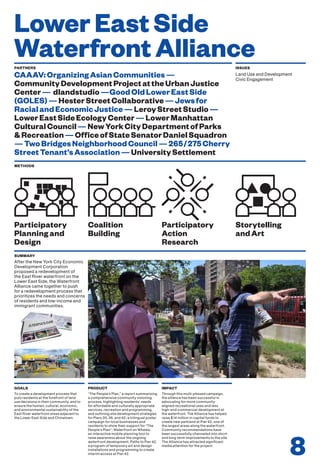
  • 5.
    Conference Day During Partneringfor Impact, participants attended an intro- ductory presentation about the Partnering for Impact model. This was followed by six workshops and panels highlighting participa- tory research, planning and design tools and a plenary panel featuring three pairs of speakers discussing partnerships in support of social justice. The day concluded with an exhibit of 17 posters, representing the work of 55 organizations, which explored exemplary partnerships. “Itwasnicetoseethatgrassroots organizationscanputtogether aneventandexhibitthatisso polished. Itmademerealizethat ifwefindtherightpartners,we canpresentourworkinaway thatwillbereallyeffectiveand looksreallygood.” —Conference Attendee “Laserfocusonpartnerships, toolsandchallenges. Socialjusticeslensiskey. Understandingofhowwork startedandevolvedwashelpful.” —Conference Attendee “Itwasavery collaborative day.” —Conference Attendee “Greatgroup ofactivistsall inoneplace.I hadsomereally goodincidental conversations today.” —Conference Attendee Conference attendees participate in Research for Organizing workshop Anne Frederick from Hester Street Collaborative at the opening presentation Conference attendees participate in Research for Organizing workshop The opening presentation for Partnering for Impact Christine Gaspar from Center for Urban Pedagogy at the opening presentation Alexa Kasdan from Community Development Project at UJC at the opening presentation Alicia Garza talks about POWER’s collaborative poster at the exhibit 17 posters were exhibited to showcase exemplary collaborations
  • 6.
    PartnershipsOverview Artist Alfredo Lopez Centerfor Urban Pedagogy Community Development Project at the Urban Justice Center The DataCenter El Diario/La Prensa Groundswell Hester Street Collaborative Hunter College Department of Community Planning and Urban Development MIT Center for Civic Media National Employment Law Project (NELP) Open Technology Institute Parsons The New School for Design Participatory Budgeting Project Partnership for Parks (a joint project of NYC Parks and City Parks Foundation) Queens Museum of Art REV- Rosten Woo (Graphic Designer) Urban Habitat Technology and Multimedia Coalition Building Community Lawyering Communications Design and Popular Education Participatory Planning and Design Mapping Storytelling and Art Participatory Action Research GRASSROOTS ORGANIZATIONS METHODS RESOURCE GROUPSPOSTER 1 2 3 4 5 6 7 8 9 10 11 13 17 16 15 14 12 Cafeteria Culture Parents, Teachers, Students, Artists Community Action for Safe Apartments —New Settlement Apartments (CASA) Adhikaar Chhaya Community Development Corporation India Home South Asian Council for Social Services (SACSS) South Asian Youth Action (SAYA!) Community Voices Heard Various grassroots community organizations FIERCE Brownsville Community Justice Center Student Farm Project CAAAV: Organizing Asian Communities Good Old Lower East Side (GOLES) Jews for Racial and Economic Equality Two Bridges Neighborhood Council 265/275 Cherry Street Tenant’s Association New Immigrant Community Empowerment (NICE) Allied Media Projects Red Hook Initiative Community Organizations and Volunteer Groups Picture the Homeless POWER Power U Center for Social Change Domestic Workers United Jews for Racial and Economic Equality VOCAL-NY Various New York City grassroots community organizations
  • 7.
    ZeroWaste SchoolCafeteriasPARTNERS ISSUES CafeteriaCulture(CafCu)—NewYorkCityDepartment ofEducation(DOE),OfficesofSchoolFoodand Sustainability—ParsonsTheNewSchoolforDesign— Parents,teachers,students,artists. Environment Education Youth METHODS Zero WasteSchool Cafeterias is an effort to drastically reduce landfill- and incinerator- bound garbage from school cafeterias in New York City, by first eliminating the 860,000 polystyrene (Styrofoam) trays used every school day. Trayless Tuesdays, implemented city- wide in 2010, has to date eliminated 70 million polystyrene trays from school lunches, incinerators, and landfills and set the stage for a citywide school composting, and a ban on polystyrene food containers in both schools and restaurants. The effort is led by Cafeteria Culture— a collection of parents, artists, teachers, and students— in partnership with the New York City Department of Education, Offices of SchoolFood and Sustainability, the Department of Sanitation, the US Environmental Protection Agency, various partner schools, and Parsons. SUMMARY To completely rid New York City public school cafeterias of polystyrene, and to drastically reduce food and food packing waste with the goal of achieving zero waste school cafeterias. GOALS Compostable/recyclable food service ware; giant puppets to protest polystyrene tray use; student Cafeteria Ranger training; ARTS+ACTION curriculum. PRODUCT Implemented Trayless Tuesday—one day a week without any polystyrene trays in 1,700 public schools in NYC, eliminating 70 million trays; a cooperative buying agreement between NYC SchoolFood and five large school districts; influenced Mayor Bloomberg’s citywide polystyrene ban on to-go containers and school trays; initiated a private-public partnership that inspired NYC’s school composting pilot; reduced public resources needed for creating climate smart policy. IMPACT 1 Coalition Building Communications Designand PopularEducation
  • 8.
    TippingtheScales AReportofTenantExperiencesin BronxHousingCourt To identify theconcrete challenges tenants face in Housing Court and identify necessary policy changes. A report documenting findings from 1,055 surveys, three focus groups with more than 25 participants, and 15 observations of courtrooms; a set of policy recommendations; coverage of the report in The New York Times and other media outlets. Over 120 people attended a forum about the research, and The New York Times and several other outlets covered the report. CASA has met with several elected officials and judges to discuss their findings and suggested housing court reforms. GOALS PRODUCT IMPACT 2 PARTNERS ISSUES NewSettlementApartments’CommunityActionforSafe Apartments(CASA)—CommunityDevelopmentProject attheUrbanJusticeCenter(CDP) Housing Court Reform METHODS CASA and CDP worked together to conduct participatory action research to document tenant experiences in housing court, to develop grassroots policy recommendations, and to produce a report on their findings. SUMMARY Participatory ActionResearch Community Lawering
  • 9.
    AShareSpacefor SouthAsiansPARTNERS ISSUES Adhikaar—ChhayaCommunityDevelopment Corporation— HesterStreetCollaborative—IndiaHome —SouthAsianCouncilforSocialServices(SACSS)— SouthAsianYouthAction(SAYA!) LandUse and Development Civic Engagement Immigration Participatory Planning andDesign Coalition Building Mapping METHODS Chhaya CDC, with technical assistance from Hester Street Collaborative, led a historic process that engaged nearly 200 South Asians who live in Queens to envision a new center to meet people’s needs for community, connection, and culturally sensitive services, all under one roof. SUMMARY To develop a plan for a community center in Northwest Queens that reflects the needs and desires of the South Asian community. Multilingual maps and “My Center” visioning posters; “A Community’s Vision: A Shared Space for South Asians,” a report proposing what a South Asian Community Center could look like; architectural analysis of spatial needs; architectural programming diagrams, floor plans and renderings; capital campaign fundraising package. The first phase of participatory planning and design for the creation of South Asian Community Center engaged 200 stakeholders in defining the programming and spatial needs for the center. Based on this needs assess- ment, Hester Street created preliminary architectural schematics and plans to guide the site selection process. The schematic design package has been used to garner support from elected officials, community leaders, and fund- ers, and to kick off a capital campaign. GOALS PRODUCT IMPACT 3
  • 10.
    ParticipatoryBudgeting inNewYorkCity 32 District 8 Council Member MelissaMark-Viverito Brooklyn Manhattan Queens Bronx Transportation for Seniors and Meals-on-Wheels Delivery Van, $103,000 Playground Improvements at Millbrook and Douglass Houses, $500,000 New Technology for NY Public Library Aguilar Branch, $60,000 A Home for Harlem RBI and Dream Charter School, $513,000 Ultrasound System for Metropolitan Hospital Center, $105,000 Additional Project New garbage cans for specific corners, funded by the Department of Sanitation, $10,000 Installation of Security Cameras at Public Housing Complexes, $525,000 CenterforUrbanPedagogy—CommunityDevelopment ProjectattheUrbanJusticeCenter—Community VoicesHeard—ParticipatoryBudgetingProject— EightNewYorkCityCouncilMembers PARTNERS ISSUES METHODS Land Use and Development Civic Engagement Coalition Building Participatory Planning and Design Communications Designand PopularEducation Mapping SUMMARY The partner organizations joined with eight New York City Council Members to implement participatory budgeting, a process in which community members—instead of elected officials alone— decide how public funds should be spent, from start to finish. They exchange ideas, collaborate to develop project proposals and then vote on which proposals should get funded. A PeoPle’s Budget By the Community development Project at the urban Justice Center with the PBNYC Research team on the Pilot Year of Participatory Budgeting in New York City A Research and evaluation Report Transparency: to make budget decisions open and accessible to the public; Equality: to give each community member the same power to propose and vote on spending ideas; Inclusion: to include all voices— especially those of community members who face obstacles to participating in politics or government; to inspire greater civic participation; to build community; and to educate and empower residents. A research and evaluation report documenting participation in Year One of Participatory Budgeting in New York City; posters for each project; maps of each council district; ballots for each NYC council district; a toolkit/handbook on how to implement PB; various educational videos. The pilot year of PBNYC involved 100 community organizations, four NYC Council Offices, and 6,000 residents voting to fund 27 priority projects totaling $5.6 million. Year Two has doubled in size with eight council members, $10 million in funds, and over 13,000 voters choosing 45 projects. Participatory budgeting has spread to several other U.S. cities including Boston, San Francisco, and Vallejo, California. GOALS PRODUCT IMPACT 4
  • 11.
    MakingPolicyPublic To increase thecapacity of individuals to more effectively advocate for themselves around an issue impacting their community. Each collaboration produces an individual fold-out poster. Those listed here produced: —I Got Arrested! Now What? a comic book guide to NYC’s juvenile justice system —Vendor Power! a map of key issues in NYC’s street vendor code —Es Tu Dinero, Decides Tú, an immigrants’ guide to financial services in Spanish and English editions —We Care! an explanation of the Domestic Workers’ Bill of Rights in five languages —What’s In the Water? a graphic showing the impacts of fracking on NYC’s water supply Over 50,000 copies of MPPs have been distributed since the program’s launch in 2008. In the last two years, the NYC Department of Probation has distributed a copy of the juvenile justice poster to every youth who gets arrested in New York City. The posters are also renowned for their design, and have been featured in the Cooper-Hewitt National Design Triennial and in the Venice Architecture Biennale. GOALS PRODUCT IMPACT 5 PARTNERS ISSUES ApartnershipofCUP,agrassrootspartner,andadesigner. Pastpartnershipsinclude: —CUP+CenterforCourtInnovation+ DanicaNovgorodoff —CUP+StreetVendorProject+CandyChang —CUP+Rémas+NeilDonnelly/MaryMeehan —CUP+DomesticWorkersUnited+DamonLocks —CUP+DamascusCitizensforSustainability+Papercut Various METHODS Through Making Policy Public, CUP collaborates with community organizers and designers to research a complex policy issue and create a fold-out poster with an accessible, visual explanation of that issue. The posters are distributed to the grassroots partner’s constituents so they can better advocate for themselves around that issue. SUMMARY Communications Designand PopularEducation
  • 12.
    OUR S.P.O.T. (Safe Placeto Organize Together) To create a safe space for LGBTQ youth in New York City’s West Village. A white paper proposing legislative solutions to expand public access to the waterfront at Hudson River Park, increase quality of life in the community, and ensure community participation in decisions made about the park; A pop- up Center on Wheels, a mobile cart that can be deployed in the West Village and transformed into street furniture, claiming space for organizing and informal outreach. The pop-up center is branded in FIERCE’s trademark hot pink, and features interactive maps and a “My Center” mini-model-making game to engage and educate youth and community residents. In 2010, FIERCE was instrumental in defeating a proposal by Related Companies to build “Vegas on the Hudson,” a development that would have prioritized luxury retail and limited access to public space for LGBTQ youth, who have historically accessed the neighborhood to build community and access services. FIERCE members have also used the white paper and pop-up center to educate youth and other community stakeholders about the importance of the 24-hour youth drop- in center. GOALS PRODUCT IMPACT 6 PARTNERS FIERCE—CommunityDevelopmentProjectattheUrban JusticeCenter—HesterStreetCollaborative ISSUES Youth LGBTQ Land Use and Development METHODS A campaign to win a 24-hour drop-in center for LGBTQ youth in New York City’s West Village. The center would provide a safe space to address critical issues facing LGBTQ youth, including homelessness, access to health resources, and job readiness. FIERCE worked with the Com- munity Development Project to develop a grassroots white paper, draft legislation, and conduct participatory action research to find a suitable spot for the center, and worked with Hester Street to create a “Center on Wheels” to reach out to and educate the youth of the West Village. SUMMARY Participatory ActionResearch Participatory Planning and Design Communications Designand PopularEducation Mapping
  • 13.
    PARTNERS BrownsvilleCommunityJusticeCenter—Groundswell —StudentFarmProject ISSUES Youth Criminal Justice Workers Storytelling andArt METHODS A muralresearched, designed, and fabricated by a team made up exclusively of young men, over half of whom were court-involved. SUMMARY To transform a blank wall above a community garden in Brownsville, one of New York City’s most economically disadvantaged neighborhoods, while providing paid summer jobs and teaching participants to become leaders in the community. GOALS A mural created by Brownsville youth. PRODUCT A group of court-involved young men used art not only to transform a streetscape in their neighborhood, but to activate public space and inspire reflection, revelation, action, and change. The collaboration also enabled the Brownsville Community Justice Center to build a coalition among a larger group of stakeholders to re-engineer how the justice system works in Brownsville. IMPACT 7 Yesterday I Was , Today I Am , Tomorrow I’ll Be .
  • 14.
    LowerEastSide WaterfrontAlliancePARTNERS CAAAV:OrganizingAsianCommunities— CommunityDevelopmentProjectattheUrbanJustice Center— dlandstudio—GoodOldLowerEastSide (GOLES)—HesterStreetCollaborative—Jewsfor RacialandEconomicJustice—LeroyStreetStudio— LowerEastSideEcologyCenter—LowerManhattan CulturalCouncil—NewYorkCityDepartmentofParks &Recreation—OfficeofStateSenatorDanielSquadron —TwoBridgesNeighborhoodCouncil—265/275Cherry StreetTenant’sAssociation—UniversitySettlement ISSUES Land Useand Development Civic Engagement METHODS After the New York City Economic Development Corporation proposed a redevelopment of the East River waterfront on the Lower East Side, the Waterfront Alliance came together to push for a redevelopment process that prioritizes the needs and concerns of residents and low-income and immigrant communities. SUMMARY To create a development process that puts residents at the forefront of land use decisions in their community, and to ensure the human, cultural, economic, and environmental sustainability of the East River waterfront areas adjacent to the Lower East Side and Chinatown. GOALS “The People’s Plan,” a report summarizing a comprehensive community visioning process, highlighting residents’ needs for affordable and culturally appropriate services, recreation and programming, and outlining site development strategies for Piers 35, 36, and 42; a trilingual poster campaign for local businesses and residents to show their support for “The People’s Plan”; Waterfront on Wheels, an interactive mobile planning tool to raise awareness about the ongoing waterfront development; Paths to Pier 42, a program of temporary art and design installations and programming to create interim access at Pier 42. PRODUCT Through this multi-phased campaign, the alliance has been successful in advocating for more community- aligned recreational uses and less high-end commercial development at the waterfront. The Alliance has helped raise $14 million in capital funds to create new parkland at Pier 42, one of the largest areas along the waterfront. Community recommendations have been successfully channeled into short- and long-term improvements to the site. The Alliance has attracted significant media attention for the project. IMPACT 8 Coalition Building Participatory Planning and Design Storytelling andArt Participatory Action Research
  • 15.
    ImmigrantConsumer JusticeCampaign To document thepractices of employment agencies and businesses that provide immigration services, to document immigrants’ experiences with agencies; to develop policy recommendations; and to educate new immigrants about common types of fraud in immigration services and at employment agencies. GOALS A graphic novel, “Jose Busca Legalizarse,” and a report, “Dreams and Schemes in Queens, New York: Immigrant Struggles to Find Work and Get Status in the Face of Consumer Fraud.” PRODUCT NICE has distributed over 2,000 copies of the graphic novels to immigrants in Queens and throughout New York City, and is now working on a sequel that will tell the story of a worker who experiences fraud at an employment agency. The report, “Dreams and Schemes,” was covered in various media outlets, including in an exclusive story in the New York Daily News, and the release was attended by various elected and agency officials. Drawing from the research and policy recommendations in the report, NICE is now working on model legislation for employment agency reform, to enhance and strengthen the enforcement capacities of the various government agencies that regulate employment agencies and immigration service providers, and to raise broader community awareness of these issues. IMPACT 9 PARTNERS CommunityDevelopmentProjectattheUrbanJustice Center—ElDiario/LaPrensa—NewImmigrant CommunityEmpowerment(NICE)—QueensMuseumof Art—ArtistAlfredoLopez ISSUES Immigration Workers METHODS Storytelling andArt Participatory Action Research Communications Designand PopularEducation Community Lawering NICE partnered with CDP to research and produce “Dreams and Schemes,” a report on the substandard, predatory, and fraudulent practices of employment agencies and business that provide immigration services in Jackson Heights, Queens. NICE also partnered with the Queens Museum of Art and Alfredo Lopez to produce a comic-style graphic novel telling the story of one man’s experience with fraud by an immigration services provider. The comic is based on the experiences of NICE’s members, and is used to teach immigrants how to avoid falling victim to fraud. NICE worked with El Diario/ La Prensa, New York City’s largest Spanish language daily, to distribute the graphic novel. SUMMARY Dreams anDschemes inQueens,newYorkImmigrant Struggles to Find Work and Get Status in the Face of Consumer Fraud A Report by New Immigrant Community Empowerment (NICE) and the Community Development Project (CDP) at the Urban Justice Center October, 2012
  • 16.
    DigitalStewards BuildingLocal WirelessNetworksPARTNERS AlliedMediaProjects—OpenTechnologyInstitute —RedHookInitiative ISSUES Access to Information Housing LandUse and Development Technology andMultimedia METHODS A collaboration of software developers, wireless engineers, urban planners, media educators and community organizers to build community-owned wireless networks for Internet access and local communication in Red Hook, Brooklyn, and Detroit, Michigan. SUMMARY To promote access to information and civic engagement in Red Hook and Detroit by engaging residents in the design, construction and ownership of their own neighborhood-scale wireless networks; to develop a model for promoting freedom of expression worldwide. GOALS Two community-owned wireless networks. PRODUCT Neighborhoods are using the wireless networks to share Internet access and to exchange local information independent of commercial service providers. Red Hook Initiative has incorporated the networks into their community organizing work, making it a cornerstone of their Hurricane Sandy recovery efforts. During and after the storm, RHI was one of the only sites for wireless access, allowing thousands of stranded residents to communicate with loved ones. IMPACT 10
  • 17.
    People Make Parks Toengage communities in the design and development of New York City parks. An online toolkit (PeopleMakeParks.org), written publications and staff-supported activities. In the first phase of the project, over a dozen parks-related groups have received training and technical assistance to participate in the improvement of parks and public spaces; NYC Parks has incorporated community input generated by PMP into park designs; and NYC Parks has encouraged the use of PMP tools and processes as part of the capital design process. GOALS PRODUCT IMPACT 11 PARTNERS ISSUES HesterStreetCollaborative—PartnershipforParks (ajointprojectofNYCParksandCityParksFoundation) —Communityorganizationsandvolunteergroups Environment Land Use and Development METHODS To date, over a dozen community groups have utilized People Make Parks (PMP) best practices for participating in the New York City Department of Parks and Recreation (NYC Parks) capital process. Community input has informed the final park designs at these sites, and PMP approaches have expanded the role of community groups in the design of parks. SUMMARY Communications Designand PopularEducation Participatory Planning and Design Storytelling andArt Mapping
  • 18.
    BankingonVacancy HomelessnessandRealEstateSpeculation To count thenumber of vacant properties in New York City, and to show that warehoused vacant property can play a role in ending the city’s housing crisis. A report: “Banking on Vacancy: Homelessness and Real Estate Speculation” Over 130 people attended the release of the report. Since then, PTH has held over a dozen town hall meetings to share the results of its count. PTH’s legislation to institute an annual count of vacant property (Intro 48) is one of the New York City Council’s Progressive Caucus’ “bold new ideas” for 2013. GOALS PRODUCT IMPACT 12 PARTNERS HunterCollegeDepartmentofCommunityPlanning andUrbanDevelopment—PicturetheHomeless ISSUES Housing Land Use and Development METHODS Picture the Homeless and its partners at Hunter College developed a research plan, mobilized over 300 volunteers to count vacant properties block by block in 20 community boards, evaluated their findings, and published a report showing that there is enough space in vacant buildings and lots in New York City to house 200,000 people. SUMMARY Communications Designand PopularEducation MappingParticipatory ActionResearch
  • 19.
    Next Stop: Justice METHODS Acomprehensive community research project documenting San Francisco’s transit system policies and its effects on low- income people and people of color. The resulting report, based on 727 surveys, census analysis, and transit agency documents, is guiding POWER’s organizing strategy and provides hard evidence that POWER and its partners can use to push for a more just transit system. SUMMARY To document San Francisco’s transit policies and their effects on low-income people and people of color in order to educate decision makers and the media about the need for policy changes and funding shifts. GOALS A report, “Next Stop—Justice, Race and Environment at the Center of Transit Planning.” PRODUCT This project strengthened POWER’s organizing and policy efforts by providing key data and case studies to help shape policy recommendations and campaign demands for transit justice. The collaboration puts powerful data in the hands of community members who are organized and ready to stand up for their needs and rights. IMPACT 13 PARTNERS TheDataCenter—POWER—UrbanHabitat ISSUES Transportation Land Use and Development Participatory ActionResearch
  • 20.
    To collect surveydata from students in Miami schools to expose the School-to- Prison Pipeline and show the need for restorative justice programs as a much- needed alternative. GOALS A local and national graphic report (“Telling It Like It Is! Miami Youth Speak Out on the School-to-Prison Pipeline”) and a short video sharing students’ stories. PRODUCT The data and knowledge generated by this research helped youth leaders to build relationships with other students in school and recruit new members to the organization. Power U has also used the report to increase their legitimacy with the School Board and to conduct workshops on restorative justice. The report was eventually made into a national version that has been distributed to thousands of people across the country to educate them on the School-to-Prison Pipeline from a young person’s perspective. IMPACT 14 Miami Youth Speak Out on the School-to-Prison Pipeline PARTNERS AdvancementProject—PowerUCenterfor SocialChange ISSUES Youth Education Criminal Justice METHODS In a youth-led effort, Power U and the Advancement Project worked together to develop and conduct a participatory survey of students’ experiences with zero-tolerance school discipline policies. Based on the survey findings and quantitative data on suspensions, expulsions, and arrests, they produced a graphic report and a short video documenting their findings and students’ stories. SUMMARY Participatory ActionResearch Communications Designand PopularEducation Storytelling andArt Telling It Like It Is . . . 5Telling It Like It Is . . . 5 Source: Florida Department of Education 4.5 3.2 Miami-Dade Out-of-School Suspensions 2008-09 Rates per 100 students Miami-Dade Out-of-School Suspensions 2008-09 Rates per 100 students BlackBlack LatinoLatino WhiteWhite For the 2009-10 school year, there were more than 18,000 referrals of Florida students to the Department of Juvenile Justice (DJJ), and over 12,000 were for misdemeanors (not felonies). Black students were sent to the DJJ three times more often than White students. How is it unfair? This stuff is totally jacked up, but if we’ re all facing the same rules, it’ s not unfair, right? Do you really think all students are treated the same? Sure, students of all races and ethnicities are affected by zero tolerance. But Black and Brown students get the worst of it. We are far more likely to be suspended, expelled, and arrested than other students. TellingItLikeItIs: MiamiYouthSpeakOutontheSchool toPrisonPipeline
  • 21.
    New Day NewStandard (NDNS)PARTNERS REV–—DomesticWorkersUnited—MITCenterforCivic Media—CommunityDevelopmentProjectattheUrban JusticeCenter—JewsforRacialandEconomicJustice —NationalEmploymentLawProject ISSUES Workers Immigration To educate the 200,000 nannies, house- keepers, and eldercare workers in the State of New York—as well as their employers— about domestic workers’ rights; to create a higher employment standard for domestic workers; to inform the public about the grow-ing movement for domestic worker justice. GOALS A humorous, informative hotline publicized through creative, eye- catching outreach materials. PRODUCT Since its launch in 2012, the hotline has received several hundred unique calls each month. The hotline supports DWU’s outreach efforts and provides an added tool to educate both workers and employers. DWU’s members continue to use the business card-sized flyers as a form of outreach in parks, community centers, religious institutions, and other places where domestic workers convene. IMPACT METHODS Storytelling andArt Community Lawering A public art project and interactive hotline that functions as a key outreach component of a New York City-wide campaign to inform domestic workers and their employers about New York’s landmark 2010 Domestic Workers Bill of Rights. SUMMARY 15 Technology andMultimedia
  • 22.
    Stuck in theSystem: Community-Driven Research about Drug Policy, Harm Reduction and Public Health To document drug users’ experience with drug treatment and syringe access programs in order to effect policy changes that reduce harm and promote public health. GOALS Two reports, “Stuck in the System: Expanding Syringe Access by Reconciling the Penal Code with Public Health Law” and “Beyond Methadone: Improving Health and Empowering Patients in Opioid Treatment Programs”. PRODUCT “Stuck in the System” helped VOCAL-NY pass major state legislation that legalized syringe exchange programs under the State Penal Code. “Beyond Methadone” led to sweeping changes within New York State Office of Alcohol and Substance Abuse and the programs it oversees, and helped establish VOCAL-NY’s Users Union as a serious and informed partner for ongoing collaboration and patient input. IMPACT 16 PARTNERS CommunityDevelopmentProjectatthe UrbanJusticeCenter—VOCAL-NY ISSUES Criminal Justice Health Housing METHODS VOCAL-NY and CDP collab- orated to produce two major reports focusing on drug policy, public health, and harm reduction. Former and active users helped define the research and were central to developing policy recommendations. SUMMARY Participatory ActionResearch Storytelling andArt StuckintheSyStem Expanding Syringe Access by Reconciling the Penal Code with the Public Health Law ImprovIng HealtHand empowerIng patIents In opIoIdtreatment programs Hepatitis C, Overdose Prevention, Syringe Exchange, Buprenorphine & Other Opportunities to Make Programs Work For Patients ImprovIng HealtHand empowerIng patpatp Ients In opIoIdtreatment programs Beyond Methadone
  • 23.
    Research for Organizing ToolkitPARTNERS CommunityDevelopmentProjectattheUrbanJustice Center—RostenWoo(graphicdesigner)—variousNew YorkCitygrassrootscommunityorganizations Tocreate a user-friendly website that includes easily accessible trainings and tools that community organizations can adapt and use to conduct participatory action research; to help grassroots organizations conduct more effective participatory action research and strengthen their organizing and campaign work; to actively engage as researchers more low-income people of color and others who are traditionally left out of the research process. GOALS A website and toolkit including worksheets, facilitator’s guides, and templates that users can download and adapt for every phase of the participatory action research process. PRODUCT Since its launch in April 2012, the site has gotten 10,849 visits and 17,757 page views. CDP has conducted trainings from the toolkit with over 200 community members. Several organizations have used the toolkit to design, implement, and launch participatory action research reports. IMPACT METHODS 17 This toolkit synthesizes all of the resources the Community Development Project has developed in its ten years of conducting participatory action research in partnership with dozens of grassroots organizations. It is a comprehensive facilitator’s guide and toolkit that leads grassroots organizations step- by-step through the process of conducting research in support of organizing. SUMMARY 1 2 4 5 6 7 8 9 10 11 12 13 14 3 PARTICIPATORY ACTION RESEARCH TIMELINERESEARCHFOR ORGANIZING Determine Organizing Goal Develop Research Question Determine Research Sample Determine Methods to be used for research Develop research instructions Train Community members in conducting primary research Administer Research Data Entry Data Analysis Develop Outline Develop Policy Recommendations Write-up Report Media Strategy Report Release ORGANIZING Courtesy of New Immigrant Community Empowerment Research for Organizing Toolkit Facilitator’s Guide and Toolkit Urban Justice Center Community Development Project Research and Organizing Initiative RESEARCH FOR ORGANIZINGwww.researchfororganizing.org Technology andMultimedia Communications Designand PopularEducation Participatory ActionResearch
  • 24.
    Sponsors,Acknowledgements, andAttendees ACKNOWLEDGEMENTS The conference organizerswould like to thank the following people and institutions for their generous support and assistance in making this conference and reception possible: from The New School, Pam Tillis, Gabrielle Bendiner-Viani, Andrew White, Andrea Marpillero-Colomina, and the facilities staff at 55 West 13th Street; the Surdna Foundation, particularly Jess Garz, Judilee Reed and Christina Rupp; the New York Foundation; the conference advisory committee: Maria Mottola, Laine Romero-Alston, Peter Gee, Michelle de la Uz, and Seema Agnani; Manuel Miranda for design of the conference posters; videographers Charlotte Glynn and Eddie Martinez; E. Tammy Kim; all the panelists, presenters, and exhibitors at today’s conference; and the volunteers who have offered their time to help make the event a success. We also extend a special thanks to all of the community organizations and members who inspire us to work for social change. Lastly, very special thanks to Ben Palmquist for the overall coordination of the conference and exhibit. ORGANIZATIONS IN ATTENDANCE 596 Acres https://596acres.org Advancement Project www.advancementproject.org Advocacy Institute www.advocacyinstitute.org Afscme www.afscme.org Albert Einstein-Montefiore Hospital www.montefiore.org Alliance for Climate Education (ACE) www.acespace.org ANHD www.anhd.org Artefacting www.artefacting.com Asian Americans for Equality (AAFE) www.aafe.org Association of Legal Aid Attorneys / UAW local 2325 www.alaa.org Bernheimer Architect www.bernheimerarchitecture.com Blank Plate www.blank-plate.com Brooklyn Food Coalition www.brooklynfoodcoalition.org Brooklyn Movement Center www.brooklynmovementcenter.org Brownsville Community Justice Center www.brownsvillejusticecenter.blogspot.com Brownsville Partnership www.brownsvillepartnership.blogspot.com Build It Green!NYC www.bignyc.org CAAAV: Organizing Asian Communities www.caaav.org Cafeteria Culture www.cafeteriaculture.org CASA — New Settlement Apartments www.settlementhousingfund.org/index.html Center for Urban Pedagogy www.welcometocup.org CFY-NYC cfy.org Chhaya CDC www.chhayacdc.org Child Welfare Organizing Project www.cwop.org Citizens Committee for New York CIty www.citizensnyc.org CoFED www.cofed.coop College and Community Fellowship www.collegeandcommunity.org Columbia University GSAPP www.arch.columbia.edu CommunitiesUnitedforPoliceReform www.changethenypd.org CommunityDevelopmentProjectatUJC www.cdp-ny.org Community Voices Heard www.cvhaction.org Cooper Square Committee www.coopersquare.org Cooper Union Institute for Sustainable Design cooper.edu/isd Cornell University www.cornell.edu CUNY www.cuny.edu/index.html Cypress Hills Local Development Corporation https://sites.google.com/a/cypresshills.org/cypress-hills- local-development-corporation Debevoise & Plimpton www.debevoise.com Design Trust for Public Space www.designtrust.org DWU Grassroots www.domesticworkersunited.org/index.php/en Eugene Lang College, The New School www.newschool.edu/lang FIERCE www.fiercenyc.org Ford Foundation www.fordfoundation.org Friends of the High Line www.thehighline.org Girls for Gender Equity www.ggenyc.org GOLES www.goles.org Groundswell www.groundswell.org Hester Street Collaborative www.hesterstreet.org Homelessness Outreach and Prevention Project www.urbanjustice.org Human Rights Project, Urban Justice Center www.urbanjustice.org/ujc/projects/human.html IDEO www.ideo.com Inscape Publico www.inscapepublico.org/index.html Interaction Institute for Social Change www.interactioninstitute.org Ironbound Community Corporation www.ironboundcc.org Jessie Smith Noyes Foundation www.noyes.org Jews for Racial & Economic Justice www.jfrej.org Labor Lines/CyTUnidos www.laborlines.com Lower Manhattan Cultural Council www.lmcc.net Lower East Side Ecology Center www.lesecologycenter.org MARP www.myrtleavenue.org Meerkat Media Collective Resource www.meerkatmedia.org Mertz Gilmore Foundation www.mertzgilmore.org Mozilla Hive NYC www.explorecreateshare.org Ms. Foundation for Women www.forwomen.org Museum of the City of New York www.mcny.org National Economic and Social Rights www.nesri.org National Housing Institute Resource www.nhi.org New Immigrant Community Empowerment (NICE) www.nynice.org New York City CouncilGovernment www.council.nyc.gov/html/home/home.shtml New York Foundation www.nyf.org New York School of Interior Design www.nysid.edu Northwest Bronx Community and Clergy Coalition Grassroots www.nyc.gov/html/dycd/html/home/home.shtml NYC Dept. of Youth and Community Development www.nyc.gov/html/dycd/html/home/home.shtml NYCpublic.org www.nycpublic.org Open Technology Institute www.oti.newamerica.net Parsons The New School for Design www.newschool.edu/parsons Partnerships for Parks www.cityparksfoundation.org/partnerships-for-parks Peoples MEDIA Center www.peoplesmediacenter.net Persist Health Project www.persisthealthproject.org Picture the Homeless www.picturethehomeless.org POWER Power U Center for Social Change www.poweru.org Pratt Institute www.pratt.edu Project Pericles www.projectpericles.org/projectpericles PW Marketing www.pwmarketing.com Queens College CUNY www.qc.cuny.edu/Pages/home.aspx Queens Museum of Art www.queensmuseum.org Red Hook Initiative www.rhicenter.org Red Umbrella Project www.redumbrellaproject.org Respond and Rebuild www.respondandrebuild.org REV- www.studiorev.org/index.html Riders Alliance www.ridersny.org Right to the City Alliance www.righttothecity.org Rise www.riseconference.org Robin Hood Foundation www.robinhood.org ROC-NY www.rocny.org Rutgers University www.rutgers.edu Scherman Foundation www.scherman.org Surdna Foundation www.surdna.org SustyQ www.sustyq.com TCC Group www.tccgrp.com The Hudson Companies www.hudsoninc.com The Laundromat Project www.laundromatproject.org The Legal Aid Society www.legal-aid.org/en/home.aspx The Nathan Cummings Foundation www.nathancummings.org The New School www.newschool.edu The New School for Public Engagement www.newschool.edu/public-engagement The Participatory Budgeting Project www.participatorybudgeting.org Transportation Alternatives www.transalt.org Two Bridges Neighborhood Council www.twobridges.org TWU www.twu.org UAW 2325 — Association of Legal Aid Attorneys www.alaa.org Union Square Awards www.unionsquareawards.org University of Hawaii at Manoa www.manoa.hawaii.edu University of Richmond www.richmond.edu Urban Justice Center www.urbanjustice.org Urban Omnibus www.urbanomnibus.net Villanova University www1.villanova.edu/villanova.html VOCAL-NY www.vocal-ny.org WE ACT for Environmental Justice www.weact.org WHEDco www.whedco.org SPONSORS Center for Urban Pedagogy The Center for Urban Pedagogy (CUP) is a nonprofit organization that uses the power of design and art to increase meaningful civic engagement, particularly among historically under-represented communities. CUP collaborates with designers, educators, advocates, students, and communities to make educational tools that demystify complex policy and planning issues. We believe that increasing understanding of how these systems work is the first step to better, more equitable, and more diverse community participation. welcometoCUP.org Community Development Project at the Urban Justice Center The Community Development Project (CDP) at the Urban Justice Center strengthens the impact of grassroots organizations in New York City’s low-income and other excluded communities. We partner with community organizations to win legal cases, publish community-driven research reports, assist with the formation of new organizations and cooperatives, and provide technical assistance in support of their work towards social justice. cdp-ny.org Hester Street Collaborative Hester Street Collaborative’s (HSC) mission is to empower residents of underserved communities by providing them with the tools and resources necessary to have a direct impact on shaping their built environment. We do this through a hands-on approach that combines design, education, and advocacy. HSC seeks to create more equitable, sustainable, and vibrant neighborhoods where community voices lead the way in improving their environment and neglected public spaces. hesterstreet.org The New School for Public Engagement The New School for Public Engagement is the university’s founding division, and is now one of seven divisions that compose The New School. The mission of The New School for Public Engagement is to create and nurture a learning community marked by interdisciplinary engagement with real-world issues and the integration of professional, civic, and liberal learning. The division’s diverse programs share a commitment to learning that makes a difference in the world. NSPE’s Civic Engagement initiatives and the Center for New York City Affairs have supported this event. www.newschool.edu/public-engagement Surdna Foundation The Surdna Foundation seeks to foster sustainable communities in the United States—communities guided by principles of social justice and distinguished by healthy environments, strong local economies, and thriving cultures. We seek to dismantle the structural barriers that limit opportunity for many, helping to create communities that are prosperous, culturally enriching, and sustainable. www.surdna.org