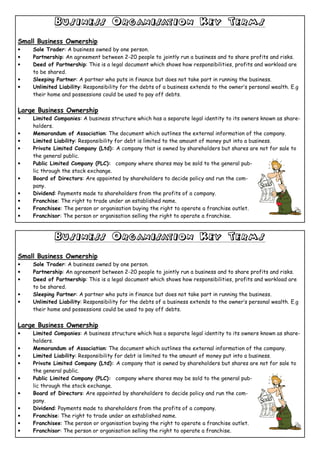
Business Organisation Key Terms
Small Business Ownership
•   Sole Trader: A business owned by one person.
•   Partnership: An agreement between 2-20 people to jointly run a business and to share profits and risks.
•   Deed of Partnership: This is a legal document which shows how responsibilities, profits and workload are
    to be shared.
•   Sleeping Partner: A partner who puts in finance but does not take part in running the business.
•   Unlimited Liability: Responsibility for the debts of a business extends to the owner’s personal wealth. E.g
    their home and possessions could be used to pay off debts.


Large Business Ownership
•   Limited Companies: A business structure which has a separate legal identity to its owners known as share-
    holders.
•   Memorandum of Association: The document which outlines the external information of the company.
•   Limited Liability: Responsibility for debt is limited to the amount of money put into a business.
•   Private Limited Company (Ltd): A company that is owned by shareholders but shares are not for sale to
    the general public.
•   Public Limited Company (PLC): company where shares may be sold to the general pub-
    lic through the stock exchange.
•   Board of Directors: Are appointed by shareholders to decide policy and run the com-
    pany.
•   Dividend: Payments made to shareholders from the profits of a company.
•   Franchise: The right to trade under an established name.
•   Franchisee: The person or organisation buying the right to operate a franchise outlet.
•   Franchisor: The person or organisation selling the right to operate a franchise.


            Business Organisation Key Terms
Small Business Ownership
•   Sole Trader: A business owned by one person.
•   Partnership: An agreement between 2-20 people to jointly run a business and to share profits and risks.
•   Deed of Partnership: This is a legal document which shows how responsibilities, profits and workload are
    to be shared.
•   Sleeping Partner: A partner who puts in finance but does not take part in running the business.
•   Unlimited Liability: Responsibility for the debts of a business extends to the owner’s personal wealth. E.g
    their home and possessions could be used to pay off debts.


Large Business Ownership
•   Limited Companies: A business structure which has a separate legal identity to its owners known as share-
    holders.
•   Memorandum of Association: The document which outlines the external information of the company.
•   Limited Liability: Responsibility for debt is limited to the amount of money put into a business.
•   Private Limited Company (Ltd): A company that is owned by shareholders but shares are not for sale to
    the general public.
•   Public Limited Company (PLC): company where shares may be sold to the general pub-
    lic through the stock exchange.
•   Board of Directors: Are appointed by shareholders to decide policy and run the com-
    pany.
•   Dividend: Payments made to shareholders from the profits of a company.
•   Franchise: The right to trade under an established name.
•   Franchisee: The person or organisation buying the right to operate a franchise outlet.
•   Franchisor: The person or organisation selling the right to operate a franchise.
Business Organisation Key Terms

Growth
•   Diversification: This is when a business expands by moving into new markets. This might be achieved by a
    merger.
•   Horizontal Integration: One firm merging with another in the same industry at the same stage of produc-
    tion.
•   Lateral Integration: A firm expands by moving into a smaller, but different, area of production eg. build-
    ing society buys an estate agent.
•   Merger: The owners of two businesses agree to join their firms together to make one larger business.
•   Vertical Integration: One firm merges with another at a different stage in the production chain.


Structure & Organisation
•   Business Plan: A detailed outline of a business’ intention over a period of time.
•   Chain of Command: A structure within a firm allowing instructions to be passed downwards through the
    organisation.
•   Objectives: Targets for a business to judge its success over a period of time. Objectives must be
    S.M.A.R.T
•   Organisational Structure: The levels of management and division of responsibilities within an organisation.
•   SWOT: An analysis of the strengths, weaknesses, opportunities and threats of a business.
•   Start up Costs: Costs paid out when setting up a new business or when expanding an existing one.


            Business Organisation Key Terms

Growth
•   Diversification: This is when a business expands by moving into new markets. This might be achieved by a
    merger.
•   Horizontal Integration: One firm merging with another in the same industry at the same stage of produc-
    tion.
•   Lateral Integration: A firm expands by moving into a smaller, but different, area of production eg. build-
    ing society buys an estate agent.
•   Merger: The owners of two businesses agree to join their firms together to make one larger business.
•   Vertical Integration: One firm merges with another at a different stage in the production chain.


Structure & Organisation
•   Business Plan: A detailed outline of a business’ intention over a period of time.
•   Chain of Command: A structure within a firm allowing instructions to be passed downwards through the
    organisation.
•   Objectives: Targets for a business to judge its success over a period of time. Objectives must be
    S.M.A.R.T
•   Organisational Structure: The levels of management and division of responsibilities within an organisation.
•   SWOT: An analysis of the strengths, weaknesses, opportunities and threats of a business.
•   Start up Costs: Costs paid out when setting up a new business or when expanding an existing one.

Key terms business organisation

  • 1.
    Business Organisation KeyTerms Small Business Ownership • Sole Trader: A business owned by one person. • Partnership: An agreement between 2-20 people to jointly run a business and to share profits and risks. • Deed of Partnership: This is a legal document which shows how responsibilities, profits and workload are to be shared. • Sleeping Partner: A partner who puts in finance but does not take part in running the business. • Unlimited Liability: Responsibility for the debts of a business extends to the owner’s personal wealth. E.g their home and possessions could be used to pay off debts. Large Business Ownership • Limited Companies: A business structure which has a separate legal identity to its owners known as share- holders. • Memorandum of Association: The document which outlines the external information of the company. • Limited Liability: Responsibility for debt is limited to the amount of money put into a business. • Private Limited Company (Ltd): A company that is owned by shareholders but shares are not for sale to the general public. • Public Limited Company (PLC): company where shares may be sold to the general pub- lic through the stock exchange. • Board of Directors: Are appointed by shareholders to decide policy and run the com- pany. • Dividend: Payments made to shareholders from the profits of a company. • Franchise: The right to trade under an established name. • Franchisee: The person or organisation buying the right to operate a franchise outlet. • Franchisor: The person or organisation selling the right to operate a franchise. Business Organisation Key Terms Small Business Ownership • Sole Trader: A business owned by one person. • Partnership: An agreement between 2-20 people to jointly run a business and to share profits and risks. • Deed of Partnership: This is a legal document which shows how responsibilities, profits and workload are to be shared. • Sleeping Partner: A partner who puts in finance but does not take part in running the business. • Unlimited Liability: Responsibility for the debts of a business extends to the owner’s personal wealth. E.g their home and possessions could be used to pay off debts. Large Business Ownership • Limited Companies: A business structure which has a separate legal identity to its owners known as share- holders. • Memorandum of Association: The document which outlines the external information of the company. • Limited Liability: Responsibility for debt is limited to the amount of money put into a business. • Private Limited Company (Ltd): A company that is owned by shareholders but shares are not for sale to the general public. • Public Limited Company (PLC): company where shares may be sold to the general pub- lic through the stock exchange. • Board of Directors: Are appointed by shareholders to decide policy and run the com- pany. • Dividend: Payments made to shareholders from the profits of a company. • Franchise: The right to trade under an established name. • Franchisee: The person or organisation buying the right to operate a franchise outlet. • Franchisor: The person or organisation selling the right to operate a franchise.
  • 2.
    Business Organisation KeyTerms Growth • Diversification: This is when a business expands by moving into new markets. This might be achieved by a merger. • Horizontal Integration: One firm merging with another in the same industry at the same stage of produc- tion. • Lateral Integration: A firm expands by moving into a smaller, but different, area of production eg. build- ing society buys an estate agent. • Merger: The owners of two businesses agree to join their firms together to make one larger business. • Vertical Integration: One firm merges with another at a different stage in the production chain. Structure & Organisation • Business Plan: A detailed outline of a business’ intention over a period of time. • Chain of Command: A structure within a firm allowing instructions to be passed downwards through the organisation. • Objectives: Targets for a business to judge its success over a period of time. Objectives must be S.M.A.R.T • Organisational Structure: The levels of management and division of responsibilities within an organisation. • SWOT: An analysis of the strengths, weaknesses, opportunities and threats of a business. • Start up Costs: Costs paid out when setting up a new business or when expanding an existing one. Business Organisation Key Terms Growth • Diversification: This is when a business expands by moving into new markets. This might be achieved by a merger. • Horizontal Integration: One firm merging with another in the same industry at the same stage of produc- tion. • Lateral Integration: A firm expands by moving into a smaller, but different, area of production eg. build- ing society buys an estate agent. • Merger: The owners of two businesses agree to join their firms together to make one larger business. • Vertical Integration: One firm merges with another at a different stage in the production chain. Structure & Organisation • Business Plan: A detailed outline of a business’ intention over a period of time. • Chain of Command: A structure within a firm allowing instructions to be passed downwards through the organisation. • Objectives: Targets for a business to judge its success over a period of time. Objectives must be S.M.A.R.T • Organisational Structure: The levels of management and division of responsibilities within an organisation. • SWOT: An analysis of the strengths, weaknesses, opportunities and threats of a business. • Start up Costs: Costs paid out when setting up a new business or when expanding an existing one.