People Key Terms
Leadership & Management
•   Authoritarian Leadership: This style of management means that one person makes the decisions.
•   Democratic Leadership: This style of management allows employees to take part in decision making.
•   Laissez Faire Leadership: Employees are left to make many of the decisions rather than receiving clear
    instructions.
•   Delegation: Giving others the authority to undertake a task.
•   Hierarchy: An organisation in which power and responsibility are built up in layers with the most powerful
    at the top.
•   Line Manager: A worker’s immediate superior.
•   Span of Control: The number of people or departments that a person has under their command.


Remuneration
•   Bonuses: Additional amounts of money above normal pay as a reward for good work.
•   Commission: Payment relating to the number of sales made, often calculated as a percentage value of sales.
•   Fringe Benefits: Non monetary rewards given as incentives to employees. (perks)
•   Minimum Wage: The lowest sum an employer can legally pay an employee.
•   Performance Related Pay: Pay related to the effectiveness of the employee.
•   Salary: A system of pay based on an annual income, paid monthly or weekly, that may not lay down the num-
    ber of hours to be worked.
•   Wage: Payment for work usually paid weekly.


                                        People Key Terms
Leadership & Management
•   Authoritarian Leadership: This style of management means that one person makes the decisions.
•   Democratic Leadership: This style of management allows employees to take part in decision making.
•   Laissez Faire Leadership: Employees are left to make many of the decisions rather than receiving clear
    instructions.
•   Delegation: Giving others the authority to undertake a task.
•   Hierarchy: An organisation in which power and responsibility are built up in layers with the most powerful
    at the top.
•   Line Manager: A worker’s immediate superior.
•   Span of Control: The number of people or departments that a person has under their command.


Remuneration
•   Bonuses: Additional amounts of money above normal pay as a reward for good work.
•   Commission: Payment relating to the number of sales made, often calculated as a percentage value of sales.
•   Fringe Benefits: Non monetary rewards given as incentives to employees. (perks)
•   Minimum Wage: The lowest sum an employer can legally pay an employee.
•   Performance Related Pay: Pay related to the effectiveness of the employee.
•   Salary: A system of pay based on an annual income, paid monthly or weekly, that may not lay down the num-
    ber of hours to be worked.
•   Wage: Payment for work usually paid weekly.
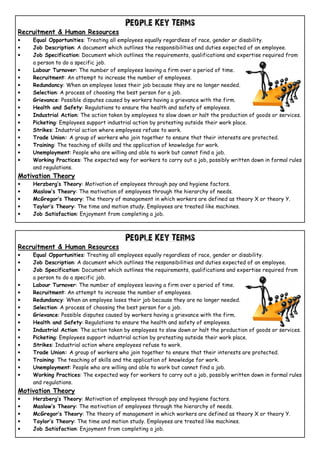
People Key Terms
Recruitment & Human Resources
•   Equal Opportunities: Treating all employees equally regardless of race, gender or disability.
•   Job Description: A document which outlines the responsibilities and duties expected of an employee.
•   Job Specification: Document which outlines the requirements, qualifications and expertise required from
    a person to do a specific job.
•   Labour Turnover: The number of employees leaving a firm over a period of time.
•   Recruitment: An attempt to increase the number of employees.
•   Redundancy: When an employee loses their job because they are no longer needed.
•   Selection: A process of choosing the best person for a job.
•   Grievance: Possible disputes caused by workers having a grievance with the firm.
•   Health and Safety: Regulations to ensure the health and safety of employees.
•   Industrial Action: The action taken by employees to slow down or halt the production of goods or services.
•   Picketing: Employees support industrial action by protesting outside their work place.
•   Strikes: Industrial action where employees refuse to work.
•   Trade Union: A group of workers who join together to ensure that their interests are protected.
•   Training: The teaching of skills and the application of knowledge for work.
•   Unemployment: People who are willing and able to work but cannot find a job.
•   Working Practices: The expected way for workers to carry out a job, possibly written down in formal rules
    and regulations.
Motivation Theory
•   Herzberg’s Theory: Motivation of employees through pay and hygiene factors.
•   Maslow’s Theory: The motivation of employees through the hierarchy of needs.
•   McGregor’s Theory: The theory of management in which workers are defined as theory X or theory Y.
•   Taylor’s Theory: The time and motion study. Employees are treated like machines.
•   Job Satisfaction: Enjoyment from completing a job.


                                        People Key Terms
Recruitment & Human Resources
•   Equal Opportunities: Treating all employees equally regardless of race, gender or disability.
•   Job Description: A document which outlines the responsibilities and duties expected of an employee.
•   Job Specification: Document which outlines the requirements, qualifications and expertise required from
    a person to do a specific job.
•   Labour Turnover: The number of employees leaving a firm over a period of time.
•   Recruitment: An attempt to increase the number of employees.
•   Redundancy: When an employee loses their job because they are no longer needed.
•   Selection: A process of choosing the best person for a job.
•   Grievance: Possible disputes caused by workers having a grievance with the firm.
•   Health and Safety: Regulations to ensure the health and safety of employees.
•   Industrial Action: The action taken by employees to slow down or halt the production of goods or services.
•   Picketing: Employees support industrial action by protesting outside their work place.
•   Strikes: Industrial action where employees refuse to work.
•   Trade Union: A group of workers who join together to ensure that their interests are protected.
•   Training: The teaching of skills and the application of knowledge for work.
•   Unemployment: People who are willing and able to work but cannot find a job.
•   Working Practices: The expected way for workers to carry out a job, possibly written down in formal rules
    and regulations.
Motivation Theory
•   Herzberg’s Theory: Motivation of employees through pay and hygiene factors.
•   Maslow’s Theory: The motivation of employees through the hierarchy of needs.
•   McGregor’s Theory: The theory of management in which workers are defined as theory X or theory Y.
•   Taylor’s Theory: The time and motion study. Employees are treated like machines.
•   Job Satisfaction: Enjoyment from completing a job.

Key terms people

  • 1.
    People Key Terms Leadership& Management • Authoritarian Leadership: This style of management means that one person makes the decisions. • Democratic Leadership: This style of management allows employees to take part in decision making. • Laissez Faire Leadership: Employees are left to make many of the decisions rather than receiving clear instructions. • Delegation: Giving others the authority to undertake a task. • Hierarchy: An organisation in which power and responsibility are built up in layers with the most powerful at the top. • Line Manager: A worker’s immediate superior. • Span of Control: The number of people or departments that a person has under their command. Remuneration • Bonuses: Additional amounts of money above normal pay as a reward for good work. • Commission: Payment relating to the number of sales made, often calculated as a percentage value of sales. • Fringe Benefits: Non monetary rewards given as incentives to employees. (perks) • Minimum Wage: The lowest sum an employer can legally pay an employee. • Performance Related Pay: Pay related to the effectiveness of the employee. • Salary: A system of pay based on an annual income, paid monthly or weekly, that may not lay down the num- ber of hours to be worked. • Wage: Payment for work usually paid weekly. People Key Terms Leadership & Management • Authoritarian Leadership: This style of management means that one person makes the decisions. • Democratic Leadership: This style of management allows employees to take part in decision making. • Laissez Faire Leadership: Employees are left to make many of the decisions rather than receiving clear instructions. • Delegation: Giving others the authority to undertake a task. • Hierarchy: An organisation in which power and responsibility are built up in layers with the most powerful at the top. • Line Manager: A worker’s immediate superior. • Span of Control: The number of people or departments that a person has under their command. Remuneration • Bonuses: Additional amounts of money above normal pay as a reward for good work. • Commission: Payment relating to the number of sales made, often calculated as a percentage value of sales. • Fringe Benefits: Non monetary rewards given as incentives to employees. (perks) • Minimum Wage: The lowest sum an employer can legally pay an employee. • Performance Related Pay: Pay related to the effectiveness of the employee. • Salary: A system of pay based on an annual income, paid monthly or weekly, that may not lay down the num- ber of hours to be worked. • Wage: Payment for work usually paid weekly.
  • 2.
    People Key Terms Recruitment& Human Resources • Equal Opportunities: Treating all employees equally regardless of race, gender or disability. • Job Description: A document which outlines the responsibilities and duties expected of an employee. • Job Specification: Document which outlines the requirements, qualifications and expertise required from a person to do a specific job. • Labour Turnover: The number of employees leaving a firm over a period of time. • Recruitment: An attempt to increase the number of employees. • Redundancy: When an employee loses their job because they are no longer needed. • Selection: A process of choosing the best person for a job. • Grievance: Possible disputes caused by workers having a grievance with the firm. • Health and Safety: Regulations to ensure the health and safety of employees. • Industrial Action: The action taken by employees to slow down or halt the production of goods or services. • Picketing: Employees support industrial action by protesting outside their work place. • Strikes: Industrial action where employees refuse to work. • Trade Union: A group of workers who join together to ensure that their interests are protected. • Training: The teaching of skills and the application of knowledge for work. • Unemployment: People who are willing and able to work but cannot find a job. • Working Practices: The expected way for workers to carry out a job, possibly written down in formal rules and regulations. Motivation Theory • Herzberg’s Theory: Motivation of employees through pay and hygiene factors. • Maslow’s Theory: The motivation of employees through the hierarchy of needs. • McGregor’s Theory: The theory of management in which workers are defined as theory X or theory Y. • Taylor’s Theory: The time and motion study. Employees are treated like machines. • Job Satisfaction: Enjoyment from completing a job. People Key Terms Recruitment & Human Resources • Equal Opportunities: Treating all employees equally regardless of race, gender or disability. • Job Description: A document which outlines the responsibilities and duties expected of an employee. • Job Specification: Document which outlines the requirements, qualifications and expertise required from a person to do a specific job. • Labour Turnover: The number of employees leaving a firm over a period of time. • Recruitment: An attempt to increase the number of employees. • Redundancy: When an employee loses their job because they are no longer needed. • Selection: A process of choosing the best person for a job. • Grievance: Possible disputes caused by workers having a grievance with the firm. • Health and Safety: Regulations to ensure the health and safety of employees. • Industrial Action: The action taken by employees to slow down or halt the production of goods or services. • Picketing: Employees support industrial action by protesting outside their work place. • Strikes: Industrial action where employees refuse to work. • Trade Union: A group of workers who join together to ensure that their interests are protected. • Training: The teaching of skills and the application of knowledge for work. • Unemployment: People who are willing and able to work but cannot find a job. • Working Practices: The expected way for workers to carry out a job, possibly written down in formal rules and regulations. Motivation Theory • Herzberg’s Theory: Motivation of employees through pay and hygiene factors. • Maslow’s Theory: The motivation of employees through the hierarchy of needs. • McGregor’s Theory: The theory of management in which workers are defined as theory X or theory Y. • Taylor’s Theory: The time and motion study. Employees are treated like machines. • Job Satisfaction: Enjoyment from completing a job.