Sole Proprietorship
Sole Proprietorship
• A sole proprietorship is a business established,
owned, and controlled by a single person.
• Sole proprietorships come in all shapes and sizes.
• The owner realizes all the profits and assumes
responsibility for all losses.
• The sole proprietorship is the most prominent of the
four forms of ownership.
Sole Proprietorship
Formation
• Of the four forms of ownership, the sole
proprietorship is by far the easiest to form.
• The government exercises very little control over the
establishment of new sole proprietorships.
• Start-up can be immediate and simple.
• You may need to obtain licenses or permits for your
particular type of business.
Advantages
• Sole proprietorships are simple to start. No formal
action is required.
• A sole proprietorship may be started immediately.
• The owner has total control of all aspects of the
business.
• The owner receives all the profits.
• The business itself pays no income tax; the owner
pays income tax as an individual.
Disadvantages
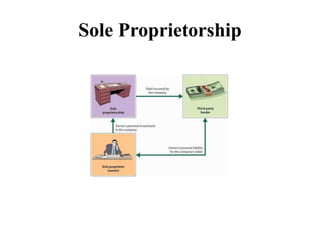
• The owner has unlimited responsibility for losses,
debts, and other liabilities the business might develop.
• The owner must make all the decisions.
• The owner is the only person who can arrange
financing or capitalization.
• The existence of the business ends upon the owner’s
death.
Operation
• Sole proprietors make all the decisions regarding
the operation of the business.
• The assets of sole proprietors are not considered
legally separate from the assets of the business.
• Owners of sole proprietorships report business
income and expenses on their personal income tax
returns.
Federal Tax Forms
Partial list of tax forms
• Form 1040: Individual Income Tax Return
• Schedule C: Profit or Loss from Business
(or Schedule C-EZ)
• Schedule SE: Self-Employment Tax
• Form 1040-ES: Estimated Tax for Individuals
• Form 4562: Depreciation and Amortization
• Form 8829: Expenses for Business Use of Your
Home
• Employment Tax Forms

Sole proprietorship

  • 1.
  • 2.
    Sole Proprietorship • Asole proprietorship is a business established, owned, and controlled by a single person. • Sole proprietorships come in all shapes and sizes. • The owner realizes all the profits and assumes responsibility for all losses. • The sole proprietorship is the most prominent of the four forms of ownership.
  • 3.
  • 4.
    Formation • Of thefour forms of ownership, the sole proprietorship is by far the easiest to form. • The government exercises very little control over the establishment of new sole proprietorships. • Start-up can be immediate and simple. • You may need to obtain licenses or permits for your particular type of business.
  • 5.
    Advantages • Sole proprietorshipsare simple to start. No formal action is required. • A sole proprietorship may be started immediately. • The owner has total control of all aspects of the business. • The owner receives all the profits. • The business itself pays no income tax; the owner pays income tax as an individual.
  • 6.
    Disadvantages • The ownerhas unlimited responsibility for losses, debts, and other liabilities the business might develop. • The owner must make all the decisions. • The owner is the only person who can arrange financing or capitalization. • The existence of the business ends upon the owner’s death.
  • 7.
    Operation • Sole proprietorsmake all the decisions regarding the operation of the business. • The assets of sole proprietors are not considered legally separate from the assets of the business. • Owners of sole proprietorships report business income and expenses on their personal income tax returns.
  • 8.
    Federal Tax Forms Partiallist of tax forms • Form 1040: Individual Income Tax Return • Schedule C: Profit or Loss from Business (or Schedule C-EZ) • Schedule SE: Self-Employment Tax • Form 1040-ES: Estimated Tax for Individuals • Form 4562: Depreciation and Amortization • Form 8829: Expenses for Business Use of Your Home • Employment Tax Forms