Approaches And Methods In Language Teaching Third Edition Jack C Richards
Approaches And Methods In Language Teaching Third Edition Jack C Richards
Approaches And Methods In Language Teaching Third Edition Jack C Richards
Approaches And Methods In Language Teaching Third Edition Jack C Richards
Approaches And Methods In Language Teaching Third Edition Jack C Richards
1.
Approaches And MethodsIn Language Teaching
Third Edition Jack C Richards download
https://ebookbell.com/product/approaches-and-methods-in-language-
teaching-third-edition-jack-c-richards-54249504
Explore and download more ebooks at ebookbell.com
2.
Here are somerecommended products that we believe you will be
interested in. You can click the link to download.
Approaches And Methods In Language Teaching 3rd Edition Jack C
Richards
https://ebookbell.com/product/approaches-and-methods-in-language-
teaching-3rd-edition-jack-c-richards-44876992
Approaches And Methods In Language Teaching 2nd Edition Jack C
Richards
https://ebookbell.com/product/approaches-and-methods-in-language-
teaching-2nd-edition-jack-c-richards-1986380
Contemporary Approaches And Methods In Fundamental Mathematics And
Mechanics 1st Ed Victor A Sadovnichiy
https://ebookbell.com/product/contemporary-approaches-and-methods-in-
fundamental-mathematics-and-mechanics-1st-ed-victor-a-
sadovnichiy-22474370
Multiscale Modeling In Solid Mechanics Computational Approaches
Computational And Experimental Methods In Structures Ugo Galvanetto
https://ebookbell.com/product/multiscale-modeling-in-solid-mechanics-
computational-approaches-computational-and-experimental-methods-in-
structures-ugo-galvanetto-2118078
3.
Departing Radically InAcademic Writing Alternative Approaches To
Writing And Methods In Qualitative Research Elizabeth Mackinlay
https://ebookbell.com/product/departing-radically-in-academic-writing-
alternative-approaches-to-writing-and-methods-in-qualitative-research-
elizabeth-mackinlay-56149118
Departing Radically In Academic Writing Alternative Approaches To
Writing And Methods In Qualitative Research Elizabeth Mackinlay
https://ebookbell.com/product/departing-radically-in-academic-writing-
alternative-approaches-to-writing-and-methods-in-qualitative-research-
elizabeth-mackinlay-56149112
Data And Methods In Corpus Linguistics Comparative Approaches Ole
Schtzler
https://ebookbell.com/product/data-and-methods-in-corpus-linguistics-
comparative-approaches-ole-schtzler-43335824
Novel And Alternative Methods In Food Processing Biotechnological
Physicochemical And Mathematical Approaches Nagaraj Veena
https://ebookbell.com/product/novel-and-alternative-methods-in-food-
processing-biotechnological-physicochemical-and-mathematical-
approaches-nagaraj-veena-48538972
Methods In Consumer Research Volume 2 Alternative Approaches And
Special Applications 1st Edition Gaston Ares
https://ebookbell.com/product/methods-in-consumer-research-
volume-2-alternative-approaches-and-special-applications-1st-edition-
gaston-ares-6838306
Contents
Acknowledgments vii
Introduction tothe third edition ix
I Major trends in twentieth-century language teaching 1
1 A brief history of early developments in language teaching 3
2 The nature of approaches and methods in language teaching 20
3 The Oral Approach and Situational Language Teaching 44
4 The Audiolingual Method 58
II Current approaches and methods 81
5 Communicative Language Teaching 83
6 Content-Based Instruction and Content and Language
Integrated Learning (CLIL) 116
7 Whole Language 139
8 Competency-Based Language Teaching, standards, and the
Common European Framework of Reference 150
9 Task-Based Language Teaching 174
10 Text-Based Instruction 200
11 The Lexical Approach 215
12 Multiple Intelligences 230
13 Cooperative Language Learning 244
III Alternative twentieth-century approaches and methods 259
14 The Natural Approach 261
15 Total Physical Response 277
16 The Silent Way 289
17 Community Language Learning 303
18 Suggestopedia 317
v
11.
vi Contents
IV Theteaching and learning environment 329
19 Learners, approaches, and methods 331
20 Teachers, approaches, and methods 346
21 Approaches, methods, and the curriculum 363
22 Postscript 382
Appendix: Comparison of approaches and methods 388
Author index 400
Subject index 403
Introduction to thethird edition
The first two editions of this book were published in the Cambridge Language Teaching
Library series, with the first edition produced in 1986 followed by a second edition in 2001.
Approaches and Methods in Language Teaching has been widely referred to by teachers and
teachers in training for an account of the major teaching approaches and methods that have
been used in language teaching from the late nineteenth century to the present day. Despite
the advances that have been made in our understanding of language teaching and learning
in the last few decades, the language teaching profession continues to explore new instruc-
tional designs and pedagogies. Language teaching today reflects the changed status of
English as an international language, which has accelerated the demand for more effective
approaches to language teaching. Innovations in technology, the growing trend to begin
teaching English at primary level as well as the use of English as a medium of instruction in
many university programs prompt an ongoing review of past and present practices as teach-
ers and teacher educators search for effective activities and resources for their classrooms.
And despite the belief that contemporary approaches to language teaching rely less on
standard approaches and methods and more on post-method conceptions of teaching – new
teaching proposals continue to appear (such as Content and Language Integrated Learning,
or CLIL, text- and task-based teaching as well as the Common European Framework of
Reference). Familiarity with these as well as with earlier traditions in language teaching
are important components of the professional knowledge expected of today’s language
teachers. For these reasons a third edition of Approaches and Methods seemed appropriate.1
As we prepared the third edition, we were reminded that not everything that is new is nec-
essarily better and that today’s teachers could continue to benefit from a text that provides
a guide to this rich repository of instructional practices in our field.
A number of changes have been incorporated into the third edition.
l
l The book is now divided into four parts, with the final part presenting three new chap-
ters focusing on approaches and methods in relation to the teaching and learning proc-
ess. These chapters seek to show how current views of the roles of learners and teachers
in the language teaching process prompt alternative conceptualizations of the status of
approaches and methods, and also how approaches and methods can be viewed in rela-
tion to the processes of curriculum development.
l
l Part I of the book, Major trends in twentieth-century language teaching, has been
updated, with the theoretical framework for the book presented in Chapter 2. Many
chapters in the book now offer fuller descriptions of approach, design, and procedure.
1
New material for the third edition has been mainly prepared by JCR.
ix
15.
x Introduction tothe third edition
l
l The chapters presenting current approaches and methods have been moved from Part III
to Part II of the book, reflecting their continuity with the major twentieth-century trends.
Chapter 5, Communicative Language Teaching, has been expanded significantly, as has
Chapter 6, which now includes the approach known as CLIL, along with Content-Based
Instruction. Chapter 8 now covers not only Competency-Based Instruction but also the
broader standards and outcomes movements and the Common European Framework of
Reference. A new chapter on Text-Based Instruction has been added.
l
l Several chapters in Part III, Alternative twentieth-century approaches and methods, have
been expanded, with fuller descriptions of the underlying framework. (One chapter
from the second edition, Neurolinguistic Programming [NLP], has not been included
since NLP is not a language teaching method, but rather a humanistic philosophy based
on popular psychology and, as such, does not meet the criteria for inclusion as an
approach or method.)
l
l Discussion questions have been added to all chapters, allowing the reader to synthesize
the material, and a comprehensive table comparing approaches and methods has been
added as an appendix. Textbook samples of a number of approaches and methods have
been provided, as well. While these samples may not reflect the approach or method in
its pure form, and may combine features of more than one method, they provide real-
istic examples of how the approaches and methods have been interpreted by materials
writers.
While we considered not including some of the “innovative” methods of the 1970s and
1980s that attract little interest today, reviewers felt that retaining them provided a useful
historical perspective on method trends; hence, they have been included in this edition.
We are grateful for the anonymous reviewers for their feedback on this edition and
who provided many useful suggestions, to Hayo Reinders for help with discussion ques-
tions, and to Debbie Goldblatt and Jacqueline French for their skillful editorial guidance.
We also wish to thank Karen Momber and Joanna Garbutt of Cambridge University Press
for their support in bringing this edition to fruition.
16.
1
Part I Majortrends in twentieth-century
language teaching
Language teaching came into its own as a profession in the twentieth century. The whole
foundation of contemporary language teaching was developed during the early part of
the twentieth century, as applied linguists and others sought to develop principles and
procedures for the design of teaching methods and materials, drawing on the developing
fields of linguistics and psychology to support a succession of proposals for what were
thought to be more effective and theoretically sound teaching methods. Language teaching
in the twentieth century was characterized by frequent change and innovation and by the
development of sometimes competing language teaching ideologies. Much of the impetus
for change in approaches to language teaching came about from changes in teaching meth-
ods. The method concept in teaching – the notion of a systematic set of teaching practices
based on a particular theory of language and language learning – is a powerful one, and
the quest for better methods was a preoccupation of many teachers and applied linguists
throughout the twentieth century. Methods typically make the same claim, namely that they
reflect a correct understanding of language learning and that adopting the newest method
will lead to better results than the method that preceded it. The chapters in Part I examine
the developments that led to the first major paradigm in modern language teaching – the
adoption of grammar-based teaching methods that came to be known as the structural
approach or Situational Language Teaching in the United Kingdom, and Audiolingualism
in the United States. In Chapter 1, we outline the historical precedents to language teaching
in the first part of the twentieth century and provide a rationale for the study of approaches
and methods and their impact on trends and practices in language teaching. In Chapter 2,
we introduce a model, or framework, for the description of approaches and methods, one
that identifies three levels of organization underlying approaches and methods that we refer
to as approach, design, and procedure. These levels of organization are used throughout
the book. In Chapter 3, we describe one of the most important British language teaching
proposals of the twentieth century, the Oral Approach or Situational Language Teaching, a
method that continues to be widely used today in textbooks and teaching materials, though
in the somewhat modified form of Presentation-Practice-Production, or PPP. In Chapter 4,
we describe the method known as Audiolingualism, an American teaching method that
has similarly left a lasting and continuing legacy in terms of commonly used teaching
procedures that focus on structure and pattern practice.
1
18.
3
1 A briefhistory of early developments
in language teaching
Introduction
By the beginning of the twentieth century, language teaching was emerging as an active
area of educational debate and innovation. Although language teaching has a very
long history, the foundations of contemporary approaches to language teaching were
developed during the early part of the twentieth century, as applied linguists and others
sought to develop principles and procedures for the design of teaching methods and
materials, drawing on the developing fields of linguistics and psychology. This led to
a succession of proposals for what were thought to be more effective and theoretically
sound language teaching methods. Language teaching in the twentieth century was
characterized at different times by change and innovation and by the development of
competing language teaching ideologies. The impetus for change in approaches to lan-
guage teaching is generally a response to increased demand for speakers of second and
foreign languages. World War II, for example, prompted the need for new ways of teach-
ing oral skills in foreign languages, as we discuss in Chapter 4. Large-scale movement of
people through immigration as well as the internationalization of education since the
1950s also created a demand for new types of language programs. And in more recent
times, globalization, the rise of the Internet, and the global spread of English has also
prompted a reassessment of language teaching policies and practices. This chapter, in
briefly reviewing the history of language teaching methods, provides a background for
the discussion of past and present methods and suggests the issues we will refer to in
analyzing these methods.
The emergence of methods
Efforts to improve the effectiveness of language teaching have often focused on changes
in teaching methods. Throughout history such changes have reflected changes in the
goals of language teaching, such as a move toward oral proficiency rather than reading
comprehension as the goal of language study; they have also reflected changes in theo-
ries of the nature of language and of language learning. The method concept in teach-
ing – the notion of a systematic set of teaching practices based on a particular theory
of language and language learning – is a powerful though controversial one, and the
quest for better methods was a preoccupation of many teachers and applied linguists
19.
4 Major trendsin twentieth-century language teaching
throughout the twentieth century. From a historical perspective, we are able to see that
the concerns that have prompted recent innovations in language teaching, such as Task-
Based Language Teaching (Chapter 9) and Content and Language Integrated Learning,
or CLIL (Chapter 6), are similar to those that have always been at the center of discus-
sions on how to teach foreign languages. Common to each method is the belief that the
teaching practices it supports provide a more effective and theoretically sound basis for
teaching than the methods that preceded it. Today’s controversies reflect contemporary
responses to questions that have often been asked throughout the history of language
teaching – questions about how to improve the quality of teaching and learning in
language teaching classrooms.
The influence of Latin
We live in a bilingual and multilingual world. From both a contemporary and a histori-
cal perspective, bilingualism or multilingualism is the norm rather than the exception. It
is fair, then, to say that throughout history foreign language learning has always been an
important practical concern. Whereas today English is the world’s most widely studied
foreign or second language, 500 years ago it was Latin, for it was the dominant language
of education, commerce, religion, and government in the Western world. In the sixteenth
century, however, French, Italian, and English gained in importance as a result of politi-
cal changes in Europe, and Latin gradually became displaced as a language of spoken and
written communication.
As the status of Latin diminished from that of a living language to that of an
“occasional” subject in the school curriculum, the study of Latin took on a different
function. The study of classical Latin (the Latin in which the works of Virgil, Ovid, and
Cicero were written) and an analysis of its grammar and rhetoric became the model
for foreign language study from the seventeenth to the nineteenth centuries. Children
entering “grammar school” in the sixteenth, seventeenth, and eighteenth centuries
in England were initially given a rigorous introduction to Latin grammar, which was
taught through rote learning of grammar rules, study of declensions and conjugations,
translation, and practice in writing sample sentences, sometimes with the use of parallel
bilingual texts and dialogue (Kelly 1969; Howatt 1984). Once basic proficiency was estab-
lished, students were introduced to the advanced study of grammar and rhetoric. School
learning must have been a deadening experience for children, for lapses in knowledge
were often met with brutal punishment. There were occasional attempts to promote
alternative approaches to education; Roger Ascham and Montaigne in the sixteenth
century and Comenius and John Locke in the seventeenth century, for example, had
made specific proposals for curriculum reform and for changes in the way Latin was
taught (Kelly 1969; Howatt 1984), but since Latin (and, to a lesser extent, Greek) had for
so long been regarded as the classical and therefore most ideal form of language, it was
not surprising that ideas about the role of language study in the curriculum reflected the
long-established status of Latin.
20.
1 A briefhistory 5
The decline of Latin also brought with it a new justification for teaching Latin. Latin
was said to develop intellectual abilities, and the study of Latin grammar became an end
in itself.
When once the Latin tongue had ceased to be a normal vehicle for communica-
tion, and was replaced as such by the vernacular languages, then it most speedily
became a “mental gymnastic,” the supremely “dead” language, a disciplined and
systematic study of which was held to be indispensable as a basis for all forms of
higher education.
(V. Mallison, cited in Titone 1968: 26)
As “modern” languages began to enter the curriculum of European schools in the eight-
eenth century, they were taught using the same basic procedures that were used for teach-
ing Latin. Textbooks consisted of statements of abstract grammar rules, lists of vocabulary,
and sentences for translation. Speaking the foreign language was not the goal, and oral
practice was limited to students reading aloud the sentences they had translated. These
sentences were constructed to illustrate the grammatical system of the language and con-
sequently bore no relation to the language of real communication. Students labored over
translating sentences such as the following:
The philosopher pulled the lower jaw of the hen.
My sons have bought the mirrors of the Duke.
The cat of my aunt is more treacherous than the dog of your uncle.
(Titone 1968: 28)
By the nineteenth century, this approach based on the study of Latin had become the
standard way of studying foreign languages in schools. A typical textbook in the mid-
nineteenth century thus consisted of chapters or lessons organized around grammar points.
Each grammar point was listed, rules on its use were explained, and it was illustrated by
sample sentences.
Nineteenth-century textbook compilers were mainly determined to codify the foreign
language into frozen rules of morphology and syntax to be explained and eventually
memorized. Oral work was reduced to an absolute minimum, while a handful of written
exercises, constructed at random, came as a sort of appendix to the rules. Of the many
books published during this period, those by Seidenstücker and Plötz were perhaps
the most typical … [Seidenstücker] reduced the material to disconnected sentences
to illustrate specific rules. He divided his text carefully into two parts, one giving the
rules and necessary paradigms, the other giving French sentences for translation into
German and German sentences for translation into French. The immediate aim was for
the student to apply the given rules by means of appropriate exercises … In [Plötz’s]
textbooks, divided into the two parts described above, the sole form of instruction
was mechanical translation. Typical sentences were: “Thou hast a book. The house is
21.
6 Major trendsin twentieth-century language teaching
beautiful. He has a kind dog. We have a bread [sic]. The door is black. He has a book
and a dog. The horse of the father was kind.”
(Titone 1968: 27)
This approach to foreign language teaching became known as the Grammar-Translation
Method.
The Grammar-Translation Method
As the names of some of its leading exponents suggest (Johann Seidenstücker, Karl Plötz,
H. S. Ollendorf, and Johann Meidinger), Grammar Translation was the offspring of
German scholarship, the object of which, according to one of its less charitable critics,
was “to know everything about something rather than the thing itself ” (W. H. D. Rouse,
quoted in Kelly 1969: 53). Grammar Translation was in fact first known in the United States
as the Prussian Method. (A book by B. Sears, an American classics teacher, published in
1845 was titled The Ciceronian or the Prussian Method of Teaching the Elements of the Latin
Language [Kelly 1969].) The principal characteristics of the Grammar-Translation Method
were these:
1. The goal of foreign language study is to learn a language in order to read its literature or
in order to benefit from the mental discipline and intellectual development that result
from foreign language study. Grammar Translation is a way of studying a language that
approaches the language first through detailed analysis of its grammar rules, followed by
application of this knowledge to the task of translating sentences and texts into and out
of the target language. It hence views language learning as consisting of little more than
memorizing rules and facts in order to understand and manipulate the morphology and
syntax of the foreign language. “The first language is maintained as the reference system
in the acquisition of the second language” (Stern 1983: 455).
2. Reading and writing are the major focus; little or no systematic attention is paid to
speaking or listening.
3. Vocabulary selection is based solely on the reading texts used, and words are taught
through bilingual word lists, dictionary study, and memorization. In a typical
Grammar-Translation text, the grammar rules are presented and illustrated, a list of
vocabulary items is presented with their translation equivalents, and translation exer-
cises are prescribed.
4. The sentence is the basic unit of teaching and language practice. Much of the lesson is
devoted to translating sentences into and out of the target language, and it is this focus
on the sentence that is a distinctive feature of the method. Earlier approaches to foreign
language study used grammar as an aid to the study of texts in a foreign language. But
this was thought to be too difficult for students in secondary schools, and the focus on
the sentence was an attempt to make language learning easier (see Howatt 1984: 131).
5. Accuracy is emphasized. Students are expected to attain high standards in translation,
because of “the high priority attached to meticulous standards of accuracy which, as well
22.
1 A briefhistory 7
as having an intrinsic moral value, was a prerequisite for passing the increasing number
of formal written examinations that grew up during the century” (Howatt 1984: 132).
6. Grammar is taught deductively – that is, by presentation and study of grammar rules,
which are then practiced through translation exercises. In most Grammar-Translation
texts, a syllabus was followed for the sequencing of grammar points throughout a text,
and there was an attempt to teach grammar in an organized and systematic way.
7. The student’s native language is the medium of instruction. It is used to explain new
items and to enable comparisons to be made between the foreign language and the stu-
dent’s native language.
Grammar Translation dominated European and foreign language teaching from the
1840s to the 1940s, and in modified form it continues to be widely used in some parts of the
world today. At its best, as Howatt (1984) points out, it was not necessarily the horror that
its critics depicted it as. Its worst excesses were introduced by those who wanted to dem-
onstrate that the study of French or German was no less rigorous than the study of clas-
sical languages. This resulted in the type of Grammar-Translation courses remembered
with distaste by thousands of school learners, for whom foreign language learning meant
a tedious experience of memorizing endless lists of unusable grammar rules and vocabu-
lary and attempting to produce perfect translations of stilted or literary prose. Although
the Grammar-Translation Method often creates frustration for students, it makes few
demands on teachers. It is still used in situations where understanding literary texts is the
primary focus of foreign language study and there is little need for a speaking knowledge
of the language. Contemporary texts for the teaching of foreign languages at the college
level still sometimes reflect Grammar-Translation principles. These texts are frequently
the products of people trained in literature rather than in language teaching or applied
linguistics. Consequently, though it may be true to say that the Grammar-Translation
Method is still widely practiced, it has no advocates. It is a method for which there is no
theory. There is no literature that offers a rationale or justification for it or that attempts to
relate it to issues in linguistics, psychology, or educational theory. However, its continued
use in some part of the world may be due to (a) the limited command of spoken English
of language teachers, (b) the fact that this was the method their teachers used, (c) it gives
teachers a sense of control and authority in the classroom, and (d) it works well in large
classes. Jin and Cortazzi (2011: 558–9) offer the following explanation for the continued
use of Grammar Translation and other traditional teaching approaches in some parts of
the world:
TAs (traditional approaches) have persisted for longer in most developing parts of the
world than in more economically developed ones, due to the slower development of
educational systems and language teacher training, cultural perceptions and different
ways of change, limited learning resources and finance.
But in Europe in the mid and late nineteenth century, opposition to the Grammar-
Translation Method gradually developed in several countries. This Reform Movement, as it
23.
8 Major trendsin twentieth-century language teaching
was referred to, laid the foundations for the development of new ways of teaching languages
and raised controversies that have continued to the present day.
Language teaching innovations in the nineteenth century
Toward the middle of the nineteenth century, several factors contributed to a questioning
and rejection of the Grammar-Translation Method. Increased opportunities for commu-
nication among Europeans created a demand for oral proficiency in foreign languages.
Initially, this created a market for conversation books and phrase books intended for pri-
vate study, but language teaching specialists also turned their attention to the way English
and modern European languages were being taught in secondary schools. Increasingly, the
public education system was seen to be failing in its responsibilities. In Germany, England,
France, and other parts of Europe, new approaches to language teaching were developed
by individual language teaching specialists, each with a specific method for reforming the
teaching of modern languages. Some of these specialists, such as C. Marcel, T. Prendergast,
and F. Gouin, did not manage to achieve any lasting impact, though their ideas are of his-
torical interest.
The Frenchman C. Marcel (1793–1896) referred to child language learning as a model
for language teaching, emphasized the importance of meaning in learning, proposed that
reading be taught before other skills, and tried to locate language teaching within a broader
educational framework. The Englishman T. Prendergast (1806–1886) was one of the first to
record the observation that children use contextual and situational cues to interpret utter-
ances and that they use memorized phrases and “routines” in speaking. He proposed the
first “structural syllabus,” advocating that learners be taught the most basic structural pat-
terns occurring in the language. In this way he was anticipating a more scientific approach
to language study, an issue that was to be taken up in the 1920s and 1930s, as we shall see
in Chapter 3. The Frenchman F. Gouin (1831–1896) is perhaps the best known of these
mid-nineteenth-century reformers. Gouin developed an approach to teaching a foreign
language based on his observations of children’s use of language. He believed that lan-
guage learning was facilitated through using language to accomplish events consisting of a
sequence of related actions. His method used situations and themes as ways of organizing
and presenting oral language – the famous Gouin “series,” which includes sequences of sen-
tences related to such activities as chopping wood and opening the door. Gouin established
schools to teach according to his method, and it was quite popular for a time. In the first
lesson of a foreign language, the following series would be learned:
I walk toward the door. I walk.
I draw near to the door. I draw near.
I draw nearer to the door. I draw nearer.
I get to the door. I get to.
I stop at the door. I stop.
I stretch out my arm. I stretch out.
24.
1 A briefhistory 9
I take hold of the handle. I take hold.
I turn the handle. I turn.
I open the door. I open.
I pull the door. I pull.
The door moves. moves
The door turns on its hinges turns
The door turns and turns. turns
I open the door wide. I open.
I let go of the handle. I let go.
(Titone 1968: 35)
Gouin’s emphasis on the need to present new teaching items in a context that makes their
meaning clear, and the use of gestures and actions to convey the meanings of utterances, are
practices that later became part of such approaches and methods as Situational Language
Teaching (Chapter 3) and Total Physical Response (Chapter 15).
The work of individual language specialists like these reflects the changing climate of
the times in which they worked. Educators recognized the need for speaking proficiency
rather than reading comprehension, grammar, or literary appreciation as the goal for foreign
language programs; there was an interest in how children learn languages, which prompted
attempts to develop teaching principles from observation of (or, more typically, reflections
about) child language learning. But the ideas and methods of Marcel, Prendergast, Gouin,
and other innovators were developed outside the context of established circles of education
and hence lacked the means for wider dissemination, acceptance, and implementation.
They were writing at a time when there was not sufficient organizational structure in the
language teaching profession (i.e., in the form of professional associations, journals, and
conferences) to enable new ideas to develop into an educational movement. This began to
change toward the end of the nineteenth century, however, when a more concerted effort
arose in which the interests of reform-minded language teachers and linguists coincided.
Teachers and linguists began to write about the need for new approaches to language
teaching, and through their pamphlets, books, speeches, and articles, the foundation for
more widespread pedagogical reforms was laid. This effort became known as the Reform
Movement in language teaching.
The Reform Movement
Language teaching specialists such as Marcel, Prendergast, and Gouin had done much
to promote alternative approaches to language teaching, but their ideas failed to receive
widespread support or attention. From the 1880s, however, practical-minded linguists such
as Henry Sweet in England, Wilhelm Viëtor in Germany, and Paul Passy in France began
to provide the intellectual leadership needed to give reformist ideas greater credibility and
acceptance. The discipline of linguistics was revitalized. Phonetics – the scientific analysis
and description of the sound systems of languages – was established, giving new insights
25.
10 Major trendsin twentieth-century language teaching
into speech processes. Linguists emphasized that speech, rather than the written word,
was the primary form of language. The International Phonetic Association was founded in
1886, and its International Phonetic Alphabet (IPA) was designed to enable the sounds of
any language to be accurately transcribed. One of the earliest goals of the association was
to improve the teaching of modern languages. It advocated
1. the study of the spoken language;
2. phonetic training in order to establish good pronunciation habits;
3. the use of conversation texts and dialogues to introduce conversational phrases and idioms;
4. an inductive approach to the teaching of grammar;
5. teaching new meanings through establishing associations within the target language
rather than by establishing associations with the native language.
Linguists too became interested in the controversies that emerged about the best
way to teach foreign languages, and ideas were fiercely discussed and defended in books,
articles, and pamphlets. Henry Sweet (1845–1912) argued that sound methodological prin-
ciples should be based on a scientific analysis of language and a study of psychology. In his
book The Practical Study of Languages (1899), he set forth principles for the development of
teaching method. These included
1. careful selection of what is to be taught;
2. imposing limits on what is to be taught;
3. arranging what is to be taught in terms of the four skills of listening, speaking, reading,
and writing;
4. grading materials from simple to complex.
In Germany, the prominent scholar Wilhelm Viëtor (1850–1918) used linguistic theory
to justify his views on language teaching. He argued that training in phonetics would enable
teachers to pronounce the language accurately. Speech patterns, rather than grammar, were
the fundamental elements of language. In 1882 he published his views in an influential pam-
phlet, Language Teaching Must Start Afresh, in which he strongly criticized the inadequacies
of Grammar Translation and stressed the value of training teachers in the new science of
phonetics.
Viëtor, Sweet, and other reformers in the late nineteenth century shared many beliefs
about the principles on which a new approach to teaching foreign languages should be
based, although they often differed considerably in the specific procedures they advocated
for teaching a language. In general the reformers believed that
1. the spoken language is primary and that this should be reflected in an oral-based
methodology;
2. the findings of phonetics should be applied to teaching and to teacher training;
3. learners should hear the language first, before seeing it in written form;
4. words should be presented in sentences, and sentences should be practiced in meaning-
ful contexts and not be taught as isolated, disconnected elements;
26.
1 A briefhistory 11
5. the rules of grammar should be taught only after the students have practiced the gram-
mar points in context – that is, grammar should be taught inductively;
6. translation should be avoided, although the native language could be used in order to
explain new words or to check comprehension.
These principles provided the theoretical foundations for a principled approach to
language teaching, one based on a scientific approach to the study of language and of lan-
guage learning. They reflect the beginnings of the discipline of applied linguistics – that
branch of language study and research concerned with the scientific study of second and
foreign language teaching and learning. The writings of such scholars as Sweet, Viëtor, and
Passy provided suggestions on how these applied linguistic principles could best be put into
practice. None of these proposals assumed the status of a method, however, in the sense of a
widely recognized and uniformly implemented design for teaching a language. But parallel
to the ideas put forward by members of the Reform Movement was an interest in develop-
ing principles for language teaching out of naturalistic principles of language learning, such
as are seen in first language acquisition. This led to what have been termed natural methods
and then ultimately to the development of what came to be known as the Direct Method.
The Direct Method
Gouin had been one of the first of the nineteenth-century reformers to attempt to build a
methodology around observation of child language learning. Other reformers toward the
end of the century likewise turned their attention to naturalistic principles of language
learning, and for this reason they are sometimes referred to as advocates of a “natural”
method. In fact, at various times throughout the history of language teaching, attempts
have been made to make second language learning more like first language learning. In the
sixteenth century, for example, Montaigne described how he was entrusted to a guardian
who addressed him exclusively in Latin for the first years of his life, since Montaigne’s father
wanted his son to speak Latin well. Among those who tried to apply natural principles to
language classes in the nineteenth century was L. Sauveur (1826–1907), who used intensive
oral interaction in the target language, employing questions as a way of presenting and
eliciting language. He opened a language school in Boston in the late 1860s, and his method
soon came to be referred to as the Natural Method.
Sauveur and other believers in the Natural Method argued that a foreign language
could be taught without translation or the use of the learner’s native language if meaning
was conveyed directly through demonstration and action. The German scholar F. Franke
wrote on the psychological principles of direct association between forms and meanings
in the target language (1884) and provided a theoretical justification for a monolingual
approach to teaching. According to Franke, a language could best be taught by using it
actively in the classroom. Rather than using analytical procedures that focus on explanation
of grammar rules in classroom teaching, teachers must encourage direct and spontaneous
use of the foreign language in the classroom. Learners would then be able to induce rules
of grammar. The teacher replaced the textbook in the early stages of learning. Speaking
27.
12 Major trendsin twentieth-century language teaching
began with systematic attention to pronunciation. Known words could be used to teach
new vocabulary, using mime, demonstration, and pictures.
These natural language learning principles provided the foundation for what came
to be known as the Direct Method, which refers to the most widely known of the natu-
ral methods. Enthusiastic supporters of the Direct Method introduced it in France and
Germany (it was officially approved in both countries at the turn of the century), and it
became widely known in the United States through its use by Sauveur and Maximilian
Berlitz in successful commercial language schools. (Berlitz, in fact, never used the term; he
referred to the method used in his schools as the Berlitz Method.) In practice it stood for
the following principles and procedures:
1. Classroom instruction was conducted exclusively in the target language.
2. Only everyday vocabulary and sentences were taught.
3. Oral communication skills were built up in a carefully graded progression organized
around question-and-answer exchanges between teachers and students in small, inten-
sive classes.
4. Grammar was taught inductively.
5. New teaching points were introduced orally.
6. Concrete vocabulary was taught through demonstration, objects, and pictures; abstract
vocabulary was taught by association of ideas.
7. Both speech and listening comprehension were taught.
8. Correct pronunciation and grammar were emphasized.
These principles are seen in the following guidelines for teaching oral language, which
are still followed in contemporary Berlitz schools:
Never translate: demonstrate
Never explain: act
Never make a speech: ask questions
Never imitate mistakes: correct
Never speak with single words: use sentences
Never speak too much: make students speak much
Never use the book: use your lesson plan
Never jump around: follow your plan
Never go too fast: keep the pace of the student
Never speak too slowly: speak normally
Never speak too quickly: speak naturally
Never speak too loudly: speak naturally
Never be impatient: take it easy
(cited in Titone 1968: 100–1)
The Direct Method was quite successful in private language schools, such as those of
the Berlitz chain, where paying clients had high motivation and the use of native-speaking
teachers was the norm. But despite pressure from proponents of the method, it was difficult
28.
1 A briefhistory 13
to implement in public secondary school education. It overemphasized and distorted the
similarities between naturalistic first language learning and classroom foreign language
learning and failed to consider the practical realities of the classroom. In addition, it lacked
a rigorous basis in applied linguistic theory, and for this reason it was often criticized by the
more academically based proponents of the Reform Movement. The Direct Method repre-
sented the product of enlightened amateurism. It was perceived to have several drawbacks.
It required teachers who were native speakers or who had native-like fluency in the foreign
language. It was largely dependent on the teacher’s skill, rather than on a textbook, and
not all teachers were proficient enough in the foreign language to adhere to the principles
of the method. Critics pointed out that strict adherence to Direct Method principles was
often counterproductive, since teachers were required to go to great lengths to avoid using
the native language, when sometimes a simple, brief explanation in the student’s native
language would have been a more efficient route to comprehension.
The Harvard psychologist Roger Brown has documented similar problems with strict
Direct Method techniques. He described his frustration in observing a teacher performing
verbal gymnastics in an attempt to convey the meaning of Japanese words, when translation
would have been a much more efficient technique (Brown 1973: 5).
By the 1920s, use of the Direct Method in noncommercial schools in Europe had
consequently declined. In France and Germany it was gradually modified into versions that
combined some Direct Method techniques with more controlled grammar-based activities.
The European popularity of the Direct Method in the early part of the twentieth century
caused foreign language specialists in the United States to attempt to have it implemented
in US schools and colleges, although they decided to move with caution. A study begun
in 1923 on the state of foreign language teaching concluded that no single method could
guarantee successful results. The goal of trying to teach conversation skills was considered
impractical in view of the restricted time available for foreign language teaching in schools,
the limited skills of teachers, and the perceived irrelevance of conversation skills in a
foreign language for the average American college student. The study – published as the
Coleman Report – argued that a more reasonable goal for a foreign language course would
be a reading knowledge of a foreign language, achieved through the gradual introduction
of words and grammatical structures in simple reading texts. The main result of this rec-
ommendation was that reading became the goal of most foreign language programs in the
United States (Coleman 1929). The emphasis on reading continued to characterize foreign
language teaching in the United States until World War II.
Although the Direct Method enjoyed popularity in Europe, not everyone embraced
it enthusiastically. The British applied linguist Henry Sweet recognized its limitations. It
offered innovations at the level of teaching procedures but lacked a thorough methodologi-
cal basis. Its main focus was on the exclusive use of the target language in the classroom, but
it failed to address many issues that Sweet thought more basic. Sweet and other applied lin-
guists argued for the development of sound methodological principles that could serve as
the basis for teaching techniques. In the 1920s and 1930s, applied linguists systematized the
principles proposed earlier by the Reform Movement and so laid the foundations for what
29.
14 Major trendsin twentieth-century language teaching
developed into the British, or Oral Approach to teaching English as a foreign language,
which emphasized the need to grade language items according to difficulty and to teach
language through a focus on its core structures and grammar (see Chapter 3). Subsequent
developments led to Audiolingualism (Chapter 4) in the United States and Situational
Language Teaching (Chapter 3) in Britain.
However, what assumptions underlie the concept of method in language teaching as
it emerged as a significant educational issue in the nineteenth and twentieth centuries? We
have seen from this historical survey some of the questions that prompted innovations and
new directions in language teaching in the past:
1. What should the goals of language teaching be? Should a language course try to teach
conversational proficiency, reading, translation, or some other skill?
2. What is the basic nature of language, and how will this affect the way we teach it?
3. What are the principles for the selection of language content in language teaching?
4. What principles of organization, sequencing, and presentation best facilitate learning?
5. What should the role of the first language or languages be?
6. What language acquisition processes do learners use in mastering a language, and can
these be incorporated into a method?
7. What teaching techniques and activities work best and under what circumstances?
Particular teaching approaches and methods differ in the way they have addressed these
issues from the late nineteenth century to the present, as we shall see throughout this book.
The Direct Method can be regarded as the first language teaching method to have caught
the attention of teachers and language teaching specialists, and it offered a methodology
that appeared to move language teaching into a new era. It marked the beginning of what
we can refer to as the “methods era.”
The methods era
One of the lasting legacies of the Direct Method was the notion of “method” itself. The
controversy over the Direct Method was the first of many debates over how second and
foreign languages should be taught. The history of language teaching throughout much of
the twentieth century and into the twenty-first century saw the rise and fall of a variety of
language teaching approaches and methods, the major examples of which are described in
this book. The distinction between an approach and a method will be covered in depth in
Chapter 2; for the purposes of this chapter, however, the terms are used indistinguishably.
Common to most approaches and methods are the following assumptions:
l An approach or method refers to a theoretically consistent set of teaching procedures
that define good practice in language teaching.
l Particular approaches and methods, if followed precisely, will lead to more effective
levels of language learning than alternative ways of teaching.
l Teacher training should include preparing teachers to understand and use the best avail-
able language teaching methods.
30.
1 A briefhistory 15
The different teaching approaches and methods that have emerged since the 1950s and
1960s, while often having very different characteristics in terms of goals, assumptions about
how a second language is learned, and preferred teaching techniques, have in common the
belief that if language learning is to be improved, it will come about through changes and
improvements in teaching methodology. This notion has been reinforced by professional
organizations that endorse particular teaching approaches and methods, by academics who
support some and reject others, by publishers who produce and sell textbooks based on the
latest teaching approaches and methods, and by teachers who are constantly looking for the
“best” method of teaching a language. Lange (1990: 253) comments:
Foreign language teacher development … has a basic orientation to methods of teach-
ing. Unfortunately, the latest bandwagon “methodologies” come into prominence with-
out much study or understanding, particularly those that appear easiest to immediately
apply in the classroom or those that are supported by a particular “guru.” Although
concern for method is certainly not a new issue, the current attraction to “method”
stems from the late 1950s, when foreign language teachers were falsely led to believe
that there was a method to remedy the “language teaching and learning problems.”
Hunter and Smith (2012: 430) suggest that the notion of methods has also been established
by the fact that accounts (such as this one) represent “a general tendency in the profession
to ‘package up’ the past by assigning methods labeled to bounded periods of history. Past
methods are presented as fixed sets of procedures and principles, with little attention paid
to the contexts in which these were developed, the way alternatives were debated at the
time, or indeed the extent to which there was continuity with previous period.” This should
be kept in mind in reading the accounts presented here.
Notwithstanding the note of caution above, debate over the teaching methods and
approaches that will be covered in this book has been a dominant theme in language teach-
ing since the 1950s. The 1950s and 1960s saw the emergence of the Audiolingual Method
and the Situational Method, which were both superseded by the Communicative Approach
(Chapter 5). During the same period, other methods attracted smaller but equally enthu-
siastic followers, including the Silent Way (Chapter 16), the Natural Approach (Chapter
14), and Total Physical Response (Chapter 15). Since the 1980s and 1990s, Content-Based
Instruction (Chapter 6), and task-based and text-based approaches (Chapters 9 and 10)
were developed as well as movements such as Competency-Based Language Teaching
(Chapter 8) that focus on the outcomes of learning rather than methods of teaching.
Other approaches such as Cooperative Language Learning (Chapter 13), Whole Language
(Chapter 7), and Multiple Intelligences (Chapter 12), originally developed in general educa-
tion, have been extended to second language settings. And more recently CLIL (Chapter 6)
has attracted considerable interest in Europe, as has the Common European Framework of
Reference which shifts focus to the outcomes of learning.
At the same time, applied linguists have also questioned the assumptions implicit in
the views of teaching underlying the concept of approaches and methods. For example,
Holliday (1994) argued that a communicative approach, as taught to teachers who are native
31.
16 Major trendsin twentieth-century language teaching
speakers of English, reflects a view of teaching and learning that is culturally bound and
reflects assumptions from dominant Western cultures – Britain, Australasia, and North
America (see Chapter 20). Kumaravadivelu presents a more radical critique of the influence
of Western methods, also known as “inner-circle” based or “center-based” methods, which
take as their starting point “the native speaker’s language competence, learning styles, com-
munication patterns, conversational maxims, cultural beliefs, and even accent”:
Briefly, Center-produced methods are based on idealized concepts geared toward
idealized contexts. Since language learning and teaching needs, wants, and situa-
tions are unpredictably numerous, no idealized teaching method can visualize all the
variables in advance to provide situation-specific suggestions that practicing teachers
need to tackle the challenges that confront the practice of their everyday teaching.
As a predominantly top-down exercise, the conception and construction of methods
have been largely guided by a one-size-fits-all cookie-cutter approach that assumes a
common clientele with common goals.
(Kumaravadivelu 2012: 18)
Others have suggested that the history of methods is often presented as evidence of
self-proclaimed progress, with little consideration of the successes achieved by teachers
using superseded methods that are depicted as “failures.” Since the 1990s, many applied
linguists and language teachers have consequently moved away from a belief that newer
and therefore “better” approaches and methods are the solution to problems in language
teaching. Alternative ways of understanding the nature of language teaching have emerged
that are sometimes viewed as characterizing the “post-methods era” (Chapter 20).
These newer approaches to understanding language teaching are discussed in Part IV of
this book.
Approaches and methods in teacher preparation programs
Despite the changing status of approaches and methods in language teaching, the study of
past and present teaching methods continues to form a component of many teacher prepa-
ration programs. This is discussed more fully in Chapter 20. There are several reasons why
methods are a component of many teacher-education programs. The study of approaches
and methods
l provides teachers with a view of how the field of language teaching has evolved and
forms part of the disciplinary knowledge expected of language teachers today;
l introduces teachers to the issues and options that are involved in planning and develop-
ing a language course;
l introduces a variety of principles and procedures that teachers can review and evaluate
in relation to their own knowledge, beliefs, and practice.
This is the orientation we adopt toward the teaching approaches and methods described
in this book. In order to understand the fundamental nature of methods in language
32.
1 A briefhistory 17
teaching, however, it is necessary to conceptualize the notion of approach and method
more systematically. This is the aim of the next chapter, in which we present a model
for the description, analysis, and comparison of methods. This model will be used as a
framework for our subsequent discussions and analyses of particular language teaching
methods and philosophies.
Conclusion
In this chapter, we have looked at the emergence of methods, which in the early years
included an emphasis on Latin and the Grammar-Translation Method. The Reform
Movement then led to an emphasis on the spoken language and development of the Direct
Method, a “natural method” emphasizing native-speaker input as a way for the learner to
induce language patterns in the target language. Criticisms that the Direct Method lacked
a thorough methodological underpinning led to the birth of the “methods era” and the
many approaches and methods that will be covered in this book. More recently, some
educators have criticized the better-known approaches and methods as “Western-centric,”
and applied linguists have begun to conceptualize new ways of understanding language.
Discussion questions
1. What changes in approaches to language teaching have you experienced? What
prompted the changes you have witnessed?
2. Have you ever been trained in, or have you ever studied, the use of a “new” language
teaching method? What are your recollections of the experience? Has it had a lasting
impact on your approach to teaching?
3. “The goal of foreign language study is to learn a language in order to ... benefit from the
mental discipline and intellectual development that result from foreign language study”
(p. 6). What do you think are examples of this “mental discipline” and “intellectual
development”? Are these relevant to language learning today?
4. Have you experienced grammar-translation instruction yourself? How was your experi-
ence? Were there any aspects of it that you enjoyed or thought were useful for your own
teaching?
5. Review the beliefs of Viëtor, Sweet, and other reformers in the late nineteenth century
presented on page 10. To what extent do these differ from your own?
6. Can you think of situations where the use of translation and a heavy reliance on the
learner’s first language can be fruitful?
7. What are some ways in which first and second language learning are similar? In what
ways are they different?
8. The Coleman Report, published in 1929, recommended a focus on reading as the basis
of language instruction. In some countries today, language classes meet for only two or
33.
18 Major trendsin twentieth-century language teaching
three hours per week and most of the learners will not move or travel overseas. Could a
similar argument be made for a focus on reading skills?
9. What do you think is the value of studying approaches and methods, including older and
more current ones? What factors contributed to the development of the methods era? Do
you perceive a Western bias in current approaches and methods that you are familiar with?
References and further reading
Brown, H. D. 1993. Principles of Language Learning and Teaching. 3rd edn. Englewood Cliffs, NJ:
Prentice Hall.
Brown, R. 1973. A First Language. Cambridge, MA: Harvard University Press.
Coleman, A. 1929. The Teaching of Modern Foreign Languages in the United States. New York:
Macmillan.
Cook, V. 2011. Teaching English as a foreign language in Europe. In Eli Hinkel (ed.), Handbook of
Research in Second Language Teaching and Learning, Vol. II. New York: Routledge. 140–54.
Darian, K. C. 1971. Generative Grammar, Structural Linguistics, and Language Teaching. Rowley, MA:
Newbury House.
Franke, F. 1884. Die Praktische Spracherlernung auf Grund der Psychologie und der Physiologie der
Sprache Dargestellt. Leipzig: O. R. Reisland.
Holliday, A. 1994. The house of TESEP and the communicative approach: the special needs of state
English language education. ELT Journal 48(1): 3–11.
Howatt, A. P. R. 1984. A History of English Language Teaching. Oxford: Oxford University Press.
Howatt, T. 1997. Talking shop: transformation and change in ELT. ELT Journal 5(3): 263–8.
Hunter, D., and R. Smith. 2012. Unpackaging the past: “CLT” through ELTJ keywords. ELT Journal
66(4): 430–9.
Jin, L., and M. Cortazzi. 2011. Re-evaluating traditional approaches to second language teaching and
learning. In E. Hinkel (ed.), Handbook of Research in Second Language Teaching and Learning,
Vol. II. New York: Routledge. 558–75.
Kelly, L. 1969. 25 Centuries of Language Teaching. Rowley, MA: Newbury House.
Kumaravadivelu. B. 2012. Individual identity, cultural globalization, and teaching English as an
international language: the case for an epistemic break. In L. Alsagoff, S. L. McKay, G. Hu,
and W. A. Renandya (eds.), Principles and Practices for Teaching English as an International
Language. New York: Routledge. 9–27.
Lange, D. 1990. A blueprint for a teacher development program. In J. C. Richards and D. Nunan
(eds.), Second Language Teacher Education. New York: Cambridge University Press. 245–68.
Larsen-Freeman, D. 1998. Expanding roles of learners and teachers in learner-centered instruction.
In W. Renandya and G. Jacobs (eds.), Learners and Language Learning. Singapore: SEAMEO
Regional Language Center. 207–26.
Mackey, W. F. 1965. Language Teaching Analysis. London: Longman.
Marcella, F. 1998. The Historical Development of ESL Materials in the United States. ERIC document
(ED425653).
Richards, J. C. 1985. The secret life of methods. In J. C. Richards, The Context of Language Teaching.
New York: Cambridge University Press. 32–45.
34.
1 A briefhistory 19
Stern, H. H. 1983. Fundamental Concepts of Language Teaching. Oxford: Oxford University Press.
Sweet, H. 1899. The Practical Study of Languages. Repr. London: Oxford University Press.
Titone, R. 1968. Teaching Foreign Languages: An Historical Sketch. Washington, DC: Georgetown
University Press.
Waters, A. 2012. Trends and issues in ELT methods and methodology. ELT Journal 66(4): 440–9.
35.
20
2 The natureof approaches and methods
in language teaching
Introduction
We saw in the preceding chapter that the changing rationale for foreign language study and
the classroom techniques and procedures used to teach languages have reflected responses
to a variety of historical issues and circumstances. Tradition was for many years the guid-
ing principle. The Grammar-Translation Method reflected a time-honored and scholarly
view of language and language study. At times, the practical realities of the classroom
determined both goals and procedures, as with the determination of reading as the goal in
US schools and colleges in the late 1920s. At other times, theories derived from linguistics,
psychology, or a mixture of both were used to develop a philosophical and practical basis
for language teaching, as with the various reformist proposals of the nineteenth century.
As the study of teaching methods and procedures in language teaching assumed a more
central role within applied linguistics in the latter part of the twentieth century, various
attempts have been made to conceptualize the nature of methods and to explore more sys-
tematically the relationship between theory and practice within a method. In this chapter
we will clarify the relationship between approach and method and present a model for the
description, analysis, and comparison of methods.
Approach and method
When linguists and language specialists sought to improve the quality of language
teaching in the late nineteenth century, they often did so by referring to general
principles and theories concerning how languages are learned, how knowledge of lan-
guage is represented and organized in memory, or how language itself is structured.
The early applied linguists, such as Henry Sweet (1845–1912), Otto Jespersen (1860–
1943), and Harold Palmer (1877–1949) (see Chapters 1 and 3), elaborated principles and
theoretically accountable approaches to the design of language teaching programs,
courses, and materials, though many of the specific practical details were left to be
worked out by others. They sought a rational answer to questions such as those regard-
ing principles for the selection and sequencing of vocabulary and grammar, though
none of these applied linguists saw in any existing method the ideal embodiment of
their ideas.
36.
2 The natureof approaches and methods 21
In describing methods, the difference between a philosophy of language teaching at
the level of theory and principles and a set of derived procedures for teaching a language
is central. In an attempt to clarify this difference, a scheme was proposed by the American
applied linguist Edward Anthony in 1963. He identified three levels of conceptualization
and organization, which he termed approach, method, and technique:
The arrangement is hierarchical. The organizational key is that techniques carry out a
method which is consistent with an approach …
… An approach is a set of correlative assumptions dealing with the nature of lan-
guage teaching and learning. An approach is axiomatic. It describes the nature of the
subject matter to be taught …
... Method is an overall plan for the orderly presentation of language material, no
part of which contradicts, and all of which is based upon, the selected approach. An
approach is axiomatic, a method is procedural.
Within one approach, there can be many methods …
… A technique is implementational – that which actually takes place in a classroom.
It is a particular trick, stratagem, or contrivance used to accomplish an immediate
objective. Techniques must be consistent with a method, and therefore in harmony
with an approach as well.
(Anthony 1963: 63–7)
According to Anthony’s model, approach is the level at which assumptions and beliefs
about language and language learning are specified; method is the level at which theory is
put into practice and at which choices are made about the particular skills to be taught, the
content to be taught, and the order in which the content will be presented; technique is the
level at which classroom procedures are described.
Anthony’s model serves as a useful way of distinguishing between different degrees
of abstraction and specificity found in different language teaching proposals. Thus, we can
see that the proposals of the Reform Movement were at the level of approach and that the
Direct Method is one method derived from this approach. The so-called Reading Method,
which evolved as a result of the Coleman Report (see Chapter 1), should really be described
in the plural – reading methods – since a number of different ways of implementing a read-
ing approach have been developed.
Other ways of conceptualizing approaches and methods in language teaching
have also been proposed. Mackey, in his book Language Teaching Analysis (1965),
elaborated perhaps the most well known model of the 1960s, one that focuses primarily
on the levels of method and technique. Mackey’s model of language teaching analysis
concentrates on the dimensions of selection, gradation, presentation, and repetition
underlying a method. In fact, despite the title of Mackey’s book, his concern is prima-
rily with the analysis of textbooks and their underlying principles of organization. His
model does not address the level of approach, nor does it deal with the actual classroom
37.
22 Major trendsin twentieth-century language teaching
behaviors of teachers and learners, except as these are represented in textbooks. Hence,
it cannot really serve as a basis for comprehensive analysis of either approaches or
methods.
Although Anthony’s original proposal has the advantage of simplicity and com-
prehensiveness and serves as a useful way of distinguishing the relationship between
underlying theoretical principles and the practices derived from them, it does not
give sufficient attention to the nature of a method itself. Nothing is said about the
roles of teachers and learners assumed in a method, for example, nor about the role
of instructional materials or the form these materials are expected to take. Nor does
it account for how an approach may be realized in a method, or for how method and
technique are related. In order to provide a more comprehensive model for the dis-
cussion and analysis of approaches and methods, we have revised and extended the
original Anthony model. The primary areas needing further clarification are, using
Anthony’s terms, method and technique. We see approach and method treated at the
level of design, that level in which objectives, syllabus, and content are determined, and
in which the roles of teachers, learners, and instructional materials are specified. The
implementation phase (the level of technique in Anthony’s model) we refer to by the
slightly more comprehensive term procedure. Thus, a method is theoretically related
to an approach, is organizationally determined by a design, and is practically realized
in procedure. In the remainder of this chapter, we will elaborate on the relationship
between approach, design, and procedure, using this framework to compare particular
methods and approaches in language teaching. In the remaining chapters of the book,
we will use the model presented here as a basis for describing a number of widely used
approaches and methods.
1 Approach
Following Anthony, approach refers to theories about the nature of language and language
learning that serve as the source of practices and principles in language teaching. In other
words, it refers to the “philosophy,” or belief system, that a method reflects. We will examine
the linguistic and psycholinguistic aspects of approach in turn.
Theory of language
Language is a very complex phenomenon and is studied from the perspective of many
different disciplines, including linguistics, literature, psychology, anthropology, and
sociology. Not surprisingly, a number of different theoretical views of language and the
nature of language proficiency explicitly or implicitly inform current as well as less recent
approaches and methods in language teaching. Here we will briefly review models of lan-
guage that have influenced language teaching methods and approaches. These include the
Cognitive model, the Structural model, the Functional model, the Interactional model, the
Sociocultural model, the Genre model, and the Lexical model.
38.
2 The natureof approaches and methods 23
Cognitive model
A cognitive view of language is based on the idea that language reflects properties of the
mind. Atkinson (2011: 4–5) identifies a number of core features and assumptions of a cogni-
tive view of language, or “cognitivism”:
1. Mind as a computer – a set of operations that take in input, process it, and produce
output, as with a computer
2. Representationalism – processes that the mind engages in to store internal representa-
tions of external events
3. Learning as abstract knowledge acquisition – i.e. abstracting the rules of the competence
that underlies linguistic performance, as Noam Chomsky put it.
Chomsky’s theory of universal grammar, or UG, first proposed in the 1980s is a well-
developed example of a cognitive model of language. According to UG theory, our minds
contain a mental grammar that consists of universal principles that are common to all
languages, and parameters that vary according to different languages. The Grammar-
Translation Method can perhaps be understood as an early example of a cognitive view of
language since it reflects the idea that the learner has built up knowledge of the principles of
language by abstracting its rules though a study of grammar and through translation-based
activities. More recently, the short-lived language teaching theory in the 1960s known as
the cognitive-code approach (Chapter 4) reflected a similar understanding of language –
one in which grammar played a central role. It referred to the organization of language
teaching around grammar while allowing for meaningful use and practice of the language.
Methods such as the Silent Way (Chapter 16) can also be seen as reflecting a cognitive
orientation to language. We will say more about cognitive approaches when we turn to
language learning theories below.
Structural model
Another way of conceptualizing language and one that has had a wide application in lan-
guage teaching is the structural view, the view that language is a system of structurally
related elements for the coding of meaning. The target of language learning is seen to
be the mastery of elements of this system, which are generally defined in terms of pho-
nological units (e.g., phonemes), grammatical units (e.g., clauses, phrases, sentences),
grammatical operations (e.g., adding, shifting, joining, or transforming elements), and
lexical items (e.g., function words and structure words). As we see in Chapter 4, the
Audiolingual Method embodies this particular view of language as do such methods as
Situational Language Teaching (Chapter 3) and Total Physical Response (Chapter 15).
Functional model
A different model of language and one which takes a number of different forms is the
functional view, the view that language is a vehicle for the expression of functional
meanings and for performing real-world activities. Functional models of language are
linked to the concept of communicative competence – knowing how language is used
39.
24 Major trendsin twentieth-century language teaching
to achieve different kinds of communicative purposes (see Chapter 5) or, as defined by
Brown (1994: 227):
That aspect of our competence which enables us to convey and interpret messages
and to negotiate meanings interpersonally within specific contexts … [The] knowledge
that enables a person to communicate functionally and interactionally.
The communicative movement in language teaching subscribes to this view of language
(see Chapter 5) as does Competency-Based Language Teaching (Chapter 8). Functional
approaches emphasize the semantic and communicative dimension rather than merely the
grammatical characteristics of language, and lead to a specification and organization of lan-
guage teaching content by categories of meaning and function rather than by elements of
structure and grammar. The Threshold Level syllabus developed by the Council of Europe
(Chapter 5) spelled out the implications of this view of language for syllabus design as does
the Common European Framework of Reference, which describes language in terms of sets
of the competencies a learner is able to express through language (Chapter 8). The English
for Specific Purposes (ESP) movement likewise begins not from a structural theory of lan-
guage but from a functional account of learner needs.
Interactional model
Yet another perspective on language can be called the interactional view. It sees language
as a vehicle for the realization of interpersonal relations and for the performance of
social transactions between individuals. Language is seen as a tool for the creation and
maintenance of social relations. Areas of inquiry being drawn on in the development
of interactional approaches to language teaching include second language acquisition,
interaction analysis, conversation analysis, and ethnomethodology. Interactional theories
focus on the patterns of moves, acts, negotiation, and interaction found in conversational
and other kinds of exchanges and which are central to an understanding of discourse
(Chapter 5). “Interaction” has been central to theories of second language learning and
pedagogy since the 1980s. Rivers (1987: 4) defined the interactive perspective in language
education: “Students achieve facility in using a language when their attention is focused
on conveying and receiving authentic messages (that is, messages that contain infor-
mation of interest to both speaker and listener in a situation of importance to both).”
Negotiation of meaning is believed to play a central role in interactive views of language
and is central to current teaching proposals, including Task-Based Language Teaching
(Chapter 9) and CLIL (see below).
Sociocultural model
A related view of language is referred to as a sociocultural model. Sociocultural theory
views language as a communicative activity in which the social context is central.
Knowledge is constructed through social interaction with others and reflects the learner’s
culture, customs, and beliefs as well as the collaborative activities people are engaged in.
A sociocultural view of language is sometimes said to undergird accounts of Task-Based
40.
2 The natureof approaches and methods 25
Language Teaching, Content-Based Instruction (Chapter 6), and Cooperative Language
Learning (Chapter 13).
Genre model
Another functional model of language is the genre-based approach. Genre refers to an area
of human activity where there are norms of language usage, such as in science, business,
medicine, literature. Texts are the units of discourse that occur in different genres such as
narratives, descriptions, and explanations (see Chapter 10). This model owes much to the
work of the Australian school of applied linguistics, drawing on the work of Halliday and
others. The main concepts of this model of language can be summarized as follows (Feez
1998: 5):
l Language is a resource for making meaning.
l The resource of language consists of a set of interrelated systems.
l Language users draw on this resource each time they use language.
l Language users create texts to create meaning.
l Texts are shaped by the social context in which they are used.
l The social context is shaped by the people using language.
The genre and text approach is seen in Text-Based Instruction (Chapter 10) as well as in
Content-Based Instruction and CLIL (Chapter 6). It has also had an impact on the teach-
ing of both English for Specific Purposes and English for Academic Purposes (Paltridge
2006).
Lexical model
The lexical view of language prioritizes the role of lexis and lexical chunks or phrases in
language and highlights the interrelatedness of grammar and vocabulary. Rather than see-
ing lexis and grammar as discrete, they are viewed as being intrinsically related (Schmitt
2004; O’Keefe, McCarthy, and Carter 2007). Drawing on the findings of corpus studies,
advocates of lexical models of language suggest that grammatical competence arises out
of phrase- and lexically-based learning and argue for a greater role for vocabulary as well
as lexical phrases and chunks in language teaching. This view is reflected most directly in
the Lexical Approach (Chapter 11), but is also compatible with aspects of Content-Based
Instruction and CLIL.
The accounts above provide a very brief description of some of the different models
of language that are reflected in language teaching methods. However, in themselves they
are incomplete and need to be complemented by theories of language learning. It is to this
dimension that we will turn next.
Theory of learning
Although specific theories of the nature of language may provide the basis for a particular
teaching method, all methods reflect, either explicitly or implicitly, a theory of language
learning. Language learning theories account for the cognitive, personal, interpersonal,
and social processes learners make use of in second language learning. We will describe
41.
26 Major trendsin twentieth-century language teaching
the theories of learning assumed in different methods throughout this book. Research on
second language acquisition has led to the development of a rich and diverse set of theories
to explain how languages are learned, and different methods draw on different learning
theories, and often more than one. These have included behaviorism, cognitive-code learn-
ing, the creative-construction hypothesis, skill learning, interactional theory, constructivism,
sociocultural learning theory (or social constructivism), as well as the role of individual
factors in language learning.
Behaviorism
This theory was based on the view that learning is a process in which specific behaviors
are acquired in response to specific stimuli. Correct responses are reinforced and increase
the chance of the behavior becoming learned (Skinner 1957). Learning was said to involve
habit formation through repetition and reinforcement. This theory provided the basis for
the Audiolingual Method (see Chapter 4). Language was taught through extensive drilling
and repetition exercises and through making use of activities that minimized the chances
of producing mistakes.
Cognitive-code learning
This view was developed in the 1960s as an alternative to behaviorism and emphasized
that language learning was a cognitive process depending on both deductive and induc-
tive learning as well as meaningful practice. Students are taught grammatical rules which
they then apply in practice. Learning is seen to depend on cognitive processing and
mental effort. The PPP approach (Presentation-Practice-Production) used in Situational
Language Teaching can be linked to cognitive-code learning, as well as to methods such
as the Silent Way.
Creative-construction hypothesis
This theory, first proposed in the 1970s but still implicit in current theories of second lan-
guage acquisition, suggests that learning is not simply a question of reproducing input but a
creative process that has common features regardless of the learner’s language background,
and that this accounts for the similarities seen in the language produced by linguistically
diverse second language learners. Errors are seen as evidence of learning rather than signs
of faulty learning. Communicative Language Teaching reflects this view of learning and
introduced the concept of fluency work in teaching, where the communication of meaning
rather than a grammatically precise use of language is the focus. It is also implicit in Task-
Based Language Teaching.
Skill learning
Skills are integrated sets of behaviors that are learned through practice. They are made up
of individual components that may be learned separately and that come together as a whole
to constitute skilled performance. Skill learning theory suggests that complex uses of lan-
guage are made up of a hierarchy of skills. Initially, skills are often consciously managed and
directed by the learner, such as learning how to make a class presentation in English. This
is called controlled processing (Ortega 2009). Over time skills can become automatic and
42.
2 The natureof approaches and methods 27
do not require conscious attention. This is called automatic processing. Learning involves
development from controlled to automatic processing, that is, the cumulative learning of
skills. Many language teaching methods treat language learning, at least in part, as skill-
based learning.
Interactional theory
This theory argues that learning is an interactive process and depends on learners working
together to achieve mutual understanding. Central to this view of learning is the concept of
negotiation of meaning – the modification of input learners receive when they communi-
cate with more advanced learners or native speakers and the kind of feedback they receive
from their interlocutors. More competent speakers will typically modify their input by
using known vocabulary, speaking more slowly, saying things in different ways, adjusting
the topic, avoiding idioms, using a slower rate of speech, using stress on key words, repeat-
ing key elements, using simpler grammatical structures, paraphrasing and elaborating, and
so on. In this way modified input facilitates both understanding and learning. These pro-
cesses in a sense “teach” the language, and the role of instruction is to support these interac-
tive processes in the classroom. Both Communicative Language Teaching and Task-Based
Language Teaching reflect aspects of interactional theory.
Constructivism
Constructivism is another learning theory that has had a powerful influence on education
and on theories of second language learning. It draws on the work of Jean Piaget and John
Dewey on child development as well as on the work of Lev Vygotsky. Rather than viewing
learning as a passive process and the result of the internalization of outside knowledge (i.e.,
as a process of transmission), learning is seen as something that results from the learner’s
internal construction of meaning (Williams and Burden 1997). Knowledge does not exist
independently of the meaning constructed from experience by the learner or community
of learners. Constructivism emphasizes that learners are actively involved in their own pro-
cess of learning. It is a dynamic process that has both cognitive dimensions, as the organizer
reorganizes new knowledge on the basis of existing knowledge, and social dimensions, as
the learner interacts with others and solves problems through dialogue. (This latter social
view of constructivism is now referred to as sociocultural learning theory and is discussed
below.) Constructivist approaches to learning emphasize student-centered and project-
based learning where students pose questions, explore multiple interpretations of meaning,
and where the teacher acts as facilitator and guide. Constructivist theories of learning are
seen in concepts such as restructuring, schema theory, and scaffolding (see below) and
can also be seen in Communicative Language Teaching, Community Language Learning
(Chapter 17), Cooperative Language Learning and Whole Language (Chapter 7).
Sociocultural learning theory (also known as social constructivism)
This theory can be seen as an extension of both constructivism and interactional theory
and views language learning as resulting from dialogue between a learner and a more
knowledgeable other person. The term sociocultural means that learning takes place in a
43.
28 Major trendsin twentieth-century language teaching
particular social setting (e.g. a classroom), in which there is interaction between people
(teachers and students), objects (texts, books, images), and culturally organized activities
and events (instructional acts and sequences). Learning is a process of guided participa-
tion, mediated through the direction of a more knowledgeable other. Through repeated
participation in a variety of joint activities, the novice gradually develops new knowledge
and skills (Rogoff 1990). A process referred to as scaffolding plays an important part in
sociocultual learning theory (Lave and Wenger 1991). In the classroom, scaffolding is the
process of interaction between two or more people as they carry out a classroom activity
and where one person (e.g., the teacher or another learner) has more advanced knowledge
than the other (the learner) (Swain, Kinnear, and Steinman 2010). During the process,
interaction proceeds as a kind of joint problem-solving activity between teacher and stu-
dent. Collaborative dialogue “scaffolds” the learning process by initially providing sup-
port (the “scaffold”) and gradually removing support as learning develops. Many current
teaching proposals, such as CLIL and text-based and task-based instruction, attribute an
important role to the process of scaffolded learning.
Individual factors
The attributes individual learners bring to language learning can also have an important
influence on learning, and teaching methods often seek to take account of these attributes.
These include learning style preferences (such as whether a learner likes to learn in groups
or prefers learning alone); affective factors such as shyness, anxiety, enthusiasm, and other
emotions that language learning may elicit and that may influence the learner’s willingness
to communicate; motivation, which refers to the learner’s attitude, desire, interest in, and
willingness to invest effort in learning a second language; learning strategies – the ways in
which learners plan, manage, and evaluate their own learning – for example, monitoring
their language development over time and identifying areas that need additional effort and
improvement. Strategies are discussed in Chapter 19.
Methods may seek to address individual learning factors by attempting to match
teaching strategies to learning styles, by enhancing motivation through the choice of
content that is of high interest value or relevance (as with Content-Based Instruction);
by delaying speaking and focusing on comprehension skills in an introductory language
course in order to address the issue of anxiety (as in the Natural Approach – Chapter 14);
or by using group-based learning (as with Cooperative Language Learning). Methods may
also seek to develop and guide learners’ use of particular learning strategies (as seen in
Task-Based Language Teaching).
Relationship between language theory and learning theory
There often appear to be natural affinities between certain theories of language and theories
of language learning; however, one can imagine different pairings of language theory and
learning theory that might work as well as those we observe. The linking of structuralism
(a linguistic theory) to behaviorism (a learning theory) produced Audiolingualism. That
particular link was not inevitable, however. Cognitive-code proponents (see Chapter 4), for
44.
2 The natureof approaches and methods 29
example, attempted to link a more sophisticated model of structuralism to a more mental-
istic and less behavioristic brand of learning theory.
At the level of approach, we are hence concerned with theoretical principles. With
respect to language theory, we are concerned with a model of language competence and an
account of the basic features of linguistic organization and language use. With respect to
learning theory, we are concerned with an account of the central processes of learning and an
account of the conditions believed to promote successful language learning. These principles
may or may not lead to “a” method. Teachers may, for example, develop their own teaching
procedures, informed by a particular view of language and a particular theory of learning.
They may constantly revise, vary, and modify teaching/learning procedures on the basis of
the performance of the learners and their reactions to instructional practice. A group of
teachers holding similar beliefs about language and language learning (i.e., sharing a similar
approach) may each implement these principles in different ways. Approach does not specify
procedure. Theory does not dictate a particular set of teaching techniques and activities.
What links theory with practice (or approach with procedure) is what we have called design.1
2 Design
In order for an approach to lead to a method, it is necessary to develop a design for an
instructional system. Design is the level of method analysis in which we consider (a) what
the objectives of a method are; (b) how language content is selected and organized within
the method, that is, the syllabus model the method incorporates; (c) the types of learning
tasks and teaching activities the method advocates; (d) the roles of learners; (e) the roles of
teachers; and (f) the role of instructional materials.
Objectives
Different theories of language and language learning influence the focus of a method; that
is, they determine what learning outcomes a method sets out to achieve. The specification
of particular learning outcomes, however, is a product of design, not of approach. Some
methods focus primarily on oral skills and say that reading and writing skills are secondary
and derive from transfer of oral skills. Some methods set out to teach general communi-
cation skills and give greater priority to the ability to express oneself meaningfully and to
make oneself understood than to grammatical accuracy or perfect pronunciation. Others
1 We should also note that focus on variations in instructional methodology is not unique to language teaching.
Mathematics and science instruction, particularly in the 1960s, adopted revised notions of effective subject matter
instruction. These notions were typically labeled “inquiry,” “discovery,” and “constructivist” approaches to educa-
tion. From a pedagogical perspective, inquiry-oriented teaching is often contrasted with more traditional exposi-
tory methods and reflects the constructivist model of learning, often referred to as active learning, so strongly held
among science educators today. As noted above, according to constructivist models, learning is the result of ongoing
changes in our mental frameworks as we attempt to make meaning out of our experiences (Osborne and Freyberg
1985). In classrooms where students are encouraged to make meaning, they are generally involved in “developing
and restructuring [their] knowledge schemes through experiences with phenomena, through exploratory talk and
teacher intervention” (Driver 1989).
45.
30 Major trendsin twentieth-century language teaching
may place a greater emphasis on accurate grammar and pronunciation from the very
beginning. Some methods set out to teach the basic grammar and vocabulary of a language.
Still others may define their objectives less in linguistic terms than in terms of learning
behaviors, that is, in terms of the processes or abilities the learner is expected to acquire as
a result of instruction. Gattegno writes, for example, “Learning is not seen as the means of
accumulating knowledge but as the means of becoming a more proficient learner in what-
ever one is engaged in” (1972: 89). This process-oriented objective may be offered in contrast
to the linguistically oriented or product-oriented objectives of more traditional methods.
The degree to which a method has process-oriented or product-oriented objectives may be
revealed in how much emphasis is placed on vocabulary acquisition and grammatical pro-
ficiency and in how grammatical or pronunciation errors are treated in the method. Many
methods that claim to be primarily process-oriented in fact show overriding concerns
with grammatical and lexical attainment and with accurate grammar and pronunciation.
Different ways of conceptualizing the relationship between learning outcomes and methods
are discussed in Chapter 21.
The syllabus
All methods of language teaching involve the use of the target language. All methods thus
involve overt or covert decisions concerning the selection of language items or features
(words, sentence patterns, tenses, constructions, functions, topics, texts, etc.) that are to be
used within a course or method. Decisions about the choice of language content relate to
both subject matter and linguistic matter. In straightforward terms, one makes decisions
about what to talk about (subject matter) and how to talk about it (linguistic matter). ESP
and content-based courses, for example, are necessarily subject matter focused. Structurally
and language-based methods, such as Situational Language Teaching, the Audiolingual
Method, the Lexical Approach, and Text-Based Instruction, are necessarily linguistically
focused. Methods typically differ in what they see as the relevant language and subject
matter around which language teaching should be organized and the principles used in
sequencing content within a course. Content issues involve the principles of selection that
ultimately shape the syllabus adopted in a course as well as the instructional materials that
are used, together with the principles of gradation the method adopts. For example, in
courses for young learners, concrete topics are likely to be introduced before abstract ones.
With adults, course topics related to immediate needs are likely to precede those related to
other issues. In grammar-based courses, matters of sequencing and gradation are generally
determined according to the difficulty of items, their frequency, and/or their usefulness in
the classroom. In communicative or functionally oriented courses (e.g., in ESP programs or
task-based courses), sequencing may be according to the learners’ perceived communicative
needs in terms of functional focus.
Traditionally, the term syllabus has been used to refer to the form in which linguistic
material is specified in a course or method. Inevitably, the term has been more closely
associated with methods that are product-centered rather than with those that are process-
centered. Syllabuses and syllabus principles for Audiolingual, Structural-Situational, and
46.
2 The natureof approaches and methods 31
communicative methods, as well as in ESP and text-based approaches to language program
design, can be readily identified. The syllabus underlying the Situational and Audiolingual
methods consists of a list of grammatical items and constructions, often together with an
associated list of vocabulary items (Fries and Fries 1961; Alexander et al. 1975). Notional-
functional syllabuses (Chapter 5) specify the communicative content of a course in terms
of functions, notions, topics, grammar, and vocabulary. Text-based approaches organize
courses in terms of text-types such as reports, recounts, and narratives. Such syllabuses are
usually determined in advance of teaching and for this reason have been referred to as “a
priori syllabuses.” (For examples of “a posteri syllabus” types see below.)
A number of taxonomies of syllabus types in language teaching have been proposed:
for example, Richards (2001) lists ten basic syllabus types – grammatical, lexical, functional,
situational, topical or content-based, competency-based, skills-based, task-based, text-
based, and integrated. These can usually be linked to specific approaches or methods: Oral/
Situational (situational); Audiolingual (grammatical), Communicative Language Teaching
(functional), Task-Based Language Teaching (task-based), and so on. However, for some of
the approaches and methods discussed in this book we have had to infer syllabus assump-
tions since no explicit syllabus specification is given (See Chapter 21). This is particularly
true where content organization rather than language organization or pedagogical issues
determines syllabus design, as with Content-Based Instruction.
The term syllabus, however, is less frequently used in process-based methods, in
which considerations of language content are often secondary. Community Language
Learning, also known as Counseling-Learning, for example, has no language syllabus as
such. Neither linguistic matter nor subject matter is specified in advance. Learners select
content for themselves by choosing topics they want to talk about. These are then translated
into the target language and used as the basis for interaction and language practice. To
find out what linguistic content had in fact been generated and practiced during a course
organized according to Counseling-Learning principles, it would be necessary to record
the lessons and later determine what items of language had been covered. This would be
an a posteriori approach to syllabus specification; that is, the syllabus would be determined
from examining lesson protocols. The same is true with more recent teaching proposals
such as “Dogme” (see Chapter 21), where the syllabus also results from interaction between
teachers and students.
Types of learning and teaching activities
The objectives of a method, whether defined primarily in terms of product or process, are
attained through the instructional process, through the organized and directed interac-
tion of teachers, learners, and materials in the classroom. Differences among methods at
the level of approach manifest themselves in the choice of different kinds of learning and
teaching activities in the classroom. Teaching activities that focus on grammatical accuracy
may be quite different from those that focus on communicative skills. Activities designed
to activate specific second language acquisition processes (such as “noticing”) will differ
from those directed toward mastery of particular features of grammar. The activity types
47.
32 Major trendsin twentieth-century language teaching
that a method advocates – the third component in the level of design in method analysis
– often serve to distinguish methods and approaches most clearly. Audiolingualism, for
example, makes extensive use of dialogues and pattern practice. Communicative Language
Teaching makes use of activities that involve an “information gap” and “information trans-
fer”; that is, learners work on the same activity, but each learner has different informa-
tion needed to complete the activity. In Task-Based Language Teaching, learners work on
specially designed tasks or tasks that reflect real-world uses of language, and in text-based
approaches students work with authentic texts. Older methods such as the Silent Way also
make use of specially designed problem-solving activities that involve the use of special
charts and colored rods.
Different philosophies at the level of approach may be reflected both in the use of
different kinds of activities and in different uses for particular activity types. For example,
interactive games were often used in audiolingual courses for motivation and to provide
a change of pace from pattern-practice drills. In Communicative Language Teaching and
Task-Based Language Teaching, the same games may be used to introduce or provide
practice for particular types of interactive exchanges. Differences in activity types in meth-
ods may also involve different arrangements and groupings of learners. A method that
stresses oral chorus drilling will require different groupings of learners in the classroom
from a method that uses problem-solving/information-exchange activities involving pair
work. Activity types in methods thus specify what classroom techniques and procedures
the method advocates, such as dialogue, drills, question and answer, responding to com-
mands, group problem-solving, information-exchange activities, task-work, text analysis,
role plays, and simulations.
Because of the different assumptions they make about learning processes, syllabuses,
and learning activities, methods also assume different roles and functions for learners,
teachers, and instructional materials within the instructional process. These constitute the
next three components of design in method analysis.
Learner roles
The design of an instructional system will be considerably influenced by how learners are
regarded. A method reflects explicit or implicit responses to questions concerning the
learners’ contribution to the learning process. This is seen in the types of activities learners
carry out, the degree of control learners have over the content of learning, the patterns of
learner groupings adopted, the degree to which learners influence the learning of others,
and the view of the learner as processor, performer, initiator, problem-solver, or other.
The emergence of learner-centered approaches to teaching in the 1980s redefined
the role of the learner. Rather than being a passive recipient of teaching – a view that was
reflected in older traditions such as Audiolingualism – learners were assigned much more
power and autonomy in learning and the great diversity of learners was acknowledged (see
Chapter 19). The emergence of what were termed humanistic methods during this period
reflected another dimension to a focus on the learner. Humanistic methods were those
which emphasized the development of human values, growth in self-awareness and the
48.
2 The natureof approaches and methods 33
understanding of others, sensitivity to human feelings and emotions, and active student
involvement in learning and the way learning takes place. Community Language Learning
and the Silent Way are often mentioned examples of this learner-centeredness as is the
more recent Multiple Intelligences (Chapter 12).
A different interpretation of learner-centeredness emerged at the same time under the
rubric of individualized approaches to language teaching. This was based on the assumption
that people learn in different ways, that they can learn from a variety of different sources,
and that they may have different goals and objectives in language learning – assump-
tions that are now part of the perspective known as learner autonomy (see Chapter 19).
Other learner roles have also emerged in more recent methods. The role of the learner as a
participant in dialogue and interpersonal communication is central to functional and task-
based methods, while the learner as an active processor of language and information and
one who draws on prior knowledge, schema, and innate cognitive processes is also reflected
in Task-Based Language Teaching as well as in Content-Based Instruction and CLIL. In
examining the different approaches and methods in this book, we will describe the different
roles they assume for learners.
Teacher roles
Learner roles in an instructional system are closely linked to the teacher’s roles and func-
tion. Teacher roles are similarly related ultimately to assumptions about both language and
language learning at the level of approach. Some methods are totally dependent on the
teacher as a source of knowledge and direction; others see the teacher’s role as catalyst, con-
sultant, guide, and model for learning; still others try to “teacher-proof” the instructional
system by limiting teacher initiative and by building instructional content and direction
into texts or lesson plans. Teacher and learner roles define the type of interaction character-
istic of classrooms in which a particular method is being used and consequently the kinds
of learning processes and opportunities for learning that are provided for.
Teacher roles in methods are related to the following issues: (a) the types of func-
tions teachers are expected to fulfill, whether that of practice director, counselor, or model,
for example; (b) the degree of control the teacher has over how learning takes place; (c)
the degree to which the teacher is responsible for determining the content of what is
taught; and (d) the interactional patterns that develop between teachers and learners.
Methods typically depend critically on teacher roles and their realizations. In the classi-
cal Audiolingual Method, the teacher is regarded as the primary source of language and
of language learning, and in more recent methods such as Task-Based Language Teaching
and Text-Based Instruction a very direct role for the teacher is assumed. But less teacher-
directed learning may still demand very specific and sometimes even more demanding
roles for the teacher. The role of the teacher in Cooperative Language Learning, for exam-
ple, requires teachers who are confident enough to step back from teacher-fronted teaching
and adopt the role of a facilitator. Only teachers who are thoroughly sure of their role and
the concomitant learner’s role will risk departure from the security of traditional textbook-
oriented and teacher-fronted teaching.
49.
34 Major trendsin twentieth-century language teaching
For some methods, the role of the teacher has been specified in detail. Individualized
approaches to learning define roles for the teacher that create specific patterns of
interaction between teachers and learners in classrooms. These are designed to shift gradu-
ally the responsibility for learning from the teacher to the learner. Community Language
Learning sees the teacher’s role as that of psychological counselor, the effectiveness of the
teacher’s role being a measure of counseling skills and attributes – warmth, sensitivity, and
acceptance.
As these examples suggest, the potential role relationships of learner and teacher are
many and varied. They may be asymmetrical relationships, such as those of conductor to
orchestra member, therapist to patient, coach to player. Some contemporary methodologies
have sought to establish more symmetrical kinds of learner–teacher relationships, such as
friend to friend, colleague to colleague, teammate to teammate. The role of the teacher will
ultimately reflect both the objectives of the method and the learning theory on which the
method is predicated, since the success of a method may depend on the degree to which the
teacher can provide access to the learning processes and content or create the conditions
for successful language learning.
The role of instructional materials
The last component within the level of design concerns the role of instructional materials
within the instructional system. What is specified with respect to objectives, content (i.e.,
the syllabus), learning activities, and learner and teacher roles suggests the function for
materials within the system. The syllabus defines linguistic content in terms of language
elements – structures, topics, notions, functions, or tasks. It also defines the goals for lan-
guage learning in terms of listening, speaking, reading, or writing skills. The instructional
materials in their turn further specify subject matter content, even where no syllabus exists,
and define or suggest the intensity of coverage for syllabus items, allocating the amount of
time, attention, and detail particular syllabus items or tasks require. Instructional materi-
als also define or imply the day-to-day learning objectives that collectively constitute the
goals of the syllabus. Materials designed on the assumption that learning is initiated and
monitored by the teacher must meet quite different requirements from those designed for
student self-instruction or for peer tutoring. Some methods require the instructional use
of existing materials, found materials, and realia. Some assume teacher-proof materials that
even poorly trained teachers with imperfect control of the target language can teach with.
Some materials require specially trained teachers with near-native competence in the target
language. Some are designed to replace the teacher, so that learning can take place inde-
pendently. Some materials dictate various interactional patterns in the classroom; others
inhibit classroom interaction; still others are noncommittal about interaction between
teacher and learner and learner and learner.
The role of instructional materials within a method or instructional system will reflect
decisions concerning the primary goal of materials (e.g., to present content, to practice
content, to facilitate communication between learners, or to enable learners to practice
50.
2 The natureof approaches and methods 35
content without the teacher’s help), the form of materials (e.g., textbook, DVDs, computer
software), the relation of materials to other sources of input (i.e., whether they serve as the
major source of input or only as a minor component of it), and the abilities of teachers (e.g.,
their competence in the language or degree of training and experience).
A particular design for an instructional system may imply a particular set of roles for
materials in support of the syllabus and the teachers and learners. For example, the role of
instructional materials within a functional/communicative methodology includes allowing
for interpretation, expression, and negotiation of meaning; focusing on understandable,
relevant, and interesting exchanges of information, rather than on the presentation of
grammatical form, and for involving different kinds of texts and different media, which
the learners can use to develop their competence through a variety of different activities
and tasks. Within the framework of autonomous learning (see Chapter 19), materials allow
learners to progress at their own rates of learning and use different styles of learning; they
also provide opportunities for independent study and use, and to provide opportunities for
self-evaluation and progress in learning.
In Task-Based Language Teaching, classroom materials provide examples of tasks
learners will need to use language beyond the classroom, or they create the need for nego-
tiation of meaning and interaction. In Text-Based Instruction, materials model the features
of texts and initiate the process by which learners engage in the creation of their own texts.
And in CLIL and Content-Based Instruction, materials are the vehicles for the communica-
tion of the content that serves as the basis of the lesson.
3 Procedure
The last level of conceptualization and organization within a method is what we will refer to as
procedure. This encompasses the actual moment-to-moment techniques, practices, and behav-
iors that operate in teaching a language according to a particular approach or method. It is the
levelatwhichwedescribehowamethodrealizesitsapproachanddesigninclassroombehavior.
At the level of design, we saw that a method will advocate the use of certain types of teaching
activities as a consequence of its theoretical assumptions about language and learning. At the
level of procedure, we are concerned with how these tasks and activities are integrated into les-
sons and used as the basis for teaching and learning. There are three dimensions to a method
at the level of procedure: (a) the use of teaching activities (drills, dialogues, information gap
activities, etc.) to present new language and to clarify and demonstrate formal, communicative,
or other aspects of the target language; (b) the ways in which particular teaching activities are
used for practicing language; and (c) the procedures and techniques used in giving feedback
to learners concerning the form or content of their utterances or sentences.
Essentially, then, procedure focuses on the way a method handles the presentation,
practice, and feedback phases of teaching. Figure 2.1 below demonstrates the relationship
between approach, design, and procedure, the final step in implementing a method.
51.
36 Major trendsin twentieth-century language teaching
Figure
2.1
Summary
of
elements
and
sub-elements
that
constitute
a
method
52.
2 The natureof approaches and methods 37
In Situational Language Teaching, a sequence of five activities is often used:
1. Presentation. The new structure is introduced and presented.
2. Controlled practice. Learners are given intensive practice in the structure, under the
teacher’s guidance and control.
3. Free practice. The students practice using the structure without any control by the
teacher.
4. Checking. The teacher elicits use of the new structure to check that it has been learned.
5. Further practice. The structure is now practiced in new situations or in combination with
other structures.
In Communicative Language Teaching (Chapter 5), the following sequence of activities is often
used:
1. Pre-communicative activities. Accuracy-based activities which focus on presentation of
structures, functions, and vocabulary.
2. Communication activities. Fluency-based activities which focus on information-sharing
and information-exchange.
Text-based lessons or units (Chapter 10) often contain the following five-stage sequence
of activities:
1. Building the context (the situations in which a particular text-type is used and its pur-
pose are discussed)
2. Modeling and deconstructing the text (the teacher shows how the text is constructed and
what its linguistic and discourse features are)
3. Joint construction of the text (teacher and students jointly create a new text following the
format of the model text)
4. Independent construction of the text (students create their own texts)
5. Links to related texts (similarities and differences between other types of texts
are discussed).
We expect methods to be most obviously idiosyncratic at the level of procedure, though
classroom observations often reveal that teachers do not necessarily follow the procedures
a method prescribes. Over time they adapt the procedures to their own preferred teaching
style.
Why is an approach or method adopted?
Throughout this book we will examine a number of language teaching approaches and
methods that have been used in recent and less recent times, as well as some that are still
very current. The fact that so many different instructional designs for second language
teaching have been proposed over a relatively short period of time poses the question of
why the language teaching field is subject to the many contrasting views of teaching that we
find reflected in different methods.
53.
38 Major trendsin twentieth-century language teaching
Factors responsible for the rise and fall of methods
What factors appear to be responsible for the rise and fall of methods? We would suggest
that a number of factors are involved, including the following.
Paradigm shifts
As with other fields of education, language teaching is subject to the influences of
changes in the theories found in the supporting disciplines of linguistics, psychology,
and second language learning. Chomsky’s attack on behaviorism (Chapter 3) and his
theory of linguistic competence was an example of such a shift – one that had a signifi-
cant impact on approaches to language teaching. The emergence of the field of second
language acquisition similarly prompted a shift in thinking about the nature of second
language learning and new approaches to language teaching that led to the Natural
Approach and Task-Based Language Teaching. Communicative Language Teaching
similarly was adopted as evidence of a new paradigm of understanding about language
teaching and learning.
Support networks
The support networks available in promoting or explaining a new teaching approach or
method are also crucial. Here a ministry or department of education, key educational
administrators, leading academics, and professional bodies and organizations can play
an important role in promoting a new approach or method. The fact that the Common
European Framework of Reference (Chapter 8) is the product of an important European
organization (the Council of Europe) has done much to give it a sense of legitimacy, as
was similarly the case with earlier proposals from the Council of Europe – the Threshold
Level – that provided a framework for Communicative Language Teaching (Chapter 5).
Practicality
A method that is simple to understand, that requires little time to master, that appears
to conform to common sense, and that can be used in many different kinds of situations
is more likely to find advocates than one that is difficult to understand and that requires
special training and resources. Total Physical Response and Text-Based Instruction would
be examples in the former category while the Silent Way and Task-Based Language
Teaching would be examples of the second.
Teacher’s language proficiency
Many of the world’s language teachers are not native speakers of the languages they teach
but nonetheless often achieve very good results. However, a method that assumes a native-
speaker level of proficiency on the part of the teacher is unlikely to find advocates in some
countries. The Direct Method proved difficult for many teachers for this reason, and more
recent methods such as Task-Based Language Teaching and CLIL may also be difficult for
some teachers to use for the same reason.
54.
2 The natureof approaches and methods 39
Used as the basis for published materials and tests
Some instructional designs can readily be used as the basis for syllabuses, courses, text-
books, and tests. Millions of textbooks have been sold based on the principles of methods
such as Audiolingualism and Communicative Language Teaching, and approaches and
methods such as Text-Based Instruction and Content-Based Instruction have similarly
been used as the basis for textbooks. These together with the principles they are based
on will generally be widely promoted by publishers and their representatives to secure
their adoption in schools. However, approaches and methods that do not provide the
basis for published coursebooks and syllabuses, such as the Natural Approach and Task-
Based Language Teaching, are unlikely to achieve similar prominence, since they are
more dependent on the efforts of individual teachers for their application than published
resources. Many language tests today are linked to the Common European Framework of
Reference – a fact that further consolidates its influence. The use of a method as the basis
for technology-supported learning will also help consolidate its impact and uptake.
Compatibility with local traditions
Styles of teaching and learning differ significantly in different parts of the world and con-
ceptions of good teaching differ from culture to culture (Tsui 2009). In some cultures a good
teacher is one who controls and directs learners and who maintains a respectful distance
between the teacher and the learners. Learners are the more or less passive recipients of the
teacher’s expertise. Teaching is viewed as a teacher-controlled and teacher-directed process.
In other cultures the teacher may be viewed more as a facilitator. The ability to form close
interpersonal relations with students is highly valued and there is a strong emphasis on
individual learner creativity and independent learning. Students may even be encouraged
to question and challenge what the teacher says. Methods that are learner-centered and that
encourage autonomous learning (Chapter 19) may not be suited to contexts where teachers
are unfamiliar with this style of teaching and learning.
A checklist for the adoption of an approach or method
The extent to which new approaches and methods become widely accepted and have a last-
ing impact on teachers’ practices hence depends on the relative ease or difficulty of introduc-
ing the changes the approach or method requires. Curriculum changes are of many different
kinds. They may affect teachers’ pedagogical values and beliefs, their understanding of the
nature of language or second language learning, or their classroom practices and uses of
teaching materials. Some changes may be readily accepted, others resisted. The following
questions will therefore affect the extent to which a new approach or method is adopted:
l What advantages does the new approach or method offer? Is it perceived to be more
effective than current practices?
l How compatible is it with teachers’ existing beliefs and attitudes and with the organiza-
tion and practices within classrooms and schools?
T
A
S
O
O
1699.—Monday, October 4,1869.
O STRAY BUZWINGS.—GRAND
INAUGURATION of the APIARY. October
swarms will occur as per notices. Postulants
will hive and buzz as directed in September
Circulars. For honey certificates apply to past
grands. For flight see further advertisements.—
J. G. B.
1700.—Tuesday, October 5, 1869.
QMLJ hmd louch avttglgj tjlljq vwjq qjeyg
tmwj xjhmiu ljttvir fdqjth ein lqdj,
viqefldqju avlg vtmwj neqtvir im otjjf lgel ivrgl.
1701.—Monday, October 11, 1869.
KZPCJJY. Bcyp Dyllw, kccr wmsp bgqrpyarcb
dpgclb zclcyrf rfc ugjjmu zwrfc jyic. Pmu
slbcp rfc qrypq. Amkkml qcy spccxcq.
Dcyrfcpucgefr. Wmspq Zgawajc.
1702.—Tuesday, October 12, 1869.
NE.—vhkk ldds nm lnmcyx mdws—he xnt
khjd—kds ld jmnv—cn mns qdlzhm hm
okzbd mzldc—ldds vgdqd xnt khjd.
1703.—Friday, October 15, 1869.
NE.—Xnt rzx xnt vhkk bnld he H khjd;
vghbg knnjr zr he xnt chc mns bzqd; he
rn oqzx cn mus sqntakd xntqrdke.
57.
“
R
V
A
A
D
A
1704.—Saturday, October 16,1869.
OLAND” 7543. 17, 359. 1946,—0751. .
287. 1. 51. 74, 6.—POLLAKY, Paddington-
green.
1705.—Monday, October 25, 1869.
NCSFMMB.—Efbs gbooz ep xsjuf epou lopx
xibu up nblf pg zpvs tjmfodf zpvss cjdzjmf.
1706.—Wednesday, October 27, 1869.
IXA.—The Horseman dangerously ill. Search
pass leading to Mountain.—POLLAKY.
1707.—Monday, November 1, 1869.
IXA (Telegram).—The Horseman slightly
better. (Rome, 27.10.69.)—POLLAKY’S
Private Inquiry-office, 13, Paddington-green.
London, W.
1708.—Monday, November 8, 1869.
IPLOMAT.—Telegram, “He has shaved.”—
POLLAKY, 13, Paddington-green.
1709.—Friday, November 12, 1869.
IXA.—The Horseman is dismounted, and left
in the cold. (Telegram R . . . . No. 9th).—
POLLAKY, Private Inquiry-office, 13,
Paddington-green.
58.
E.
A
I
H
B
M
1710.—Saturday, November 13,1869.
NEST., F. Nest., C. Nest., 22d February.—
Snow on the ground, yet ’twas then the
heart grew warmer. You did quite right. I am
very grateful. Listen, when another year
dawns. Be very careful of yourself. I bide my
time. God bless you ever.—28 M. E 8, Letters.
1711.—Monday, November 22, 1869.
WHISPER. Empty pocket. As quiet as a
mouse. At Xmas.—POLLAKY, 13,
Paddington-green, W.
1712.—Thursday, November 25, 1869.
LE! Endlich Nachricht Noch nicht wohl,
immer Dein, bleibe es.
1713.—Tuesday, November 30, 1869.
AWKER.——Particulars rewarded.—CALL.—
MUM.
1714.—Tuesday, November 30, 1869.
RAS PIQUE:—You are a dark shadow on the
Road of life. I will not touch it.—POLLAKY,
13 Paddington-green.
1715.—Wednesday, December 8, 1869.
ARGUERITE.—Rien de nouveau. Look next
year and the years following. Write soon.
Tout à toi.—FAUST. Fleurs qui vivaient auprès
d’elles. Dites lui qu’elle est belle.
59.
C
C
T
F.
N
C.
1716.—Saturday, December 18,21, 23, 1869.
URLY FEATHER.—Wet or dry, must I never
see you more?—Disconsolate Umbrella.
1717.—Thursday, December 30, 1869.
URLY FEATHER CANNOT TELL.
1718.—Tuesday, January 4, 1870.
HE CRUELLEST WRONG of ALL. Not in the
slightest hurt. Thought it the most natural
thing in the world. The cruellest wrong of all is
not to have a personal knowledge of Jesus;
wrongs Him—wrongs oneself.
1719.—Friday, January 7, 1870.
O. G.—Leave E for N January 7th. M any
time, “if you care.” The sooner the better.
If there is not rain—Loyal à mort. “BLUE BELL.”
1720.—Tuesday, January 11, 1870.
B.—Read Jan. 7. Am so disappointed. Do
you care for M—? If so, make it soon. E.
for N. Jan. 7. M, if fine, any time. Fidèle à
mort.—“Blue Bell.”
1721.—Wednesday, January 19, 1870.
E. C.—Too late. On ne doit jamais aimer le
bien d’autrui. Blaspheme not.—L. M. L.
60.
L.
T
N
A
T
1722.—Thursday, January 20,1870.
M. L.—Courage, mon petit chou. Soyez
ferme, fiez-vous à moi, et soyez aussi
silencieuse que les rochers au fond de la mer.
Votre Français est très mauvais.—C. E. C.
1723.—Thursday, January 20, 1870.
HE GOSPEL “for the period” (αιωνιον)—“He
that hath ears to hear let him hear”—and
nothing else can meet the exigencies of these
perilous times. Inquiring Churchmen are invited
to send their cards to G. W., 90, Stamford-
street, Blackfriars.
1724.—Saturday, January 22, 24, 25, 26, 27,
28, 1870.
OT IN THESE BOOTS.—H. R.
1725.—Thursday, January 27, 1870.
LL very pleased indeed, with “several
things,” especially cuffs. “Little blue
oddity” very pretty. Used daily by me. Did not
like intruding on them in their trouble, so send
word thus. Let me know maker’s name of
cotton. Farewell, Birdie.
1726.—Monday, January 31, 1870.
O STRAY BUZWINGS.—In consequence of
the destruction by fire of the Star and
Garter Hotel, Richmond, a GRAND FLITTING of
the Order will occur Tuesday, 8th proximo. Red
61.
T
T
G
P
N.
tickets obtained onlyof J. G. B. The Buzwing-
hall, Jan. 26, 1870. By order.
1727.—Monday, January 31, 1870.
O STRAY BUZWINGS.—JAHARAH SINGH,
P.B., will LECTURE (D.V.) at the Buzwing-
hall, on Monday, 7th inst. Subject—“The
Buzwing Theory of Flight.” By order.
1728.—Wednesday, February 2, 1870.
HE ICE around the C. B. is very Rotten, and
has broken up.—N. C. G.
1729.—Monday, February 14, 1870.
RACE.—His Eminence declares that, “of all
the penitents he ever confessed, you cap
them.” C’est facile à comprendre!—POLLAKY,
Private Inquiry-office, 13, Paddington-green.
1730.—Friday, February 18, 1870.
EERLESS ONE.—“Il faut l’amour ou la
religion pour goûter la nature.” Scorching
inside last cover will discover affinity. Pray
respond. Yours for ever. P * * * * R.
1731.—Tuesday, March 1, 1870.
D. to PRIMA-DONNA.—L. B. H. B. A. Y. L.
G. V. Y. Y. Q R. N. G. W. Y. R. G. G. R. E.
S. B. E. L. B. H. F. H. A. Q. N. L. A. V. T. W. G.
62.
S
B
F
F
H
1732.—Tuesday, March 8,1870.
ECULAR (Rome).—Nos. 50, 52, 53 safe—51,
52 ominous fingermarks! 51, struggled
nobly.—POLLAKY, 13, Paddington-green.
1733.—Tuesday, March 22, 1870.
Y the WATER, wishing for me, cruel fates
that separate us. Why not break the cord?
All my efforts useless. For many — — J.
1734.—Friday, April 8, 9, 1870.
RANKENSTEIN.—Wjshg grws ikwh uja afv vp
dnm eg ddwulqvv cobyihtf hxfq ko jgspco
lp dduf rh thkaatf rt twqqschh qnlv thiodvvug x
iqs wjf stfvgow vxli grt tdhfwa dpz oguwgs wq
nh ubig ihtf wtvvv uh k xlum qgwht hixf bqv xr
ohxfu fbunjqi swu snfqvz rh mrxf lp zrws
oguwgsv.
1735.—Monday, April 25, 1870.
RANKENSTEIN—oguwgs ugdhkwhf
ddtpokoh ufwvmhf nb epxii zqmo ubuci
kgsh ko pcz vjbon j wtz kgs gkbna ukkswa
tkgfwu shceb df vwsh qg lvt vcghvz zjfq apx
ufqf grt jw npbcm mg thtbl apx fbunjqi udmf
fcsh qgbqvu jfdnuk apx vshctxtf.
1736.—Saturday, April 30, 1870.
OTEL—VIPER.—Henceforth you will not find
such easy victims.—POLLAKY, 13,
Paddington-green.
63.
W
A.
F
U
E.
W.
S
1737.—Tuesday, May 10,1870.
OOLOOMOOLOO.—SHOUT.
1738.—Tuesday, May 10, 1870.
E. T.—All well. Will carry out the
instructions. Will smoke only one pipe. It
may throw a light on the subject. Ahem! I am
water-proof. Dieu vous garde.
1739.—Tuesday, May 10, 1870.
RANKENSTEIN — — gqow vsb hpu rvenjf
eputfvr-pqffqef zcjw hpu tfdupqu j ikog dz
fjbqef l qnlvuhf ur ijyg zrw grws vjfhvt rh
jqvfugtwkoj dvw ppw knsqswcow fjdtz bqvuu
grt fygs gcsokoj cojgm qgyw ejsjfu vsxdoht.
1740.—Friday, May 20, 1870.
NKIND and UNGENEROUS.—Pertinacious.
1741.—Monday, May 23, 1870.
R.—157, 345. 671 Le Diable in miniature,
8621, 4561,,., 751, 8417,, 00—Pollaky.
1742.—Monday, May 30, 1870.
—Think of A. C.: Ux: M: En:—ret: W·d: to
Dom:—A FRIEND.
1743.—Saturday, June 18, 1870.
HIPTON to MACDONOGH.—Come back. Are
the husks so pleasant that for them you
desert the father’s house and bread? Walk in
64.
W
T
C
T
F
and take yourdesk as though you had left
yesterday; and go home with Minchin as
though nothing had happened. The Disciples of
Jesus have no reproaches for returning
Prodigals.
1744.—Tuesday, June 21, 1870.
OOLOOMOOLOO shout rapidly and royally.
Varmint all vanished. Impetuous Popsey
impecunious.
1745.—Tuesday, June 21, 1870.
ARTARUS.—They appeared to be
exceedingly jolly in their mourning-
coaches.—POLLAKY, 13 Paddington-green, W.
1746.—Saturday, June 25, 1870.
ECILIA!
1747.—Tuesday, June 28, 1870.
RUBNER.—rpf l vilpl vq uzq or ybv vihtf d
jboh tkqfw yjwj ukg elcsb kg vq erpu
zqsua ehcs sgu hpwhnpsg cxttw k farffv tr
hvon.
1748.—Saturday, July 2, 1870.
OUNDRY was so pleased. Much dearer to
her since. Happier by far. You and hope.
Intend only gardens. Love Birdie for your sake.
—Boo.
65.
E.
E.
E.
E.
E.
L
1749.—Thursday, July 21,1870.
G. G. (en voyage).—Grenoble.—X.
1750.—Friday, July 22, 1870.
G. G. (en voyage).—K. E. Y. has been
boiling eggs in the crater of Mount
Vesuvius; back in Grenoble end of this month,
at Hotel du Commerce.—X.
1751.—Saturday, July 23, 1870.
G. G. (en voyage).—Look at the Times;
telegrams now uncertain. Call at S——g,
in Moravia, on the same line of longitude as
Austerlitz. Make all haste to Grenoble.—X.
1752.—Tuesday, July 26, 1870.
G. G. (en voyage).—Telegrams of no use
whatsoever. Stick to the Times for
correspondence. Pass by the Tyrol and the
Land of William Tell to Grenoble. K.E.Y. is
there.—X.
1753.—Wednesday, July 27, 1870.
G. G. (en voyage).—Avoid the Land of
William Tell; pass through the Tyrol, over
the Stelvio then by Solferino, Magenta, and the
Mount Cenis to Grenoble. (5th advertisement.)
—X.
1754.—Saturday, August 5, 1870.
ILY.—TIME FLIES.
66.
W
M
T
M
P
I
P
1755.—Friday, August 15,1870.
ITH T.—You are merely her stepping stone.
Arrived at T. B. G. B. Infatuated. Stop it.
Some day you will turn, and her ruin will
follow. She pretends you know all.
1756.—Thursday, August 25, 1870.
Y Life, your S. Wife, Rosy.—Letter,
telegram, fortnight. Are you better?
Unhappy. V. S. when. £25 gone.
1757.—Thursday, August 25, 1870.
O STRAY BUZWINGS.—The BUZWING
CHESTER CUP THIS DAY. Fluttering at 11.
Banquet at 1. By order.
1758.—Saturday, September 10, 1870.
EDBERY and Mc Raye, attention! Julius
stops at the Tavistock.
1759.—Thursday, October 6, 1870.
EARLS and GARNET.—Search large one first
if practicable. Duplicates: if first is not
found it will not much signify.
1760.—Saturday, October 8, 12, 1870.
COULD not speak; it was too sudden.
1761.—Saturday, October 8, 1870.
EARL and GARNET.—The sooner the better.
Not the small one, as that and the next
67.
F
M.
E.
E.
D
will be triedhere. We cannot insure it, the last
day you mention. If large is not found yet, no
matter.
1762.—Monday, October 24, 1870.
CTNKPT. cnh,. K. yknn. dg. ev. vfg. Itgcv.
Yguvgtp. Fqvgn. cv. ukz. qp. Ygfpgufcy.
Pgnnkg.
1763.—Thursday, October 27, 1870.
to DOLCE.—Will Dolce correct the
shadow. M. cannot accompany it as it is
now.
1764.—Friday, October 28, 1870.
rave ramap eh efkvc devh qn cqzv
wahhav. Stc fqh hegu sfhavaih sf cqzv
eddaevefga? Tasvaii ja pexfap. Tera xgva hvzih.
Iteww ewleci vaxesf ei zizew cqzvi qfwc.—V.
1765.—Tuesday, November 1, 1870.
qf dvqlw efp facv kexa. Devhc iyvqnzwqzi
jzh kgh hta jveii. Devgav!! Nexswc rave
iqnhef pygxa moqx Waapi. Xega afozsvsai
Hozihsi jvqgaf vaap vaepc lefhap hq ilekkav
lshtew. Tawd cqzvi zizewwc.—V.
1766.—Wednesday, November 2, 1870.
INNA FORGET! My silence forgie. Whistle at
Christmas and I’ll come to ye. Loyal je
serai durant ma vie.
68.
F
T
Y
1767.—Monday, November 7,1870.
CTNKPTCNH.—Uqtty yqw ctg knn ugpt cp
cfftguu vjcx k ocy ytkvg gxgty vjkpy ucetq
in vjg itcxg ecppqv cfxgtvkug cickp ugpf hkxg
rqwpfu vq Fghtcy gzrgpugu cpf k ykun yckv.
PGNNKG.
1768.—Monday, November 21, 1870.
HE weight of this deep feeling is almost
more than I can bear.
1769.—Wednesday, November 23, 1870.
OU could not speak. It was too sudden. I
am a good rider. Green is my favourite
colour. I want money.
Transcriber’s Notes
The printerof the source document used (almost)
identical characters for number zero and lower-
case letter o, which may have led to errors in the
transcriptions of some of the the coded messages.
The same applies to some instances of capital
letter I and number 1.
Except as mentioned under Changes below, all
advertisements have been transcribed verbatim,
including inconsistencies, obviously missing
punctuation, and obvious typesetting, spelling,
factual or other errors, as they may have been
inserted deliberately or may in some instances
constitute (part of) a code. In addition, it is not
clear where errors originated: in the original
newspaper advertisement or in the transcription
to or the printing of the book. The non-English
advertisements in particular are full of (possibly
deliberate) errors.
Changes made:
Advertisement headings (number and date) have
been standardised to be entirely in italics.
No. 12: ... eyes,.it is ... changed to ... eyes, it is ...;
No. 127: Period inserted after first capital M;
No. 261: comma inserted after May 1;
No. 598: missing hyphen in mitge bracht assumed
(changed to mitgebracht);
No. 695: 1876 changed to 1856.
71.
*** END OFTHE PROJECT GUTENBERG EBOOK THE AGONY
COLUMN OF THE "TIMES" 1800-1870 ***
Updated editions will replace the previous one—the old editions will
be renamed.
Creating the works from print editions not protected by U.S.
copyright law means that no one owns a United States copyright in
these works, so the Foundation (and you!) can copy and distribute it
in the United States without permission and without paying
copyright royalties. Special rules, set forth in the General Terms of
Use part of this license, apply to copying and distributing Project
Gutenberg™ electronic works to protect the PROJECT GUTENBERG™
concept and trademark. Project Gutenberg is a registered trademark,
and may not be used if you charge for an eBook, except by following
the terms of the trademark license, including paying royalties for use
of the Project Gutenberg trademark. If you do not charge anything
for copies of this eBook, complying with the trademark license is
very easy. You may use this eBook for nearly any purpose such as
creation of derivative works, reports, performances and research.
Project Gutenberg eBooks may be modified and printed and given
away—you may do practically ANYTHING in the United States with
eBooks not protected by U.S. copyright law. Redistribution is subject
to the trademark license, especially commercial redistribution.
START: FULL LICENSE
72.
THE FULL PROJECTGUTENBERG LICENSE
PLEASE READ THIS BEFORE YOU DISTRIBUTE OR USE THIS WORK
To protect the Project Gutenberg™ mission of promoting the free
distribution of electronic works, by using or distributing this work (or
any other work associated in any way with the phrase “Project
Gutenberg”), you agree to comply with all the terms of the Full
Project Gutenberg™ License available with this file or online at
www.gutenberg.org/license.
Section 1. General Terms of Use and
Redistributing Project Gutenberg™
electronic works
1.A. By reading or using any part of this Project Gutenberg™
electronic work, you indicate that you have read, understand, agree
to and accept all the terms of this license and intellectual property
(trademark/copyright) agreement. If you do not agree to abide by all
the terms of this agreement, you must cease using and return or
destroy all copies of Project Gutenberg™ electronic works in your
possession. If you paid a fee for obtaining a copy of or access to a
Project Gutenberg™ electronic work and you do not agree to be
bound by the terms of this agreement, you may obtain a refund
from the person or entity to whom you paid the fee as set forth in
paragraph 1.E.8.
1.B. “Project Gutenberg” is a registered trademark. It may only be
used on or associated in any way with an electronic work by people
who agree to be bound by the terms of this agreement. There are a
few things that you can do with most Project Gutenberg™ electronic
works even without complying with the full terms of this agreement.
See paragraph 1.C below. There are a lot of things you can do with
Project Gutenberg™ electronic works if you follow the terms of this
73.
agreement and helppreserve free future access to Project
Gutenberg™ electronic works. See paragraph 1.E below.
1.C. The Project Gutenberg Literary Archive Foundation (“the
Foundation” or PGLAF), owns a compilation copyright in the
collection of Project Gutenberg™ electronic works. Nearly all the
individual works in the collection are in the public domain in the
United States. If an individual work is unprotected by copyright law
in the United States and you are located in the United States, we do
not claim a right to prevent you from copying, distributing,
performing, displaying or creating derivative works based on the
work as long as all references to Project Gutenberg are removed. Of
course, we hope that you will support the Project Gutenberg™
mission of promoting free access to electronic works by freely
sharing Project Gutenberg™ works in compliance with the terms of
this agreement for keeping the Project Gutenberg™ name associated
with the work. You can easily comply with the terms of this
agreement by keeping this work in the same format with its attached
full Project Gutenberg™ License when you share it without charge
with others.
1.D. The copyright laws of the place where you are located also
govern what you can do with this work. Copyright laws in most
countries are in a constant state of change. If you are outside the
United States, check the laws of your country in addition to the
terms of this agreement before downloading, copying, displaying,
performing, distributing or creating derivative works based on this
work or any other Project Gutenberg™ work. The Foundation makes
no representations concerning the copyright status of any work in
any country other than the United States.
1.E. Unless you have removed all references to Project Gutenberg:
1.E.1. The following sentence, with active links to, or other
immediate access to, the full Project Gutenberg™ License must
appear prominently whenever any copy of a Project Gutenberg™
74.
work (any workon which the phrase “Project Gutenberg” appears,
or with which the phrase “Project Gutenberg” is associated) is
accessed, displayed, performed, viewed, copied or distributed:
This eBook is for the use of anyone anywhere in the United
States and most other parts of the world at no cost and with
almost no restrictions whatsoever. You may copy it, give it away
or re-use it under the terms of the Project Gutenberg License
included with this eBook or online at www.gutenberg.org. If you
are not located in the United States, you will have to check the
laws of the country where you are located before using this
eBook.
1.E.2. If an individual Project Gutenberg™ electronic work is derived
from texts not protected by U.S. copyright law (does not contain a
notice indicating that it is posted with permission of the copyright
holder), the work can be copied and distributed to anyone in the
United States without paying any fees or charges. If you are
redistributing or providing access to a work with the phrase “Project
Gutenberg” associated with or appearing on the work, you must
comply either with the requirements of paragraphs 1.E.1 through
1.E.7 or obtain permission for the use of the work and the Project
Gutenberg™ trademark as set forth in paragraphs 1.E.8 or 1.E.9.
1.E.3. If an individual Project Gutenberg™ electronic work is posted
with the permission of the copyright holder, your use and distribution
must comply with both paragraphs 1.E.1 through 1.E.7 and any
additional terms imposed by the copyright holder. Additional terms
will be linked to the Project Gutenberg™ License for all works posted
with the permission of the copyright holder found at the beginning
of this work.
1.E.4. Do not unlink or detach or remove the full Project
Gutenberg™ License terms from this work, or any files containing a
part of this work or any other work associated with Project
Gutenberg™.
75.
1.E.5. Do notcopy, display, perform, distribute or redistribute this
electronic work, or any part of this electronic work, without
prominently displaying the sentence set forth in paragraph 1.E.1
with active links or immediate access to the full terms of the Project
Gutenberg™ License.
1.E.6. You may convert to and distribute this work in any binary,
compressed, marked up, nonproprietary or proprietary form,
including any word processing or hypertext form. However, if you
provide access to or distribute copies of a Project Gutenberg™ work
in a format other than “Plain Vanilla ASCII” or other format used in
the official version posted on the official Project Gutenberg™ website
(www.gutenberg.org), you must, at no additional cost, fee or
expense to the user, provide a copy, a means of exporting a copy, or
a means of obtaining a copy upon request, of the work in its original
“Plain Vanilla ASCII” or other form. Any alternate format must
include the full Project Gutenberg™ License as specified in
paragraph 1.E.1.
1.E.7. Do not charge a fee for access to, viewing, displaying,
performing, copying or distributing any Project Gutenberg™ works
unless you comply with paragraph 1.E.8 or 1.E.9.
1.E.8. You may charge a reasonable fee for copies of or providing
access to or distributing Project Gutenberg™ electronic works
provided that:
• You pay a royalty fee of 20% of the gross profits you derive
from the use of Project Gutenberg™ works calculated using the
method you already use to calculate your applicable taxes. The
fee is owed to the owner of the Project Gutenberg™ trademark,
but he has agreed to donate royalties under this paragraph to
the Project Gutenberg Literary Archive Foundation. Royalty
payments must be paid within 60 days following each date on
which you prepare (or are legally required to prepare) your
periodic tax returns. Royalty payments should be clearly marked
76.
as such andsent to the Project Gutenberg Literary Archive
Foundation at the address specified in Section 4, “Information
about donations to the Project Gutenberg Literary Archive
Foundation.”
• You provide a full refund of any money paid by a user who
notifies you in writing (or by e-mail) within 30 days of receipt
that s/he does not agree to the terms of the full Project
Gutenberg™ License. You must require such a user to return or
destroy all copies of the works possessed in a physical medium
and discontinue all use of and all access to other copies of
Project Gutenberg™ works.
• You provide, in accordance with paragraph 1.F.3, a full refund of
any money paid for a work or a replacement copy, if a defect in
the electronic work is discovered and reported to you within 90
days of receipt of the work.
• You comply with all other terms of this agreement for free
distribution of Project Gutenberg™ works.
1.E.9. If you wish to charge a fee or distribute a Project Gutenberg™
electronic work or group of works on different terms than are set
forth in this agreement, you must obtain permission in writing from
the Project Gutenberg Literary Archive Foundation, the manager of
the Project Gutenberg™ trademark. Contact the Foundation as set
forth in Section 3 below.
1.F.
1.F.1. Project Gutenberg volunteers and employees expend
considerable effort to identify, do copyright research on, transcribe
and proofread works not protected by U.S. copyright law in creating
the Project Gutenberg™ collection. Despite these efforts, Project
Gutenberg™ electronic works, and the medium on which they may
be stored, may contain “Defects,” such as, but not limited to,
incomplete, inaccurate or corrupt data, transcription errors, a
77.
copyright or otherintellectual property infringement, a defective or
damaged disk or other medium, a computer virus, or computer
codes that damage or cannot be read by your equipment.
1.F.2. LIMITED WARRANTY, DISCLAIMER OF DAMAGES - Except for
the “Right of Replacement or Refund” described in paragraph 1.F.3,
the Project Gutenberg Literary Archive Foundation, the owner of the
Project Gutenberg™ trademark, and any other party distributing a
Project Gutenberg™ electronic work under this agreement, disclaim
all liability to you for damages, costs and expenses, including legal
fees. YOU AGREE THAT YOU HAVE NO REMEDIES FOR
NEGLIGENCE, STRICT LIABILITY, BREACH OF WARRANTY OR
BREACH OF CONTRACT EXCEPT THOSE PROVIDED IN PARAGRAPH
1.F.3. YOU AGREE THAT THE FOUNDATION, THE TRADEMARK
OWNER, AND ANY DISTRIBUTOR UNDER THIS AGREEMENT WILL
NOT BE LIABLE TO YOU FOR ACTUAL, DIRECT, INDIRECT,
CONSEQUENTIAL, PUNITIVE OR INCIDENTAL DAMAGES EVEN IF
YOU GIVE NOTICE OF THE POSSIBILITY OF SUCH DAMAGE.
1.F.3. LIMITED RIGHT OF REPLACEMENT OR REFUND - If you
discover a defect in this electronic work within 90 days of receiving
it, you can receive a refund of the money (if any) you paid for it by
sending a written explanation to the person you received the work
from. If you received the work on a physical medium, you must
return the medium with your written explanation. The person or
entity that provided you with the defective work may elect to provide
a replacement copy in lieu of a refund. If you received the work
electronically, the person or entity providing it to you may choose to
give you a second opportunity to receive the work electronically in
lieu of a refund. If the second copy is also defective, you may
demand a refund in writing without further opportunities to fix the
problem.
1.F.4. Except for the limited right of replacement or refund set forth
in paragraph 1.F.3, this work is provided to you ‘AS-IS’, WITH NO
OTHER WARRANTIES OF ANY KIND, EXPRESS OR IMPLIED,
78.
INCLUDING BUT NOTLIMITED TO WARRANTIES OF
MERCHANTABILITY OR FITNESS FOR ANY PURPOSE.
1.F.5. Some states do not allow disclaimers of certain implied
warranties or the exclusion or limitation of certain types of damages.
If any disclaimer or limitation set forth in this agreement violates the
law of the state applicable to this agreement, the agreement shall be
interpreted to make the maximum disclaimer or limitation permitted
by the applicable state law. The invalidity or unenforceability of any
provision of this agreement shall not void the remaining provisions.
1.F.6. INDEMNITY - You agree to indemnify and hold the Foundation,
the trademark owner, any agent or employee of the Foundation,
anyone providing copies of Project Gutenberg™ electronic works in
accordance with this agreement, and any volunteers associated with
the production, promotion and distribution of Project Gutenberg™
electronic works, harmless from all liability, costs and expenses,
including legal fees, that arise directly or indirectly from any of the
following which you do or cause to occur: (a) distribution of this or
any Project Gutenberg™ work, (b) alteration, modification, or
additions or deletions to any Project Gutenberg™ work, and (c) any
Defect you cause.
Section 2. Information about the Mission
of Project Gutenberg™
Project Gutenberg™ is synonymous with the free distribution of
electronic works in formats readable by the widest variety of
computers including obsolete, old, middle-aged and new computers.
It exists because of the efforts of hundreds of volunteers and
donations from people in all walks of life.
Volunteers and financial support to provide volunteers with the
assistance they need are critical to reaching Project Gutenberg™’s
goals and ensuring that the Project Gutenberg™ collection will
79.
remain freely availablefor generations to come. In 2001, the Project
Gutenberg Literary Archive Foundation was created to provide a
secure and permanent future for Project Gutenberg™ and future
generations. To learn more about the Project Gutenberg Literary
Archive Foundation and how your efforts and donations can help,
see Sections 3 and 4 and the Foundation information page at
www.gutenberg.org.
Section 3. Information about the Project
Gutenberg Literary Archive Foundation
The Project Gutenberg Literary Archive Foundation is a non-profit
501(c)(3) educational corporation organized under the laws of the
state of Mississippi and granted tax exempt status by the Internal
Revenue Service. The Foundation’s EIN or federal tax identification
number is 64-6221541. Contributions to the Project Gutenberg
Literary Archive Foundation are tax deductible to the full extent
permitted by U.S. federal laws and your state’s laws.
The Foundation’s business office is located at 809 North 1500 West,
Salt Lake City, UT 84116, (801) 596-1887. Email contact links and up
to date contact information can be found at the Foundation’s website
and official page at www.gutenberg.org/contact
Section 4. Information about Donations to
the Project Gutenberg Literary Archive
Foundation
Project Gutenberg™ depends upon and cannot survive without
widespread public support and donations to carry out its mission of
increasing the number of public domain and licensed works that can
be freely distributed in machine-readable form accessible by the
widest array of equipment including outdated equipment. Many
80.
small donations ($1to $5,000) are particularly important to
maintaining tax exempt status with the IRS.
The Foundation is committed to complying with the laws regulating
charities and charitable donations in all 50 states of the United
States. Compliance requirements are not uniform and it takes a
considerable effort, much paperwork and many fees to meet and
keep up with these requirements. We do not solicit donations in
locations where we have not received written confirmation of
compliance. To SEND DONATIONS or determine the status of
compliance for any particular state visit www.gutenberg.org/donate.
While we cannot and do not solicit contributions from states where
we have not met the solicitation requirements, we know of no
prohibition against accepting unsolicited donations from donors in
such states who approach us with offers to donate.
International donations are gratefully accepted, but we cannot make
any statements concerning tax treatment of donations received from
outside the United States. U.S. laws alone swamp our small staff.
Please check the Project Gutenberg web pages for current donation
methods and addresses. Donations are accepted in a number of
other ways including checks, online payments and credit card
donations. To donate, please visit: www.gutenberg.org/donate.
Section 5. General Information About
Project Gutenberg™ electronic works
Professor Michael S. Hart was the originator of the Project
Gutenberg™ concept of a library of electronic works that could be
freely shared with anyone. For forty years, he produced and
distributed Project Gutenberg™ eBooks with only a loose network of
volunteer support.
81.
Project Gutenberg™ eBooksare often created from several printed
editions, all of which are confirmed as not protected by copyright in
the U.S. unless a copyright notice is included. Thus, we do not
necessarily keep eBooks in compliance with any particular paper
edition.
Most people start at our website which has the main PG search
facility: www.gutenberg.org.
This website includes information about Project Gutenberg™,
including how to make donations to the Project Gutenberg Literary
Archive Foundation, how to help produce our new eBooks, and how
to subscribe to our email newsletter to hear about new eBooks.
82.
Welcome to ourwebsite – the perfect destination for book lovers and
knowledge seekers. We believe that every book holds a new world,
offering opportunities for learning, discovery, and personal growth.
That’s why we are dedicated to bringing you a diverse collection of
books, ranging from classic literature and specialized publications to
self-development guides and children's books.
More than just a book-buying platform, we strive to be a bridge
connecting you with timeless cultural and intellectual values. With an
elegant, user-friendly interface and a smart search system, you can
quickly find the books that best suit your interests. Additionally,
our special promotions and home delivery services help you save time
and fully enjoy the joy of reading.
Join us on a journey of knowledge exploration, passion nurturing, and
personal growth every day!
ebookbell.com


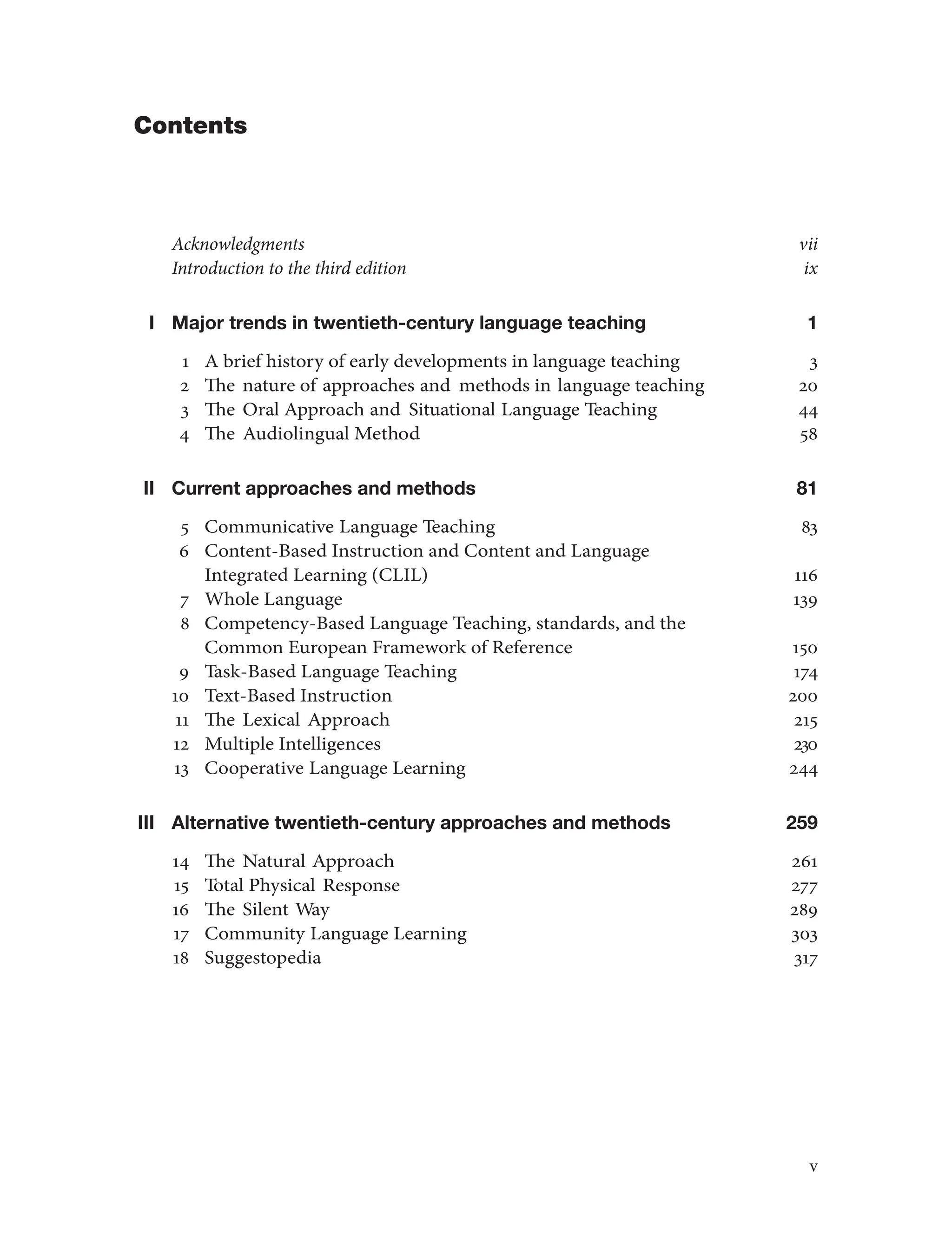
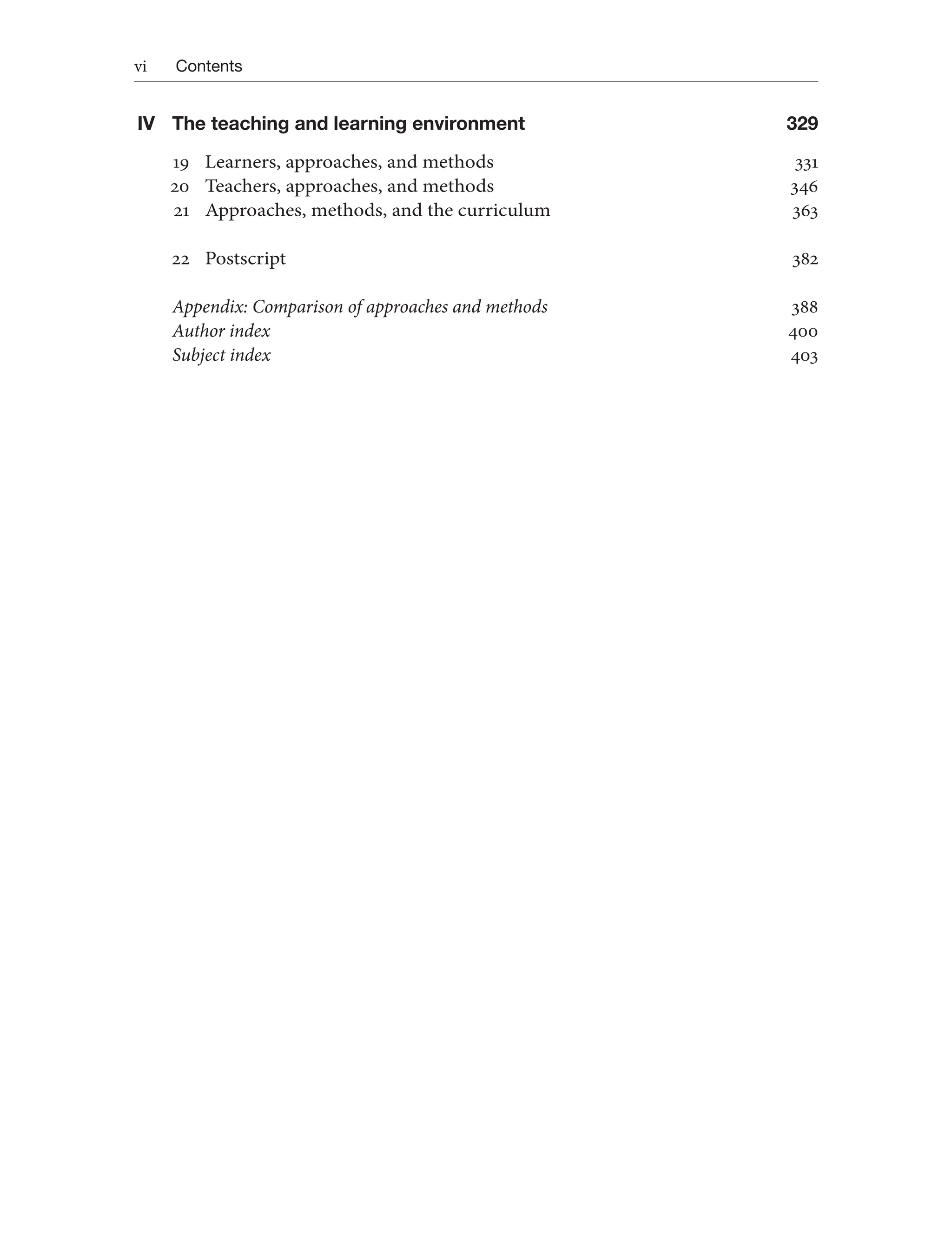
![x Introduction to the third edition
l
l The chapters presenting current approaches and methods have been moved from Part III
to Part II of the book, reflecting their continuity with the major twentieth-century trends.
Chapter 5, Communicative Language Teaching, has been expanded significantly, as has
Chapter 6, which now includes the approach known as CLIL, along with Content-Based
Instruction. Chapter 8 now covers not only Competency-Based Instruction but also the
broader standards and outcomes movements and the Common European Framework of
Reference. A new chapter on Text-Based Instruction has been added.
l
l Several chapters in Part III, Alternative twentieth-century approaches and methods, have
been expanded, with fuller descriptions of the underlying framework. (One chapter
from the second edition, Neurolinguistic Programming [NLP], has not been included
since NLP is not a language teaching method, but rather a humanistic philosophy based
on popular psychology and, as such, does not meet the criteria for inclusion as an
approach or method.)
l
l Discussion questions have been added to all chapters, allowing the reader to synthesize
the material, and a comprehensive table comparing approaches and methods has been
added as an appendix. Textbook samples of a number of approaches and methods have
been provided, as well. While these samples may not reflect the approach or method in
its pure form, and may combine features of more than one method, they provide real-
istic examples of how the approaches and methods have been interpreted by materials
writers.
While we considered not including some of the “innovative” methods of the 1970s and
1980s that attract little interest today, reviewers felt that retaining them provided a useful
historical perspective on method trends; hence, they have been included in this edition.
We are grateful for the anonymous reviewers for their feedback on this edition and
who provided many useful suggestions, to Hayo Reinders for help with discussion ques-
tions, and to Debbie Goldblatt and Jacqueline French for their skillful editorial guidance.
We also wish to thank Karen Momber and Joanna Garbutt of Cambridge University Press
for their support in bringing this edition to fruition.](https://image.slidesharecdn.com/27124752-250518125243-0bc0ec96/75/Approaches-And-Methods-In-Language-Teaching-Third-Edition-Jack-C-Richards-15-2048.jpg)

![1 A brief history 5
The decline of Latin also brought with it a new justification for teaching Latin. Latin
was said to develop intellectual abilities, and the study of Latin grammar became an end
in itself.
When once the Latin tongue had ceased to be a normal vehicle for communica-
tion, and was replaced as such by the vernacular languages, then it most speedily
became a “mental gymnastic,” the supremely “dead” language, a disciplined and
systematic study of which was held to be indispensable as a basis for all forms of
higher education.
(V. Mallison, cited in Titone 1968: 26)
As “modern” languages began to enter the curriculum of European schools in the eight-
eenth century, they were taught using the same basic procedures that were used for teach-
ing Latin. Textbooks consisted of statements of abstract grammar rules, lists of vocabulary,
and sentences for translation. Speaking the foreign language was not the goal, and oral
practice was limited to students reading aloud the sentences they had translated. These
sentences were constructed to illustrate the grammatical system of the language and con-
sequently bore no relation to the language of real communication. Students labored over
translating sentences such as the following:
The philosopher pulled the lower jaw of the hen.
My sons have bought the mirrors of the Duke.
The cat of my aunt is more treacherous than the dog of your uncle.
(Titone 1968: 28)
By the nineteenth century, this approach based on the study of Latin had become the
standard way of studying foreign languages in schools. A typical textbook in the mid-
nineteenth century thus consisted of chapters or lessons organized around grammar points.
Each grammar point was listed, rules on its use were explained, and it was illustrated by
sample sentences.
Nineteenth-century textbook compilers were mainly determined to codify the foreign
language into frozen rules of morphology and syntax to be explained and eventually
memorized. Oral work was reduced to an absolute minimum, while a handful of written
exercises, constructed at random, came as a sort of appendix to the rules. Of the many
books published during this period, those by Seidenstücker and Plötz were perhaps
the most typical … [Seidenstücker] reduced the material to disconnected sentences
to illustrate specific rules. He divided his text carefully into two parts, one giving the
rules and necessary paradigms, the other giving French sentences for translation into
German and German sentences for translation into French. The immediate aim was for
the student to apply the given rules by means of appropriate exercises … In [Plötz’s]
textbooks, divided into the two parts described above, the sole form of instruction
was mechanical translation. Typical sentences were: “Thou hast a book. The house is](https://image.slidesharecdn.com/27124752-250518125243-0bc0ec96/75/Approaches-And-Methods-In-Language-Teaching-Third-Edition-Jack-C-Richards-20-2048.jpg)
![6 Major trends in twentieth-century language teaching
beautiful. He has a kind dog. We have a bread [sic]. The door is black. He has a book
and a dog. The horse of the father was kind.”
(Titone 1968: 27)
This approach to foreign language teaching became known as the Grammar-Translation
Method.
The Grammar-Translation Method
As the names of some of its leading exponents suggest (Johann Seidenstücker, Karl Plötz,
H. S. Ollendorf, and Johann Meidinger), Grammar Translation was the offspring of
German scholarship, the object of which, according to one of its less charitable critics,
was “to know everything about something rather than the thing itself ” (W. H. D. Rouse,
quoted in Kelly 1969: 53). Grammar Translation was in fact first known in the United States
as the Prussian Method. (A book by B. Sears, an American classics teacher, published in
1845 was titled The Ciceronian or the Prussian Method of Teaching the Elements of the Latin
Language [Kelly 1969].) The principal characteristics of the Grammar-Translation Method
were these:
1. The goal of foreign language study is to learn a language in order to read its literature or
in order to benefit from the mental discipline and intellectual development that result
from foreign language study. Grammar Translation is a way of studying a language that
approaches the language first through detailed analysis of its grammar rules, followed by
application of this knowledge to the task of translating sentences and texts into and out
of the target language. It hence views language learning as consisting of little more than
memorizing rules and facts in order to understand and manipulate the morphology and
syntax of the foreign language. “The first language is maintained as the reference system
in the acquisition of the second language” (Stern 1983: 455).
2. Reading and writing are the major focus; little or no systematic attention is paid to
speaking or listening.
3. Vocabulary selection is based solely on the reading texts used, and words are taught
through bilingual word lists, dictionary study, and memorization. In a typical
Grammar-Translation text, the grammar rules are presented and illustrated, a list of
vocabulary items is presented with their translation equivalents, and translation exer-
cises are prescribed.
4. The sentence is the basic unit of teaching and language practice. Much of the lesson is
devoted to translating sentences into and out of the target language, and it is this focus
on the sentence that is a distinctive feature of the method. Earlier approaches to foreign
language study used grammar as an aid to the study of texts in a foreign language. But
this was thought to be too difficult for students in secondary schools, and the focus on
the sentence was an attempt to make language learning easier (see Howatt 1984: 131).
5. Accuracy is emphasized. Students are expected to attain high standards in translation,
because of “the high priority attached to meticulous standards of accuracy which, as well](https://image.slidesharecdn.com/27124752-250518125243-0bc0ec96/75/Approaches-And-Methods-In-Language-Teaching-Third-Edition-Jack-C-Richards-21-2048.jpg)

![24 Major trends in twentieth-century language teaching
to achieve different kinds of communicative purposes (see Chapter 5) or, as defined by
Brown (1994: 227):
That aspect of our competence which enables us to convey and interpret messages
and to negotiate meanings interpersonally within specific contexts … [The] knowledge
that enables a person to communicate functionally and interactionally.
The communicative movement in language teaching subscribes to this view of language
(see Chapter 5) as does Competency-Based Language Teaching (Chapter 8). Functional
approaches emphasize the semantic and communicative dimension rather than merely the
grammatical characteristics of language, and lead to a specification and organization of lan-
guage teaching content by categories of meaning and function rather than by elements of
structure and grammar. The Threshold Level syllabus developed by the Council of Europe
(Chapter 5) spelled out the implications of this view of language for syllabus design as does
the Common European Framework of Reference, which describes language in terms of sets
of the competencies a learner is able to express through language (Chapter 8). The English
for Specific Purposes (ESP) movement likewise begins not from a structural theory of lan-
guage but from a functional account of learner needs.
Interactional model
Yet another perspective on language can be called the interactional view. It sees language
as a vehicle for the realization of interpersonal relations and for the performance of
social transactions between individuals. Language is seen as a tool for the creation and
maintenance of social relations. Areas of inquiry being drawn on in the development
of interactional approaches to language teaching include second language acquisition,
interaction analysis, conversation analysis, and ethnomethodology. Interactional theories
focus on the patterns of moves, acts, negotiation, and interaction found in conversational
and other kinds of exchanges and which are central to an understanding of discourse
(Chapter 5). “Interaction” has been central to theories of second language learning and
pedagogy since the 1980s. Rivers (1987: 4) defined the interactive perspective in language
education: “Students achieve facility in using a language when their attention is focused
on conveying and receiving authentic messages (that is, messages that contain infor-
mation of interest to both speaker and listener in a situation of importance to both).”
Negotiation of meaning is believed to play a central role in interactive views of language
and is central to current teaching proposals, including Task-Based Language Teaching
(Chapter 9) and CLIL (see below).
Sociocultural model
A related view of language is referred to as a sociocultural model. Sociocultural theory
views language as a communicative activity in which the social context is central.
Knowledge is constructed through social interaction with others and reflects the learner’s
culture, customs, and beliefs as well as the collaborative activities people are engaged in.
A sociocultural view of language is sometimes said to undergird accounts of Task-Based](https://image.slidesharecdn.com/27124752-250518125243-0bc0ec96/75/Approaches-And-Methods-In-Language-Teaching-Third-Edition-Jack-C-Richards-39-2048.jpg)
![2 The nature of approaches and methods 29
example, attempted to link a more sophisticated model of structuralism to a more mental-
istic and less behavioristic brand of learning theory.
At the level of approach, we are hence concerned with theoretical principles. With
respect to language theory, we are concerned with a model of language competence and an
account of the basic features of linguistic organization and language use. With respect to
learning theory, we are concerned with an account of the central processes of learning and an
account of the conditions believed to promote successful language learning. These principles
may or may not lead to “a” method. Teachers may, for example, develop their own teaching
procedures, informed by a particular view of language and a particular theory of learning.
They may constantly revise, vary, and modify teaching/learning procedures on the basis of
the performance of the learners and their reactions to instructional practice. A group of
teachers holding similar beliefs about language and language learning (i.e., sharing a similar
approach) may each implement these principles in different ways. Approach does not specify
procedure. Theory does not dictate a particular set of teaching techniques and activities.
What links theory with practice (or approach with procedure) is what we have called design.1
2 Design
In order for an approach to lead to a method, it is necessary to develop a design for an
instructional system. Design is the level of method analysis in which we consider (a) what
the objectives of a method are; (b) how language content is selected and organized within
the method, that is, the syllabus model the method incorporates; (c) the types of learning
tasks and teaching activities the method advocates; (d) the roles of learners; (e) the roles of
teachers; and (f) the role of instructional materials.
Objectives
Different theories of language and language learning influence the focus of a method; that
is, they determine what learning outcomes a method sets out to achieve. The specification
of particular learning outcomes, however, is a product of design, not of approach. Some
methods focus primarily on oral skills and say that reading and writing skills are secondary
and derive from transfer of oral skills. Some methods set out to teach general communi-
cation skills and give greater priority to the ability to express oneself meaningfully and to
make oneself understood than to grammatical accuracy or perfect pronunciation. Others
1 We should also note that focus on variations in instructional methodology is not unique to language teaching.
Mathematics and science instruction, particularly in the 1960s, adopted revised notions of effective subject matter
instruction. These notions were typically labeled “inquiry,” “discovery,” and “constructivist” approaches to educa-
tion. From a pedagogical perspective, inquiry-oriented teaching is often contrasted with more traditional exposi-
tory methods and reflects the constructivist model of learning, often referred to as active learning, so strongly held
among science educators today. As noted above, according to constructivist models, learning is the result of ongoing
changes in our mental frameworks as we attempt to make meaning out of our experiences (Osborne and Freyberg
1985). In classrooms where students are encouraged to make meaning, they are generally involved in “developing
and restructuring [their] knowledge schemes through experiences with phenomena, through exploratory talk and
teacher intervention” (Driver 1989).](https://image.slidesharecdn.com/27124752-250518125243-0bc0ec96/75/Approaches-And-Methods-In-Language-Teaching-Third-Edition-Jack-C-Richards-44-2048.jpg)