Teacher Language AwarenessStephen Andrews
download
https://ebookbell.com/product/teacher-language-awareness-stephen-
andrews-1755058
Explore and download more ebooks at ebookbell.com
2.
Here are somerecommended products that we believe you will be
interested in. You can click the link to download.
Alive To Language Perspectives On Language Awareness For English
Language Teachers Arndt
https://ebookbell.com/product/alive-to-language-perspectives-on-
language-awareness-for-english-language-teachers-arndt-55997608
Words Matter Teacher Language And Student Learning Susan Mandel Glazer
https://ebookbell.com/product/words-matter-teacher-language-and-
student-learning-susan-mandel-glazer-5293842
English Language Teacher Education In Changing Times Perspectives
Strategies And New Ways Of Teaching And Learning 1st Edition Liz
England
https://ebookbell.com/product/english-language-teacher-education-in-
changing-times-perspectives-strategies-and-new-ways-of-teaching-and-
learning-1st-edition-liz-england-49032126
Second Language Teacher Professional Development Technological
Innovations For Postemergency Teacher Education Karim Sadeghi
https://ebookbell.com/product/second-language-teacher-professional-
development-technological-innovations-for-postemergency-teacher-
education-karim-sadeghi-49435418
3.
Language Teacher EducatorIdentity 1st Edition Gary Barkhuizen
https://ebookbell.com/product/language-teacher-educator-identity-1st-
edition-gary-barkhuizen-49472374
Language Teacher Agency 1st Edition Jian Tao Xuesong Andy Gao
https://ebookbell.com/product/language-teacher-agency-1st-edition-
jian-tao-xuesong-andy-gao-49472378
Language Teacher Education And Technology Approaches And Practices
Jeongbae Son Scott Windeatt
https://ebookbell.com/product/language-teacher-education-and-
technology-approaches-and-practices-jeongbae-son-scott-
windeatt-50223798
Language Teacher Wellbeing Across The Career Span Giulia Sulis Sarah
Mercer Sonja Babic Astrid Mairitsch
https://ebookbell.com/product/language-teacher-wellbeing-across-the-
career-span-giulia-sulis-sarah-mercer-sonja-babic-astrid-
mairitsch-50965212
Language Teacher Psychology Sarah Mercer Editor Achilleas Kostoulas
Editor
https://ebookbell.com/product/language-teacher-psychology-sarah-
mercer-editor-achilleas-kostoulas-editor-51814132
CAMBRIDGE LANGUAGE TEACHINGLIBRARY
A series covering central issues in language teaching and learning, by authors who
have expert knowledge in their field.
In this series:
Affect in Language Learning edited by Jane Arnold
Approaches and Methods in Language Teaching second edition by Jack C.
Richards and Theodore S. Rodgers
Beyond Training by Jack C. Richards
Classroom Decision-Making edited by Michael Breen and Andrew Littlejohn
Collaborative Action Research for English Language Teachers by Anne Burns
Collaborative Language Learning and Teaching edited by David Nunan
Communicative Language Teaching by William Littlewood
Developing Reading Skills by Françoise Grellet
Developments in English for Specific Purposes by Tony Dudley-Evans and Maggie
Jo St John
Discourse Analysis for Language Teachers by Michael McCarthy
Discourse and Language Education by Evelyn Hatch
The Dynamics of the Language Classroom by Ian Tudor
English for Academic Purposes by R. R. Jordan
English for Specific Purposes by Tom Hutchinson and Alan Waters
Establishing Self-Access by David Gardner and Lindsay Miller
Foreign and Second Language Learning by William Littlewood
Group Dynamics in the Language Classroom by Zoltán Dörnyei and Tim
Murphey
Language Learning in Distance Education by Cynthia White
Language Learning in Intercultural Perspective edited by Michael Byram and
Michael Fleming
The Language Teaching Matrix by Jack C. Richards
Language Test Construction and Evaluation by J. Charles Alderson, Caroline
Clapham and Dianne Wall
Learner-Centredness as Language Education by Ian Tudor
Learners’ Stories: Difference and Diversity in Language Teaching edited by Phil
Benson and David Nunan
Managing Curricular Innovation by Numa Markee
Materials Development in Language Teaching edited by Brian Tomlinson
Motivational Strategies in the Language Classroom by Zoltán Dörnyei
Psychology for Language Teachers by Marion Williams and Robert L. Burden
Research Methods in Language Learning by David Nunan
Rules, Patterns and Words: Grammar and Lexis in English Language Teaching by
Dave Willis
Second Language Teacher Education edited by Jack C. Richards and David Nunan
Society and the Language Classroom edited by Hywel Coleman
Task-Based Language Teaching by David Nunan
Teaching Languages to Young Learners by Lynne Cameron
Teacher Learning in Language Teaching edited by Donald Freeman and Jack C.
Richards
Testing for Language Teachers second edition by Arthur Hughes
The Experience of Language Teaching by Rose M. Senior
Understanding Research in Second Language Learning by James Dean Brown
Using Surveys in Language Programs by James Dean Bown
Vocabulary: Description, Acquisition and Pedagogy edited by Norbert Schmitt and
Michael McCarthy
Vocabulary, Semantics and Language Education by Evelyn Hatch and Cheryl
Brown
Voices from the Language Classroom edited by Kathleen M. Bailey and David
Nunan
Contents
Acknowledgements vi
Introduction ix
Prologue:Thechallenge of being ‘language-aware’ 1
1 Language Awareness, ‘Knowledge About Language’
and TLA 9
2 TLA and the teaching of language 23
3 TLA and the ‘grammar debate’ 48
4 TLA and teachers’ subject-matter cognitions 70
5 TLA and pedagogical practice 94
6 The TLA of expert and novice teachers 118
7 TLA and the native-speaker and non-native-speaker
debate 143
8 TLA and student learning 167
9 TLA and teacher learning 181
Epilogue:TLA and teacher professionalism 200
Appendix 205
References 207
Index 224
Publisher’s acknowledgements 230
v
11.
Acknowledgements
Although I amsolely responsible for the final version of this book
(including any errors), the ideas it contains are the product of more than
30 years’ professional involvement in language education and have
inevitably been influenced by colleagues, as well as students, past and
present. I would like to express my thanks to all those I have had the
good fortune to encounter within the profession (some only via the
printed page), too numerous to mention individually, whose ideas may
have had an impact upon my own thinking.
At the same time, I feel that I should acknowledge the influence, con-
tribution and support of certain specific individuals. During the time I
have been involved with language teaching, I have been fortunate enough
to have been taught by two of the major figures in Applied Linguistics
and Language Education: Eric Hawkins, the ‘father’ of Language
Awareness, with whom I completed my Postgraduate Certificate in
Education at the University of York Language Teaching Centre in
1971–2; and Christopher Brumfit, who supervised my doctoral research
at the University of Southampton in the 1990s. I encountered these
scholars at very different stages of my professional life, but both were an
inspiration, not just because of the depth and breadth of their expertise
but also because of their humanity and their passion for language edu-
cation. I owe Chris a particular debt of gratitude as my PhD supervisor.
His premature death in March 2006 robbed the profession of one of its
finest scholars.
I should also like to thank my friend and colleague Amy Tsui for her
unstinting support during the time that I was working on this book, and
conducting the research upon which much of it is based. I am especially
grateful to Amy for allowing me to gather data of my own from Marina,
the ‘expert’ teacher in her 2003 book (A. B. M. Tsui, Understanding
expertise in teaching, Cambridge University Press), for use in Chapter 6
of this book, and for permitting me access to the data from the ‘Good
Practices’ project (Tsui et al., 2005), as discussed in Chapter 8.
Two friends and former colleagues also deserve a particular vote of
thanks: Arthur McNeill and Peter Falvey. Arthur’s work on Teacher
Language Awareness and lexis has influenced me greatly. He made a
major contribution to the early work on this book, and a number of his
vi
12.
ideas (and words)have no doubt found their way into this final version.
Peter’s influence on my thinking about L2 teachers’ language proficiency,
knowledge and awareness began in the late 1980s, when we were
working at the University of Cambridge Local Examinations Syndicate
(UCLES, now known as Cambridge Assessment) on the Cambridge
Examinations in English for Language Teachers (CEELT), and continued
when we were colleagues in Hong Kong throughout the 1990s. His
friendship and support helped me through a number of troughs during
my doctoral studies.
I should also like to thank everyone else who has contributed in dif-
ferent ways to this book: the publishing team at Cambridge University
Press (particularly Mickey Bonin, for his initial support for such a book,
and Jane Walsh for seeing it through to publication) for all their pro-
fessional help, support, patience and flexibility; Jacqueline French for
her painstakingly professional editing; Song Yanan for her invaluable
help with the references; Joffee Lam for his help with the statistical
analyses in Chapter 8; ‘Marina’, and all the other teachers who allowed
themselves to be tested, interviewed and observed when I was gathering
data for the book; and the anonymous reviewers of earlier versions of
the manuscript for their extremely constructive advice and suggestions.
This book is dedicated to my wife, Veronica, our children (Merryn,
Jamie, Tom, and Tamsin) and my mother-in-law, Kathleen McCarthy.
vii
Acknowledgements
14.
Introduction
1 What isthe book about?
This book is concerned with Teacher Language Awareness, or TLA,
defined by Thornbury (1997:x) as ‘the knowledge that teachers have of
the underlying systems of the language that enables them to teach effec-
tively’. The focus of the book is the language awareness of L2 teachers
(i.e. teachers of a Foreign or Second Language (EFL/ESL)), and the exam-
ples are drawn from the teaching of L2 English. However, the issues
raised are equally applicable to teachers of any language that is not the
mother tongue of their students. In many cases, they are likely to be of
relevance to teachers of the mother tongue, too.
The book concentrates on teachers’ knowledge and understanding of
the language systems, in the belief that these systems are at the heart of
the language acquisition process and must therefore form the core of any
teacher’s language awareness. As the quotation above from Thornbury
makes clear, TLA applies to all the language systems and assumes their
interdependence, given that they are, as Carter (in Bolitho et al.,
2003:253) points out, ‘closely interwoven in the construction of mean-
ings and of texts, both spoken and written’. The specific focus of the
present book is on TLA as it relates to grammar. However, the discus-
sion and the examples in the following chapters acknowledge and reflect
the interrelationship between the language systems, and in particular
between grammar, lexis and discourse.
The basic argument presented in the book is that the possession of an
adequate level of TLA is an essential attribute of any competent L2
teacher. The assumption underlying that argument is that there is a rela-
tionship between the language awareness of the L2 teacher and the effec-
tiveness of that teacher as indicated by the language learning achieved by
his/her students. Put simply, the book assumes that TLA has a positive
impact on student learning: TLA is seen as a potentially crucial variable
in the language teaching / language learning enterprise, in the sense that
the language-aware L2 teacher is more likely to be effective in promot-
ing student learning than the teacher who is less language-aware.
The book discusses the findings of a number of studies conducted in a
variety of locations and in a range of areas relevant to TLA. However,
ix
15.
the snapshots ofthe teaching of L2 English presented and discussed in
the book are all drawn from one particular context: the Hong Kong sec-
ondary school. Although the official English Language curriculum in
Hong Kong has been based on communicative principles since the early
1980s, the vast majority of schools and teachers have adopted a very
‘weak’ version of communicative/task-based language teaching, in which
the explicit teaching of grammar continues to play a significant role. The
Hong Kong teachers whose performance is examined in the book are all
non-native speakers (NNS) of English.
2 Who is this book for?
Although Teacher Language Awareness has received scant attention in
terms of published research, it is an area of increasing concern to those
involved in language teacher education, as well as those responsible for
quality assurance in language teaching. Because of this, the book should
be of interest to a wide range of people with an involvement or interest
in language education issues: practising teachers, students on in-service
teacher education programmes, language teacher educators, academics
and other professionals engaged in language education.
3 What is the purpose of the book?
The book sets out to address the following fundamental questions about
teachers’ knowledge of the systems of language, i.e. their TLA: what
form does this knowledge take, and what is its potential impact on
teacher effectiveness? The aim in the following chapters is to examine
these and related questions by exploring the nature of teachers’ know-
ledge of the language systems (with particular reference to grammar),
and the relationship between teachers’ knowledge and their handling of
language-related issues in their teaching.
The purpose of the book is to encourage teachers and others involved
in language education, including teacher educators, to think more deeply
about the importance of TLA, the nature of TLA and the impact of TLA
upon teaching (and, potentially, upon learning). The book is intended to
contribute to a greater understanding of TLA, making teachers more
aware of the potential significance of their language-related interventions,
and enabling teacher educators to adopt a more principled approach to the
planning of those parts of their programmes associated with TLA. At the
same time, I hope that the book will provoke debate and raise questions
that will help to establish the beginnings of a research agenda for TLA.
x
Teacher Language Awareness
16.
4 What isthe book NOT about?
This book does not set out to develop teachers’ awareness of language
via any direct treatment. There are no language-analysis tasks designed
to stimulate teachers’ reflections on the workings of different parts of the
language systems. A number of books containing tasks of this type are
already available, such as Bolitho and Tomlinson’s Discover English
(1980; 1995), Wright’s Investigating English (1994) and Thornbury’s
About Language (1997). The interested reader need look no further than
these three texts to find a wealth of activities intended to foster the devel-
opment of TLA.
The book does not promote particular approaches to the teaching of
grammar. Frequent reference is made to data from studies of teachers’
language awareness as it relates to grammar. However, in the analysis of
these data, there is a deliberate attempt to avoid evaluation of the
methodology employed by individual teachers: instead, the discussion
focuses exclusively on language-related issues.
There is also no attempt to suggest that a teacher’s explicit knowledge
of grammar should be based exclusively upon any single model of lan-
guage. My own views of language and of grammar are the product of a
number of influences, including the grammars of Leech and Svartvik
(1975), Quirk et al. (1985), Biber et al. (1999) and Carter and McCarthy
(2006), as well as systemic functional linguistics (see, e.g., Halliday,
1985), which emphasises the role of the language systems as a resource
for making meaning, the close interrelationship of grammar and lexis
(the ‘lexico-grammar’) and the importance of discourse grammar.
Inevitably, where judgemental comment is made on an individual
teacher’s awareness in relation to, for example, a specific feature of
grammar, such comment passes through the filter of my own perspective
on language. However, as far as possible, such remarks are based upon
what might reasonably be expected of that teacher within the prevailing
norms of the context within which he or she works. They are not set
within a single theoretical framework of grammar.
The aim is therefore not to specify the precise form or extent of the
knowledge that teachers of language should have about grammar. In my
view, the knowledge of the language-aware teacher should not be based
upon any single theoretical model, but rather upon informed, principled
eclecticism. Such knowledge is not static: it is constantly changing,
developing, renewing itself. The developments in any teacher’s language
awareness over the course of a career are likely to occur idiosyncrat-
ically, as a result of a combination of factors, including exposure to
theoretical developments and reflections on practical experience. The
adequacy and appropriateness of an individual teacher’s language
xi
Introduction
17.
awareness at anystage of his or her career need to be considered in rela-
tion to the demands posed by the context in which that teacher is
working at that time.
5 How is the book organised?
The book consists of a Prologue, followed by nine chapters and an
Epilogue. The Prologue introduces some of the major questions
addressed in the main body of the book, with snapshots from the Hong
Kong secondary school classroom. Chapter 1 provides a brief overview
of the history of interest in Teacher Language Awareness, in the context
of the increased attention since the late 1970s to ‘Language Awareness’
generally, and to the role of explicit language knowledge in language
learning in particular. Chapter 2 presents a detailed analysis of the lan-
guage awareness of the L2 teacher, exploring the complex nature of TLA,
its significance in L2 teaching and learning, how it affects teacher behav-
iour and its potential impact on pedagogical practice. Chapter 3 exam-
ines some of the issues and debates concerning the value of explicit
knowledge about the language systems, particularly grammar, for L2
learning and teaching, together with the implications for TLA of current
understandings of these issues.
Chapters 4 and 5 revisit issues originally discussed in Chapter 2.
Chapter 4 focuses on L2 teachers’ knowledge, beliefs, feelings and under-
standings about the content of learning (i.e. the subject-matter cogni-
tions which form the core of any teacher’s language awareness). Chapter
5 explores various aspects of TLA in pedagogical practice, in particular
(a) how the L2 teacher’s language awareness both influences and is influ-
enced by that teacher’s engagement with the content of learning, and (b)
the relationship between TLA and teaching materials. Both chapters
draw extensively on data from Hong Kong secondary school teachers
and classrooms.
Chapters 6 and 7 consider the TLA of teachers of L2 English at dif-
ferent stages of their careers and from different backgrounds. Chapter 6
examines the TLA of novice, highly proficient and expert teachers, while
Chapter 7 attempts a dispassionate analysis of the TLA of native-speaker
(NS) and non-native-speaker (NNS) teachers.
Chapter 8 focuses on the relationship between TLA and student learn-
ing. While acknowledging the difficulty of identifying any direct causative
connection between TLA and students’ learning outcomes, the chapter
discusses relevant research in relation to three themes: teachers’ subject-
matter knowledge; teacher engagement with the content of learning; and
teachers’ awareness of learner difficulties.
xii
Teacher Language Awareness
18.
Chapter 9 alsolooks at TLA and learning, but in this case focusing on
teachers’ own learning. The chapter examines issues relating to the devel-
opment of the L2 teacher’s language awareness, and principles that
might be applied to the planning of TLA-related courses and activities.
The Epilogue returns to the central argument of the book – that pos-
session of an adequate level of TLA is an essential attribute of any com-
petent L2 teacher – and sets it within the context of the broader debate
about teacher professionalism in general and L2 teacher professionalism
in particular.
xiii
Introduction
20.
Prologue: The challengeof being
‘language-aware’
1
Snapshot 1a: Clara
It’s a warm afternoon in early October in a large modern co-
educational secondary school in Hong Kong’s New Territories. The
air-conditioners are on in all the classrooms, making the ambient
temperature pleasantly comfortable, but also creating a constant
background whirring. A Secondary 5 class of forty Hong Kong
Chinese 16-year-olds is listening with varying degrees of attention,
as their English teacher, Clara, takes them through a set of exercises
they were expected to have completed for homework.
Clara, like her students, is Hong Kong Chinese and shares their
mother tongue, Cantonese. Clara is in her fourth year as a full-time
secondary school teacher of English. She has a first degree from
Canada (in Social Sciences rather than English) and is currently
studying part-time for an initial qualification as a teacher of English.
Clara’s students will be taking their first major public examination
(the Hong Kong Certificate in Education Examination, or HKCEE) at
the end of the academic year, and they are already accustomed to
lessons in most subjects dominated by practice tests and past papers.
Although most of the students do not have much intrinsic interest in
English, they know that a good result in the public exam is important
for their future study and job prospects.
In Clara’s lesson this afternoon she is working through a series of
exercises from a book of practice tests. The particular exercise that
she is checking consists of single-sentence multiple-choice grammar
items in which the students have to identify the correct way to com-
plete the sentence from four given alternatives.
One of the first items in the exercise reads:
He did very little work for his exam. He___________ (pass).
The desired completion according to the Teacher’s Book is can’t
have passed. However, one of the students has selected another of
the four possible options: could have passed. He asks Clara whether
his chosen answer might also be correct . . .
21.
This snapshot describesan episode that is likely to resonate with the
experiences of most of us who have taught a second language. Not all of
us will have worked with teenagers in the public sector (like Clara), but
we have all been in situations where we find ourselves confronted with
the unexpected – in Clara’s case, a question from a student – and where
we are forced to make a spontaneous and more-or-less instant decision
about how to react.
Experience and an awareness of potential pitfalls may have taught us
the benefits of caution, leading us to take the prudent step of deciding
to defer a response so that we can buy ourselves some thinking time
(‘That’s a very interesting question . . .!’). As part of this strategy,
perhaps we refer the problem back to the individual student (‘What do
you think?’), and invite the other students to contribute to the problem-
solving activity (‘What do the rest of you think?’). Meanwhile, we
attempt a smile of encouragement as we rack our brains to work out our
own answer. If our antennae have warned us that the question is really
tricky, we may well decide not to commit ourselves to an explanation
there and then, undertaking instead to provide a more carefully consid-
ered reply shortly afterwards (‘Let me think about that and get back to
you in the next class’).
Very often, however, we seem to end up improvising a response. We
may do so for a variety of reasons, and often without being fully aware
of them. For some of us, there may be times when we make a conscious,
principled decision to exploit a learning opportunity and aim to provide
the learners with knowledge at a moment when we sense that they may
be especially receptive, i.e. (to use the contemporary jargon of second
language acquisition) we think that our response to the learner’s problem
may trigger a restructuring of not only the interlanguage1 of that learner
but also potentially the interlanguage of others in the class.
For the majority of us, though, the reasons are likely to be less sophis-
ticated and skilfully calculated, particularly when we are not so experi-
enced and streetwise. We may improvise out of misplaced confidence, or
naïveté – perhaps simply because our instinct when asked a question is
to try to be helpful and provide a response. Or we may, of course, impro-
vise for the opposite reason: out of fear and a lack of confidence. Perhaps
we are worried that our students will judge us to be incompetent
and deficient in basic knowledge if we do not provide them with an on-
the-spot solution to their problem. We may be afraid that we will lose
face as a result: that rather than perceiving our delaying strategy as the
2
Teacher Language Awareness
1
Interlanguage is defined by Thornbury (2006:109) as a term describing ‘the grammatical
system that a learner creates in the course of learning another language’. It is a constantly evolv-
ing system of rules. Restructuring refers to the process by which the learner’s interlanguage
appears to adapt in response to new information.
22.
responsible action ofa thinking professional teacher, the students will
view such stalling tactics as signs of weakness and inadequacy.
Whatever blend of beliefs, emotions and anxieties influences our deci-
sion, once we have made a move to answer the question, it is very diffi-
cult to turn back. Even as it begins to dawn on us that the problem is
perhaps not as straightforward as we had initially assumed, we usually
carry on, possibly feeling that, having once started, there is no way out.
In the worst case, it is only when it is far too late, as we observe (or try
to ignore) the glazed incomprehension in the expressions of our students,
that we realise how big a hole we may have dug for ourselves in our well-
intentioned attempt to be of assistance.
In the case of Clara, and the lesson described in Snapshots 1a and 1b,
we do not know what influenced her actions at this point. Unfortunately,
there was no opportunity to interview her after the class, so we can only
speculate. In the event, for whatever reason, Clara opted to provide a vir-
tually instant response to her student’s question, as described in the
second part of the snapshot:
As we look at Snapshot 1b, we may have different reactions, both to
Clara’s choice of strategy, and to the content of her response. However,
the reason for focusing on this incident and on Clara’s behaviour is not
to invite analysis of her motivations or any evaluation of the quality of
her explanation. Our interest is in the general rather than the specific,
and in this case Clara’s experience is being presented in order to
draw our attention to the challenges facing any L2 teacher in a similar
situation.
When Clara produced the explanation in Snapshot 1b, electing to
improvise in front of a class of 40 students (not to mention the video
camera that was recording the lesson on this occasion), her skills as a
3
Prologue: The challenge of being ‘language-aware’
Snapshot 1b: Clara
Clara’s face betrays no emotion, and she pauses for barely a couple
of seconds before providing the following response:
So in this case actually it’s better to use He can’t have passed
because you are just predicting something to happen, but you
are not sure whether he can pass or not. You just predict it.
Since he is not working hard, so he has the chance of failing
in the exam, OK? If the test paper was returned to that
student, you can say He could have passed or He couldn’t
have passed
23.
teacher were beingchallenged in a number of ways and at a variety of
levels. Some aspects of the challenge had little or no relation to the
content of the lesson. For instance, the situation was demanding on an
emotional and psychological level. Clara was new to the school, she had
been teaching this class for only a few weeks and it was the first time in
her career that she had taught a class preparing for a major public
examination. The incident was therefore a genuine test of her ability to
keep her nerve in front of a (potentially critical) student audience. The
situation also presented a challenge to Clara’s overall teaching compe-
tence, and whether, for example, she would be able to engage the atten-
tion of a class of students and retain their interest in what she was
saying.
But the most significant aspects of the challenge for our present pur-
poses are those that are language-related. The most obvious of these was
the challenge to her knowledge of subject matter. The practice test item
and the student’s question concerned modality, a notoriously complex
area for both students and teachers of L2 English. In addition, the ques-
tion did not relate to a relatively straightforward formal feature of verb
phrases involving modal auxiliaries: instead it focused on semantic inter-
pretations of modalised verb phrases referring to past time, interpret-
ations that were rendered that much more difficult and speculative
because of the inevitable lack of context accompanying a single-sentence
multiple-choice practice test item.
However, knowledge of subject matter represents just one aspect of the
multifaceted language-related challenge facing Clara, or any of us when
we find ourselves in similar situations in our teaching. A degree in
Linguistics and an in-depth knowledge of the relevant area of grammar
might (though not necessarily) equip us to cope with certain aspects of
the challenge related specifically to subject matter, but there would be
other language-related ways in which we might find ourselves chal-
lenged, going well beyond mere knowledge of subject matter, as the fol-
lowing observation from Michael Swan depicts so vividly.
Good teaching involves a most mysterious feat – sitting, so to
speak, on one’s listener’s shoulder, monitoring what one is saying
with the listener’s ears, and using this feedback to shape and
adapt one’s words from moment to moment so that the thread of
communication never breaks. This is art, not science . . .
(Swan, 1994:54–5)
Swan was actually writing about pedagogic language rules, and
proposing a set of criteria for such rules, criteria that might be applied
to the ‘rules of thumb’ that teachers produce on the spur of the moment,
like Clara, just as much as to the more carefully honed statements
4
Teacher Language Awareness
24.
appearing in textbooks.The quotation comes from the end of Swan’s
paper, when he provides a spirited defence of teachers’ ‘rules of thumb’,
arguing that the pedagogic focus of such rules may enable them to fit the
need of a given classroom moment more successfully than other, more
descriptively ‘respectable’ statements of that rule.
The significance of Swan’s remarks in the context of the present dis-
cussion is that they highlight the paramount importance of the learner
perspective in determining how we select and package the information
and examples we make available to our students in the hopes of pro-
moting learning. Snapshot 2 (see p. 6) illustrates this point. Like Clara in
Snapshot 1, the teacher in this case (Pearl) is reacting to a student’s con-
tribution, and providing feedback, not only for the benefit of that student
but also for the whole class. Unlike Snapshot 1, however, the area of lan-
guage focus should not have posed any challenges to the teacher’s knowl-
edge of subject matter.
In this case, as we can see, the teacher adopts a different strategy from
that employed by Clara in Snapshot 1. Pearl correctly identifies that
there is a problem with the student’s answer, but rather than providing
a detailed explanation, drawing on her knowledge of the relevant
subject matter, she tries to use a mixture of question and gesture in an
apparent attempt to guide the student towards self-correction of the
error. Given that these are young students with relatively limited
English, this approach would seem to have much to commend it.
However, it is a strategy that Pearl uses to little obvious effect. She may
well have understood the confusion that was the likely basis of the
student’s error. But from the way she handles that error, there is little to
indicate that she has made any real attempt to view the problem from
the learner perspective. If she has, then somewhere in the ‘real-time’
process of analysing his problem and providing potentially useful feed-
back, there must have been a breakdown, because her correction
conveys very little, either to the student making the error or to the rest
of the class. The second student’s correct response has nothing to do
with Pearl’s intervention: he is merely reading out what he has already
written in his book.
There are, of course, a number of language-related questions to be
considered when one attempts to evaluate a teacher’s content-focused
intervention from the learner perspective, whether that intervention is
Pearl’s, Clara’s or any of our own. All of these considerations connect
in some way to Swan’s (1994) ‘design criteria for pedagogic language
rules’. Some of them relate exclusively to knowledge of subject matter,
such as:
• Is the teacher’s explanation an accurate representation of the ‘truth’?
5
Prologue: The challenge of being ‘language-aware’
25.
Other considerations, however,involve a complex blend of language-
related competences, including the teacher’s ability to communicate
effectively. For instance:
• Does the teacher’s explanation provide the learners with what they
need at that particular moment? (In other words, does the teacher
appear to have diagnosed the learners’ problem correctly?)
• Does the teacher’s explanation provide the learners with the right
amount of information (neither too much nor too little) to serve their
immediate learning needs?
6
Teacher Language Awareness
Snapshot 2: Pearl
Pearl works in a large co-educational secondary school (for 11- to
18-year-olds) in a residential district of Hong Kong Island. She
teaches both English and Home Economics, and all her English
teaching is with the junior forms in the school.
It is a Wednesday morning, and Pearl is teaching a group of
Secondary 1 students (11- to 12-year-olds). The class size is small by
Hong Kong standards – there are just 20 children – because it con-
sists of so-called ‘remedial’ students (i.e. those in the form whose test
scores label them as being among the weakest in English).
Pearl is going through a blank-filling exercise, which the students
worked on in pairs earlier in the lesson. The exercise focuses on the
Present Simple and Present Progressive.
One of the items in the exercise reads:
My brother _______ (swim) very well. Perhaps he can give you
swimming lessons.
When Pearl nominates one student to provide his answer, the boy
says:
My brother is swimming very well. Perhaps he can give you
swimming lessons.
Pearl’s immediate reaction is to laugh (in a slightly nervous, but not
unfriendly way). She starts miming breast-stroke movements, saying
‘My brother is swimming very well?’ as she does so. She then says
‘He is swimming all the time?’ and laughs again, looking towards
the student who gave the incorrect reply. The boy stares at his text-
book, saying nothing. Pearl turns to another student, from whom
she immediately elicits the correct sentence completion. She then
moves on to the next item in the exercise.
26.
• Is theexplanation pitched at the right level, in that it uses only concepts
and terminology with which the learners are already familiar?
• Is the explanation expressed in a clear, coherent and fully intelligible
way?
In focusing attention on such questions, we are in fact identifying
many of the key characteristics of Teacher Language Awareness, which
is the focus of this book. The quotation from Swan is especially useful
as we consider the nature of TLA because it encapsulates many aspects
of the challenges involved in being a language-aware teacher and high-
lights some of the associated complexities and paradoxes which we shall
explore in more detail in the following chapters.
Swan’s final words, in which he talks about the art involved in good
teaching, are also highly significant in relation to TLA, if language
awareness is (as I would argue) one of the attributes one would expect
the ‘good teacher’ to possess, since those words remind us that TLA as
exemplified in the act of teaching is both art and science. TLA is in one
sense science, in that it is dependent upon the teacher’s possession of an
appropriate base of knowledge and understanding about language (in
particular, the target language) and how it works. At the same time,
however, TLA, when it is demonstrated in good classroom practice, is
much more than the direct application of science, i.e. the teacher’s
knowledge of linguistics. It involves a complex blend of learning- and
learner-related understanding and sensitivity, such that the teacher
is able to provide the precise amount of knowledge the learner needs at
a given point and to convey that knowledge in a form that creates no
barriers to comprehension. The language-aware teacher therefore needs
to be both scientist and artist, and therein lies much of the challenge.
Earl Stevick, writing in 1980 about grammatical explanation, captures
the essence of this blend of science and artistry, at the same time provid-
ing a strong argument in support of the need for the L2 teacher to be
language-aware:
The explaining of grammar. . . casts light on the unfamiliar pathways
and the arbitrary obstacles through which [the student] must
eventually be able to run back and forth with his eyes shut. It can
thus save him a certain amount of time, energy, and barked shins.
It is for this same reason, of course, that the teacher needs to know
these same pathways and obstacles – not only to run back and forth
in them for herself, but also to see them as they look to a newcomer.
On top of this are the skills of knowing when to turn on the spotlight
of explanation and when to turn it off, and knowing just how to aim
it so that it will help the student instead of blinding him.
(Stevick, 1980:251)
7
Prologue: The challenge of being ‘language-aware’
27.
At first sight,the message of a book on TLA might appear to be simply
that it’s a good idea for teachers of a language to know something about
the subject (i.e. the language) they are teaching. If so, then the writer of
such a book could with good reason be accused of what Basil Fawlty (in
the TV comedy series Fawlty Towers) might describe as ‘stating the
bleeding obvious’.
I hope this book succeeds in doing rather more than that. There is in
my view very little about language teaching and language learning that
could justifiably be described as obvious, and it is the assumed truths
about the processes we engage in as language teachers and about the
qualities we require in order to be effective practitioners that are often
most in need of interrogation and critical analysis. In the chapters that
follow, an attempt is made to subject this particular assumed truth about
language teaching and language teachers to questioning by exploring
such issues as:
• What sort of knowledge about language do L2 teachers need?
• Why is knowledge of this kind important?
• How does such knowledge (or the lack of it) affect L2 teachers’ hand-
ling of language-related issues in their teaching?
As far as possible, these issues are discussed and illustrated in relation to
the lives and experiences of real teachers. As noted in the Introduction,
the examples are drawn from one particular type of L2 teaching (the
teaching of English as a Foreign Language) and a single macro-context,
the Hong Kong secondary school, which has been the focus of my pro-
fessional life since 1990. The problems and issues confronting the teach-
ers in the book are, however, universal, and the experiences of these
Hong Kong teachers (and the constraints they face) will, I am sure, be
accessible and indeed familiar to L2 teachers around the world.
8
Teacher Language Awareness
28.
1 Language Awareness,‘Knowledge
About Language’ and TLA
1.1 Introduction
The aim of the present chapter is to provide a context for the book’s
focus on TLA: conceptually, by setting TLA within the broader frame-
work of Language Awareness more generally, and historically, by situat-
ing the growing interest in TLA within the context of changing
perspectives on grammar and L2 teaching. The chapter begins by briefly
outlining the emergence of the Language Awareness ‘movement’, and
examining what is understood by the terms ‘Language Awareness’ and
‘Knowledge About Language’ (KAL) – the associated phrase which
appears in much of the literature, particularly that concerned with the
National Curriculum for English Language in the UK (see, e.g., Carter,
1990). The chapter then discusses the central concern of the Language
Awareness ‘movement’ with explicit knowledge about language, and
with the relationship between explicit and implicit knowledge. The
debate about the interface between these two types of knowledge is
linked to parallel discussions about declarative/procedural knowledge
and learning/acquisition, as well as the related concept of consciousness.
The relationship between Language Awareness, ‘consciousness-raising’
and the language awareness of teachers is examined, and the chapter
ends with a brief discussion of the increased attention to TLA within the
context of recent trends in L2 education.
1.2 The Language Awareness ‘movement’
Since the early 1980s, Language Awareness has become a major
concern in language education. There has been much discussion of
Language Awareness both in relation to the language development of
students and, to a lesser extent, in connection with the study and analy-
sis of language by teachers of language (see, e.g., Hawkins, 1984;
Donmall, 1985; Sinclair, 1985; James and Garrett, 1991a; Fairclough,
1992; Carter, 1994; McCarthy and Carter, 1994; van Lier, 1995; 1996).
The so-called Language Awareness ‘movement’, which has embraced
both mother-tongue and second-/foreign-language teaching, has sought
9
29.
to find waysof improving the language awareness of students and of
their teachers.
Initially the Language Awareness movement’s focus was specifically on
the language awareness of learners. An underlying belief behind the
movement is that students who are able to analyse and describe language
accurately are likely to be more effective users of the language. A direct
relationship is assumed between explicit knowledge of formal aspects of
language and performance in using the language. In the case of teachers,
it is assumed that an understanding of the language they teach and the
ability to analyse it will contribute directly to teaching effectiveness. This
is the view expressed, for example, by Edge (1988:9): ‘My position on
this may seem over-conservative in some circles . . . but I want to argue
that knowledge about language and language learning still has a central
role to play in English language teacher training for speakers of other
languages.’ The language awareness development activities in Bolitho
and Tomlinson (1980; 1995), Wright (1994) and Thornbury (1997)
reflect such an assumption. Although these assumptions about learners
and teachers may appear compelling, there was initially little or no
empirical evidence produced to support them, at least as far as native
English speakers are concerned. However, recent research (see, e.g.,
Andrews, 1999b; McNeill, 1999) suggests that TLA does have the poten-
tial to exert a powerful influence upon teaching effectiveness, at least as
far as L2 teachers are concerned. Evidence from related studies is pre-
sented in subsequent chapters, particularly Chapters 5, 6 and 8.
1.3 Language Awareness and ‘Knowledge About
Language’ (KAL)
The term ‘Language Awareness’ was put on the international agenda of
language education as recently as 1992, with the formation of the
Association for Language Awareness and the setting up of the journal
Language Awareness. The association and the journal were the outcomes
of a growing interest in language awareness, originating in the 1970s
and burgeoning in the 1980s, especially in Britain (where Language
Awareness is frequently referred to as ‘Knowledge About Language’, or
KAL). Mitchell, Hooper and Brumfit (1994:2) describe KAL as a new title
for an old concern: ‘that pupils learning languages in formal settings
should acquire some explicit understandings and knowledge of the nature
of language, alongside the development of practical language skills’.
Much of the impetus for the British interest in Language Awareness /
KAL stemmed from a widespread reaction to the poor language perfor-
mance of children at school. According to James and Garrett (1991b:3),
10
Teacher Language Awareness
30.
for example: ‘It[Language Awareness] was initially and essentially a
response to the notoriously dismal achievements in two areas of British
education: foreign language learning and school-leavers’ illiteracy.’ Such
concern is far from new, as Hawkins (1992) points out, charting the
history of the debate about Language Awareness / KAL in the curricu-
lum during the twentieth century. He sees the concerns about children’s
language performance as originating in dissatisfaction with the teaching
of English as a mother tongue (L1), and developing subsequently into a
perception that failure to foster ‘awareness of language’ (Halliday, 1971)
was hindering children’s progress in both the mother tongue and L2
(Hawkins, 1992).
In his review of the development of the Language Awareness move-
ment, Gnutzmann (1997) argues, from a European perspective, that
British protagonists of Language Awareness can be placed in the trad-
ition of a deficit model of language behaviour, where educational failure
is associated with cultural (in this case linguistic) deprivation, resulting
from students not having learned the language in which the school cur-
riculum is delivered and examined (Hawkins, 1999).
It could be argued, however, that it is somewhat of a caricature to
portray the Language Awareness movement as being based on a deficit
model. Much language awareness work focuses on the noticing of dif-
ferences, without the necessary implication of a deficit. In the case, for
example, of the relationship between the standard variety of a language
and the dialect used by a particular speech community, the goal of lan-
guage awareness, as viewed by many within the Language Awareness
movement, would be to increase awareness of the differences between
the two varieties, without the superiority of either being implied. One
consequence of achieving this goal would be that enhanced awareness
would empower those who are speakers of the dialect to succeed when
following a school curriculum based upon the standard variety.
Although there has been great interest in Language Awareness / KAL
in recent years, it is far from easy to find a useful definition of either. As
van Lier (1996) points out, the definition of Language Awareness agreed
by the 1982 Language Awareness Working Party – ‘Language Awareness
is a person’s sensitivity to and conscious awareness of the nature of lan-
guage and its role in human life’ (Donmall, 1985:7) – is open to a wide
range of interpretations. As a result, according to van Lier, it is difficult
to decide whether the two terms – Language Awareness and Knowledge
About Language – are synonymous or whether one is a subset of the
other. The focus on KAL in the UK National Curriculum for English may
have led to a narrow view of KAL in some quarters: ‘in the media and
elsewhere KAL is often interpreted as a renewed call for formal grammar
teaching’ (van Lier, 1996:80). However, van Lier (1996:80) suggests
11
Language Awareness, ‘Knowledge About Language’ and TLA
31.
that, ‘In principlethis term [KAL] should be compatible with any con-
ception of LA, all the way along the continuum from the most utopian
to the most utilitarian position.’
The variety of activity related to Language Awareness / KAL has also
made it increasingly difficult to pin down the concept. As indicated by
Mitchell, Hooper and Brumfit (1994:5), KAL-related concerns have now
broadened to include the relationships between languages, language devel-
opment in young children, the nature of social interaction, language-
choice and personal identity, individual and societal bilingualism and
multilingualism, language variation, and the (mis)uses of language for
social control, as well as the more traditional questions (of central impor-
tance to both mother-tongue and L2 teachers) about the contribution
made by explicit study of language to the learning of language, i.e. mastery
of the system.
Carter’s (1994) definition of Language Awareness reflects the breadth
of the concerns encompassed by Language Awareness:
The definition would appear to be particularly appropriate to the lan-
guage awareness of native speakers, with the emphasis on the creative
properties of language and the importance attached to awareness of lan-
guage and ideology, in (a) and (d), although (b) and especially (c) are
highly relevant to the second language context. Traditionally, (c) has
been the cornerstone of curricula in L2 education, where, whatever the
disagreements about the role of explicit knowledge of grammar, a focus
on the forms of language and the relationship between form and
12
Teacher Language Awareness
A general language awareness involves at least:
(a) awareness of some of the properties of language; creativity and
playfulness; its double meanings.
(b) awareness of the embedding of language within culture.
Learning to read the language is learning about the cultural
properties of the language. Idioms and metaphors, in particular,
reveal a lot about the culture.
(c) a greater self-consciousness about the forms of the language we
use. We need to recognise that the relations between the forms
and meanings of a language are sometimes arbitrary, but that
language is a system and that it is for the most part systemati-
cally patterned.
(d) awareness of the close relationship between language and ideol-
ogy. It involves ‘seeing through language’ in other words.
(Carter, 1994:5)
32.
meaning is generallyuncontroversial (see Chapter 3 for further discus-
sion), even within less form-oriented approaches to language teaching,
such as the Communicative Approach (see, e.g., Littlewood, 1981;
Brumfit, 1984) and Task-based Language Teaching (see, e.g., Ellis, 2003;
Nunan, 2004). By contrast, the teaching of English as a mother tongue
has typically attached less importance to the formal aspects of language:
this was particularly the case during the 1970s and 1980s.
As I have shown, the concept of Language Awareness is essentially
broad in character. However, while the breadth of its coverage may give
the impression of uniting scholars from different language backgrounds
and from different disciplines in a common goal of promoting higher lan-
guage standards, some underlying differences in focus do need to be clar-
ified. For example, Gnutzmann (1997) argues that European scholars’
interest in language awareness pre-dates the current British movement
and points out that concepts such as conscience métalinguistique,
Reflexion über Sprache, Sprachbetrachtung, Sprachbewußtheit and
Sprachbewußtsein have been current in the language education literature
for some time (see, e.g., Candelier, 1992; Gnutzmann, 1992; van Essen,
1992). The extent to which these various terms refer to the same concept
is open to debate. For instance, Gnutzmann accounts for the different
German terms by arguing that each reflects a slightly different topic of
interest and that each was in vogue at a different time.
1.4 Language Awareness, TLA and the explicit/implicit
knowledge dichotomy
If there is a single unifying feature of all the Language Awareness / KAL-
inspired interests and activities outlined above, it appears to be concern
with ‘explicit knowledge about language’, a phrase which appears in all
three original aims of the journal Language Awareness. The implication
in the repeated use of the word explicit is that there is a distinction
between ‘conscious or overt knowledge about language’ and ‘intuitive
awareness that children demonstrate when they use language’ (Goodman,
1990), i.e. between explicit and implicit knowledge.
In the L2 context, explicit knowledge is defined by Ellis (2004:244) as
declarative knowledge of ‘the phonological, lexical, grammatical, prag-
matic and socio-critical features of an L2’. According to Ellis, such know-
ledge ‘is held consciously and is learnable and verbalisable. It is typically
accessed through controlled processing when L2 learners experience some
kind of difficulty in the use of the L2’ (2004:245). Explicit knowledge
includes what Ellis calls ‘metalingual knowledge’ – knowledge of the tech-
nical terminology for labelling those linguistic and socio-critical features.
13
Language Awareness, ‘Knowledge About Language’ and TLA
33.
However, the twoterms are not synonymous, since learners may make
their knowledge explicit with or without the use of such terminology.
Nevertheless, as Alderson, Clapham and Steel (1996:2) point out, ‘it
would appear that whatever . . . explicit knowledge consists of, it must
include metalanguage, and this metalanguage must include words for
grammatical categories and functions’.
Implicit knowledge, by contrast, is ‘procedural, is held unconsciously
and can only be verbalized if it is made explicit. It is accessed rapidly and
easily and thus is available for use in rapid, fluent communication’ (Ellis,
2005:214). Ellis (1994) characterises two types of implicit knowledge –
formulaic knowledge (ready-made chunks of language) and rule-based
implicit knowledge. In both cases, according to Ellis (1994:356),
‘the knowledge is intuitive and, therefore, largely hidden; learners are
not conscious of what they know. It becomes manifest only in actual
performance.’
Implicit knowledge is generally agreed to be the type of knowledge that
enables a language user to communicate with confidence and fluency. The
development of such knowledge and the role, if any, that explicit know-
ledge might play in that process have been the focus of considerable
debate and research. The nature of the relationship between these two
types of knowledge/awareness has also been a long-standing concern of
those interested in Language Awareness (see, e.g., Little, 1997). The
research evidence has not always provided consistent support for the
strength of that relationship. For example, Alderson, Clapham and Steel,
in their 1996 study referred to above, conclude that ‘Whilst knowledge
about language may be worthwhile in its own right, there is no evidence
from this study to justify the teaching of metalinguistic knowledge as a
means of improving students’ linguistic proficiency’ (p. 14).
The contrast between explicit and implicit knowledge is closely con-
nected to the distinction between declarative and procedural knowledge,
which, according to Robinson (1997), has been the subject of much
recent debate in cognitive psychology about general theories of human
learning. For example, Anderson (1983) claims that ‘separate systems are
responsible for declarative (factual) knowledge and procedural knowl-
edge of how to apply factual knowledge during skilled performance’
(Robinson, 1997:47). According to Anderson (1995:308), ‘Declarative
knowledge is explicit knowledge that we can report and of which we are
consciously aware. Procedural knowledge is knowledge of how to do
things, and it is often implicit.’ However, the relationship between these
two systems is controversial. Anderson argues that there is an interface
between the two systems and describes mechanisms responsible for con-
verting declarative knowledge into procedural knowledge, while other
cognitive psychologists (see, e.g., Willingham, Nissen and Bullemer,
14
Teacher Language Awareness
34.
1989; Squire, 1992)claim that ‘the two knowledge bases are qualitatively
different and non-interfaced’ (Robinson, 1997:47).
In relation to the controversy surrounding the interface between
explicit and implicit knowledge in the L2 teaching context, there are, as
Ellis (2005) points out, three basic positions. The first is that espoused
by Krashen (1981). According to Krashen, ‘acquisition’ and ‘learning’
are two separate processes. ‘Acquisition’ (of implicit knowledge) is a sub-
conscious process which takes place only when the learner is focused on
conveying meaning – it is unaffected by practice, error correction or any
other form-focused activities. Such activities may, however, give rise to
conscious ‘learning’. The ‘learned system’ (i.e. explicit knowledge)
resulting from the latter process is, in Krashen’s opinion, of use only
when the learner has time to monitor the output from his/her ‘acquired
system’. Krashen asserts that ‘learned knowledge’ (explicit knowledge)
cannot be converted into ‘acquired knowledge’ (implicit knowledge).
This position is frequently referred to as the non-interface position.
In direct contrast with the view adopted by Krashen, there are
others (see, e.g., Johnson, 1996; DeKeyser, 1998) who argue, based on
skill-learning theory, that if learners have plenty of opportunity for
communicative practice, then explicit knowledge can become implicit
knowledge. This is the interface position. Johnson (1996) provides a
book-length exploration of the relationship between language acquisi-
tion and skill learning. He argues (pp. 170–7) that skill learning pro-
vides a justification for the P-P-P (Presentation-Practice-Production)
approach to L2 teaching associated with the ‘weak’ form of commu-
nicative language teaching (CLT), the argument being that grammar
rules presented explicitly can become proceduralised (i.e. converted into
implicit knowledge) as a result of extensive communicative practice with
a ‘form defocus’.
Ellis (2005) describes a third position, which he labels the weak inter-
face position. Those who take this position believe that explicit knowledge
facilitates processes such as ‘noticing’ and ‘noticing the gap’ (Schmidt,
1994), which have been claimed to be crucial to L2 acquisition. In other
words, rather than justifying the explicit presentation and practice of
grammar on the grounds that practice will promote proceduralisation (the
interface position), the weak interface position is that ‘explicit knowledge
of a grammatical structure makes it more likely learners will attend to the
structure in the input and carry out the cognitive comparison between
what they observe in the input and their own output’ (Ellis, 2005:215).
Whichever view is taken on the possibility of there being an interface
between implicit and explicit L2 knowledge (and it is a debate that con-
tinues to preoccupy L2 acquisition theorists and researchers), the dis-
tinction between on the one hand applying rules of grammar successfully
15
Language Awareness, ‘Knowledge About Language’ and TLA
35.
in production andcomprehension, and on the other hand being able to
explain those rules is of considerable significance for the L2 teacher.
Conventional wisdom would suggest that both types of knowledge are
essential parts of the L2 teacher’s TLA, an argument that is developed
further in Chapter 2. Indeed, this book argues that it is important for the
L2 teacher to possess a high level of explicit knowledge of grammar
whether or not that teacher believes in the value of learners’ developing
such knowledge (see 2.4 below). Equally, however, the L2 teacher faces
potential problems with both types of knowledge, as we shall see in a
number of the snapshots in succeeding chapters.
1.5 Language Awareness, TLA and ‘consciousness-raising’
As Ellis (2002a:162) reminds us, the distinction between implicit and
explicit knowledge should not be confused with the distinction between
implicit and explicit learning, i.e.: ‘whether a person is able to learn a
language without consciousness . . . needs to be considered indepen-
dently of the kind of knowledge they develop’. Nevertheless, ‘underlying
the whole question of the relationship between explicit and implicit
knowledge and how they are internalised is the question of “conscious-
ness” in language learning’ (Ellis, 1994:361). The concept of conscious-
ness and the nature of the role played by the learner’s conscious mental
processes in L2 acquisition have been widely discussed in the literature
(see, e.g., the studies cited in Schmidt, 1993:207).
Schmidt (1990), in exploring the role of consciousness in L2 learning,
adopts the view that the importance of unconscious learning (i.e.
Krashen’s ‘acquisition’) has been exaggerated. He argues instead that
learners have to pay some kind of attention to language forms in order
for acquisition to occur. Schmidt distinguishes between three senses of the
word ‘conscious’: ‘consciousness as awareness’, ‘consciousness as inten-
tion’ and ‘consciousness as knowledge’. He also differentiates between
levels of awareness – which he labels ‘perception’, ‘noticing’ and ‘under-
standing’. Noticing – i.e. ‘the process of bringing some stimulus into focal
attention, . . . registering its simple occurrence, whether voluntarily or
involuntarily’ (Mitchell and Myles, 1998:139) – is seen by Ellis (1994:361)
as being ‘of considerable theoretical importance because it accounts for
which features in the input are attended to and so become intake’.1
16
Teacher Language Awareness
1
Ellis (1990:96) defines input as ‘the target language samples to which the learner is exposed’,
while intake is ‘that portion of the input which the learner actively attends to and is, therefore,
used for acquisition’. In other words, intake refers to that subset of the available input which
is taken into the learner’s short-term memory, ‘the first step in the process of accommodating
it into the learner’s developing interlanguage system’ (Thornbury, 2006:106).
36.
As Ellis (2005)points out, however, the extent to which ‘noticing’ is
necessary for learning is controversial. Swan (2001:204), for example,
suggests that regarding ‘noticing’ as a prerequisite for acquiring gram-
matical features is ‘an extreme and decidedly eccentric notion’. Harmer
(2003) is also sceptical about the more extreme claim being made for
‘noticing’: that we can acquire a language feature only if we have con-
sciously noticed it. He comments from experience that ‘some language is
clearly acquired subconsciously without any conscious attention being
drawn to it either by the learner or by some other agent (such as the
teacher)’ (Harmer, 2003:10). Such views are supported by evidence from
research. For instance, Williams’s (2005) study suggests that the learn-
ing of some form–meaning relationships can take place without aware-
ness. Ellis (2005) notes that Schmidt has modified his position to
acknowledge that there may be some non-conscious registration of lin-
guistic form. Nevertheless, Schmidt (2001:30) still argues that ‘more
attention results in more learning’.
One term which has come to the fore in relation to these reassessments
of the role of consciousness and of explicit knowledge of grammar
in L2 acquisition is consciousness-raising (see, e.g., Sharwood Smith,
1981; Rutherford and Sharwood Smith, 1985; Rutherford, 1987).
Consciousness-raising, for Rutherford and Sharwood Smith (1988), is not
seen as referring just to one type of classroom activity, or one set of roles
for teacher and learner. Instead, the term applies to activities on a contin-
uum ranging from, at one end, the intensive promotion of conscious
awareness via the articulation of pedagogical rules through to, at the other
end, simply exposing the learner to specific grammatical phenomena. This
broad conceptualisation of consciousness-raising therefore incorporates
varying degrees of explicitness and elaboration by the teacher, and the
possibility, but not the necessity, of learners’ ‘verbalising’ or ‘articulating’
what they have become aware of (Sharwood Smith, 1981:162).
In Sharwood Smith’s subsequent work (see, e.g., Sharwood Smith,
1991:119–20), he abandons the term consciousness-raising in favour of
‘input enhancement’, on the grounds that as a teacher it is not possible
to know whether the learner’s consciousness has been raised, only that
aspects of the input have been highlighted in some way. Sharwood Smith
also distinguishes between what he calls ‘externally created salience’
(e.g., by the teacher) and ‘internally created salience’ (by learning mech-
anisms), to bring out the point that ‘what is made salient by the teacher
may not be perceived as salient by the learner’ (1991:120–1).
James (1992; 1996) explicitly addresses the relationship between
consciousness-raising and Language Awareness. He argues that they are
in fact two contrasting manifestations of linguistic metacognitions. For
James, consciousness-raising is for L2 learners and is intended to facilitate
17
Language Awareness, ‘Knowledge About Language’ and TLA
37.
a move fromthe explicit to the implicit. As James (1992:184) puts it,
‘Consciousness gives the learner insight into what he [sic] does not know
and therefore needs to learn. That is, consciousness-raising defines a set of
learning objectives, what needs to be done to put a deficiency right.’ By
contrast, Language Awareness, according to James (1996:223), is ‘an
ability to contemplate metacognitively language over which one already
has a high degree of skilled control and inexplicit intuitions’, i.e. it is
‘implicit knowledge that has become explicit’ (Levelt et al., 1978:5, cited
in James, 1996). James (1996) draws the conclusion that logically
Language Awareness applies more to knowledge of the mother tongue,
while consciousness-raising is for L2 learners.
It could be argued that James presents a rather narrow view of
consciousness-raising, emphasising the remedying of deficiencies (i.e. the
corrective function) rather than the broadening of the learner’s linguis-
tic repertoire that may also result from activities in which specific fea-
tures of the input have been made salient by the teacher (i.e. the additive
function). It is also something of an over-simplification to associate
Language Awareness primarily with knowledge of the mother tongue,
since language awareness work with intermediate and advanced L2
learners and with L2 teachers often involves reflection on and analysis
of language where the learner/teacher already has a measure of implicit
knowledge and skilled control.
Certainly, though, for the L2 teacher (whether a native speaker or non-
native speaker of the language being taught), both sorts of linguistic
metacognition mentioned by James are important. For instance, any ped-
agogical decision relating to the language content of one’s teaching
undoubtedly involves metacognitions about language over which the
teacher has, to a greater or lesser extent, ‘skilled control and inexplicit
intuitions’, a point which is discussed at greater length in 2.2. At the
same time, it is clear that consciousness-raising (or input enhancement /
creating salience) – indeed any structuring (‘tuning’ or mediation) of lan-
guage input for pedagogical purposes – places significant demands on the
L2 teacher’s language awareness. The nature of these demands is dis-
cussed further in 2.4. Examples of teachers’ responses to such demands
can be found in snapshots throughout the book, but particularly in
Chapter 5, which focuses on TLA and pedagogical practice.
1.6 TLA and recent perspectives on L2 education
The role of grammar in L2 pedagogy will be discussed in detail in
Chapter 3, with a historical review and an examination of the major
areas of debate. At this point, the aim is simply to place TLA and the
18
Teacher Language Awareness
38.
development of interestin this specific area of L2 teacher competence
within the context of recent perspectives on grammar and L2 teaching.
The debate about the importance of grammar and whether it should be
taught explicitly has a long history, with different views prevailing, at least
in certain sectors of L2 education, at various times. Contrasting traditions
seem to have developed, for instance, in ESL and EFL contexts – with the
latter exhibiting a greater tendency to retain an explicit focus on the teach-
ing of grammar (Celce-Murcia, Dörnyei and Thurrell, 1997).
In the latter part of the twentieth century, the role of form-focused
instruction in L2 education (i.e. explicit teaching of grammar) was chal-
lenged in a number of ways, but particularly as a result of the advent of
the Communicative Approach to language teaching (CLT), which
prompted a re-evaluation of the role of grammar, causing a ‘switch of
attention from teaching the language system to teaching the language as
communication’ (Howatt, 1984:277). As Roberts (1998:150) observes,
it is a myth to assert that CLT ‘has no place for grammar in the formal
sense’. Nevertheless, according to Tonkyn (1994:4), pedagogical practice
in many CLT classrooms ‘tended to play down the value of grammar
teaching. Communicative success, it was suggested, did not necessarily
require grammar.’
The rise of CLT, and the accompanying switch of focus from the
teacher to the learner, led not only to a changed perception of the value
of grammar-focused teaching, but also to an altered view of the teacher’s
role, which very often became primarily that of facilitator. If the L2
teacher’s main role was to facilitate learning, then this was frequently
taken to imply that the principal need of such a teacher was familiarity
with CLT techniques and the skills of managing pair- and group work,
rather than knowledge of subject matter (i.e. knowledge about the spe-
cific language being taught). The methodological enrichment accompa-
nying CLT had a significant impact on many training courses of the time,
and the extent to which they moderated their focus on such traditional
concerns as how to teach grammar.
Nevertheless, courses of language teacher training such as those
leading to the Royal Society of Arts (RSA) Certificates and Diplomas in
the Teaching of English as a Foreign Language (TEFL)2
continued to pay
19
Language Awareness, ‘Knowledge About Language’ and TLA
2 Administration of the RSA TEFL schemes was taken over by the University of Cambridge
Local Examinations Syndicate (UCLES) in the late 1980s,when they became known as the
RSA/UCLES schemes. UCLES is now re-branded as Cambridge Assessment, with a subsidiary
department known as Cambridge ESOL. The Certificate and Diploma in the Teaching of
English as a Foreign Language to Adults (CTEFLA and DTEFLA) and their counterpart
schemes aimed at non-native-speaker teachers (the Certificate and Diploma for Overseas
Teachers of English, COTE and DOTE) have been replaced by a certificate and diploma tar-
geted at both native-speaker and non-native-speaker teachers of English: the Certificate and
Diploma in English Language Teaching to Adults (known as CELTA and DELTA).
39.
at least someattention to ‘Language Awareness’, following the practice
established by John and Brita Haycraft on their pioneering four-week
pre-service courses for native speakers at International House, London,
in the 1960s. Also during this period, Bolitho and Tomlinson’s book
Discover English (1980) appeared, the first published materials to focus
on developing teachers’ awareness about language, and there were
others who were still prepared to advocate the importance of teachers’
subject-matter knowledge. However, it is noticeable that when Edge
(1988), for example, makes his case for language study as part of L2
teacher education programmes (see 1.2), he does so somewhat apolo-
getically, in acknowledgement of the continuing anti-grammar senti-
ment in some sectors of the ELT profession in the 1980s.
More recently, coinciding with what is sometimes characterised
(perhaps over-simplistically) as a grammar revival, and with the best-
selling ELT textbooks once again mainly having grammatical syllabuses
as their primary organising principle (Thornbury, 1998), there have been
more forthright assertions about the importance of focusing on language
awareness in L2 teacher development courses. Wright and Bolitho
(1993:292), for instance, make the point very simply: ‘the more aware a
teacher is of language and how it works, the better’.
It should be emphasised that, in making such claims, Wright and
Bolitho (1993) were not in any way implying that the primary focus of
language awareness activity should be on grammar, nor that such activ-
ity necessarily entailed a traditional view of grammar. Many of the
grammar-related language analysis tasks in TLA-related books and on
teacher development courses have focused on grammar in context,
drawing increasingly on insights from research (often corpus-based) on
grammar and lexis, discourse grammar, and spoken and written
grammar (as discussed further in 3.5).
Since the early 1990s, there has been growing attention to TLA, both in
books and in such journals as the English Language Teaching Journal and
Language Awareness. TLA has also become an increasingly important
componentoftheprofessionalstandardsexpectedoftheL2teacher,asindi-
cated, for instance, by the greater emphasis accorded to the teaching and
assessment of language awareness within the RSA/UCLES TEFL pro-
grammes referred to above (UCLES, 1996; 1998). However, much of what
has been written on the subject has tended to concentrate in the main on
methodsofpromotingTLA,as,forexample,intheworksmentionedearlier
(Bolitho and Tomlinson, 1980; 1995; Wright, 1994; Thornbury, 1997).
Although form-focused language instruction is a major part of so
much L2 teaching, many teachers, particularly those with some expo-
sure to the debates of recent years, remain uncertain about the role of
grammar, and how it is best taught and learned. For many teachers,
20
Teacher Language Awareness
40.
especially those native-speakerteachers who went through an education
system in which they themselves did not experience formal grammar
teaching, such uncertainty is accompanied by feelings of doubt and inse-
curity about their own TLA. However, as the discussion in later chapters
reveals, teacher uncertainty about grammar is not confined to the native-
speaker teacher. Chapter 7 explores the TLA of native-speaker and non-
native-speaker L2 teachers.
Perhaps surprisingly, despite all the attention given to Language
Awareness / KAL in recent years, it has taken some time for TLA to find
its way on to the research agenda. The interest in Language Awareness /
KAL referred to earlier in the chapter has focused primarily on the
awareness/knowledge required by children, and although it has been
acknowledged that any changes in expectations about the knowledge to
be acquired by learners have implications for the knowledge base needed
by teachers, there has been relatively little research into the nature of that
knowledge base. Meanwhile, in L2 education, as noted above, attention
seems to have centred mainly on ways of helping teachers to develop that
knowledge base and enhance their language awareness, rather than on
investigating the nature of TLA or its impact on pedagogical practice.
In recent years, however, a certain amount of research has been con-
ducted, initially mainly in the UK, related to the language awareness of
teachers of both L1 and L2 (see, e.g., Brumfit, 1988; Chandler, Robinson
and Noyes, 1988; Mitchell and Hooper, 1991; Wray, 1993; Mitchell,
Hooper and Brumfit, 1994; Brumfit and Mitchell, 1995; Williamson and
Hardman, 1995; Brumfit, Mitchell and Hooper, 1996; Berry, 1997;
Murray, 1998; McNeill, 1999; Andrews, 1999b; Walsh, 2001; Morris,
2002; 2003). There is also a growing body of research specifically on L2
teacher cognitions about grammar (see, e.g., Palfreyman, 1993; Borg,
1998; 1999a; 1999b; Johnston and Goettsch, 2000; and the review of
such research in Borg, 2003a; 2006). The strength of current research
interest in the language awareness and subject-matter cognitions of
teachers of language, particularly L2 teachers, is demonstrated by two
recent volumes reporting a wide range of related studies (Trappes-
Lomax and Ferguson, 2002; Bartels, 2005a)3
. The data discussed in the
following chapters are drawn largely from my own research.
1.7 Conclusion
In the present chapter, I have attempted to provide a historical and con-
ceptual background to the book’s specific focus on Teacher Language
21
Language Awareness, ‘Knowledge About Language’ and TLA
3
The papers in Bartels (2005a) all use the term ‘Knowledge About Language’ (KAL).
41.
Awareness by settingthe discussion within the context of the general
growth of interest in Language Awareness or ‘Knowledge About
Language’ since the 1980s. The chapter has noted the following:
• the emergence (particularly in the UK) of the Language Awareness
movement as a response to the poor language performance in the L1
and also L2 of children at school;
• the broad (and generally similar) focus of Language Awareness and
‘Knowledge About Language’ (KAL);
• the central importance for the Language Awareness movement of
‘explicit knowledge about language’;
• contrasting views in the literature about the relationship between
explicit and implicit language knowledge and about the role of
‘consciousness’;
• the demands that any explicit attention to features of language in L2
teaching places on the L2 teacher’s language awareness;
• recent perspectives in L2 education on grammar pedagogy and an
explicit focus on grammar, and their implications for the L2 teacher’s
language awareness.
The following chapter attempts to explore the precise nature of Teacher
Language Awareness.
22
Teacher Language Awareness
Questions for discussion and reflection
1) How would you rate your own language awareness?
2) How do you feel that it affects your performance as a teacher?
3) Do you feel more confident about your language awareness in
some areas (of the language generally, and of grammar specifi-
cally) than others? If so, in which areas are you most confident,
and why? In which areas are you least confident, and why?
4) Based on your experiences as L2 teacher and learner, what are
your own views on the question of the interface (if any) between
explicit and implicit language knowledge?
5) In your own teaching, to what extent do you seek to promote the
development of your students’ explicit knowledge about lan-
guage? What is your rationale for the approach you adopt?
6) In your previous experience of L2 teacher education courses (e.g.,
your initial training), was there a component focusing on
‘Language Awareness’ or ‘Language Analysis’? What form did
that component take? What impact, if any, did it have on (a) your
knowledge, and (b) your confidence?
42.
2 TLA andthe teaching of language
2.1 Introduction
The previous chapter provided a brief overview of the history of interest
in Teacher Language Awareness (TLA), in the context of the renewed
attention given since the late 1970s to issues relating to ‘Language
Awareness’ / ‘Knowledge About Language’, and in particular to the role
of explicit language knowledge in language learning. The aim of the
present chapter is to examine the language awareness of the teacher more
closely, and to consider the nature of the role it plays in the context of
language teaching and learning. The focus of the chapter is on L2 teach-
ing and learning, with particular reference to TLA as it relates to
grammar. However, many of the issues raised may be equally relevant to
L1 teaching, and, as I have already noted, the TLA construct is seen as
applying in principle to the full range of a teacher’s language knowledge
and awareness, not just to grammar.
The chapter begins by asking What is Teacher Language Awareness?
The complex nature of TLA is explored, including its relationship with
language proficiency and with the generic construct pedagogical content
knowledge. The chapter then goes on to ask whether TLA is important
for all L2 teachers and why, by examining the relevance of TLA within
different approaches to L2 pedagogy. This is followed by discussion of
how TLA can affect teacher behaviour, particularly through its impact
on the ways in which target language input is made available to learners
in the L2 classroom. The chapter concludes with an analysis of the
factors that can affect the application of TLA in pedagogical
practice, and of the potential impact of TLA on the teacher’s handling of
language-related issues both before the lesson and in the classroom.
2.2 What is Teacher Language Awareness?
Let us begin our examination of the nature of TLA by looking again at
Thornbury’s (1997:x) definition, quoted in the Introduction, which
describes TLA as ‘the knowledge that teachers have of the underlying
systems of the language that enables them to teach effectively’.
23
43.
According to sucha view, TLA is essentially concerned with subject-
matter knowledge and its impact upon teaching. In other words, it
relates to the L2 teacher’s need to be able to function effectively as an
analyst of the language, with the ability ‘to talk about the language itself,
to analyse it, to understand how it works and to make judgements about
acceptability in doubtful cases’ (Edge, 1988:10). Hales’s (1997:217) def-
inition shows a similar focus on subject-matter knowledge: ‘Language
awareness could be glossed as a sensitivity to grammatical, lexical, or
phonological features, and the effect on meaning brought about by the
use of different forms.’
Snapshot 3 provides a clear illustration of the central role of subject-
matter knowledge in any teacher’s language awareness. It also highlights
the sorts of problems that can arise when teacher subject-matter knowl-
edge is lacking.
In the classroom episode that Rose describes, she and her students
apparently have no problems dealing with mechanical exercises trans-
forming active sentences to passive and vice versa. However, once atten-
tion switches to the meaning of passive voice, and the reasons for
selecting active or passive, i.e. what Hales (1997:217) refers to as ‘the
effect on meaning brought about by the use of different forms’, Rose
admits that she is unable to resolve her students’ difficulties, because she
lacks the relevant knowledge of the underlying systems of the language.
From Rose’s comments, it appears that she is not alone: other English
teachers in her school find her query equally challenging.
From Rose’s comments, subject-matter knowledge is evidently an
important, indeed necessary, part of TLA, a point we noted in the
Prologue. However, when we look at examples of how teachers handle
grammar-related issues in the classroom itself, it becomes apparent that
the relationship between subject-matter knowledge and classroom teach-
ing is very complex, and that subject-matter knowledge alone is not suf-
ficient to ensure the effective application of TLA in pedagogical practice,
as Snapshot 4 confirms.
From the learners’ perspective, there seem to be a number of potential
problems with Karen’s explanation in Snapshot 4 (see p. 26). However,
the inadequacies of Karen’s explanation are much less obviously the result
of a gap in subject-matter knowledge than are the problems reported by
Rose in Snapshot 3. Indeed, Karen, over a series of observed lessons,
revealed no major weaknesses in subject-matter knowledge per se. There
were, though, a number of similar instances in those lessons where Karen’s
output in the classroom seemed to be inadequately monitored, where she
tended to say too much about grammar-related issues with arguably insuf-
ficient reflection upon the intelligibility or usefulness of what she was
saying. In other words, it appeared that Karen was not really
24
Teacher Language Awareness
44.
25
TLA and theteaching of language
Snapshot 3: Rose
Rose teaches English in a very academic Catholic secondary school
for girls in Kowloon. Rose has received all her education in Hong
Kong, almost all of it through the medium of English, both at sec-
ondary school and at university, where she majored in English
Literature. As a result of her background, she is a very fluent and
confident communicator in English. However, she finds the handling
of grammar in her teaching extremely challenging. She attributes this
to her experience as a learner, an experience she describes as ‘self-
learning’ and which seems to have involved little or no explicit
teaching of grammar.
Perhaps because of her own uncertainties about grammar, Rose
claims to be wholeheartedly committed to the school’s ‘traditional’
approach, in which the textbook is supplemented by deductive
form-focused teaching of discrete grammar points, using ‘standard-
ised exercises for the whole form prepared by the teacher’ with set
answers.
Rose has just been observed giving a lesson during which the
entire 35 minutes were spent on a set of ‘standardised grammar exer-
cises’. During the post-lesson interview, she reflects on the challenges
she faces whenever she deals with grammar. As an illustration, she
recounts the difficulties she experienced in a recent lesson teaching
passive voice:
It’s easy if you ask them to rewrite the sentences, because
they find it easy to follow. However . . . they just don’t know
when we are supposed to use passive voice and when we are
supposed to use active voice. And one of the students even
asked me, ‘Miss Wong, why do we have to use passive voice
in our daily life?’ and I find this question difficult to answer,
ha, and I said, ‘Oh, I’ll tell you next time’ . . . and then I
asked my colleagues, ‘Why do we use and teach passive
voice?’ and no one can give me the correct answer. And then
I go home and think about it. But even now I really don’t
know how to handle that student’s questions. I finish the
worksheets with them and they know how to rewrite the
sentences. But I don’t know how to explain to them.
45.
26
Teacher Language Awareness
Snapshot4: Karen
Karen has been teaching English for three years. She is currently in
her second school, a co-educational secondary school in the New
Territories. She is happy and less stressed than in her previous job:
although the students in her present school are rather passive, they
are generally well intentioned and pleasant.
Karen teaches three classes of English this year. One of them is a
Secondary 4 (Year 10) class: a group of forty-two 15-year-olds who
will be taking the HKCEE public examination towards the end of
the following school year. Karen enjoys teaching this class. As she
says of them herself: ‘Most of them are very nice . . . and I really
want to help them.’
One Thursday morning, Karen and her Secondary 4 students are
spending the whole of a 40-minute lesson revising the formation of
questions in English. The students have just been focusing on the
order of the words in the question Will you come at 8 am? Karen
feels that her students may not be learning much from their analysis
of such a sentence, given that the simple subject–verb inversion is of
the type they learned in primary school. She therefore attempts to
extend their opportunities for learning by explaining some of the
complexities of meaning associated with the modal auxiliary will, as
used in the question Will you come at 8 am? In doing so, Karen gives
her students the following explanation:
For this word will we have two kinds of meaning. Number 1
you can say that it’s about future tense . . . maybe it’s now 4
am, and then Will you come at 8 am? Future tense . . . Or
another one maybe . . . Do you know that traditionally if I
say I shall go / I will go, they are different? Can you
remember? I shall go is about future, I shall go future tense.
And then I will go – maybe the underlying meaning is like
this: I must go / I have to go. And then for this one again it’s
the same, Will you come at 8 am? Maybe it’s about the future
and secondly you can say that Do you have to come? Or
Will you really come? Because I hope that you can come.
And then Yes, I will come, I must come, I will come . . .
something like that.
46.
thinking about thelanguage content from the viewpoint of the learners,
taking into account their potential difficulties. Analysing language from
the learner/learning perspective is clearly an important aspect of TLA, as
we saw in the Prologue. Karen’s problems in this regard offer confirma-
tion of the point made earlier, that the successful application of TLA in
practice is dependent not only on a sound language systems knowledge
base.
The extract from Karen’s lesson in Snapshot 4 suggests that there are a
number of elements that contribute to the complexity of TLA. Of partic-
ular significance is the relationship between teachers’ subject-matter
knowledge and their language proficiency, or ‘communicative language
ability’ (CLA) in Bachman’s terms. Bachman’s model of CLA consists of
‘both knowledge, or competence, and the capacity for implementing, or
executing, that competence in appropriate, contextualised communicative
language use’ (Bachman, 1990:84). A major part of CLA is what Bachman
calls language competence. This includes organisational competence (cov-
ering grammatical and textual competences) and pragmatic competence
(illocutionary and sociolinguistic competences). The second major part of
CLA is strategic competence, which refers to the higher-order processes
that enable the language user to determine communicative goals, assess
communicative resources, plan communication and execute that plan. The
third part of Bachman’s model of CLA is what he refers to as psy-
chophysiological mechanisms: the auditory, articulatory and neurological
processes that are part of human communication. The problems with
Karen’s explanation in Snapshot 4 appear to be linked, at least in part, to
her strategic competence, and the extent to which she is able to draw on
her communicative resources and convey her intended message effectively.
The closeness and pervasiveness of the interconnections between
subject-matter knowledge and language proficiency become clear if we
stop to consider the nature of teachers’ content-related activity both pre-
lesson and in-lesson. In preparing for lessons with a grammar focus, for
example, language-aware teachers’ reflections on lesson content (their
metacognitions) are likely to encompass both their explicit knowledge of
the relevant grammar rules and their own communicative use of the
grammar item. Then, once teachers are in the classroom, anything they
say about grammar during the lesson not only will draw on their subject-
matter knowledge, but will also be mediated through their language pro-
ficiency, assuming that the medium of instruction is the L2. From this,
then, it seems reasonable to argue that much of the complexity of TLA
derives from the uniqueness of the situation in language teaching (as
compared with the teaching of other subjects), where content and
medium of instruction (MOI) are inextricably intertwined. Even in L2
teaching contexts where there is considerable classroom use of the L1,
27
TLA and the teaching of language
47.
this observation stillapplies to those parts of the lesson in which the L2
is the MOI.
A second element contributing to the complexity of TLA, as noted
above, is the need for teachers to be aware of the learners, to be aware
(to the extent that such awareness is possible) of the learners’ present
level of language development (their interlanguage), and to tailor their
handling of grammar-related input to that level. As Wright (2002:115)
observes, ‘A linguistically aware teacher not only understands how lan-
guage works, but understands the student’s struggle with language and
is sensitive to errors and other interlanguage features.’ Given that any
class of learners will contain as many interlanguages as there are learn-
ers, all at different stages of development, this presents the teacher with
particular challenges.
Based on all the above, it would seem that any model of TLA would
need to take account of the following:
• The language knowledge/awareness of the teacher embraces both
knowledge of subject matter and language proficiency, since it involves
reflections on both and entails the mediation of the former through the
latter.
• The language knowledge/awareness required by the teacher of a lan-
guage is qualitatively different from that of the educated user of that
language. As I have argued elsewhere (see, e.g., Andrews, 1999a),
teachers of a language, like any educated users of that language,
undoubtedly need sufficiently high levels of implicit and explicit
knowledge of grammar to facilitate effective communication. In the
case of teachers, their effectiveness as communicators is directly linked
to their adequacy as models for their students. At the same time,
however: ‘effective L2 teaching requires of the teacher more than just
the possession of such knowledge and the ability to draw upon it for
communicative purposes. The L2 teacher also needs to reflect upon
that knowledge and ability, and upon her [sic] knowledge of the
underlying systems of the language, in order to ensure that her stu-
dents receive maximally useful input for learning’ (Andrews,
1999a:163).
• The language knowledge/awareness of the teacher is therefore
‘metacognitive’, i.e. it involves ‘cognition about cognition’ (Flavell,
1981, quoted by Gombert, 1992:7). In other words, TLA is not just
knowledge of subject matter mediated through a teacher’s language
proficiency, but rather, as suggested above, it also involves an extra
cognitive dimension of reflections upon both knowledge of subject-
matter and language proficiency, which provides a basis for the tasks
of planning and teaching. (See, e.g., Andrews, 1997, and 1999a, where
28
Teacher Language Awareness
48.
the term ‘teachermetalinguistic awareness’ is used to emphasise the
importance of this metacognitive dimension.)
• The language knowledge/awareness of the teacher also encompasses
an awareness of language from the learner’s perspective, incorporat-
ing awareness of the learner’s developing interlanguage. Such aware-
ness would include an appreciation of the current state of each
learner’s interlanguage and of its likely developmental path, as well as
an awareness of the processes of interlingual development. Awareness
of the learner and the learner’s perspective also includes an awareness
of the extent to which the language content of the materials/lessons
poses difficulties for learners.
2.3 TLA and pedagogical content knowledge
There are clearly close connections between this conception of TLA and
the more generic construct pedagogical content knowledge, or PCK (see,
e.g., Shulman, 1987; Brophy, 1991; Gess-Newsome and Lederman,
1999; and Turner-Bisset, 1999 and 2001). Brophy (1991:xii) describes
PCK as ‘a special form of professional understanding that is unique to
teachers and combines knowledge of the content to be taught with
knowledge of what students know or think they know about this content
and knowledge of how this content can be represented to the students
through examples, analogies, etc. in ways that are most likely to be effec-
tive in helping them to attain the intended outcomes of instruction’.
Shulman developed the original conceptualisation of PCK in a series
of papers (e.g., Shulman, 1986a; 1986b; 1987) in which he focused on
the need for educational researchers to engage in the study of ‘teachers’
cognitive understanding of subject matter content and the relationships
between such understanding and the instruction teachers provide for stu-
dents’ (Shulman, 1986a:25). Shulman (1987:15) identified a number of
possible categories of a knowledge base for teaching, but he saw the rela-
tionship between content and pedagogy as centrally important: ‘the key
to distinguishing the knowledge base of teaching lies at the intersection
of content and pedagogy, in the capacity of a teacher to transform the
content knowledge he or she possesses into forms that are pedagogically
powerful and yet adaptive to the variations in ability and background
presented by the students’.
More recent attempts to describe teacher knowledge have used the
term PCK slightly differently. Turner-Bisset (2001), for example, uses
PCK as an overarching term to describe all the knowledge bases that
underpin effective teaching. This use of the term acknowledges the central
importance of the content–pedagogy relationship and, as the quote from
29
TLA and the teaching of language
49.
Shulman (1987) suggests,its close interrelationship with other categories
of the knowledge base of teaching, such as knowledge of the learners.
Turner-Bisset identifies several knowledge bases (e.g., subject knowledge,
beliefs about the subject, curriculum knowledge, beliefs about teaching
and learning, knowledge of learners, knowledge of self, and contextual
knowledge) and speaks of them as interacting sets: at times only some
work together, but in acts of expert teaching they blend together.
Freeman (2002) has described PCK as a messy, even unworkable
concept to apply to language as subject matter. Freeman argues that in L2
teaching, the teacher’s knowledge of subject matter would probably be
defined in linguistic terms, while students’ prior knowledge and concep-
tions of language would most likely be based on their L1. The meeting of
these teacher and student conceptions in the L2 classroom would there-
fore take place in a mixture of L1 and L2, creating, as Freeman (2002:6)
put it, ‘at least three, potentially conflicting, levels of representation: the
teacher’s linguistic knowledge, the students’ first language background,
and the classroom language interactions’. The situation pointed out by
Freeman does indeed (as Tsui has pointed out in a personal communica-
tion) illustrate the complexity of the L2 teacher’s PCK, which necessarily
involves knowledge about students’ conceptions and misconceptions
about both the L2 and the L1. However, rather than taking such argu-
ments as grounds for rejecting PCK as an unworkable concept in L2
teaching, I would argue that it is precisely at the interface Freeman
describes that TLA comes into play, with the language-aware teacher
being equipped to resolve what Freeman sees as potential conflicts. As a
result, I have preferred to interpret issues of the sort mentioned by
Freeman as lending support to the arguments outlined here and elsewhere
(see, e.g., Andrews, 2001; 2003) for a modified model of PCK incorpo-
rating the TLA construct. As such, PCK is seen as the overarching know-
ledge base, and TLA is seen as one subset of the teacher’s knowledge bases
(a knowledge base subset that is unique to the L2 teacher), which inter-
acts with others and blends with them in acts of expert L2 teaching.
The model below (Figure 1) reflects the characteristics of TLA outlined
in 2.2 above, by representing TLA as forming a bridge between language
proficiency and knowledge of subject matter. This enables TLA to be seen
both as a pedagogically related reflective dimension of language profi-
ciency, and also as a sub-component of the L2 teacher’s PCK, which inter-
acts with the other sub-components. Figure 1 is a modified version of the
model in Andrews, 1999b and 2001. The present model differs from the
earlier versions in a number of ways, but primarily in that knowledge of
the learners has been incorporated as an integral component of TLA, and
knowledge of subject matter has been replaced with the broader heading
‘subject-matter cognitions’ in order to reflect the close interrelationship
30
Teacher Language Awareness
50.
of knowledge andbeliefs (see, e.g., Woods, 1996). The categories into
which teacher cognitions are divided in any such model are, as Tsui
(2003:137) has pointed out, more analytic than real. The model is nev-
ertheless included here in an attempt to focus attention on those aspects
of the L2 teacher’s professional knowledge base which seem to intermesh
particularly closely whenever pedagogical practice is specifically engaged
with the content of learning, i.e. the language itself. Chapter 4 contains
further discussion of TLA and teachers’ subject-matter cognitions.
One other point that needs to be emphasised in any discussion of the
nature of TLA is the use of the word ‘awareness’ in preference to ‘know-
ledge’. This underlines both the dynamism of the construct, and also the
important difference between the possession of knowledge and the use
made of such knowledge: i.e. the declarative and procedural dimensions.
I would argue that TLA incorporates a procedural as well as a declarative
dimension, with knowledge of subject matter (i.e. the language systems
knowledge base) at the core of the declarative dimension. If I began using
the word ‘awareness’ in part for historical reasons (since the term ‘lan-
guage awareness’ has been extensively used in discussions of L2 teacher
development, especially in relation to TEFL/TESL, for a number of years),
it was retained deliberately, in order to emphasise the difference between
the possession of subject-matter knowledge and ‘knowledge-in-action’
(i.e. awareness). Knowledge and awareness are, of course, interlinked. As
Duff (1988) has observed, the L2 teacher needs a deep and wide-ranging
knowledge of the language being taught, since this knowledge informs the
teacher’s awareness. Duff (1988:72) suggests that an awareness ‘that is not
sustained by knowledge is inadequate’. I would concur with Duff’s posi-
tion, since subject-matter knowledge forms the core of the conception of
TLA as set out in this chapter. At the same time, however, I would argue
31
TLA and the teaching of language
Figure 1: Teacher Language Awareness, language proficiency and
pedagogical content knowledge (modified from Andrews, 1999b; 2001)
Pedagogical
content
knowledge
Language
proficiency
Psychomotor
skills
Strategic
competence
Language
competence
Subject-
matter
cognitions
Knowledge
of
learners
Knowledge
of
contexts
Knowledge
of
curriculum
Knowledge
of
pedagogy
Teacher
Language
Awareness
51.
that, for theL2 teacher, knowledge without an accompanying awareness
may be equally inadequate, leading, for example, to the type of lesson in
which the teacher seems to be intent upon displaying his/her own knowl-
edge about language rather than drawing upon that knowledge selectively
in order to facilitate the learners’ acquisition of language.
2.4 Is TLA important, and if so, why?
In the previous chapter (section 1.6), the changing perceptions of the
importance of grammar in L2 teaching were briefly outlined. Although
an explicit focus on grammar seems to form part of much L2 teaching
around the world, there are still lingering uncertainties (at the theoretical
level at least) about the importance and role of grammar teaching within
L2 pedagogy. We therefore need to look closely at any assertion that TLA
is important for the L2 teacher and consider the supporting arguments
with care. Wright and Bolitho (1993:292), for example, may claim (as
noted in Chapter 1) that ‘the more aware a teacher is of language and
how it works, the better’, but what are the justifications for such a claim?
In attempting to examine those justifications, it may be helpful to con-
sider the relevance of TLA to each of the three options in language teach-
ing outlined by Long and Robinson (1998) – ‘focus on formS’, ‘focus on
form’ and ‘focus on meaning’ – options which are linked to different
teaching/learning foci. The first option, ‘focus on formS’, is the label
applied by Long and Robinson to ‘synthetic’ approaches to language
teaching (Wilkins, 1976), i.e. those which focus on the teaching of dis-
crete points of language in accordance with what Rutherford (1987:4)
describes as the ‘accumulated entities’ view of language learning. These
‘synthetic’ approaches have predominated throughout most of the
history of L2 education.
Long and Robinson call the second of their options ‘focus on form’.
As Ellis (2005) points out, there are a number of possible interpretations
of the term ‘focus on form’ (including the interpretation which Long and
Robinson label ‘focus on formS’). However, Long (1991:45–6) specifi-
cally defines ‘focus on form’ as an approach which ‘overtly draws stu-
dents’ attention to linguistic elements as they arise incidentally in lessons
whose overriding focus is on meaning or communication’. In other
words, ‘focus on form’ refers to approaches where the students’ primary
engagement is with meaning-focused activity, as in ‘strong’ versions of a
task-based approach. Within such approaches, ‘focus on form’ occurs as
attention switches to language when the need/opportunity arises in the
course of communication, and not as part of a predetermined plan to
teach specific language features.
32
Teacher Language Awareness
52.
The final option,‘focus on meaning’, refers to the range of approaches
which Long and Robinson (1998:18) call ‘non-interventionist’. These
approaches (often referred to as ‘natural’, and associated in more recent
years with, e.g., Newmark, 1966; Krashen, 1985; and Prabhu, 1987)
advocate abandoning a focus on language formS. Instead, they seek to
replicate the processes of L1 development in the belief that ‘classroom
language learning will proceed more effectively if language learners are
allowed to construct their interlanguages “naturally”, in the same way
as they would if they were learning grammar through the process of
learning to communicate’ (Ellis, 1994:652).
If we take the first of these options, it should be clear from the pre-
ceding discussion that Teacher Language Awareness can potentially play
a crucial role in determining the success of any ‘focus-on-formS’
approach designed to help develop learners’ explicit knowledge.
Whatever the nature of the focus-on-formS approach adopted – whether
it is based upon the traditional P-P-P (Presentation-Practice-Production)
teaching sequence, or on a less production-focused approach such as
‘consciousness-raising’ (Rutherford and Sharwood Smith, 1985) or
‘input enhancement’ (Sharwood Smith, 1991) – if the syllabus is broadly
linguistic, then TLA will necessarily be a significant factor at each stage
from lesson preparation through to the provision of corrective feedback.
The type of demand which might be exerted on TLA within teaching
that corresponds to the second of these options, ‘focus on form’, would
vary according to the precise nature of the approach adopted. The
approach most commonly identified with ‘focus on form’ is Task-based
Language Teaching (TBLT). However, as Skehan (1996; 2003) has pointed
out, there are strong and weak forms of TBLT, a distinction reflecting that
made by Howatt (1984) in relation to Communicative Language Teaching
(CLT) (see Chapter 3). Skehan’s strong form of TBLT (which corresponds
more closely to Long and Robinson’s ‘focus on form’) sees the task as the
basic unit of teaching, in which acquisition of form takes care of itself with
relatively little intervention by the teacher. A weak form of TBLT would
still have tasks at its core, but these may be preceded and/or followed by
focused instruction, the post-task instruction usually depending on the
quality of the students’ performance of the task.
Whichever type of ‘focus-on-form’ approach is adopted, however, it
seems that ‘focus on form’ in fact poses no less of a challenge to a
teacher’s language awareness than ‘focus on formS’. For example, even
the strong form of TBLT would entail the selection of suitable learning
tasks, which would involve considering such factors as the potential lin-
guistic demands of the task and the linguistic capacity of the learners
to cope with those demands. In addition, and perhaps most signifi-
cantly, a strong ‘focus-on-form’ approach might actually increase the
33
TLA and the teaching of language
53.
demands on ateacher’s language awareness, because of the emphasis
on language-related activity arising spontaneously out of the tasks
rather than being determined in advance. TLA would significantly
affect both the teacher’s judgement of whether and when to intervene,
and also the ability to intervene in ways likely to promote learning.
With the weaker form of TBLT, the demands on TLA are that much
more apparent, as the teacher is confronted with the need to make deci-
sions about whether and how to address grammar issues before,
during, and after the task (for further discussion, see Richards, 2002,
and Nunan, 2004).
It is with the third option, ‘focus on meaning’, that the importance
of TLA is perhaps the least obvious. After all, if the emphasis is on
non-intervention, then it might be assumed that the demands on a
teacher’s language awareness would be greatly reduced, if not entirely
eliminated. However, even within those approaches which are the least
sympathetic to form-focused instruction (such as those inspired by the
work of Krashen), one could argue that TLA plays a significant part in
the effectiveness or otherwise of what takes place in the classroom.
Krashen’s ‘input hypothesis’ (1981; 1985), for example, proposes that
comprehensible input is a major causative factor in L2 acquisition. If a
teacher wanted the classroom to be a major source of comprehensible
input and therefore an ‘acquisition-rich’ environment, then he/she would
presumably need to make decisions about the current stage of develop-
ment of the students’ ‘acquired systems’, and
(a) select texts providing comprehensible input;
(b) devise tasks entailing an appropriate level of linguistic challenge; and
(c) control his/her own language to a level a little beyond the students’
current level of competence.
All of these tasks would pose considerable challenges to the teacher’s
language awareness.
From this it would appear that although TLA is of particular import-
ance where teachers are employing ‘focus-on-formS’ or ‘focus-on-form’
approaches, it can also impact upon a teacher’s effectiveness even within
the most extreme of meaning-focused approaches. It therefore seems rea-
sonable to argue that TLA is an essential part of any language teacher’s
knowledge/skills base.
2.5 How does TLA affect teacher behaviour?
In recent years, there have been various attempts to characterise how
Teacher Language Awareness affects teacher behaviour. Thornbury
34
Teacher Language Awareness
54.
(1997), for example,lists a number of potential consequences of weak-
ness in the area of language awareness:
Wright and Bolitho (1993) identify a number of pedagogic tasks where
TLA may have a significant positive impact, including preparing lessons;
evaluating, adapting and writing materials; understanding, interpreting
and designing syllabuses; and assessing learners’ performance. They
suggest that a lack of awareness most typically shows itself at the class-
room level: ‘for example when a teacher is unable to identify and com-
pensate for shortcomings in a coursebook, or is “caught out” by a
learner’s question on the language’ (Wright and Bolitho, 1993:292).
They emphasise that these points about TLA apply equally to NS and
NNS teachers, a point we shall discuss further in Chapter 7.
In an early investigation of TLA (Andrews, 1994), I asked trainers of
English native-speaker teachers of EFL to characterise the grammatical
knowledge and awareness required of teachers. The list below gives an
indication of the range of aspects mentioned by the trainers and represents
one view of how TLA might ideally manifest itself in teacher behaviour.
35
TLA and the teaching of language
• a failure on the part of the teacher to anticipate learners’ learning problems
and a consequent inability to plan lessons that are pitched at the right level;
• an inability to interpret coursebook syllabuses and materials and to adapt
these to the specific needs of the learners;
• an inability to deal satisfactorily with errors, or to field learners’ queries; and
• a general failure to earn the confidence of the learners due to a lack of basic
terminology and ability to present new language clearly and efficiently
(Thornbury, 1997:xii)
1) Knowledge of grammatical terminology
2) Understanding of the concepts associated with terms
3) Awareness of meaning/language in communication
4) Ability to reflect on language and analyse language forms
5) Ability to select/grade language and break down grammar points for
teaching purposes
6) Ability to analyse grammar from learners’ perspective
7) Ability to anticipate learners’ grammatical difficulties
8) Ability to deal confidently with spontaneous grammar questions
9) Ability to think on one’s feet in dealing with grammar problems
10) Ability to explain grammar to students without complex metalanguage
11) Awareness of ‘correctness’ and ability to justify an opinion about what
is acceptable usage and what is not
12) Sensitivity to language/awareness of how language works
(Andrews, 1994:75)
called giving alist by the French (donner une lisière). The piece is
transferred alternately from one hand to another.
Stains. When we observe stains produced by mordants, upon spots
where no colour is to come, we must, before dunging the goods,
apply a little of the lime juice, or tartaro-oxalic acid discharge paste,
to the place. If, on the contrary, the stains are not perceived till after
the maddering, we must then apply to it first a strong solution of
chloride of lime with a pencil, next a solution of oxalic acid mixed
with a little muriatic with another pencil, and immediately afterwards
wash with water. Every madder stain will be effaced by this means.
Rust stains are removable by a mixture of oxalic and muriatic acids.
Indigo stains by the combined action of chloride of lime and muriatic
acid.
Topical yellow stains, or yellow dyes, by the same combination.
Metallic greens and Scheele’s green by the acid alone.
Chrome green, and Prussian blue. The blue may be taken out by a
caustic alkali; after which the goods must be washed: the residuary
rust stain may be removed by the mixture of oxalic and muriatic
acids. The above methods refer to cotton and linen. The stains on
silk and woollen stuffs should be removed before fixing the colours
by the soap boil; which may generally be done by scratching with
the finger, with the aid of a little water.
For a direct calico green, see oxide of Chrome.
Mr. Hudson, of Gale, near Rochdale, obtained a patent, in December,
1834, for a mechanism which furnishes a continual and regular
supply of colour to the sieve or tear (tiré, Fr.) into which the printer
has to dip his block, for the purpose of receiving the colour about to
be transferred to the fabric in the operations of printing calicoes or
paper hangings. The contrivance consists in a travelling endless web,
moved by power, which, by passing progressively from the colour vat
57.
over the diaphragm,brings forward continuously an equable supply
of the coloured paste for the workman’s block.
Fig. 251. represents the construction of this ingenious apparatus,
shown partly in section. a a is a vessel of iron, supported upon
wooden standards b b, over the upper surface of which vessel a
sheet or diaphragm, c c, of oiled cloth, or other suitable elastic
material, is distended, and made fast at its edges by being bent over
a flange, and packed or cemented to render the joints water-tight. A
vertical pipe d is intended to conduct water to the interior of the
vessel a, and, by a small elevation of the column, to create such
upward pressure as shall give to the diaphragm a slight bulge like
the swimming tub.
An endless web, e e e, passing over the surface of the diaphragm, is
distended over three rollers, f g h, the lower of which, f, is in contact
with the colour-roller i in the colour-trough K. On the axle of the
roller i a pulley wheel is fixed, which allows the roller to be turned by
a band from any first mover; or the roller may receive rotatory
motion by a winch fixed on its axle. On this said axle there is also a
toothed wheel, taking into another toothed wheel on the axle of the
roller f; hence, the rotation of the colour-roller i in the one direction
will cause the roller f to revolve in the opposite, and to carry forward
58.
the endless webe e e, over the elastic diaphragm, the web taking
with it a stratum of colour received from the roller i, evenly
distributed over its surface, and ready for the printer to dip his block
into.
The axles of the rollers f and g turn in stationary bearings; but the
axle of h is mounted in sliding nuts, which may be moved by turning
the screws m, for the purpose of tightening the endless web. The
axle of the colour-roller i turns in mortises, and may be raised by
screws n, in order to bring its surface into contact with the endless
web. To prevent too great a quantity of colour being taken up, the
endless web passes through a long slit, or parallel aperture, in a
frame o, which acts as a scraper or doctor, and is adjustable by a
screw p, to regulate the quantity of colour carried up. The contents
of the vessel a, and of the colour-trough K, may be discharged when
required by a cock in the bottom of each. See Paper Hangings, for the
Fondu style.
59.
CALOMEL. (Chlorure deMercure, Fr.; Versüsstes Quecksilber, Germ.) The mild
protochloride of mercury. The manufacture of this substance upon the great scale
may be performed in two ways. The cheapest and most direct consists in mixing
11⁄8 part of pure quicksilver with 1 part of pure nitric acid, of sp. grav. from 1·2 to
1·25; and in digesting the mixture till no more metal can be dissolved, or till the
liquid has assumed a yellow colour. At the same time, a solution of 1 part of
common salt is made in 32 parts of distilled water, to which a little muriatic acid is
added; and, when heated to nearly the boiling point, it is mixed with the mercurial
solution. The two salts exchange bases, and a protochloride of mercury precipitates
in a white powder, which, after being digested for some time in the acidulous
supernatant liquor, is to be washed with the greatest care in boiling water. The
circumstances which may injure the process are the following:—1. When less
mercury is employed than the acid can dissolve, there is formed a deuto-nitrate of
mercury, which forms some corrosive sublimate with the common salt, and causes
a proportional defalcation of calomel. 2. If the liquors are perfectly neutral at the
moment of mixing them, some subnitrate of mercury is thrown down, which cannot
be removed by washing, and which gives a noxious contamination to the bland
calomel. The acid prescribed in the above formula obviates this danger.
The second manner of manufacturing calomel is to grind very carefully 4 parts of
corrosive sublimate (bi-chloride of mercury) with 3 parts of quicksilver, adding a
little water or spirits to repress the noxious dust during the trituration. The mass is
then introduced into a glass globe, and sublimed at a temperature gradually raised.
The quicksilver combines with the deutochloride, and converts it into the
protochloride, or calomel. The following formula, upon the same principle, was
recommended to the chemical manufacturer in Brande’s Journal, for July, 1818:—
“Prepare an oxysulphate of mercury, by boiling 25 pounds of mercury with 35
pounds of sulphuric acid to dryness. Triturate 31 pounds of this dry salt with 20
pounds 4 ounces of mercury, until the globules disappear, and then add 17 pounds
of common salt. The whole is to be thoroughly mixed, and sublimed in earthen
vessels. Between 46 and 48 pounds of pure calomel are thus produced: it is to be
washed and levigated in the usual way.” The above is the process used at
Apothecaries’ Hall, London. The oxysulphate is made in an iron pot; and the
sublimation is performed in earthen vessels. The crystalline crust or cake of calomel
should be separated from the accompanying gray powder, which is nearest the
glass, and consists of mercury mixed with corrosive sublimate.
An ingenious modification of the latter process, for which a patent, now expired,
was obtained by Mr. Jewell, consists in conducting the sublimed vapours over an
extensive surface of water contained in a covered cistern. The calomel thus
obtained is a superior article, in an impalpable powder, propitious to its medical
efficacy.
60.
The presence ofcorrosive sublimate in calomel is easily detected by digesting
alcohol upon it, and testing the decanted alcohol with a drop of caustic potash,
when the characteristic brick-coloured precipitate will fall, if any of the poisonous
salt be present. To detect subnitrate of mercury in calomel, digest dilute nitric acid
on it, and test the acid with potash, when a precipitate will fall in case of that
contamination. As it is a medicine so extensively administered to children at a very
tender age, its purity ought to be scrupulously watched.
118 parts of calomel contain 100 of quicksilver.
CALORIC. The chemical name of the power or matter of heat.
CALORIFÈRE OF WATER. (Calorifère d’eau, Fr.; Wasser-Heitzung, Germ.) In the
Dictionnaire Technologique, vol. iv., published in 1823, we find the following
description of this apparatus, of late years so much employed in Great Britain for
heating conservatories, &c. by hot water circulating in pipes:—
“This mode of heating is analogous to that by stove pipes: it is effected by the
circulation of water, which, like air, is a bad conductor, but may serve as a carrier of
caloric by its mobility. We may readily form an idea of the apparatus which has
been employed for this purpose. We adapt to the upper part of either a close kettle,
or of an ordinary cylindric boiler A, fig. 252, a tube B, which rises to a certain
height, then descends, making several sinuosities with a gentle slope till it reaches
61.
the level ofthe bottom of the boiler, to whose lowest part, as that which is least
heated, it is fitted at C. At the highest point of the tube F we adapt a vertical pipe,
destined to serve as an outlet to the steam which may be formed if the
temperature be too much raised: it serves also for the escape of the air expelled
from the water by the heat; and it permits the boiler to be replenished from time to
time as the water is dissipated by evaporation; lastly, it is a tube of safety.
“The apparatus being thus arranged, and all the tubes as well as the boiler filled
with water, if we kindle fire in the grate D, the first portions of water heated, having
become specifically lighter, will tend to rise: they will actually mount into the upper
part of the boiler, and, of course, enter the tube B F: at the same time an equivalent
quantity of water will re-enter the boiler by the other extremity C of the tube. We
perceive that these simultaneous movements will determine a circulation in the
whole mass of the liquid, which will continue as long as heat is generated in the
fire-place; and if we suppose that the tubes, throughout their different windings,
are applied against the walls of a chamber, or a stove-room, the air will get warmed
by contact with the hot surfaces; and we may accelerate the warming by
multiplying these contacts in the mode indicated.
“This calorifère cannot be employed so usefully as those with heated air, when it is
wished to heat large apartments. In fact, the passage of heat through metallic
plates is in the ratio of the difference of temperature and quantity of the heating
surfaces. In the present case, the temperature of the water, without pressure, in
the tubes, must be always under 100° C. (212° F.), even in those points where it is
most heated, and less still in all the other points, while the temperature of the flues
in air stoves, heated directly by the products of combustion, may be greatly higher.
In these stoves, also, the pipes may without inconvenience have a large diameter,
and present, consequently, a large heating surface; whereas, with the water
calorifère, the pressure exercised by the liquid upon the sides of the tubes being in
the ratio of the surfaces, we are obliged, in order to avoid too great pressure, to
employ a multitude of small tubes, which is expensive. Lastly, if the hot-water
circulation is to be carried high, as may be often necessary in lofty buildings, the
pressure resulting from the great elevation would call for proportional thickness in
the tubes and the boiler: for these reasons, and others which we shall state in
treating of heating by steam, it appears that water cannot be advantageously
substituted for air or steam in the applications above stated; yet this mode of
heating presents very decided advantages where it is useful to raise the
temperature a small number of degrees in a uniform manner.” See Incubation,
artificial.
“M. Bonnemain applied, with much success, these ingenious processes of heating
by the circulation of water, to maintain a very equal temperature in hot-houses
(serres-chaudes), in stoves adapted to artificial incubation, and in preserving or
62.
quickening vegetation withinhot-houses, or outside of their walls, during seasons
unpropitious to horticulture.
“Since the capacity of water for heat is very great, if the mass of it in a circulation-
apparatus be very considerable, and the circulation be accelerated by proper
arrangements, as by cooling the descending tube exterior to the stove-room, we
may easily obtain by such means a moderately high and uniform temperature,
provided the heat generated in the fire-place be tolerably regular. We may easily
secure this essential point by the aid of the fire-regulator, an instrument invented
by M. Bonnemain, and which is described under the article Incubation, because there
its use seems to be indispensable.”
From the above quotation, and, more especially, from the evidence adduced in the
article Incubation, we see how little claim the Marquis de Chabannes, or any of his
followers, can have to invention in their arrangements for heating apartments by
the calorific motions of the particles of water, enclosed in pipes of any kind.
CAMBRIC. (Batiste, Fr.; Kammertuch, Germ.) A sort of very fine and rather thin
linen fabric, first made at Cambray. An excellent imitation of this fabric is made in
Lancashire, woven from fine cotton yarn hard twisted. Linen cambric of a good
quality is also now manufactured in the United Kingdom from power-spun flax.
CAMLET OR CAMBLET. A light stuff, much used for female apparel. It is made of
long wool hard spun, sometimes mixed in the loom with cotton or linen yarn.
CAMPHOR, or CAMPHIRE. This immediate product of vegetation was known to the
Arabs under the names of kamphur and kaphur, whence the Greek and Latin name
camphora. It is found in a great many plants, and is secreted, in purity, by several
laurels: it occurs combined with the essential oils of many of the labiatæ; but it is
extracted, for manufacturing purposes only, from the Laurus camphora, which
abounds in China and Japan, as well as from a tree which grows in Sumatra and
Borneo, called, in the country, Kapour barros, from the name of the place where it
is most common. The camphor exists, ready formed, in these vegetables, between
the wood and the bark; but it does not exude spontaneously. On cleaving the tree
Laurus sumatrensis, masses of pure camphor are found in the pith.
The wood of the laurus is cut into small pieces, and put, with plenty of water, into
large iron boilers, which are covered with an earthen capital or dome, lined within
with rice straw. As the water boils, the camphor rises with the steam, and attaches
itself as a sublimate to the stalks, under the form of granulations of a grey colour.
In this state it is picked off the straw, and packed up for exportation to Europe.
63.
Formerly Venice heldthe monopoly of refining camphor, but now France, England,
Holland, and Germany refine it for their own markets. All the purifying processes
proceed on the principle that camphor is volatile at the temperature of 400° F. The
substance is mixed, as intimately as possible, with 2 per cent. of quicklime, and the
mixture is introduced into a large bottle made of thin uniform glass, sunk in a sand
bath. The fire is slowly raised till the whole vessel becomes heated, and then its
upper part is gradually laid bare in proportion as the sublimation goes on. Much
attention and experience are required to make this operation succeed. If the
temperature be raised too slowly, the neck of the bottle might be filled with
camphor before the heat had acquired the proper subliming pitch; and, if too
quickly, the whole contents might be exploded. If the operation be carried on
languidly, and the heat of the upper part of the bottle be somewhat under the
melting point of camphor, that is to say, a little under 350° F., the condensed
camphor would be snowy, and not sufficiently compact and transparent to be
saleable. Occasionally, sudden alternations of temperature cause little jets to be
thrown up out of the liquid camphor at the bottom upon the cake formed above,
which soil it, and render its re-sublimation necessary.
If, to the mixture of 100 parts of crude camphor and 2 of quicklime, 2 parts of
bone-black, in fine powder, be added, the small quantity of colouring matter in the
camphor will be retained at the bottom, and whiter cakes will be produced. A spiral
slip of platina foil immersed in the liquid may tend to equalise its ebullition.
By exposing some volatile oils to spontaneous evaporation, at the heat of about 70°
F., Proust obtained a residuum of camphor; from oil of lavender, 25 per cent. of its
weight; from oil of sage, 121⁄2; from oil of marjoram, 10.
Refined camphor is a white translucid solid, possessing a peculiar taste and smell. It
may be obtained, from the slow cooling of its alcoholic solution, in octahedral
crystals. It may be scratched by the nail, is very flexible, and can be reduced into
powder merely by mixing it with a few drops of alcohol. Its specific gravity varies
from 0·985 to 0·996. Mixed and distilled with six times its weight of clay, it is
decomposed, and yields a golden yellow aromatic oil, which has a flavour analogous
to that of a mixture of thyme and rosemary; along with a small quantity of
acidulous water tinged with that oil, charcoal remains in the retort. In the air,
camphor takes fire on contact of an ignited body, and burns all away with a bright
fuliginous flame.
Camphor is little soluble in water; one part being capable of communicating smell
and taste to 1000 of the fluid. 100 parts of alcohol, spec. grav. 0·806, dissolve 120
parts of camphor, at ordinary temperatures. It is separated, in a pulverulent state,
by water. Ether and oils, both expressed and volatile, also dissolve it.
When distilled with eight parts of aquafortis, camphor is converted into camphoric
acid. Camphor absorbs 144 times its volume of muriatic acid gas, and is
64.
transformed into acolourless transparent liquid, which becomes solid in the air,
because the acid attracts humidity, which precipitates the camphor. One part of
strong acetic acid dissolves two parts of camphor. By my analysis, camphor consists
of 77·38 carbon, 11·14 hydrogen, and 11·48 oxygen. Berzelius’s numbers are
certainly erroneous.
CAMWOOD. An article imported from Sierra Leone, which seems to possess similar
dyeing powers with Brazil or Nicaragua wood.
CANDLE. (Chandelle, Fr.; Kerze, Licht, Germ.) I shall first briefly describe the
ordinary manufacture of candles. They are either dipped or moulded. But the first
part of the process is the sorting of the tallow. Mutton suet with a proportion of ox-
tallow is selected for mould candles, because it gives them gloss and consistence.
Coarser tallow is reserved for the dipped candles. After being sorted, it is cut into
small pieces, preparatory to being melted or rendered; and the sooner this is done
after the fat is taken from the carcase the better, because the fibrous and fleshy
matters mixed with it promote its putrefaction. Tallow is too commonly melted by a
naked fire applied to the bottom of the vessel, whereas it should be done either in a
cold set pan, where the flame plays only round the sides a little way above the
bottom, or in a steam-cased pan. After being fused a considerable time, the
membranous matters collect at the surface, constituting the cracklings used
sometimes for feeding dogs, after the fat has been squeezed out of it by a press.
The liquid tallow is strained through a sieve into another copper, where it is treated
with water at a boiling temperature in order to wash it. After a while, when the foul
water has settled to the bottom, the purified tallow is lifted out, by means of tinned
iron buckets, into tubs of a moderate size, where it concretes, and is ready for use.
It is a remarkable circumstance, that the wicks for the best candles are still cotton
rovings imported from Turkey, notwithstanding the vast extension and perfection of
cotton-spinning in this country. Four or more of these Turkey skeins, according to
the intended thickness of the wick, are wound off at once into bottoms or clues,
and afterwards cut by a simple machine into lengths corresponding to those of the
candles to be made. Mr. Colebank obtained a patent, in June, 1822, for a machine
for cutting, twisting, and spreading wicks, which, though convenient, does not seem
to have come into general use. The operations are performed upon a series of
threads at once. The apparatus is placed in a box, in front of which the operator
sits. A reel extends across the box, at the hinder part, upon which the cotton
threads have been previously wound: from this reel they are drawn off in proper
lengths, doubled, and cut by an ingenious mechanism. By dipping the wicks into the
melted tallow, rubbing them between the palms of the hands, and allowing the
tallow which adheres to harden, they may be arranged with facility upon the
broaches for the purpose of dipping. The dipping room is furnished with a boiler for
65.
melting the tallow,the dipping mould, or cistern, and a large wheel for supporting
the broaches. From the ceiling of the workshop a long balance-shaped beam is
suspended, to one end of which a wooden frame is attached for holding the
broaches with the wicks arranged at proper distances. The opposite arm is loaded
with a weight to counterbalance the wooden frame, and to enable the workman to
ascertain the proper size of the candles. The end of the lever which supports the
frame is placed immediately above the dipping cistern; and the whole machine is so
balanced that, by a gentle pressure of the hand, the wicks are let down into the
melted tallow as often as may be required.
The following convenient apparatus for dipping candles has been long in use at
Edinburgh. In the centre of the dipping-room a strong upright post A A, fig. 253., is
erected, with turning iron pivots at its two ends. Near its middle, six mortises are
cut at small distances from one another, into each of which is inserted a long bar of
wood B B, which moves vertically upon an iron pin, also passing through the middle
of the shaft. The whole presents the appearance of a large horizontal wheel with
twelve arms. A complete view of two of them only is given in the figure. From the
extremity of each arm is suspended a frame, or port, as the workmen call it,
containing 6 rods, on each of which are hung 18 wicks, making the whole number
of wicks upon the wheel 1296. The machine, though apparently heavy, turns round
by the smallest effort of the workman; and each port, as it comes in succession
over the dipping-mould, is gently pressed downwards, by which means the wicks
are regularly immersed in melted tallow. As the arms of the lever are all of the
66.
same length, andas each is loaded with nearly the same weight, it is obvious that
they will all naturally assume a horizontal position. In order, however, to prevent
any oscillation of the machine in turning round, the levers are kept in a horizontal
position by means of small chains a a, one end of which is fixed to the top of the
upright shaft, and the other terminates in a small square piece of wood b, which
exactly fills the notch c in the lever. As one end of the levers must be depressed at
each dip, the square piece of wood is thrown out of the notch by the workman
pressing down the handle D, which communicates with the small lever e, inserted
into a groove in the bar B. In order that the square piece of wood, fixed in one
extremity of the chain, may recover its position upon the workman’s raising the
port, a small cord is attached to it, which passes over a pulley inserted in a groove
near c, and communicates with another pulley and weight, which draws it forward
to the notch. In this way the operation of dipping may be conducted by a single
workman with perfect ease and regularity, and even dispatch. No time is lost, and
no unnecessary labour expended, in removing the ports after each dip; and,
besides, the process of cooling is much accelerated by the candles being kept in
constant motion through the air. The number of revolutions which the wheel must
make, in order to complete one operation, must obviously depend upon the state of
the weather and the size of the candles; but it is said that, in moderately cold
weather, not more than two hours are necessary for a single person to finish one
wheel of candles of a common size. Upon the supposition, therefore, that six
wheels are completed in one day, no less a number than 7776 candles will be
manufactured in that space of time by one workman.
I shall next describe the process of moulding, which, if possible, is even less
complicated in its details than that of dipping. The moulds are made of some
metallic substance, usually pewter, and consist of two parts. The shaft or great
body of the mould is a hollow cylinder, finely polished in the inside, and open at
both extremities. The top of the mould is a small metallic cup, having a moulding
within-side, and a hole to admit the wick. The two parts are soldered together, and
when united, as will readily be imagined, have the shape of a moulded candle. A
third piece, called the foot, is sometimes added; it is a kind of small funnel, through
which the liquid tallow runs into the mould, and, being screwed to the opposite
extremity of the shaft, is removable at pleasure. This additional piece may certainly
be useful in very mild weather; since, by removing it, the candles may be drawn
more easily from the moulds; but, in general, it may be dispensed with.
Eight or twelve of these moulds, according to their size, are fixed in a frame, which
bears a great resemblance to a wooden stool, the upper surface of which forms a
kind of trough. The top of the moulds points downwards, and the other extremity,
which is open, is inserted into the bottom trough or top of the stool, and made
quite level with its upper surface. In order to introduce the wicks into the mould,
the workman lays the frame upon its side on an adjoining table, and holding in his
left hand a quantity of wicks, previously cut to the proper length, he introduces into
67.
the mould along wire with a hooked point. As soon as the hook of the wire appears
through the hole in the top of the mould, he attaches to it the looped end of the
wick, and, immediately drawing back the wire, carries the wick along with it. In this
manner each mould in succession is furnished with a wick. Another workman now
follows, and passes a small wire through the loop of each wick. This wire is
obviously intended to keep the wick stretched, and to prevent it from falling back
into the mould upon the frame being placed in the proper position for filling. The
frame is then handed to the person that fills the moulds, who previously arranges
the small wires in such a manner that each wick may be exactly in the middle of the
mould.
The moulds are filled by running tallow into each of them, or into the trough, from
a cistern furnished with a cock, and which is regularly supplied with tallow of the
proper temperature from an adjoining boiler. When the workman observes that the
moulds are nearly half filled he turns the cock, and, laying hold of that portion of
the wick which hangs out of the mould, pulls it tight, and thus prevents any curling
of the wick, which might injure the candles: he then opens the cock, and completes
the process of filling. The frame is now set aside to cool; and when the tallow has
acquired a proper consistence, which the workman easily discovers by a snapping
noise emitted by the candles upon pressing his thumb against the bottom of the
moulds, he first withdraws the small wires which kept the wicks tense, and then,
scraping off the loose tallow from the top of the frame with a small wooden spade,
he introduces a bodkin into the loop of the wick, and thus draws each candle in
succession from its mould. The candles are now laid upon a table for the inspection
of the exciseman, and afterwards removed to the storehouse. Previous to storing
them up, some candle-makers bleach their candles, by exposing them to the air
and dews for several days. This additional labour can be necessary only when the
dealer is obliged to have early sales; for if the candles are kept for some months, as
they ought to be, before they are brought to market, they become sufficiently
whitened by age.
Wax candles.—Next to tallow, the substance most employed in the manufacture of
candles is wax. Wax candles are made either by the hand or with a ladle. In the
former case, the wax, being kept soft in hot water, is applied bit by bit to the wick,
which is hung from a hook in the wall; in the latter, the wicks are hung round an
iron circle, placed immediately over a large copper-tinned basin full of melted wax,
which is poured upon their tops, one after another, by means of a large ladle. When
the candles have by either process acquired the proper size, they are taken from
the hooks, and rolled upon a table, usually of walnut-tree, with a long square
instrument of box, smooth at the bottom.
A few years ago I made a set of experiments upon the relative intensities of light,
and duration of different candles, the results of which are contained in the following
table.
68.
Number in
a pound.
Duration
ofa
candle.
Weight
in
grains.
Consump-
tion per
hour
in grains.
Propor-
tion of
light.
Economy
of light.
Candles
equal one
Argand.
h. m.
10 mould 5 9 682 132 121⁄4 68 5·7
10 dipped 4 36 672 150 13 651⁄2 5·25
8 mould 6 31 856 132 101⁄2 591⁄2 6·6
6 ditto 7 21⁄2 1160 163 142⁄3 66 5·0
4 ditto 9 3·6 1707 186 201⁄4 80 3·5
Argand oil flame — — 512 69·4 100
A Scotch mutchkin, or 1⁄8 of a gallon of good seal oil, weighs 6010 gr., or 131⁄10 oz.,
avoirdupois, and lasts in a bright Argand lamp 11 hours 44 minutes. The weight of
oil it consumes per hour is equal to 4 times the weight of tallow in candles 8 to the
pound, and 1⁄7 the weight of tallow in candles 6 to the pound. But, its light being
equal to that of 5 of the latter candles, it appears from the above table that 2
pounds weight of oil, value 9d. in an Argand, are equivalent in illuminating power to
3 pounds of tallow candles, which cost about two shillings. The larger the flame in
the above candles the greater the economy of light.
In June, 1825, M. Gay Lussac obtained a patent in England for making candles from
margaric and stearic acids, improperly called stearine, by converting tallow into the
above fat acids by the following process:—Tallow consists, by Chevreul’s researches,
of stearine, a solid fat, and elaine, a liquid fat; the former being in much the larger
proportion. When tallow is treated with an alkaline body, such as potash, soda, or
lime, it is saponified; that is, its stearine and elaine become respectively stearic and
elaic acids, and, as such, form compounds with these bases. When by the action of
an acid, such as the sulphuric or muriatic, these combinations are decomposed, the
fats reappear in the altered form of stearic and elaic acids; the former body being
harder than tallow, and of a texture, somewhat like spermaceti, the latter body
being fluid, like oil. “The decomposition of the soap should be made,” says the
patentee, “in a large quantity of water, kept well stirred during the operation, and
warmed by steam introduced in any convenient way. When the mixture has been
allowed to stand, the acid of the tallow or fat will rise to the surface, and the water
being drawn off will carry the alkaline or saline matters with it; but, if the acids of
the tallow should retain any portion of the salts, fresh water may be thrown upon it,
and the whole well agitated, until the acids have become perfectly free from the
alkaline matters; and, when allowed to cool, the acids will be formed into a solid
mass. This mass is now to be submitted to considerable pressure in such an
apparatus as is employed in expressing oil from seeds; when the liquid acid will run
69.
off in theform of a substance resembling oil, leaving a solid matter, similar, in every
respect, to spermaceti, which is fit for making candles.”
The wick to be used in the manufacture of these improved candles, and which
forms one of the features of this invention, is to be made of cotton yarn, twisted
rather hard, and laid in the same manner as wire is sometimes coiled round the
bass strings of musical instruments. For this purpose, straight rods or wires are to
be procured, of suitable lengths and diameters, according to the intended size of
the candles about to be made; and these wires, having been covered with cotton
coiled round them, as described, are to be inserted in the candle moulds as the
common wicks are; and when the candle is made, and perfectly hard, the wire is to
be withdrawn, leaving a hollow cylindrical aperture entirely through the middle of
the candle. See Stearine.
CANE-MILL. See Mill and Sugar.
CANNON. For the composition of these implements of destruction, see Bronze.
CANVASS (Canevas, Fr.; Segeltuch, Germ.) It has been found that sails of ships
made with the selvages and seams of the canvass running down parallel to their
edges, are very apt to bag, and become torn in the middle, from the strain to which
they are subjected by the pressure of the wind. To obviate this inconvenience, a
mode of making sails, with the seams and selvages running diagonally, was
proposed by Admiral Brooking, and a patent granted to him for the same on 4th of
September, 1828. The invention of Messrs. Ramsay and Orr, which we are about to
describe, has a similar object, viz., that of giving additional strength to sails by a
peculiar manner of weaving the canvass of which they are made.
The improvement proposed under their patent of March, 1830, consists in weaving
the canvass with diagonal threads; that is, placing the weft yarn, or shoot, in
weaving, at an oblique angle to the warp yarns, instead of making the decussation
of the warp, or weft threads, or yarns, at right angles to each other, as in the
ordinary mode of weaving.
To accomplish this object the loom must be peculiarly constructed; that is, its warp
and work beams must stand at an oblique angle with the sides of the loom, and the
batten and slay must be hung in a peculiar manner, in order to beat up the weft, or
shoot, in lines ranging diagonally with the warp. No drawing is shown of the
method by which this arrangement of the loom is to be made, but it is presumed
that any weaver would know how to accomplish it: the invention consisting solely in
producing sail cloth with the threads, or yarns, of the weft ranging diagonally at any
desired angle with the direction of the warp thread.
70.
CAOUTCHOUC, GUM-ELASTIC, ORINDIAN-RUBBER, (Federharz, Germ.) occurs as a
milky juice in several plants, such as the siphonia cahuca, called also hevea
guianensis, cautschuc, jatropha elastica, castilleja elastica, cecropia pellata, ficus
religiosa and indica, urceolaria elastica, &c. It is, however, extracted chiefly from
the first plant, which grows in South America and Java. The tree has incisions made
into it through the bark in many places, and it discharges the milky juice, which is
spread upon clay moulds, and dried in the sun, or with the smoke of a fire, which
blackens it.
The juice itself has been of late years imported. It is of a pale yellow colour, and
has the consistence of cream. It becomes covered in the bottles containing it with a
pellicle of concrete caoutchouc. Its spec. grav. is 1·012. When it is dried it loses 55
per cent. of its weight: the residuary 45 is elastic gum. When the juice is heated it
immediately coagulates, in virtue of its albumen, and the elastic gum rises to the
surface. It mixes with water in any proportion; and, when thus diluted, it coagulates
with heat and alcohol as before.
The specific gravity of caoutchouc is 0·925, and it is not permanently increased by
any degree of pressure. By cold or long quiescence it becomes hard and stiff. When
the milky juice has become once coherent, no means hitherto known can restore it
to the emulsive state. By long boiling in water it softens, swells, and becomes more
readily soluble in its peculiar menstrua; but when exposed to the air it speedily
resumes its pristine consistence and volume. It is quite insoluble in alcohol; but in
ether, deprived of alcohol by washing with water, it readily dissolves, and affords a
colourless solution. When the ether is evaporated, the caoutchouc becomes again
solid, but is somewhat clammy for a while. When treated with hot naphtha, distilled
from native petroleum, or from coal tar, it swells to 30 times its former bulk; and if
then triturated with a pestle, and pressed through a sieve, it affords a
homogeneous varnish, which being applied by a flat edge of metal or wood to
cloth, prepares it for forming the patent water-proof cloth of Mackintosh. Two
surfaces of cloth, to which several coats of the above varnish have been applied,
are, when partially dried, brought evenly in contact, and then passed between
rollers, in order to condense and smooth them together. This double cloth is
afterwards suspended in a stove-room to dry, and to discharge the disagreeable
odour of the naphtha.
Caoutchouc dissolves in the fixed oils, such as linseed oil, but the varnish has not
the property of becoming concrete upon exposure to air.
It has been lately asserted that caoutchouc is soluble in the oils of lavender and
sassafras.
It melts at 248° F., and stands afterwards a much higher heat without undergoing
any further change. When the melted caoutchouc is exposed to the air, it becomes
71.
hard on thesurface in the course of a year. When kindled it burns with a bright
flame and a great deal of smoke.
Neither chlorine, sulphurous acid gas, muriatic acid gas, ammonia, nor fluosilicic
acid gas, affect it, whence it forms very valuable flexible tubes for pneumatic
chemistry. Cold sulphuric acid does not readily decompose it, nor does nitric acid,
unless it be somewhat strong. The strongest caustic potash lye does not dissolve it
even at a boiling heat.
Caoutchouc, according to my experiments, which have been confirmed by those of
Mr. Faraday, contains no oxygen, as almost all other solid vegetable products do,
but is a mere compound of carbon and hydrogen, in the proportion, by my results,
of 90 carbon to 10 hydrogen, being three atoms of the former to two of the latter.
Mr. Faraday obtained only 87·2 carbon, from which I would infer that some of the
carbon, which in this substance is difficult to acidify by peroxide of copper, had
escaped its action. It is obvious that too little carbonic acid gas may be obtained,
but certainly not more than corresponds to the carbon in the body. No carbon can
be created in the process of ultimate analysis by pure peroxide of copper such as I
employed; and I repeated the ignition after attrition of the mixture used in the
experiment. Melted caoutchouc forms a very excellent chemical lute, as it adheres
very readily to glass vessels, and withstands the corrosive action of acid vapours.
This substance is much used for effacing the traces of plumbago pencils, whence it
derived the name of Indian-rubber. It has been lately employed very extensively for
making elastic bands or braces. The caoutchouc bottles are skilfully cut into long
spiral slips, which are stretched, and kept extended till nearly deprived of their
elasticity, and till they form a thread of moderate fineness. This thread is put into a
braid machine, and covered with a sheath of cotton, silk, linen, or worsted. The
clothed caoutchouc is then laid as warp in a loom, and woven into an elegant
riband. When woven, it is exposed, upon a table to the action of a hot smoothing
iron, which restoring to the caoutchouc all its primitive elasticity, the riband retracts
considerably in length, and the braiding corrugates equally upon the caoutchouc
cores. Such bands possess a remarkable elasticity, combined with any desired
degree of softness. Sometimes cloth is made of these braided strands of
caoutchouc used both as warp and as weft, which is therefore elastic in all
directions. When a light fabric is required, the strands of caoutchouc, either naked
or braided, are alternated with common warp yarns. For this mixed fabric a patent
has been obtained. The original manufacturer of these elastic webs is a major in
the Austrian service, who has erected a great factory for them at St. Denys, near
Paris. See Elastic Bands.
72.
Mr. William HenryBarnard, in the course of some experiments upon the
impregnation of ropes with caoutchouc, at the factory of Messrs. Enderby at
Greenwich, discovered that when this substance was exposed to a heat of about
600° F. it resolved itself into a vapour, which, by proper refrigeratory methods, was
condensable into a liquid possessing very remarkable properties, to which the name
caoutchoucine has been given. For this invention “of a solvent not hitherto used in
the arts” Mr. Barnard obtained a patent, in August, 1833. His process for preparing
it is described in his specification as follows:—I take a mass of the said caoutchouc,
or Indian rubber, as imported, and having cut it into small lumps, containing about
two cubic inches each (which I prefer), I throw these lumps into a cast-iron still
(which I find adapted for the purpose, and a diagram of which is annexed to, and
forms part of, this my specification), with a worm attached; fig. 254., A is the still, B
the cover ground to a metallic fit, to admit of a thermometer to take the
temperature; C the fire-place, D the ash-pit, E the worm-tub and worm, F the brick-
work of the still, G a roller and carriage, in conjunction with a crane, or other
means, to raise the cover to take out the residue, and to charge the same; H the
chain.
I then apply heat to the still in the usual manner, which heat is increased until the
thermometer ranges at 600 degrees of Fahrenheit, or thereabouts. And, as the
thermometer ranges progressively upwards to 600 degrees of Fahrenheit, a dark-
coloured oil or liquid is distilled over, which I claim as my said invention, such liquid
being a solvent of caoutchouc, and other resinous and oleaginous substances.
When the thermometer reaches 600 degrees, or thereabouts, nothing is left in the
still but dirt and charcoal.
73.
I have foundthe operation of distillation to be facilitated by the addition of a
portion of this oil, either previous or subsequent to rectification, as hereinafter
mentioned, in the proportion of one third of oil to two thirds of caoutchouc.
I afterwards subject the dark-coloured liquid thus distilled to the ordinary process of
rectification, and thereby obtain fluids varying in specific gravity, of which the
lightest hitherto has not been under 670, taking distilled water at 1000, which fluids
I also claim as my said invention.
At each rectification the colour of the liquid becomes more bright and transparent,
until at the specific gravity of 680, or thereabouts, it is colourless and highly
volatile.
In the process of rectification (for the purpose of obtaining a larger product of the
oil colourless) I put about one third of water into the still. In each and every state
the liquid is a solvent of caoutchouc, and several resinous and oleaginous
substances, and also of other substances (such as copal), in combination with very
strong alcohol.
Having experienced much difficulty in removing the dirt which adheres to the
bottom of the still, I throw into the still, lead and tin in a state of alloy (commonly
called solder), to the depth of about half an inch, and, as this becomes fused, the
dirt which lies on the surface of it is more easily removed.
Objections have been made to the smell of this liquid:—I have found such smell
removed by mixing and shaking up the liquid with nitro-muriatic acid, or chlorine, in
the proportion of a quarter of a pint of the acid (of the usual commercial strength)
to a gallon of the liquid.
The discovery of the chemical solvent, which forms the subject of the patent above
described, has excited considerable interest in the philosophic world, not only from
its probable usefulness as a new article of commerce, but also from two very
extraordinary characteristics which it is found to possess, viz., that, in a liquid state,
it has less specific gravity than any other liquid known to chemists, being
considerably lighter than sulphuric ether, and, in a state of vapour, is heavier than
the most ponderous of the gases.
Its elementary constituents are,
Carbon 6·812 8 proportions.
Hydrogen 1·000 7 ditto.
This new material (when mixed with alcohol) is a solvent of all the resins and
particularly of copal, which it dissolves, without artificial heat, at the ordinary
temperature of the atmosphere; a property possessed by no other solvent known;
74.
and hence itis peculiarly useful for making varnishes in general. It also mixes
readily with oils, and will be found to be a valuable and cheap menstruum for
liquefying oil-paints; and without in the slightest degree affecting the most delicate
colours, will, from its ready evaporation, cause the paint to dry almost instantly.
Cocoa-nut oil, at the common temperature of the atmosphere, always assumes a
concrete form; but a portion of this caoutchoucine mixed with it will cause the oil to
become fluid, and to retain sufficient fluidity to burn in a common lamp with
extraordinary brilliancy.
Caoutchoucine is extremely volatile; and yet its vapour is so exceedingly heavy, that
it may be poured, without the liquor, from one vessel into another like water.
CAPERS. The caper is a small prickly shrub, cultivated in Spain, Italy, and the
southern provinces of France. The flowers are large roses of a pretty appearance,
but the flower buds alone are the objects of this cultivation.
They are plucked before they open, and thrown into strong vinegar slightly salted,
where they are pickled. The crop of each day is added to the same vinegar tub, so
that in the course of the six months during which the caper shrub flowers, the
vessel gets filled, and is sold to persons who sort the capers, (the smallest being
most valued) by means of copper sieves. This metal is attacked by the acid,
wherefrom the fruit acquires a green colour, much admired by ignorant
connoisseurs.
The capers, as found in the French market, are distinguished into five sorts; the
non-pareille, the capucine, the capote, the second, and the third; this being the
decreasing order of their quality, which depends upon the strength of the vinegar
used in pickling them, as also the size and colour of the buds.
The caper shrub grows in the driest situations, even upon walls, and does not
disdain any soil; but it loves a hot and sheltered exposure. It is multiplied by grafts
made in autumn, as also by slips of the roots taken off in spring.
CAPSTAN. (Cabestan, Fr.; Spille, Germ.) A machine whereon the cable is wound
successively in weighing the anchor of a vessel. It is a species of wheel and axle;
the axle being vertical, and pierced with holes near its top for the insertion of the
ends of horizontal levers, called handspikes, which represent the wheel. These are
turned by the force of men moving in a circle. The power applied to the lever is to
the resistance to be overcome, (the weight of the anchor, for example,) when the
forces are in equilibrio, as the radius of the cylinder round which the cable is coiled
is to the circumference described by the power.
75.
It is manifestthat the radius of the axle must be augmented in this computation by
half the diameter of the cable, which is supposed to lie always one coil thick upon
it. The force of a man, thus applied, has been commonly estimated as equal to the
traction of 27 pounds hanging over a pulley.
Friction being so variable a quantity in capstans, renders the exact calculation of its
mechanical effect somewhat uncertain.
A stout man, stationed near the bottom of the axle, holds fast the loose part of the
cable, which has already made two or three turns; and, being aided by its friction
upon the wood, he both prevents it from slipping backwards, and uncoils each turn
as it is progressively made.
Mr. Hindmarsh, master mariner of Newcastle, obtained a patent, in February, 1827,
for a contrivance to enable a capstan or windlass to be occasionally worked with
increased mechanical advantage. With this view, he placed toothed wheel-work,
partly in the drum-head of the capstan, and partly in the upper part of the barrel,
upon which the cable is coiled and uncoiled in successive portions.
The drum-head, and also the barrel, turn loosely upon a central spindle,
independent of each other, and are connected together either by the toothed geer,
or by bolts. On raising or withdrawing the connecting pinion from the toothed
wheels, and then locking the drum-head and barrel together, the capstan works
with a power equal only to that exerted by the men at the capstan-bars, as an
ordinary capstan; but on lowering the pinion into geer with the wheel-work, and
withdrawing the bolts which locked the drum-head to the barrel, the power exerted
by the men becomes increased in proportion to the diameter and numbers of teeth
in the wheels and pinions.
76.
Fig. 255. isthe external appearance of this capstan. Fig. 256. a horizontal view of
the toothed geer at the top of the barrel. The barrel, with the whelps a a, turns
loosely upon a verticle spindle fixed into the deck of the vessel. The drum-head b
also turns loosely upon the same spindle. The circular frame c c, in fig. 256., in
which the axes of the toothed wheels d d d are mounted, is fixed to the central
spindle. The rim e e e, with internal teeth, is made fast to the top of the barrel; and
the pinion f, which slides upon the spindle, is connected to the drum-head.
When it is intended to work the capstan with ordinary power, the pinion f is raised
up into the recess of the drum-head, by means of a screw g, fig. 255., which
throws it out of geer with the toothed wheels, and it is then locked up by a pin z:
the bolts h h are now introduced, for the purpose of fastening the drum-head and
barrel together, when it becomes an ordinary capstan.
But when it is required that the same number of men shall exert a greater power,
the bolts h are withdrawn, and the pinion f lowered into geer, with the toothed
wheels. The rotation of the drum-head, then carrying the pinion round, causes it to
drive the toothed wheels d d d; and these working into the toothed rim e e,
attached to the barrel, cause the barrel to revolve with an increased power.
Thus, under particular circumstances, a smaller number of men at the capstan or
windlass (which is to be constructed upon the same principle) will be enabled to
haul in the cable and anchor, or warp off the vessel, which is an important object to
be effected.
77.
In 1819, CaptainPhillips obtained a patent for certain improvements in capstans, a
part of which invention is precisely the same as this in principle, though slightly
varied in its adaptation.
James Brown, ship-rigger, in his capstan, patented in 1833, instead of applying the
moving power by handspikes, having fixed two rims of teeth round the top of the
capstan, acts upon them by a rotatory worm, or pinions turned by a winch.
Fig. 257. is an elevation of this capstan, and fig. 258. is a horizontal top view. a is
an upright shaft, fixed firmly to the deck, serving as an axle round which the body
of the capstan revolves. A frame c, fixed to the top of a stationary shaft a, above
the body of the capstan, carries the driving apparatus.
The upper part of the body of the capstan has a ring of oblique teeth d formed
round its edge; and above this, on the top of the capstan, is a ring of bevel teeth e.
A horizontal shaft f, mounted in the top frame c, has a worm or endless screw,
which takes into the teeth of the ring d; and a short axle g, having its bearings in
the central shaft a, and in the frame c, carries a bevel pinion, which takes into the
bevel teeth of the ring c.
The bearings of the shaft f, in the top frame, are in long slots, with angular returns,
something like the fastening of a bayonet, which is for the purpose of enabling the
shaft to be readily lifted in and out of geer with the teeth of the ring d: the outer
78.
bearing of theaxle g of the bevel pinion is also supported in the frame c, in a
similar way, in order to put it in and out of geer with the teeth of the bevel ring e. A
mode of shifting these is essential; because the two toothed rings, and their driving
worm and pinion, give different speeds, and, of course, cannot be both in operation
at the same time.
The worm of the shaft f, being placed in geer with the teeth of the ring d, on
applying rotatory power thereto, by means of winches attached to the ends of the
shaft, the barrel or body of the capstan will be made to revolve with a slow motion,
but with great power; and thus two men at the winches will do the same work as
many men with capstan bars in the ordinary way.
If a quicker movement than that of the endless screw is desired, then the driving
power may be applied by a winch to the axle g of the bevel pinion, that pinion
being put into geer with the bevel ring e, and the endless screw withdrawn. It
should, however, be here remarked, that the patentee proposes to employ two
short axles g, placed opposite to each other, with bevel pinions acting in the bevel-
toothed ring, though only one is shown in the figure to avoid confusion. He also
contemplates a modification of the same contrivance, in which four short axles g,
placed at right angles, with pinions taking into a bevel ring, may be employed, and
made effective in giving rotatory motion to the barrel of a capstan by means of
winches applied to the outer ends of the axle, and turned by the labour of four
men.
CARAT or CARACT is a weight used by goldsmiths and jewellers. See Assay and
Diamond.
CARBON, (Carbone, Fr.; Kohlenstoff, Germ.) in a perfectly pure state, constitutes
diamond. Carbonaceous substances are usually more or less compound, containing
hydrogen, or sometimes oxygen, and azote, along with earthy and metallic matters.
Carbon, tolerably pure, abounds in the mineral kingdom; and, in a combined state,
it forms a main constituent of vegetable and animal bodies. Anthracite is a mineral
charcoal, differing from common pit-coal in containing no bitumen, and, therefore,
burning without flame or smoke. Coke is the carbonaceous mass which remains
after pit-coal has been exposed to ignition for some time out of contact of air; its
volatile parts having been dissipated by the heat. It is a spongy substance, of an
iron-black colour, a somewhat metallic lustre, and does not easily burn unless
several pieces are kindled together. With a good draught, however, it produces a
most intense heat. Wood charcoal is obtained by the calcination of wood in close
vessels, as described under the article Acetic Acid, or in piles of various shapes,
covered with loam, to screen it from the free action of the atmosphere, which
would otherwise consume it entirely. See Charcoal. Such carbon is a solid, without
smell or taste, and bears the strongest heats of our furnaces without suffering any
79.
Welcome to ourwebsite – the perfect destination for book lovers and
knowledge seekers. We believe that every book holds a new world,
offering opportunities for learning, discovery, and personal growth.
That’s why we are dedicated to bringing you a diverse collection of
books, ranging from classic literature and specialized publications to
self-development guides and children's books.
More than just a book-buying platform, we strive to be a bridge
connecting you with timeless cultural and intellectual values. With an
elegant, user-friendly interface and a smart search system, you can
quickly find the books that best suit your interests. Additionally,
our special promotions and home delivery services help you save time
and fully enjoy the joy of reading.
Join us on a journey of knowledge exploration, passion nurturing, and
personal growth every day!
ebookbell.com





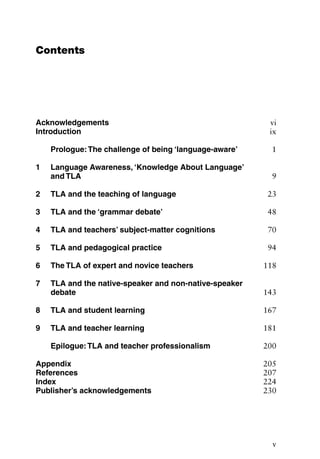


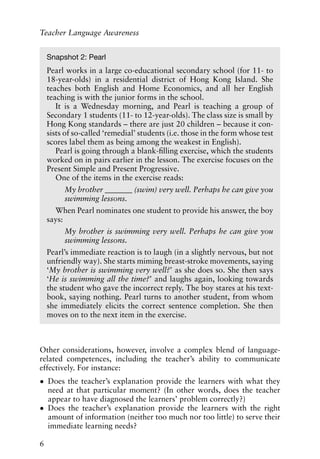
![• Is the explanation pitched at the right level, in that it uses only concepts
and terminology with which the learners are already familiar?
• Is the explanation expressed in a clear, coherent and fully intelligible
way?
In focusing attention on such questions, we are in fact identifying
many of the key characteristics of Teacher Language Awareness, which
is the focus of this book. The quotation from Swan is especially useful
as we consider the nature of TLA because it encapsulates many aspects
of the challenges involved in being a language-aware teacher and high-
lights some of the associated complexities and paradoxes which we shall
explore in more detail in the following chapters.
Swan’s final words, in which he talks about the art involved in good
teaching, are also highly significant in relation to TLA, if language
awareness is (as I would argue) one of the attributes one would expect
the ‘good teacher’ to possess, since those words remind us that TLA as
exemplified in the act of teaching is both art and science. TLA is in one
sense science, in that it is dependent upon the teacher’s possession of an
appropriate base of knowledge and understanding about language (in
particular, the target language) and how it works. At the same time,
however, TLA, when it is demonstrated in good classroom practice, is
much more than the direct application of science, i.e. the teacher’s
knowledge of linguistics. It involves a complex blend of learning- and
learner-related understanding and sensitivity, such that the teacher
is able to provide the precise amount of knowledge the learner needs at
a given point and to convey that knowledge in a form that creates no
barriers to comprehension. The language-aware teacher therefore needs
to be both scientist and artist, and therein lies much of the challenge.
Earl Stevick, writing in 1980 about grammatical explanation, captures
the essence of this blend of science and artistry, at the same time provid-
ing a strong argument in support of the need for the L2 teacher to be
language-aware:
The explaining of grammar. . . casts light on the unfamiliar pathways
and the arbitrary obstacles through which [the student] must
eventually be able to run back and forth with his eyes shut. It can
thus save him a certain amount of time, energy, and barked shins.
It is for this same reason, of course, that the teacher needs to know
these same pathways and obstacles – not only to run back and forth
in them for herself, but also to see them as they look to a newcomer.
On top of this are the skills of knowing when to turn on the spotlight
of explanation and when to turn it off, and knowing just how to aim
it so that it will help the student instead of blinding him.
(Stevick, 1980:251)
7
Prologue: The challenge of being ‘language-aware’](https://image.slidesharecdn.com/877529-250609134008-aaf8618c/85/Teacher-Language-Awareness-Stephen-Andrews-26-320.jpg)
![for example: ‘It [Language Awareness] was initially and essentially a
response to the notoriously dismal achievements in two areas of British
education: foreign language learning and school-leavers’ illiteracy.’ Such
concern is far from new, as Hawkins (1992) points out, charting the
history of the debate about Language Awareness / KAL in the curricu-
lum during the twentieth century. He sees the concerns about children’s
language performance as originating in dissatisfaction with the teaching
of English as a mother tongue (L1), and developing subsequently into a
perception that failure to foster ‘awareness of language’ (Halliday, 1971)
was hindering children’s progress in both the mother tongue and L2
(Hawkins, 1992).
In his review of the development of the Language Awareness move-
ment, Gnutzmann (1997) argues, from a European perspective, that
British protagonists of Language Awareness can be placed in the trad-
ition of a deficit model of language behaviour, where educational failure
is associated with cultural (in this case linguistic) deprivation, resulting
from students not having learned the language in which the school cur-
riculum is delivered and examined (Hawkins, 1999).
It could be argued, however, that it is somewhat of a caricature to
portray the Language Awareness movement as being based on a deficit
model. Much language awareness work focuses on the noticing of dif-
ferences, without the necessary implication of a deficit. In the case, for
example, of the relationship between the standard variety of a language
and the dialect used by a particular speech community, the goal of lan-
guage awareness, as viewed by many within the Language Awareness
movement, would be to increase awareness of the differences between
the two varieties, without the superiority of either being implied. One
consequence of achieving this goal would be that enhanced awareness
would empower those who are speakers of the dialect to succeed when
following a school curriculum based upon the standard variety.
Although there has been great interest in Language Awareness / KAL
in recent years, it is far from easy to find a useful definition of either. As
van Lier (1996) points out, the definition of Language Awareness agreed
by the 1982 Language Awareness Working Party – ‘Language Awareness
is a person’s sensitivity to and conscious awareness of the nature of lan-
guage and its role in human life’ (Donmall, 1985:7) – is open to a wide
range of interpretations. As a result, according to van Lier, it is difficult
to decide whether the two terms – Language Awareness and Knowledge
About Language – are synonymous or whether one is a subset of the
other. The focus on KAL in the UK National Curriculum for English may
have led to a narrow view of KAL in some quarters: ‘in the media and
elsewhere KAL is often interpreted as a renewed call for formal grammar
teaching’ (van Lier, 1996:80). However, van Lier (1996:80) suggests
11
Language Awareness, ‘Knowledge About Language’ and TLA](https://image.slidesharecdn.com/877529-250609134008-aaf8618c/85/Teacher-Language-Awareness-Stephen-Andrews-30-320.jpg)
![that, ‘In principle this term [KAL] should be compatible with any con-
ception of LA, all the way along the continuum from the most utopian
to the most utilitarian position.’
The variety of activity related to Language Awareness / KAL has also
made it increasingly difficult to pin down the concept. As indicated by
Mitchell, Hooper and Brumfit (1994:5), KAL-related concerns have now
broadened to include the relationships between languages, language devel-
opment in young children, the nature of social interaction, language-
choice and personal identity, individual and societal bilingualism and
multilingualism, language variation, and the (mis)uses of language for
social control, as well as the more traditional questions (of central impor-
tance to both mother-tongue and L2 teachers) about the contribution
made by explicit study of language to the learning of language, i.e. mastery
of the system.
Carter’s (1994) definition of Language Awareness reflects the breadth
of the concerns encompassed by Language Awareness:
The definition would appear to be particularly appropriate to the lan-
guage awareness of native speakers, with the emphasis on the creative
properties of language and the importance attached to awareness of lan-
guage and ideology, in (a) and (d), although (b) and especially (c) are
highly relevant to the second language context. Traditionally, (c) has
been the cornerstone of curricula in L2 education, where, whatever the
disagreements about the role of explicit knowledge of grammar, a focus
on the forms of language and the relationship between form and
12
Teacher Language Awareness
A general language awareness involves at least:
(a) awareness of some of the properties of language; creativity and
playfulness; its double meanings.
(b) awareness of the embedding of language within culture.
Learning to read the language is learning about the cultural
properties of the language. Idioms and metaphors, in particular,
reveal a lot about the culture.
(c) a greater self-consciousness about the forms of the language we
use. We need to recognise that the relations between the forms
and meanings of a language are sometimes arbitrary, but that
language is a system and that it is for the most part systemati-
cally patterned.
(d) awareness of the close relationship between language and ideol-
ogy. It involves ‘seeing through language’ in other words.
(Carter, 1994:5)](https://image.slidesharecdn.com/877529-250609134008-aaf8618c/85/Teacher-Language-Awareness-Stephen-Andrews-31-320.jpg)
![a move from the explicit to the implicit. As James (1992:184) puts it,
‘Consciousness gives the learner insight into what he [sic] does not know
and therefore needs to learn. That is, consciousness-raising defines a set of
learning objectives, what needs to be done to put a deficiency right.’ By
contrast, Language Awareness, according to James (1996:223), is ‘an
ability to contemplate metacognitively language over which one already
has a high degree of skilled control and inexplicit intuitions’, i.e. it is
‘implicit knowledge that has become explicit’ (Levelt et al., 1978:5, cited
in James, 1996). James (1996) draws the conclusion that logically
Language Awareness applies more to knowledge of the mother tongue,
while consciousness-raising is for L2 learners.
It could be argued that James presents a rather narrow view of
consciousness-raising, emphasising the remedying of deficiencies (i.e. the
corrective function) rather than the broadening of the learner’s linguis-
tic repertoire that may also result from activities in which specific fea-
tures of the input have been made salient by the teacher (i.e. the additive
function). It is also something of an over-simplification to associate
Language Awareness primarily with knowledge of the mother tongue,
since language awareness work with intermediate and advanced L2
learners and with L2 teachers often involves reflection on and analysis
of language where the learner/teacher already has a measure of implicit
knowledge and skilled control.
Certainly, though, for the L2 teacher (whether a native speaker or non-
native speaker of the language being taught), both sorts of linguistic
metacognition mentioned by James are important. For instance, any ped-
agogical decision relating to the language content of one’s teaching
undoubtedly involves metacognitions about language over which the
teacher has, to a greater or lesser extent, ‘skilled control and inexplicit
intuitions’, a point which is discussed at greater length in 2.2. At the
same time, it is clear that consciousness-raising (or input enhancement /
creating salience) – indeed any structuring (‘tuning’ or mediation) of lan-
guage input for pedagogical purposes – places significant demands on the
L2 teacher’s language awareness. The nature of these demands is dis-
cussed further in 2.4. Examples of teachers’ responses to such demands
can be found in snapshots throughout the book, but particularly in
Chapter 5, which focuses on TLA and pedagogical practice.
1.6 TLA and recent perspectives on L2 education
The role of grammar in L2 pedagogy will be discussed in detail in
Chapter 3, with a historical review and an examination of the major
areas of debate. At this point, the aim is simply to place TLA and the
18
Teacher Language Awareness](https://image.slidesharecdn.com/877529-250609134008-aaf8618c/85/Teacher-Language-Awareness-Stephen-Andrews-37-320.jpg)
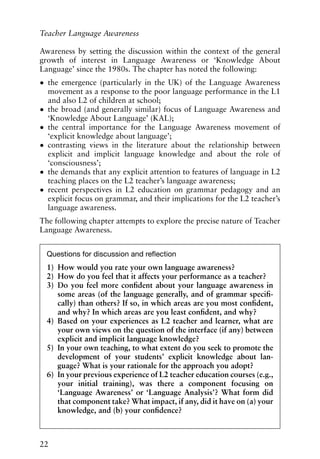
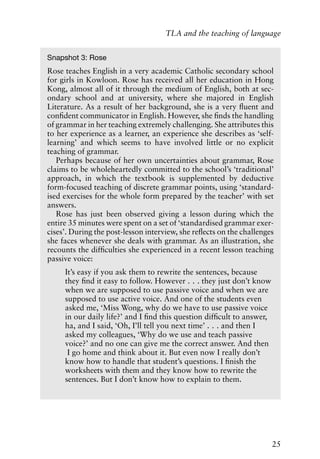
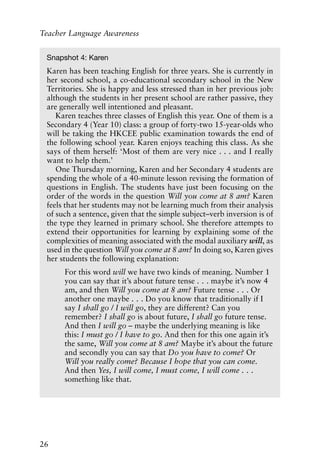
![this observation still applies to those parts of the lesson in which the L2
is the MOI.
A second element contributing to the complexity of TLA, as noted
above, is the need for teachers to be aware of the learners, to be aware
(to the extent that such awareness is possible) of the learners’ present
level of language development (their interlanguage), and to tailor their
handling of grammar-related input to that level. As Wright (2002:115)
observes, ‘A linguistically aware teacher not only understands how lan-
guage works, but understands the student’s struggle with language and
is sensitive to errors and other interlanguage features.’ Given that any
class of learners will contain as many interlanguages as there are learn-
ers, all at different stages of development, this presents the teacher with
particular challenges.
Based on all the above, it would seem that any model of TLA would
need to take account of the following:
• The language knowledge/awareness of the teacher embraces both
knowledge of subject matter and language proficiency, since it involves
reflections on both and entails the mediation of the former through the
latter.
• The language knowledge/awareness required by the teacher of a lan-
guage is qualitatively different from that of the educated user of that
language. As I have argued elsewhere (see, e.g., Andrews, 1999a),
teachers of a language, like any educated users of that language,
undoubtedly need sufficiently high levels of implicit and explicit
knowledge of grammar to facilitate effective communication. In the
case of teachers, their effectiveness as communicators is directly linked
to their adequacy as models for their students. At the same time,
however: ‘effective L2 teaching requires of the teacher more than just
the possession of such knowledge and the ability to draw upon it for
communicative purposes. The L2 teacher also needs to reflect upon
that knowledge and ability, and upon her [sic] knowledge of the
underlying systems of the language, in order to ensure that her stu-
dents receive maximally useful input for learning’ (Andrews,
1999a:163).
• The language knowledge/awareness of the teacher is therefore
‘metacognitive’, i.e. it involves ‘cognition about cognition’ (Flavell,
1981, quoted by Gombert, 1992:7). In other words, TLA is not just
knowledge of subject matter mediated through a teacher’s language
proficiency, but rather, as suggested above, it also involves an extra
cognitive dimension of reflections upon both knowledge of subject-
matter and language proficiency, which provides a basis for the tasks
of planning and teaching. (See, e.g., Andrews, 1997, and 1999a, where
28
Teacher Language Awareness](https://image.slidesharecdn.com/877529-250609134008-aaf8618c/85/Teacher-Language-Awareness-Stephen-Andrews-47-320.jpg)