MEASURING THE DIGITAL
ECONOMY
Jennifer Ribarsky
Head of Section, National Accounts Division, STD
11th Meeting of the Advisory Expert Group on National Accounts
5-7 December 2017, New York
Where is the digital economy in
macroeconomic statistics?
2
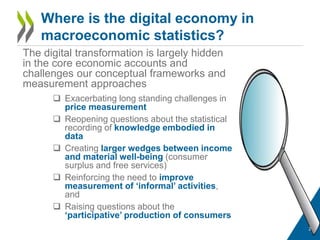
The digital transformation is largely hidden
in the core economic accounts and
challenges our conceptual frameworks and
measurement approaches
 Exacerbating long standing challenges in
price measurement
 Reopening questions about the statistical
recording of knowledge embodied in
data
 Creating larger wedges between income
and material well-being (consumer
surplus and free services)
 Reinforcing the need to improve
measurement of ‘informal’ activities,
and
 Raising questions about the
‘participative’ production of consumers
Measuring macroeconomic statistics
in a digital economy
 Response of the international statistical community
 OECD Measuring GDP in a digitalised economy
 OECD-IMF Can potential mismeasurement of the digital
economy explain the post-crisis slowdown in GDP and
productivity growth?
 OECD-IMF Measuring consumer inflation in a digital
economy
 Advisory Group on measuring GDP in a
digitalised economy
 Consists of NSOs, Eurostat, IMF, UN, and members of OECD
WP Measurement & Analysis of the Digital Economy (WPMADE)
 Surveys, discussions and in-person meeting November 2017
 TF on International Trade in Services
Statistics (TFITS) exploring similar issues
 Measuring digital trade framework presented at BOPCOMM
24-26 October 2017
3
Going Digital Horizontal Project
• OECD’s project “Going Digital”, making the
transformation work for growth and well-being
– Multidisciplinary, cross-cutting initiative to help
policymakers better understand the digital
transformation that is taking place
– Modules
• Jobs and skills; Productivity, competition and market
openness; Well-being in the digital age
• Measurement : Developing new tools and a longer-term
agenda for measuring the digital transformation
– Collaborative projects
• Policy design; Digital security and resilience; Foresight
scenarios
4
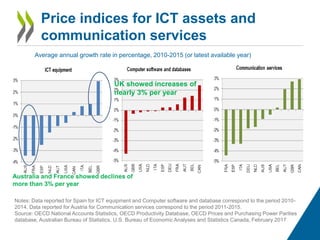
Price indices for ICT assets and
communication services
Notes: Data reported for Spain for ICT equipment and Computer software and database correspond to the period 2010-
2014. Data reported for Austria for Communication services correspond to the period 2011-2015.
Source: OECD National Accounts Statistics, OECD Productivity Database, OECD Prices and Purchasing Power Parities
database, Australian Bureau of Statistics, U.S. Bureau of Economic Analyses and Statistics Canada, February 2017
Average annual growth rate in percentage, 2010-2015 (or latest available year)
Australia and France showed declines of
more than 3% per year
UK showed increases of
nearly 3% per year
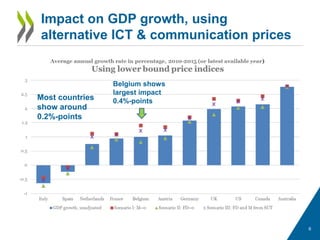
Impact on GDP growth, using
alternative ICT & communication prices
6
Belgium shows
largest impact
0.4%-pointsMost countries
show around
0.2%-points
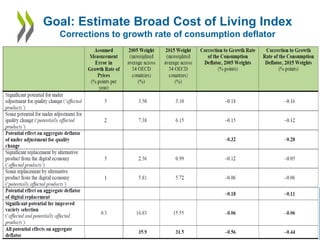
Goal: Estimate Broad Cost of Living Index
Corrections to growth rate of consumption deflator
7
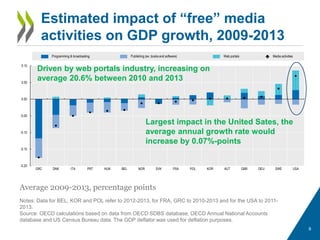
Estimated impact of “free” media
activities on GDP growth, 2009-2013
8
-0.20
-0.15
-0.10
-0.05
0.00
0.05
0.10
GRC DNK ITA PRT HUN BEL NOR SVK FRA POL KOR AUT GBR DEU SWE USA
Programming & broadcasting Publishing (ex. books and software) Web portals Media activities
Notes: Data for BEL, KOR and POL refer to 2012-2013, for FRA, GRC to 2010-2013 and for the USA to 2011-
2013.
Source: OECD calculations based on data from OECD SDBS database, OECD Annual National Accounts
database and US Census Bureau data. The GDP deflator was used for deflation purposes.
Average 2009-2013, percentage points
Largest impact in the United Sates, the
average annual growth rate would
increase by 0.07%-points
Driven by web portals industry, increasing on
average 20.6% between 2010 and 2013
OECD Advisory Group on Measuring
GDP in a Digitalised Economy
Advisory Group on Measuring GDP
in a Digitalised Economy
• Consists of 40 members: NSOs, Eurostat, IMF, UN,
and members of WPMADE
• Survey of Digital Economy Typology
– Initial framework based on digital trade framework
– Questions on country practices with regards to digital
intermediaries
– Identifying data gaps
– How to highlight the digital economy
10
Digital economy typology
• The majority of the AG agreed with the multi-
dimensional scope proposed
• Different views of the digital economy
depending on what you want to study
• Some refinement was needed to make it
operational for a potential satellite account on
the digital economy
– Dimensions further disaggregated (or dissected
in different ways)
– Additional category specifying SNA production
boundary 11
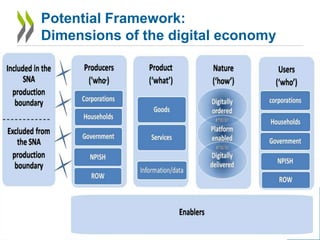
Potential Framework:
Dimensions of the digital economy
12
• Digitally ordered
– The sale or purchase of a good or service, conducted over
computer networks by methods specifically designed for the
purpose of receiving or placing orders (follows OECD ecommerce
definition)
• Platform enabled
– Transactions that are facilitated via online intermediary platforms
that match buyer and supplier (e.g. eBay, Amazon, Uber)
• Platform may be based domestically or abroad, foreign or domestically owned
• Digitally delivered
– ‘downloadable’ services and data flows (software, data, database
services, etc.)
Nature of transaction (‘how’)
13
• Traditional: Goods and services
• BUT: importance of data/information flows
that may not result in monetary transaction, but
may support one
– e.g. Facebook: advertising revenue is
captured, the data flows are currently not >
Measurement of consumer surpluses?
– E.g. Use of public goods (open-source/free
software)> currently no imputations are made
Product (‘what’)
14
• Producers
– Can be broken down in a number of ways
• Institutional sector (highlights the importance of ROW)
– Categories of industries
• Digital/non-digital industries and/or producers of digital
products
• Users
– Can be broken down in a number of ways
• Institutional sector (again including ROW)
• Industries, and also consumers of final demand (notably
households)
Actors involved (‘who’)
15
Other columns of framework
• Enablers
– Important pillar of the digital economy
– Namely investment and infrastructure
channels that help drive digital transformation
• SNA production boundary
– Not all transactions are currently within the
SNA production boundary
16
Questions on overarching framework
• Do you agree with the broad multi-
dimensional scope proposed?
• Do you think it is useful as an
organising principle?
17
Making the Framework Operational
• Preliminary stage… it is ambitious
– Driven by conceptual considerations and
policy needs
• Could be expanded…
– to develop gross and net capital stock
estimates (service lives, depreciation rates)
and capital services
– Price and volume measures
Proposal
19
Organising principle
• Nature of the transaction is organising principle
but… does not dictate what should be digital
goods and services or digital industries.
• Transactions that are in scope…
– only captures transactions that are either
‘digitally delivered’, digitally ordered, or platform
enabled
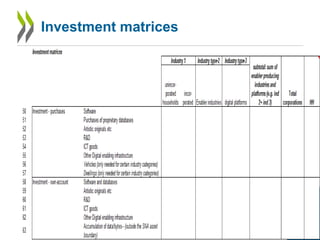
• Satellite account includes a separate section on
enablers (investment matrices) 20
21
Investment matrices
22
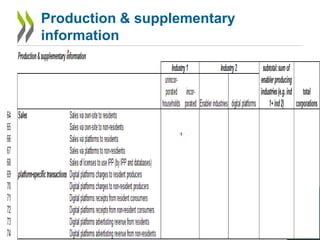
Production & supplementary
information
23
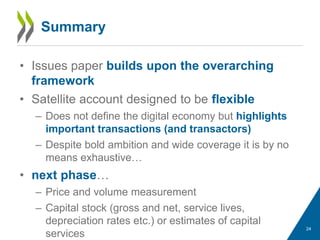
Summary
• Issues paper builds upon the overarching
framework
• Satellite account designed to be flexible
– Does not define the digital economy but highlights
important transactions (and transactors)
– Despite bold ambition and wide coverage it is by no
means exhaustive…
• next phase…
– Price and volume measurement
– Capital stock (gross and net, service lives,
depreciation rates etc.) or estimates of capital
services
24
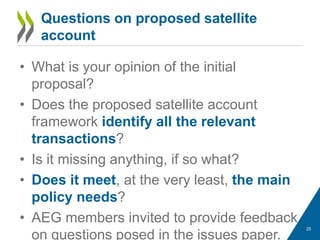
Questions on proposed satellite
account
• What is your opinion of the initial
proposal?
• Does the proposed satellite account
framework identify all the relevant
transactions?
• Is it missing anything, if so what?
• Does it meet, at the very least, the main
policy needs?
• AEG members invited to provide feedback
on questions posed in the issues paper.
25
Thank you!
26

M11 4 1_digitalisation

  • 1.
    MEASURING THE DIGITAL ECONOMY JenniferRibarsky Head of Section, National Accounts Division, STD 11th Meeting of the Advisory Expert Group on National Accounts 5-7 December 2017, New York
  • 2.
    Where is thedigital economy in macroeconomic statistics? 2 The digital transformation is largely hidden in the core economic accounts and challenges our conceptual frameworks and measurement approaches  Exacerbating long standing challenges in price measurement  Reopening questions about the statistical recording of knowledge embodied in data  Creating larger wedges between income and material well-being (consumer surplus and free services)  Reinforcing the need to improve measurement of ‘informal’ activities, and  Raising questions about the ‘participative’ production of consumers
  • 3.
    Measuring macroeconomic statistics ina digital economy  Response of the international statistical community  OECD Measuring GDP in a digitalised economy  OECD-IMF Can potential mismeasurement of the digital economy explain the post-crisis slowdown in GDP and productivity growth?  OECD-IMF Measuring consumer inflation in a digital economy  Advisory Group on measuring GDP in a digitalised economy  Consists of NSOs, Eurostat, IMF, UN, and members of OECD WP Measurement & Analysis of the Digital Economy (WPMADE)  Surveys, discussions and in-person meeting November 2017  TF on International Trade in Services Statistics (TFITS) exploring similar issues  Measuring digital trade framework presented at BOPCOMM 24-26 October 2017 3
  • 4.
    Going Digital HorizontalProject • OECD’s project “Going Digital”, making the transformation work for growth and well-being – Multidisciplinary, cross-cutting initiative to help policymakers better understand the digital transformation that is taking place – Modules • Jobs and skills; Productivity, competition and market openness; Well-being in the digital age • Measurement : Developing new tools and a longer-term agenda for measuring the digital transformation – Collaborative projects • Policy design; Digital security and resilience; Foresight scenarios 4
  • 5.
    Price indices forICT assets and communication services Notes: Data reported for Spain for ICT equipment and Computer software and database correspond to the period 2010- 2014. Data reported for Austria for Communication services correspond to the period 2011-2015. Source: OECD National Accounts Statistics, OECD Productivity Database, OECD Prices and Purchasing Power Parities database, Australian Bureau of Statistics, U.S. Bureau of Economic Analyses and Statistics Canada, February 2017 Average annual growth rate in percentage, 2010-2015 (or latest available year) Australia and France showed declines of more than 3% per year UK showed increases of nearly 3% per year
  • 6.
    Impact on GDPgrowth, using alternative ICT & communication prices 6 Belgium shows largest impact 0.4%-pointsMost countries show around 0.2%-points
  • 7.
    Goal: Estimate BroadCost of Living Index Corrections to growth rate of consumption deflator 7
  • 8.
    Estimated impact of“free” media activities on GDP growth, 2009-2013 8 -0.20 -0.15 -0.10 -0.05 0.00 0.05 0.10 GRC DNK ITA PRT HUN BEL NOR SVK FRA POL KOR AUT GBR DEU SWE USA Programming & broadcasting Publishing (ex. books and software) Web portals Media activities Notes: Data for BEL, KOR and POL refer to 2012-2013, for FRA, GRC to 2010-2013 and for the USA to 2011- 2013. Source: OECD calculations based on data from OECD SDBS database, OECD Annual National Accounts database and US Census Bureau data. The GDP deflator was used for deflation purposes. Average 2009-2013, percentage points Largest impact in the United Sates, the average annual growth rate would increase by 0.07%-points Driven by web portals industry, increasing on average 20.6% between 2010 and 2013
  • 9.
    OECD Advisory Groupon Measuring GDP in a Digitalised Economy
  • 10.
    Advisory Group onMeasuring GDP in a Digitalised Economy • Consists of 40 members: NSOs, Eurostat, IMF, UN, and members of WPMADE • Survey of Digital Economy Typology – Initial framework based on digital trade framework – Questions on country practices with regards to digital intermediaries – Identifying data gaps – How to highlight the digital economy 10
  • 11.
    Digital economy typology •The majority of the AG agreed with the multi- dimensional scope proposed • Different views of the digital economy depending on what you want to study • Some refinement was needed to make it operational for a potential satellite account on the digital economy – Dimensions further disaggregated (or dissected in different ways) – Additional category specifying SNA production boundary 11
  • 12.
    Potential Framework: Dimensions ofthe digital economy 12
  • 13.
    • Digitally ordered –The sale or purchase of a good or service, conducted over computer networks by methods specifically designed for the purpose of receiving or placing orders (follows OECD ecommerce definition) • Platform enabled – Transactions that are facilitated via online intermediary platforms that match buyer and supplier (e.g. eBay, Amazon, Uber) • Platform may be based domestically or abroad, foreign or domestically owned • Digitally delivered – ‘downloadable’ services and data flows (software, data, database services, etc.) Nature of transaction (‘how’) 13
  • 14.
    • Traditional: Goodsand services • BUT: importance of data/information flows that may not result in monetary transaction, but may support one – e.g. Facebook: advertising revenue is captured, the data flows are currently not > Measurement of consumer surpluses? – E.g. Use of public goods (open-source/free software)> currently no imputations are made Product (‘what’) 14
  • 15.
    • Producers – Canbe broken down in a number of ways • Institutional sector (highlights the importance of ROW) – Categories of industries • Digital/non-digital industries and/or producers of digital products • Users – Can be broken down in a number of ways • Institutional sector (again including ROW) • Industries, and also consumers of final demand (notably households) Actors involved (‘who’) 15
  • 16.
    Other columns offramework • Enablers – Important pillar of the digital economy – Namely investment and infrastructure channels that help drive digital transformation • SNA production boundary – Not all transactions are currently within the SNA production boundary 16
  • 17.
    Questions on overarchingframework • Do you agree with the broad multi- dimensional scope proposed? • Do you think it is useful as an organising principle? 17
  • 18.
  • 19.
    • Preliminary stage…it is ambitious – Driven by conceptual considerations and policy needs • Could be expanded… – to develop gross and net capital stock estimates (service lives, depreciation rates) and capital services – Price and volume measures Proposal 19
  • 20.
    Organising principle • Natureof the transaction is organising principle but… does not dictate what should be digital goods and services or digital industries. • Transactions that are in scope… – only captures transactions that are either ‘digitally delivered’, digitally ordered, or platform enabled • Satellite account includes a separate section on enablers (investment matrices) 20
  • 21.
  • 22.
  • 23.
  • 24.
    Summary • Issues paperbuilds upon the overarching framework • Satellite account designed to be flexible – Does not define the digital economy but highlights important transactions (and transactors) – Despite bold ambition and wide coverage it is by no means exhaustive… • next phase… – Price and volume measurement – Capital stock (gross and net, service lives, depreciation rates etc.) or estimates of capital services 24
  • 25.
    Questions on proposedsatellite account • What is your opinion of the initial proposal? • Does the proposed satellite account framework identify all the relevant transactions? • Is it missing anything, if so what? • Does it meet, at the very least, the main policy needs? • AEG members invited to provide feedback on questions posed in the issues paper. 25
  • 26.

Editor's Notes

  • #3 There is a growing recognition that the role of digitalisation in our statistics is not sufficiently visible, which appears, at least in part, to explain the current hypothesis that mismeasurement of digitalised transactions is occurring. It would be good to better identify the part of the digital economy that is already within official statistics so that indicators can be created.
  • #7 The impact depends on whether the affected products are for final or intermediate uses, and on whether they are imported or domestically produced. Graph only shows the growth rate adjustment implied by the lower bound price indices because the usual mismeasurement concern is that the official price indices under adjust for quality change. Scenario I assumes that imports prices are measured well, so that the adjustments made to the price indices affect only volume estimates of final demand. (Shown by red square- this shows the largest impact on GDP growth (upward revision to GDP growth rates). Scenario II assumes that only import prices are mismeasured and that final demand prices are measured well. (Shown by green triangle- this shows the smallest impact on GDP growth (downward revision to GDP growth rates) Scenario III gives results in between these 2 extremes by adjusting both the final demand and import price indices. (Shown by purple asterisk- shows upward revision to GDP but not as much as in scenario I). Under rather strong assumptions Belgium shows that overall growth rates could be adversely affected by price mismeasurement by as much as 0.4 percent per year (unadjusted GDP growth rate was 1 %, adjusted GDP (red square) 1.4 %). Implied adjustment are only around 0.2% for most countries.
  • #9 Another reason to have more granular statistics available is to do more detailed analysis through what we call satellite accounting. This allows for showing the impact of say certain changes of what should be included within the framework and see the impact on economic growth… The programming and broadcasting industry a little more than half of the countries experienced declines in inflation-adjusted turnover. The industry that saw the strongest growth in most countries was the web portals industry. In the United States, the country with the largest share relative to GDP (at 0.4%), inflation-adjusted turnover for the web portals industry increased at an average annual growth rate of 20.6% between 2010 and 2013. If free media funded by advertising were added to household consumption expenditures, the largest estimated impact would be in the United States. There, the average growth rate of GDP in 2011-2013 would increase by 0.07 percentage points, driven mainly by web portals. web portals (includes operation of search engines and websites that act as portals to the Internet)
  • #14 Basis for digital trade framework Visible economic transaction… to be inscape needs to reflect at least one of the following: digitally ordered, platform enabled, and digitally delivered.
  • #15 The third column, ‘product’, introduces information, or data, as a separate product to consider in addition to goods and services. This reflects the fact that many transactions in data do not result in monetary transactions per se. Note that if there is an explicit monetary transaction - i.e. purchases/sales of data - then this should, in theory, be picked up within services, including knowledge based assets that are also classified as services, such as databases where the full value of the underlying ‘knowledge’ embodied in data may also be captured within ‘goodwill’, so, as currently classified, the item information/data refers primarily to exchanges of data/information where there is no monetary exchange. However the AG is asked to consider whether it would be useful to also separately identify ‘data and information’ exchange where there is a monetary transaction.
  • #16 Highlights the importance of ROW and the high policy relevance of cross-border digital trade.
  • #21 Prices and balance sheets
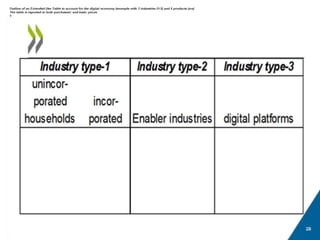
  • #22 Breakdown of products based on nature of transaction Including distinctions of resident & non-resident intermediary platforms Whether the underlying product was imported or domestically produced Role of digital platform intermediaries Most AG thought the platform intermediation fees are digital services Mixed response whether the full value of the intermediated service should be part of digital services… however may be useful to know Satellite account highlights transactions facilitated by digital intermediary platforms Gross flows and intermediation fees, shown separately Further disaggregated by type of service provided(e.g., transportation services, accommodation/dwelling services, financial services, business services, household services, etc Digitisation can arguably impact all industries Digital industries could be the industries that produce the digital products… Satellite account proposes breakdowns by (1)household/corporations split; (2) digital enabling industries; and (3) digital platforms The first type (column A and B) breaks down the relevant activity into activity performed by unincorporated households and activity performed by corporations; allowing an analysis of goods and services provided by the household sector within the ‘sharing’ economy, but also as a means of reinforcing estimation methods and methodologies in difficult to measure areas.   The second type (column C) separately identifies those industries engaged in the production of enabling tools (identified as the goods and services produced in the broad investment rows 50-55 and 58-63)). Feedback from the AG supported the view that the enabling industries (along with the enabling investment) should be separately identified. The third type (column D) is to separately identify digital platforms, on which the AG has earlier expressed strong support. As noted above, digital platforms could be further broken down into digital intermediaries and other types of platforms, differentiating for example by the nature of service being intermediated (e.g., accommodation, transport).