Key Drivers for the Green Construction Industry Allentown CSI Expo April 21, 2010 Scott Kriner,  CSI, AIA, LEED AP O+M  President  Green Metal Consulting, Inc.
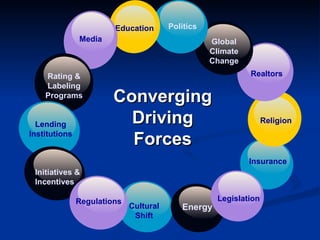
Converging Driving Forces Cultural Shift Insurance Religion Realtors Global Climate Change Politics Education Media Rating & Labeling Programs Lending Institutions Initiatives & Incentives Energy Regulations Legislation
 
Building Themes of the Next Decade “ Green building  and computer technology assistance (ex. BIM) are expected to re-form the industry in ways current practitioners are just beginning  to imagine.”    (prediction of  Business Review’s  economic forum 2007)
What is GREEN Building? The practice of increasing the efficiency of buildings‘ use of  energy ,  water  and  materials
Sustainable Building Practice “  Development that meets the needs of the present without compromising the ability of future generations to meet their own needs”  –  ASTM E2114
You May Already Be Building Green and Don’t Even Know It!
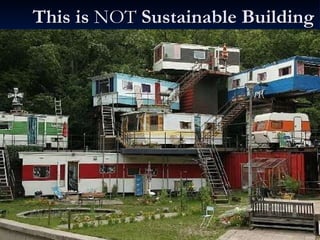
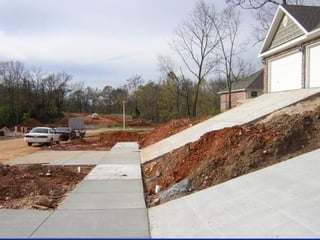
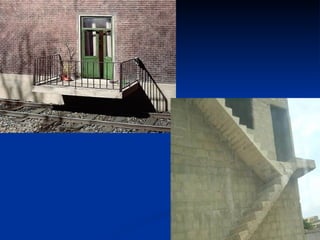
This is  NOT  Sustainable Building !
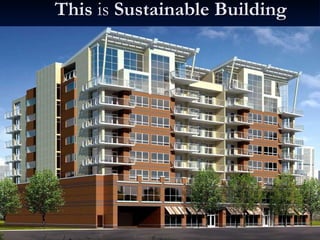
This  is  Sustainable Building
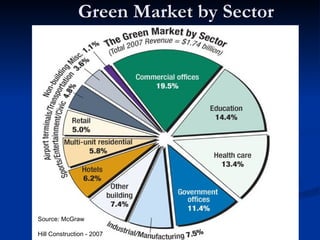
Green Market by Sector Source: McGraw  Hill Construction - 2007 *
Green Construction $13 billion of green non-res construction put in place in 2006 $49 billion of green non-res construction put in place in 2008 $140 billion of green non-res construction expected by 2013 “ Green business has shifted from a movement  to a market.”  – Greener World Media FMI 2008 US Construction Overview, and BRG Group
Why Build Green?
Benefits of GREEN Buildings Reduce energy use 30-50% Reduce impact on solid  waste stream Command higher rents Save employers $58 Billion of  sick time Add $180 Billion in increased  worker productivity
Energy Dependence
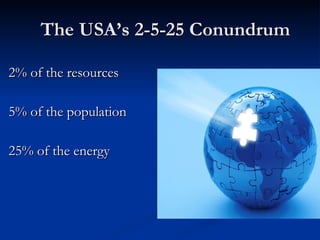
The USA’s 2-5-25 Conundrum 2% of the resources 5% of the population 25% of the energy
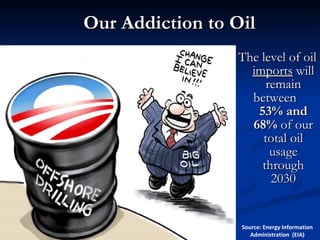
Our Addiction to Oil The level of oil  imports  will remain between  53% and 68%  of our total oil usage through 2030 Source: Energy Information Administration  (EIA)
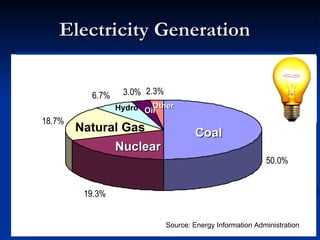
Electricity Generation Source: Energy Information Administration Coal Nuclear Natural Gas Hydro Oil Other
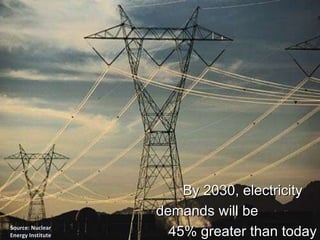
By 2030, electricity demands will be  45% greater than today Source: Nuclear Energy Institute
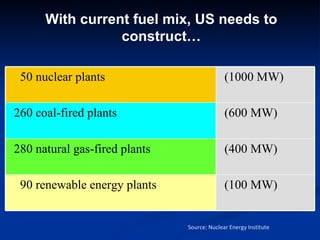
Source: Nuclear Energy Institute With current fuel mix, US needs to construct… 50 nuclear plants (1000 MW) 260 coal-fired plants (600 MW) 280 natural gas-fired plants (400 MW) 90 renewable energy plants (100 MW)
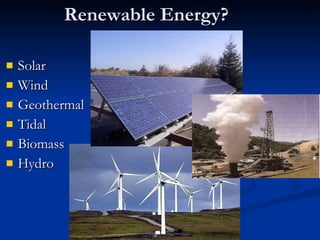
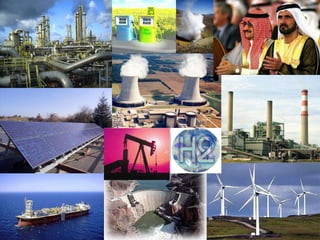
Renewable Energy? Solar Wind Geothermal Tidal Biomass Hydro *
 
 
Conservation and Efficiency Peter Turnbull, PG&E “ The cheapest, most reliable source of new energy is    saved energy.”  Peter Turnbull, PGE
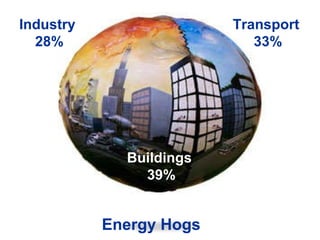
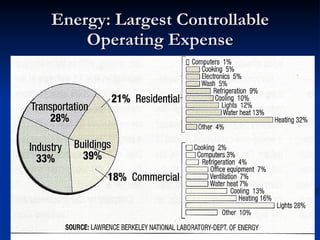
Energy Hogs Buildings  39% Transport  33% Industry  28%
Energy: Largest Controllable Operating Expense
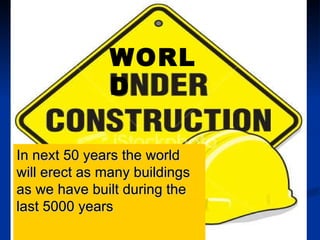
Source: IISI WORLD In next 50 years the world  will erect as many buildings as we have built during the last 5000 years
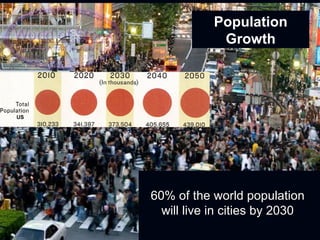
Population Growth 60% of the world population  will live in cities by 2030  US
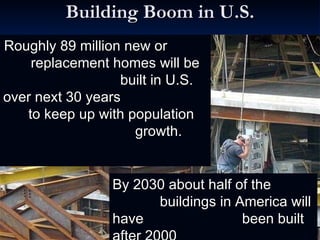
Building Boom in U.S. Roughly 89 million new or  replacement homes will be  built in U.S. over next 30 years  to keep up with population  growth. By 2030 about half of the  buildings in America will have  been built after 2000
Building Boom in United States By 2030 about half of the  buildings in America will have  been built after 2000 Roughly 89 million new or  replacement homes will be  built in U.S. over next 30 years  to keep up with population  growth.
Climate Change
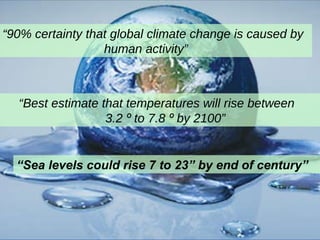
“ Best estimate that temperatures will rise between  3.2  º  to 7.8  º  by 2100”  “ Sea levels could rise 7 to 23” by end of century” “ 90% certainty that global climate change is caused by human activity”
 
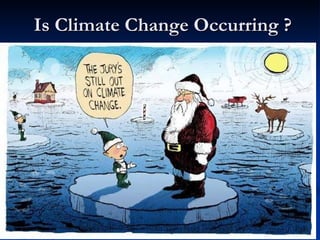
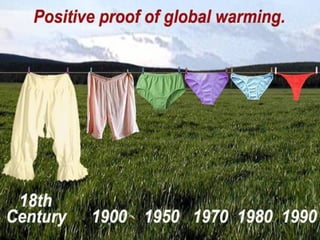
Is Climate Change Occurring ?
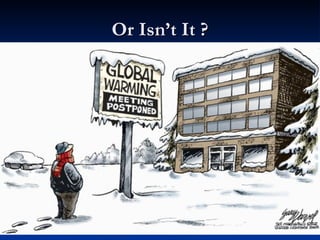
Or Isn’t It ?
 
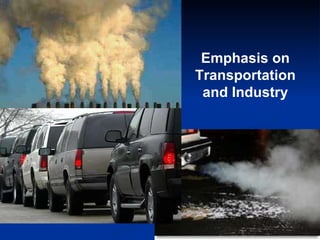
Emphasis on Transportation and Industry
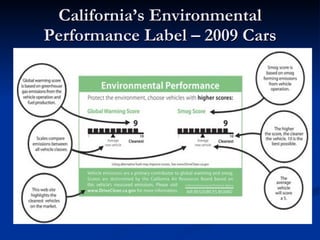
California’s Environmental Performance Label – 2009 Cars
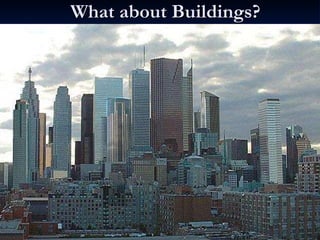
What about Buildings?
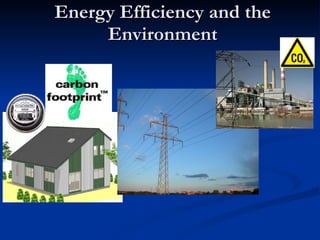
Energy Efficiency and the Environment
Society
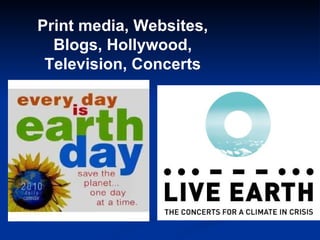
Print media, Websites, Blogs, Hollywood, Television, Concerts
Religion
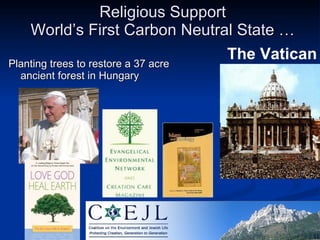
Religious Support World’s First Carbon Neutral State … Planting trees to restore a 37 acre  ancient forest in Hungary  The Vatican
Culture
Regulations
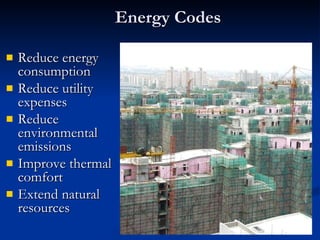
Energy Codes Reduce energy consumption Reduce utility expenses Reduce environmental emissions Improve thermal comfort  Extend natural resources
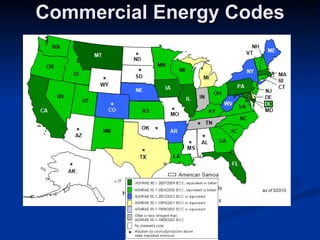
Commercial Energy Codes
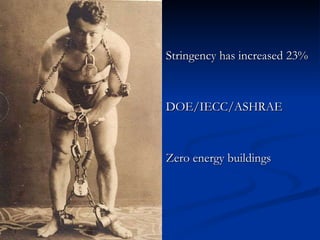
Stringency has increased 23% DOE/IECC/ASHRAE Zero energy buildings
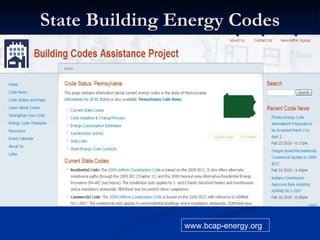
State Building Energy Codes www.bcap-energy.org
New Standards since 2007 GBI Green Globes Standard - Covering commercial (non-residential) buildings.  ASTM Standards   Principles of Sustainability Relative to Buildings NAHB Standard (ICC-700)   Green Residential Building Standard ASHRAE Standard 189.1   Standard for the Design of High-Performance Green Buildings Except Low-Rise Residential Buildings. ISO 21930:2007   Sustainability in Building Construction –  Environmental Declaration of Building Products
ASTM Standards E 2432 Guide for General Principles of Sustainability Relative to Buildings Identifies environmental, economic & social principles on equal footing E60 Sustainability E2114, Terminology for Sustainability Relative to the Performance of Buildings Balloting draft Specification for the Minimum Attributes of a building that Promotes Sustainability (WK11944)
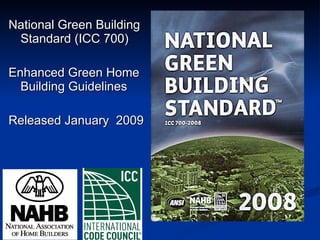
National Green Building Standard (ICC 700) Enhanced Green Home Building Guidelines Released January  2009
Contents Site Design and Development Lot Design, Preparation and Development Energy Efficiency Water Efficiency Indoor Environmental Quality Operation, Maintenance and Building Owner Education
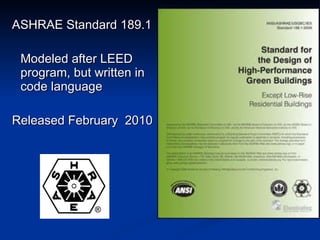
ASHRAE Standard 189.1 Modeled after LEED  program, but written in code language Released February  2010
Contents Site Sustainability Water Use Efficiency Energy Efficiency Indoor Environmental Quality Impact on Atmosphere, Materials and Resources Construction and Plans for Operation
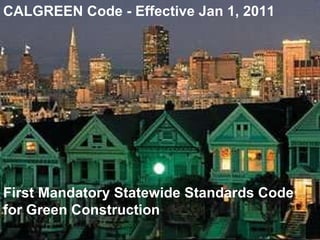
CALGREEN Code - Effective Jan 1, 2011 First Mandatory Statewide Standards Code for Green Construction
Mandatory 20% water use reductions Divert 50% of construction waste from landfills Mandatory inspections of energy systems Low pollutant emitting finish materials
International Code Council ASHRAE US Green Building Council Illuminating Eng. Society of N. America Int’l Green Construction Code
“ model” code approach Minimum and advanced performance Prescriptive, performance and pre-engineered approaches Overlay to ICC codes Work in tandem with green rating programs
IgCC ASHRAE
Site Development and Land Use Material Resource Conservation & Efficiency Energy Conservation, Efficiency and Atmospheric Quality Water Resource Conservation and Efficiency Indoor Environmental Quality Building Operation Maintenance and Owner Education Existing Buildings Existing Building Site Development
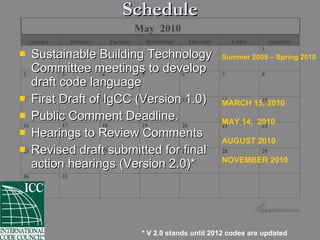
Schedule Sustainable Building Technology  Committee meetings to develop  draft code language First Draft of IgCC (Version 1.0) Public Comment Deadline. Hearings to Review Comments  Revised draft submitted for final  action hearings (Version 2.0)* Summer 2009 – Spring 2010 MARCH 15, 2010 MAY 14,  2010 AUGUST 2010 NOVEMBER 2010 * V 2.0 stands until 2012 codes are updated
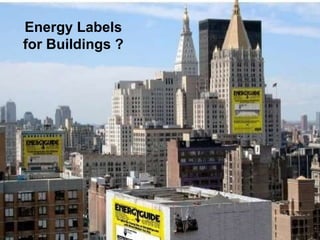
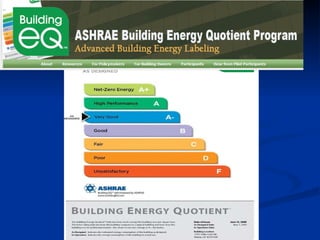
Energy Labels for Buildings ?
 
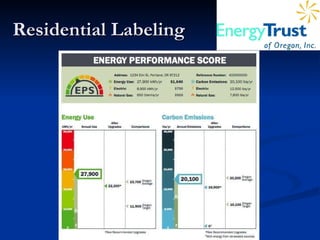
Residential Labeling
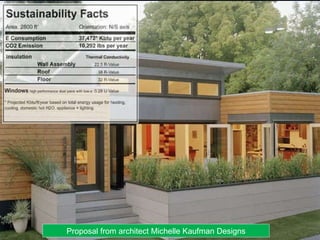
Proposal from architect Michelle Kaufman Designs
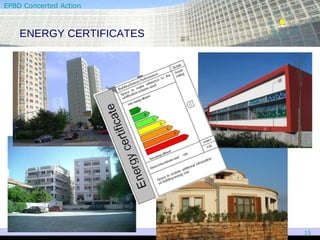
EPBD Concerted Action  ’ ’ ’ ’ ’ ’ ’ ’ ’’’’ ’ ’ ’ ’ ’ ’ ’ ’ ENERGY CERTIFICATES  ’ ’’ ’ 15
Incentives
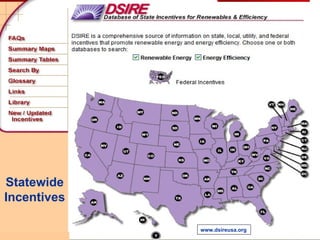
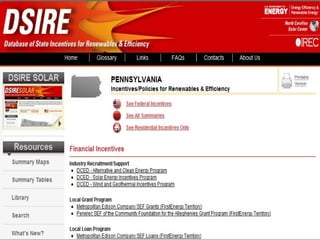
www.dsireusa.org Statewide Incentives www.dsireusa.org
 
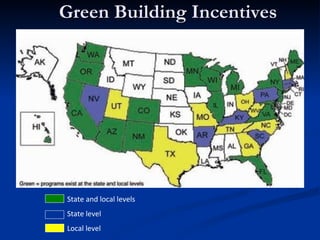
Green Building Incentives State and local levels State level Local level
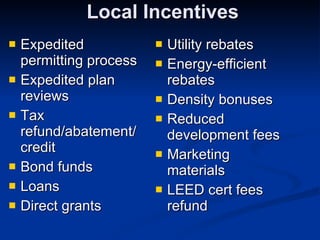
Local Incentives Expedited permitting process Expedited plan reviews Tax refund/abatement/ credit Bond funds Loans Direct grants Utility rebates Energy-efficient rebates Density bonuses Reduced development fees Marketing materials LEED cert fees refund


Legislation
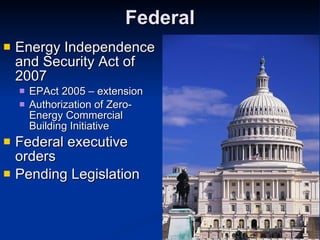
Federal Energy Independence and Security Act of 2007 EPAct 2005 – extension Authorization of Zero- Energy Commercial Building Initiative Federal executive orders Pending Legislation
EO 13101 directs Federal agencies to  purchase products that are manufactured using recycled content materials EO13423 requires federal agencies to  use sustainable building practices
Comprehensive Procurement Guideline IV for Procurement of Products Containing Recovered Materials  EPA -  April 30, 2004
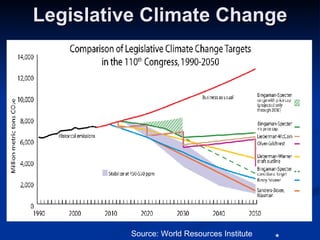
Legislative Climate Change Source: World Resources Institute *
 
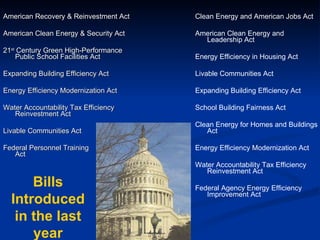
American Recovery & Reinvestment Act American Clean Energy & Security Act 21 st  Century Green High-Performance Public School Facilities Act Expanding Building Efficiency Act Energy Efficiency Modernization Act Water Accountability Tax Efficiency Reinvestment Act Livable Communities Act Federal Personnel Training  Act Clean Energy and American Jobs Act American Clean Energy and Leadership Act Energy Efficiency in Housing Act Livable Communities Act Expanding Building Efficiency Act School Building Fairness Act Clean Energy for Homes and Buildings Act Energy Efficiency Modernization Act Water Accountability Tax Efficiency Reinvestment Act Federal Agency Energy Efficiency Improvement Act Bills Introduced in the last year
State and Local Laws State legislative bills State executive orders State mandates requiring minimum level of LEED for public buildings City ordinances *
Action in California Assembly 25% reduction in  GHG by 2020  focusing on building energy efficiency 20% increase in standards for non-res buildings by 2015.
Industry Initiatives
Architecture 2030 Challenge Eliminate fossil-fuel energy consumption from all new buildings by 2030
Zero-Energy Commercial Building Initiative * Achieve marketable zero-energy buildings by 2030
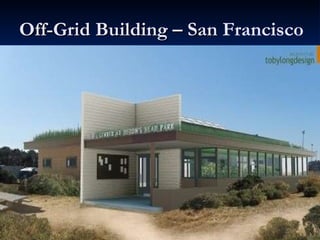
Off-Grid Building – San  Francisco
Voluntary Programs
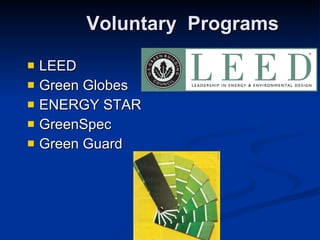
Voluntary  Programs LEED Green Globes ENERGY STAR GreenSpec Green Guard
LEED 2009
Categories Sustainable Sites Water Efficiency Energy and Atmosphere Materials and Resources Indoor Environmental Quality Innovation and Design Regional Priority


Online assessment tool for commercial structures  Benchmarks energy and environmental performance against best practices in energy, water, waste management, hazardous materials, and indoor environment ANSI/GBI 01-2010:  Green Building Assessment Protocol for Commercial Buildings
 
 
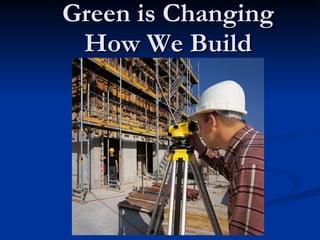
Green is Changing How We Build
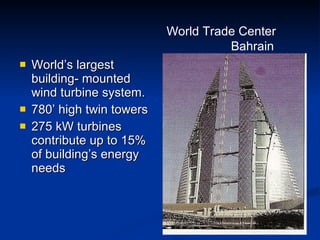
World’s largest building- mounted wind turbine system. 780’ high twin towers 275 kW turbines contribute up to 15% of building’s energy needs World Trade Center  Bahrain
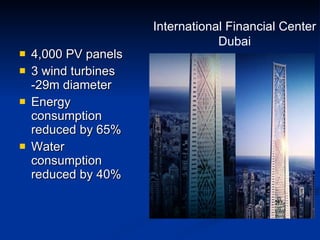
4,000 PV panels 3 wind turbines -29m diameter Energy consumption reduced by 65% Water consumption reduced by 40% International Financial Center Dubai
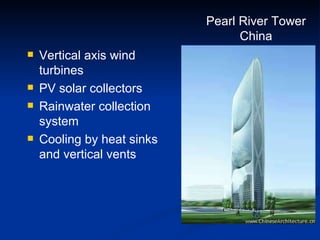
Pearl River Tower China Vertical axis wind turbines PV solar collectors Rainwater collection system Cooling by heat sinks and vertical vents
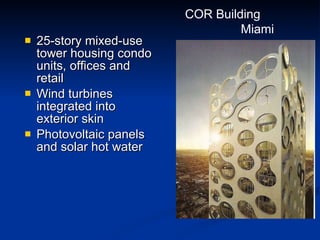
25-story mixed-use tower housing condo units, offices and retail Wind turbines integrated into exterior skin  Photovoltaic panels and solar hot water  COR Building  Miami
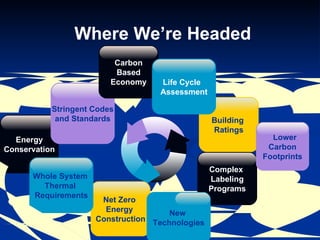
Where We’re Headed Complex  Labeling  Programs Building  Ratings Lower Carbon Footprints Energy Conservation Net Zero  Energy  Construction Whole System  Thermal  Requirements New  Technologies Stringent Codes  and Standards Carbon Based Economy Life Cycle  Assessment
The CSI  Darwin Awards


Questions ?

Key Drivers in Green Construction Market

  • 1.
    Key Drivers forthe Green Construction Industry Allentown CSI Expo April 21, 2010 Scott Kriner, CSI, AIA, LEED AP O+M President Green Metal Consulting, Inc.
  • 2.
    Converging Driving ForcesCultural Shift Insurance Religion Realtors Global Climate Change Politics Education Media Rating & Labeling Programs Lending Institutions Initiatives & Incentives Energy Regulations Legislation
  • 3.
  • 4.
    Building Themes ofthe Next Decade “ Green building and computer technology assistance (ex. BIM) are expected to re-form the industry in ways current practitioners are just beginning to imagine.” (prediction of Business Review’s economic forum 2007)
  • 5.
    What is GREENBuilding? The practice of increasing the efficiency of buildings‘ use of energy , water and materials
  • 6.
    Sustainable Building Practice“ Development that meets the needs of the present without compromising the ability of future generations to meet their own needs” – ASTM E2114
  • 7.
    You May AlreadyBe Building Green and Don’t Even Know It!
  • 8.
    This is NOT Sustainable Building !
  • 9.
    This is Sustainable Building
  • 10.
    Green Market bySector Source: McGraw Hill Construction - 2007 *
  • 11.
    Green Construction $13billion of green non-res construction put in place in 2006 $49 billion of green non-res construction put in place in 2008 $140 billion of green non-res construction expected by 2013 “ Green business has shifted from a movement to a market.” – Greener World Media FMI 2008 US Construction Overview, and BRG Group
  • 12.
  • 13.
    Benefits of GREENBuildings Reduce energy use 30-50% Reduce impact on solid waste stream Command higher rents Save employers $58 Billion of sick time Add $180 Billion in increased worker productivity
  • 14.
  • 15.
    The USA’s 2-5-25Conundrum 2% of the resources 5% of the population 25% of the energy
  • 16.
    Our Addiction toOil The level of oil imports will remain between 53% and 68% of our total oil usage through 2030 Source: Energy Information Administration (EIA)
  • 17.
    Electricity Generation Source:Energy Information Administration Coal Nuclear Natural Gas Hydro Oil Other
  • 18.
    By 2030, electricitydemands will be 45% greater than today Source: Nuclear Energy Institute
  • 19.
    Source: Nuclear EnergyInstitute With current fuel mix, US needs to construct… 50 nuclear plants (1000 MW) 260 coal-fired plants (600 MW) 280 natural gas-fired plants (400 MW) 90 renewable energy plants (100 MW)
  • 20.
    Renewable Energy? SolarWind Geothermal Tidal Biomass Hydro *
  • 21.
  • 22.
  • 23.
    Conservation and EfficiencyPeter Turnbull, PG&E “ The cheapest, most reliable source of new energy is saved energy.” Peter Turnbull, PGE
  • 24.
    Energy Hogs Buildings 39% Transport 33% Industry 28%
  • 25.
  • 26.
    Source: IISI WORLDIn next 50 years the world will erect as many buildings as we have built during the last 5000 years
  • 27.
    Population Growth 60%of the world population will live in cities by 2030 US
  • 28.
    Building Boom inU.S. Roughly 89 million new or replacement homes will be built in U.S. over next 30 years to keep up with population growth. By 2030 about half of the buildings in America will have been built after 2000
  • 29.
    Building Boom inUnited States By 2030 about half of the buildings in America will have been built after 2000 Roughly 89 million new or replacement homes will be built in U.S. over next 30 years to keep up with population growth.
  • 30.
  • 31.
    “ Best estimatethat temperatures will rise between 3.2 º to 7.8 º by 2100” “ Sea levels could rise 7 to 23” by end of century” “ 90% certainty that global climate change is caused by human activity”
  • 32.
  • 33.
    Is Climate ChangeOccurring ?
  • 34.
  • 35.
  • 36.
  • 37.
  • 38.
  • 39.
    Energy Efficiency andthe Environment
  • 40.
  • 41.
    Print media, Websites,Blogs, Hollywood, Television, Concerts
  • 42.
  • 43.
    Religious Support World’sFirst Carbon Neutral State … Planting trees to restore a 37 acre ancient forest in Hungary The Vatican
  • 44.
  • 45.
  • 46.
    Energy Codes Reduceenergy consumption Reduce utility expenses Reduce environmental emissions Improve thermal comfort Extend natural resources
  • 47.
  • 48.
    Stringency has increased23% DOE/IECC/ASHRAE Zero energy buildings
  • 49.
    State Building EnergyCodes www.bcap-energy.org
  • 50.
    New Standards since2007 GBI Green Globes Standard - Covering commercial (non-residential) buildings. ASTM Standards Principles of Sustainability Relative to Buildings NAHB Standard (ICC-700) Green Residential Building Standard ASHRAE Standard 189.1 Standard for the Design of High-Performance Green Buildings Except Low-Rise Residential Buildings. ISO 21930:2007 Sustainability in Building Construction – Environmental Declaration of Building Products
  • 51.
    ASTM Standards E2432 Guide for General Principles of Sustainability Relative to Buildings Identifies environmental, economic & social principles on equal footing E60 Sustainability E2114, Terminology for Sustainability Relative to the Performance of Buildings Balloting draft Specification for the Minimum Attributes of a building that Promotes Sustainability (WK11944)
  • 52.
    National Green BuildingStandard (ICC 700) Enhanced Green Home Building Guidelines Released January 2009
  • 53.
    Contents Site Designand Development Lot Design, Preparation and Development Energy Efficiency Water Efficiency Indoor Environmental Quality Operation, Maintenance and Building Owner Education
  • 54.
    ASHRAE Standard 189.1Modeled after LEED program, but written in code language Released February 2010
  • 55.
    Contents Site SustainabilityWater Use Efficiency Energy Efficiency Indoor Environmental Quality Impact on Atmosphere, Materials and Resources Construction and Plans for Operation
  • 56.
    CALGREEN Code -Effective Jan 1, 2011 First Mandatory Statewide Standards Code for Green Construction
  • 57.
    Mandatory 20% wateruse reductions Divert 50% of construction waste from landfills Mandatory inspections of energy systems Low pollutant emitting finish materials
  • 58.
    International Code CouncilASHRAE US Green Building Council Illuminating Eng. Society of N. America Int’l Green Construction Code
  • 59.
    “ model” codeapproach Minimum and advanced performance Prescriptive, performance and pre-engineered approaches Overlay to ICC codes Work in tandem with green rating programs
  • 60.
  • 61.
    Site Development andLand Use Material Resource Conservation & Efficiency Energy Conservation, Efficiency and Atmospheric Quality Water Resource Conservation and Efficiency Indoor Environmental Quality Building Operation Maintenance and Owner Education Existing Buildings Existing Building Site Development
  • 62.
    Schedule Sustainable BuildingTechnology Committee meetings to develop draft code language First Draft of IgCC (Version 1.0) Public Comment Deadline. Hearings to Review Comments Revised draft submitted for final action hearings (Version 2.0)* Summer 2009 – Spring 2010 MARCH 15, 2010 MAY 14, 2010 AUGUST 2010 NOVEMBER 2010 * V 2.0 stands until 2012 codes are updated

  • 63.
    Energy Labels forBuildings ?
  • 64.
  • 65.
  • 66.
    Proposal from architectMichelle Kaufman Designs
  • 67.
    EPBD Concerted Action ’ ’ ’ ’ ’ ’ ’ ’ ’’’’ ’ ’ ’ ’ ’ ’ ’ ’ ENERGY CERTIFICATES ’ ’’ ’ 15
  • 68.
  • 69.
  • 70.
  • 71.
    Green Building IncentivesState and local levels State level Local level
  • 72.
    Local Incentives Expeditedpermitting process Expedited plan reviews Tax refund/abatement/ credit Bond funds Loans Direct grants Utility rebates Energy-efficient rebates Density bonuses Reduced development fees Marketing materials LEED cert fees refund
  • 73.
  • 74.
  • 75.
  • 76.
  • 77.
    Federal Energy Independenceand Security Act of 2007 EPAct 2005 – extension Authorization of Zero- Energy Commercial Building Initiative Federal executive orders Pending Legislation
  • 78.
    EO 13101 directsFederal agencies to purchase products that are manufactured using recycled content materials EO13423 requires federal agencies to use sustainable building practices
  • 79.
    Comprehensive Procurement GuidelineIV for Procurement of Products Containing Recovered Materials EPA - April 30, 2004
  • 80.
    Legislative Climate ChangeSource: World Resources Institute *
  • 81.
  • 82.
    American Recovery &Reinvestment Act American Clean Energy & Security Act 21 st Century Green High-Performance Public School Facilities Act Expanding Building Efficiency Act Energy Efficiency Modernization Act Water Accountability Tax Efficiency Reinvestment Act Livable Communities Act Federal Personnel Training Act Clean Energy and American Jobs Act American Clean Energy and Leadership Act Energy Efficiency in Housing Act Livable Communities Act Expanding Building Efficiency Act School Building Fairness Act Clean Energy for Homes and Buildings Act Energy Efficiency Modernization Act Water Accountability Tax Efficiency Reinvestment Act Federal Agency Energy Efficiency Improvement Act Bills Introduced in the last year
  • 83.
    State and LocalLaws State legislative bills State executive orders State mandates requiring minimum level of LEED for public buildings City ordinances *
  • 84.
    Action in CaliforniaAssembly 25% reduction in GHG by 2020 focusing on building energy efficiency 20% increase in standards for non-res buildings by 2015.
  • 85.
  • 86.
    Architecture 2030 ChallengeEliminate fossil-fuel energy consumption from all new buildings by 2030
  • 87.
    Zero-Energy Commercial BuildingInitiative * Achieve marketable zero-energy buildings by 2030
  • 88.
    Off-Grid Building –San Francisco
  • 89.
  • 90.
    Voluntary ProgramsLEED Green Globes ENERGY STAR GreenSpec Green Guard
  • 91.
  • 92.
    Categories Sustainable SitesWater Efficiency Energy and Atmosphere Materials and Resources Indoor Environmental Quality Innovation and Design Regional Priority
  • 93.
  • 94.
  • 95.
  • 96.
    Online assessment toolfor commercial structures Benchmarks energy and environmental performance against best practices in energy, water, waste management, hazardous materials, and indoor environment ANSI/GBI 01-2010: Green Building Assessment Protocol for Commercial Buildings
  • 97.
  • 98.
  • 99.
    Green is ChangingHow We Build
  • 100.
    World’s largest building-mounted wind turbine system. 780’ high twin towers 275 kW turbines contribute up to 15% of building’s energy needs World Trade Center Bahrain
  • 101.
    4,000 PV panels3 wind turbines -29m diameter Energy consumption reduced by 65% Water consumption reduced by 40% International Financial Center Dubai
  • 102.
    Pearl River TowerChina Vertical axis wind turbines PV solar collectors Rainwater collection system Cooling by heat sinks and vertical vents
  • 103.
    25-story mixed-use towerhousing condo units, offices and retail Wind turbines integrated into exterior skin Photovoltaic panels and solar hot water COR Building Miami
  • 104.
    Where We’re HeadedComplex Labeling Programs Building Ratings Lower Carbon Footprints Energy Conservation Net Zero Energy Construction Whole System Thermal Requirements New Technologies Stringent Codes and Standards Carbon Based Economy Life Cycle Assessment
  • 105.
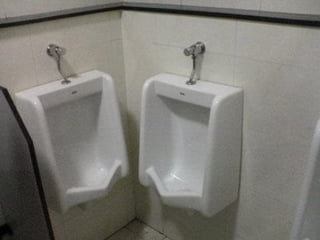
    The CSI Darwin Awards
  • 106.
  • 107.
  • 108.
  • 109.

Editor's Notes

  • #47 Adding energy codes to building codes was done to help reduce energy consumption in construction. As part of the sustainability movement, energy codes are working to lower emissions of greenhouse gases at the power plants, improve energy efficiency of buildings, and conserve natural resources.
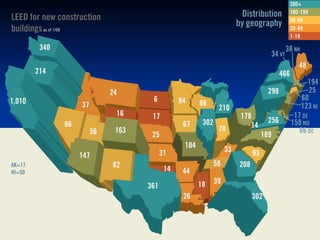
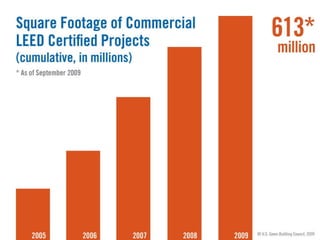
  • #94 There are LEED certified and registered projects in every state in the union – and California leads the way