Integrated Instruction Framework for Information Literacy

Pamela Kessinger, Portland Community College.

Email: pkessing@pcc.edu

Introduction
The Research Support Framework developed at Portland Community College, in Oregon, is an
integrated instructional framework which serves as a template for guiding students’
progression through several cognitive domains of information literacy. It is applicable to in-
class, outcomes-based assessment and programmatic evaluation. The Framework also builds
support for a collaborative effort between library faculty (librarians) and content faculty
(instructors) for students’ information literacy attainment.

“Could you just show my students where the library databases are, and how to use them?” an
instructor might typically ask. That tools-based approach offers little conceptual development
and only the most rudimentary transferrable skills. Instead, we offer this Framework, which
aligns with Barbara Fister’s suggestion that librarians teach the “rhetorical dimensions of
research,” and, that “searching, reading, and writing are nonconsecutive research activities. “

Structure of the Research Support Framework
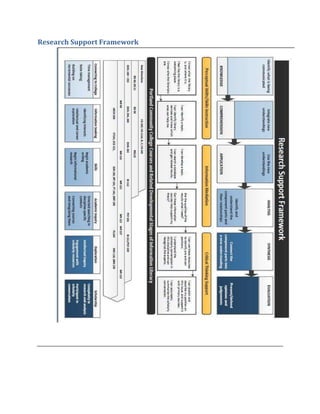
The six steps of the traditional “Bloom’s taxonomy of educational objectives” are listed across
the top of the Framework. An example is stated for each step from the taxonomy, such as
“Identify what is being communicated” for the foundational step of “knowledge.”

The six steps from the Taxonomy correlate roughly to the progression through three
instructional categories:

       Perceptual shifts and basic skills
       Information mediation
       Higher level critical thinking

Each instructional category has two stages, aligned with the cognitive domains at the bottom of
the framework. The resulting six instructional stages have examples from the students’ point of
view.

Sample courses are placed on a linear scale to illustrate their approximate alignment with the
developmental level of information literacy attainment, and the six cognitive domains, shown
at the bottom, from left to right:
1.   Connecting to college
   2.   Information seeking
   3.   Skills
   4.   Academic inquiry
   5.   Exploration
   6.   Scholarship

Since courses in different disciplines can have similar information literacy outcomes, the model
presented here is iterative, allowing students to practice through various learning experiences
in different contexts.

Information Literacy Instruction Dimension 1: Perceptual Shifts and Skills Instruction
One type of community college student is of course the post high school graduate, who
requires career guidance as they adjust to the college experience. But many others present
those factors unique to adult returning students, such as contending with undiagnosed (or
hidden) learning disabilities, aspects of post-traumatic stress disorders, economic hardship and
employment displacement. A new group of students are the dual-enrolled high school/college
student. Affective objectives are particularly important to this group: one instructor has noted
that a “friendly smile and open-ended support in helping students find what they are looking
for [is key]. I think that the smile and support is more powerful and important than most staff
know for students” (Lekas, 2013).

 Cognitive domain: Connecting to College
The library instruction activities for this beginning level cognitive domain within Perceptual
Shifts will include learning objectives similar to the course content, which at first glance may
seem unrelated to library research. But skills like note taking are foundational to academic
success. Acknowledging students’ accomplishments of sequenced tasks helps them build
incremental success. In addition, gaining a relationship with a librarian—a college staff member
beyond their course instructor—provides an additional connection to the college, and supports
the idea of the library as a place to belong.

The information literacy outcomes and library instruction learning objectives for a course at this
level would include verbs appropriate for the Knowledge stage of Bloom’s taxonomy, such as:
label; name; select; define; locate; listen.

When students physically experience the library as place and they orient to the services, they
accomplish a necessary step for developing understanding and decoding skills, especially for
those who have never experienced a library before. When librarians direct students to robust
collections on topics like managing test anxiety or career assessment, with the challenge to use
at least one item, they accomplish two goals. They initiate students into the frame of using
sources beyond what they are familiar with, or what they easily access within their personal
“filter bubble” as Eli Pariser has illustrated. They also extend and solidify the idea of librarians
as contacts for referral and support.

At this first stage of the Research Support Framework, we keep the objectives of the learning
experiences simple and accomplishable in a short time-frame in order for the library visit to be
a predictably positive experience. We also incorporate the social aspect of learning, using
group work and discussion, for active learning and frankly, fun.

Cognitive domain: Information seeking
The principles introduced in the next level up of critical thinking, the cognitive domain of
information seeking are applied again later for discerning the many types of sources which can
be framed by a computer screen. We start with the obvious indicators, like author and title,
and introduce the types of information “channels” from Katriina Bystrőm (pp.175-176).
Rudimentary understanding of the typical publication cycle is introduced here, for students to
recognize some of the indicators of reliability, and to stretch beyond sources which only amplify
their initial opinions.

Students at this level often prefer task-oriented assignments as opposed to extending their
critical thinking skills. Until they gain confidence, they can over-focus on the requirements of
an assignment and deliberately avoid imagination or creativity. Cox (2009) found that college
students assumed that knowledge was only what was graded in a course—not knowledge or
learning (p. 98). Some resistance to exercises in self-reflection or extending thought, then, is to
be somewhat expected.

Community college students typically start writing projects with a personal interest but struggle
to identify what it is “researchable” about it. Adult students often lack the background
knowledge needed for success in an academic setting, but they do possess background
knowledge, plus schema, from their life experience and personal interests. Richard Anderson
(1984) provides this classic example of schema: “The big number 37 smashed the ball over the
fence.” (p. 595). Like with an inside joke, a person without any knowledge what is being
referred to would have extreme difficulty correctly interpreting that sentence. A more apt
example for Americans could be from the incomprehensible vocabulary of the sport of cricket.
We might easily read each word, but not be able to apprehend the meaning.

Ruth Schoenbach et al. (2012) makes a persuasive case for training students to identify—to be
metacognitive about—their schema. She says it is a “concept that students should understand
and own. They can think of schema as a personal library of knowledge—based on a lifetime of
reading and experience—that they already have and can draw on, add to daily, and revise if
they need to as they learn more” (p. 234).
Topic development at the level of information seeking begins with students identifying their
schema and background knowledge and activating their problem solving strategies, in order to
make a commitment to a single topic area. Then, to structure a search, they must work to
define a conflict or issue within it. What would make their interest area reportable, worthy of
news, or worthy of study?

Information Literacy Instruction Dimension 2: Information Mediation
The second instructional dimension, information mediation, is for courses which have
prerequisites. We are now moving into the taxonomic stages of application and then, analysis.
Notice that the librarians have placed courses upon the Framework based not just on
sequenced course numbers, but by what is actually in the course outcomes. This placement is
also informed by the librarians’ experiences teaching students in library instruction sessions and
in assisting students through reference services.

Cognitive Domain: Information Skills
Clearly differentiating fact from opinion is the emphasis for the cognitive domain of information
skills. Composition at this level is typically patterned in the form of extended definition (for
example, compare/contrast; cause/effect; process analysis). For initially simple topics to move
to a question to explore, students will need to follow models for argumentation.

Students are expected to recognize the elements for citations and to incorporate sources
properly. Librarians should address the gaps in students’ experience and use examples of
bridging concepts for scaffolding as necessary. Because students at this level may still depend
on simple matching of search terms, it may be necessary to guide them to go beyond the
decoding mode of reading, to a deciphering mode, to think of related concepts.

Students are expected to give closer scrutiny to types of sources here, and to the difference
between popular and scholarly sources. The concept of peer review is introduced in a basic
way.

Identifying perspective and point of view should be clarified. The first can encompass the
second; that is, architects would research a topic like skateboarding in terms of building design
and aesthetics. But within that professional perspective, they may completely disagree on the
importance of certain design elements, or, on which of the approaches are the most useful.

Topic development for the instructional domain of skills takes into account that students will
now have some beginning discipline specific knowledge. Instructors have collaborated with
librarians to identify discipline specific approaches to information, or what they loosely term
“threshold concepts”. For Biology 112 for example, the IMRAD (Introduction, Methods, Results
and Discussion) structure of scientific journal articles must be understood before students can
grasp how scholars are “conversing” with previous researchers. Placed in the middle of the
Framework, Biology 112 would have library instruction objectives with Application verbs like
differentiate, interpret, and demonstrate.

Cognitive Domain: Academic inquiry
A more complex view of information generation is introduced at the academic inquiry cognitive
domain, tying more into discipline specific modes of writing and the differences in the
information cycle, depending on the discipline. Instructors focus on discipline specific contexts,
but are often directive about topic selection and search terms. Delving into why an information
source was created and the possibility of misconstrued or deliberately misleading content is
now emphasized. The consequences of the 24-hour news cycle, crowd-sourced content and
newer forms of authority are key concepts to present.

Librarians must take care, however, to attenuate students’ attempts at “early closure—settling
quickly on a thesis statement rather than dwelling with a problematic and significant thesis
question” as Bean and Iyer note. A librarian’s teaching role would incorporate demonstrating
database searching. Yet, in this context, the emphasis is not on differences in interfaces or
presenting a flawless search, but on “modeling a trial and error research process, trying
different combinations of keyword or subject searches” (Bean and Iyer 2009, p.33).

Information Literacy Instruction Dimension 3: Critical Thinking Support
Few courses are placed into the third Instructional Dimension, of Critical Thinking Support.
Those that are mention using “primary documents,” in their course outcomes, but little actual
primary research is required. More frequently the concept of entering into the scholarly
conversation is what students are to learn about; at this level they are to acquire and use
discipline specific knowledge and practices.

Cognitive Domain: Exploration
Students at the level of the Exploration cognitive domain use not only the traditional indicators
of reliability, but also author affiliation, citation tracing, and discipline specific terminology. A
full understanding of the peer review process is expected here, not only as a qualifier for
reliability, but also as a measure of relevance.

Cognitive Domain: Scholarship
Courses with information literacy outcomes at the level of scholarship (within the context of the
second year of community college) are typically for transfer students seeking particular majors
later in the baccalaureate, or, for one-year certificate or two-year Associate degrees in
Career/Technical programs. Complexity in both research and in analysis of sources is
contextual, tied to their chosen major or career path. There is a common denominator for both
academic and career track students here, however: the need to select high quality sources and
to identify specific reasons for their reliability and usefulness.
Professional competence for students in programs as varied as Veterinary Technology, or
Microelectronics, requires the ability to assess the validity as well as the usefulness of
information. Graduates in these programs are expected to continuously update their
awareness of new trends to embrace or avoid.

Topic development for this final instructional dimension requires using discipline specific modes
of argument. Students will need to recognize the publication cycle for their field, and apply that
to source selection. They will need to know what the various information outlets are, and their
relative value in terms of usefulness as compared to authority or reliability.

Conclusion
The Research Support Framework is not only about an upward progression for academic
performance. It is also a multi-dimensional view of information literacy outcomes across the
curriculum. To clarify the level of information literacy critical thinking that is appropriate for a
particular course, a Course Specific Research Support form is set up for those courses which
have information literacy related outcomes. These forms include instructional objectives,
bridging competencies and threshold concepts, and finally, recommended library tools and
guides. Careful attention is given to vocabulary on the forms to replicate the focus and
terminology particular to each discipline. Librarians adopt the terms that the instructors in
those disciplines typically use, not the other way around.

We customize our library instruction learning outcomes and invite the instructors to participate
with us. We see our teaching and outreach as providing students with the parts of an
achievable whole. Our major interest has been to take hold of existing ideas and tools and to
combine them into a useable and revelatory framework. This framework is set up as a guide to
instructors seeking not only to identify useful assignments, and sources, but also to raise
awareness of the iterative nature of information literacy outcomes.
References

Anderson, R. C. 1984. “Role of the reader’s schema in comprehension, learning, and
memory.” In: Ruddell, R.B. and Norman, J. U. (eds.). Theoretical models and processes of
reading. 2004. 5th ed. Newark DE: International Reading Association. pp. 594-619.

Bean, J.C. and Iyer, N. 2009. “’I couldn’t find an article that answered my question’: teaching
the construction of meaning in undergraduate literacy research.” In: Johnson, K.A. and Harris,
S.R. (eds.) Teaching literary research: challenges in a changing environment. Chicago:
Association of College and Research Libraries. pp. 22-40.

Bystrőm, K. 2005. “Information activities in work tasks.” In: Fisher, K., Erdelez, S. and
McKechnie, L.E.F. (eds.). Theories of information behavior. Medford. NJ: Information Today,
Inc. pp. 175-178.

Cox, R.D. (2009). The College fear factor: how students and professors misunderstand one
another. Cambridge: Harvard University Press.

Fister, B. 1993. “Teaching the rhetorical dimensions of research.” Research Strategies
[Online] 31 (4). Available at: http://homepages.gac.edu/~fister/rs.html [Accessed: 5 March
2013].

Hinton, D. [2013?]. Measurable and observable verbs. University of Birmingham. [Online].
Available at: http://www.education2.bham.ac.uk/elearning/currdes2/mlos/measurable.php
[Accessed 5 March 2013].

Lekas, J. 2013. High school students experience the library, e-mail to Kessinger, P.
(pkessing@pcc.edu) 29 January 2013.

Meyer, H.F. and Land, R. 2006. “Threshold concepts and troublesome knowledge: an
introduction.” In: Meyer, H.F. and Land, R. Overcoming barriers to student understanding:
threshold concepts and troublesome knowledge. London: Routledge. pp.3-18.

Pariser, E. 2011. The Filter bubble: what the Internet is hiding from you. New York: Penguin
Press.

Schoenbach, R., Greenleaf, C. and Lynn Murphy, L. 2012. Reading for understanding: how
Reading Apprenticeship improves disciplinary learning in secondary and college classrooms.
Hoboken: John Wiley & Sons.

Upcraft, M.L., Gardner, J.N. and Barefoot, B.O. 2005. “Introduction: the first year of college
revisited.” Challenging and supporting the first-year student: a handbook for improving the first
year of college. San Francisco: Jossey-Bass. pp. 1-14.
Research Support Framework
Course Specific Research Support form


Microbiology
Use this tool to see how librarians can help support information and research integration in
your class. This guide was prepared by the librarians for Microbiology (BI 234)

Research support framework
The following shows where Microbiology fits into the Research Support
Framework [PDF] developed by the librarians.

Information literacy developmental stage:

Critical Thinking Support
   1. I can explain and describe my position on this issue, and support it with primary sources

   2. I can accurately summarize the scholarly conversation

Cognitive domains and information literacy outcomes:

Scholarship
       Complexity in research and analysis

       Participant in scholarly conversation

Library support of CCOGs
These are the course outcomes and other indicators which require library support.

CCOG for BI 234

Intended course outcomes related to information literacy:
       B. Use an understanding of the impact of microbes on human cultures around the world
       both historically and in the present day to evaluate current social health issues.

       D. Use an understanding of research and laboratory experiences to organize, evaluate,
       and present data and information to illustrate and articulate basic microbiology
       concepts.

Outcome assessment strategies relating to information literacy:
       Research paper(s) on microbial topics, library skills and presentations
Course content relating to information literacy:
       Library research skills
       Writing scientific research paper

Course integrated research support
These are the ways that the librarians can support information literacy achievement for the
students in this course.

Corresponding information literacy outcomes:
   1. Identify and select a research question related to microbiology and human culture

   2. Locate and use sources from primary scientific literature to support thesis

   3. Identify reliable quantitative data sources for current social health issues

Information literacy instructional objectives:
   1. Identify and select a research question related to microbiology and human culture

   2. Locate and use sources from primary scientific literature to support thesis

   3. Identify reliable quantitative data sources for current social health issues

Bridging competencies:
       Understand utility of books for historical topics, using their indexes and table of
       contents to read selectively

       Navigate to library databases, to select those that are appropriate for selected topic(s)

       Identify "authority" of authors, recognizing significance of author affiliation statements
       or organizations

       Differentiate between magazine and journal articles

Recommended tools and guides:
       Tutorials and Handouts for Research Tools

       Biology Research Guide

Library Assignment Ideas:
       Using Google Scholar, search for a journal article about a Microbiology topic, then link
       out to the "Cited By" authors

Kessinger - Integrated instruction framework for information literacy (accompanying document)

  • 1.
    Integrated Instruction Frameworkfor Information Literacy Pamela Kessinger, Portland Community College. Email: pkessing@pcc.edu Introduction The Research Support Framework developed at Portland Community College, in Oregon, is an integrated instructional framework which serves as a template for guiding students’ progression through several cognitive domains of information literacy. It is applicable to in- class, outcomes-based assessment and programmatic evaluation. The Framework also builds support for a collaborative effort between library faculty (librarians) and content faculty (instructors) for students’ information literacy attainment. “Could you just show my students where the library databases are, and how to use them?” an instructor might typically ask. That tools-based approach offers little conceptual development and only the most rudimentary transferrable skills. Instead, we offer this Framework, which aligns with Barbara Fister’s suggestion that librarians teach the “rhetorical dimensions of research,” and, that “searching, reading, and writing are nonconsecutive research activities. “ Structure of the Research Support Framework The six steps of the traditional “Bloom’s taxonomy of educational objectives” are listed across the top of the Framework. An example is stated for each step from the taxonomy, such as “Identify what is being communicated” for the foundational step of “knowledge.” The six steps from the Taxonomy correlate roughly to the progression through three instructional categories: Perceptual shifts and basic skills Information mediation Higher level critical thinking Each instructional category has two stages, aligned with the cognitive domains at the bottom of the framework. The resulting six instructional stages have examples from the students’ point of view. Sample courses are placed on a linear scale to illustrate their approximate alignment with the developmental level of information literacy attainment, and the six cognitive domains, shown at the bottom, from left to right:
  • 2.
    1. Connecting to college 2. Information seeking 3. Skills 4. Academic inquiry 5. Exploration 6. Scholarship Since courses in different disciplines can have similar information literacy outcomes, the model presented here is iterative, allowing students to practice through various learning experiences in different contexts. Information Literacy Instruction Dimension 1: Perceptual Shifts and Skills Instruction One type of community college student is of course the post high school graduate, who requires career guidance as they adjust to the college experience. But many others present those factors unique to adult returning students, such as contending with undiagnosed (or hidden) learning disabilities, aspects of post-traumatic stress disorders, economic hardship and employment displacement. A new group of students are the dual-enrolled high school/college student. Affective objectives are particularly important to this group: one instructor has noted that a “friendly smile and open-ended support in helping students find what they are looking for [is key]. I think that the smile and support is more powerful and important than most staff know for students” (Lekas, 2013). Cognitive domain: Connecting to College The library instruction activities for this beginning level cognitive domain within Perceptual Shifts will include learning objectives similar to the course content, which at first glance may seem unrelated to library research. But skills like note taking are foundational to academic success. Acknowledging students’ accomplishments of sequenced tasks helps them build incremental success. In addition, gaining a relationship with a librarian—a college staff member beyond their course instructor—provides an additional connection to the college, and supports the idea of the library as a place to belong. The information literacy outcomes and library instruction learning objectives for a course at this level would include verbs appropriate for the Knowledge stage of Bloom’s taxonomy, such as: label; name; select; define; locate; listen. When students physically experience the library as place and they orient to the services, they accomplish a necessary step for developing understanding and decoding skills, especially for those who have never experienced a library before. When librarians direct students to robust collections on topics like managing test anxiety or career assessment, with the challenge to use at least one item, they accomplish two goals. They initiate students into the frame of using
  • 3.
    sources beyond whatthey are familiar with, or what they easily access within their personal “filter bubble” as Eli Pariser has illustrated. They also extend and solidify the idea of librarians as contacts for referral and support. At this first stage of the Research Support Framework, we keep the objectives of the learning experiences simple and accomplishable in a short time-frame in order for the library visit to be a predictably positive experience. We also incorporate the social aspect of learning, using group work and discussion, for active learning and frankly, fun. Cognitive domain: Information seeking The principles introduced in the next level up of critical thinking, the cognitive domain of information seeking are applied again later for discerning the many types of sources which can be framed by a computer screen. We start with the obvious indicators, like author and title, and introduce the types of information “channels” from Katriina Bystrőm (pp.175-176). Rudimentary understanding of the typical publication cycle is introduced here, for students to recognize some of the indicators of reliability, and to stretch beyond sources which only amplify their initial opinions. Students at this level often prefer task-oriented assignments as opposed to extending their critical thinking skills. Until they gain confidence, they can over-focus on the requirements of an assignment and deliberately avoid imagination or creativity. Cox (2009) found that college students assumed that knowledge was only what was graded in a course—not knowledge or learning (p. 98). Some resistance to exercises in self-reflection or extending thought, then, is to be somewhat expected. Community college students typically start writing projects with a personal interest but struggle to identify what it is “researchable” about it. Adult students often lack the background knowledge needed for success in an academic setting, but they do possess background knowledge, plus schema, from their life experience and personal interests. Richard Anderson (1984) provides this classic example of schema: “The big number 37 smashed the ball over the fence.” (p. 595). Like with an inside joke, a person without any knowledge what is being referred to would have extreme difficulty correctly interpreting that sentence. A more apt example for Americans could be from the incomprehensible vocabulary of the sport of cricket. We might easily read each word, but not be able to apprehend the meaning. Ruth Schoenbach et al. (2012) makes a persuasive case for training students to identify—to be metacognitive about—their schema. She says it is a “concept that students should understand and own. They can think of schema as a personal library of knowledge—based on a lifetime of reading and experience—that they already have and can draw on, add to daily, and revise if they need to as they learn more” (p. 234).
  • 4.
    Topic development atthe level of information seeking begins with students identifying their schema and background knowledge and activating their problem solving strategies, in order to make a commitment to a single topic area. Then, to structure a search, they must work to define a conflict or issue within it. What would make their interest area reportable, worthy of news, or worthy of study? Information Literacy Instruction Dimension 2: Information Mediation The second instructional dimension, information mediation, is for courses which have prerequisites. We are now moving into the taxonomic stages of application and then, analysis. Notice that the librarians have placed courses upon the Framework based not just on sequenced course numbers, but by what is actually in the course outcomes. This placement is also informed by the librarians’ experiences teaching students in library instruction sessions and in assisting students through reference services. Cognitive Domain: Information Skills Clearly differentiating fact from opinion is the emphasis for the cognitive domain of information skills. Composition at this level is typically patterned in the form of extended definition (for example, compare/contrast; cause/effect; process analysis). For initially simple topics to move to a question to explore, students will need to follow models for argumentation. Students are expected to recognize the elements for citations and to incorporate sources properly. Librarians should address the gaps in students’ experience and use examples of bridging concepts for scaffolding as necessary. Because students at this level may still depend on simple matching of search terms, it may be necessary to guide them to go beyond the decoding mode of reading, to a deciphering mode, to think of related concepts. Students are expected to give closer scrutiny to types of sources here, and to the difference between popular and scholarly sources. The concept of peer review is introduced in a basic way. Identifying perspective and point of view should be clarified. The first can encompass the second; that is, architects would research a topic like skateboarding in terms of building design and aesthetics. But within that professional perspective, they may completely disagree on the importance of certain design elements, or, on which of the approaches are the most useful. Topic development for the instructional domain of skills takes into account that students will now have some beginning discipline specific knowledge. Instructors have collaborated with librarians to identify discipline specific approaches to information, or what they loosely term “threshold concepts”. For Biology 112 for example, the IMRAD (Introduction, Methods, Results and Discussion) structure of scientific journal articles must be understood before students can grasp how scholars are “conversing” with previous researchers. Placed in the middle of the
  • 5.
    Framework, Biology 112would have library instruction objectives with Application verbs like differentiate, interpret, and demonstrate. Cognitive Domain: Academic inquiry A more complex view of information generation is introduced at the academic inquiry cognitive domain, tying more into discipline specific modes of writing and the differences in the information cycle, depending on the discipline. Instructors focus on discipline specific contexts, but are often directive about topic selection and search terms. Delving into why an information source was created and the possibility of misconstrued or deliberately misleading content is now emphasized. The consequences of the 24-hour news cycle, crowd-sourced content and newer forms of authority are key concepts to present. Librarians must take care, however, to attenuate students’ attempts at “early closure—settling quickly on a thesis statement rather than dwelling with a problematic and significant thesis question” as Bean and Iyer note. A librarian’s teaching role would incorporate demonstrating database searching. Yet, in this context, the emphasis is not on differences in interfaces or presenting a flawless search, but on “modeling a trial and error research process, trying different combinations of keyword or subject searches” (Bean and Iyer 2009, p.33). Information Literacy Instruction Dimension 3: Critical Thinking Support Few courses are placed into the third Instructional Dimension, of Critical Thinking Support. Those that are mention using “primary documents,” in their course outcomes, but little actual primary research is required. More frequently the concept of entering into the scholarly conversation is what students are to learn about; at this level they are to acquire and use discipline specific knowledge and practices. Cognitive Domain: Exploration Students at the level of the Exploration cognitive domain use not only the traditional indicators of reliability, but also author affiliation, citation tracing, and discipline specific terminology. A full understanding of the peer review process is expected here, not only as a qualifier for reliability, but also as a measure of relevance. Cognitive Domain: Scholarship Courses with information literacy outcomes at the level of scholarship (within the context of the second year of community college) are typically for transfer students seeking particular majors later in the baccalaureate, or, for one-year certificate or two-year Associate degrees in Career/Technical programs. Complexity in both research and in analysis of sources is contextual, tied to their chosen major or career path. There is a common denominator for both academic and career track students here, however: the need to select high quality sources and to identify specific reasons for their reliability and usefulness.
  • 6.
    Professional competence forstudents in programs as varied as Veterinary Technology, or Microelectronics, requires the ability to assess the validity as well as the usefulness of information. Graduates in these programs are expected to continuously update their awareness of new trends to embrace or avoid. Topic development for this final instructional dimension requires using discipline specific modes of argument. Students will need to recognize the publication cycle for their field, and apply that to source selection. They will need to know what the various information outlets are, and their relative value in terms of usefulness as compared to authority or reliability. Conclusion The Research Support Framework is not only about an upward progression for academic performance. It is also a multi-dimensional view of information literacy outcomes across the curriculum. To clarify the level of information literacy critical thinking that is appropriate for a particular course, a Course Specific Research Support form is set up for those courses which have information literacy related outcomes. These forms include instructional objectives, bridging competencies and threshold concepts, and finally, recommended library tools and guides. Careful attention is given to vocabulary on the forms to replicate the focus and terminology particular to each discipline. Librarians adopt the terms that the instructors in those disciplines typically use, not the other way around. We customize our library instruction learning outcomes and invite the instructors to participate with us. We see our teaching and outreach as providing students with the parts of an achievable whole. Our major interest has been to take hold of existing ideas and tools and to combine them into a useable and revelatory framework. This framework is set up as a guide to instructors seeking not only to identify useful assignments, and sources, but also to raise awareness of the iterative nature of information literacy outcomes.
  • 7.
    References Anderson, R. C.1984. “Role of the reader’s schema in comprehension, learning, and memory.” In: Ruddell, R.B. and Norman, J. U. (eds.). Theoretical models and processes of reading. 2004. 5th ed. Newark DE: International Reading Association. pp. 594-619. Bean, J.C. and Iyer, N. 2009. “’I couldn’t find an article that answered my question’: teaching the construction of meaning in undergraduate literacy research.” In: Johnson, K.A. and Harris, S.R. (eds.) Teaching literary research: challenges in a changing environment. Chicago: Association of College and Research Libraries. pp. 22-40. Bystrőm, K. 2005. “Information activities in work tasks.” In: Fisher, K., Erdelez, S. and McKechnie, L.E.F. (eds.). Theories of information behavior. Medford. NJ: Information Today, Inc. pp. 175-178. Cox, R.D. (2009). The College fear factor: how students and professors misunderstand one another. Cambridge: Harvard University Press. Fister, B. 1993. “Teaching the rhetorical dimensions of research.” Research Strategies [Online] 31 (4). Available at: http://homepages.gac.edu/~fister/rs.html [Accessed: 5 March 2013]. Hinton, D. [2013?]. Measurable and observable verbs. University of Birmingham. [Online]. Available at: http://www.education2.bham.ac.uk/elearning/currdes2/mlos/measurable.php [Accessed 5 March 2013]. Lekas, J. 2013. High school students experience the library, e-mail to Kessinger, P. (pkessing@pcc.edu) 29 January 2013. Meyer, H.F. and Land, R. 2006. “Threshold concepts and troublesome knowledge: an introduction.” In: Meyer, H.F. and Land, R. Overcoming barriers to student understanding: threshold concepts and troublesome knowledge. London: Routledge. pp.3-18. Pariser, E. 2011. The Filter bubble: what the Internet is hiding from you. New York: Penguin Press. Schoenbach, R., Greenleaf, C. and Lynn Murphy, L. 2012. Reading for understanding: how Reading Apprenticeship improves disciplinary learning in secondary and college classrooms. Hoboken: John Wiley & Sons. Upcraft, M.L., Gardner, J.N. and Barefoot, B.O. 2005. “Introduction: the first year of college revisited.” Challenging and supporting the first-year student: a handbook for improving the first year of college. San Francisco: Jossey-Bass. pp. 1-14.
  • 8.
  • 9.
    Course Specific ResearchSupport form Microbiology Use this tool to see how librarians can help support information and research integration in your class. This guide was prepared by the librarians for Microbiology (BI 234) Research support framework The following shows where Microbiology fits into the Research Support Framework [PDF] developed by the librarians. Information literacy developmental stage: Critical Thinking Support 1. I can explain and describe my position on this issue, and support it with primary sources 2. I can accurately summarize the scholarly conversation Cognitive domains and information literacy outcomes: Scholarship Complexity in research and analysis Participant in scholarly conversation Library support of CCOGs These are the course outcomes and other indicators which require library support. CCOG for BI 234 Intended course outcomes related to information literacy: B. Use an understanding of the impact of microbes on human cultures around the world both historically and in the present day to evaluate current social health issues. D. Use an understanding of research and laboratory experiences to organize, evaluate, and present data and information to illustrate and articulate basic microbiology concepts. Outcome assessment strategies relating to information literacy: Research paper(s) on microbial topics, library skills and presentations
  • 10.
    Course content relatingto information literacy: Library research skills Writing scientific research paper Course integrated research support These are the ways that the librarians can support information literacy achievement for the students in this course. Corresponding information literacy outcomes: 1. Identify and select a research question related to microbiology and human culture 2. Locate and use sources from primary scientific literature to support thesis 3. Identify reliable quantitative data sources for current social health issues Information literacy instructional objectives: 1. Identify and select a research question related to microbiology and human culture 2. Locate and use sources from primary scientific literature to support thesis 3. Identify reliable quantitative data sources for current social health issues Bridging competencies: Understand utility of books for historical topics, using their indexes and table of contents to read selectively Navigate to library databases, to select those that are appropriate for selected topic(s) Identify "authority" of authors, recognizing significance of author affiliation statements or organizations Differentiate between magazine and journal articles Recommended tools and guides: Tutorials and Handouts for Research Tools Biology Research Guide Library Assignment Ideas: Using Google Scholar, search for a journal article about a Microbiology topic, then link out to the "Cited By" authors