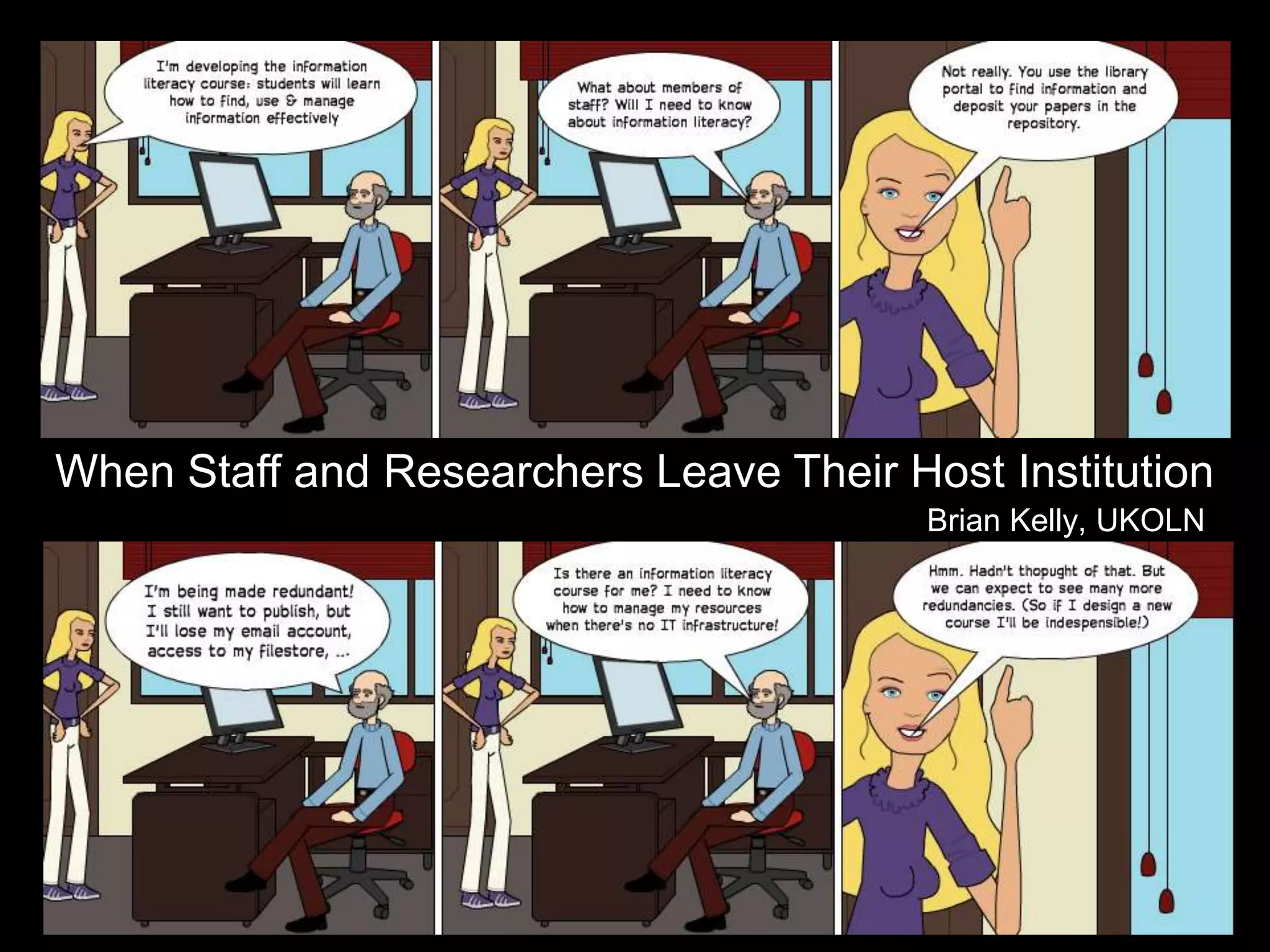
When Staff and Researchers
    Leave Their Host Institution


    When Staff and Researchers Leave Their Host Institution
                                             Brian Kelly, UKOLN


1
Twitter:                   http://www.ukoln.ac.uk/web-focus/events/conferences/lilac-2013/
#lilac2013

                                                  LILAC2013:
                    When Staff and Researchers
                    Leave Their Host Institution
             Brian Kelly                                 Acceptable Use Policy
             UKOLN                                       Recording this talk, taking photos,
             University of Bath                          having discussions using Twitter,
             BATH, UK                                    etc. is encouraged - but try to keep
                                                         distractions to others minimised.
             Email:
             b.kelly@ukoln.ac.uk
             Blog:
             http://ukwebfocus.wordpress.com/
             Twitter: @briankelly

             UKOLN is supported by:
                                                                           This work is licensed under a
             A centre of expertise in digital information management       Creativewww.ukoln.ac.uk 2.0
                                                                                     Commons Attribution
                                                                           licence (but note caveat)
Information Literacy


    • Defined as “the ability to find, use, evaluate
      and communicate information”

    • Felt to be “an essential skill in this digital age
      and era of life-long learning”
                       LILAC Conference home page


3
About This Talk
    What happens when:
      • “The axeman cometh” and staff are made
        redundant or take early retirement?
      • They wish to continue to exploit their professional
        interests as:
            A consultant
            An itinerant researcher
            A means of developing their CV


     Who has responsibilities for ensuring staff and
     researchers are able to respond appropriately
     to such „life events‟?

4
Assumptions
    The University service environment may
    assume:
      • You can trust the institution
      • We will provide the appropriate IT infrastructure
      • We are here to help you
    But:
      • When you leave we don‟t care (unless you donate
        money!)
      • Our auditors tell us we must delete accounts when
        people leave
      • We run courses for new staff & students (our
        assets) but not when they are about to leave (our
        liabilities)
5
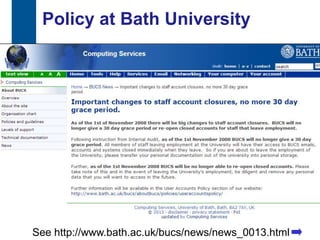
Policy at Bath University
      When staff leave


6   See http://www.bath.ac.uk/bucs/news/news_0013.html
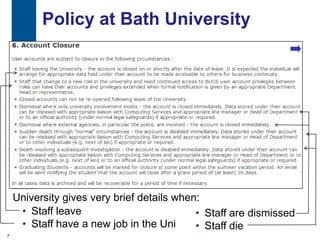
Policy at Bath University
          Detailed policies


    University gives very brief details when:
     • Staff leave                          • Staff are dismissed
     • Staff have a new job in the Uni      • Staff die
7
Revisiting Information Literacy
    Information literacy is defined as
       • “the ability to find, use, evaluate and
          communicate information”
    And is regarded as
       • “an essential skill in this digital age and era of
          life-long learning”
    Therefore let‟s explore ways of:
       • Supporting staff who wish to continue use and
         communicate information after they leave the
         host institution
       • Ensure staff have the life-long skills to use,
         evaluate and communicate information beyond
         their host institution‟s IT environment
8
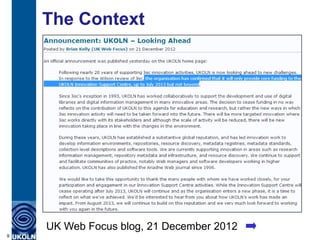
The Context
    Cessation of core funding for UKOLN, CETIS and
    OSS Watch.


    UK Web Focus blog, 21 December 2012
9
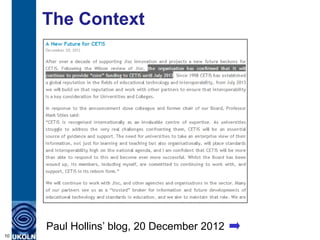
The Context
     Cessation of core funding for UKOLN,
     CETIS and OSS Watch.


     Paul Hollins‟ blog, 20 December 2012
10
The Context
     Cessation of core funding for UKOLN,
     CETIS and OSS Watch.


                                             We are seeing
                                             staff at well-
                                             established
                                             JISC-funded
                                             organisations
                                             having to
                                             prepare for a
                                             “new future”

11   JISC OSS Watch blog, 15 February 2013
Personal Motivations
     My interests are to ensure that:
       • My professional „brand‟ persists when I leave my
         host institution
       • My research publications continue to be an asset
         after I leave my host institution
       • My authorship of papers is correctly
       • I can continue to engage with my professional
         communities after I leave my host institution
       • I can continue to access and manage relevant
         services after I leave my host institution
       • I do not undermine relationships with my current
         host institution after I leave

12
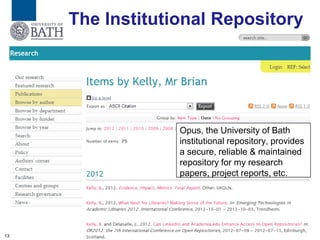
The Institutional Repository


                  Opus, the University of Bath
                  institutional repository, provides
                  a secure, reliable & maintained
                  repository for my research
                  papers, project reports, etc.


13
Persistency of Records
                    Policy seeks to ensure
                    long-term persistency of
                    content


                              When people
                              leave will they
                              still have their
                              contributions
                              listed?


14
Persistency of Records
     Informal feedback:
         • "Records disappear when someone leaves because
            that's entirely appropriate."
         • "Staff leaving the university have a different
            relationship to the organisation. By rights we should
            shut off ALL accounts the day the relationship with
            the organisation ends."
     Institutional context:
         “this is obviously down to institutional management of
         people records”
     Where does your policy fit in the spectrum?
         • We‟re focussing on the REF and our CRIS
             (Current Research Information System)
15       • We are loyal to former employees
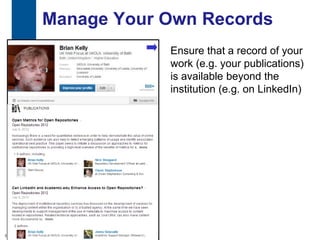
Manage Your Own Records
                 Ensure that a record of your
                 work (e.g. your publications)
                 is available beyond the
                 institution (e.g. on LinkedIn)


16
Manage Your Own Data
                  Ensure that your (open
                  access) publications are
                  hosted in an environment
                  you can maintain when you
                  leave the institution.
                  For example:
                     • ResearchGate


                  Papers hosted initially in
                  local open access repository
17
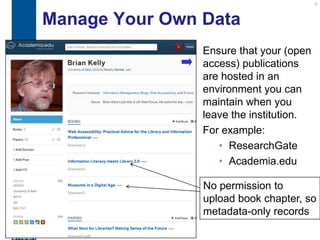
Manage Your Own Data
                     Ensure that your (open
                     access) publications
                     are hosted in an
                     environment you can
                     maintain when you
                     leave the institution.
                     For example:
                        • ResearchGate
                        • Academia.edu

                     No permission to
                     upload book chapter, so
                     metadata-only records

18
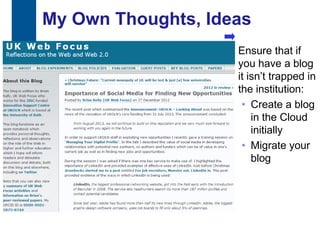
My Own Thoughts, Ideas
                         Ensure that if
                         you have a blog
                         it isn‟t trapped in
                         the institution:
                          • Create a blog
                             in the Cloud
                             initially
                          • Migrate your
                             blog


19
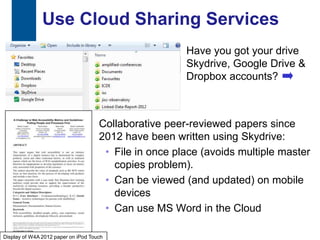
Use Cloud Sharing Services
                                                       Have you got your drive
                                                       Skydrive, Google Drive &
                                                       Dropbox accounts?


                                     Collaborative peer-reviewed papers since
                                     2012 have been written using Skydrive:
                                      • File in once place (avoids multiple master
                                        copies problem).
                                      • Can be viewed (and updated) on mobile
                                        devices
                                      • Can use MS Word in the Cloud

20
Display of W4A 2012 paper on iPod Touch
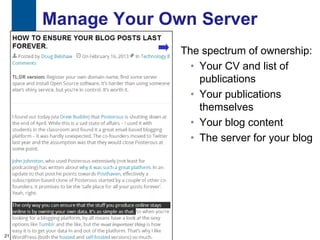
Manage Your Own Server
                   The spectrum of ownership:
                     • Your CV and list of
                       publications
                     • Your publications
                       themselves
                     • Your blog content
                     • The server for your blog


21
Netskills Training
                          Netskills course


22
View of a retired academic
     “Last night, I wrote reference for an ex-colleague,
     and noticed that the form expected me to belong to
     an institution. I guess that identity formation is
     ongoing work. Am I retired just because I have a
     pension? Retired is a deadly label I think.”
     Recently retired academic from a northern university


23
Your Digital Identity
     What is your digital identity?
     What makes you you online?
       • Your ideas (e.g. express on your blog)?
       • Your email engagement?
       • Your community engagement?
       • Your community?
       • Your resources?
       • Your affiliation with your institution (e.g. (1) you
         are a „corporate‟ person; (2) “blue till I die”; …)?
       • Your work colleagues
       • …?

24
ORCID
                                     Take control of your
                                     research identity!
                                     ORCID:
                                      • Open Researcher and
                                        Contributor ID
                                      • Non-proprietary
                                        alphanumeric code to
                                        uniquely identify
                                        scientific / academic
                                        authors
                                      • Managed by ORCID
                                        Inc. an open &
                                        independent registry
     My ORCID: 0000-0001-5875-8744
25
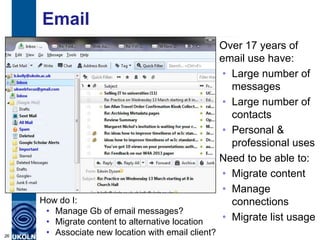
Email
                                                    Over 17 years of
                                                    email use have:
                                                    • Large number of
                                                      messages
                                                    • Large number of
                                                      contacts
                                                    • Personal &
                                                      professional uses
                                                    Need to be able to:
                                                    • Migrate content
                                                    • Manage
     How do I:                                        connections
      • Manage Gb of email messages?
      • Migrate content to alternative location     • Migrate list usage
26    • Associate new location with email client?
Email As Authentication Tool
                                            Change your email address to
                                            ensure you aren‟t locked out
                                            of Cloud services!


                                                    Claim your papers in
                                                    Google Scholar while your
                                                    institutional email is valid –
                                                    otherwise you might not
 Without access to valid email address you won‟t be be able to claim them!
 able to use & manage your content (info literacy!)
27
Links with the Institution


     “You’ve rejected me /
     Our relationship was fated to finish.
     But I still care about you”


28
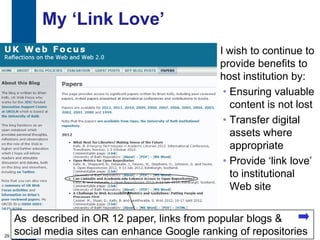
My „Link Love‟
                                               I wish to continue to
                                               provide benefits to
                                               host institution by:
                                                • Ensuring valuable
                                                  content is not lost
                                                • Transfer digital
                                                  assets where
                                                  appropriate
                                                • Provide „link love‟
                                                  to institutional
                                                  Web site


     As described in OR 12 paper, links from popular blogs &
29
     social media sites can enhance Google ranking of repositories
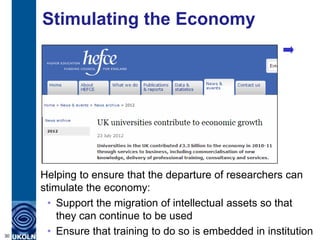
Stimulating the Economy


     Helping to ensure that the departure of researchers can
     stimulate the economy:
      • Support the migration of intellectual assets so that
         they can continue to be used
30
      • Ensure that training to do so is embedded in institution
“After Bath”


                    Advice for
                    graduates
                    provided by
                    Careers
31                  Service
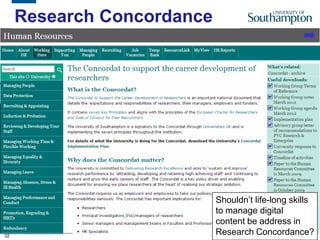
Research Concordance


                            Shouldn‟t life-long skills
                            to manage digital
                            content be address in
32
                            Research Concordance?
Conclusions
     To conclude:
        • Staff & researchers will spend only a part of their
          working lives within their current host institution
        • They should develop skills in being productive
          beyond the institutional environment
        • This can enhance the productivity of UK plc.
        • Opportunities for librarians to support such work
        • But do librarians see their role primarily to support
          use of institutional services?
        • Opportunity to address this as part of a Research
          Concordance suitable for changed economic
          environment?

33
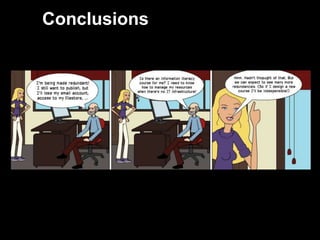
Conclusions


     The Data will be Big, but our users will continue to use
     Facebook and Twitter
     But research data will grow in importance as will use of
     mobiles.
     According to the evidence the future isn‟t quite what I
     expected. But it has helped to identify our business
     strategies.


34

Kelly - When staff and researchers leave their host institution

  • 1.
    When Staff andResearchers Leave Their Host Institution When Staff and Researchers Leave Their Host Institution Brian Kelly, UKOLN 1
  • 2.
    Twitter: http://www.ukoln.ac.uk/web-focus/events/conferences/lilac-2013/ #lilac2013 LILAC2013: When Staff and Researchers Leave Their Host Institution Brian Kelly Acceptable Use Policy UKOLN Recording this talk, taking photos, University of Bath having discussions using Twitter, BATH, UK etc. is encouraged - but try to keep distractions to others minimised. Email: b.kelly@ukoln.ac.uk Blog: http://ukwebfocus.wordpress.com/ Twitter: @briankelly UKOLN is supported by: This work is licensed under a A centre of expertise in digital information management Creativewww.ukoln.ac.uk 2.0 Commons Attribution licence (but note caveat)
  • 3.
    Information Literacy • Defined as “the ability to find, use, evaluate and communicate information” • Felt to be “an essential skill in this digital age and era of life-long learning” LILAC Conference home page 3
  • 4.
    About This Talk What happens when: • “The axeman cometh” and staff are made redundant or take early retirement? • They wish to continue to exploit their professional interests as:  A consultant  An itinerant researcher  A means of developing their CV Who has responsibilities for ensuring staff and researchers are able to respond appropriately to such „life events‟? 4
  • 5.
    Assumptions The University service environment may assume: • You can trust the institution • We will provide the appropriate IT infrastructure • We are here to help you But: • When you leave we don‟t care (unless you donate money!) • Our auditors tell us we must delete accounts when people leave • We run courses for new staff & students (our assets) but not when they are about to leave (our liabilities) 5
  • 6.
    Policy at BathUniversity When staff leave 6 See http://www.bath.ac.uk/bucs/news/news_0013.html
  • 7.
    Policy at BathUniversity Detailed policies University gives very brief details when: • Staff leave • Staff are dismissed • Staff have a new job in the Uni • Staff die 7
  • 8.
    Revisiting Information Literacy Information literacy is defined as • “the ability to find, use, evaluate and communicate information” And is regarded as • “an essential skill in this digital age and era of life-long learning” Therefore let‟s explore ways of: • Supporting staff who wish to continue use and communicate information after they leave the host institution • Ensure staff have the life-long skills to use, evaluate and communicate information beyond their host institution‟s IT environment 8
  • 9.
    The Context Cessation of core funding for UKOLN, CETIS and OSS Watch. UK Web Focus blog, 21 December 2012 9
  • 10.
    The Context Cessation of core funding for UKOLN, CETIS and OSS Watch. Paul Hollins‟ blog, 20 December 2012 10
  • 11.
    The Context Cessation of core funding for UKOLN, CETIS and OSS Watch. We are seeing staff at well- established JISC-funded organisations having to prepare for a “new future” 11 JISC OSS Watch blog, 15 February 2013
  • 12.
    Personal Motivations My interests are to ensure that: • My professional „brand‟ persists when I leave my host institution • My research publications continue to be an asset after I leave my host institution • My authorship of papers is correctly • I can continue to engage with my professional communities after I leave my host institution • I can continue to access and manage relevant services after I leave my host institution • I do not undermine relationships with my current host institution after I leave 12
  • 13.
    The Institutional Repository Opus, the University of Bath institutional repository, provides a secure, reliable & maintained repository for my research papers, project reports, etc. 13
  • 14.
    Persistency of Records Policy seeks to ensure long-term persistency of content When people leave will they still have their contributions listed? 14
  • 15.
    Persistency of Records Informal feedback: • "Records disappear when someone leaves because that's entirely appropriate." • "Staff leaving the university have a different relationship to the organisation. By rights we should shut off ALL accounts the day the relationship with the organisation ends." Institutional context: “this is obviously down to institutional management of people records” Where does your policy fit in the spectrum? • We‟re focussing on the REF and our CRIS (Current Research Information System) 15 • We are loyal to former employees
  • 16.
    Manage Your OwnRecords Ensure that a record of your work (e.g. your publications) is available beyond the institution (e.g. on LinkedIn) 16
  • 17.
    Manage Your OwnData Ensure that your (open access) publications are hosted in an environment you can maintain when you leave the institution. For example: • ResearchGate Papers hosted initially in local open access repository 17
  • 18.
    Manage Your OwnData Ensure that your (open access) publications are hosted in an environment you can maintain when you leave the institution. For example: • ResearchGate • Academia.edu No permission to upload book chapter, so metadata-only records 18
  • 19.
    My Own Thoughts,Ideas Ensure that if you have a blog it isn‟t trapped in the institution: • Create a blog in the Cloud initially • Migrate your blog 19
  • 20.
    Use Cloud SharingServices Have you got your drive Skydrive, Google Drive & Dropbox accounts? Collaborative peer-reviewed papers since 2012 have been written using Skydrive: • File in once place (avoids multiple master copies problem). • Can be viewed (and updated) on mobile devices • Can use MS Word in the Cloud 20 Display of W4A 2012 paper on iPod Touch
  • 21.
    Manage Your OwnServer The spectrum of ownership: • Your CV and list of publications • Your publications themselves • Your blog content • The server for your blog 21
  • 22.
    Netskills Training Netskills course 22
  • 23.
    View of aretired academic “Last night, I wrote reference for an ex-colleague, and noticed that the form expected me to belong to an institution. I guess that identity formation is ongoing work. Am I retired just because I have a pension? Retired is a deadly label I think.” Recently retired academic from a northern university 23
  • 24.
    Your Digital Identity What is your digital identity? What makes you you online? • Your ideas (e.g. express on your blog)? • Your email engagement? • Your community engagement? • Your community? • Your resources? • Your affiliation with your institution (e.g. (1) you are a „corporate‟ person; (2) “blue till I die”; …)? • Your work colleagues • …? 24
  • 25.
    ORCID Take control of your research identity! ORCID: • Open Researcher and Contributor ID • Non-proprietary alphanumeric code to uniquely identify scientific / academic authors • Managed by ORCID Inc. an open & independent registry My ORCID: 0000-0001-5875-8744 25
  • 26.
    Email Over 17 years of email use have: • Large number of messages • Large number of contacts • Personal & professional uses Need to be able to: • Migrate content • Manage How do I: connections • Manage Gb of email messages? • Migrate content to alternative location • Migrate list usage 26 • Associate new location with email client?
  • 27.
    Email As AuthenticationTool Change your email address to ensure you aren‟t locked out of Cloud services! Claim your papers in Google Scholar while your institutional email is valid – otherwise you might not Without access to valid email address you won‟t be be able to claim them! able to use & manage your content (info literacy!) 27
  • 28.
    Links with theInstitution “You’ve rejected me / Our relationship was fated to finish. But I still care about you” 28
  • 29.
    My „Link Love‟ I wish to continue to provide benefits to host institution by: • Ensuring valuable content is not lost • Transfer digital assets where appropriate • Provide „link love‟ to institutional Web site As described in OR 12 paper, links from popular blogs & 29 social media sites can enhance Google ranking of repositories
  • 30.
    Stimulating the Economy Helping to ensure that the departure of researchers can stimulate the economy: • Support the migration of intellectual assets so that they can continue to be used 30 • Ensure that training to do so is embedded in institution
  • 31.
    “After Bath” Advice for graduates provided by Careers 31 Service
  • 32.
    Research Concordance Shouldn‟t life-long skills to manage digital content be address in 32 Research Concordance?
  • 33.
    Conclusions To conclude: • Staff & researchers will spend only a part of their working lives within their current host institution • They should develop skills in being productive beyond the institutional environment • This can enhance the productivity of UK plc. • Opportunities for librarians to support such work • But do librarians see their role primarily to support use of institutional services? • Opportunity to address this as part of a Research Concordance suitable for changed economic environment? 33
  • 34.
    Conclusions The Data will be Big, but our users will continue to use Facebook and Twitter But research data will grow in importance as will use of mobiles. According to the evidence the future isn‟t quite what I expected. But it has helped to identify our business strategies. 34