Proximity, Democracy, and SustainabilityTracing the connection between physical proximity and negotiated interests.Gabriel MugarTechnology as Public GoodSpring 2011
Space and DemocracyThis weeks readings look at the element of proximity and how it is integral to sustainability and democracyEnvironments for information sharing are critical for:Telling a story and seeing if others have similar experiencesLearning about resources that can help overcome obstacles
Shared Awareness	Beauregard believes that sustainability begins with attention to shared needsPolitical struggle of today is NOT about power, but about recognition, the recognition of needs.A politics of recognition requires a discursive democracy
Shared Awareness	Shared awareness begins with conversation. It is an aggregation of ideas that forms the ground for collective actionHegel’s collective world building, Appadurai’s imagination as staging ground for action.Anderson’s notion of the “embryo of the nationally imagined community” that emerged after printing press.Clay Shirky’s description of the Korean teenage protestors who connected in an online boy band forum.
Surrounded by Others	When we become aware of our needs in relation to others, we begin to negotiate our needs with others needs.Negotiation as a form of empathy.The city cultivates empathy because we are constantly in public:“In them [public spaces], people will encounter strangers…living together under these circumstances means  learning how to be tolerant of others. This provides the basis for empathy and for a willingness to engage with those unlike ones self.” -Beauregard
Negotiated Interests and SustainabilityThe passage for a private story to become public is for the storyteller to consider “alternatives understandings and to differentiate among personal responsibility, private interests, and public concerns.” –BeauregardWhen people can share their stories and negotiate understandings, they are more likely to become concerned with the sustainability of their shared worldSustainability emphasizes the concerns that people hold in common.
Places to ShareInformation Grounds: A space with a primary activity that has information sharing as a secondary outcome.Oldenburg’s concept of the “Third Place.,” a space between work and home where informal sharing of information takes place.Coffee shops, bars, libraries, gyms…foot clinics…
Third PlaceCharacteristics of a Third Place:Occur on neutral groundNo formal criteria for membershipConversation as main activityAccessibleInformation flow as byproduct of social interaction.
QBPLBefore coming to the United States, immigrants bound for Queens are told to connect with the QBPL to learn about valuable resources in their community.The librarian act as nodes of information transfer
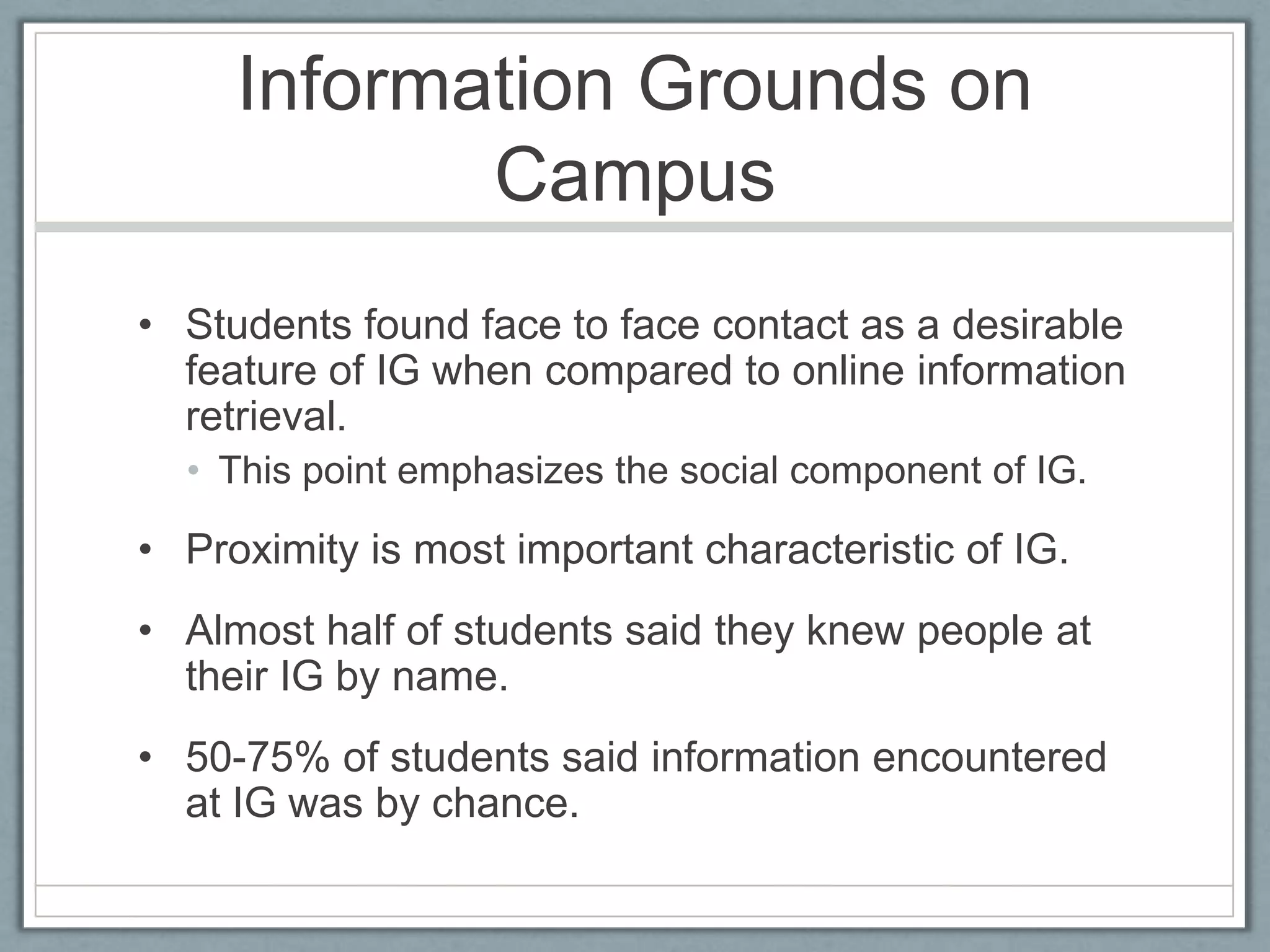
Information Grounds on CampusStudents found face to face contact as a desirable feature of IG when compared to online information retrieval.This point emphasizes the social component of IG.Proximity is most important characteristic of IG.Almost half of students said they knew people at their IG by name.50-75% of students said information encountered at IG was by chance.
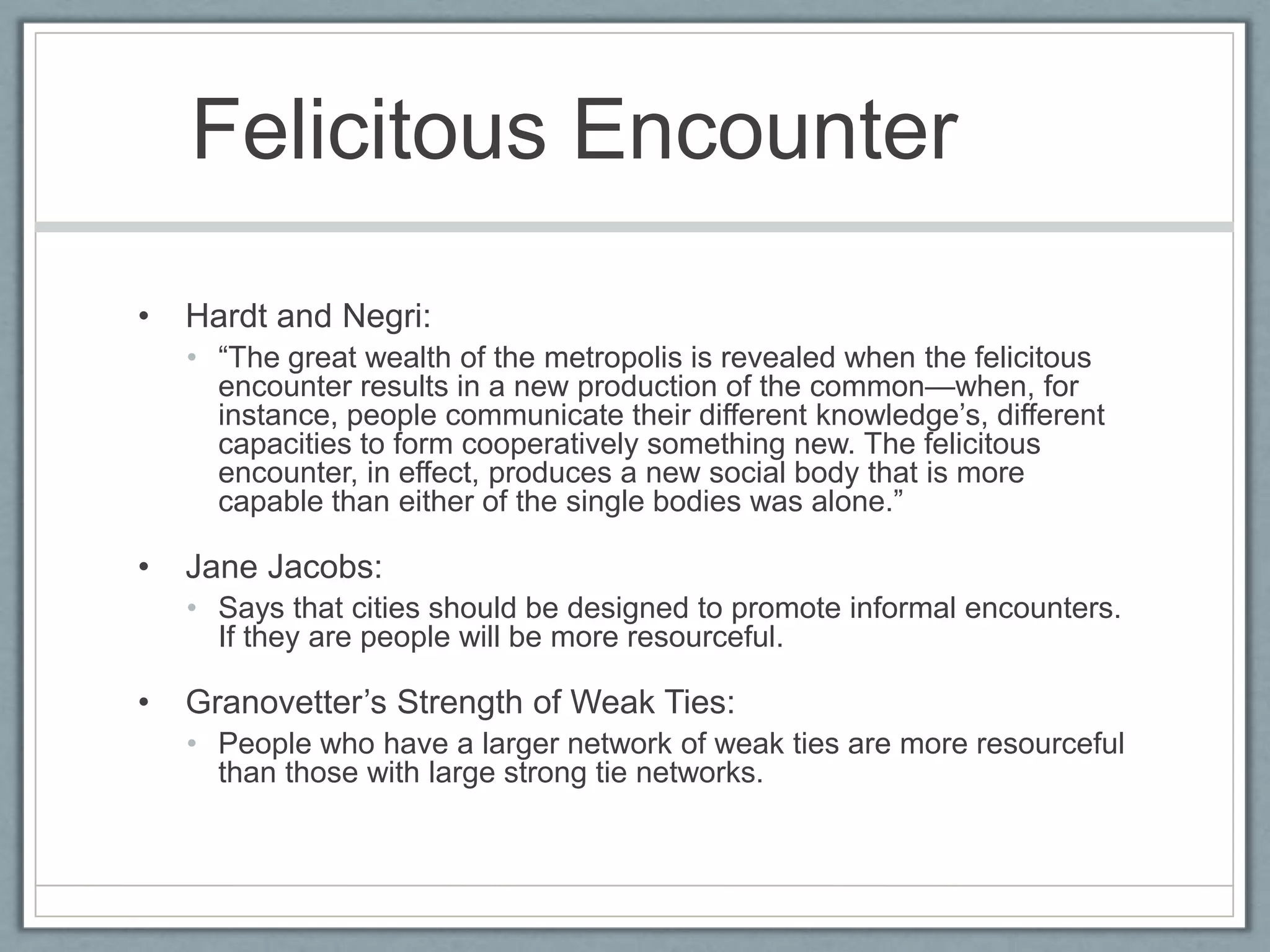
Felicitous Encounter	Hardt and Negri: “The great wealth of the metropolis is revealed when the felicitous encounter results in a new production of the common—when, for instance, people communicate their different knowledge’s, different capacities to form cooperatively something new. The felicitous encounter, in effect, produces a new social body that is more capable than either of the single bodies was alone.”Jane Jacobs: Says that cities should be designed to promote informal encounters. If they are people will be more resourceful.Granovetter’s Strength of Weak Ties:People who have a larger network of weak ties are more resourceful than those with large strong tie networks.
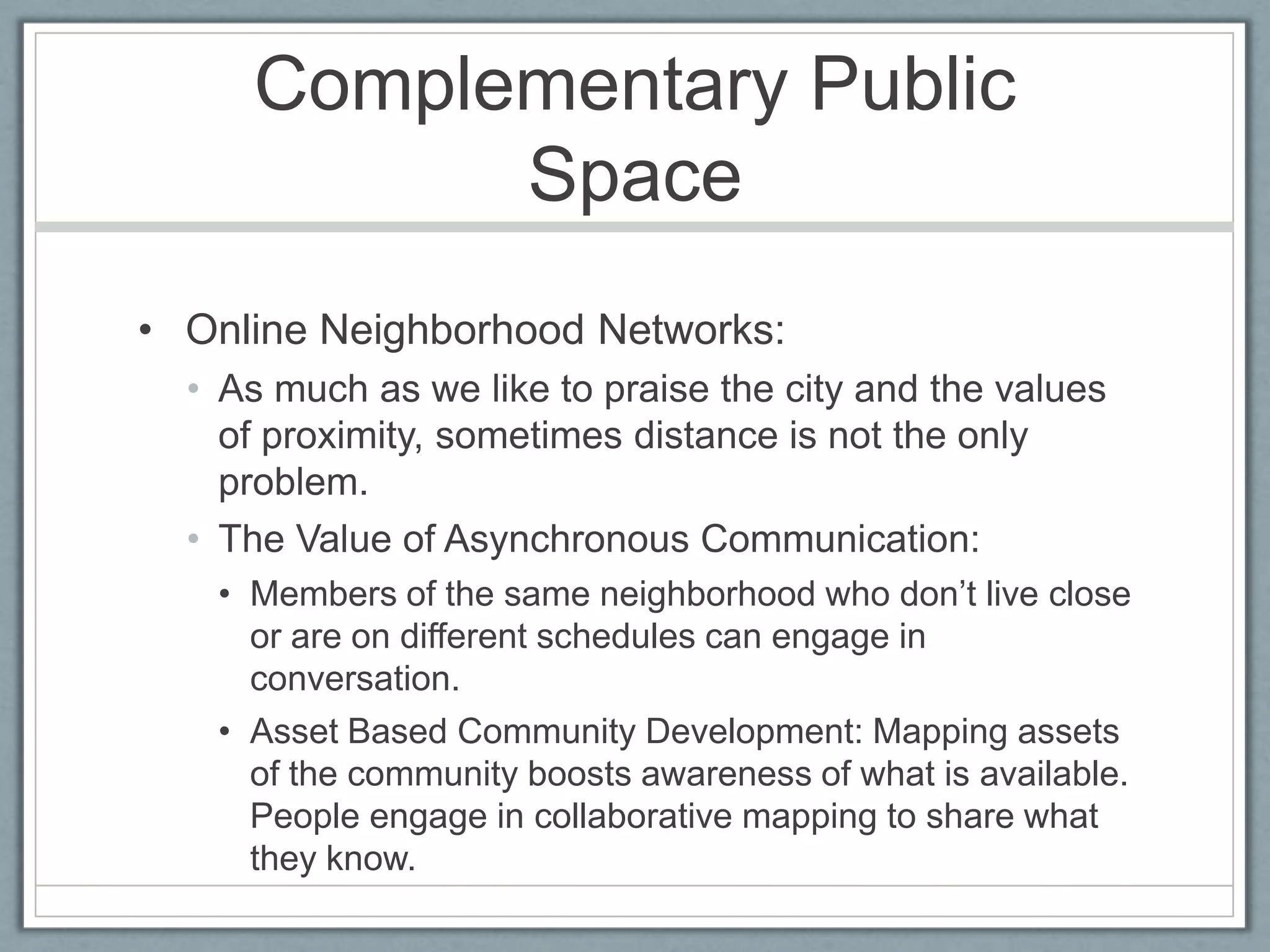
Complementary Public SpaceOnline Neighborhood Networks:As much as we like to praise the city and the values of proximity, sometimes distance is not the only problem.The Value of Asynchronous Communication:Members of the same neighborhood who don’t live close or are on different schedules can engage in conversation.Asset Based Community Development: Mapping assets of the community boosts awareness of what is available. People engage in collaborative mapping to share what they know.

Proximatedemocracy

  • 1.
    Proximity, Democracy, andSustainabilityTracing the connection between physical proximity and negotiated interests.Gabriel MugarTechnology as Public GoodSpring 2011
  • 2.
    Space and DemocracyThisweeks readings look at the element of proximity and how it is integral to sustainability and democracyEnvironments for information sharing are critical for:Telling a story and seeing if others have similar experiencesLearning about resources that can help overcome obstacles
  • 3.
    Shared Awareness Beauregard believesthat sustainability begins with attention to shared needsPolitical struggle of today is NOT about power, but about recognition, the recognition of needs.A politics of recognition requires a discursive democracy
  • 4.
    Shared Awareness Shared awarenessbegins with conversation. It is an aggregation of ideas that forms the ground for collective actionHegel’s collective world building, Appadurai’s imagination as staging ground for action.Anderson’s notion of the “embryo of the nationally imagined community” that emerged after printing press.Clay Shirky’s description of the Korean teenage protestors who connected in an online boy band forum.
  • 5.
    Surrounded by Others Whenwe become aware of our needs in relation to others, we begin to negotiate our needs with others needs.Negotiation as a form of empathy.The city cultivates empathy because we are constantly in public:“In them [public spaces], people will encounter strangers…living together under these circumstances means learning how to be tolerant of others. This provides the basis for empathy and for a willingness to engage with those unlike ones self.” -Beauregard
  • 6.
    Negotiated Interests andSustainabilityThe passage for a private story to become public is for the storyteller to consider “alternatives understandings and to differentiate among personal responsibility, private interests, and public concerns.” –BeauregardWhen people can share their stories and negotiate understandings, they are more likely to become concerned with the sustainability of their shared worldSustainability emphasizes the concerns that people hold in common.
  • 7.
    Places to ShareInformationGrounds: A space with a primary activity that has information sharing as a secondary outcome.Oldenburg’s concept of the “Third Place.,” a space between work and home where informal sharing of information takes place.Coffee shops, bars, libraries, gyms…foot clinics…
  • 8.
    Third PlaceCharacteristics ofa Third Place:Occur on neutral groundNo formal criteria for membershipConversation as main activityAccessibleInformation flow as byproduct of social interaction.
  • 9.
    QBPLBefore coming tothe United States, immigrants bound for Queens are told to connect with the QBPL to learn about valuable resources in their community.The librarian act as nodes of information transfer
  • 10.
    Information Grounds onCampusStudents found face to face contact as a desirable feature of IG when compared to online information retrieval.This point emphasizes the social component of IG.Proximity is most important characteristic of IG.Almost half of students said they knew people at their IG by name.50-75% of students said information encountered at IG was by chance.
  • 11.
    Felicitous Encounter Hardt andNegri: “The great wealth of the metropolis is revealed when the felicitous encounter results in a new production of the common—when, for instance, people communicate their different knowledge’s, different capacities to form cooperatively something new. The felicitous encounter, in effect, produces a new social body that is more capable than either of the single bodies was alone.”Jane Jacobs: Says that cities should be designed to promote informal encounters. If they are people will be more resourceful.Granovetter’s Strength of Weak Ties:People who have a larger network of weak ties are more resourceful than those with large strong tie networks.
  • 12.
    Complementary Public SpaceOnlineNeighborhood Networks:As much as we like to praise the city and the values of proximity, sometimes distance is not the only problem.The Value of Asynchronous Communication:Members of the same neighborhood who don’t live close or are on different schedules can engage in conversation.Asset Based Community Development: Mapping assets of the community boosts awareness of what is available. People engage in collaborative mapping to share what they know.