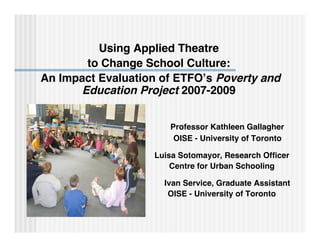
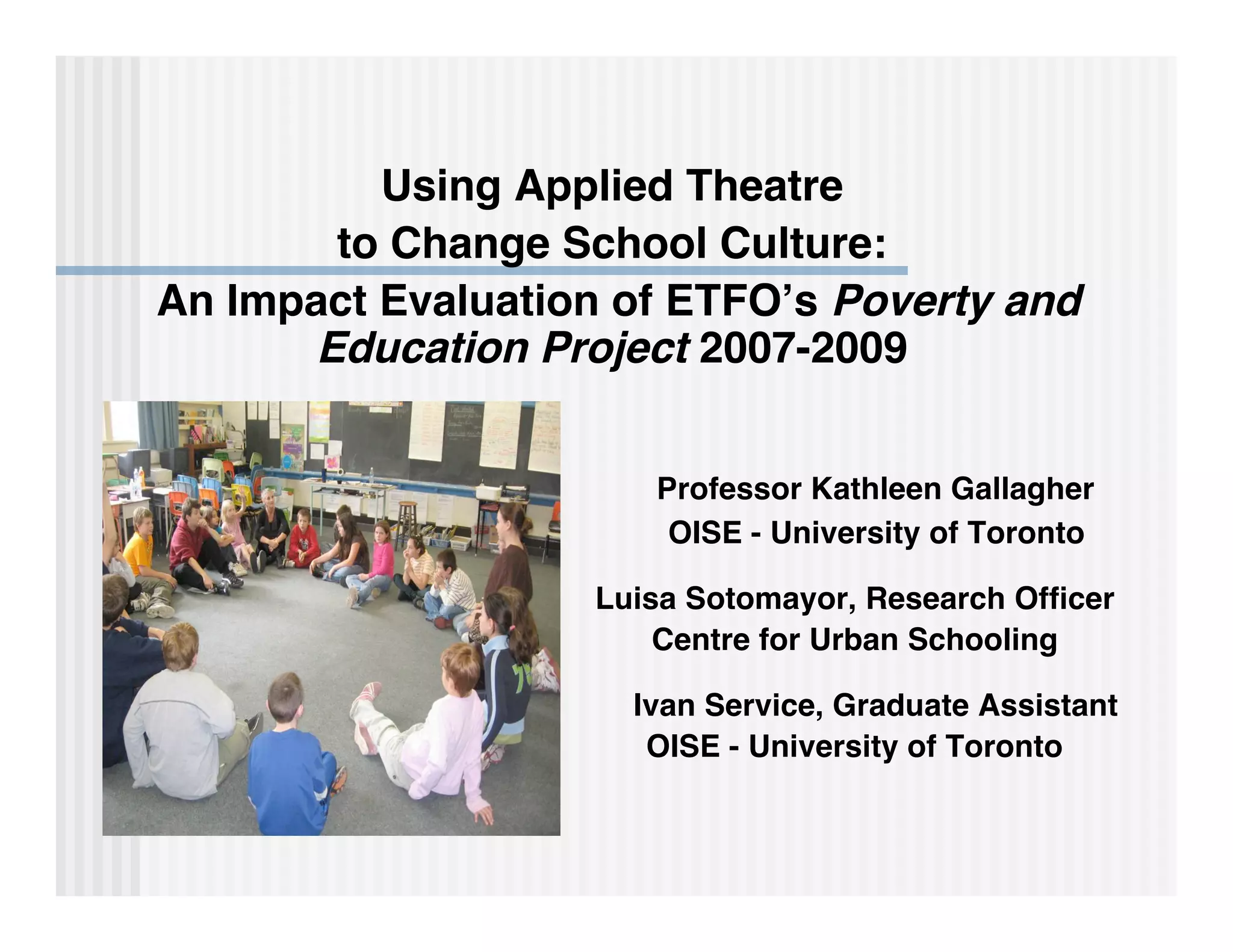
Using Applied Theatre
       to Change School Culture:
An Impact Evaluation of ETFO’s Poverty and
      Education Project 2007-2009


                      Professor Kathleen Gallagher
                       OISE - University of Toronto

                   Luisa Sotomayor, Research Officer
                       Centre for Urban Schooling

                     Ivan Service, Graduate Assistant
                      OISE - University of Toronto
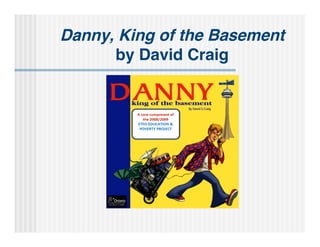
Danny, King of the Basement
      by David Craig
The Ontario Context
   One in six children - approximately 478, 480 - live in poverty.
   132,000 children rely on a food bank each month.
   Two in every five children living in low-income families have a
    parent working full-time, year round.
   Women and youth account for 83% of Canada’s minimum wage
    workers.
   The majority- 54.6%- of children living in low-income, single-
    parent families live with their mother.
   47% of children in new immigrant families and 32% of children
    in racialized families are considered poor, an increase of 60%
    over the last 20 years.
   70% of Ontario’s Aboriginal population lives off-reserve. One-
    third of off-reserve Aboriginal children live in poverty.
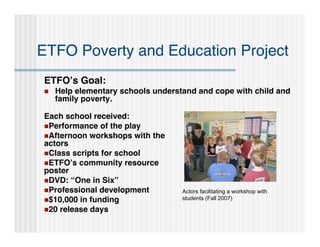
ETFO Poverty and Education Project
ETFO’s Goal:
   Help elementary schools understand and cope with child and
    family poverty.

Each school received:
Performance of the play
Afternoon workshops with the
actors
Class scripts for school
ETFO’s community resource
poster
DVD: “One in Six”
Professional development          Actors facilitating a workshop with
$10,000 in funding                students (Fall 2007)

20 release days
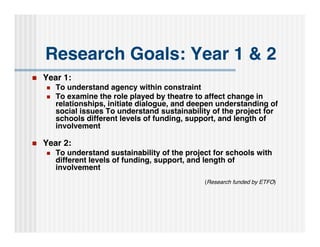
Research Goals: Year 1 & 2
   Year 1:
       To understand agency within constraint
       To examine the role played by theatre to affect change in
        relationships, initiate dialogue, and deepen understanding of
        social issues To understand sustainability of the project for
        schools different levels of funding, support, and length of
        involvement

   Year 2:
       To understand sustainability of the project for schools with
        different levels of funding, support, and length of
        involvement
                                                 (Research funded by ETFO)
* Film Intermission *
Discovering Danny: Challenging
Assumptions, Seeing Context

 “…the other day [a student] said something about
 moving. ‘Oh that’s like my mom, she doesn’t like to stay
 in one place. We just usually stay there for a month at a
 time…’ We went on a bus trip and so we had gone by
 one of his old houses. And he was referring to some of
 the different places that he’s lived and he said, ‘My
 mom doesn’t like to stay any longer than a month at a
 place.’ So I thought, that’s Danny, really.”
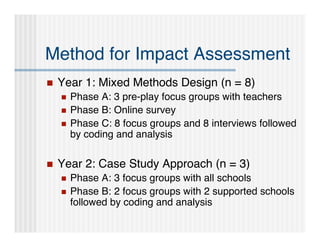
Method for Impact Assessment
   Year 1: Mixed Methods Design (n = 8)
       Phase A: 3 pre-play focus groups with teachers
       Phase B: Online survey
       Phase C: 8 focus groups and 8 interviews followed
        by coding and analysis

   Year 2: Case Study Approach (n = 3)
       Phase A: 3 focus groups with all schools
       Phase B: 2 focus groups with 2 supported schools
        followed by coding and analysis
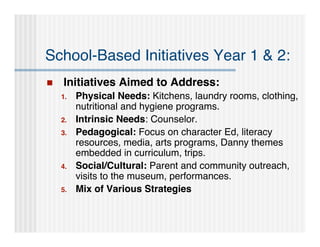
School-Based Initiatives Year 1 & 2:
   Initiatives Aimed to Address:
    1.   Physical Needs: Kitchens, laundry rooms, clothing,
         nutritional and hygiene programs.
    2.   Intrinsic Needs: Counselor.
    3.   Pedagogical: Focus on character Ed, literacy
         resources, media, arts programs, Danny themes
         embedded in curriculum, trips.
    4.   Social/Cultural: Parent and community outreach,
         visits to the museum, performances.
    5.   Mix of Various Strategies
School-Based Initiatives Year 1 & 2:
 “And that’s a big part of what we want to do
 this year is the whole student engagement
 piece and getting them involved in things
 that they may not have a chance to at home
 because our kids don’t have the money to
 join sports teams and go to dance classes
 and things like that.”
Applied Theatre: Changing
School Culture

“There is now a greater amount of patience for
the students on the part of some teachers as a
result of the play...The sentiment was that the play
inspired one to remember why one wanted to
teach in first place, something that can get lost in
the daily grind of school life.”
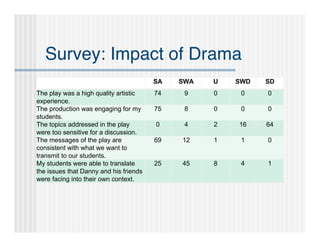
Survey: Impact of Drama
              Question                  SA   SWA   U   SWD   SD
The play was a high quality artistic    74    9    0    0    0
experience.
The production was engaging for my      75    8    0    0    0
students.
The topics addressed in the play        0     4    2   16    64
were too sensitive for a discussion.
The messages of the play are            69   12    1    1    0
consistent with what we want to
transmit to our students.
My students were able to translate      25   45    8    4    1
the issues that Danny and his friends
were facing into their own context.
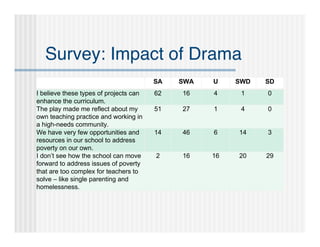
Survey: Impact of Drama
              Question                  SA   SWA   U    SWD   SD
I believe these types of projects can   62   16    4     1    0
enhance the curriculum.
The play made me reflect about my       51   27    1     4    0
own teaching practice and working in
a high-needs community.
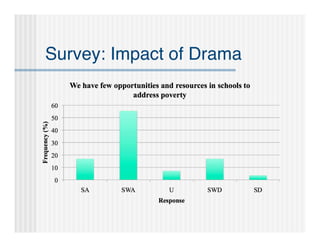
We have very few opportunities and      14   46    6    14    3
resources in our school to address
poverty on our own.
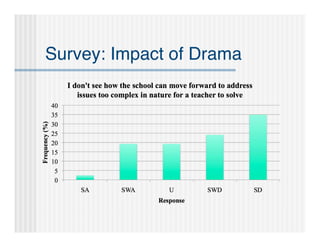
I don’t see how the school can move     2    16    16   20    29
forward to address issues of poverty
that are too complex for teachers to
solve – like single parenting and
homelessness.
Survey: Impact of Drama
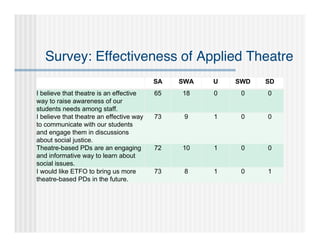
Survey: Effectiveness of Applied Theatre
              Question                    SA   SWA   U   SWD   SD
I believe that theatre is an effective    65   18    0    0    0
way to raise awareness of our
students needs among staff.
I believe that theatre an effective way   73    9    1    0    0
to communicate with our students
and engage them in discussions
about social justice.
Theatre-based PDs are an engaging         72   10    1    0    0
and informative way to learn about
social issues.
I would like ETFO to bring us more        73    8    1    0    1
theatre-based PDs in the future.
Aesthetic Engagement
   Responses describing the intrinsic value of
    seeing drama or appreciation of the art form
   “The play and drama workshops were wonderful, and they have
    inspired both our staff and students to feel empowered to
    overcome obstacles associated with poverty.”
   “Really listening, really thinking about it. I know it's had an impact
    well-beyond that week. We're still hearing things about it. Talking to
    other teachers too, um, I know that in Mr. Adam’s room upstairs he
    has kids that are making text connections to it, and still talking
    about it. So it's really carrying on, and affecting all the kids in the
    school.”
Catharsis and Empathy
   Emotional response or change in thinking towards
    issues of poverty that resulted from watching the
    drama
   "Well, particularly a scene where Danny is being revived after he
    has been exposed to the elements and the kids in three groups that
    made the comment…about the fact that it was fairly awful how he
    found himself in that situation and how terrible it would be to be put
    into the situation where you felt you had no options but to run away
    and be left at the mercy of mother nature and not feel that there
    was any place to turn to. So the kids talked about options and
    things within the community that were available to people that
    need."
Dialogue
   Frequency of conversations or depth of the
    discussions that followed the drama
   "It knocked down those walls that you didn’t realize were there, but
    it was just something that you never really talked about, but it
    opened the doorway for communication to start.”
   “…before the play came to the school we were asked to discuss
    poverty…and I found my students didn’t really understand the word
    poverty…but it was after the play came to the school that the
    conversation became really interesting…I had kids who were
    twelve years old understanding the parents perspective,
    understanding the parents motivations, understanding the parents
    challenges, which I didn’t think they were capable of doing.”
Changes In Social Relations
   New relationships that emerged within the school-
    community as a result of the performance
   "After seeing ‘Danny King of The Basement’ and the readings…it
    really opened the doors to free communication.”
   "In my classroom, I have a lot of students that act out because
    they're hungry, and that, they haven't had proper nutrition, and I
    have this one student in particular that, um, it's really severe. And
    this year, because of the inclusive environment that we've created,
    and through talking about poverty, he will no longer shut that off, he
    will say out loud, put his hand up, and when we're on the carpet
    and say, “You know Miss Betty I'm really hungry, can I have a
    banana…That's something that they feel like they can discuss not
    only one on one but they feel like they can discuss it with their
    peers, so, it's pretty good."
Learning From The Drama
   Staff and students learned more about issues of poverty
    directly from the drama
   "It brought personal beliefs and experiences to the forefront through
    character experiences and situations. This play was excellent and helped
    me get in touch with what some of our students are likely feeling, and why
    they are reacting the way they do."
   "For us, it’s broadened our definition because we often think of poverty we
    only think in terms of physical needs but garbled… you see there are some
    kids that are emotionally poor that are well provided for but…the
    comments that they make, you know give the impression that they are
    emotionally poor. They are missing something else from their life that isn’t
    necessarily connected to a monetary value."
Pedagogical Tool
   Incorporating themes or ideas found within the
    drama into the curriculum or teaching practices
   "And I was impressed with how fast they picked up drama as a
    means of communication. They respected the form of
    communication…it moved us ahead in conversation to a deeper
    depth, discussing everything in language arts…So I felt that it had
    spin offs that were valuable in the curriculum content as well.”
   "Where as instead of saying someone, you know, it might be like
    first they can relate, well, Danny in the play he was poor, like,
    monetarily, but, you know, he was rich in his imagination and stuff
    like that. So, they can talk about, you know, the characteristics of
    different types of poverty of stage characters. Where as normally if
    you were talking without seeing a play or something, it’d be like
    they couldn’t bring that realization of seeing someone like that."
Other research themes
   Principals’ Awareness
   Teachers’ Awareness
   Teachers’ Practice
   Collaboration
   Engagement
   Students
   Leadership
   Impact on students
   School environment
   School Culture
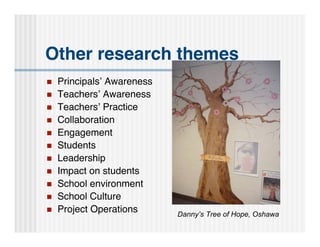
   Project Operations      Danny’s Tree of Hope, Oshawa
The Sustainability of Applied
Theatre

 “…we’re not going outside to find something all the
 time. It’s Diana, it’s Fiona, it’s Tammy. We’re looking at
 ourselves and what can we do and we teach one
 another…We’re going to teach one another how to do it
 on a daily basis in a classroom. So I see that as
 sustainable instead of being a one-time fun, oh this is
 great, let’s do this. No, it’s something we help one
 another with and then you know we have more
 confidence to do it on our own…”
Sustainability: Where did the
    Drama Go?
   For these three schools, the focus of the Danny play
    disappeared as the project progressed
   “Last year the focus for us was really on Character Education…we
    have veered off in a different direction while keeping going what we
    did last year.”
   “Well they only know about swimming, but we haven’t really tied it to
    the Danny project or Danny play or project with the kids.”
Sustainability: Embedding
    Initiatives In Curriculum
   Incorporating initiatives into the curriculum led to greater
    sustainability of the lessons and insights
   “We definitely considered it from the beginning and especially last
    year embedding it in the curriculum was the best way we could think
    of continuing it. And you can see that it’s still happening. A lot of the
    lessons that were written have been passed on and people are using
    or just remembering what happened last year.”
Sustainability: Developing
    Partnerships
   Partnerships with community organizations sustained the
    initiatives because of increased resources, support, and
    energy
   “That is a big part of it. That was the sort of more of the focus of our
    presentation to all the community people that day was we want this to
    continue. How can you help us make this continue? What can you do
    for us? And where can the volunteers tap in? So who has volunteers
    or who knows where we can get some? So between some service
    groups and the church group and things like that, that was one focus
    of the people we invited and the other part was who has the most
    money to give us each year?”
Sustainability: Raising
    Consciousness
   Raising staff consciousness about issues of poverty impacted their
    teaching practices and school programs well into the future, with or
    without continued support from ETFO
   “I’m an awful lot more sensitive, I think most teachers are to where
    our kids are coming from and it affects their work in school and so on.
    And I just have a class full of needy kids this year. And I probably
    always have had a class of needy kids, I just didn’t really pay much
    attention to the need. Or not enough attention.”
   “Well I’m much more attentive to parents and to kids. I’m listening a
    lot more than I used to. So you know the teacher-learner relationships
    are just a whole lot better. So make time for that to happen and good
    things happen.”
Conclusions
   Applied theatre proved effective to initiate
    dialogue and transform social relations.
   Flexibility was key to programme success.
   Workshops, grants, release days, embedding
    in curriculum, and raising consciousness kept
    the themes of the play alive.
Effective practices
   Enough pre-play preparation time
   All-school involvement
   Horizontal partnerships
   Distributed Leadership
   Sound use of resources
   Regular meeting times
   Team work
   Embedding in curriculum
   Raising consciousness
In Summary


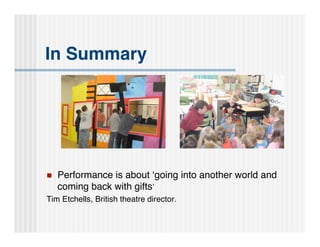
   Performance is about ‘going into another world and
    coming back with gifts’
Tim Etchells, British theatre director.
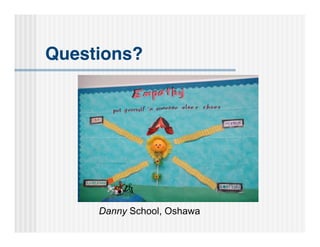
Questions?


     Danny School, Oshawa

Kathleen Gallagher

  • 1.
    Using Applied Theatre to Change School Culture: An Impact Evaluation of ETFO’s Poverty and Education Project 2007-2009 Professor Kathleen Gallagher OISE - University of Toronto Luisa Sotomayor, Research Officer Centre for Urban Schooling Ivan Service, Graduate Assistant OISE - University of Toronto
  • 2.
    Danny, King ofthe Basement by David Craig
  • 3.
    The Ontario Context  One in six children - approximately 478, 480 - live in poverty.  132,000 children rely on a food bank each month.  Two in every five children living in low-income families have a parent working full-time, year round.  Women and youth account for 83% of Canada’s minimum wage workers.  The majority- 54.6%- of children living in low-income, single- parent families live with their mother.  47% of children in new immigrant families and 32% of children in racialized families are considered poor, an increase of 60% over the last 20 years.  70% of Ontario’s Aboriginal population lives off-reserve. One- third of off-reserve Aboriginal children live in poverty.
  • 4.
    ETFO Poverty andEducation Project ETFO’s Goal:  Help elementary schools understand and cope with child and family poverty. Each school received: Performance of the play Afternoon workshops with the actors Class scripts for school ETFO’s community resource poster DVD: “One in Six” Professional development Actors facilitating a workshop with $10,000 in funding students (Fall 2007) 20 release days
  • 5.
    Research Goals: Year1 & 2  Year 1:  To understand agency within constraint  To examine the role played by theatre to affect change in relationships, initiate dialogue, and deepen understanding of social issues To understand sustainability of the project for schools different levels of funding, support, and length of involvement  Year 2:  To understand sustainability of the project for schools with different levels of funding, support, and length of involvement (Research funded by ETFO)
  • 6.
  • 7.
    Discovering Danny: Challenging Assumptions,Seeing Context “…the other day [a student] said something about moving. ‘Oh that’s like my mom, she doesn’t like to stay in one place. We just usually stay there for a month at a time…’ We went on a bus trip and so we had gone by one of his old houses. And he was referring to some of the different places that he’s lived and he said, ‘My mom doesn’t like to stay any longer than a month at a place.’ So I thought, that’s Danny, really.”
  • 8.
    Method for ImpactAssessment  Year 1: Mixed Methods Design (n = 8)  Phase A: 3 pre-play focus groups with teachers  Phase B: Online survey  Phase C: 8 focus groups and 8 interviews followed by coding and analysis  Year 2: Case Study Approach (n = 3)  Phase A: 3 focus groups with all schools  Phase B: 2 focus groups with 2 supported schools followed by coding and analysis
  • 9.
    School-Based Initiatives Year1 & 2:  Initiatives Aimed to Address: 1. Physical Needs: Kitchens, laundry rooms, clothing, nutritional and hygiene programs. 2. Intrinsic Needs: Counselor. 3. Pedagogical: Focus on character Ed, literacy resources, media, arts programs, Danny themes embedded in curriculum, trips. 4. Social/Cultural: Parent and community outreach, visits to the museum, performances. 5. Mix of Various Strategies
  • 10.
    School-Based Initiatives Year1 & 2: “And that’s a big part of what we want to do this year is the whole student engagement piece and getting them involved in things that they may not have a chance to at home because our kids don’t have the money to join sports teams and go to dance classes and things like that.”
  • 11.
    Applied Theatre: Changing SchoolCulture “There is now a greater amount of patience for the students on the part of some teachers as a result of the play...The sentiment was that the play inspired one to remember why one wanted to teach in first place, something that can get lost in the daily grind of school life.”
  • 12.
    Survey: Impact ofDrama Question SA SWA U SWD SD The play was a high quality artistic 74 9 0 0 0 experience. The production was engaging for my 75 8 0 0 0 students. The topics addressed in the play 0 4 2 16 64 were too sensitive for a discussion. The messages of the play are 69 12 1 1 0 consistent with what we want to transmit to our students. My students were able to translate 25 45 8 4 1 the issues that Danny and his friends were facing into their own context.
  • 13.
    Survey: Impact ofDrama Question SA SWA U SWD SD I believe these types of projects can 62 16 4 1 0 enhance the curriculum. The play made me reflect about my 51 27 1 4 0 own teaching practice and working in a high-needs community. We have very few opportunities and 14 46 6 14 3 resources in our school to address poverty on our own. I don’t see how the school can move 2 16 16 20 29 forward to address issues of poverty that are too complex for teachers to solve – like single parenting and homelessness.
  • 14.
  • 15.
  • 16.
    Survey: Effectiveness ofApplied Theatre Question SA SWA U SWD SD I believe that theatre is an effective 65 18 0 0 0 way to raise awareness of our students needs among staff. I believe that theatre an effective way 73 9 1 0 0 to communicate with our students and engage them in discussions about social justice. Theatre-based PDs are an engaging 72 10 1 0 0 and informative way to learn about social issues. I would like ETFO to bring us more 73 8 1 0 1 theatre-based PDs in the future.
  • 17.
    Aesthetic Engagement  Responses describing the intrinsic value of seeing drama or appreciation of the art form  “The play and drama workshops were wonderful, and they have inspired both our staff and students to feel empowered to overcome obstacles associated with poverty.”  “Really listening, really thinking about it. I know it's had an impact well-beyond that week. We're still hearing things about it. Talking to other teachers too, um, I know that in Mr. Adam’s room upstairs he has kids that are making text connections to it, and still talking about it. So it's really carrying on, and affecting all the kids in the school.”
  • 18.
    Catharsis and Empathy  Emotional response or change in thinking towards issues of poverty that resulted from watching the drama  "Well, particularly a scene where Danny is being revived after he has been exposed to the elements and the kids in three groups that made the comment…about the fact that it was fairly awful how he found himself in that situation and how terrible it would be to be put into the situation where you felt you had no options but to run away and be left at the mercy of mother nature and not feel that there was any place to turn to. So the kids talked about options and things within the community that were available to people that need."
  • 19.
    Dialogue  Frequency of conversations or depth of the discussions that followed the drama  "It knocked down those walls that you didn’t realize were there, but it was just something that you never really talked about, but it opened the doorway for communication to start.”  “…before the play came to the school we were asked to discuss poverty…and I found my students didn’t really understand the word poverty…but it was after the play came to the school that the conversation became really interesting…I had kids who were twelve years old understanding the parents perspective, understanding the parents motivations, understanding the parents challenges, which I didn’t think they were capable of doing.”
  • 20.
    Changes In SocialRelations  New relationships that emerged within the school- community as a result of the performance  "After seeing ‘Danny King of The Basement’ and the readings…it really opened the doors to free communication.”  "In my classroom, I have a lot of students that act out because they're hungry, and that, they haven't had proper nutrition, and I have this one student in particular that, um, it's really severe. And this year, because of the inclusive environment that we've created, and through talking about poverty, he will no longer shut that off, he will say out loud, put his hand up, and when we're on the carpet and say, “You know Miss Betty I'm really hungry, can I have a banana…That's something that they feel like they can discuss not only one on one but they feel like they can discuss it with their peers, so, it's pretty good."
  • 21.
    Learning From TheDrama  Staff and students learned more about issues of poverty directly from the drama  "It brought personal beliefs and experiences to the forefront through character experiences and situations. This play was excellent and helped me get in touch with what some of our students are likely feeling, and why they are reacting the way they do."  "For us, it’s broadened our definition because we often think of poverty we only think in terms of physical needs but garbled… you see there are some kids that are emotionally poor that are well provided for but…the comments that they make, you know give the impression that they are emotionally poor. They are missing something else from their life that isn’t necessarily connected to a monetary value."
  • 22.
    Pedagogical Tool  Incorporating themes or ideas found within the drama into the curriculum or teaching practices  "And I was impressed with how fast they picked up drama as a means of communication. They respected the form of communication…it moved us ahead in conversation to a deeper depth, discussing everything in language arts…So I felt that it had spin offs that were valuable in the curriculum content as well.”  "Where as instead of saying someone, you know, it might be like first they can relate, well, Danny in the play he was poor, like, monetarily, but, you know, he was rich in his imagination and stuff like that. So, they can talk about, you know, the characteristics of different types of poverty of stage characters. Where as normally if you were talking without seeing a play or something, it’d be like they couldn’t bring that realization of seeing someone like that."
  • 23.
    Other research themes  Principals’ Awareness  Teachers’ Awareness  Teachers’ Practice  Collaboration  Engagement  Students  Leadership  Impact on students  School environment  School Culture  Project Operations Danny’s Tree of Hope, Oshawa
  • 24.
    The Sustainability ofApplied Theatre “…we’re not going outside to find something all the time. It’s Diana, it’s Fiona, it’s Tammy. We’re looking at ourselves and what can we do and we teach one another…We’re going to teach one another how to do it on a daily basis in a classroom. So I see that as sustainable instead of being a one-time fun, oh this is great, let’s do this. No, it’s something we help one another with and then you know we have more confidence to do it on our own…”
  • 25.
    Sustainability: Where didthe Drama Go?  For these three schools, the focus of the Danny play disappeared as the project progressed  “Last year the focus for us was really on Character Education…we have veered off in a different direction while keeping going what we did last year.”  “Well they only know about swimming, but we haven’t really tied it to the Danny project or Danny play or project with the kids.”
  • 26.
    Sustainability: Embedding Initiatives In Curriculum  Incorporating initiatives into the curriculum led to greater sustainability of the lessons and insights  “We definitely considered it from the beginning and especially last year embedding it in the curriculum was the best way we could think of continuing it. And you can see that it’s still happening. A lot of the lessons that were written have been passed on and people are using or just remembering what happened last year.”
  • 27.
    Sustainability: Developing Partnerships  Partnerships with community organizations sustained the initiatives because of increased resources, support, and energy  “That is a big part of it. That was the sort of more of the focus of our presentation to all the community people that day was we want this to continue. How can you help us make this continue? What can you do for us? And where can the volunteers tap in? So who has volunteers or who knows where we can get some? So between some service groups and the church group and things like that, that was one focus of the people we invited and the other part was who has the most money to give us each year?”
  • 28.
    Sustainability: Raising Consciousness  Raising staff consciousness about issues of poverty impacted their teaching practices and school programs well into the future, with or without continued support from ETFO  “I’m an awful lot more sensitive, I think most teachers are to where our kids are coming from and it affects their work in school and so on. And I just have a class full of needy kids this year. And I probably always have had a class of needy kids, I just didn’t really pay much attention to the need. Or not enough attention.”  “Well I’m much more attentive to parents and to kids. I’m listening a lot more than I used to. So you know the teacher-learner relationships are just a whole lot better. So make time for that to happen and good things happen.”
  • 29.
    Conclusions  Applied theatre proved effective to initiate dialogue and transform social relations.  Flexibility was key to programme success.  Workshops, grants, release days, embedding in curriculum, and raising consciousness kept the themes of the play alive.
  • 30.
    Effective practices  Enough pre-play preparation time  All-school involvement  Horizontal partnerships  Distributed Leadership  Sound use of resources  Regular meeting times  Team work  Embedding in curriculum  Raising consciousness
  • 31.
    In Summary  Performance is about ‘going into another world and coming back with gifts’ Tim Etchells, British theatre director.
  • 32.
    Questions? Danny School, Oshawa