Kata Skill @ Novice
Common Themes
Illustrated
with a Healthcare Example
Beth Carrington
1
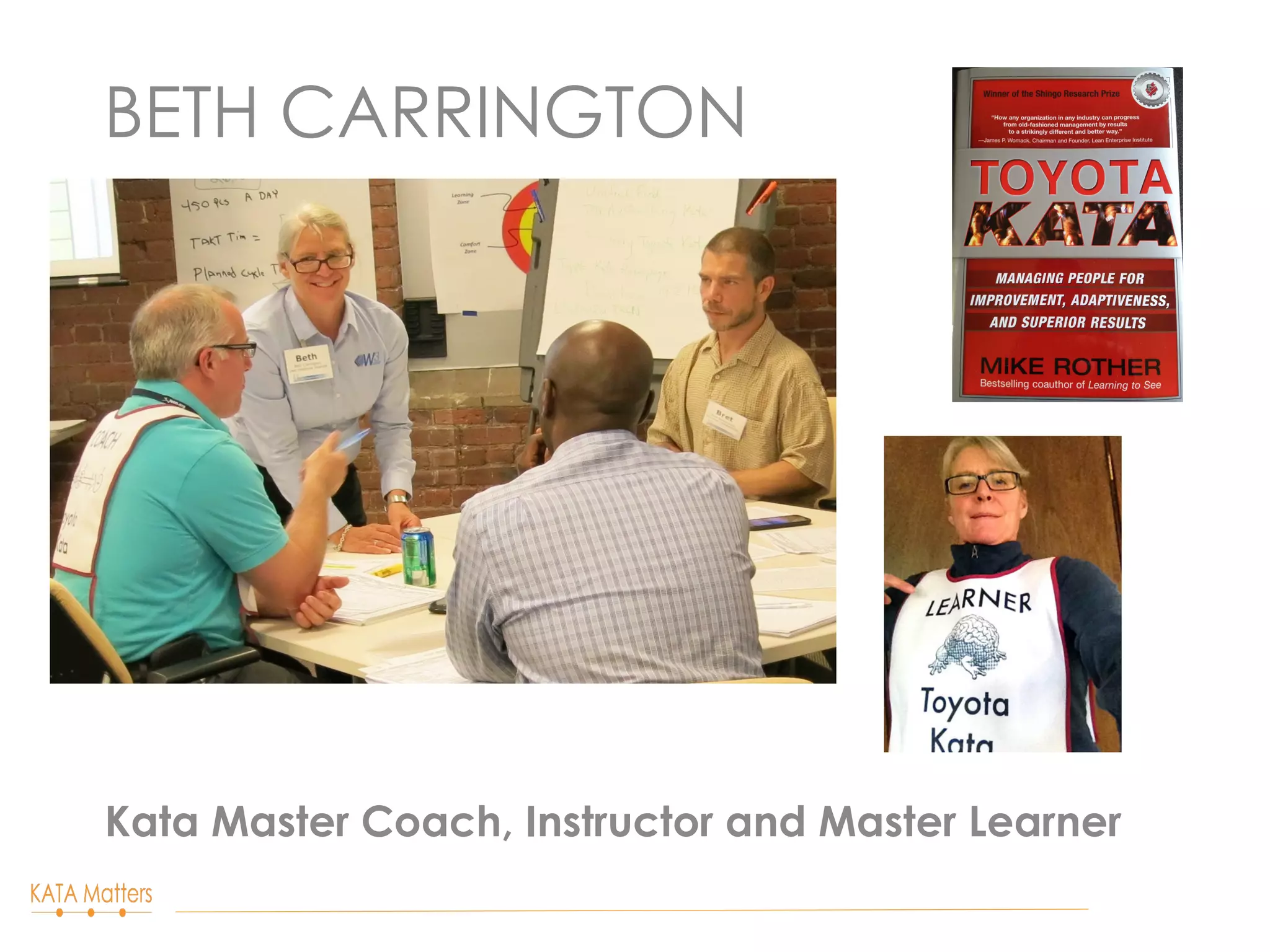
BETH CARRINGTON
Kata Master Coach, Instructor and Master Learner
Discussion
•  This presentation is intended to illustrate 5
common themes demonstrated in the
practice by Kata Skill @ Novice Learners and
Coaches.
•  I used a casual but real call with 2 CI coaches
at a Healthcare organization just a few short
weeks after their initial coached practice
workshop.
•  Corrective feedback to improve their practice
are linked to the role of the Advance Group
and a Kata Master Coach.
3
Kata Skill @ Novice
1.  Target Conditions too far
into the future.
2.  Target Conditions too
large, broad in scope
and/or reach.
3.  Metrics are unnecessarily
complicated.
4.  Obstacles large and/or
vague, not directly
observed.
5.  PDCA’s too large, listed
as Action Item not
experiment.
4
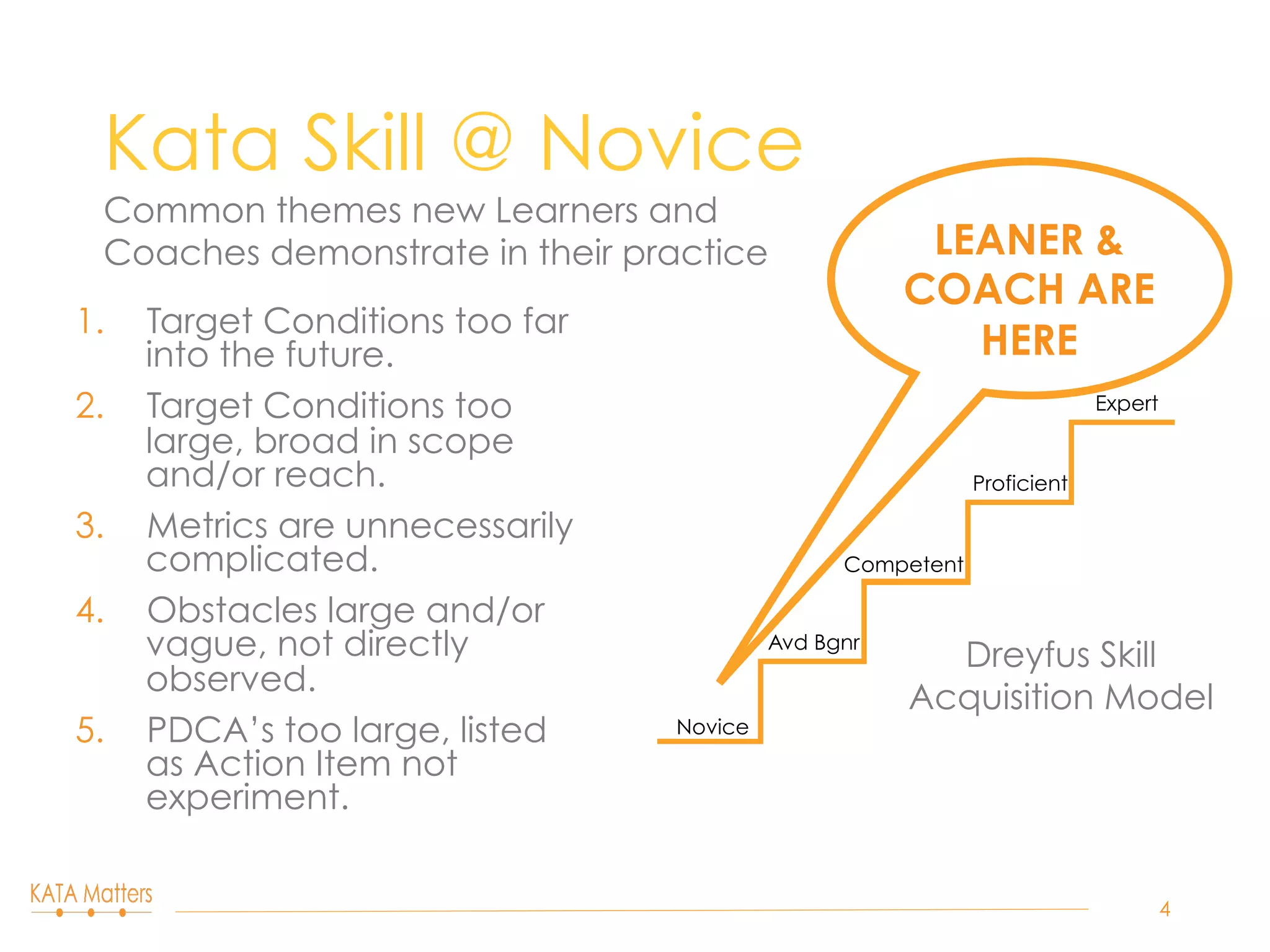
Common themes new Learners and
Coaches demonstrate in their practice
Novice
Avd Bgnr
Competent
Proficient
Expert
Dreyfus Skill
Acquisition Model
LEANER &
COACH ARE
HERE
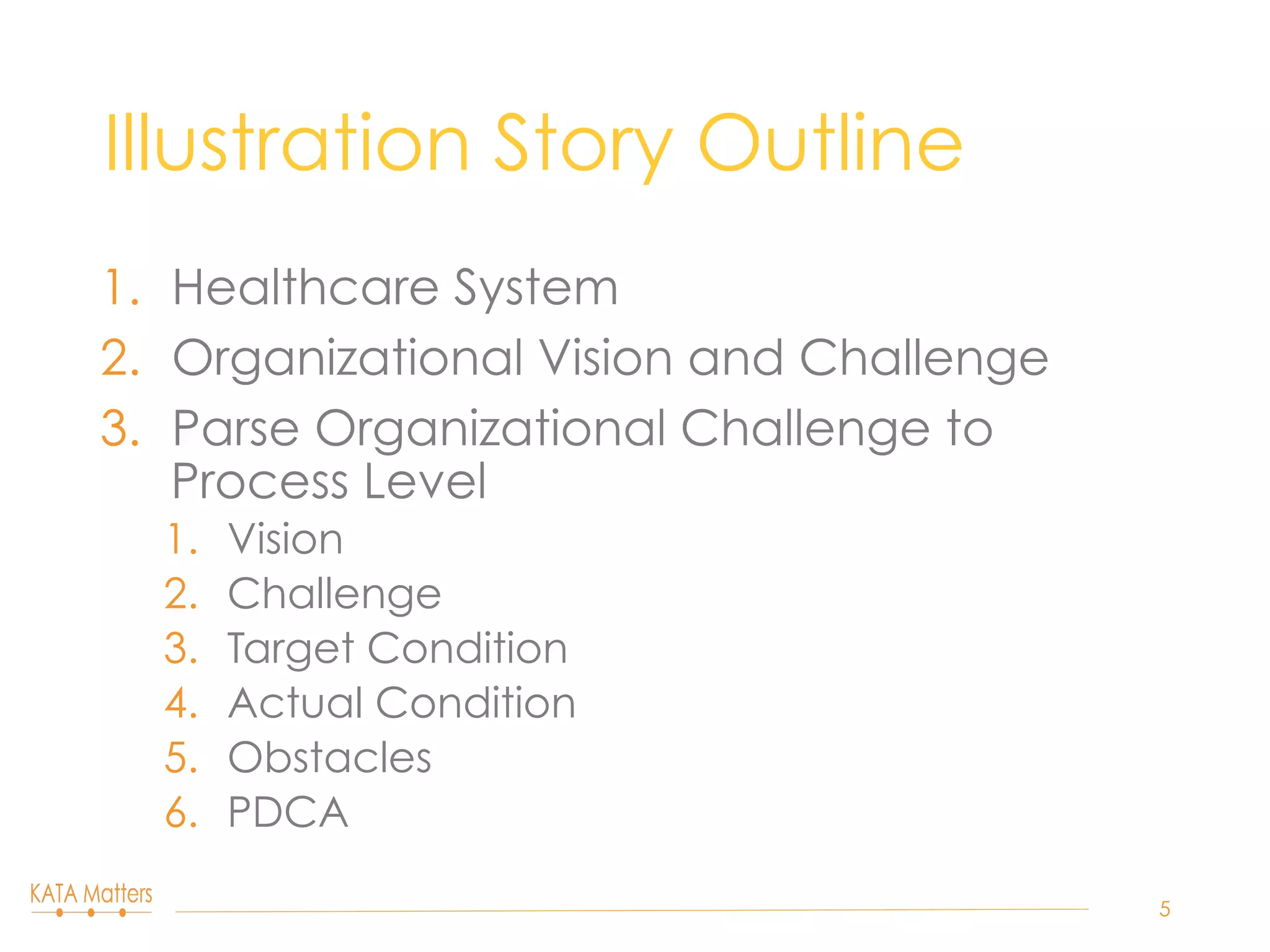
Illustration Story Outline
1.  Healthcare System
2.  Organizational Vision and Challenge
3.  Parse Organizational Challenge to
Process Level
1.  Vision
2.  Challenge
3.  Target Condition
4.  Actual Condition
5.  Obstacles
6.  PDCA
5
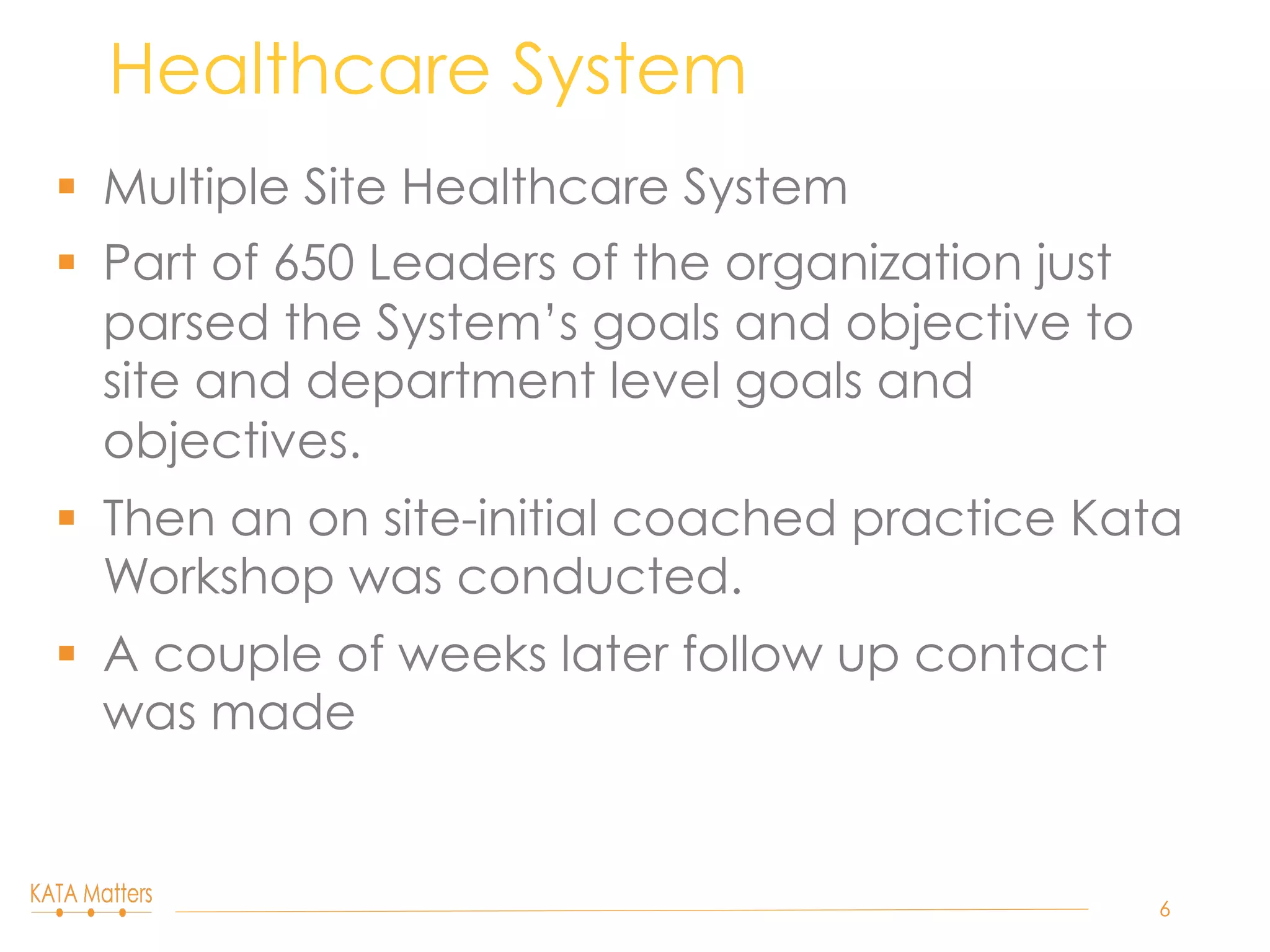
§  Multiple Site Healthcare System
§  Part of 650 Leaders of the organization just
parsed the System’s goals and objective to
site and department level goals and
objectives.
§  Then an on site-initial coached practice Kata
Workshop was conducted.
§  A couple of weeks later follow up contact
was made
Healthcare System
6
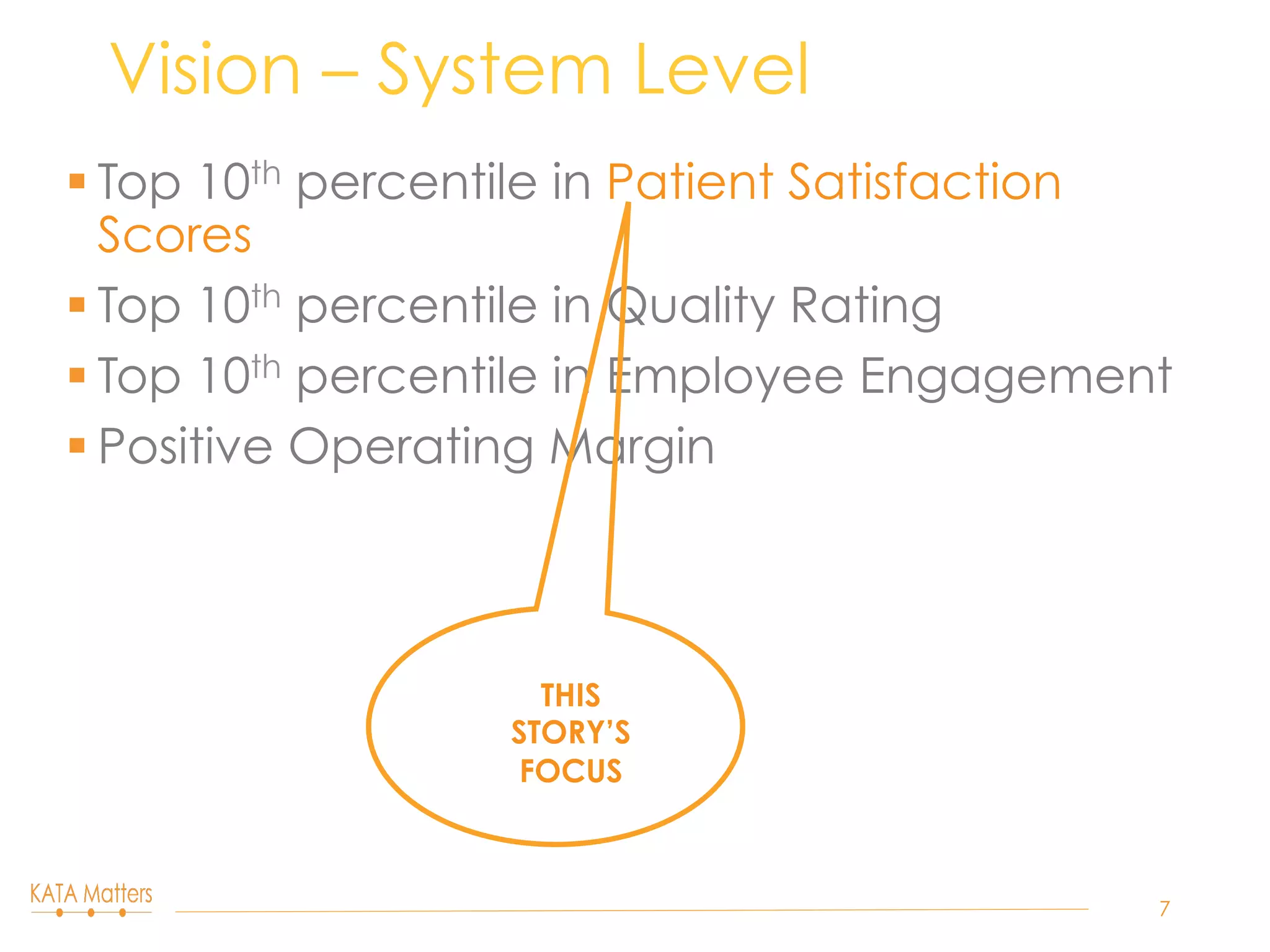
§ Top 10th percentile in Patient Satisfaction
Scores
§ Top 10th percentile in Quality Rating
§ Top 10th percentile in Employee Engagement
§ Positive Operating Margin
Vision – System Level
7
THIS
STORY’S
FOCUS
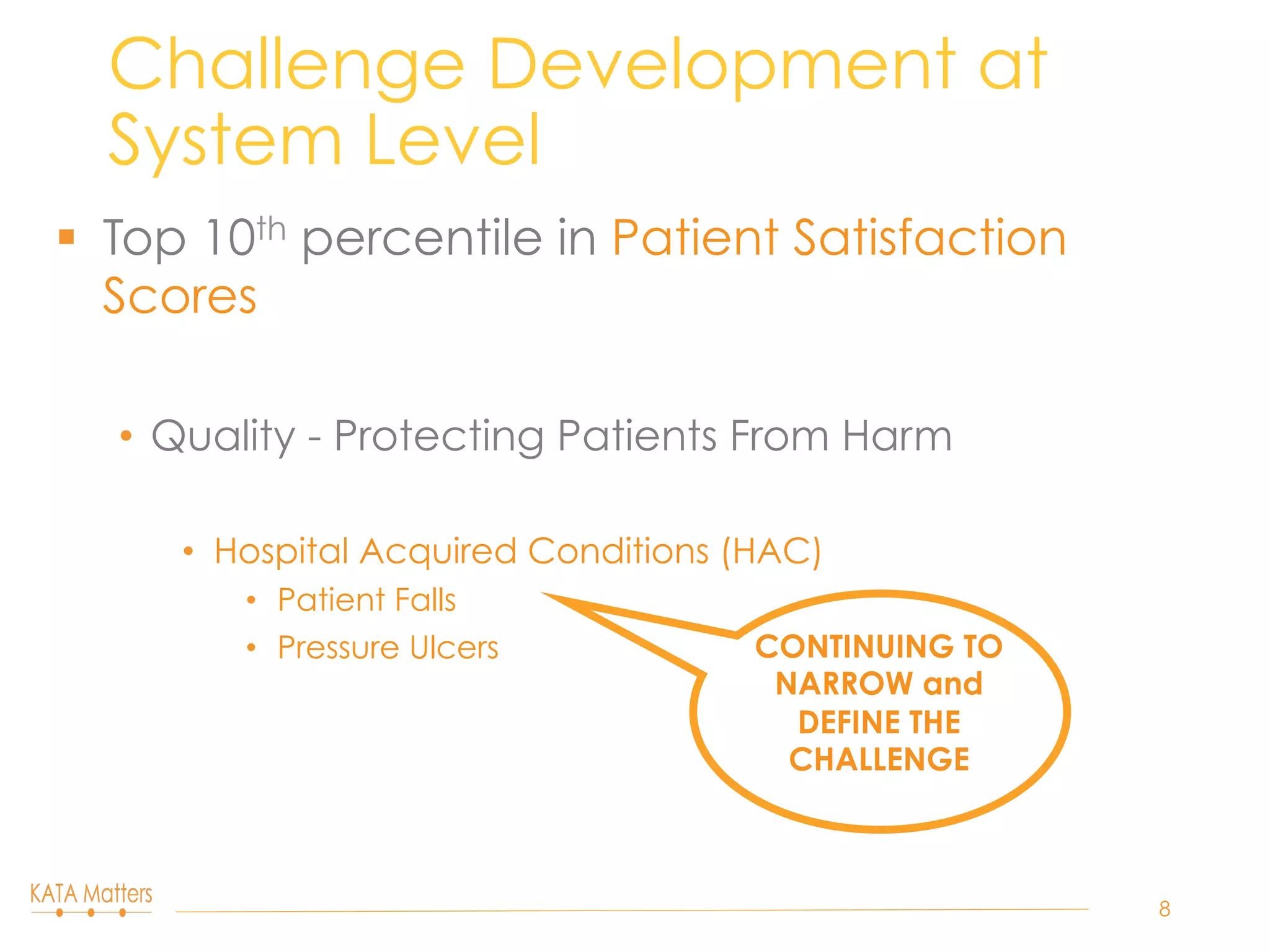
§  Top 10th percentile in Patient Satisfaction
Scores
•  Quality - Protecting Patients From Harm
•  Hospital Acquired Conditions (HAC)
•  Patient Falls
•  Pressure Ulcers
Challenge Development at
System Level
8
CONTINUING TO
NARROW and
DEFINE THE
CHALLENGE
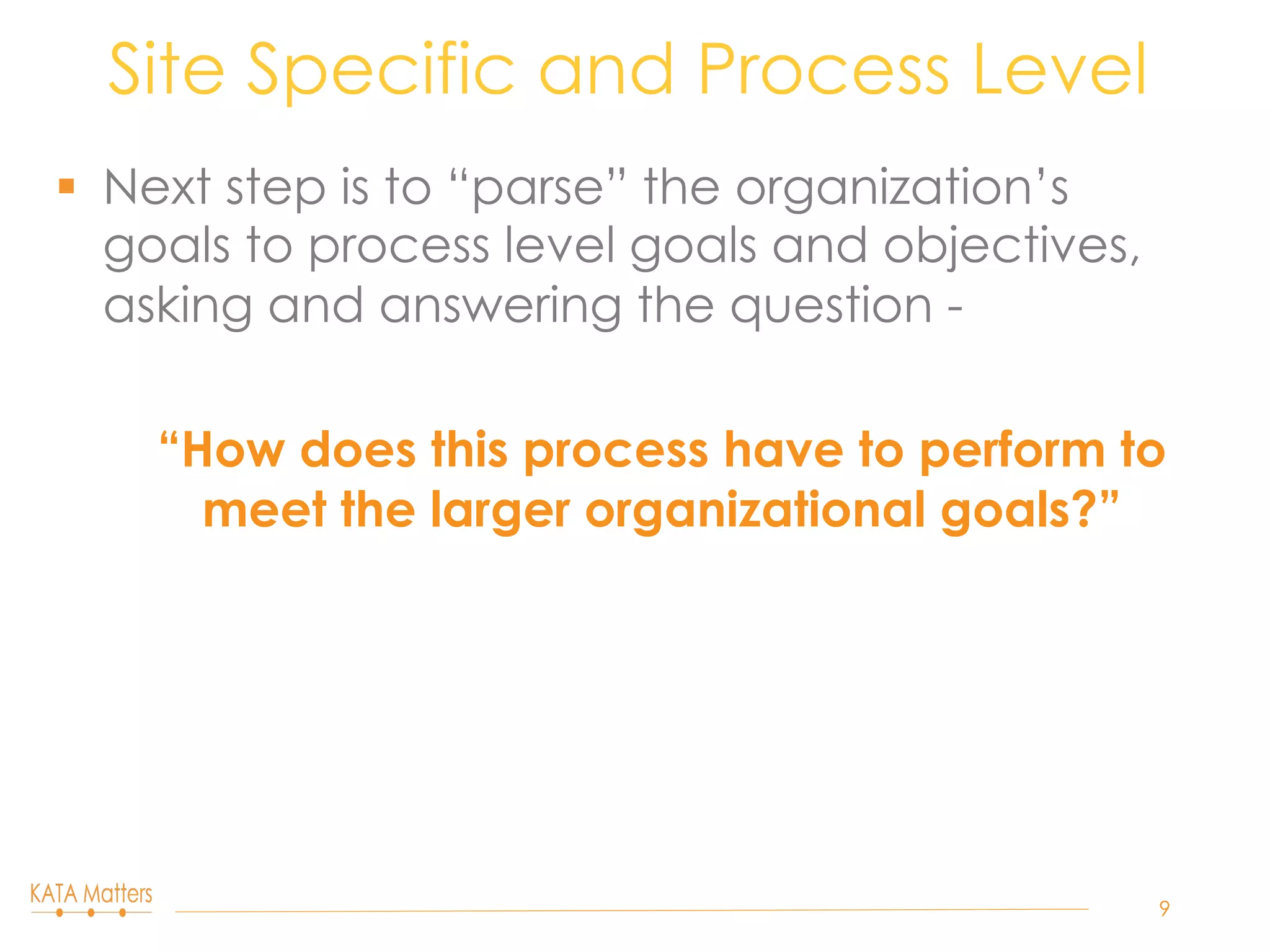
§  Next step is to “parse” the organization’s
goals to process level goals and objectives,
asking and answering the question -
“How does this process have to perform to
meet the larger organizational goals?”
Site Specific and Process Level
9
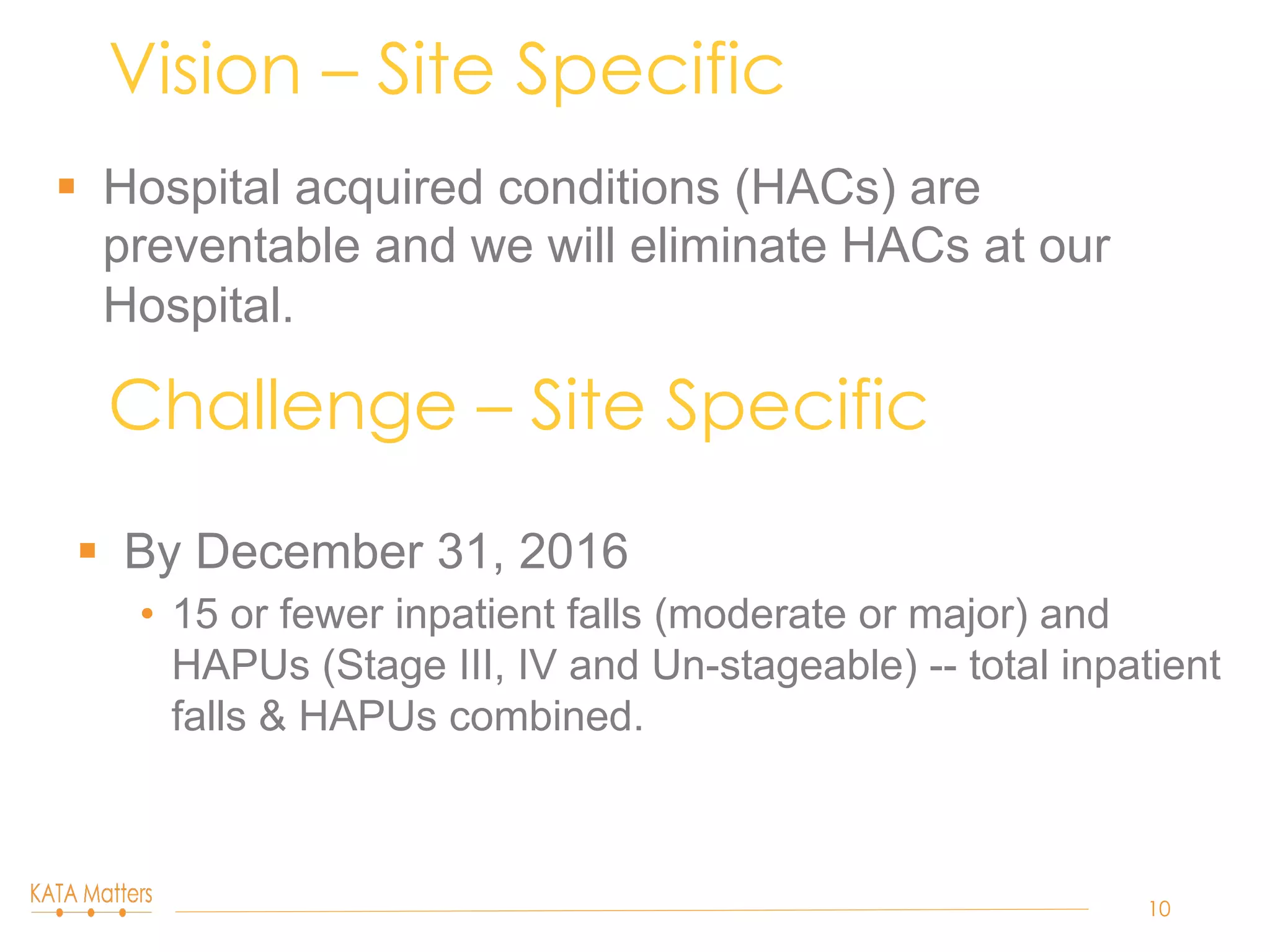
§  Hospital acquired conditions (HACs) are
preventable and we will eliminate HACs at our
Hospital.
Vision – Site Specific
10
Challenge – Site Specific
§  By December 31, 2016
•  15 or fewer inpatient falls (moderate or major) and
HAPUs (Stage III, IV and Un-stageable) -- total inpatient
falls & HAPUs combined.
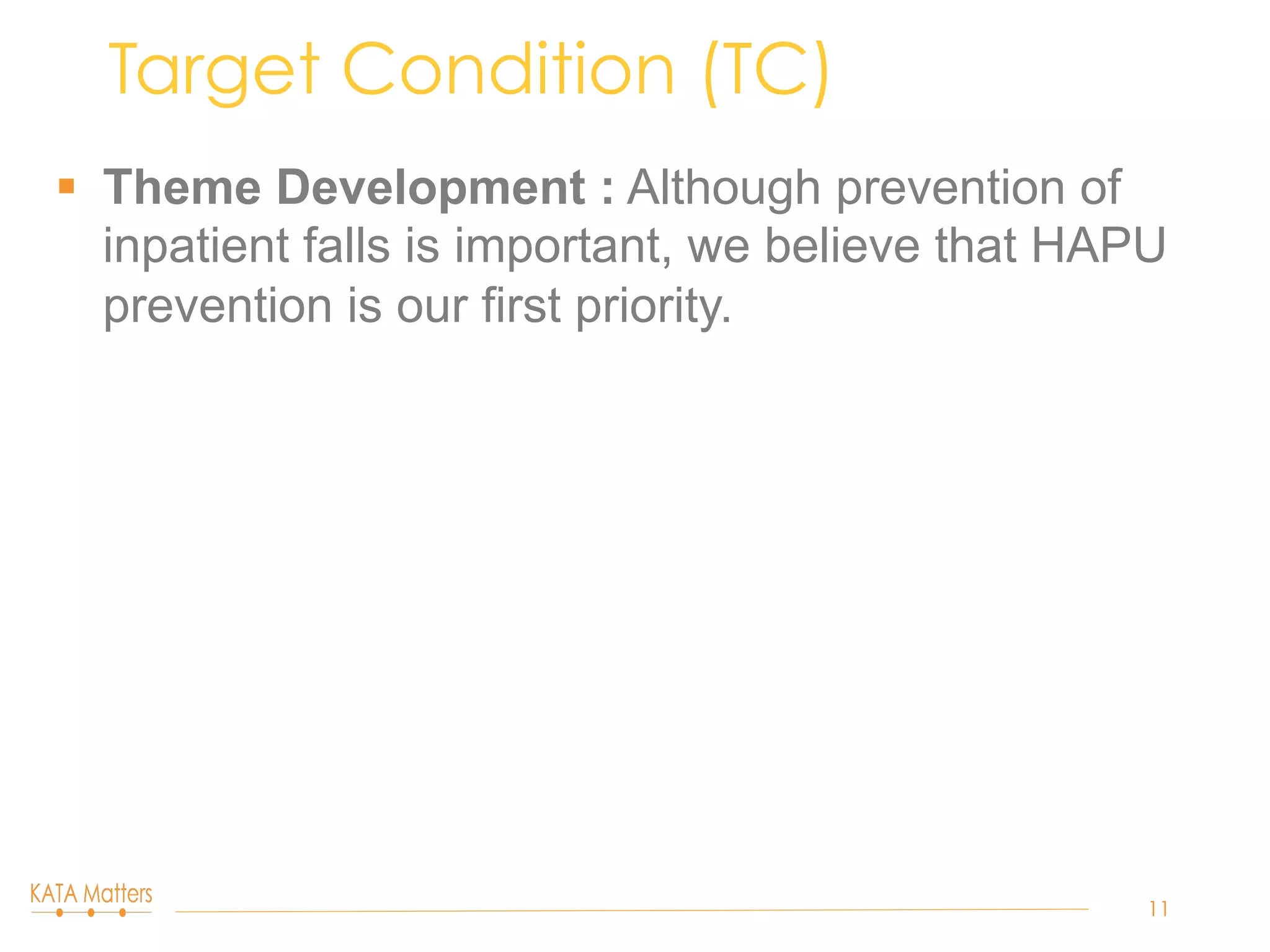
§  Theme Development : Although prevention of
inpatient falls is important, we believe that HAPU
prevention is our first priority.
Target Condition (TC)
11
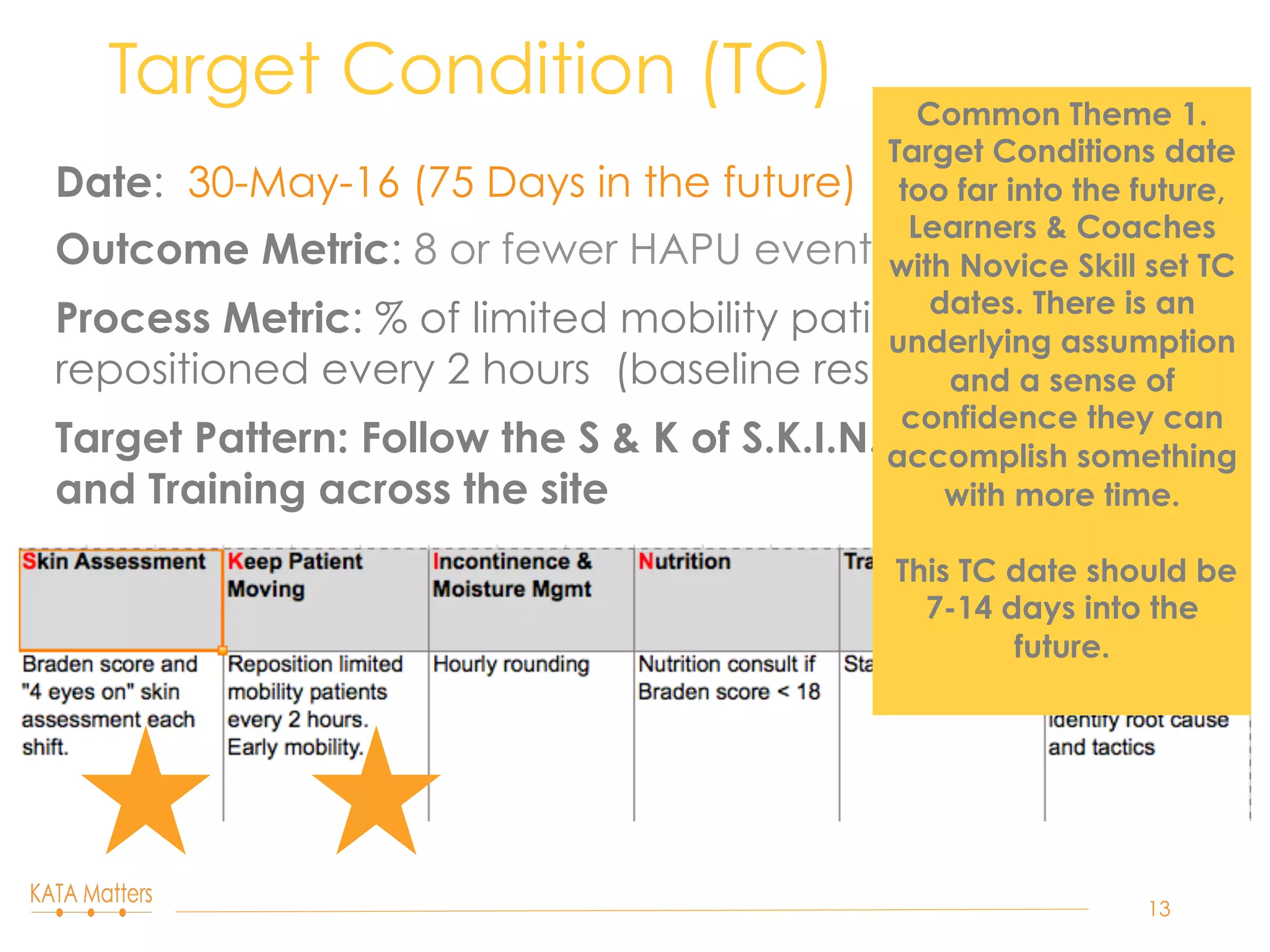
Date: 30-May-16 (75 Days in the future)
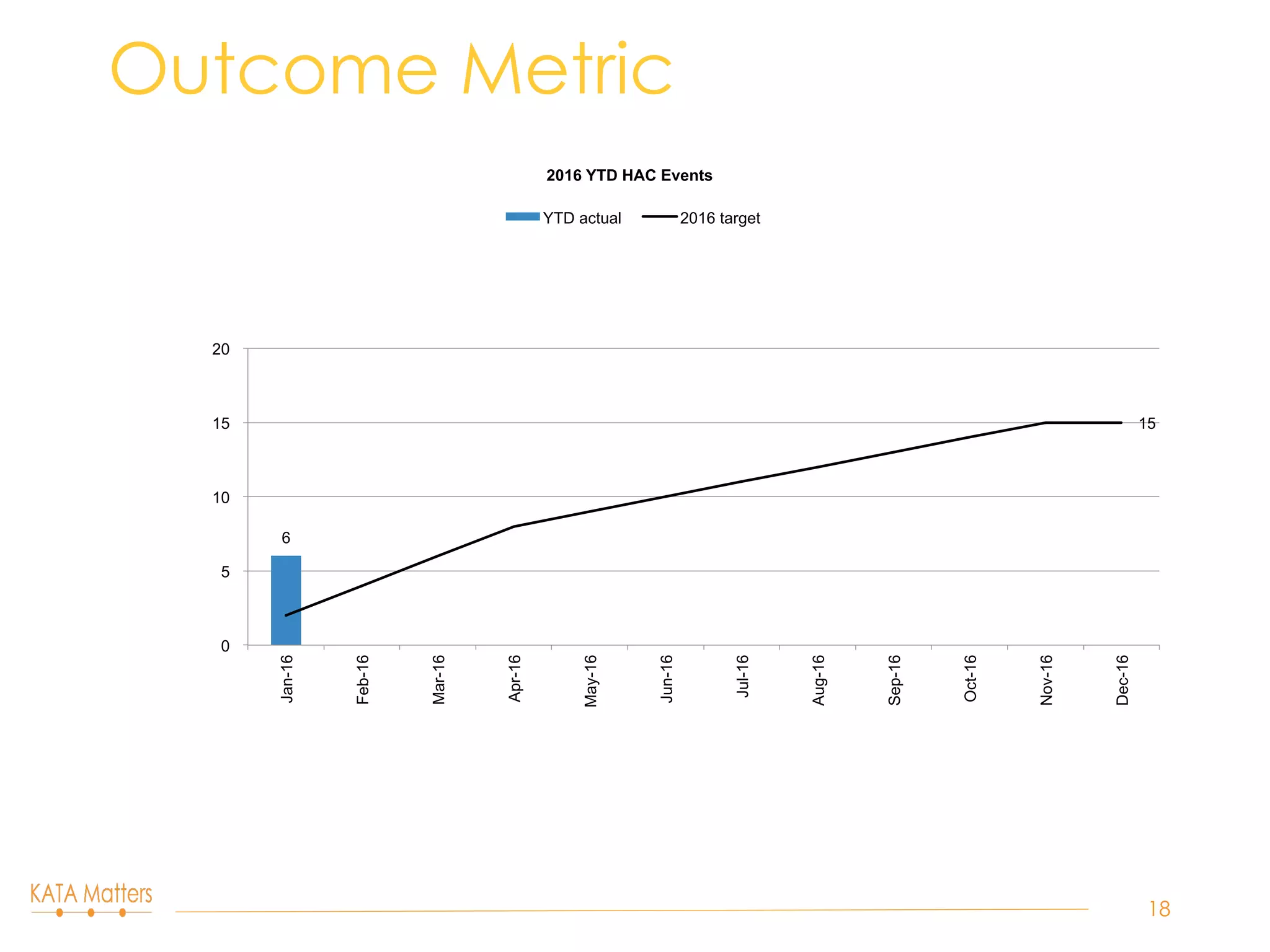
Outcome Metric: 8 or fewer HAPU events
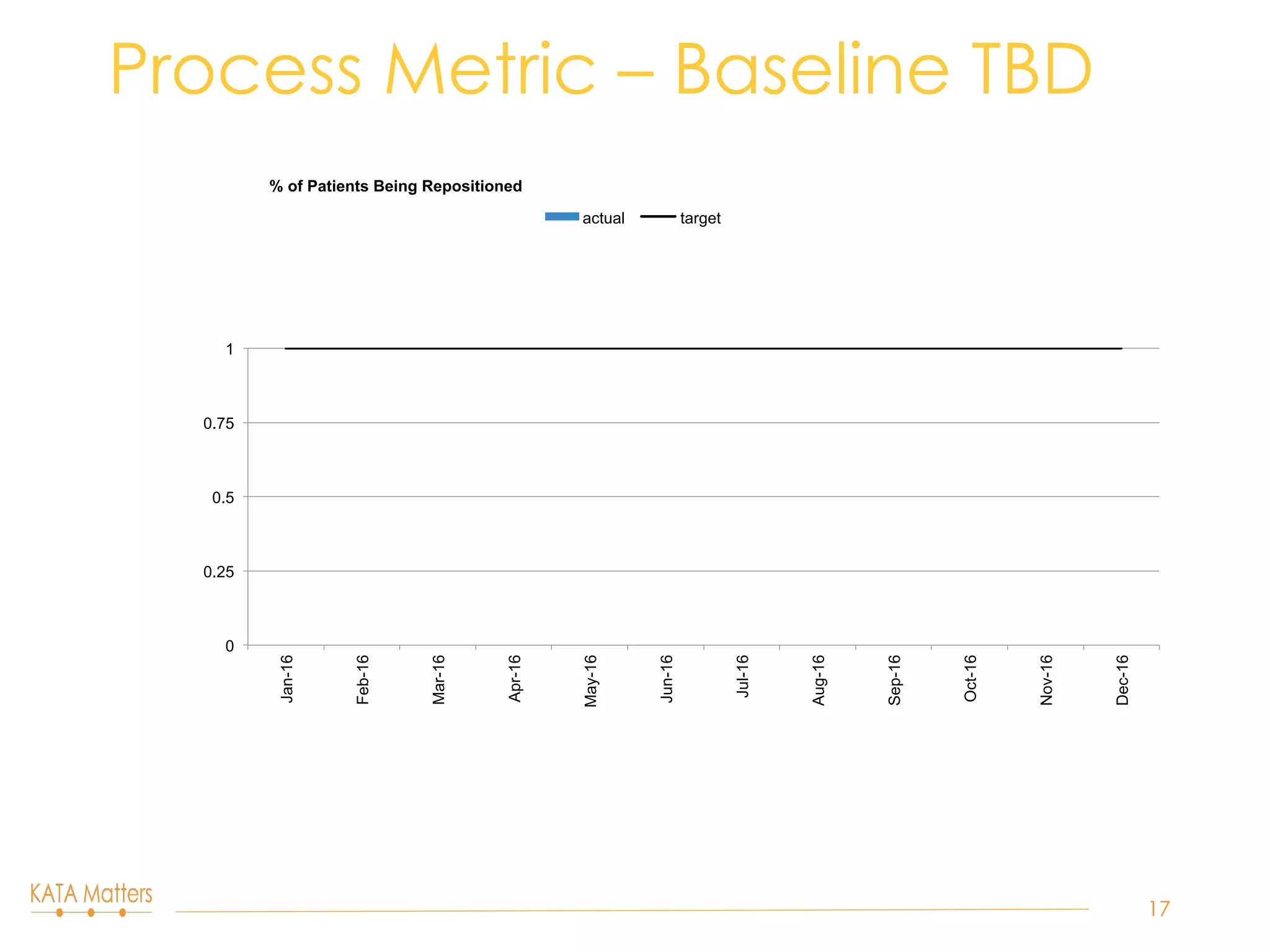
Process Metric: % of limited mobility patients being
repositioned every 2 hours (baseline results TBD)
Target Pattern: Follow the S & K of S.K.I.N., Inspection
and Training across the site
Target Condition (TC)
12
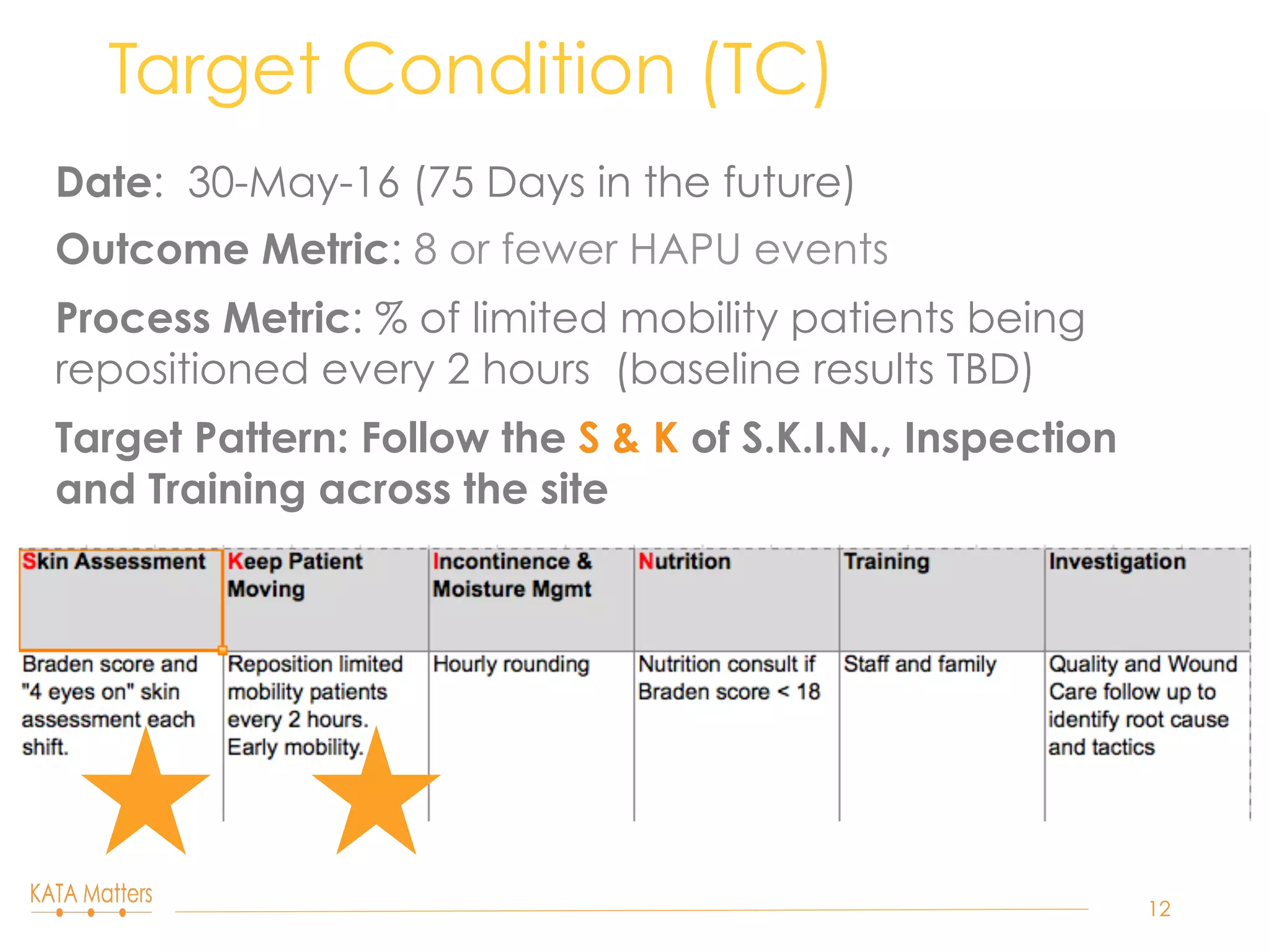
Date: 30-May-16 (75 Days in the future)
Outcome Metric: 8 or fewer HAPU events
Process Metric: % of limited mobility patients being
repositioned every 2 hours (baseline results TBD)
Target Pattern: Follow the S & K of S.K.I.N., Inspection
and Training across the site
Target Condition (TC)
13
Common Theme 1.
Target Conditions date
too far into the future,
Learners & Coaches
with Novice Skill set TC
dates. There is an
underlying assumption
and a sense of
confidence they can
accomplish something
with more time.
This TC date should be
7-14 days into the
future.
Date: 30-May-16 (75 Days in the future)
Outcome Metric: 8 or fewer HAPU events
Process Metric: % of limited mobility patients being
repositioned every 2 hours (baseline results TBD)
Target Pattern: Follow the S & K of S.K.I.N., Inspection
and Training across the site
Target Condition (TC)
14
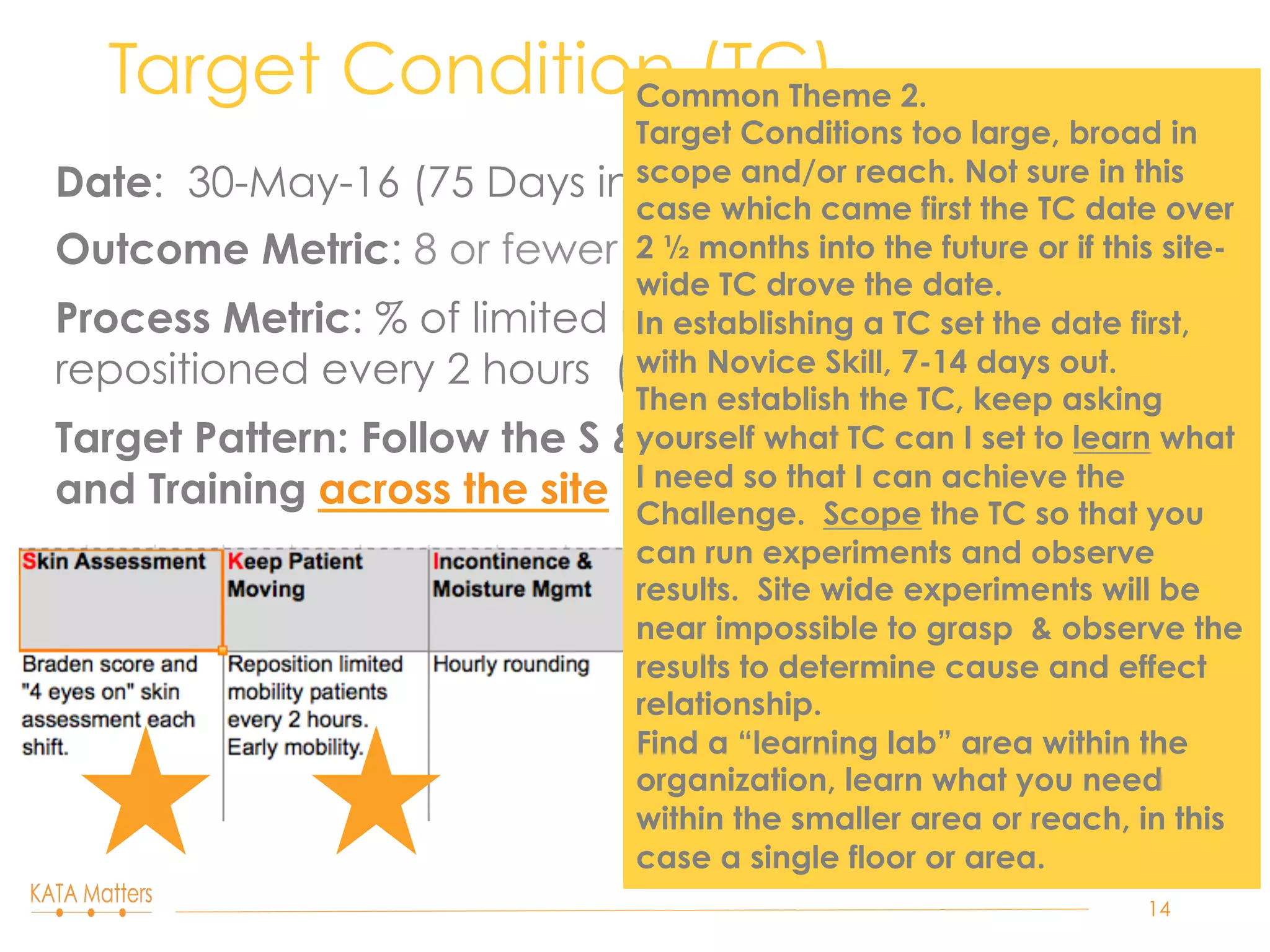
Common Theme 2.
Target Conditions too large, broad in
scope and/or reach. Not sure in this
case which came first the TC date over
2 ½ months into the future or if this site-
wide TC drove the date.
In establishing a TC set the date first,
with Novice Skill, 7-14 days out.
Then establish the TC, keep asking
yourself what TC can I set to learn what
I need so that I can achieve the
Challenge. Scope the TC so that you
can run experiments and observe
results. Site wide experiments will be
near impossible to grasp & observe the
results to determine cause and effect
relationship.
Find a “learning lab” area within the
organization, learn what you need
within the smaller area or reach, in this
case a single floor or area.
Date: 30-May-16 (75 Days in the future)
Outcome Metric: 8 or fewer HAPU events
Process Metric: % of limited mobility patients being
repositioned every 2 hours (baseline results TBD)
Target Pattern: Follow the S & K of S.K.I.N., Inspection
and Training across the site
Target Condition (TC)
15
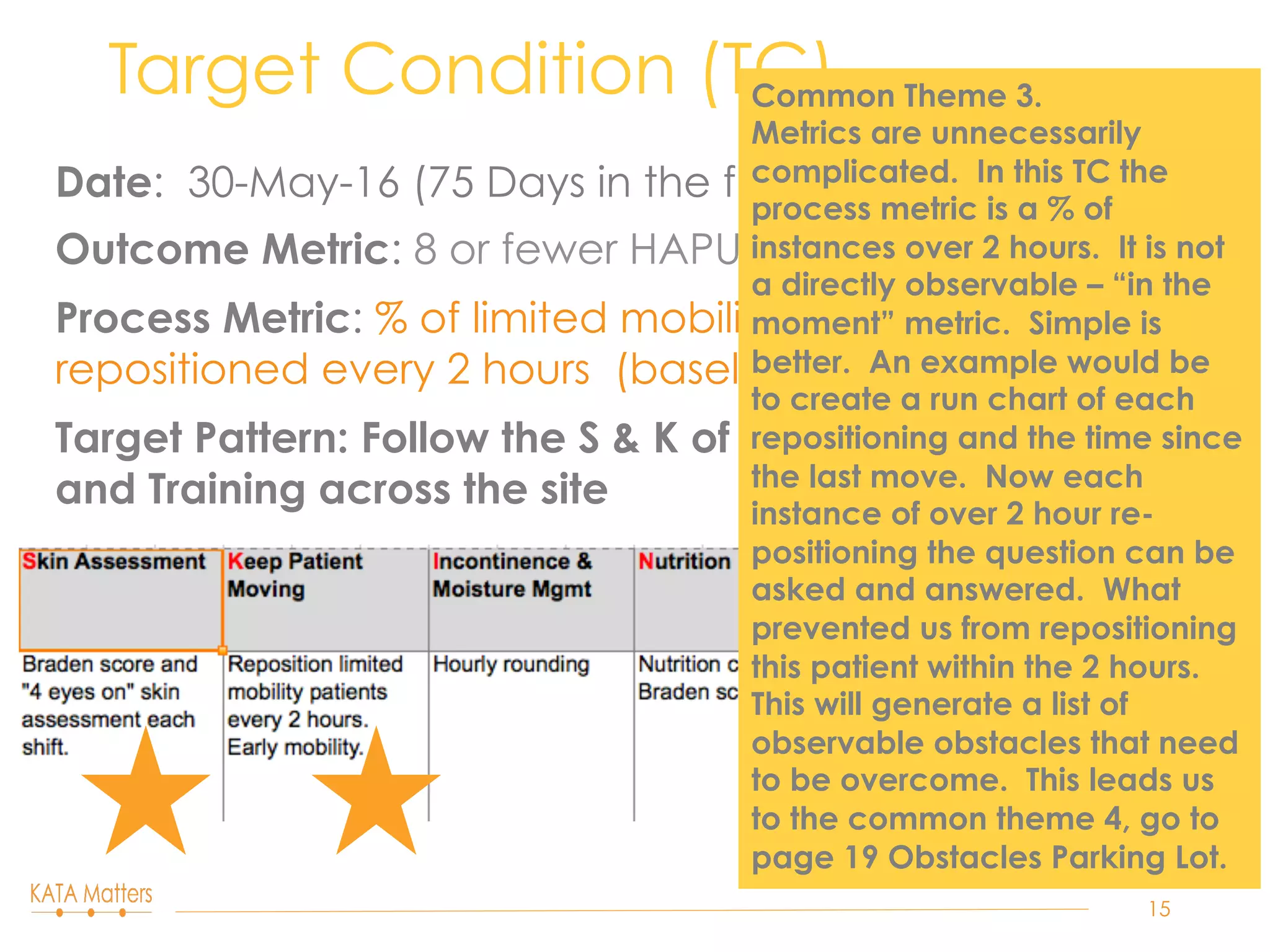
Common Theme 3.
Metrics are unnecessarily
complicated. In this TC the
process metric is a % of
instances over 2 hours. It is not
a directly observable – “in the
moment” metric. Simple is
better. An example would be
to create a run chart of each
repositioning and the time since
the last move. Now each
instance of over 2 hour re-
positioning the question can be
asked and answered. What
prevented us from repositioning
this patient within the 2 hours.
This will generate a list of
observable obstacles that need
to be overcome. This leads us
to the common theme 4, go to
page 19 Obstacles Parking Lot.
Current Condition
16
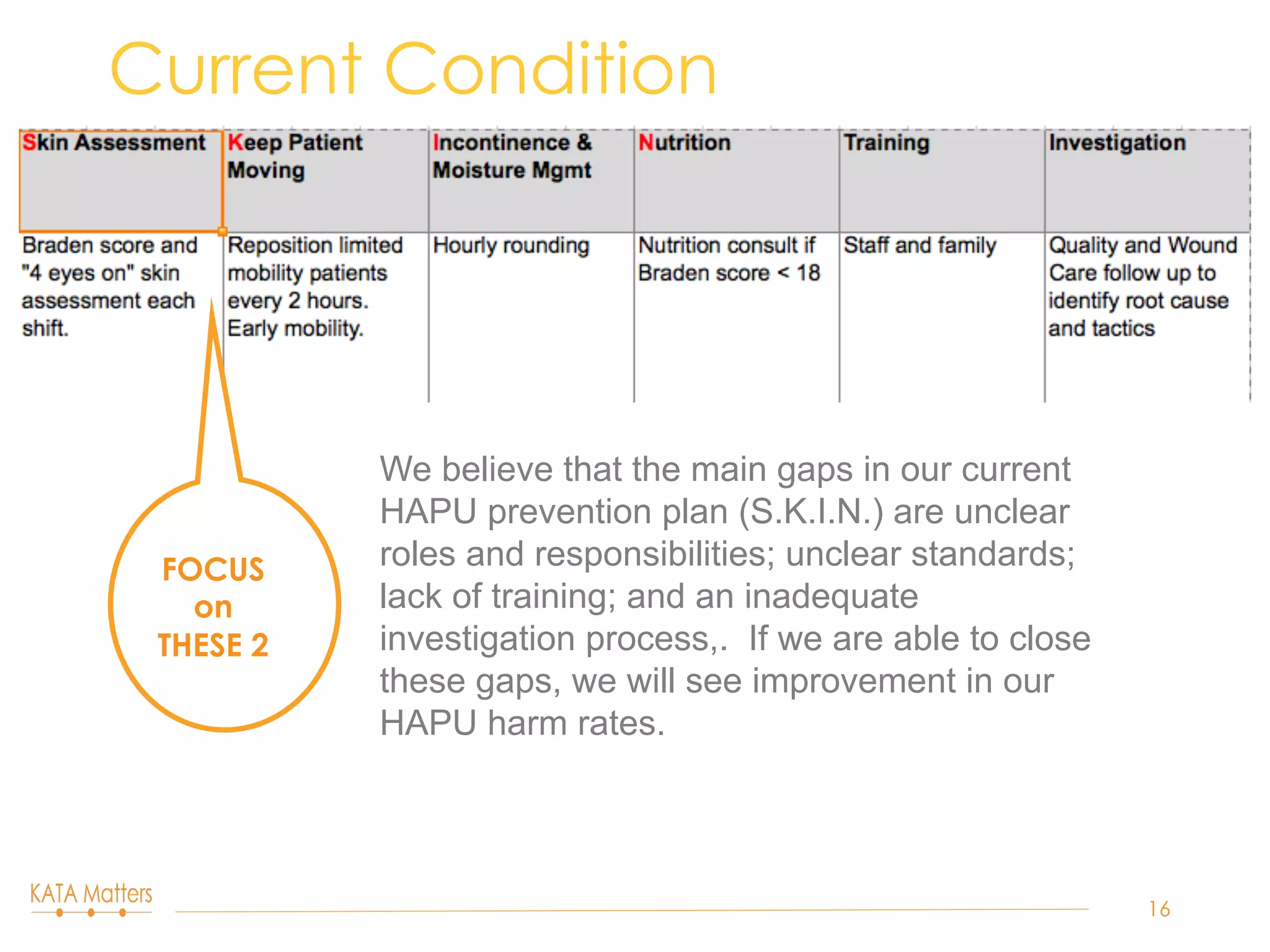
FOCUS
on
THESE 2
We believe that the main gaps in our current
HAPU prevention plan (S.K.I.N.) are unclear
roles and responsibilities; unclear standards;
lack of training; and an inadequate
investigation process,. If we are able to close
these gaps, we will see improvement in our
HAPU harm rates.
Process Metric – Baseline TBD
17
0
0.25
0.5
0.75
1
Jan-16
Feb-16
Mar-16
Apr-16
May-16
Jun-16
Jul-16
Aug-16
Sep-16
Oct-16
Nov-16
Dec-16
% of Patients Being Repositioned
actual target
Outcome Metric
18
6
15
0
5
10
15
20
Jan-16
Feb-16
Mar-16
Apr-16
May-16
Jun-16
Jul-16
Aug-16
Sep-16
Oct-16
Nov-16
Dec-16
2016 YTD HAC Events
YTD actual 2016 target
§  Variation in
understanding of
expectations for S.K.I.N.
protocols (who, what,
when)
§  Inadequate standard/
expectation for "4 eyes
on" skin assessment
Obstacles
19
Common Theme 4.
Obstacles large and/or
vague, not directly
observed. With a broad TC,
obstacles typically become
fuzzy, not observed but
intuitively developed.
As stated in the prior
conversation box, with a
crisp/focused TC and a
directly measurable and “in
the moment” process
metric, obstacles are easily
recognized and observed.
I.E. What prevented us from
repositioning that patient
within 2 hour expectation.
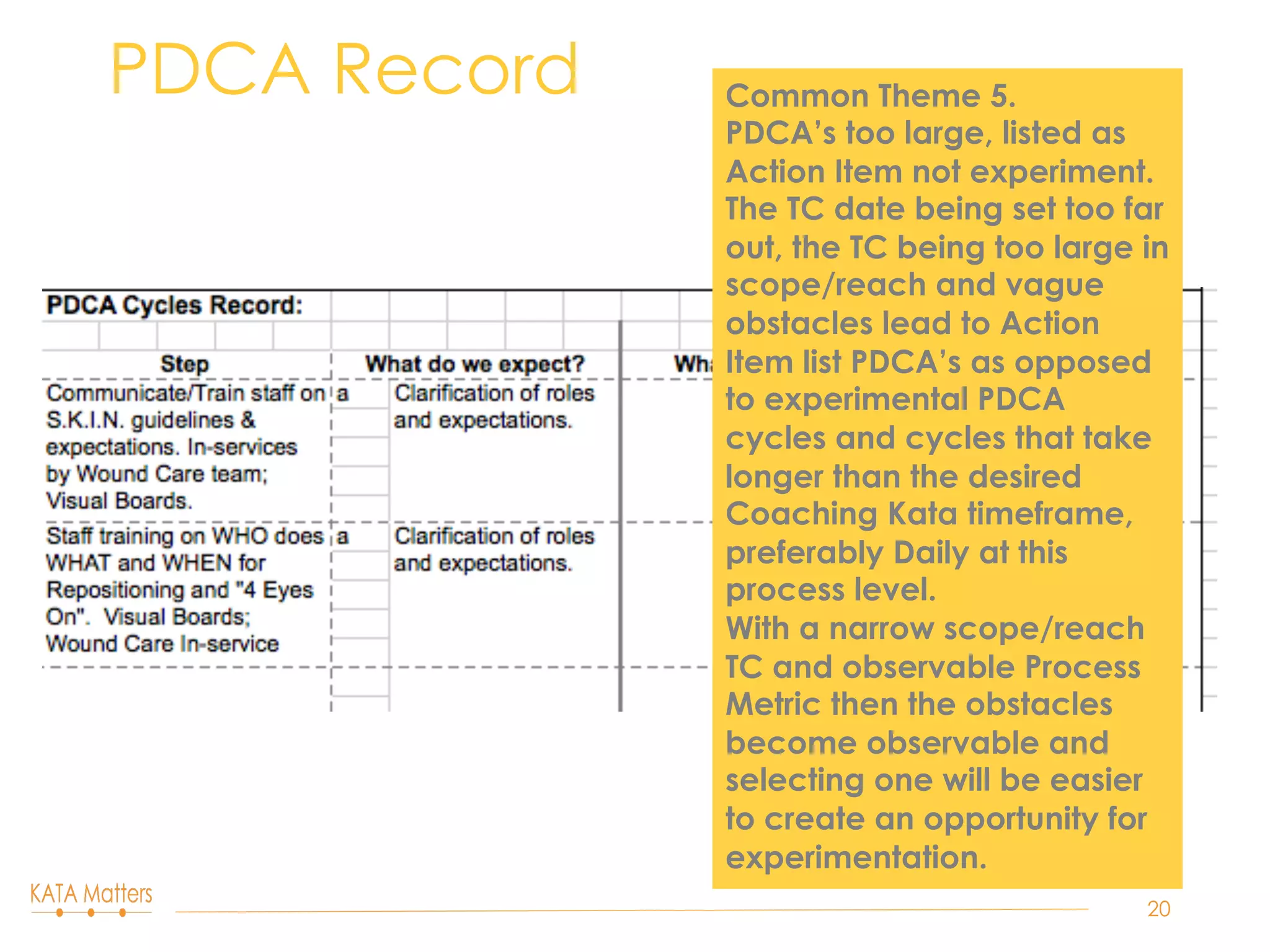
PDCA Record
20
Common Theme 5.
PDCA’s too large, listed as
Action Item not experiment.
The TC date being set too far
out, the TC being too large in
scope/reach and vague
obstacles lead to Action
Item list PDCA’s as opposed
to experimental PDCA
cycles and cycles that take
longer than the desired
Coaching Kata timeframe,
preferably Daily at this
process level.
With a narrow scope/reach
TC and observable Process
Metric then the obstacles
become observable and
selecting one will be easier
to create an opportunity for
experimentation.
Kata Skill @ Novice
1.  Target Conditions too far
into the future.
2.  Target Conditions too
large, broad in scope
and/or reach.
3.  Metrics are unnecessarily
complicated.
4.  Obstacles large and/or
vague, not directly
observed.
5.  PDCA’s too large, listed
as Action Item not
experiment.
21
Common themes new Learners and
Coaches demonstrate in their practice
Novice
Avd Bgnr
Competent
Proficient
Expert
Dreyfus Skill
Acquisition Model
LEANER &
COACH ARE
HERE
§  Experience shows that creating an active
and engaged Advance Group helps an
organization create competent coaching
capacity more quickly.
§  Learners and Coaches @ Novice Kata Skill
engaged with a Kata Master Coach also
build their coaching capability (skill) to
competent more quickly.
Avoid these Common Themes
22
Wishing you success in your Kata Deployment!
Kata, kata, kata...
Beth
Beth.Carrington@KATAMatters.com

Kata skill @ novice: 5 Common Themes of Novice Skill

  • 1.
    Kata Skill @Novice Common Themes Illustrated with a Healthcare Example Beth Carrington 1
  • 2.
    BETH CARRINGTON Kata MasterCoach, Instructor and Master Learner
  • 3.
    Discussion •  This presentationis intended to illustrate 5 common themes demonstrated in the practice by Kata Skill @ Novice Learners and Coaches. •  I used a casual but real call with 2 CI coaches at a Healthcare organization just a few short weeks after their initial coached practice workshop. •  Corrective feedback to improve their practice are linked to the role of the Advance Group and a Kata Master Coach. 3
  • 4.
    Kata Skill @Novice 1.  Target Conditions too far into the future. 2.  Target Conditions too large, broad in scope and/or reach. 3.  Metrics are unnecessarily complicated. 4.  Obstacles large and/or vague, not directly observed. 5.  PDCA’s too large, listed as Action Item not experiment. 4 Common themes new Learners and Coaches demonstrate in their practice Novice Avd Bgnr Competent Proficient Expert Dreyfus Skill Acquisition Model LEANER & COACH ARE HERE
  • 5.
    Illustration Story Outline 1. Healthcare System 2.  Organizational Vision and Challenge 3.  Parse Organizational Challenge to Process Level 1.  Vision 2.  Challenge 3.  Target Condition 4.  Actual Condition 5.  Obstacles 6.  PDCA 5
  • 6.
    §  Multiple SiteHealthcare System §  Part of 650 Leaders of the organization just parsed the System’s goals and objective to site and department level goals and objectives. §  Then an on site-initial coached practice Kata Workshop was conducted. §  A couple of weeks later follow up contact was made Healthcare System 6
  • 7.
    § Top 10th percentilein Patient Satisfaction Scores § Top 10th percentile in Quality Rating § Top 10th percentile in Employee Engagement § Positive Operating Margin Vision – System Level 7 THIS STORY’S FOCUS
  • 8.
    §  Top 10thpercentile in Patient Satisfaction Scores •  Quality - Protecting Patients From Harm •  Hospital Acquired Conditions (HAC) •  Patient Falls •  Pressure Ulcers Challenge Development at System Level 8 CONTINUING TO NARROW and DEFINE THE CHALLENGE
  • 9.
    §  Next stepis to “parse” the organization’s goals to process level goals and objectives, asking and answering the question - “How does this process have to perform to meet the larger organizational goals?” Site Specific and Process Level 9
  • 10.
    §  Hospital acquiredconditions (HACs) are preventable and we will eliminate HACs at our Hospital. Vision – Site Specific 10 Challenge – Site Specific §  By December 31, 2016 •  15 or fewer inpatient falls (moderate or major) and HAPUs (Stage III, IV and Un-stageable) -- total inpatient falls & HAPUs combined.
  • 11.
    §  Theme Development: Although prevention of inpatient falls is important, we believe that HAPU prevention is our first priority. Target Condition (TC) 11
  • 12.
    Date: 30-May-16 (75Days in the future) Outcome Metric: 8 or fewer HAPU events Process Metric: % of limited mobility patients being repositioned every 2 hours (baseline results TBD) Target Pattern: Follow the S & K of S.K.I.N., Inspection and Training across the site Target Condition (TC) 12
  • 13.
    Date: 30-May-16 (75Days in the future) Outcome Metric: 8 or fewer HAPU events Process Metric: % of limited mobility patients being repositioned every 2 hours (baseline results TBD) Target Pattern: Follow the S & K of S.K.I.N., Inspection and Training across the site Target Condition (TC) 13 Common Theme 1. Target Conditions date too far into the future, Learners & Coaches with Novice Skill set TC dates. There is an underlying assumption and a sense of confidence they can accomplish something with more time. This TC date should be 7-14 days into the future.
  • 14.
    Date: 30-May-16 (75Days in the future) Outcome Metric: 8 or fewer HAPU events Process Metric: % of limited mobility patients being repositioned every 2 hours (baseline results TBD) Target Pattern: Follow the S & K of S.K.I.N., Inspection and Training across the site Target Condition (TC) 14 Common Theme 2. Target Conditions too large, broad in scope and/or reach. Not sure in this case which came first the TC date over 2 ½ months into the future or if this site- wide TC drove the date. In establishing a TC set the date first, with Novice Skill, 7-14 days out. Then establish the TC, keep asking yourself what TC can I set to learn what I need so that I can achieve the Challenge. Scope the TC so that you can run experiments and observe results. Site wide experiments will be near impossible to grasp & observe the results to determine cause and effect relationship. Find a “learning lab” area within the organization, learn what you need within the smaller area or reach, in this case a single floor or area.
  • 15.
    Date: 30-May-16 (75Days in the future) Outcome Metric: 8 or fewer HAPU events Process Metric: % of limited mobility patients being repositioned every 2 hours (baseline results TBD) Target Pattern: Follow the S & K of S.K.I.N., Inspection and Training across the site Target Condition (TC) 15 Common Theme 3. Metrics are unnecessarily complicated. In this TC the process metric is a % of instances over 2 hours. It is not a directly observable – “in the moment” metric. Simple is better. An example would be to create a run chart of each repositioning and the time since the last move. Now each instance of over 2 hour re- positioning the question can be asked and answered. What prevented us from repositioning this patient within the 2 hours. This will generate a list of observable obstacles that need to be overcome. This leads us to the common theme 4, go to page 19 Obstacles Parking Lot.
  • 16.
    Current Condition 16 FOCUS on THESE 2 Webelieve that the main gaps in our current HAPU prevention plan (S.K.I.N.) are unclear roles and responsibilities; unclear standards; lack of training; and an inadequate investigation process,. If we are able to close these gaps, we will see improvement in our HAPU harm rates.
  • 17.
    Process Metric –Baseline TBD 17 0 0.25 0.5 0.75 1 Jan-16 Feb-16 Mar-16 Apr-16 May-16 Jun-16 Jul-16 Aug-16 Sep-16 Oct-16 Nov-16 Dec-16 % of Patients Being Repositioned actual target
  • 18.
  • 19.
    §  Variation in understandingof expectations for S.K.I.N. protocols (who, what, when) §  Inadequate standard/ expectation for "4 eyes on" skin assessment Obstacles 19 Common Theme 4. Obstacles large and/or vague, not directly observed. With a broad TC, obstacles typically become fuzzy, not observed but intuitively developed. As stated in the prior conversation box, with a crisp/focused TC and a directly measurable and “in the moment” process metric, obstacles are easily recognized and observed. I.E. What prevented us from repositioning that patient within 2 hour expectation.
  • 20.
    PDCA Record 20 Common Theme5. PDCA’s too large, listed as Action Item not experiment. The TC date being set too far out, the TC being too large in scope/reach and vague obstacles lead to Action Item list PDCA’s as opposed to experimental PDCA cycles and cycles that take longer than the desired Coaching Kata timeframe, preferably Daily at this process level. With a narrow scope/reach TC and observable Process Metric then the obstacles become observable and selecting one will be easier to create an opportunity for experimentation.
  • 21.
    Kata Skill @Novice 1.  Target Conditions too far into the future. 2.  Target Conditions too large, broad in scope and/or reach. 3.  Metrics are unnecessarily complicated. 4.  Obstacles large and/or vague, not directly observed. 5.  PDCA’s too large, listed as Action Item not experiment. 21 Common themes new Learners and Coaches demonstrate in their practice Novice Avd Bgnr Competent Proficient Expert Dreyfus Skill Acquisition Model LEANER & COACH ARE HERE
  • 22.
    §  Experience showsthat creating an active and engaged Advance Group helps an organization create competent coaching capacity more quickly. §  Learners and Coaches @ Novice Kata Skill engaged with a Kata Master Coach also build their coaching capability (skill) to competent more quickly. Avoid these Common Themes 22
  • 23.
    Wishing you successin your Kata Deployment! Kata, kata, kata... Beth Beth.Carrington@KATAMatters.com