Managing healthcare quality and safety
1.Seeing things how they are
2.How the work works
3.Data driven leadership
4.Capacity and capability
5.Psychological safety
6.Prosjectitis or a plan?
7.Personals leadership
Managing healthcare quality and safety
1.Seeing things how they are
2.How the work works
3.Data driven leadership
4.Capacity and capability
5.Psychological safety
6.Prosjectitis or a plan?
7.Personals leadership
”What we observe is not nature itself, but nature
exposed to our method of questioning.”
Werner Heisenberg
Seeing
things how
they are
”Every problem seems to cry out in its own language”
Thomas Transtrømer
“I call it cruel, perhaps the root of all
cruelty to know what occurs, but not
recognize the fact.”
William Stafford
Seeing
things how
they are
How the
work
works
Work as imagined – nominal work
System input is regular and
predictable
Demands and resources are
compatible.
Working conditions fall within normal
limits.
Other people behave as
prescribed
Output (actions) will comply
with norms.
… no need to make adjustments
©Erik Hollnagel 2015
Work as done – actual work
System input may be irregular
and unpredictable
Demands vary and resources may be
inadequate.
Working conditions may at times be
sub-optimal.
Other people behave
egocentrically
Output (actions) will vary
considerably.
… necessary to make local adjustments
Efficiency-Thoroughness Trade-Off (ETTO)
©Erik Hollnagel 2015
Efficiency-Thoroughness Trade-Off
Time & resources needed
Time & resources available
©Erik Hollnagel 2015
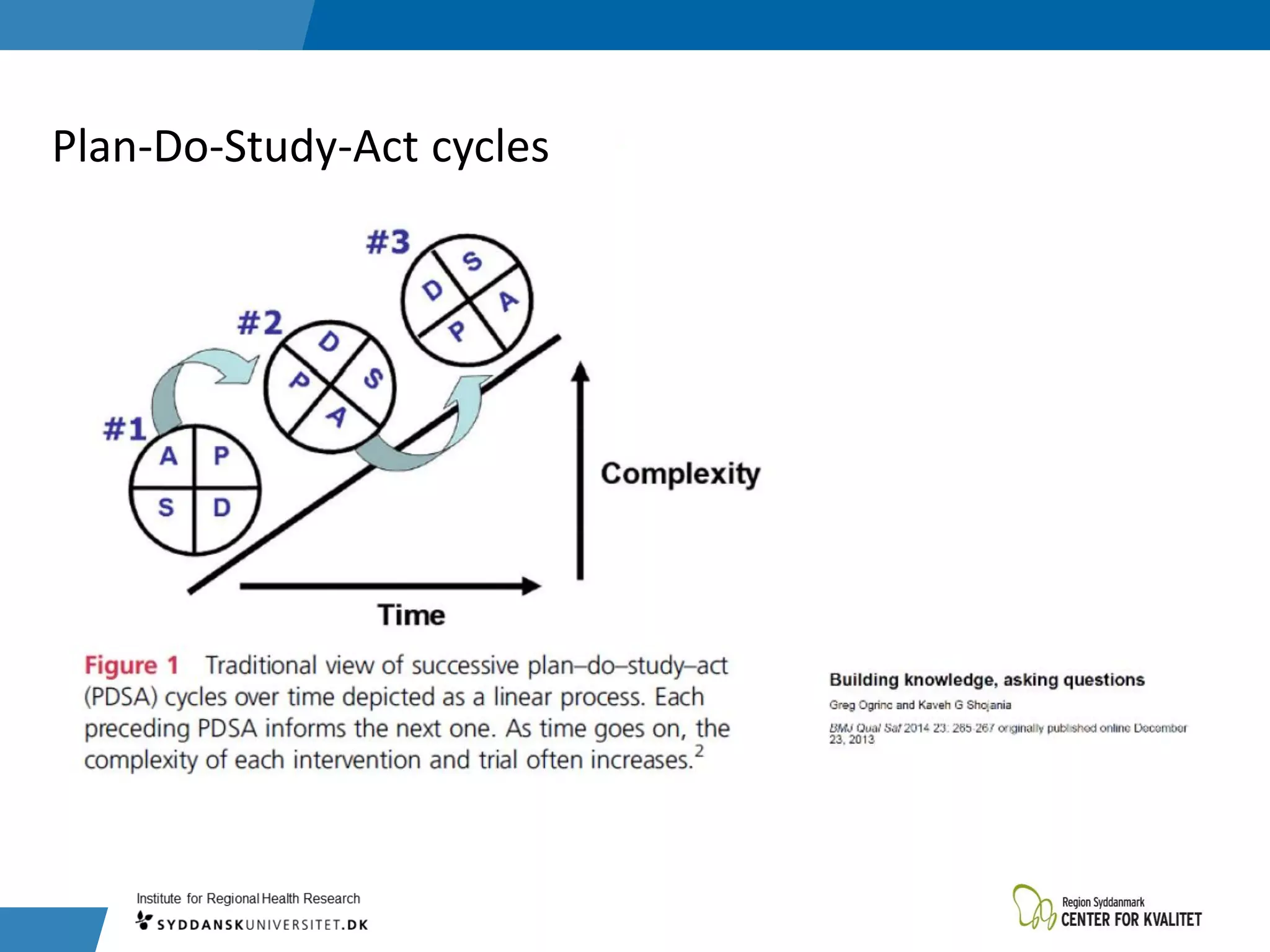
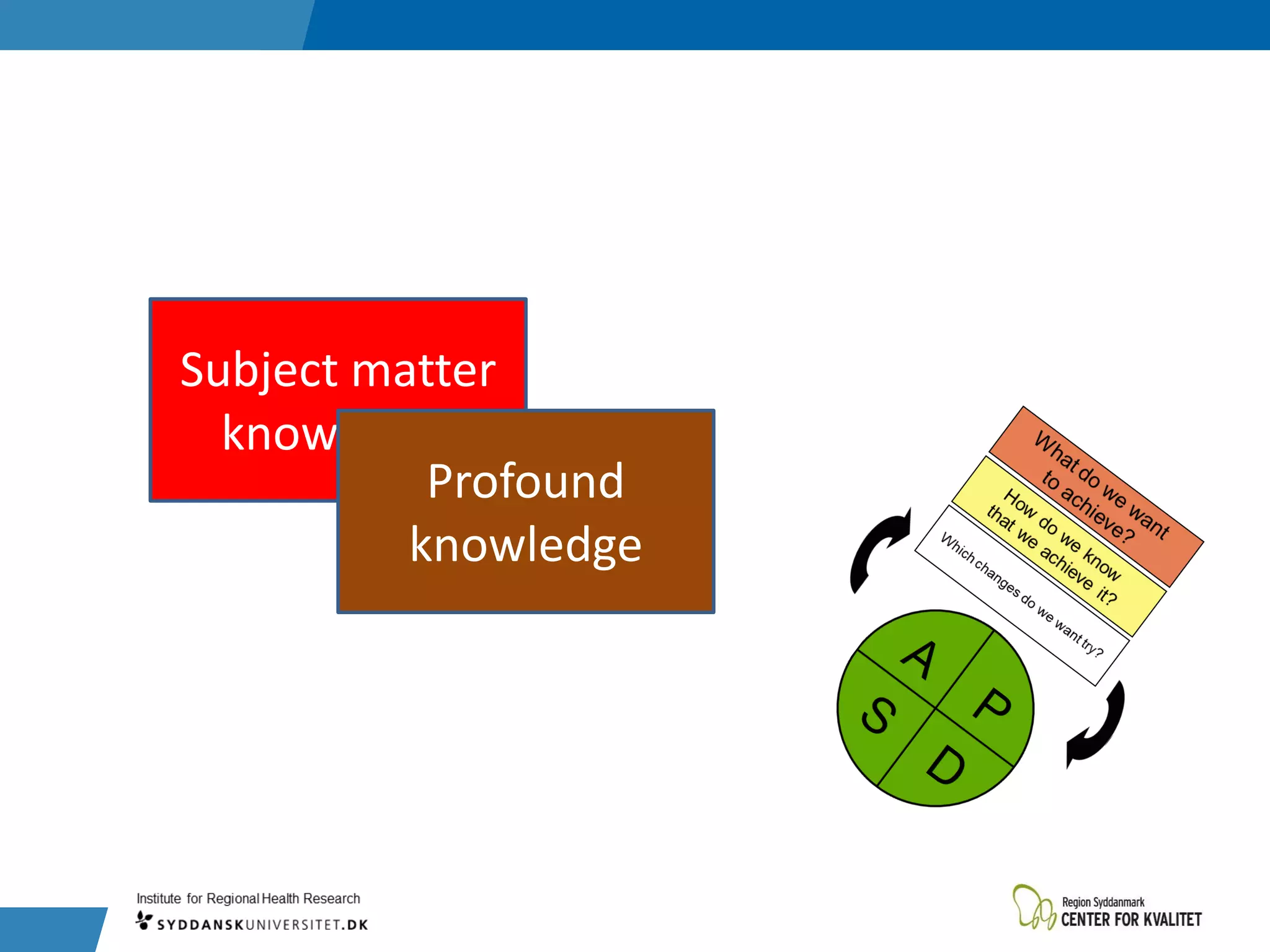
Plan-Do-Study-Act cycles
Seeing
things how
they are
Data driven
leadership
How the
work
works
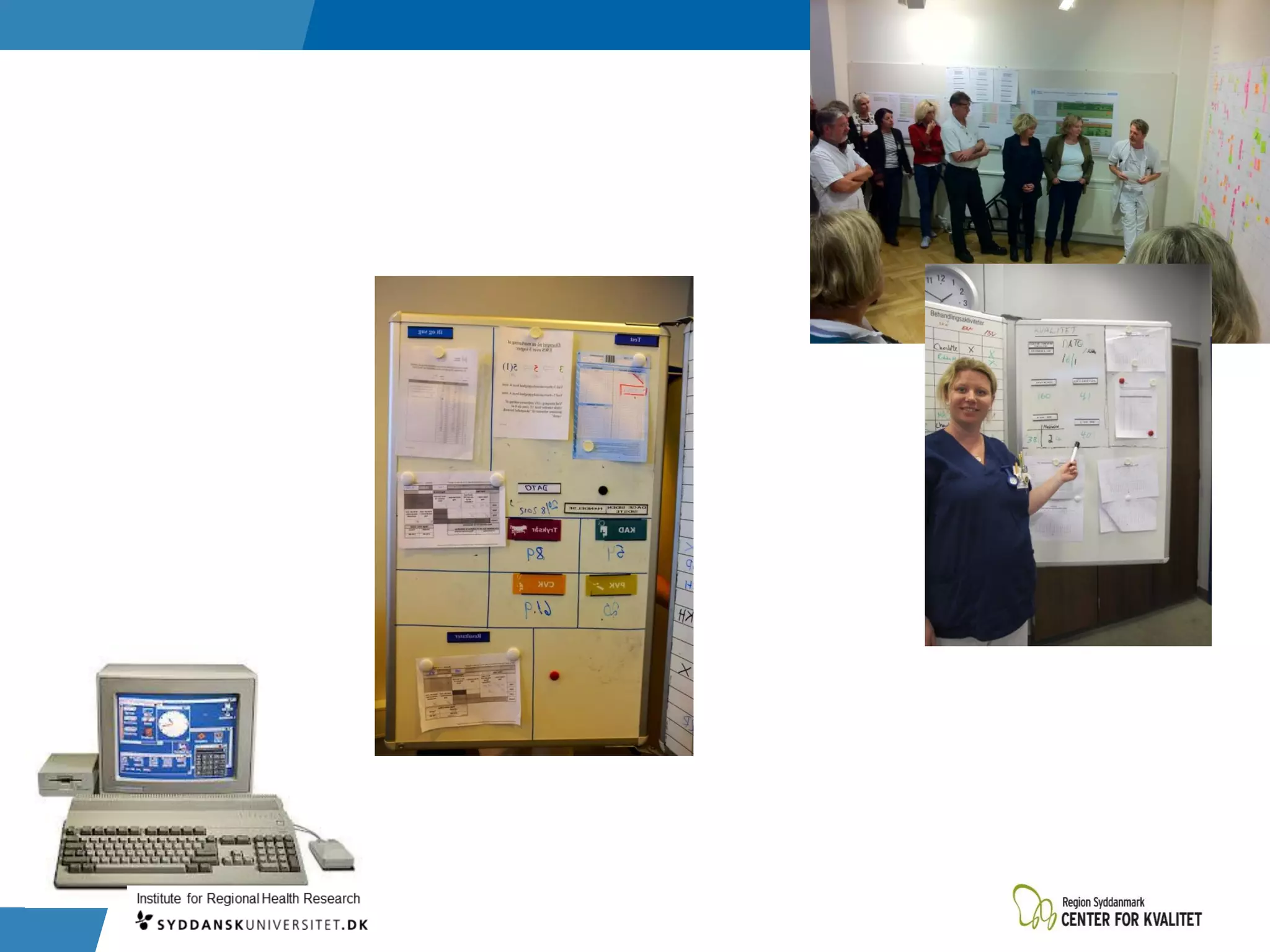
Source: Gitte Madsen, North Zealand Hospital
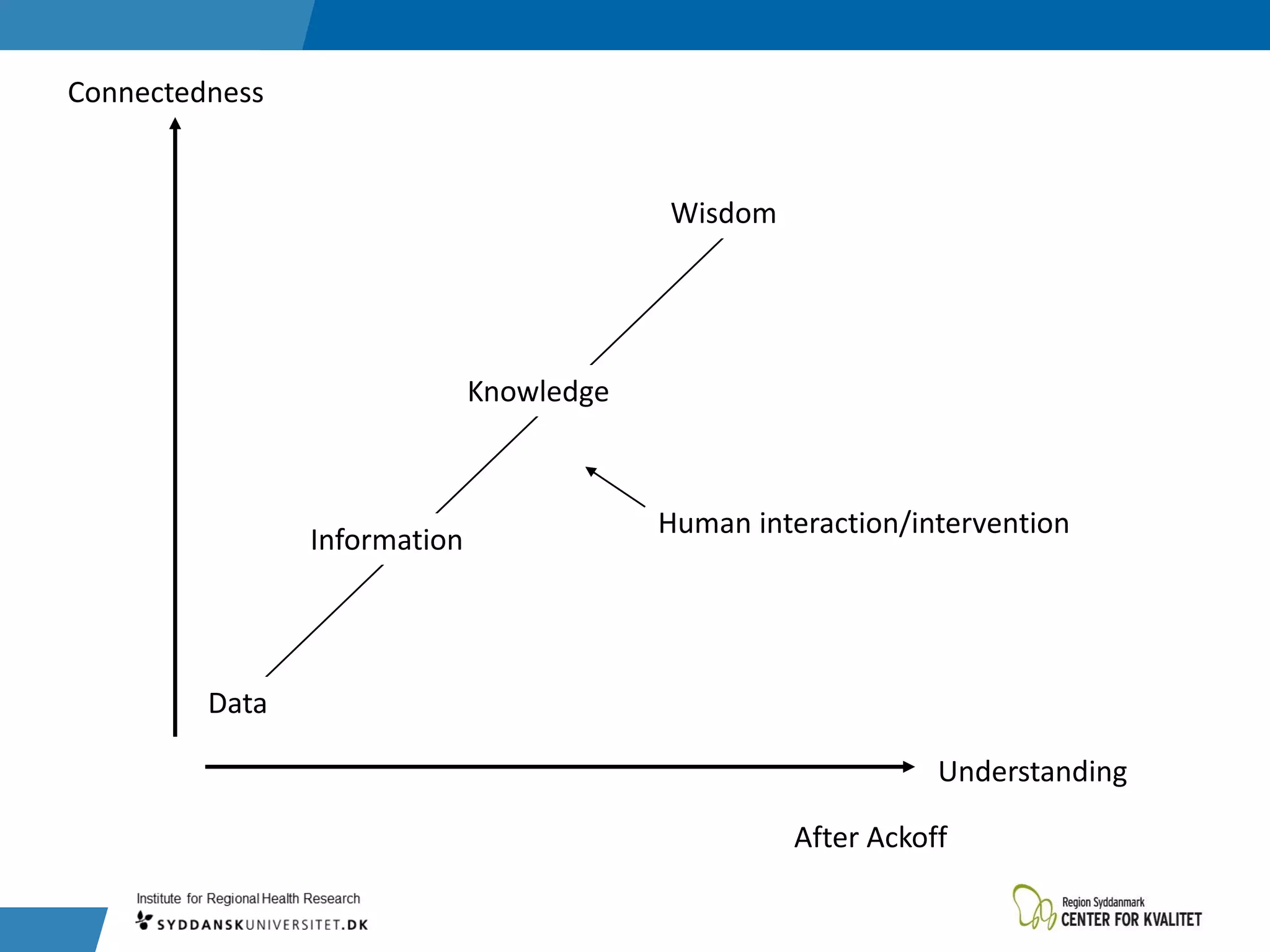
After Ackoff
Information
Knowledge
Wisdom
Data
Connectedness
Understanding
Human interaction/intervention
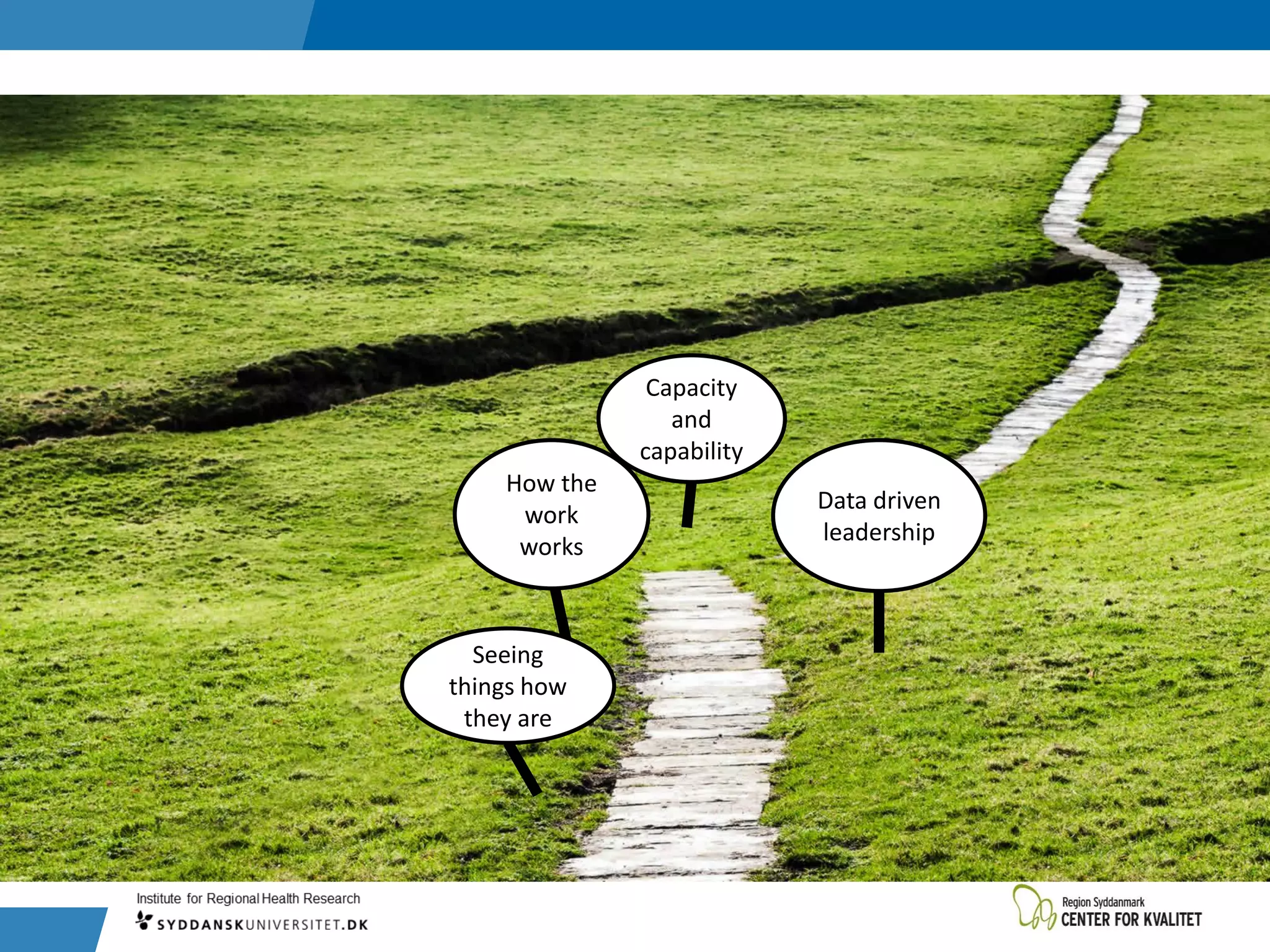
Seeing
things how
they are
Data driven
leadership
Capacity
and
capability
How the
work
works
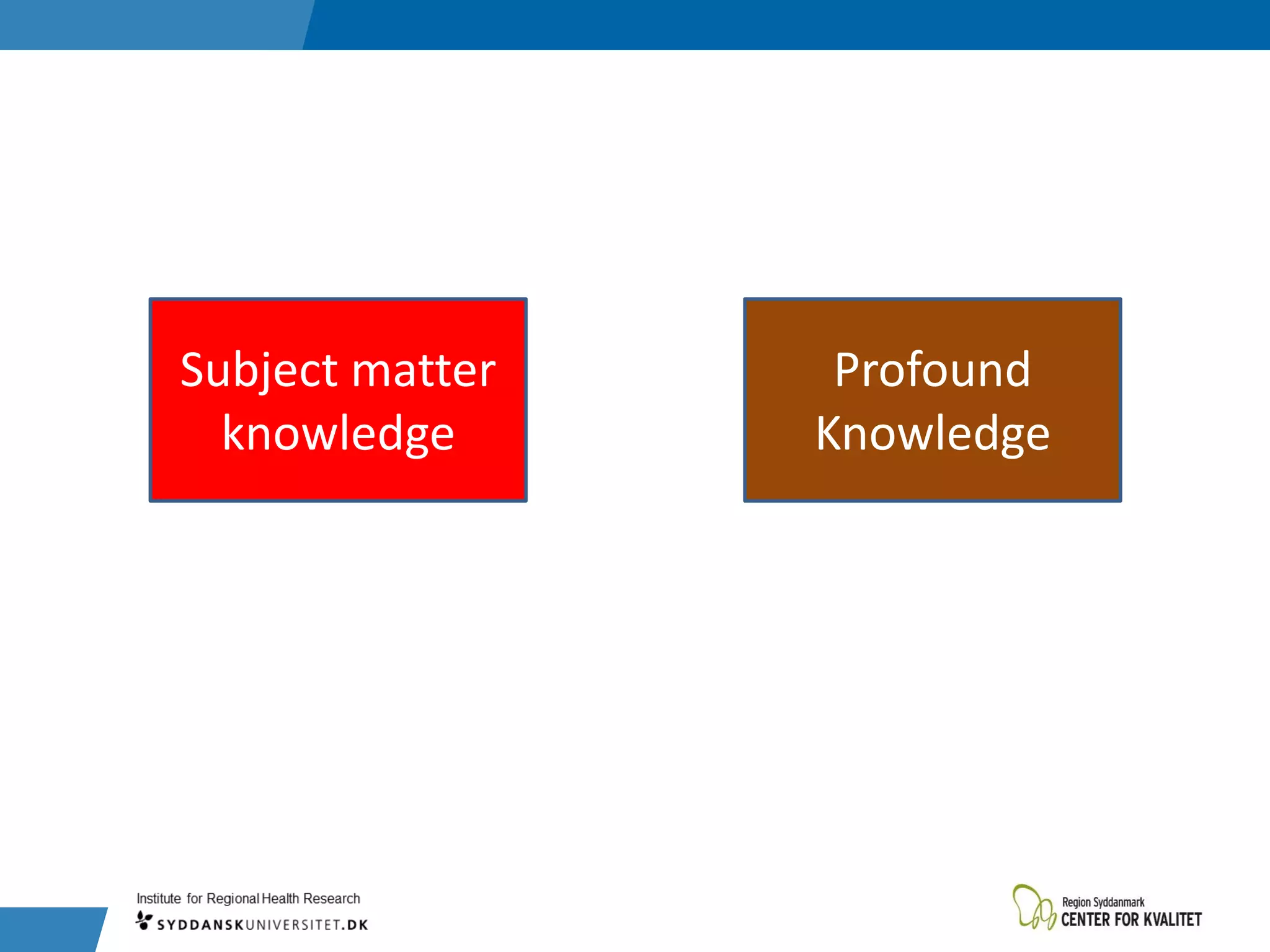
Subject matter
knowledge
Profound
Knowledge
Subject matter
knowledge
Profound
knowledge
Number of staff by level
Total
employees
Practitioners
(clinical and
support staff)
Change
agents, middle
managers,
project leads
Hospital
executives,
department
leads
Exsperts
Cincinnati
Childrens’
12.600 / 440 70
(Faculty
640)
Tayside 14.000 1200 400 70 40
Hillerød 4000 300 100 40 10
Kompetanseutvikling
Seeing
things how
they are
Data driven
leadership
Capacity
and
capability
Psycho-
logical
safety
How the
work
works
“Fear is toxic to both safety and improvement.”
NHS: A commitment to learn—a promise to act
Seeing
things how
they are
Data driven
leadership
Capacity
and
capability
Psycho-
logical
safety
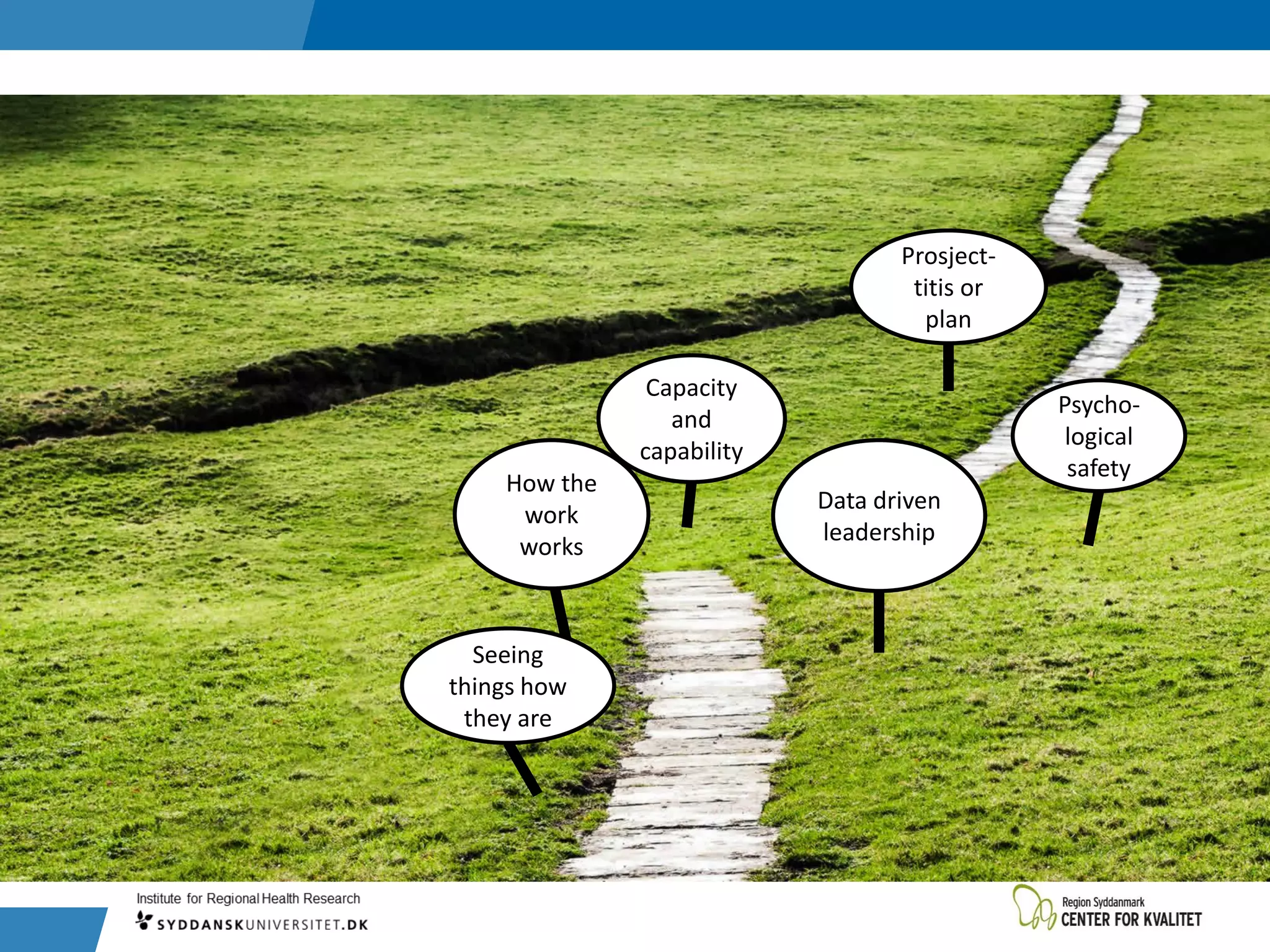
Prosject-
titis or
plan
How the
work
works
An impressive firework of ongoing quality improvement initiatives in the Danish healthcare system
Too much of a good thing…?
Gerdes, U. Centre for Quality
Nelson EC, Institute for Healthcare Improvement, Dartmouth
Medical School & Dartmouth-Hitchcock Medical Center,
presented at ISQua, London October 23, 2006
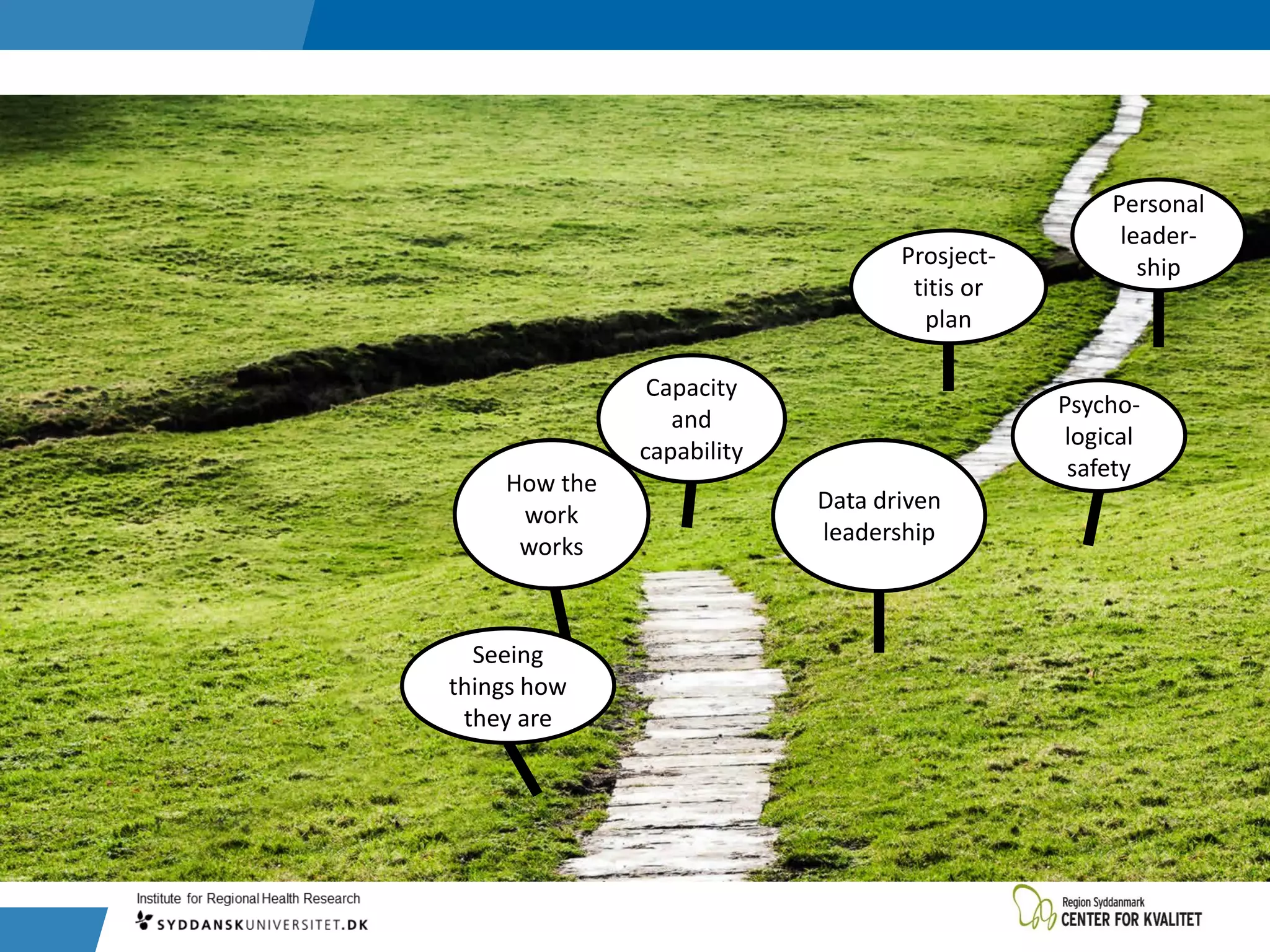
Seeing
things how
they are
Data driven
leadership
Capacity
and
capability
Psycho-
logical
safety
Prosject-
titis or
plan
Personal
leader-
ship
How the
work
works
MOTIVASJON
Størkholm MH: PhD thesis 2018
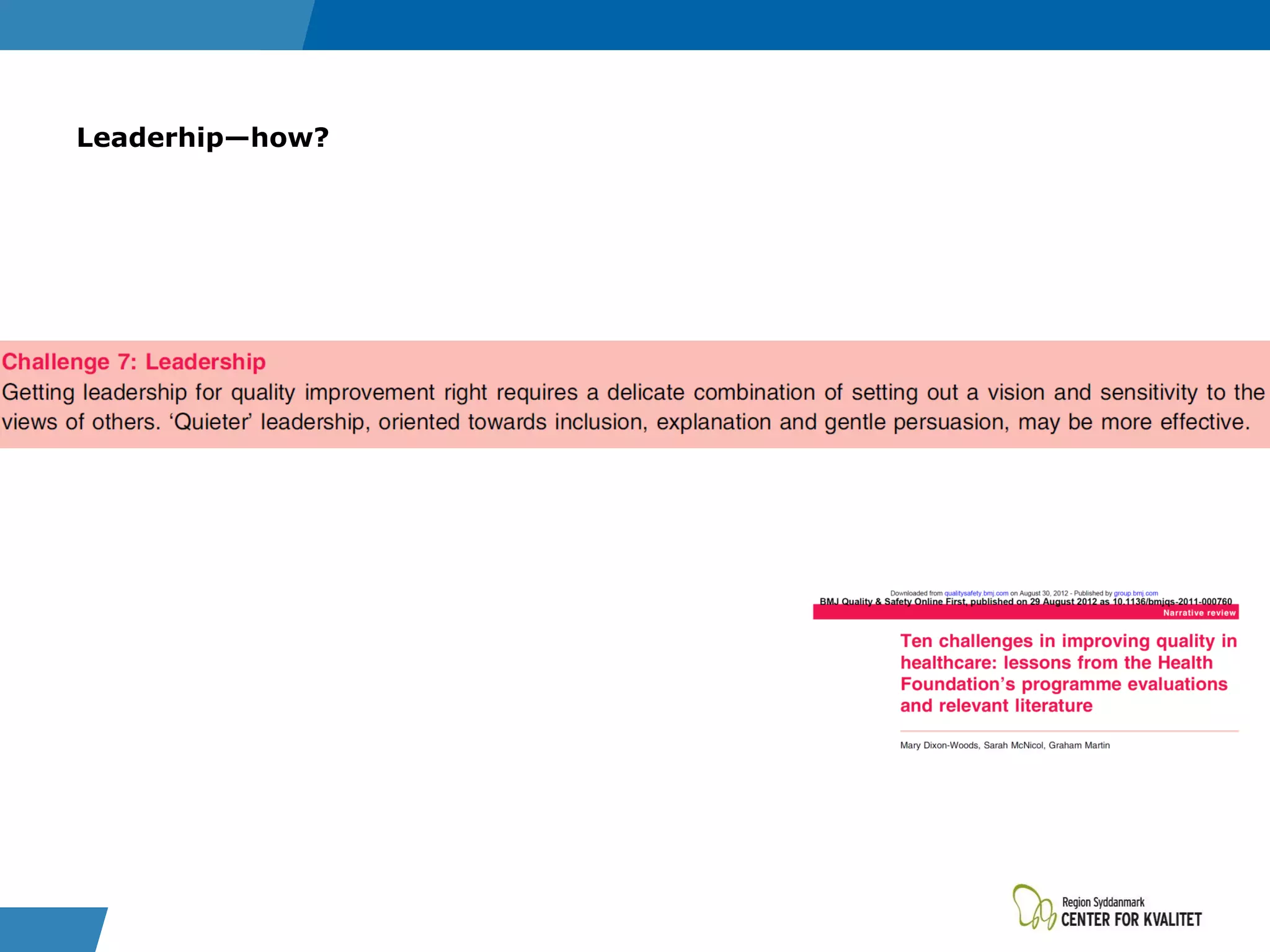
Leaderhip—how?
WAI—WAD
Observe and
follow up
Use data as a
«window to the
work»
Invest in
professional
development Create a safe
environment
Work on the
system
Combine
transfor-
matory and
operational
leadership
”I would rather have my ignorance than
another men’s knowledge, because I have got
so much of it.”
P 250—Mark Twain’s letters [1917 ed.], Vol 1
Litterature
• Batalden, P: Leading the improvement of healht care, a one page book, her
• Botwinick L et al (2006). Leadership Guide to Patient Safety. IHI Innovation Series white paper. Cambridge, Massachusetts: Institute for Healthcare
Improvement. (Available on www.IHI.org)
• Deming WE: 14 points for management, https://deming.org/explore/fourteen-points
• Detert GR, Buris E (2016): Can your employees really speak freely? Harvard Business Review, Jan-Feb
• Ferlie EB, Shortell SM (2001): Improving the quality of health care in the United Kingdom and the United States. Milbank Quarterly, 79,2
• Hardace et al (2011): What’s leadership got to do with it? Exploring links between quality improvement and leadership in the NHS. The Health
Foundation.
• Helsefirektoratet 2005: Og bedre skal det bli – Nasjonal strategi for kvalitetsforbedring i sosial- og helsetjenesten 2005–2015
• Hollnagel E. et al (2015): From Safety-I to Safety-II: A White Paper. The Resilient Health Care Net: Published simultaneously by the University of
Southern Denmark, University of Florida, USA, and Macquarie University, Australia.
• Institute of Medicine (IOM). Crossing the Quality Chasm: A New Health System for the 21st Century. Washington, D.C: National Academy Press; 2001.
• Kozes IM, Posner BZ (1988): The leadership challenge: How to get extraordinary things done in organizations. San Francisco: Jossey-Bass
• Joshua M. Liao JM et al (2014) Speaking Up About The Dangers Of The Hidden Curriculum. Health Affairs, 33, 1: 168-171
• National Advisory Group on the Safety of Patients in England (2013): A promise to learn—a commitment to act
• Pronovost Peter J, Berenholtz Sean M, Needham Dale M. Translating evidence into practice: a model for large scale knowledge translation BMJ 2008; 337
:a1714
• Reinertsen JL et al (2008): Seven Leadership Leverage Points for Organization-Level. Improvement in Health Care (Second Edition). Cambridge,
Massachusetts: Institute for Healthcare Improvement. (Available on www.ihi.org)
• Stafford W: A ritual to read to each other
• Størkholm, M H: Innovation inside the box: How contextual constraints can contribute to improvement in health care. PhD thesis, Karolinska Institut 2018
• Swensen S et al (2013): High-Impact Leadership: Improve Care, Improve the Health of Populations, and Reduce Costs. IHI White Paper. Cambridge,
Massachusetts: Institute for Healthcare Improvement; 2013. (Available at ihi.org)
• Thude B et al (2018): Staff acting resiliently at two hospitals. Paper three of PhD thesis Leaderhip at Danish Hospitals. Submitted to Leadership in Health
Services
• Wears B (2015): Improvement and evaluation. QSHC, 24: 92-94
• Weiner BJ et al (1997): Promoting clinical involvement in hospital quality improvement efforts: The effects of top management, board and physician
leadership. Health Services Research, 32, 4
• Wiig S et al (2014) Talking about quality: Exploring how quality is conceptualized across hospitals and health care systems. BMC Health Services
Research
Christian von Plessen, MD ph.d.
Director/research lead
Centre for Quality
Associate Professor
Institute for Regional Health Research
T: +45 2482 2165
christian.von.plessen@rsyd.dk
P.V. Tuxensvej 5, 5500 Middelfart, Denmark
www.centerforkvalitet.dk
No conflicts of interest

2018 11 13 management of qi cple

  • 1.
    Managing healthcare qualityand safety 1.Seeing things how they are 2.How the work works 3.Data driven leadership 4.Capacity and capability 5.Psychological safety 6.Prosjectitis or a plan? 7.Personals leadership
  • 2.
    Managing healthcare qualityand safety 1.Seeing things how they are 2.How the work works 3.Data driven leadership 4.Capacity and capability 5.Psychological safety 6.Prosjectitis or a plan? 7.Personals leadership ”What we observe is not nature itself, but nature exposed to our method of questioning.” Werner Heisenberg
  • 4.
  • 6.
    ”Every problem seemsto cry out in its own language” Thomas Transtrømer
  • 8.
    “I call itcruel, perhaps the root of all cruelty to know what occurs, but not recognize the fact.” William Stafford
  • 9.
  • 11.
    Work as imagined– nominal work System input is regular and predictable Demands and resources are compatible. Working conditions fall within normal limits. Other people behave as prescribed Output (actions) will comply with norms. … no need to make adjustments ©Erik Hollnagel 2015
  • 12.
    Work as done– actual work System input may be irregular and unpredictable Demands vary and resources may be inadequate. Working conditions may at times be sub-optimal. Other people behave egocentrically Output (actions) will vary considerably. … necessary to make local adjustments Efficiency-Thoroughness Trade-Off (ETTO) ©Erik Hollnagel 2015
  • 13.
    Efficiency-Thoroughness Trade-Off Time &resources needed Time & resources available ©Erik Hollnagel 2015
  • 14.
  • 16.
    Seeing things how they are Datadriven leadership How the work works
  • 17.
    Source: Gitte Madsen,North Zealand Hospital
  • 18.
    Source: Gitte Madsen,North Zealand Hospital
  • 21.
  • 22.
    Seeing things how they are Datadriven leadership Capacity and capability How the work works
  • 23.
  • 24.
  • 25.
    Number of staffby level Total employees Practitioners (clinical and support staff) Change agents, middle managers, project leads Hospital executives, department leads Exsperts Cincinnati Childrens’ 12.600 / 440 70 (Faculty 640) Tayside 14.000 1200 400 70 40 Hillerød 4000 300 100 40 10 Kompetanseutvikling
  • 26.
    Seeing things how they are Datadriven leadership Capacity and capability Psycho- logical safety How the work works
  • 27.
    “Fear is toxicto both safety and improvement.” NHS: A commitment to learn—a promise to act
  • 30.
    Seeing things how they are Datadriven leadership Capacity and capability Psycho- logical safety Prosject- titis or plan How the work works
  • 31.
    An impressive fireworkof ongoing quality improvement initiatives in the Danish healthcare system Too much of a good thing…? Gerdes, U. Centre for Quality
  • 32.
    Nelson EC, Institutefor Healthcare Improvement, Dartmouth Medical School & Dartmouth-Hitchcock Medical Center, presented at ISQua, London October 23, 2006
  • 33.
    Seeing things how they are Datadriven leadership Capacity and capability Psycho- logical safety Prosject- titis or plan Personal leader- ship How the work works
  • 35.
  • 38.
    Størkholm MH: PhDthesis 2018
  • 39.
  • 40.
    WAI—WAD Observe and follow up Usedata as a «window to the work» Invest in professional development Create a safe environment Work on the system Combine transfor- matory and operational leadership
  • 42.
    ”I would ratherhave my ignorance than another men’s knowledge, because I have got so much of it.” P 250—Mark Twain’s letters [1917 ed.], Vol 1
  • 43.
    Litterature • Batalden, P:Leading the improvement of healht care, a one page book, her • Botwinick L et al (2006). Leadership Guide to Patient Safety. IHI Innovation Series white paper. Cambridge, Massachusetts: Institute for Healthcare Improvement. (Available on www.IHI.org) • Deming WE: 14 points for management, https://deming.org/explore/fourteen-points • Detert GR, Buris E (2016): Can your employees really speak freely? Harvard Business Review, Jan-Feb • Ferlie EB, Shortell SM (2001): Improving the quality of health care in the United Kingdom and the United States. Milbank Quarterly, 79,2 • Hardace et al (2011): What’s leadership got to do with it? Exploring links between quality improvement and leadership in the NHS. The Health Foundation. • Helsefirektoratet 2005: Og bedre skal det bli – Nasjonal strategi for kvalitetsforbedring i sosial- og helsetjenesten 2005–2015 • Hollnagel E. et al (2015): From Safety-I to Safety-II: A White Paper. The Resilient Health Care Net: Published simultaneously by the University of Southern Denmark, University of Florida, USA, and Macquarie University, Australia. • Institute of Medicine (IOM). Crossing the Quality Chasm: A New Health System for the 21st Century. Washington, D.C: National Academy Press; 2001. • Kozes IM, Posner BZ (1988): The leadership challenge: How to get extraordinary things done in organizations. San Francisco: Jossey-Bass • Joshua M. Liao JM et al (2014) Speaking Up About The Dangers Of The Hidden Curriculum. Health Affairs, 33, 1: 168-171 • National Advisory Group on the Safety of Patients in England (2013): A promise to learn—a commitment to act • Pronovost Peter J, Berenholtz Sean M, Needham Dale M. Translating evidence into practice: a model for large scale knowledge translation BMJ 2008; 337 :a1714 • Reinertsen JL et al (2008): Seven Leadership Leverage Points for Organization-Level. Improvement in Health Care (Second Edition). Cambridge, Massachusetts: Institute for Healthcare Improvement. (Available on www.ihi.org) • Stafford W: A ritual to read to each other • Størkholm, M H: Innovation inside the box: How contextual constraints can contribute to improvement in health care. PhD thesis, Karolinska Institut 2018 • Swensen S et al (2013): High-Impact Leadership: Improve Care, Improve the Health of Populations, and Reduce Costs. IHI White Paper. Cambridge, Massachusetts: Institute for Healthcare Improvement; 2013. (Available at ihi.org) • Thude B et al (2018): Staff acting resiliently at two hospitals. Paper three of PhD thesis Leaderhip at Danish Hospitals. Submitted to Leadership in Health Services • Wears B (2015): Improvement and evaluation. QSHC, 24: 92-94 • Weiner BJ et al (1997): Promoting clinical involvement in hospital quality improvement efforts: The effects of top management, board and physician leadership. Health Services Research, 32, 4 • Wiig S et al (2014) Talking about quality: Exploring how quality is conceptualized across hospitals and health care systems. BMC Health Services Research
  • 44.
    Christian von Plessen,MD ph.d. Director/research lead Centre for Quality Associate Professor Institute for Regional Health Research T: +45 2482 2165 christian.von.plessen@rsyd.dk P.V. Tuxensvej 5, 5500 Middelfart, Denmark www.centerforkvalitet.dk No conflicts of interest