Sep tem b er 2010                                 For Private Circulation Only


            K A RV Y P R I VAT E W E A LT H ’ S
            INDIA WEALTH REPORT
          Where do Indian Individuals Invest their Wealth?
                                              Key Trends.
Foreword
In this “India Wealth Report” brought out by Karvy Private Wealth, we attempt to go deeper into the “India Rising” story,

and try to unravel as to how the high GDP growth rate and savings rate manifest themselves as wealth for the Indian

Individuals. Wealth in India is a relatively nascent concept, since so far, the quantum of cumulatively collected savings was

never more than a blip on the world wealth radar. But the sheer math of high GDP growth rate, high savings rate and

increasing awareness of smart investment products is going to increase wealth in India manifold in the coming years. We

believe the wealth held by Individuals in India would double in the next 3 years.

We present this Report to Indian HNIs and emerging HNIs and invite you to understand the slice-and-dice of existing wealth

in India – across asset classes of equity, debt and alternatives; and then across instruments within each of these asset

classes. This should give you a quick idea of where Indian Individuals are investing their wealth and if there is some change

required in your portfolio.

We compare breakdown of Indian wealth with global wealth to possibly forecast which type of investments we are

under-invested in. We also forecast how this would change in the coming years. We clearly see the individuals in India

having a much larger exposure to the equity asset class and we also believe that Alternative Assets will be the fastest

growing “Asset Class” in the next few years in India. The key premise of many of these alternative assets is to have single

products serving multiple investment objectives. As long as we are clear about our multiple investment objectives and do

not follow the herd, we can identify smart alternative investment instruments to make us winners. As has been shown in

recent world economic events, we need not pick up all learnings on this from the West – but instead use our capabilities to

develop sharp-shooting alternative investment products in India to meet such objectives.

To have a more detailed discussion on any of the contents of this Report, please feel free to drop me a line. Happy reading

…Get More Out of Life.


                                                                                                Hrishikesh Parandekar
                                                                                                Chief Executive Officer
                                                                                                Karvy Private Wealth
                                                                                                Email: hrishi@karvy.com
C O N T E N T S

The Changing Face of India                                     5

Section 1: A Bird’s Eye-view of Global Wealth                  7

Section 2: India Rising                                        8

Section 3: Break-up of India’s Individual Wealth Investment    9

        3.1 Direct Equity                                      9

        3.2 Mutual Funds                                      10

        3.3 Insurance                                         11

        3.4 Fixed Deposits & Bonds                            12

        3.5 Savings Bank Deposits                             14

        3.6 Small Savings                                     15

        3.7 Provident Fund                                    16

        3.8 Alternative Assets                                17

        3.9 Total Wealth in India                             19

Section 4: Individual Wealth in India vis-a-vis the World     20

Section 5: The Future of India’s Wealth                       21

        5.1 Financial Household Savings                       21

        5.2 Forecast of Individual Wealth                     21

        5.3 Key Trends                                        23

About Karvy Private Wealth                                    25


                                     — 3 —
List of Tables


Table 1: Asset-wise break-up of Individual Wealth in India                             5

Table 2: Classification of Individual Wealth in India according to Key Asset Classes    6

Table 3: Classification of World Wealth according to Asset Class                        7

Table 4: Overall Direct Equity break-up                                                 9

Table 5: Break-up of Mutual Funds by Underlying Investment                             10

Table 6: Assets in Insurance                                                           11

Table 7: Assets of Individuals in Fixed Deposits and Bonds                             12

Table 8: Distribution of Fixed Deposits                                                13

Table 9: Assets in Bonds                                                               13

Table 10: Savings Bank Deposits                                                        14

Table 11: Small Savings                                                                15

Table 12: Provident Fund                                                               16

Table 13: Alternative Assets                                                           18

Table 14: Comparison of Global & Indian Individual Wealth according to Asset Class     20

Table 15: Financial Household Savings Projection                                       21

Table 16: Individual Wealth Forecast                                                   23

Table 17: Forecast of Individual Wealth in India according to Key Asset Classes        23


                                       — 4 —
The Changing Face of India
The outlook of the world towards India is fast changing. Gone are the days when India was considered an under developed country.

The nation as a whole has undergone a total face-lift with regard to its economy and financial growth. It is now considered as one

of the fastest growing economies. This report talks about the amount of wealth available with Individuals in India and its break-up

across various asset classes.


Estimated Individual Wealth in the World

The total estimated global wealth in financial assets with High Net Worth Individuals (HNIs)1 at the end of December 2009 was

US$ 39 trillion2.

Estimated Individual Wealth in India
The amount of overall wealth in India has been calculated on the basis of the sum of all investment assets. For the purpose of this

report only, the investments with individuals have been considered and does not include Government and Insitutional holdings.
                                                                                       3
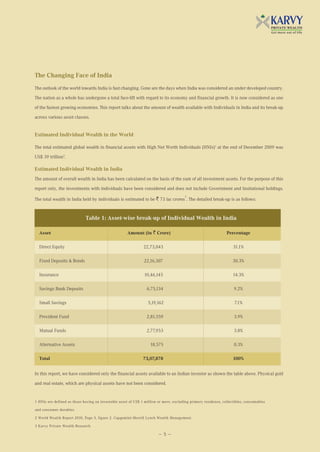
The total wealth in India held by individuals is estimated to be ` 73 lac crores . The detailed break-up is as follows:


                             Table 1: Asset-wise break-up of Individual Wealth in India

  Asset                                               Amount (in ` Crore)                                       Percentage

  Direct Equity                                                22,73,043                                            31.1%

  Fixed Deposits & Bonds                                        22,16,307                                           30.3%

  Insurance                                                     10,46,145                                           14.3%

  Savings Bank Deposits                                          6,75,134                                           9.2%

  Small Savings                                                   5,19,162                                           7.1%

  Provident Fund                                                 2,81,559                                           3.9%

  Mutual Funds                                                   2,77,953                                           3.8%

  Alternative Assets                                               18,575                                           0.3%

  Total                                                        73,07,878                                            100%


In this report, we have considered only the financial assets available to an Indian investor as shown the table above. Physical gold

and real estate, which are physical assets have not been considered.


1 HNIs are defined as those having an investable asset of US$ 1 million or more, excluding primary residence, collectibles, consumables

and consumer durables.

2 World Wealth Report 2010, Page 5, figure 2. Capgemini-Merrill Lynch Wealth Management.

3 Karvy Private Wealth Research

                                                                        — 5 —
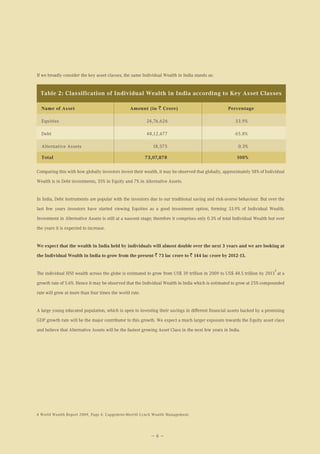
If we broadly consider the key asset classes, the same Individual Wealth in India stands as:


  Table 2: Classification of Individual Wealth in India according to Key Asset Classes

  Name of Asset                                  Amount (in ` Crore)                                Percentage

  Equities                                               24,76,626                                      33.9%

  Debt                                                   48,12,677                                      65.8%

  Alternative Assets                                         18,575                                       0.3%

  Total                                                  73,07,878                                       100%

Comparing this with how globally investors invest their wealth, it may be observed that globally, approximately 58% of Individual
Wealth is in Debt investments, 35% in Equity and 7% in Alternative Assets.


In India, Debt instruments are popular with the investors due to our traditional saving and risk-averse behaviour. But over the

last few years investors have started viewing Equities as a good investment option, forming 33.9% of Individual Wealth.

Investment in Alternative Assets is still at a nascent stage; therefore it comprises only 0.3% of total Individual Wealth but over

the years it is expected to increase.


We expect that the wealth in India held by individuals will almost double over the next 3 years and we are looking at

the Individual Wealth in India to grow from the present ` 73 lac crore to ` 144 lac crore by 2012-13.


                                                                                                                            4
The individual HNI wealth across the globe is estimated to grow from US$ 39 trillion in 2009 to US$ 48.5 trillion by 2013 at a

growth rate of 5.6%. Hence it may be observed that the Individual Wealth in India which is estimated to grow at 25% compounded

rate will grow at more than four times the world rate.


A large young educated population, which is open to investing their savings in different financial assets backed by a promising

GDP growth rate will be the major contributor to this growth. We expect a much larger exposure towards the Equity asset class

and believe that Alternative Assets will be the fastest growing Asset Class in the next few years in India.


4 World Wealth Report 2009, Page 4. Capgemini-Merrill Lynch Wealth Management.


                                                            — 6 —
Section 1: A Bird’s Eye-view of Global Wealth

                                                                                                                                    5
The total estimated global wealth with HNIs at the end of 2009 was US$ 39 trillion. This figure is almost same as the US $40.7

trillion at the end of 2007 i.e. before the global recession. Most of the wealth was concentrated in North-America, US$ 10.7 trillion
                                                          6
to be exact. The Asia-Pacific region accounts for US$ 9.7 trillion.


Classification of World Wealth according to Asset Class

The total estimated global wealth in the key financial assets with HNIs at the end of 2009

is shown below:


                  Table 3: Classification of World Wealth according to Asset Class 7

  Name of Asset                               Amount (in US $ Trillion)                        Percentage of Wealth

  Equities                                                    11.2                                         35%

  Debt                                                        18.5                                         58%

  Alternative Assets                                          2.3                                            7%


The above table does not include Real Estate which is included in the total estimated US$ 39 trillion. With the global economy

having recouped and gained significant ground, in 2009 we have seen the Asia-Pacific region leading the world with a 30.9%
                                                                             8
increase in wealth as compared to global wealth which increased by 18.9 %.


 5, 6 and 8 World Wealth Report 2010, Page 5, figure 2. Capgemini-Merrill Lynch Wealth Management.
 7 World Wealth Report 2010, Page 17, figure 8. Capgemini-Merrill Lynch Wealth Management.


                                                                     — 7 —
Section 2: India Rising

The economy of India is the eleventh largest in the world by nominal value and fourth largest on Purchasing Power Parity

(PPP) basis.


Till 1990, there existed industrial licensing regime in India under which license was required for starting new companies, for

producing new products, expanding productive capacity, laying off workers or for shutting down. Import of consumer goods,

particularly luxuries, was restricted by means of high tariffs and low quotas or banning some items altogether. In 1991, India took

a big leap away from the socialist protectionism in the wake of an exceptionally severe balance of payments crisis. The

government signaled a systemic shift to a more open economy with greater reliance upon market forces, a larger role for the

private sector including foreign investment, and a restructuring of the role of government in business.


With the liberalization of its economy, India witnessed tremendous economic

growth. Between 2000 and 2005 India’s GDP grew at 6-8% annually. In

2006-07 the growth rate was 9.7%. The GDP for 2007-08 was 9.2%. This figure

fell to 6.7% for the year 2008-09. The main reason for this fall was the global

economic downturn that began in the industrialized nations of the world in

2007.


In 2009–10, besides the global recession, factors such as sub-normal monsoon
also contributed to the declining economy. In spite of all these negative factors, the economy, posted a remarkable comeback and
                                                9                                                    10
the GDP growth rate for 2009-10 stands at 7.2% . The estimated GDP growth rate for 2010-11 is 8.5% .


For the purpose of this Report we are considering only Individual Wealth and it does not include Institutional and

Government holdings. The total wealth in India has been found as a sum of investments across the different asset classes available

in the market.


The following financial assets have been considered as part of wealth, whereas physical assets such as gold and real estate have

been excluded.

• Direct Equity                      • Mutual Funds               • Insurance            • Fixed Deposits & Bonds

• Saving Bank Deposits               • Small Savings              • Provident Fund       • Alternative Assets


9 Economic Survey of India 2009-10
10 PMEAC


                                                          — 8 —
Section 3: Break-up of India’s Individual Wealth Investment

The estimated total Individual Wealth in India stands at ` 73 lac crores. It is derived from the sum of all the asset

classes, which are majorly classified into Equities, Debt and Alternative Assets. As our Report estimates Individual

Wealth in India, we will further divide these assets based on the investment instruments available in India.


3.1 Direct Equity

Indians have conventionally invested in low risk assets but this behaviour is gradually changing with the economic

boom and people experiencing higher returns in Direct Equities. The market capitalization value of Direct Equity

changes according to the movements of the stock market. The overall amount invested in Direct Equities as on

31 st March, 2010 is ` 60 lac crores.


                                   Table 4: Overall Direct Equity Break-up

   Investor type                                   % of Market Cap                  Amount(in ` Crore)

   Promoter Holdings                                    28.1%                                 16,89,755

   Institutions / FII / QIBs                            62.2%                                 37,36,130

   Retail Investors                                         9.7%                               5,83,288

   Total                                                    100%                             60,09,173


However for the purpose of this Report on Individual Wealth we have only considered:

a. Promoter and Promoter Group – We have only considered the portion with Individuals/HUF, Bodies Corporate and

Any Other (Trust/Partnership, etc) sections. We have not considered

Government holdings as promoter in the report.

b. Public   Shareholding       –   We   have   considered    only   the

percentage of Individuals in this section.


Thus the portion of total Individual Wealth invested in Direct Equity comes to ` 22.7 lac crores which is 31.1% of
the Overall Individual Wealth in India. It is the highest contributor of all of the asset classes. We also see Direct

Equity to continue to grow and form a more prominent share of Individual Wealth in the years to come.


                                                            — 9 —
3.2 Mutual Funds

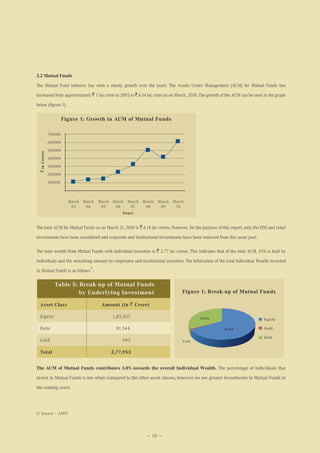
The Mutual Fund industry has seen a steady growth over the years. The Assets Under Management (AUM) for Mutual Funds has

increased from approximately ` 1 lac crore in 2003 to ` 6.14 lac crore as on March, 2010. The growth of the AUM can be seen in the graph

below (figure 1).

                         Figure 1: Growth in AUM of Mutual Funds

                700000

                600000

                500000
  ` in Crores


                400000

                300000

                200000

                100000


                           March March   March March   March   March   March   March
                            03    04      05    06      07      08      09      10
                                                   Years


The total AUM for Mutual Funds as on March 31, 2010 is ` 6.14 lac crores. However, for the purpose of this report, only the HNI and retail

investments have been considered and corporate and institutional investments have been removed from this asset pool.

The total wealth from Mutual Funds with individual investors is ` 2.77 lac crores. This indicates that of the total AUM, 45% is held by

individuals and the remaining amount by corporates and institutional investors. The bifurcation of the total Individual Wealth invested
                                    11
in Mutual Funds is as follows :

                   Table 5: Break-up of Mutual Funds
                            by Underlying Investment                               Figure 1: Break-up of Mutual Funds

  Asset Class                             Amount (in ` Crore)

  Equity                                       1,85,817                                   32.8%                               Equity

  Debt                                          91,144                                                 66.8%                  Gold

                                                                                                                              Debt
  Gold                                             992                             0.4%


  Total                                       2,77,953


The AUM of Mutual Funds contributes 3.8% towards the overall Individual Wealth. The percentage of individuals that

invest in Mutual Funds is low when compared to the other asset classes, however we see greater investments in Mutual Funds in

the coming years.


11 Source – AMFI


                                                                — 10 —
3.3 Insurance
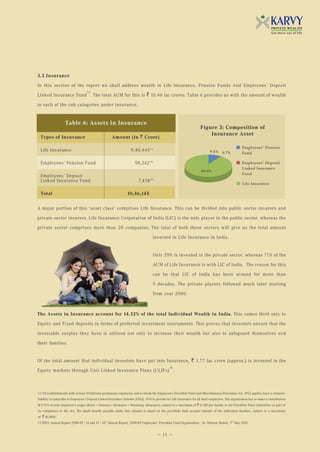
In this section of the report we shall address wealth in Life Insurance, Pension Funds And Employees’ Deposit
                                   12
Linked Insurance Fund . The total AUM for this is ` 10.46 lac crores. Table 6 provides us with the amount of wealth
in each of the sub categories under insurance.


                   Table 6: Assets in Insurance
                                                                                                                      Figure 3: Composition of
                                                                                                                          Insurance Asset
 Types of Insurance                                  Amount (in ` Crore)

                                                                                                                                                    Employees’ Pension
 Life Insurance                                                    9,40,445 13                                               9.4%     0.7%          Fund

 Employees’ Pension Fund                                              98,242 14                                                                     Employees’ Deposit
                                                                                                                                                    Linked Insurance
                                                                                                                      89.9%
                                                                                                                                                    Fund
 Employees’ Deposit
 Linked Insurance Fund                                                   7,458   15
                                                                                                                                                    Life Insurance

 Total                                                           10,46,145


A major portion of this ‘asset class’ comprises Life Insurance. This can be divided into public sector insurers and

private sector insurers. Life Insurance Corporation of India (LIC) is the only player in the public sector, whereas the

private sector comprises more than 20 companies. The total of both these sectors will give us the total amount

                                                                                   invested in Life Insurance in India.


                                                                                   Only 29% is invested in the private sector, whereas 71% of the

                                                                                   AUM of Life Insurance is with LIC of India. The reason for this
                                                                                   can be that LIC of India has been around for more than

                                                                                   5 decades. The private players followed much later starting

                                                                                   from year 2000.


The Assets in Insurance account for 14.32% of the total Individual Wealth in India. This comes third only to

Equity and Fixed deposits in terms of preferred investment instruments. This proves that investors ensure that the

investable surplus they have is utilized not only to increase their wealth but also to safeguard themselves and

their families.


Of the total amount that individual investors have put into Insurance, ` 1.77 lac crore (approx.) is invested in the
                                                                                               16
Equity markets through Unit Linked Insurance Plans (ULIPs) .


12 All establishments with at least 10 full-time permanent employees and to whom the Employee's Provident Fund and Miscellaneous Provisions Act, 1952 applies, have a statutory
liability to subscribe to Employee's Deposit Linked Insurance Scheme (EDLI), 1976 to provide for Life Insurance for all their employees. The organization has to make a contribution
@ 0.51% of each employee's wages (Basic + Dearness Allowance + Retaining Allowance), subject to a maximum of ` 6,500 per month, to the Provident Fund Authorities as part of
its compliance to the Act. The death benefit payable under this scheme is based on the provident fund account balance of the individual member, subject to a maximum
of ` 60,000/.
13 IRDA Annual Report 2008-09 ; 14 and 15 - 56th Annual Report, 2008-09 Employees’ Provident Fund Organization ; 16- Outlook Money, 5th May 2010.


                                                                                       — 11 —
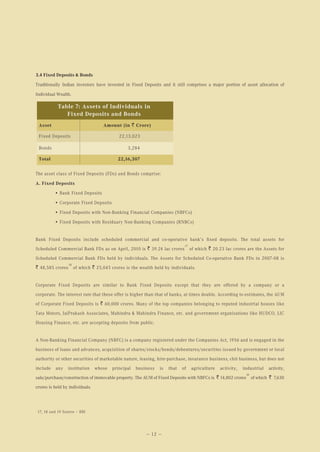
3.4 Fixed Deposits & Bonds

Traditionally Indian investors have invested in Fixed Deposits and it still comprises a major portion of asset allocation of

Individual Wealth.

            Table 7: Assets of Individuals in
               Fixed Deposits and Bonds
 Asset                               Amount (in ` Crore)

 Fixed Deposits                              22,13,023

 Bonds                                           3,284

 Total                                      22,16,307


The asset class of Fixed Deposits (FDs) and Bonds comprise:

A. Fixed Deposits

          • Bank Fixed Deposits

          • Corporate Fixed Deposits

          • Fixed Deposits with Non-Banking Financial Companies (NBFCs)

          • Fixed Deposits with Residuary Non-Banking Companies (RNBCs)


Bank Fixed Deposits include scheduled commercial and co-operative bank’s fixed deposits. The total assets for
                                                                             17
Scheduled Commercial Bank FDs as on April, 2010 is ` 39.24 lac crores             of which ` 20.23 lac crores are the Assets for
Scheduled Commercial Bank FDs held by individuals. The Assets for Scheduled Co-operative Bank FDs in 2007-08 is
                  18
` 48,585 crores        of which ` 25,045 crores is the wealth held by individuals.


Corporate Fixed Deposits are similar to Bank Fixed Deposits except that they are offered by a company or a
corporate. The interest rate that these offer is higher than that of banks, at times double. According to estimates, the AUM
of Corporate Fixed Deposits is ` 60,000 crores. Many of the top companies belonging to reputed industrial houses like
Tata Motors, JaiPrakash Associates, Mahindra & Mahindra Finance, etc. and government organisations like HUDCO, LIC
Housing Finance, etc. are accepting deposits from public.


A Non-Banking Financial Company (NBFC) is a company registered under the Companies Act, 1956 and is engaged in the
business of loans and advances, acquisition of shares/stocks/bonds/debentures/securities issued by government or local
authority or other securities of marketable nature, leasing, hire-purchase, insurance business, chit business, but does not
include   any    institution     whose   principal   business   is   that   of    agriculture   activity,   industrial   activity,
                                                                                                             19
sale/purchase/construction of immovable property. The AUM of Fixed Deposits with NBFCs is ` 14,802 crores of which ` 7,630
crores is held by individuals.


 17, 18 and 19 Source – RBI


                                                          — 12 —
Residuary Non-Banking Companies (RNBCs) are companies which are non-banking institutions receiving deposits under any

scheme/arrangement in one lump sum/installments by way of contributions/subscriptions or by sale of units/certificates/other

instruments. The Assets in FDs with RNBCs is ` 97,082 crores.


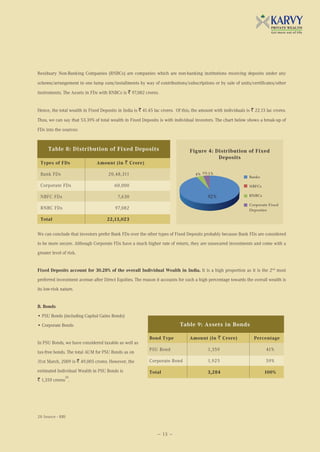
Hence, the total wealth in Fixed Deposits in India is ` 41.45 lac crores. Of this, the amount with individuals is ` 22.13 lac crores.

Thus, we can say that 53.39% of total wealth in Fixed Deposits is with individual investors. The chart below shows a break-up of

FDs into the sources:


      Table 8: Distribution of Fixed Deposits                                    Figure 4: Distribution of Fixed
                                                                                            Deposits
 Types of FDs                  Amount (in ` Crore)

 Bank FDs                            20,48,311                                      4% 3% 1%
                                                                                                                 Banks

 Corporate FDs                           60,000                                                                  NBFCs

 NBFC FDs                                 7,630                                            92%                   RNBCs

                                                                                                                 Corporate Fixed
 RNBC FDs                                97,082                                                                  Deposites

 Total                               22,13,023


We can conclude that investors prefer Bank FDs over the other types of Fixed Deposits probably because Bank FDs are considered
to be more secure. Although Corporate FDs have a much higher rate of return, they are unsecured investments and come with a
greater level of risk.


Fixed Deposits account for 30.28% of the overall Individual Wealth in India. It is a high proportion as it is the 2nd most
preferred investment avenue after Direct Equities. The reason it accounts for such a high percentage towards the overall wealth is
its low-risk nature.


B. Bonds
• PSU Bonds (including Capital Gains Bonds)
• Corporate Bonds                                                           Table 9: Assets in Bonds

                                                           Bond Type             Amount (in ` Crore)               Percentage
In PSU Bonds, we have considered taxable as well as
                                                           PSU Bond                        1,359                          41%
tax-free bonds. The total AUM for PSU Bonds as on
31st March, 2009 is ` 49,005 crores. However, the          Corporate Bond                  1,925                          59%

estimated Individual Wealth in PSU Bonds is                Total                           3,284                         100%
               20
` 1,359 crores .


20 Source - RBI


                                                                — 13 —
The total AUM for Corporate Bonds as on 31 st March, 2010 is ` 3,750 crores 21. This consists of individual and

institutional investors. Considering only individual investors, ` 1,925 crores is the total Individual Wealth in

Corporate Bonds.


From the above data, we conclude that total AUM in Bonds with the individuals is ` 3,284 crores. Thus, PSU Bonds

and Corporate Bonds account for a very minimal percentage of the total Individual Wealth in India (lower than 1%).


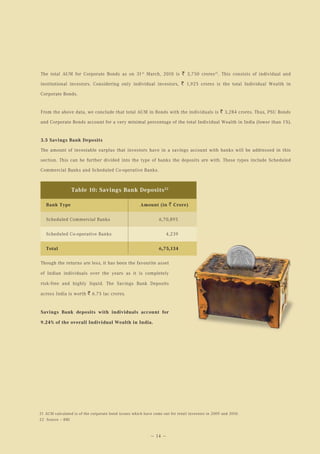
3.5 Savings Bank Deposits

The amount of investable surplus that investors have in a savings account with banks will be addressed in this

section. This can be further divided into the type of banks the deposits are with. These types include Scheduled

Commercial Banks and Scheduled Co-operative Banks.


                 Table 10: Savings Bank Deposits 22

   Bank Type                                          Amount (in ` Crore)


   Scheduled Commercial Banks                                   6,70,895


   Scheduled Co-operative Banks                                      4,239


   Total                                                        6,75,134

Though the returns are less, it has been the favourite asset

of Indian individuals over the years as it is completely

risk-free and highly liquid. The Savings Bank Deposits

across India is worth ` 6.75 lac crores.


Savings Bank deposits with individuals account for

9.24% of the overall Individual Wealth in India.


21 AUM calculated is of the corporate bond issues which have come out for retail investors in 2009 and 2010.
22 Source – RBI


                                                            — 14 —
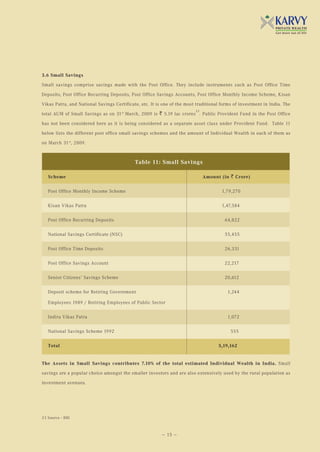
3.6 Small Savings

Small savings comprise savings made with the Post Office. They include instruments such as Post Office Time

Deposits, Post Office Recurring Deposits, Post Office Savings Accounts, Post Office Monthly Income Scheme, Kisan

Vikas Patra, and National Savings Certificate, etc. It is one of the most traditional forms of investment in India. The
                                                                         23
total AUM of Small Savings as on 31 st March, 2009 is ` 5.19 lac crores . Public Provident Fund in the Post Office

has not been considered here as it is being considered as a separate asset class under Provident Fund. Table 11

below lists the different post office small savings schemes and the amount of Individual Wealth in each of them as

on March 31 st, 2009.


                                            Table 11: Small Savings

   Scheme                                                                     Amount (in ` Crore)

   Post Office Monthly Income Scheme                                                  1,79,270

   Kisan Vikas Patra                                                                  1,47,584

   Post Office Recurring Deposits                                                      64,822

   National Savings Certificate (NSC)                                                  55,455

   Post Office Time Deposits                                                           26,331

   Post Office Savings Account                                                         22,217

   Senior Citizens’ Savings Scheme                                                     20,612

   Deposit scheme for Retiring Government                                                1,244

   Employees 1989 / Retiring Employees of Public Sector

   Indira Vikas Patra                                                                    1,072

   National Savings Scheme 1992                                                           555

   Total                                                                            5,19,162


The Assets in Small Savings contributes 7.10% of the total estimated Individual Wealth in India. Small

savings are a popular choice amongst the smaller investors and are also extensively used by the rural population as

investment avenues.


23 Source - RBI


                                                         — 15 —
3.7 Provident Fund

Provident Fund (PF) is an investment-cum-tax savings instrument. It has been used traditionally as a

retirement planning tool by individual investors in India. It is an asset class which provides the investor with the

luxury of saving tax and also safeguarding their capital. Provident Fund can be divided into Employee Provident

Fund (EPF) and Public Provident Fund (PPF). EPF is a retirement benefit scheme that is available to salaried

employees. Both the employees and employer contribute to EPF as a percentage (12% in most cases) of the basic

wages, dearness and retaining allowance, which is remitted to the PF authorities. PPF is a voluntary yearly amount

that an individual deposits with Post Office (PPF with Post Office) or with Banks (PPF with Banks). Table 12 lists the

break-up of all types of PPF accounts.


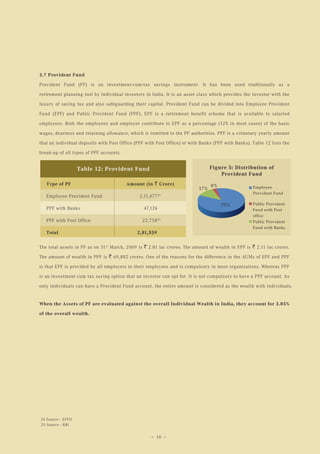
                   Table 12: Provident Fund                                      Figure 5: Distribution of
                                                                                     Provident Fund
   Type of PF                            Amount (in ` Crore)                     8%
                                                                           17%                      Employee
                                                                                                    Provident Fund
   Employee Provident Fund                     2,11,677   24


                                                                                      75%           Public Provident
   PPF with Banks                                47,124                                             Fund with Post
                                                                                                    office
   PPF with Post Office                         22,758 25                                           Public Provident
                                                                                                    Fund with Banks
   Total                                      2,81,559

The total assets in PF as on 31 st March, 2009 is ` 2.81 lac crores. The amount of wealth in EPF is ` 2.11 lac crores.

The amount of wealth in PPF is ` 69,882 crores. One of the reasons for the difference in the AUMs of EPF and PPF

is that EPF is provided by all employers to their employees and is compulsory in most organizations. Whereas PPF

is an investment cum tax saving option that an investor can opt for. It is not compulsory to have a PPF account. As

only individuals can have a Provident Fund account, the entire amount is considered as the wealth with individuals.


When the Assets of PF are evaluated against the overall Individual Wealth in India, they account for 3.85%

of the overall wealth.


24 Source - EPFO
25 Source - RBI


                                                    — 16 —
3.8 Alternative Assets

Investments which are considered outside the traditional asset classes like Equity, Mutual Funds, Saving and Fixed

Deposits, Insurance and other instruments covered earlier are known as alternative assets. These assets include

private equity/venture capital, structured products, real estate funds, art funds, film funds etc. These alternative

assets usually have a larger initial investment and hence not accessible to general investors.


A. Equity Linked Debentures
Equity–linked Debentures are instruments whose returns on investment are tied to the equity markets. These are comparatively
new in the Indian market and are of two types:
• Principal Protected, where the principal amount is fixed while the interest component is variable and linked to stock market
movements;
• Non-Principal Protected instruments are a riskier variant, where even the principal is linked to the market.

The total assets in ELDs as on 18th November, 2009 is ` 15,000 crores.


B. Private Equity Funds/Venture Capital
Starting and growing a business always requires capital. There are a number of alternative methods of raising funds. These include
the owner or proprietor’s own capital, arranging debt finance or seeking an equity partner, as is the case with Private Equity and
Venture Capital. Private Equity (PE) is a broad term that refers to any type of non-public ownership equity securities that are not
listed on a public exchange. Private Equity encompasses both early stage (venture capital) and later stage (buy-out, expansion)
investing.
                                                                    26
The assets with PE Funds as of December, 2009 is ` 7,514 crores . Of this, the amount of wealth with individuals is ` 1,503 crores.


C. Real Estate Funds
Like Mutual Funds, Real Estate funds are founded by a group of real estate
professionals/experts to 'manage' property/real estate for the investor. Investors
get the benefit of diversification across cities and across property – Residential and
Commercial. The introduction of Real Estate Mutual Funds has further ensured
large-scale investments in the Indian real estate market.


As of now, the real estate window is open to high net worth individuals, institutional
                                                                                         27
investors and global investors. The total assets in Real Estate Funds is ` 6,753 crores . The total AUM of Real Estate Funds with
individuals is ` 1,351 crores.


  26 and 27 Source - SEBI


                                                                  — 17 —
D. Film Funds
Film Funds mobilize money to invest in movie productions/marketing. While not all films are successful, the payoffs from those
that are successful can be huge. The fund sets up Special Purpose Vehicles (SPVs) to fund each film project. The revenues from
the film will flow directly into the SPV and will be re-distributed according to the ownership pattern. The filmmaker too will have
a stake in the SPV.

                                                                   28
The total amount of wealth in Film Funds amounts to ` 965 crores . The assets in Film Funds, considered for the purpose of this
report, to be with individuals is ` 482 crores.


E. Art Funds
An Art Fund works much like a Mutual Fund, the difference being that the former invests in Art. The funds aim at investing in a
diversified portfolio of select works by leading artists and providing investors with the opportunity to profit from leveraging the
fund's pooled purchasing power. Art funds are a fairly recent phenomenon in India, and are cumulatively estimated to command
AUM of ` 239 crore under management.


Table 13 lists the break–up of the amount of wealth under each sub-category of Alternative Assets.


                                                                        Table 13: Alternative Assets

                                                       Type of Asset                                 AUM (in ` Crore)

                                                       Equity-linked Debentures                                 15,000

                                                       Private Equity/Venture Capital                            1,503

                                                       Real Estate Funds                                         1,351

                                                       Film Funds                                                  482

                                                       Art Funds                                                   239

                                                       Total                                                   18,575

                                                     The total AUM in Alternative Assets is ` 18,575 crores. This asset
                                                     class is relatively new in India and as the initial investment is huge
                                                     and risk is fairly high, people are still reluctant to invest in it. But
                                                     this scenario is expected to change over the next decade as HNIs will
                                                     look for different options for portfolio diversification. We expect
                                                     investments in Alternative Assets to grow at a phenomenal rate of
                                                     100% over the next three years.


28 Source - SEBI


                                                         — 18 —
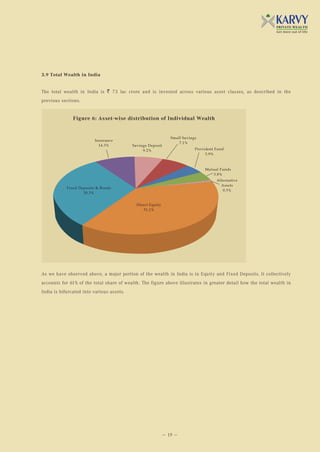
3.9 Total Wealth in India


The total wealth in India is ` 73 lac crore and is invested across various asset classes, as described in the
previous sections.


               Figure 6: Asset-wise distribution of Individual Wealth


                                                                Small Savings
                          Insurance
                                                                    7.1%
                            14.3%          Savings Deposit
                                                9.2%                        Provident Fund
                                                                                 3.9%


                                                                                Mutual Funds
                                                                                   3.8%
                                                                                      Alternative
                                                                                        Assets
            Fixed Deposits & Bonds
                                                                                         0.3%
                    30.3%


                                             Direct Equity
                                                 31.1%


As we have observed above, a major portion of the wealth in India is in Equity and Fixed Deposits. It collectively
accounts for 61% of the total share of wealth. The figure above illustrates in greater detail how the total wealth in
India is bifurcated into various assets.


                                                             — 19 —
Section 4: Individual Wealth in India vis-a-vis the World


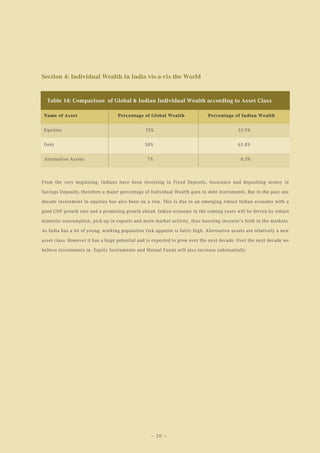
  Table 14: Comparison of Global & Indian Individual Wealth according to Asset Class

 Name of Asset                      Percentage of Global Wealth               Percentage of Indian Wealth


 Equities                                        35%                                        33.9%


 Debt                                           58%                                         65.8%


 Alternative Assets                               7%                                          0.3%


From the very beginning, Indians have been investing in Fixed Deposits, Insurance and depositing money in

Savings Deposits, therefore a major percentage of Individual Wealth goes in debt instruments. But in the past one

decade investment in equities has also been on a rise. This is due to an emerging robust Indian economy with a

good GDP growth rate and a promising growth ahead. Indian economy in the coming years will be driven by robust

domestic consumption, pick-up in exports and more market activity, thus boosting investor’s faith in the markets.

As India has a lot of young, working population risk appetite is fairly high. Alternative assets are relatively a new

asset class. However it has a huge potential and is expected to grow over the next decade. Over the next decade we

believe investments in Equity Instruments and Mutual Funds will also increase substantially.


                                                   — 20 —
Section 5: The Future of India’s Wealth
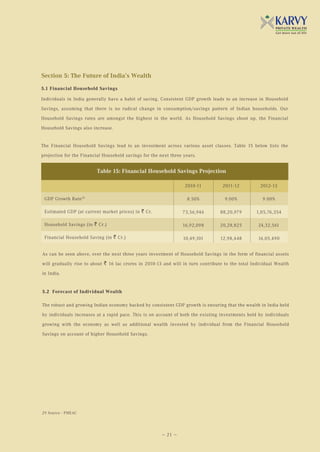
5.1 Financial Household Savings

Individuals in India generally have a habit of saving. Consistent GDP growth leads to an increase in Household

Savings, assuming that there is no radical change in consumption/savings pattern of Indian households. Our

Household Savings rates are amongst the highest in the world. As Household Savings shoot up, the Financial

Household Savings also increase.


The Financial Household Savings lead to an investment across various asset classes. Table 15 below lists the

projection for the Financial Household savings for the next three years.


                         Table 15: Financial Household Savings Projection

                                                                   2010-11         2011-12          2012-13

 GDP Growth Rate 29                                                 8.50%           9.00%            9.00%

 Estimated GDP (at current market prices) in ` Cr.               73,56,946        88,20,979       1,05,76,354

 Household Savings (in ` Cr.)                                     16,92,098       20,28,825        24,32,561

 Financial Household Saving (in ` Cr.)                            10,49,101       12,98,448        16,05,490


As can be seen above, over the next three years investment of Household Savings in the form of financial assets

will gradually rise to about ` 16 lac crores in 2010-13 and will in turn contribute to the total Individual Wealth

in India.


5.2 Forecast of Individual Wealth

The robust and growing Indian economy backed by consistent GDP growth is ensuring that the wealth in India held

by individuals increases at a rapid pace. This is on account of both the existing investments held by individuals

growing with the economy as well as additional wealth invested by individual from the Financial Household

Savings on account of higher Household Savings.


29 Source - PMEAC


                                                        — 21 —
— 22 —
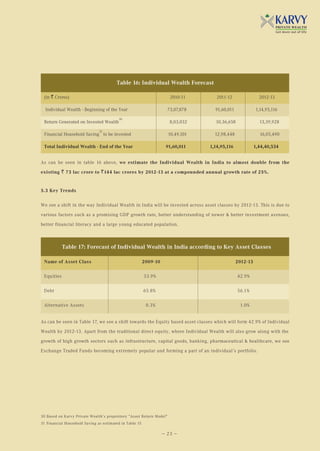
Table 16: Individual Wealth Forecast

 (in ` Crores)                                                         2010-11       2011-12                2012-13

  Individual Wealth - Beginning of the Year                           73,07,878     91,60,011             1,14,95,116
                                         30
 Return Generated on Invested Wealth                                   8,03,032     10,36,658               13,39,928
                               31
 Financial Household Saving to be invested                            10,49,101     12,98,448               16,05,490

 Total Individual Wealth - End of the Year                          91,60,011     1,14,95,116             1,44,40,534


As can be seen in table 16 above, we estimate the Individual Wealth in India to almost double from the

existing ` 73 lac crore to `144 lac crores by 2012-13 at a compounded annual growth rate of 25%.


5.3 Key Trends


We see a shift in the way Individual Wealth in India will be invested across asset classes by 2012-13. This is due to

various factors such as a promising GDP growth rate, better understanding of newer & better investment avenues,

better financial literacy and a large young educated population.


            Table 17: Forecast of Individual Wealth in India according to Key Asset Classes

 Name of Asset Class                                     2009-10                                2012-13


 Equities                                                33.9%                                  42.9%


 Debt                                                    65.8%                                  56.1%


 Alternative Assets                                       0.3%                                   1.0%


As can be seen in Table 17, we see a shift towards the Equity based asset classes which will form 42.9% of Individual

Wealth by 2012-13. Apart from the traditional direct equity, where Individual Wealth will also grow along with the

growth of high growth sectors such as infrastructure, capital goods, banking, pharmaceutical & healthcare, we see

Exchange Traded Funds becoming extremely popular and forming a part of an individual’s portfolio.


30 Based on Karvy Private Wealth’s propreitory “Asset Return Model”
31 Financial Household Saving as estimated in Table 15

                                                                   — 23 —
While the investments in Debt asset class instruments would increase by 20% YOY in volume terms its overall

proportion would reduce from the present 65.8% of Individual Wealth in India to 56.1% in 2012-13. Individuals would

broadly continue to invest in the same debt instruments as they presently invest in, although the growth in small

savings will be limited. We do not see futuristic products such as Inflation linked bonds getting popular in the next

3 years.


We believe that individuals in India are under-invested in Alternative Assets. With just 0.3% of our wealth presently

in Alternative Assets as compared to 7% globally, we believe this will be a huge area of investments in the next

decade. We see Private Equity Funds, Real Estate (Real Estate Funds & Real Estate Investment Trusts) and

International investments becoming extremely popular among the HNIs. However we do not see Hedge funds

becoming a popular option in the next 2-3 years.


                                                   — 24 —
About Karvy Private Wealth

Founded in 1985, the KARVY Group has grown to be become one of the leading financial groups in India. Our wide network spans
more than 800 offices across India, Dubai and New York. The group operates multiple businesses – stock broking, IPO
marketing, registry and transfer of shares, depository participants, insurance broking, mutual fund distribution and commodity
broking – and is ranked among the top five in each of these businesses.


All this has been built upon the Group’s unwavering commitment to integrity and transparency in all its dealings – a fact all our
customers attest to. Out of this very culture of success has emerged Karvy Private Wealth, the wealth management arm of the
KARVY Group. Karvy Private Wealth focuses on providing Wealth management advisory services to High Net worth Individuals
and Business Families. Karvy Private Wealth provides a spectrum of innovative solutions to privileged individuals like you who
need wealth management solutions to manage their hard–earned fortunes efficiently.


At Karvy Private Wealth, we believe that expert wealth management is important to maintain the value of your wealth over a
longer period of time and to grow it to fulfill your aspirations and financial goals.


The Karvy Private Wealth Edge

We aspire to become your trusted and primary advisor.


We act as more than just investment advisors: we provide access to a complete suite of services. With the right people guiding
your wealth in the right direction, there is no limit to what you can achieve. All our investment recommendations are backed by
intense in-house research and tailor-made for you as bespoke solutions by our highly experienced senior management team. Our
strategic asset allocation framework takes into account your unique circumstances and financial personality for recommending
an asset allocation specific to your needs.


Karvy Private Wealth is a neutral advisor as we are not affiliated to any product partner, thus giving you honest & unbiased
advice at all times.


At Karvy Private Wealth, we ensure that you get the freedom to actually enjoy your success by offering you end-to-end advice,
helping you enjoy the good life while we take care of your wealth strategies.


                                                                 — 25 —
Disclaimer


The information and views presented here are prepared by Karvy Private Wealth or other Karvy Group companies. The
information contained herein is based on our analysis and upon sources that we consider reliable. We, however, do not vouch for
the accuracy or the completeness thereof. This material is for personal information and we are not responsible for any loss
incurred based upon it.


The author, directors and other employees of Karvy and its affiliates may hold long or short positions in the various companies
from time to time. Every employee of Karvy and its associated companies are required to disclose their individual stock holdings
and details of trades, if any, that they undertake. The team rendering corporate analysis and investment recommendations are
restricted in purchasing/selling of shares or other securities till such a time this recommendation has either been displayed or has
been forwarded to clients of Karvy. All employees are further restricted to place orders only through Karvy Stock Broking Ltd.


The investments, if any, discussed or recommended here may not be suitable for all investors. Investors must make their own
investment decisions based on their specific investment objectives and financial position and using such independent advice, as
they believe necessary. While acting upon any information or analysis mentioned here, investors may please note that neither
Karvy nor any person connected with any associated companies of Karvy accepts any liability arising from the use of this
information and views mentioned here.


The information given in this document on tax, if any, is for guidance only, and should not be construed as tax advice. Investors
are advised to consult their respective tax advisers to understand the specific tax incidence applicable to them. We also expect
significant changes in the tax laws once the new Direct Tax Code is in force.


                                                           —26—
Office Address: Karvy Private Wealth (A division of Karvy Stock Broking Limited), 702, Hallmark Business
                                        Plaza, Sant Dnyaneshwar Marg, Off. Bandra-Kurla Complex, Bandra (East), Mumbai - 400 051.
                                        Registered Office Address: Karvy Stock Broking Ltd, “KARVY HOUSE”, 46, Avenue 4, Street No. 1, Banjara
                                        Hills, Hyderabad - 500 034.
                                        SEBI Registration Nos: “NSE (CM): INB230770138, NSE(F&O): INF230770138, BSE:INB010770130, BSE(F&O): INF010770131, MCX: 10775,
A division of Karvy Stock Broking Ltd   NCDEX: 00236” NSE (CDS) : INE230770138, MCX(SX) INE260770138 NSDL-SEBI Registration No.: IN-DP-NSDL-247-2005,
                                        CSDL-SEBI-Registration No.: IN-DP-CSDL-305-2005, PMS Registration No.: INP000001512.

Karvy Private Wealth - India Wealth Report

  • 1.
    Sep tem ber 2010 For Private Circulation Only K A RV Y P R I VAT E W E A LT H ’ S INDIA WEALTH REPORT Where do Indian Individuals Invest their Wealth? Key Trends.
  • 2.
    Foreword In this “IndiaWealth Report” brought out by Karvy Private Wealth, we attempt to go deeper into the “India Rising” story, and try to unravel as to how the high GDP growth rate and savings rate manifest themselves as wealth for the Indian Individuals. Wealth in India is a relatively nascent concept, since so far, the quantum of cumulatively collected savings was never more than a blip on the world wealth radar. But the sheer math of high GDP growth rate, high savings rate and increasing awareness of smart investment products is going to increase wealth in India manifold in the coming years. We believe the wealth held by Individuals in India would double in the next 3 years. We present this Report to Indian HNIs and emerging HNIs and invite you to understand the slice-and-dice of existing wealth in India – across asset classes of equity, debt and alternatives; and then across instruments within each of these asset classes. This should give you a quick idea of where Indian Individuals are investing their wealth and if there is some change required in your portfolio. We compare breakdown of Indian wealth with global wealth to possibly forecast which type of investments we are under-invested in. We also forecast how this would change in the coming years. We clearly see the individuals in India having a much larger exposure to the equity asset class and we also believe that Alternative Assets will be the fastest growing “Asset Class” in the next few years in India. The key premise of many of these alternative assets is to have single products serving multiple investment objectives. As long as we are clear about our multiple investment objectives and do not follow the herd, we can identify smart alternative investment instruments to make us winners. As has been shown in recent world economic events, we need not pick up all learnings on this from the West – but instead use our capabilities to develop sharp-shooting alternative investment products in India to meet such objectives. To have a more detailed discussion on any of the contents of this Report, please feel free to drop me a line. Happy reading …Get More Out of Life. Hrishikesh Parandekar Chief Executive Officer Karvy Private Wealth Email: hrishi@karvy.com
  • 4.
    C O NT E N T S The Changing Face of India 5 Section 1: A Bird’s Eye-view of Global Wealth 7 Section 2: India Rising 8 Section 3: Break-up of India’s Individual Wealth Investment 9 3.1 Direct Equity 9 3.2 Mutual Funds 10 3.3 Insurance 11 3.4 Fixed Deposits & Bonds 12 3.5 Savings Bank Deposits 14 3.6 Small Savings 15 3.7 Provident Fund 16 3.8 Alternative Assets 17 3.9 Total Wealth in India 19 Section 4: Individual Wealth in India vis-a-vis the World 20 Section 5: The Future of India’s Wealth 21 5.1 Financial Household Savings 21 5.2 Forecast of Individual Wealth 21 5.3 Key Trends 23 About Karvy Private Wealth 25 — 3 —
  • 5.
    List of Tables Table1: Asset-wise break-up of Individual Wealth in India 5 Table 2: Classification of Individual Wealth in India according to Key Asset Classes 6 Table 3: Classification of World Wealth according to Asset Class 7 Table 4: Overall Direct Equity break-up 9 Table 5: Break-up of Mutual Funds by Underlying Investment 10 Table 6: Assets in Insurance 11 Table 7: Assets of Individuals in Fixed Deposits and Bonds 12 Table 8: Distribution of Fixed Deposits 13 Table 9: Assets in Bonds 13 Table 10: Savings Bank Deposits 14 Table 11: Small Savings 15 Table 12: Provident Fund 16 Table 13: Alternative Assets 18 Table 14: Comparison of Global & Indian Individual Wealth according to Asset Class 20 Table 15: Financial Household Savings Projection 21 Table 16: Individual Wealth Forecast 23 Table 17: Forecast of Individual Wealth in India according to Key Asset Classes 23 — 4 —
  • 6.
    The Changing Faceof India The outlook of the world towards India is fast changing. Gone are the days when India was considered an under developed country. The nation as a whole has undergone a total face-lift with regard to its economy and financial growth. It is now considered as one of the fastest growing economies. This report talks about the amount of wealth available with Individuals in India and its break-up across various asset classes. Estimated Individual Wealth in the World The total estimated global wealth in financial assets with High Net Worth Individuals (HNIs)1 at the end of December 2009 was US$ 39 trillion2. Estimated Individual Wealth in India The amount of overall wealth in India has been calculated on the basis of the sum of all investment assets. For the purpose of this report only, the investments with individuals have been considered and does not include Government and Insitutional holdings. 3 The total wealth in India held by individuals is estimated to be ` 73 lac crores . The detailed break-up is as follows: Table 1: Asset-wise break-up of Individual Wealth in India Asset Amount (in ` Crore) Percentage Direct Equity 22,73,043 31.1% Fixed Deposits & Bonds 22,16,307 30.3% Insurance 10,46,145 14.3% Savings Bank Deposits 6,75,134 9.2% Small Savings 5,19,162 7.1% Provident Fund 2,81,559 3.9% Mutual Funds 2,77,953 3.8% Alternative Assets 18,575 0.3% Total 73,07,878 100% In this report, we have considered only the financial assets available to an Indian investor as shown the table above. Physical gold and real estate, which are physical assets have not been considered. 1 HNIs are defined as those having an investable asset of US$ 1 million or more, excluding primary residence, collectibles, consumables and consumer durables. 2 World Wealth Report 2010, Page 5, figure 2. Capgemini-Merrill Lynch Wealth Management. 3 Karvy Private Wealth Research — 5 —
  • 7.
    If we broadlyconsider the key asset classes, the same Individual Wealth in India stands as: Table 2: Classification of Individual Wealth in India according to Key Asset Classes Name of Asset Amount (in ` Crore) Percentage Equities 24,76,626 33.9% Debt 48,12,677 65.8% Alternative Assets 18,575 0.3% Total 73,07,878 100% Comparing this with how globally investors invest their wealth, it may be observed that globally, approximately 58% of Individual Wealth is in Debt investments, 35% in Equity and 7% in Alternative Assets. In India, Debt instruments are popular with the investors due to our traditional saving and risk-averse behaviour. But over the last few years investors have started viewing Equities as a good investment option, forming 33.9% of Individual Wealth. Investment in Alternative Assets is still at a nascent stage; therefore it comprises only 0.3% of total Individual Wealth but over the years it is expected to increase. We expect that the wealth in India held by individuals will almost double over the next 3 years and we are looking at the Individual Wealth in India to grow from the present ` 73 lac crore to ` 144 lac crore by 2012-13. 4 The individual HNI wealth across the globe is estimated to grow from US$ 39 trillion in 2009 to US$ 48.5 trillion by 2013 at a growth rate of 5.6%. Hence it may be observed that the Individual Wealth in India which is estimated to grow at 25% compounded rate will grow at more than four times the world rate. A large young educated population, which is open to investing their savings in different financial assets backed by a promising GDP growth rate will be the major contributor to this growth. We expect a much larger exposure towards the Equity asset class and believe that Alternative Assets will be the fastest growing Asset Class in the next few years in India. 4 World Wealth Report 2009, Page 4. Capgemini-Merrill Lynch Wealth Management. — 6 —
  • 8.
    Section 1: ABird’s Eye-view of Global Wealth 5 The total estimated global wealth with HNIs at the end of 2009 was US$ 39 trillion. This figure is almost same as the US $40.7 trillion at the end of 2007 i.e. before the global recession. Most of the wealth was concentrated in North-America, US$ 10.7 trillion 6 to be exact. The Asia-Pacific region accounts for US$ 9.7 trillion. Classification of World Wealth according to Asset Class The total estimated global wealth in the key financial assets with HNIs at the end of 2009 is shown below: Table 3: Classification of World Wealth according to Asset Class 7 Name of Asset Amount (in US $ Trillion) Percentage of Wealth Equities 11.2 35% Debt 18.5 58% Alternative Assets 2.3 7% The above table does not include Real Estate which is included in the total estimated US$ 39 trillion. With the global economy having recouped and gained significant ground, in 2009 we have seen the Asia-Pacific region leading the world with a 30.9% 8 increase in wealth as compared to global wealth which increased by 18.9 %. 5, 6 and 8 World Wealth Report 2010, Page 5, figure 2. Capgemini-Merrill Lynch Wealth Management. 7 World Wealth Report 2010, Page 17, figure 8. Capgemini-Merrill Lynch Wealth Management. — 7 —
  • 9.
    Section 2: IndiaRising The economy of India is the eleventh largest in the world by nominal value and fourth largest on Purchasing Power Parity (PPP) basis. Till 1990, there existed industrial licensing regime in India under which license was required for starting new companies, for producing new products, expanding productive capacity, laying off workers or for shutting down. Import of consumer goods, particularly luxuries, was restricted by means of high tariffs and low quotas or banning some items altogether. In 1991, India took a big leap away from the socialist protectionism in the wake of an exceptionally severe balance of payments crisis. The government signaled a systemic shift to a more open economy with greater reliance upon market forces, a larger role for the private sector including foreign investment, and a restructuring of the role of government in business. With the liberalization of its economy, India witnessed tremendous economic growth. Between 2000 and 2005 India’s GDP grew at 6-8% annually. In 2006-07 the growth rate was 9.7%. The GDP for 2007-08 was 9.2%. This figure fell to 6.7% for the year 2008-09. The main reason for this fall was the global economic downturn that began in the industrialized nations of the world in 2007. In 2009–10, besides the global recession, factors such as sub-normal monsoon also contributed to the declining economy. In spite of all these negative factors, the economy, posted a remarkable comeback and 9 10 the GDP growth rate for 2009-10 stands at 7.2% . The estimated GDP growth rate for 2010-11 is 8.5% . For the purpose of this Report we are considering only Individual Wealth and it does not include Institutional and Government holdings. The total wealth in India has been found as a sum of investments across the different asset classes available in the market. The following financial assets have been considered as part of wealth, whereas physical assets such as gold and real estate have been excluded. • Direct Equity • Mutual Funds • Insurance • Fixed Deposits & Bonds • Saving Bank Deposits • Small Savings • Provident Fund • Alternative Assets 9 Economic Survey of India 2009-10 10 PMEAC — 8 —
  • 10.
    Section 3: Break-upof India’s Individual Wealth Investment The estimated total Individual Wealth in India stands at ` 73 lac crores. It is derived from the sum of all the asset classes, which are majorly classified into Equities, Debt and Alternative Assets. As our Report estimates Individual Wealth in India, we will further divide these assets based on the investment instruments available in India. 3.1 Direct Equity Indians have conventionally invested in low risk assets but this behaviour is gradually changing with the economic boom and people experiencing higher returns in Direct Equities. The market capitalization value of Direct Equity changes according to the movements of the stock market. The overall amount invested in Direct Equities as on 31 st March, 2010 is ` 60 lac crores. Table 4: Overall Direct Equity Break-up Investor type % of Market Cap Amount(in ` Crore) Promoter Holdings 28.1% 16,89,755 Institutions / FII / QIBs 62.2% 37,36,130 Retail Investors 9.7% 5,83,288 Total 100% 60,09,173 However for the purpose of this Report on Individual Wealth we have only considered: a. Promoter and Promoter Group – We have only considered the portion with Individuals/HUF, Bodies Corporate and Any Other (Trust/Partnership, etc) sections. We have not considered Government holdings as promoter in the report. b. Public Shareholding – We have considered only the percentage of Individuals in this section. Thus the portion of total Individual Wealth invested in Direct Equity comes to ` 22.7 lac crores which is 31.1% of the Overall Individual Wealth in India. It is the highest contributor of all of the asset classes. We also see Direct Equity to continue to grow and form a more prominent share of Individual Wealth in the years to come. — 9 —
  • 11.
    3.2 Mutual Funds TheMutual Fund industry has seen a steady growth over the years. The Assets Under Management (AUM) for Mutual Funds has increased from approximately ` 1 lac crore in 2003 to ` 6.14 lac crore as on March, 2010. The growth of the AUM can be seen in the graph below (figure 1). Figure 1: Growth in AUM of Mutual Funds 700000 600000 500000 ` in Crores 400000 300000 200000 100000 March March March March March March March March 03 04 05 06 07 08 09 10 Years The total AUM for Mutual Funds as on March 31, 2010 is ` 6.14 lac crores. However, for the purpose of this report, only the HNI and retail investments have been considered and corporate and institutional investments have been removed from this asset pool. The total wealth from Mutual Funds with individual investors is ` 2.77 lac crores. This indicates that of the total AUM, 45% is held by individuals and the remaining amount by corporates and institutional investors. The bifurcation of the total Individual Wealth invested 11 in Mutual Funds is as follows : Table 5: Break-up of Mutual Funds by Underlying Investment Figure 1: Break-up of Mutual Funds Asset Class Amount (in ` Crore) Equity 1,85,817 32.8% Equity Debt 91,144 66.8% Gold Debt Gold 992 0.4% Total 2,77,953 The AUM of Mutual Funds contributes 3.8% towards the overall Individual Wealth. The percentage of individuals that invest in Mutual Funds is low when compared to the other asset classes, however we see greater investments in Mutual Funds in the coming years. 11 Source – AMFI — 10 —
  • 12.
    3.3 Insurance In thissection of the report we shall address wealth in Life Insurance, Pension Funds And Employees’ Deposit 12 Linked Insurance Fund . The total AUM for this is ` 10.46 lac crores. Table 6 provides us with the amount of wealth in each of the sub categories under insurance. Table 6: Assets in Insurance Figure 3: Composition of Insurance Asset Types of Insurance Amount (in ` Crore) Employees’ Pension Life Insurance 9,40,445 13 9.4% 0.7% Fund Employees’ Pension Fund 98,242 14 Employees’ Deposit Linked Insurance 89.9% Fund Employees’ Deposit Linked Insurance Fund 7,458 15 Life Insurance Total 10,46,145 A major portion of this ‘asset class’ comprises Life Insurance. This can be divided into public sector insurers and private sector insurers. Life Insurance Corporation of India (LIC) is the only player in the public sector, whereas the private sector comprises more than 20 companies. The total of both these sectors will give us the total amount invested in Life Insurance in India. Only 29% is invested in the private sector, whereas 71% of the AUM of Life Insurance is with LIC of India. The reason for this can be that LIC of India has been around for more than 5 decades. The private players followed much later starting from year 2000. The Assets in Insurance account for 14.32% of the total Individual Wealth in India. This comes third only to Equity and Fixed deposits in terms of preferred investment instruments. This proves that investors ensure that the investable surplus they have is utilized not only to increase their wealth but also to safeguard themselves and their families. Of the total amount that individual investors have put into Insurance, ` 1.77 lac crore (approx.) is invested in the 16 Equity markets through Unit Linked Insurance Plans (ULIPs) . 12 All establishments with at least 10 full-time permanent employees and to whom the Employee's Provident Fund and Miscellaneous Provisions Act, 1952 applies, have a statutory liability to subscribe to Employee's Deposit Linked Insurance Scheme (EDLI), 1976 to provide for Life Insurance for all their employees. The organization has to make a contribution @ 0.51% of each employee's wages (Basic + Dearness Allowance + Retaining Allowance), subject to a maximum of ` 6,500 per month, to the Provident Fund Authorities as part of its compliance to the Act. The death benefit payable under this scheme is based on the provident fund account balance of the individual member, subject to a maximum of ` 60,000/. 13 IRDA Annual Report 2008-09 ; 14 and 15 - 56th Annual Report, 2008-09 Employees’ Provident Fund Organization ; 16- Outlook Money, 5th May 2010. — 11 —
  • 13.
    3.4 Fixed Deposits& Bonds Traditionally Indian investors have invested in Fixed Deposits and it still comprises a major portion of asset allocation of Individual Wealth. Table 7: Assets of Individuals in Fixed Deposits and Bonds Asset Amount (in ` Crore) Fixed Deposits 22,13,023 Bonds 3,284 Total 22,16,307 The asset class of Fixed Deposits (FDs) and Bonds comprise: A. Fixed Deposits • Bank Fixed Deposits • Corporate Fixed Deposits • Fixed Deposits with Non-Banking Financial Companies (NBFCs) • Fixed Deposits with Residuary Non-Banking Companies (RNBCs) Bank Fixed Deposits include scheduled commercial and co-operative bank’s fixed deposits. The total assets for 17 Scheduled Commercial Bank FDs as on April, 2010 is ` 39.24 lac crores of which ` 20.23 lac crores are the Assets for Scheduled Commercial Bank FDs held by individuals. The Assets for Scheduled Co-operative Bank FDs in 2007-08 is 18 ` 48,585 crores of which ` 25,045 crores is the wealth held by individuals. Corporate Fixed Deposits are similar to Bank Fixed Deposits except that they are offered by a company or a corporate. The interest rate that these offer is higher than that of banks, at times double. According to estimates, the AUM of Corporate Fixed Deposits is ` 60,000 crores. Many of the top companies belonging to reputed industrial houses like Tata Motors, JaiPrakash Associates, Mahindra & Mahindra Finance, etc. and government organisations like HUDCO, LIC Housing Finance, etc. are accepting deposits from public. A Non-Banking Financial Company (NBFC) is a company registered under the Companies Act, 1956 and is engaged in the business of loans and advances, acquisition of shares/stocks/bonds/debentures/securities issued by government or local authority or other securities of marketable nature, leasing, hire-purchase, insurance business, chit business, but does not include any institution whose principal business is that of agriculture activity, industrial activity, 19 sale/purchase/construction of immovable property. The AUM of Fixed Deposits with NBFCs is ` 14,802 crores of which ` 7,630 crores is held by individuals. 17, 18 and 19 Source – RBI — 12 —
  • 14.
    Residuary Non-Banking Companies(RNBCs) are companies which are non-banking institutions receiving deposits under any scheme/arrangement in one lump sum/installments by way of contributions/subscriptions or by sale of units/certificates/other instruments. The Assets in FDs with RNBCs is ` 97,082 crores. Hence, the total wealth in Fixed Deposits in India is ` 41.45 lac crores. Of this, the amount with individuals is ` 22.13 lac crores. Thus, we can say that 53.39% of total wealth in Fixed Deposits is with individual investors. The chart below shows a break-up of FDs into the sources: Table 8: Distribution of Fixed Deposits Figure 4: Distribution of Fixed Deposits Types of FDs Amount (in ` Crore) Bank FDs 20,48,311 4% 3% 1% Banks Corporate FDs 60,000 NBFCs NBFC FDs 7,630 92% RNBCs Corporate Fixed RNBC FDs 97,082 Deposites Total 22,13,023 We can conclude that investors prefer Bank FDs over the other types of Fixed Deposits probably because Bank FDs are considered to be more secure. Although Corporate FDs have a much higher rate of return, they are unsecured investments and come with a greater level of risk. Fixed Deposits account for 30.28% of the overall Individual Wealth in India. It is a high proportion as it is the 2nd most preferred investment avenue after Direct Equities. The reason it accounts for such a high percentage towards the overall wealth is its low-risk nature. B. Bonds • PSU Bonds (including Capital Gains Bonds) • Corporate Bonds Table 9: Assets in Bonds Bond Type Amount (in ` Crore) Percentage In PSU Bonds, we have considered taxable as well as PSU Bond 1,359 41% tax-free bonds. The total AUM for PSU Bonds as on 31st March, 2009 is ` 49,005 crores. However, the Corporate Bond 1,925 59% estimated Individual Wealth in PSU Bonds is Total 3,284 100% 20 ` 1,359 crores . 20 Source - RBI — 13 —
  • 15.
    The total AUMfor Corporate Bonds as on 31 st March, 2010 is ` 3,750 crores 21. This consists of individual and institutional investors. Considering only individual investors, ` 1,925 crores is the total Individual Wealth in Corporate Bonds. From the above data, we conclude that total AUM in Bonds with the individuals is ` 3,284 crores. Thus, PSU Bonds and Corporate Bonds account for a very minimal percentage of the total Individual Wealth in India (lower than 1%). 3.5 Savings Bank Deposits The amount of investable surplus that investors have in a savings account with banks will be addressed in this section. This can be further divided into the type of banks the deposits are with. These types include Scheduled Commercial Banks and Scheduled Co-operative Banks. Table 10: Savings Bank Deposits 22 Bank Type Amount (in ` Crore) Scheduled Commercial Banks 6,70,895 Scheduled Co-operative Banks 4,239 Total 6,75,134 Though the returns are less, it has been the favourite asset of Indian individuals over the years as it is completely risk-free and highly liquid. The Savings Bank Deposits across India is worth ` 6.75 lac crores. Savings Bank deposits with individuals account for 9.24% of the overall Individual Wealth in India. 21 AUM calculated is of the corporate bond issues which have come out for retail investors in 2009 and 2010. 22 Source – RBI — 14 —
  • 16.
    3.6 Small Savings Smallsavings comprise savings made with the Post Office. They include instruments such as Post Office Time Deposits, Post Office Recurring Deposits, Post Office Savings Accounts, Post Office Monthly Income Scheme, Kisan Vikas Patra, and National Savings Certificate, etc. It is one of the most traditional forms of investment in India. The 23 total AUM of Small Savings as on 31 st March, 2009 is ` 5.19 lac crores . Public Provident Fund in the Post Office has not been considered here as it is being considered as a separate asset class under Provident Fund. Table 11 below lists the different post office small savings schemes and the amount of Individual Wealth in each of them as on March 31 st, 2009. Table 11: Small Savings Scheme Amount (in ` Crore) Post Office Monthly Income Scheme 1,79,270 Kisan Vikas Patra 1,47,584 Post Office Recurring Deposits 64,822 National Savings Certificate (NSC) 55,455 Post Office Time Deposits 26,331 Post Office Savings Account 22,217 Senior Citizens’ Savings Scheme 20,612 Deposit scheme for Retiring Government 1,244 Employees 1989 / Retiring Employees of Public Sector Indira Vikas Patra 1,072 National Savings Scheme 1992 555 Total 5,19,162 The Assets in Small Savings contributes 7.10% of the total estimated Individual Wealth in India. Small savings are a popular choice amongst the smaller investors and are also extensively used by the rural population as investment avenues. 23 Source - RBI — 15 —
  • 17.
    3.7 Provident Fund ProvidentFund (PF) is an investment-cum-tax savings instrument. It has been used traditionally as a retirement planning tool by individual investors in India. It is an asset class which provides the investor with the luxury of saving tax and also safeguarding their capital. Provident Fund can be divided into Employee Provident Fund (EPF) and Public Provident Fund (PPF). EPF is a retirement benefit scheme that is available to salaried employees. Both the employees and employer contribute to EPF as a percentage (12% in most cases) of the basic wages, dearness and retaining allowance, which is remitted to the PF authorities. PPF is a voluntary yearly amount that an individual deposits with Post Office (PPF with Post Office) or with Banks (PPF with Banks). Table 12 lists the break-up of all types of PPF accounts. Table 12: Provident Fund Figure 5: Distribution of Provident Fund Type of PF Amount (in ` Crore) 8% 17% Employee Provident Fund Employee Provident Fund 2,11,677 24 75% Public Provident PPF with Banks 47,124 Fund with Post office PPF with Post Office 22,758 25 Public Provident Fund with Banks Total 2,81,559 The total assets in PF as on 31 st March, 2009 is ` 2.81 lac crores. The amount of wealth in EPF is ` 2.11 lac crores. The amount of wealth in PPF is ` 69,882 crores. One of the reasons for the difference in the AUMs of EPF and PPF is that EPF is provided by all employers to their employees and is compulsory in most organizations. Whereas PPF is an investment cum tax saving option that an investor can opt for. It is not compulsory to have a PPF account. As only individuals can have a Provident Fund account, the entire amount is considered as the wealth with individuals. When the Assets of PF are evaluated against the overall Individual Wealth in India, they account for 3.85% of the overall wealth. 24 Source - EPFO 25 Source - RBI — 16 —
  • 18.
    3.8 Alternative Assets Investmentswhich are considered outside the traditional asset classes like Equity, Mutual Funds, Saving and Fixed Deposits, Insurance and other instruments covered earlier are known as alternative assets. These assets include private equity/venture capital, structured products, real estate funds, art funds, film funds etc. These alternative assets usually have a larger initial investment and hence not accessible to general investors. A. Equity Linked Debentures Equity–linked Debentures are instruments whose returns on investment are tied to the equity markets. These are comparatively new in the Indian market and are of two types: • Principal Protected, where the principal amount is fixed while the interest component is variable and linked to stock market movements; • Non-Principal Protected instruments are a riskier variant, where even the principal is linked to the market. The total assets in ELDs as on 18th November, 2009 is ` 15,000 crores. B. Private Equity Funds/Venture Capital Starting and growing a business always requires capital. There are a number of alternative methods of raising funds. These include the owner or proprietor’s own capital, arranging debt finance or seeking an equity partner, as is the case with Private Equity and Venture Capital. Private Equity (PE) is a broad term that refers to any type of non-public ownership equity securities that are not listed on a public exchange. Private Equity encompasses both early stage (venture capital) and later stage (buy-out, expansion) investing. 26 The assets with PE Funds as of December, 2009 is ` 7,514 crores . Of this, the amount of wealth with individuals is ` 1,503 crores. C. Real Estate Funds Like Mutual Funds, Real Estate funds are founded by a group of real estate professionals/experts to 'manage' property/real estate for the investor. Investors get the benefit of diversification across cities and across property – Residential and Commercial. The introduction of Real Estate Mutual Funds has further ensured large-scale investments in the Indian real estate market. As of now, the real estate window is open to high net worth individuals, institutional 27 investors and global investors. The total assets in Real Estate Funds is ` 6,753 crores . The total AUM of Real Estate Funds with individuals is ` 1,351 crores. 26 and 27 Source - SEBI — 17 —
  • 19.
    D. Film Funds FilmFunds mobilize money to invest in movie productions/marketing. While not all films are successful, the payoffs from those that are successful can be huge. The fund sets up Special Purpose Vehicles (SPVs) to fund each film project. The revenues from the film will flow directly into the SPV and will be re-distributed according to the ownership pattern. The filmmaker too will have a stake in the SPV. 28 The total amount of wealth in Film Funds amounts to ` 965 crores . The assets in Film Funds, considered for the purpose of this report, to be with individuals is ` 482 crores. E. Art Funds An Art Fund works much like a Mutual Fund, the difference being that the former invests in Art. The funds aim at investing in a diversified portfolio of select works by leading artists and providing investors with the opportunity to profit from leveraging the fund's pooled purchasing power. Art funds are a fairly recent phenomenon in India, and are cumulatively estimated to command AUM of ` 239 crore under management. Table 13 lists the break–up of the amount of wealth under each sub-category of Alternative Assets. Table 13: Alternative Assets Type of Asset AUM (in ` Crore) Equity-linked Debentures 15,000 Private Equity/Venture Capital 1,503 Real Estate Funds 1,351 Film Funds 482 Art Funds 239 Total 18,575 The total AUM in Alternative Assets is ` 18,575 crores. This asset class is relatively new in India and as the initial investment is huge and risk is fairly high, people are still reluctant to invest in it. But this scenario is expected to change over the next decade as HNIs will look for different options for portfolio diversification. We expect investments in Alternative Assets to grow at a phenomenal rate of 100% over the next three years. 28 Source - SEBI — 18 —
  • 20.
    3.9 Total Wealthin India The total wealth in India is ` 73 lac crore and is invested across various asset classes, as described in the previous sections. Figure 6: Asset-wise distribution of Individual Wealth Small Savings Insurance 7.1% 14.3% Savings Deposit 9.2% Provident Fund 3.9% Mutual Funds 3.8% Alternative Assets Fixed Deposits & Bonds 0.3% 30.3% Direct Equity 31.1% As we have observed above, a major portion of the wealth in India is in Equity and Fixed Deposits. It collectively accounts for 61% of the total share of wealth. The figure above illustrates in greater detail how the total wealth in India is bifurcated into various assets. — 19 —
  • 21.
    Section 4: IndividualWealth in India vis-a-vis the World Table 14: Comparison of Global & Indian Individual Wealth according to Asset Class Name of Asset Percentage of Global Wealth Percentage of Indian Wealth Equities 35% 33.9% Debt 58% 65.8% Alternative Assets 7% 0.3% From the very beginning, Indians have been investing in Fixed Deposits, Insurance and depositing money in Savings Deposits, therefore a major percentage of Individual Wealth goes in debt instruments. But in the past one decade investment in equities has also been on a rise. This is due to an emerging robust Indian economy with a good GDP growth rate and a promising growth ahead. Indian economy in the coming years will be driven by robust domestic consumption, pick-up in exports and more market activity, thus boosting investor’s faith in the markets. As India has a lot of young, working population risk appetite is fairly high. Alternative assets are relatively a new asset class. However it has a huge potential and is expected to grow over the next decade. Over the next decade we believe investments in Equity Instruments and Mutual Funds will also increase substantially. — 20 —
  • 22.
    Section 5: TheFuture of India’s Wealth 5.1 Financial Household Savings Individuals in India generally have a habit of saving. Consistent GDP growth leads to an increase in Household Savings, assuming that there is no radical change in consumption/savings pattern of Indian households. Our Household Savings rates are amongst the highest in the world. As Household Savings shoot up, the Financial Household Savings also increase. The Financial Household Savings lead to an investment across various asset classes. Table 15 below lists the projection for the Financial Household savings for the next three years. Table 15: Financial Household Savings Projection 2010-11 2011-12 2012-13 GDP Growth Rate 29 8.50% 9.00% 9.00% Estimated GDP (at current market prices) in ` Cr. 73,56,946 88,20,979 1,05,76,354 Household Savings (in ` Cr.) 16,92,098 20,28,825 24,32,561 Financial Household Saving (in ` Cr.) 10,49,101 12,98,448 16,05,490 As can be seen above, over the next three years investment of Household Savings in the form of financial assets will gradually rise to about ` 16 lac crores in 2010-13 and will in turn contribute to the total Individual Wealth in India. 5.2 Forecast of Individual Wealth The robust and growing Indian economy backed by consistent GDP growth is ensuring that the wealth in India held by individuals increases at a rapid pace. This is on account of both the existing investments held by individuals growing with the economy as well as additional wealth invested by individual from the Financial Household Savings on account of higher Household Savings. 29 Source - PMEAC — 21 —
  • 23.
  • 24.
    Table 16: IndividualWealth Forecast (in ` Crores) 2010-11 2011-12 2012-13 Individual Wealth - Beginning of the Year 73,07,878 91,60,011 1,14,95,116 30 Return Generated on Invested Wealth 8,03,032 10,36,658 13,39,928 31 Financial Household Saving to be invested 10,49,101 12,98,448 16,05,490 Total Individual Wealth - End of the Year 91,60,011 1,14,95,116 1,44,40,534 As can be seen in table 16 above, we estimate the Individual Wealth in India to almost double from the existing ` 73 lac crore to `144 lac crores by 2012-13 at a compounded annual growth rate of 25%. 5.3 Key Trends We see a shift in the way Individual Wealth in India will be invested across asset classes by 2012-13. This is due to various factors such as a promising GDP growth rate, better understanding of newer & better investment avenues, better financial literacy and a large young educated population. Table 17: Forecast of Individual Wealth in India according to Key Asset Classes Name of Asset Class 2009-10 2012-13 Equities 33.9% 42.9% Debt 65.8% 56.1% Alternative Assets 0.3% 1.0% As can be seen in Table 17, we see a shift towards the Equity based asset classes which will form 42.9% of Individual Wealth by 2012-13. Apart from the traditional direct equity, where Individual Wealth will also grow along with the growth of high growth sectors such as infrastructure, capital goods, banking, pharmaceutical & healthcare, we see Exchange Traded Funds becoming extremely popular and forming a part of an individual’s portfolio. 30 Based on Karvy Private Wealth’s propreitory “Asset Return Model” 31 Financial Household Saving as estimated in Table 15 — 23 —
  • 25.
    While the investmentsin Debt asset class instruments would increase by 20% YOY in volume terms its overall proportion would reduce from the present 65.8% of Individual Wealth in India to 56.1% in 2012-13. Individuals would broadly continue to invest in the same debt instruments as they presently invest in, although the growth in small savings will be limited. We do not see futuristic products such as Inflation linked bonds getting popular in the next 3 years. We believe that individuals in India are under-invested in Alternative Assets. With just 0.3% of our wealth presently in Alternative Assets as compared to 7% globally, we believe this will be a huge area of investments in the next decade. We see Private Equity Funds, Real Estate (Real Estate Funds & Real Estate Investment Trusts) and International investments becoming extremely popular among the HNIs. However we do not see Hedge funds becoming a popular option in the next 2-3 years. — 24 —
  • 26.
    About Karvy PrivateWealth Founded in 1985, the KARVY Group has grown to be become one of the leading financial groups in India. Our wide network spans more than 800 offices across India, Dubai and New York. The group operates multiple businesses – stock broking, IPO marketing, registry and transfer of shares, depository participants, insurance broking, mutual fund distribution and commodity broking – and is ranked among the top five in each of these businesses. All this has been built upon the Group’s unwavering commitment to integrity and transparency in all its dealings – a fact all our customers attest to. Out of this very culture of success has emerged Karvy Private Wealth, the wealth management arm of the KARVY Group. Karvy Private Wealth focuses on providing Wealth management advisory services to High Net worth Individuals and Business Families. Karvy Private Wealth provides a spectrum of innovative solutions to privileged individuals like you who need wealth management solutions to manage their hard–earned fortunes efficiently. At Karvy Private Wealth, we believe that expert wealth management is important to maintain the value of your wealth over a longer period of time and to grow it to fulfill your aspirations and financial goals. The Karvy Private Wealth Edge We aspire to become your trusted and primary advisor. We act as more than just investment advisors: we provide access to a complete suite of services. With the right people guiding your wealth in the right direction, there is no limit to what you can achieve. All our investment recommendations are backed by intense in-house research and tailor-made for you as bespoke solutions by our highly experienced senior management team. Our strategic asset allocation framework takes into account your unique circumstances and financial personality for recommending an asset allocation specific to your needs. Karvy Private Wealth is a neutral advisor as we are not affiliated to any product partner, thus giving you honest & unbiased advice at all times. At Karvy Private Wealth, we ensure that you get the freedom to actually enjoy your success by offering you end-to-end advice, helping you enjoy the good life while we take care of your wealth strategies. — 25 —
  • 27.
    Disclaimer The information andviews presented here are prepared by Karvy Private Wealth or other Karvy Group companies. The information contained herein is based on our analysis and upon sources that we consider reliable. We, however, do not vouch for the accuracy or the completeness thereof. This material is for personal information and we are not responsible for any loss incurred based upon it. The author, directors and other employees of Karvy and its affiliates may hold long or short positions in the various companies from time to time. Every employee of Karvy and its associated companies are required to disclose their individual stock holdings and details of trades, if any, that they undertake. The team rendering corporate analysis and investment recommendations are restricted in purchasing/selling of shares or other securities till such a time this recommendation has either been displayed or has been forwarded to clients of Karvy. All employees are further restricted to place orders only through Karvy Stock Broking Ltd. The investments, if any, discussed or recommended here may not be suitable for all investors. Investors must make their own investment decisions based on their specific investment objectives and financial position and using such independent advice, as they believe necessary. While acting upon any information or analysis mentioned here, investors may please note that neither Karvy nor any person connected with any associated companies of Karvy accepts any liability arising from the use of this information and views mentioned here. The information given in this document on tax, if any, is for guidance only, and should not be construed as tax advice. Investors are advised to consult their respective tax advisers to understand the specific tax incidence applicable to them. We also expect significant changes in the tax laws once the new Direct Tax Code is in force. —26—
  • 28.
    Office Address: KarvyPrivate Wealth (A division of Karvy Stock Broking Limited), 702, Hallmark Business Plaza, Sant Dnyaneshwar Marg, Off. Bandra-Kurla Complex, Bandra (East), Mumbai - 400 051. Registered Office Address: Karvy Stock Broking Ltd, “KARVY HOUSE”, 46, Avenue 4, Street No. 1, Banjara Hills, Hyderabad - 500 034. SEBI Registration Nos: “NSE (CM): INB230770138, NSE(F&O): INF230770138, BSE:INB010770130, BSE(F&O): INF010770131, MCX: 10775, A division of Karvy Stock Broking Ltd NCDEX: 00236” NSE (CDS) : INE230770138, MCX(SX) INE260770138 NSDL-SEBI Registration No.: IN-DP-NSDL-247-2005, CSDL-SEBI-Registration No.: IN-DP-CSDL-305-2005, PMS Registration No.: INP000001512.