KARL MARX
Dr. Laxmi Kumari
Assistant Professor
PG Dept of Pol Sci, Veer Kunwar Singh University,
Ara, Bihar
Birth:1818, Germany
Death: 1883, London (U.K.)
• Books: Communist Manifesto (1848)
Das Capital (1867) etc.
• Friend & Co-author : Engels
Human Nature
• Social, Creative, Potential
• “A human being does not regard himself as independent
unless he is his own master, and he is only his own master
when he owes his existence to himself”.
Core Concepts by Marx
1) Historical (Dialectical) Materialism
2) Alienation
3) Class-conflict
4) Theory of Surplus Value
5) Theory of Revolution
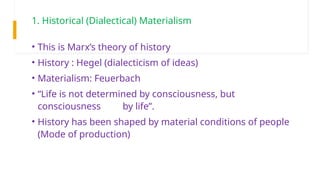
1. Historical (Dialectical) Materialism
• This is Marx’s theory of history
• History : Hegel (dialecticism of ideas)
• Materialism: Feuerbach
• “Life is not determined by consciousness, but
consciousness by life”.
• History has been shaped by material conditions of people
(Mode of production)
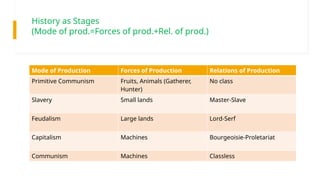
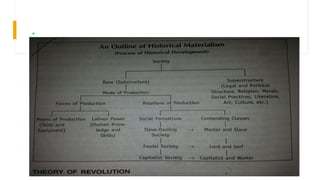
History as Stages
(Mode of prod.=Forces of prod.+Rel. of prod.)
Mode of Production Forces of Production Relations of Production
Primitive Communism Fruits, Animals (Gatherer,
Hunter)
No class
Slavery Small lands Master-Slave
Feudalism Large lands Lord-Serf
Capitalism Machines Bourgeoisie-Proletariat
Communism Machines Classless
.
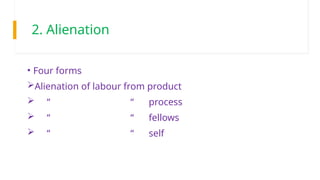
2. Alienation
• Four forms
Alienation of labour from product
 “ “ process
 “ “ fellows
 “ “ self
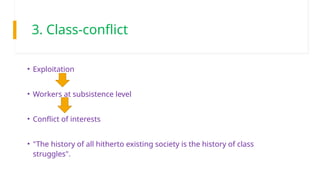
3. Class-conflict
• Exploitation
• Workers at subsistence level
• Conflict of interests
• "The history of all hitherto existing society is the history of class
struggles".
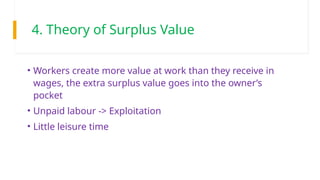
4. Theory of Surplus Value
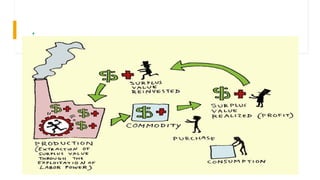
• Workers create more value at work than they receive in
wages, the extra surplus value goes into the owner’s
pocket
• Unpaid labour -> Exploitation
• Little leisure time
.
5. Theory of Revolution
• Exploitation at peak
• Socialism------------------------------------Communism
(Dictatorship (Classless, Stateless)
of proletariats)
[From each a/t his ability [From each a/t his ability
to each a/t his work] to each a/t his need}
Marx’s views on:
• State (It is an instrument in the hands of the ruling class
to exploit the oppressed class.)
• Ideology & False-consciousness (Class in itself -> Class for
itself)
• Religion-’Opium’
Bonapartism
• Mentioned in 18th
Brumaire of Louis Bonaparte (1852)
• Marx saw the state as largely derivative of the economic forces and class
interests, however he did at times allow it a substantial degree of political
autonomy.
• In December,1851, French President Louis Bonaparte (Napoleon's nephew)’s
followers broke up the Legislative Assembly and established a dictatorship
(proclaiming himself Emperor Napoleon III), achieving not only a considerable
degree of independence from the bourgeoisie, but often acting directly against its
immediate interests.
• According to Marx, however, the Bonapartist state served the long term interests
of the capitalist system, even if it often acted against the immediate interests and
will of the bourgeoisie.
.
.
Marx’s Criticism
See notes
• Independence of Culture & tradition
• More than two classes e.g., managerial
• After elimination of capitalism, others can exploit e.g., state bureaucracy
• Marx’s theory of history suffers from weakness e.g., revolution in peasant society, rather
than capitalist one
• Doubt over word ‘scientific’ with socialism
• After revolution, those in charge of dictatorship of proletariat can turn despotic e.g., Stalin
• Many doubt how capitalism will be replaced i.e, process is complicated
• Problem of over-consumption and need of capital e.g., Marx inability to envision self-
sufficient local economy like Gandhi
• The simpler way of lifestyle with values & without technology i.e., real communism
• Use of violence
• Role & position of women ignored
Importance of Marxism
• Only/greatest tool to understand menace of capitalism
Workers can understand their problem
• Emancipation of (all) human beings
• It enjoys new currency in economic crisis e.g., Covid-19
• As the inequality rises, it is helpful in understanding the
situation

KARL MARX power point presentation slides.pptx

  • 1.
    KARL MARX Dr. LaxmiKumari Assistant Professor PG Dept of Pol Sci, Veer Kunwar Singh University, Ara, Bihar
  • 2.
    Birth:1818, Germany Death: 1883,London (U.K.) • Books: Communist Manifesto (1848) Das Capital (1867) etc. • Friend & Co-author : Engels
  • 3.
    Human Nature • Social,Creative, Potential • “A human being does not regard himself as independent unless he is his own master, and he is only his own master when he owes his existence to himself”.
  • 4.
    Core Concepts byMarx 1) Historical (Dialectical) Materialism 2) Alienation 3) Class-conflict 4) Theory of Surplus Value 5) Theory of Revolution
  • 5.
    1. Historical (Dialectical)Materialism • This is Marx’s theory of history • History : Hegel (dialecticism of ideas) • Materialism: Feuerbach • “Life is not determined by consciousness, but consciousness by life”. • History has been shaped by material conditions of people (Mode of production)
  • 6.
    History as Stages (Modeof prod.=Forces of prod.+Rel. of prod.) Mode of Production Forces of Production Relations of Production Primitive Communism Fruits, Animals (Gatherer, Hunter) No class Slavery Small lands Master-Slave Feudalism Large lands Lord-Serf Capitalism Machines Bourgeoisie-Proletariat Communism Machines Classless
  • 7.
  • 8.
    2. Alienation • Fourforms Alienation of labour from product  “ “ process  “ “ fellows  “ “ self
  • 9.
    3. Class-conflict • Exploitation •Workers at subsistence level • Conflict of interests • "The history of all hitherto existing society is the history of class struggles".
  • 10.
    4. Theory ofSurplus Value • Workers create more value at work than they receive in wages, the extra surplus value goes into the owner’s pocket • Unpaid labour -> Exploitation • Little leisure time
  • 11.
  • 12.
    5. Theory ofRevolution • Exploitation at peak • Socialism------------------------------------Communism (Dictatorship (Classless, Stateless) of proletariats) [From each a/t his ability [From each a/t his ability to each a/t his work] to each a/t his need}
  • 13.
    Marx’s views on: •State (It is an instrument in the hands of the ruling class to exploit the oppressed class.) • Ideology & False-consciousness (Class in itself -> Class for itself) • Religion-’Opium’
  • 14.
    Bonapartism • Mentioned in18th Brumaire of Louis Bonaparte (1852) • Marx saw the state as largely derivative of the economic forces and class interests, however he did at times allow it a substantial degree of political autonomy. • In December,1851, French President Louis Bonaparte (Napoleon's nephew)’s followers broke up the Legislative Assembly and established a dictatorship (proclaiming himself Emperor Napoleon III), achieving not only a considerable degree of independence from the bourgeoisie, but often acting directly against its immediate interests. • According to Marx, however, the Bonapartist state served the long term interests of the capitalist system, even if it often acted against the immediate interests and will of the bourgeoisie.
  • 15.
  • 16.
    Marx’s Criticism See notes •Independence of Culture & tradition • More than two classes e.g., managerial • After elimination of capitalism, others can exploit e.g., state bureaucracy • Marx’s theory of history suffers from weakness e.g., revolution in peasant society, rather than capitalist one • Doubt over word ‘scientific’ with socialism • After revolution, those in charge of dictatorship of proletariat can turn despotic e.g., Stalin • Many doubt how capitalism will be replaced i.e, process is complicated • Problem of over-consumption and need of capital e.g., Marx inability to envision self- sufficient local economy like Gandhi • The simpler way of lifestyle with values & without technology i.e., real communism • Use of violence • Role & position of women ignored
  • 17.
    Importance of Marxism •Only/greatest tool to understand menace of capitalism Workers can understand their problem • Emancipation of (all) human beings • It enjoys new currency in economic crisis e.g., Covid-19 • As the inequality rises, it is helpful in understanding the situation