SOCIAL SCIENCE
THEORIES
MARXISM
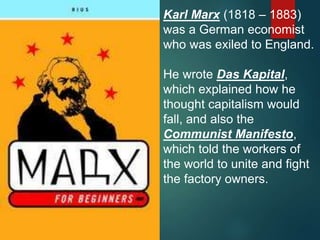
Karl Marx (1818 – 1883)
was a German economist
who was exiled to England.
He wrote Das Kapital,
which explained how he
thought capitalism would
fall, and also the
Communist Manifesto,
which told the workers of
the world to unite and fight
the factory owners.
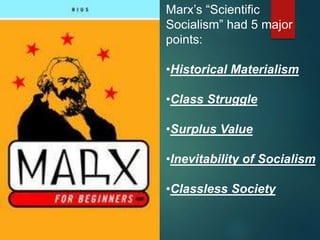
Marx’s “Scientific
Socialism” had 5 major
points:
•Historical Materialism
•Class Struggle
•Surplus Value
•Inevitability of Socialism
•Classless Society
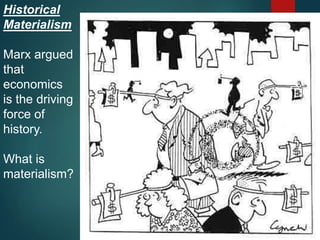
Historical
Materialism
Marx argued
that
economics
is the driving
force of
history.
What is
materialism?
Historical materialism
 a theory on human society and history that
states that thoughts and social institutions
develop only as a superstructure founded on
an economic base
 To understand human interaction and the
changes human civilization has been through,
it becomes necessary to trace the history from
the point of human evolution from a scientific
perspective.
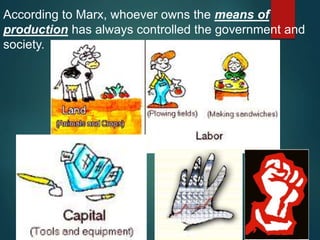
According to Marx, whoever owns the means of
production has always controlled the government and
society.
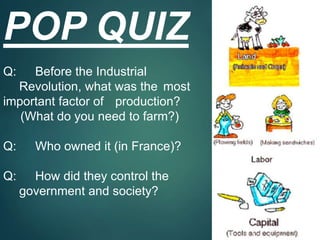
POP QUIZ
Q: Before the Industrial
Revolution, what was the most
important factor of production?
(What do you need to farm?)
Q: Who owned it (in France)?
Q: How did they control the
government and society?
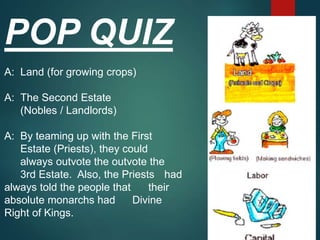
POP QUIZ
A: Land (for growing crops)
A: The Second Estate
(Nobles / Landlords)
A: By teaming up with the First
Estate (Priests), they could
always outvote the outvote the
3rd Estate. Also, the Priests had
always told the people that their
absolute monarchs had Divine
Right of Kings.
POP QUIZ
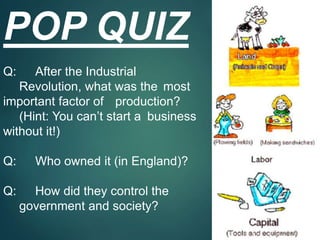
Q: After the Industrial
Revolution, what was the most
important factor of production?
(Hint: You can’t start a business
without it!)
Q: Who owned it (in England)?
Q: How did they control the
government and society?
POP QUIZ
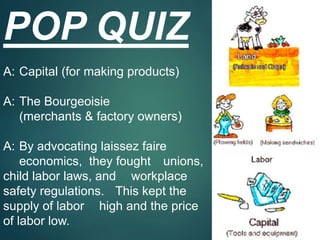
A: Capital (for making products)
A: The Bourgeoisie
(merchants & factory owners)
A: By advocating laissez faire
economics, they fought unions,
child labor laws, and workplace
safety regulations. This kept the
supply of labor high and the price
of labor low.
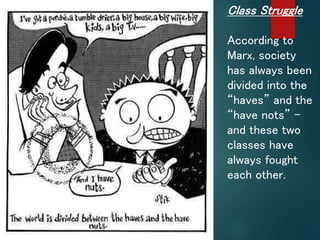
Class Struggle
According to
Marx, society
has always been
divided into the
“haves” and the
“have nots” –
and these two
classes have
always fought
each other.
Examples:
Patricians vs.
Plebeians
Serfs vs. Lords
Bourgeoisie vs.
Proletariat (Urban
Wage Laborers)
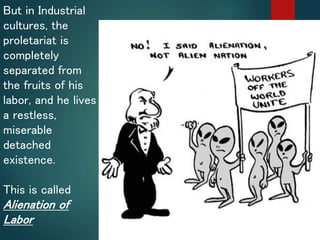
But in Industrial
cultures, the
proletariat is
completely
separated from
the fruits of his
labor, and he lives
a restless,
miserable
detached
existence.
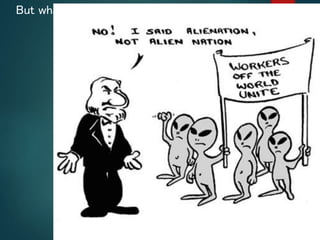
This is called
Alienation of
Labor
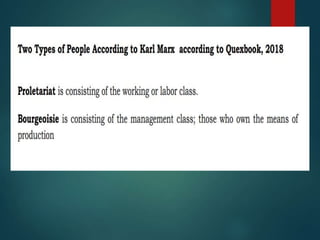
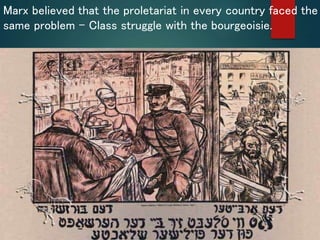
Marx believed that the proletariat in every country faced the
same problem – Class struggle with the bourgeoisie.
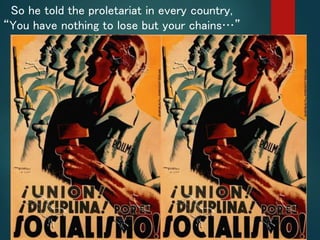
So he told the proletariat in every country,
“You have nothing to lose but your chains…”
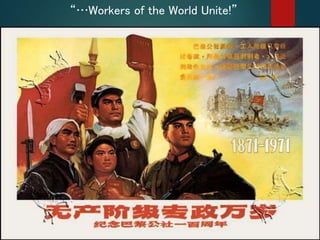
“…Workers of the World Unite!”
But what do you notice about all of these pictures?
Surplus Value
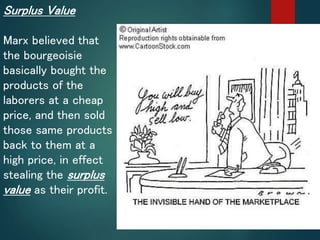
Marx believed that
the bourgeoisie
basically bought the
products of the
laborers at a cheap
price, and then sold
those same products
back to them at a
high price, in effect
stealing the surplus
value as their profit.
Inevitability of Socialism
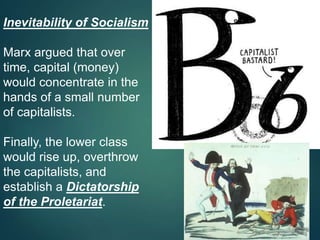
Marx argued that over
time, capital (money)
would concentrate in the
hands of a small number
of capitalists.
Finally, the lower class
would rise up, overthrow
the capitalists, and
establish a Dictatorship
of the Proletariat.
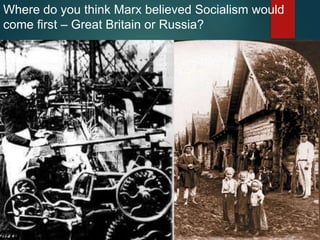
Where do you think Marx believed Socialism would
come first – Great Britain or Russia?
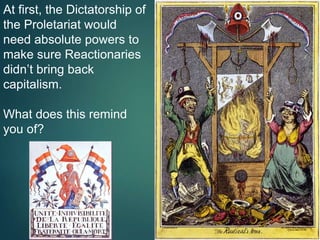
At first, the Dictatorship of
the Proletariat would
need absolute powers to
make sure Reactionaries
didn’t bring back
capitalism.
What does this remind
you of?
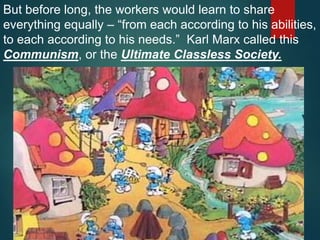
But before long, the workers would learn to share
everything equally – “from each according to his abilities,
to each according to his needs.” Karl Marx called this
Communism, or the Ultimate Classless Society.
karl marx.ppt

karl marx.ppt

  • 1.
  • 2.
    Karl Marx (1818– 1883) was a German economist who was exiled to England. He wrote Das Kapital, which explained how he thought capitalism would fall, and also the Communist Manifesto, which told the workers of the world to unite and fight the factory owners.
  • 3.
    Marx’s “Scientific Socialism” had5 major points: •Historical Materialism •Class Struggle •Surplus Value •Inevitability of Socialism •Classless Society
  • 4.
    Historical Materialism Marx argued that economics is thedriving force of history. What is materialism?
  • 5.
    Historical materialism  atheory on human society and history that states that thoughts and social institutions develop only as a superstructure founded on an economic base  To understand human interaction and the changes human civilization has been through, it becomes necessary to trace the history from the point of human evolution from a scientific perspective.
  • 6.
    According to Marx,whoever owns the means of production has always controlled the government and society.
  • 7.
    POP QUIZ Q: Beforethe Industrial Revolution, what was the most important factor of production? (What do you need to farm?) Q: Who owned it (in France)? Q: How did they control the government and society?
  • 8.
    POP QUIZ A: Land(for growing crops) A: The Second Estate (Nobles / Landlords) A: By teaming up with the First Estate (Priests), they could always outvote the outvote the 3rd Estate. Also, the Priests had always told the people that their absolute monarchs had Divine Right of Kings.
  • 9.
    POP QUIZ Q: Afterthe Industrial Revolution, what was the most important factor of production? (Hint: You can’t start a business without it!) Q: Who owned it (in England)? Q: How did they control the government and society?
  • 10.
    POP QUIZ A: Capital(for making products) A: The Bourgeoisie (merchants & factory owners) A: By advocating laissez faire economics, they fought unions, child labor laws, and workplace safety regulations. This kept the supply of labor high and the price of labor low.
  • 11.
    Class Struggle According to Marx,society has always been divided into the “haves” and the “have nots” – and these two classes have always fought each other.
  • 13.
    Examples: Patricians vs. Plebeians Serfs vs.Lords Bourgeoisie vs. Proletariat (Urban Wage Laborers)
  • 14.
    But in Industrial cultures,the proletariat is completely separated from the fruits of his labor, and he lives a restless, miserable detached existence. This is called Alienation of Labor
  • 15.
    Marx believed thatthe proletariat in every country faced the same problem – Class struggle with the bourgeoisie.
  • 16.
    So he toldthe proletariat in every country, “You have nothing to lose but your chains…”
  • 17.
    “…Workers of theWorld Unite!”
  • 18.
    But what doyou notice about all of these pictures?
  • 19.
    Surplus Value Marx believedthat the bourgeoisie basically bought the products of the laborers at a cheap price, and then sold those same products back to them at a high price, in effect stealing the surplus value as their profit.
  • 20.
    Inevitability of Socialism Marxargued that over time, capital (money) would concentrate in the hands of a small number of capitalists. Finally, the lower class would rise up, overthrow the capitalists, and establish a Dictatorship of the Proletariat.
  • 21.
    Where do youthink Marx believed Socialism would come first – Great Britain or Russia?
  • 22.
    At first, theDictatorship of the Proletariat would need absolute powers to make sure Reactionaries didn’t bring back capitalism. What does this remind you of?
  • 23.
    But before long,the workers would learn to share everything equally – “from each according to his abilities, to each according to his needs.” Karl Marx called this Communism, or the Ultimate Classless Society.